child restraint MERCEDES-BENZ CLS COUPE 2011 User Guide
[x] Cancel search | Manufacturer: MERCEDES-BENZ, Model Year: 2011, Model line: CLS COUPE, Model: MERCEDES-BENZ CLS COUPE 2011Pages: 337, PDF Size: 7.37 MB
Page 51 of 337
the dashboard and on both sides of the sun
visor on the front-passenge rside.
Information about recommended child
restraint systems is available at any
Mercedes-Benz Service Centre.
Automatic child seat recognition on the
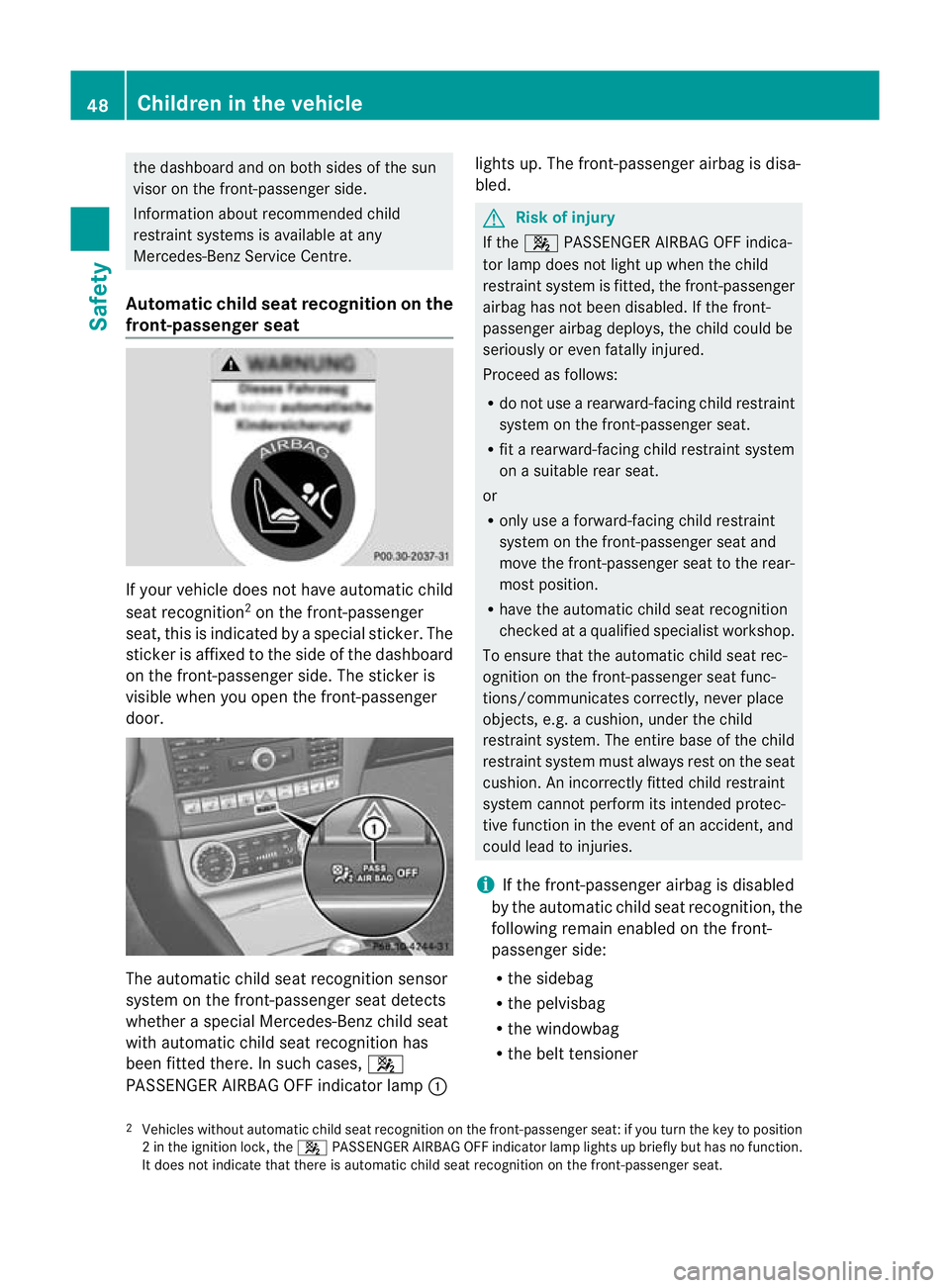
front-passenger seat If your vehicle does not have automatic child
seat recognition 2
on the front-passenger
seat, this is indicated by a special sticker .The
sticker is affixed to the side of the dashboard
on the front-passenger side. The sticker is
visible when you open the front-passenger
door. The automatic child seat recognition sensor
system on the front-passenger seat detects
whether a special Mercedes-Ben zchild seat
with automatic child seat recognition has
been fitted there. In such cases, 4
PASSENGER AIRBAG OFF indicator lamp :lights up. The front-passenger airbag is disa-
bled. G
Risk of injury
If the 4 PASSENGER AIRBAG OFF indica-
tor lamp does not light up when the child
restraint system is fitted, the front-passenger
airbag has not been disabled. If the front-
passenger airbag deploys, the child could be
seriously or even fatally injured.
Proceed as follows:
R do not use a rearward-facing child restraint
system on the front-passenger seat.
R fit a rearward-facing child restraint system
on a suitable rear seat.
or
R only use a forward-facing child restraint
system on the front-passenger seat and
move the front-passenger seat to the rear-
most position.
R have the automatic child seat recognition
checked at a qualified specialist workshop.
To ensure that the automatic child seat rec-
ognition on the front-passenger seat func-
tions/communicates correctly, never place
objects, e.g. a cushion, under the child
restraint system. The entire base of the child
restraint system must always rest on the seat
cushion. An incorrectly fitted child restraint
system cannot perform its intended protec-
tive function in the event of an accident, and
could lead to injuries.
i If the front-passenger airbag is disabled
by the automatic child seat recognition, the
following remain enabled on the front-
passenger side:
R the sidebag
R the pelvisbag
R the windowbag
R the belt tensioner
2 Vehicles without automatic child seat recognition on the front-passenger seat: if you turn the key to position
2int he ignition lock, the 4PASSENGER AIRBAG OFF indicator lamp lights up briefly but has no function.
It does not indicate that there is automatic child seat recognition on the front-passenger seat. 48
Children in the vehicleSafety
Page 52 of 337
G
Risk of injury
Do not place electronic devices on the front-
passenger seat, e.g.:
R laptops, whe nswitched on
R mobile phones
R cards with transponders, e.g .ski passes or
access cards
Signals from electronic equipment can cause
interference in the automatic child seat rec-
ognitio nsensor system. This can lead to a
system malfunction. This may cause the
4 PASSENGER AIRBAG OFF indicator
lamp to light up without there being a child
seat with automatic child seat recognition fit-
ted, and the front-passenger fron tairbag will
not deploy during an accident .Itis also pos-
sible that the 6SRS warning lamp lights
up and/or the 4PASSENGER AIRBAG OFF
indicator lamp does not light up briefly when
you turn the key in the ignition lock to position
2.
ISOFIX child seat securing system for
the rear seats ISOFIX is a standardised securing system for
specially designed child restraint systems on
the rear seats. Securing rings for two ISOFIX
child restraint systems are fitted on the left
and right of the rear seats. G
Risk of injury
Ac hild restraint system secured by the ISOFIX
child seat securing system does not provide
sufficient protection for children weighing
more than 22 kg. For this reason, do not
secure children weighing more than 22 kg in
a child restraint system secured by the ISOFIX
child seat securing system. If the child weighs
more than 22 kg, secure the child restraint
system using a three-point seat belt. G
Risk of injury
The child restraint system cannot perform its
protective function if it is not correctly fitted
to a suitable vehicle seat. The child cannot be restrained in the event of an accident, heavy
braking or sudden changes of direction. The
child could be seriously or even fatally injured.
For this reason, when fitting a child restraint
system, observe the manufacturer's installa-
tion instructions and the correct use of the
child restraint system.
For reasons of safety, only use child restraint
systems with the ISOFIX child seat securing
system on the rear seats.
We recommend that you use the ISOFIX child
restraint systems that have been recommen-
ded for Mercedes-Benz.
An incorrectly fitted child restraint system
could come loose and seriously or even fatally
injure the child or other vehicle occupants.
When fitting the child restraint system, always
make sure that it is engaged correctly in the
securing rings on both sides. G
Risk of injury
Please note that if child restraint systems, or
their retaining systems, are damaged or sub-
jected to a load in an accident, they may not
be able to provide their protective function.
This could result in serious or even fatal inju-
ries to the secured child in the event of an
accident, heavy braking or a sudden change
in direction.
For this reason, have child restraint systems
and their anchorages which have been dam-
aged or subjected to a load in an accident
checked immediately at a qualified specialist
workshop. Children in the vehicle
49Safety Z
Page 53 of 337

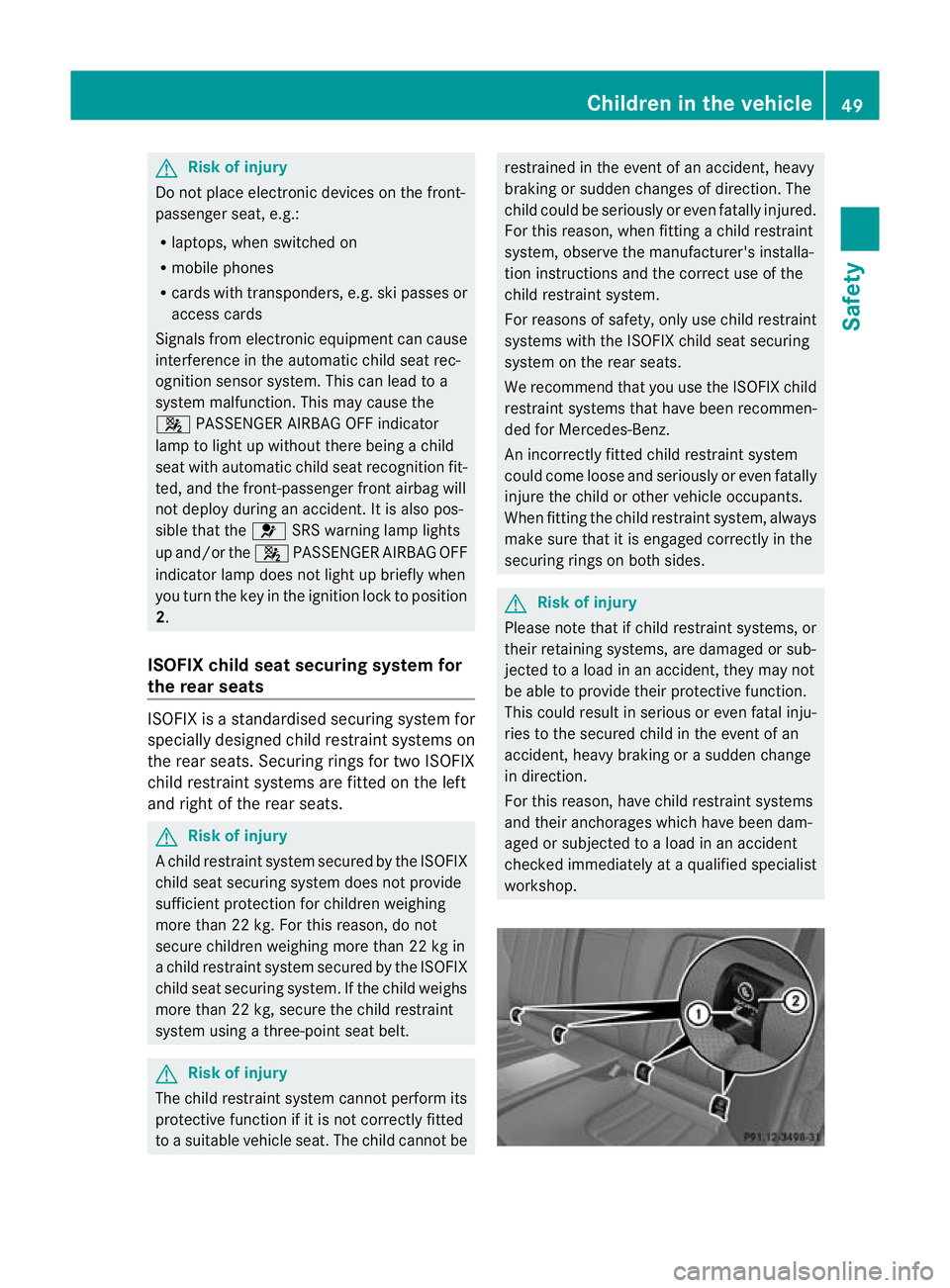
When installing the ISOFIX child restraint sys-
tem, fold protective caps 2of securing rings
1 inwards.
X Install the ISOFIX child restraint system.
Comply with the manufacturer's instruc-
tions when installing the ISOFIX child
restraint system.
Top Tether Top Tether provides an additional connection
between the child restraint system secured
with ISOFIX and the rear seat. It helps reduce
the risk of injury even further.
The Top Tether anchorage points are located
in the rear compartment behind the head
restraints.
X
Move head restraint :upwards.
X Fold up cover ;of Top Tether anchorage
=.
X Route Top Tether belt Aunder head
restraint :between the two head restraint
bars. X
Hook Top Tether hook ?into Top Tether
anchorage =.
X Make sure that Top Tether belt Ais not
twisted.
X Fold down cover ;of Top Tether anchor-
age =.
X Slide down head restraint :until it
engages (Y page 87). Make sure that you
do not interfere with the correct routing of
Top Tether belt A.
X Fit the ISOFIX child restraint system with
Top Tether. Comply with the manufactur-
er's installation instructions when doing so.
Make sure that Top Tether belt Ais tight. 50
Children in the vehicleSafety
Page 55 of 337

Suitable positioning of the child restraint system
Weight categories
Seat positions Group 0: up to
10 kg Group 0+: up to
13 kg Group I: 9 to 18 kg
Front-passenger
seat (the front-
passenger airbag
is not disabled)
X
3 X
UF
4, 5, 6 Front-passenger
seat (the front-
passenger airbag
is disabled)
7
) U
5, 6, 8 U
5, 6, 8 U
5, 6, 8 Rear seats
U
6, 8 U
6, 8 U
6, 8 Weight categories
Seat positions Group II: 15 to 25 kg Group III: 22 to 36 kg
Front-passenger seat (the
front-passenger airbag is not
disabled)
UF
9, 10, 11 UF
9, 10, 11 Front-passenger seat (the
front-passenger airbag is dis-
abled)
12
) U
10, 11, 13 U
10, 11, 13 Rear seats
U
11, 13 U
11, 13 "Universal" category child restraint systems can be recognised by their orange approval label.
3 X: seat unsuitable for children in this weight category.
4 UF: suitable for forward-facing child seat securing systems in the Universal category approved for use in this
weight category.
5 Adjust the front-passenger seat to the rearmost position and the belt outlet height to the lowest position.
6 As recommended; see the following table "Recommended child restraint systems".
7 Vehicles with automatic child seat recognition on the front-passenger seat: a child restraint system of the
"Universal" category with automatic child seat recognition must be fitted. The 4PASSENGER AIRBAG
OFF indicator lamp must be lit.
8 U: suitable for child seat securing systems in the Universal category approved for use in this weight category.
9 UF: suitable for forward-facing child seat securing systems in the "Universal" category approved for use in
this weight category.
10 Adjust the front-passenger seat to the rearmost position and the belt outlet height to the lowest position.
11 As recommended; see the following table "Recommended child restraint systems".
12 Vehicles with automatic child seat recognition on the front-passenger seat: a child restraint system of the
"Universal" category with automatic child seat recognition must be fitted. The 4PASSENGER AIRBAG
OFF indicator lamp must be lit.
13 U: suitable for child seat securing systems in the Universal category approved for use in this weight category. 52
Children in the vehicleSafety
Page 56 of 337
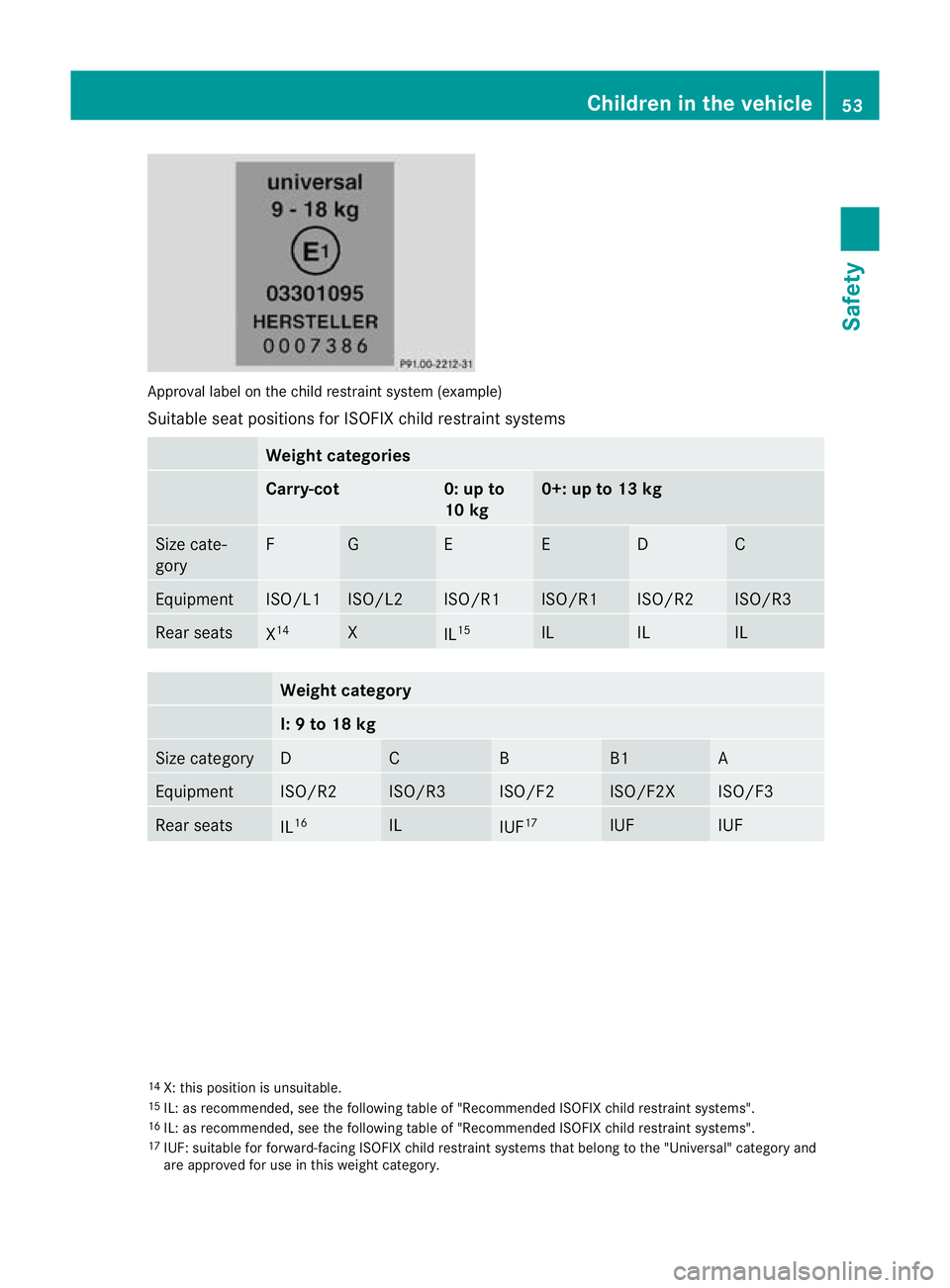
Approval label on the child restraint system (example)
Suitable sea tpositions for ISOFIX child restraint systems Weight categories
Carry-cot 0: up to
10 kg 0+: up to 13 kg
Size cate-
gory F G E E D C
Equipment ISO/L1 ISO/L2 ISO/R1 ISO/R1 ISO/R2 ISO/R3
Rear seats
X
14 X
IL
15 IL IL IL
Weight category
I: 9 to 18 kg
Size category D C B B1 A
Equipment ISO/R2 ISO/R3 ISO/F2 ISO/F2X ISO/F3
Rear seats
IL
16 IL
IUF
17 IUF IUF
14
X: this position is unsuitable.
15 IL: as recommended, see the following table of "Recommended ISOFIX child restraint systems".
16 IL: as recommended, see the following table of "Recommended ISOFIX child restraint systems".
17 IUF: suitable for forward-facing ISOFIX child restraint systems that belong to the "Universal" category and
are approved for use in this weight category. Children in the vehicle
53Safety Z
Page 57 of 337

Recommended child restraint systems
Weight catego-
ries Manufac-
turer Type Approval
number Order num-
ber Automatic
child seat
recognition
Group 0+: up to
13 kg Britax
Römer BABY
SAFE
PLUS E1 03 301146
E1 04 301146 A 000 970 10
00 Yes
Group I: 9 to
18 kg Britax
Römer DUO
PLUS E1 03 301133
E1 04 301133 A 000 970 11
00 Yes
A 000 970 16
00
No
18 Category II/III:
15 to 36 kg Britax
Römer KID E1 03 301148
E1 04 301148 A 000 970 12
00 Yes
A 000 970 17
00
No
18 KIDFIX E1 04 301198 A 000 970 18
00 Yes
A000 970 19
00
No
18 Recommended ISOFIX child restraint systems
Weight categories
Group 0:
up to
10 kg Group 0:
up to
10 kg Group 0:
up to
10 kg Group 0+:
up to
13 kg Group 0+:
up to
13 kg Group 0+:
up to
13 kg
Size cate-
gory
E F G C D E
Manufac-
turer
- - - - - Britax
Römer
Type
- - - - - BABY SAFE
ISOFIX
PLUS
Type
approval
number
- - - - - E1 04
301146
Category
- - - - - Universal
18
For child restraint systems withou tautomatic child seat recognition, move th efront-passenger seat to the
rearmos tposition. 54
Children in the vehicleSafety
Page 81 of 337
X
Turn the emergency key element anti-
clockwise as far as it will go to position
1.
The boot is unlocked.
X Turn the emergency key element back and
remove it.
X Insert the emergency key element into the
key. Side windows
Important safety notes
G
Risk of injury
Make sure that nobody can become trapped
between the side window and the door frame
when a side window is opened. Do not touch
or lean against the side window during the
opening procedure. You could become trap-
ped between the side window and the door
frame as the side window moves down. If
there is a risk of becoming trapped, release
the switch or pull the switch upwards to close
the side window again. G
Risk of injury
Make sure that nobody can become trapped
as you close a side window. If there is a risk
of becoming trapped, release the switch or
press it again to open the side window again. G
Risk of injury
Children may injure themselves if they open
or close the side windows.
Never leave children unsupervised in the vehi-
cle. Always take the key with you when leaving
the vehicle, even if you are only leaving it for
a short time. G
Risk of injury
Do not leave children unsupervised in the
vehicle, even if they are secured in a child
restraint system. The children could:
R be seriously or even fatally injured on parts
of the vehicle
R be seriously or even fatally injured by pro-
longed exposure to extremely high or
extremely low temperatures
If children open a door, they could:
R seriously or even fatally injure other people
R get out of the vehicle and injure them-
selves, or be seriously or even fatally
injured by a passing vehicle
Activate the child-proof locks/override fea-
ture if children are travelling in the vehicle.
They could otherwise open doors or side win-
dows while the vehicle is in motion and
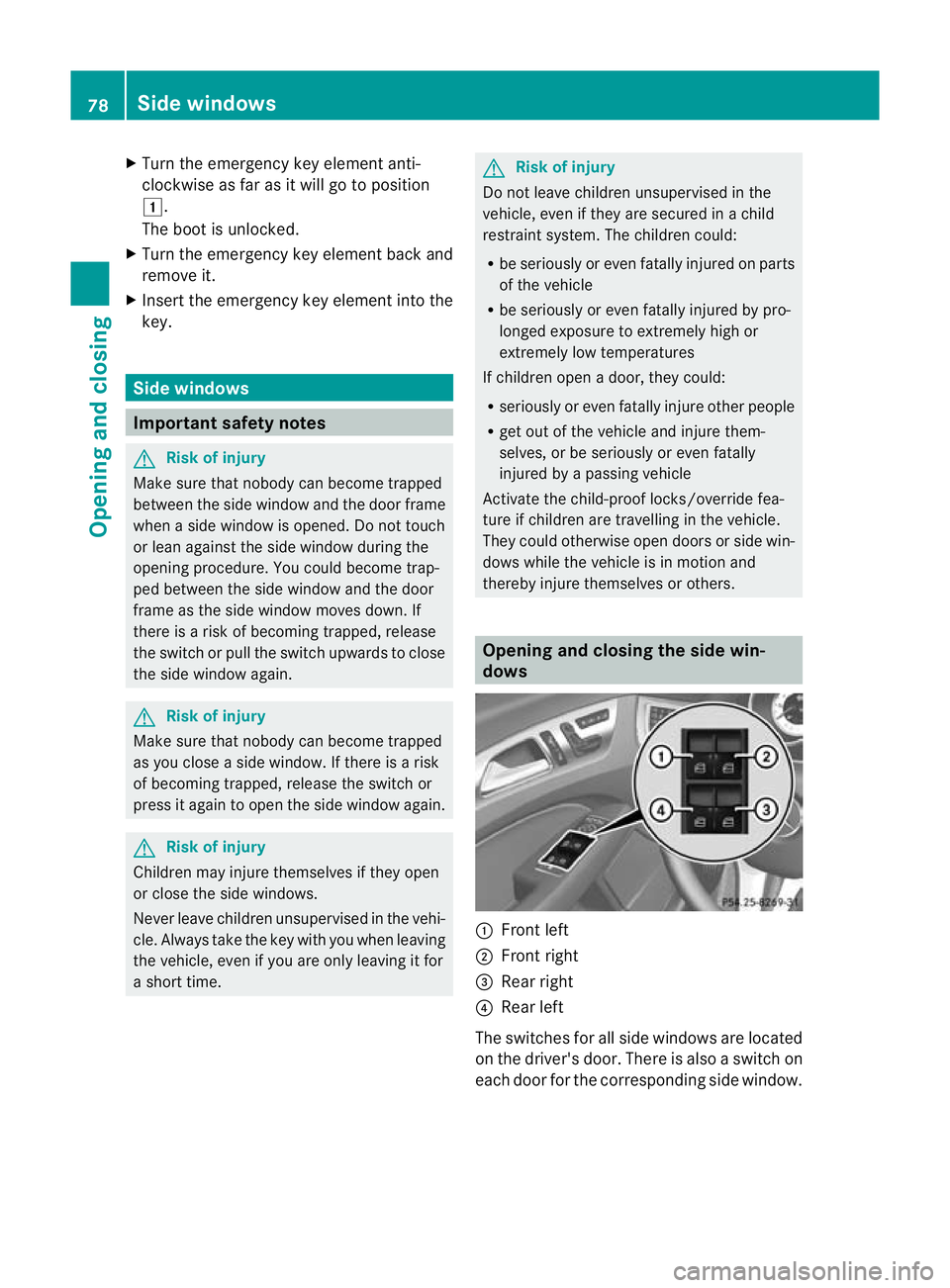
thereby injure themselves or others. Opening and closing the side win-
dows
:
Front left
; Front right
= Rear right
? Rear left
The switches for all side windows are located
on the driver's door. There is also a switch on
each door for the corresponding side window. 78
Side windowsOpening and closing
Page 88 of 337
Seats
Important safety notes
G
Risk of injury
The seats can still be adjusted when there is
no key in the ignition lock. For this reason,
children should never be left unsupervised in
the vehicle. They could adjust the seats and
become trapped. G
Risk of accident
Only adjust the driver's seat when the vehicle
is stationary. You will otherwise be distracted
from the road and traffic conditions and you
could lose control of the vehicle as a result of
the seat moving. This could cause an acci-
dent. G
Risk of injury
Make sure that nobody can become trapped
when adjusting the seats.
Observe the notes on airbags.
Secure children as recommended; see the
"Children in the vehicle" section. G
Risk of injury
Make sure that the back of your head is sup-
ported at eye level by the central area of the
head restraint .Ifyour head is not supported
correctly by the head restraint, you could suf-
fer a severe neck injury in the event of an
accident .Never drive if the head restraints are
not engaged and set correctly. G
Risk of injury
Occupants should only travel sitting on seats
which have the head restraints fitted. On a
seat which is occupied, move the head
restraint into the upright position .This
reduces the risk of injury to the passenger in
the event of an accident. !
To avoid damage to the seats and the seat
heating, observe the following information:
R do not spill any liquids on the seats. If
liquid is spilled on the seats, dry them as
soon as possible.
R if the seat covers are damp or wet, do not
switch on the seat heating. The seat
heating should also not to be used to dry
the seats.
R clean the seat covers as recommended;
see the "Interior care" section.
R do not transport heavy loads on the
seats. Do not place sharp objects on the
seat cushions, e.g. knives, nails or tools.
The seats should only be occupied by
passengers, if possible.
R when the seat heating is in operation, do
not cover the seats with insulating mate-
rials, e.g. blankets, coats, bags, seat cov-
ers, child seats or booster seats.
! When you move the seats, make sure that
there are no objects in the footwell or
behind the seats. Otherwise, you could
damage the seats and the objects.
i The head restraints in the front seats are
fitted with the NECK-PRO system
(Y page 41). For this reason, it is not pos-
sible to remove the head restraints from
the front seats.
Please contact a Mercedes-Benz Service
Centre for more information.
i Related topics:
R Through-loading feature, rear bench seat Seats
85Seats, steering wheel and mirrors Z
Page 98 of 337
exterior mirror such that the rear
wheel and kerb are visible.
X Press memory button M? and one of
the arrows on adjustment button =
within three seconds.
The parking position is stored if the
exterior mirror does not move.
If the mirror moves out of position, repeat
the steps.
Calling up astore dparking position set-
ting X
With the key in position 2in the ignition
lock and the exterior mirror on the front-
passenge rside activated, engage reverse
gear.
The exterior mirror on the front-passenger
side moves to the stored parking position.
The exterior mirror on the front-passenger
side moves back to its original position:
R as soon as you exceed a speed of
10 km/h
R about ten seconds after you have disen-
gaged reverse gear
R if you press button :for the exterior mir-
ror on the driver's side Memory functions
Storing settings
With the memory function, you can store up
to three different settings, e.g. for three dif-
ferent people.
The following settings are stored as a single
memory preset:
R position of the seat, backrest and head
restraint
R active multicontour seat :seat cushion
length, seat backrest side bolsters, contour
of the backrest, dynamic function level set-
ting R
driver's side: steering wheel position
R driver's side: position of the exterior mir-
rors on the driver's and front-passenger
sides G
Risk of injury
The memory function can still be used when
the key has been removed. For this reason,
children should never be left unsupervised in
the vehicle. They could otherwise become
trapped when adjusting the seat or the steer-
ing wheel. G
Risk of accident
Only use the memory function on the driver's
side when the vehicle is stationary. Other-
wise, you could be distracted from the traffic
conditions by the steering wheel and seat
moving of their own accord, and as a result
cause an accident. X
Adjust the seat (Y page 86).
X On the driver's side, adjust the steering
wheel (Y page 91) and the exterior mirrors
(Y page 93).
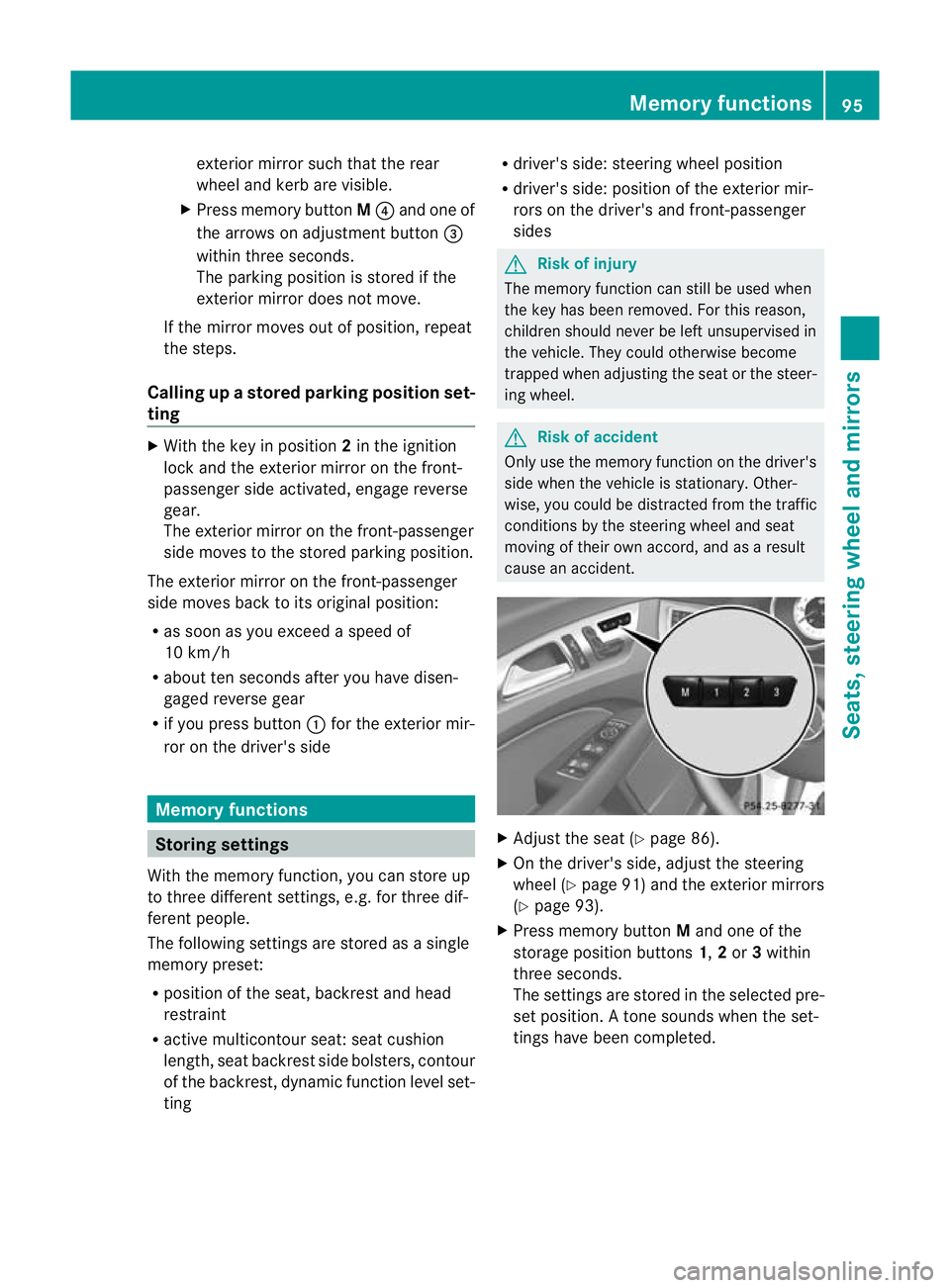
X Press memory button Mand one of the
storage position buttons 1,2or 3within
three seconds.
The settings are stored in the selected pre-
set position .Atone sounds when the set-
tings have been completed. Memory functions
95Seats, steering wheel and mirrors Z
Page 214 of 337
X
Press the :or9 button to select
one of the three departure times or Timeroff (no timer active).
X Press the abutton to confirm.
When a departure time is selected, the yel-
low indicator lamp lights up on the auxiliary
heating button.
Changing the departure time
X Press the =or; button on the steer-
ing wheel to select the Settings menu.
X Press the :or9 button to select the
Heating submenu.
X Press the abutton to confirm.
You will see the selected setting.
X Press the abutton to confirm.
X Press the :or9 button to select
Change A ,
B or
C .
X Press the abutton to confirm.
You can now change the departure time.
X Press the =or; button to select the
display to be changed: hours, minutes.
X Press the :or9 button to set the
selected display.
X Press the abutton to store the entry.
The yellow indicator lamp on the auxiliary
heating button lights up.
Convenience Activating/deactivating the EASY-
ENTRY/EXIT feature
You can use the
Easy Entry/Exit: function
to activate or deactivate the EASY ENTRY/
EXIT feature (Y page 92). G
Risk of injury
The steering wheel moves when the EASY-
ENTRY/EXIT feature is active. There is a risk
of occupants becoming trapped. Before acti-
vating the EASY-ENTRY/EXIT feature, make
sure that nobody can become trapped.
Do not leave children unsupervised in the
vehicle, even if they are secured in a child
restraint system. The children could open the driver's door and thereby unintentionally acti-
vate the EASY-ENTRY/EXIT feature and
become trapped.
X Press the =or; button on the steer-
ing wheel to select the Settings menu.
X Press the :or9 button to select the
Convenience submenu.
X Press the abutton to confirm.
X Press the :or9 button to select the
Easy Entry/Exit: function.
When the Easy Entry/Exit: function is
activated, the vehicle steering wheel is dis-
played in red in the multifunction display.
X Press the abutton to save the setting.
Switching the belt adjustment on/off
For further information on belt adjustment
(Y page 43).
X Press =or; on the steering wheel
to select the Settings menu.
X Press the :or9 button to select the
Convenience submenu.
X Press the abutton to confirm.
X Press the :or9 button to select the
Belt adjustment function.
When the Belt adjustment function is
activated, the vehicle seat belt is displayed
in red in the multifunction display.
X Press the abutton to save the setting.
Switching the fold-in mirrors when lock-
ing function on/off
If you switch on the Auto. fold in function,
the exterior mirrors fold in when you lock the
vehicle. When you unlock the vehicle and then
open the driver's or front-passenger door, the
exterior mirrors fold out again.
If you have switched the function on and you
fold the exterior mirrors in using the button
on the door (Y page 93), they will not fold out
automatically. The exterior mirrors can then
only be folded out using the button on the
door. Menus and submenus
211On-board computer and displays Z