light MERCEDES-BENZ CLS COUPE 2012 User Guide
[x] Cancel search | Manufacturer: MERCEDES-BENZ, Model Year: 2012, Model line: CLS COUPE, Model: MERCEDES-BENZ CLS COUPE 2012Pages: 373, PDF Size: 9.12 MB
Page 33 of 373
Instrumen
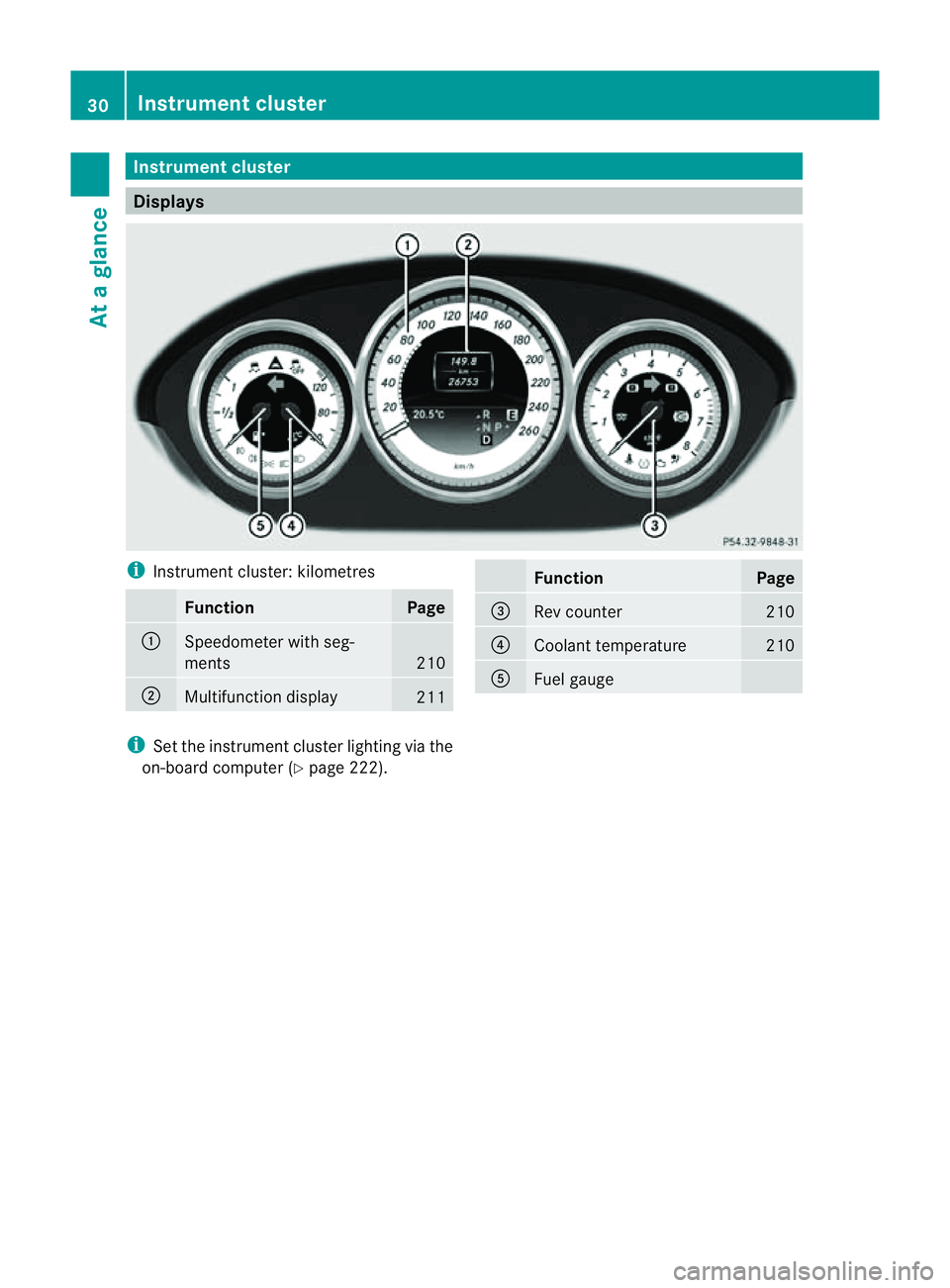
tcluster Displays
i
Instrument cluster: kilometres Function Page
:
Speedometer with seg-
ments
210
;
Multifunction display
211 Function Page
=
Rev counter 210
?
Coolant temperature 210
A
Fuel gauge
i
Set the instrumen tcluster lighting via the
on-board computer (Y page 222).30
Instrument clusterAt
ag lance
Page 34 of 373
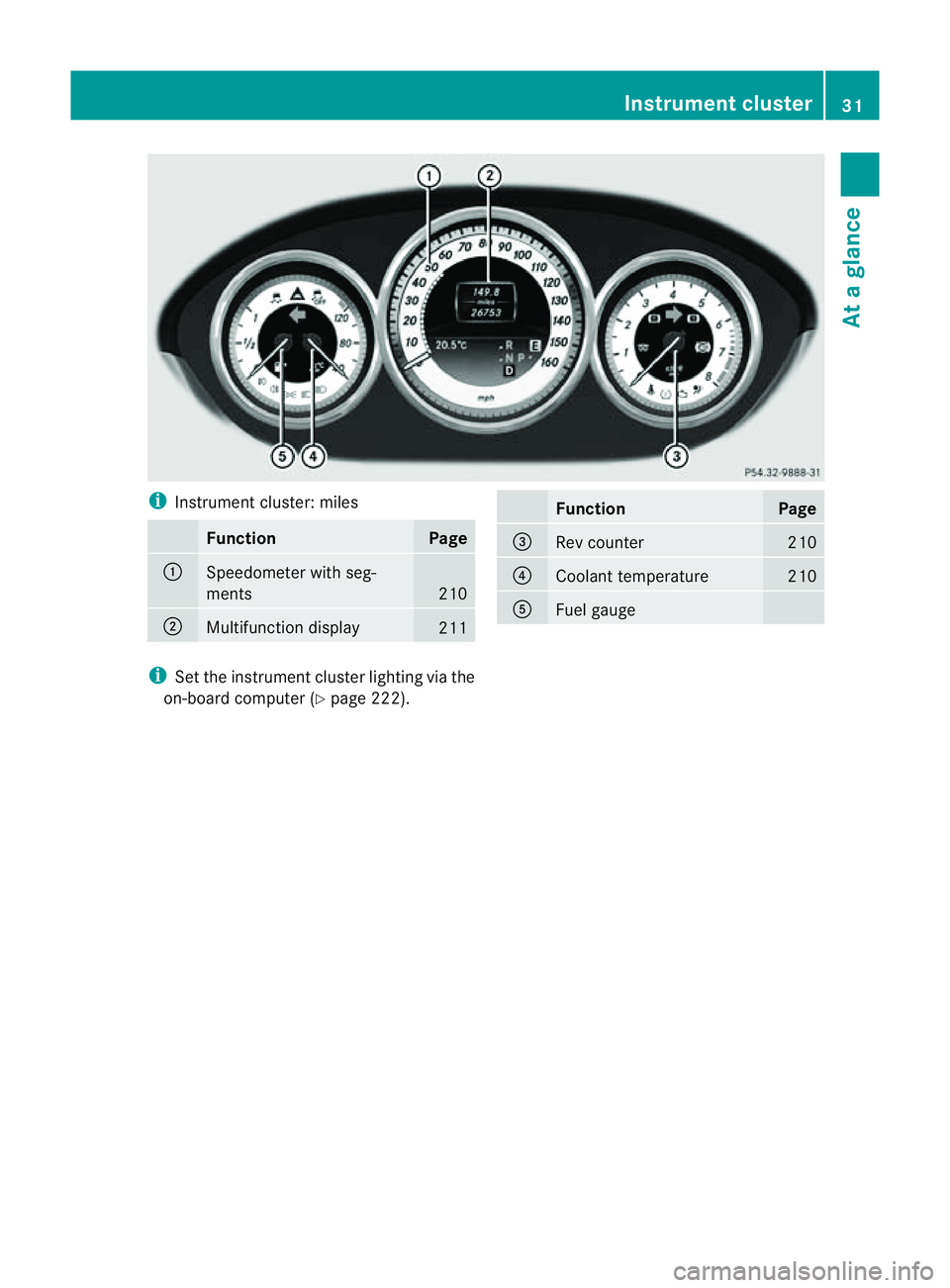
i
Instrument cluster: miles Function Page
:
Speedometer with seg-
ments
210
;
Multifunction display
211 Function Page
=
Rev counter 210
?
Coolant temperature 210
A
Fuel gauge
i
Set the instrument cluster lighting via the
on-board computer (Y page 222). Instrument cluster
31Atag lance
Page 38 of 373
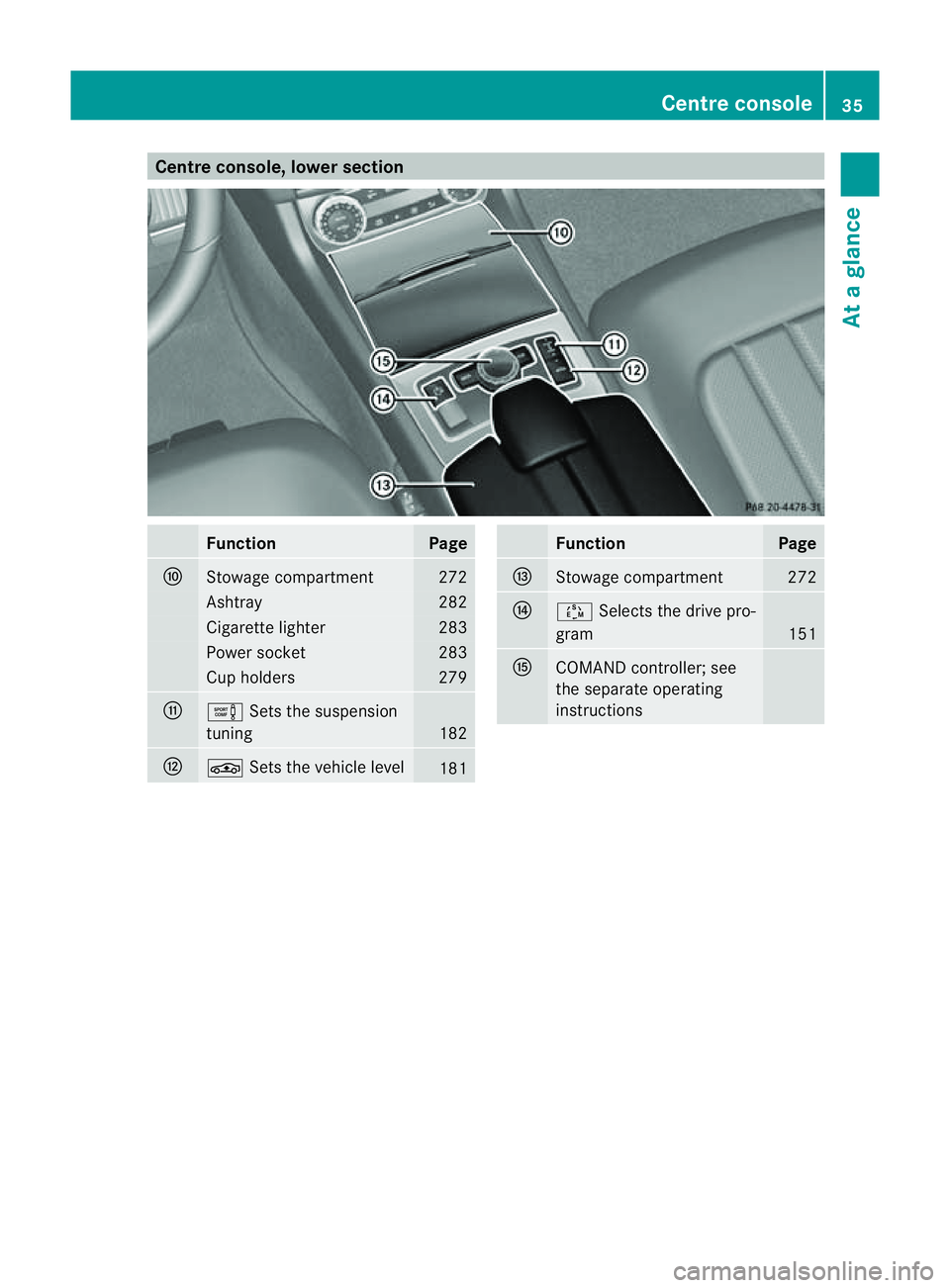
Centre console, lower section
Function Page
F
Stowage compartment 272
Ashtray 282
Cigarett
elighter 283
Power socket 283
Cup holders 279
G
e
Setsthe suspension
tuning 182
H
É
Setsthe vehicle level 181 Function Page
I
Stowage compartment 272
J
Ú
Select sthe driv epro-
gram 151
K
COMAND controller; see
th
es eparate operating
instructions Centre console
35Atag lance
Page 39 of 373
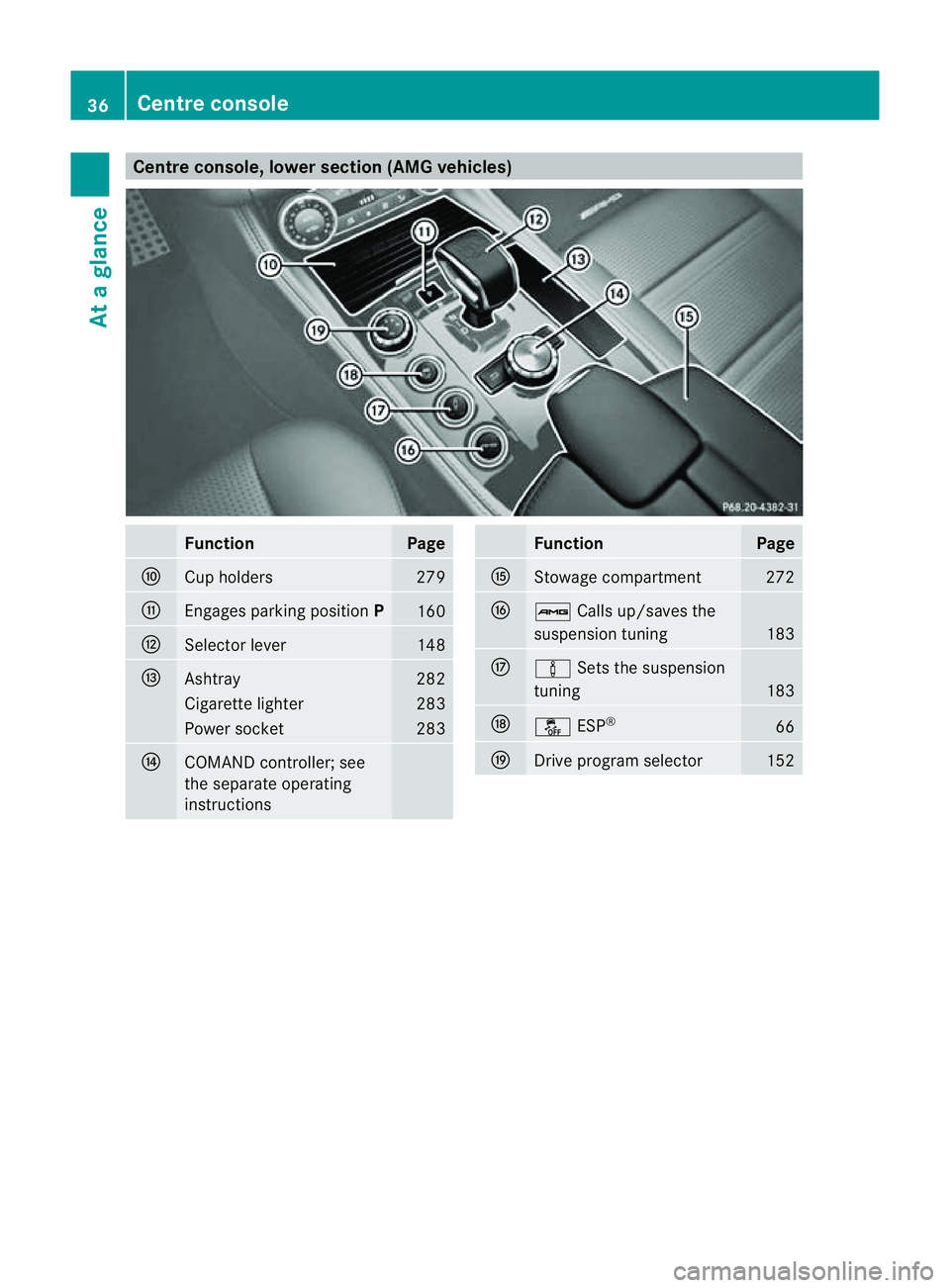
Centre console, lower section (AMG vehicles)
Function Page
F
Cup holders 279
G
Engages parking position
P 160
H
Selector lever 148
I
Ashtray 282
Cigarett
elighter 283
Power socket 283
J
COMAND controller; see
th
es eparate operating
instructions Function Page
K
Stowage compartment 272
L
ß
Calls up/saves the
suspension tuning 183
M
à
Setsthe suspension
tuning 183
N
å
ESP® 66
O
Drive program selector 15236
Centre consoleAt
ag lance
Page 40 of 373
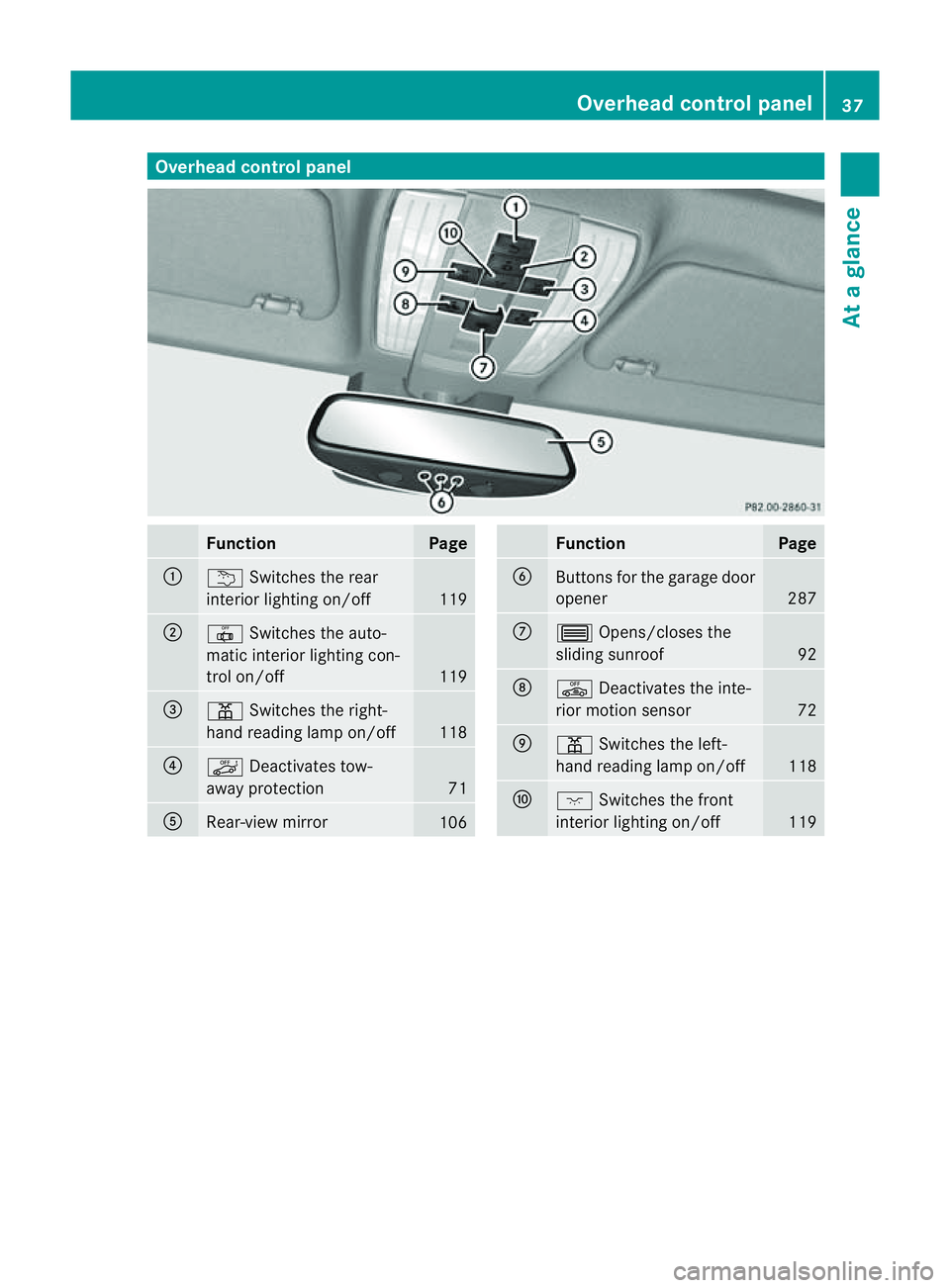
Overhea
dcontrol panel Function Page
:
u
Switche sthe rear
interio rlighting on/off 119
;
|
Switches the auto-
matic interior lighting con-
trol on/off 119
=
p
Switches the right-
hand readin glamp on/off 118
?
ë
Deactivates tow-
away protection 71
A
Rear-view mirror
106 Function Page
B
Button
sfor the garage door
opener 287
C
3
Opens/closes the
slidin gsunroof 92
D
ê
Deactivates the inte-
rior motion sensor 72
E
p
Switches the left-
hand readin glamp on/off 118
F
c
Switches the front
interior lighting on/off 119Overhead control panel
37Atag lance
Page 43 of 373
Useful information
i This Owner's Manual describes all mod-
els, series and optional equipment for your
vehicle that were available at the time of
going to press. National variation sare pos-
sible. Not ethat your vehicle may not be
equipped with all of the function sdescri-
bed. This is also the case for system sand
function srelevan ttosafety.
i Read the information on qualified special-
ist workshops: (Y page 23). Panic alarm
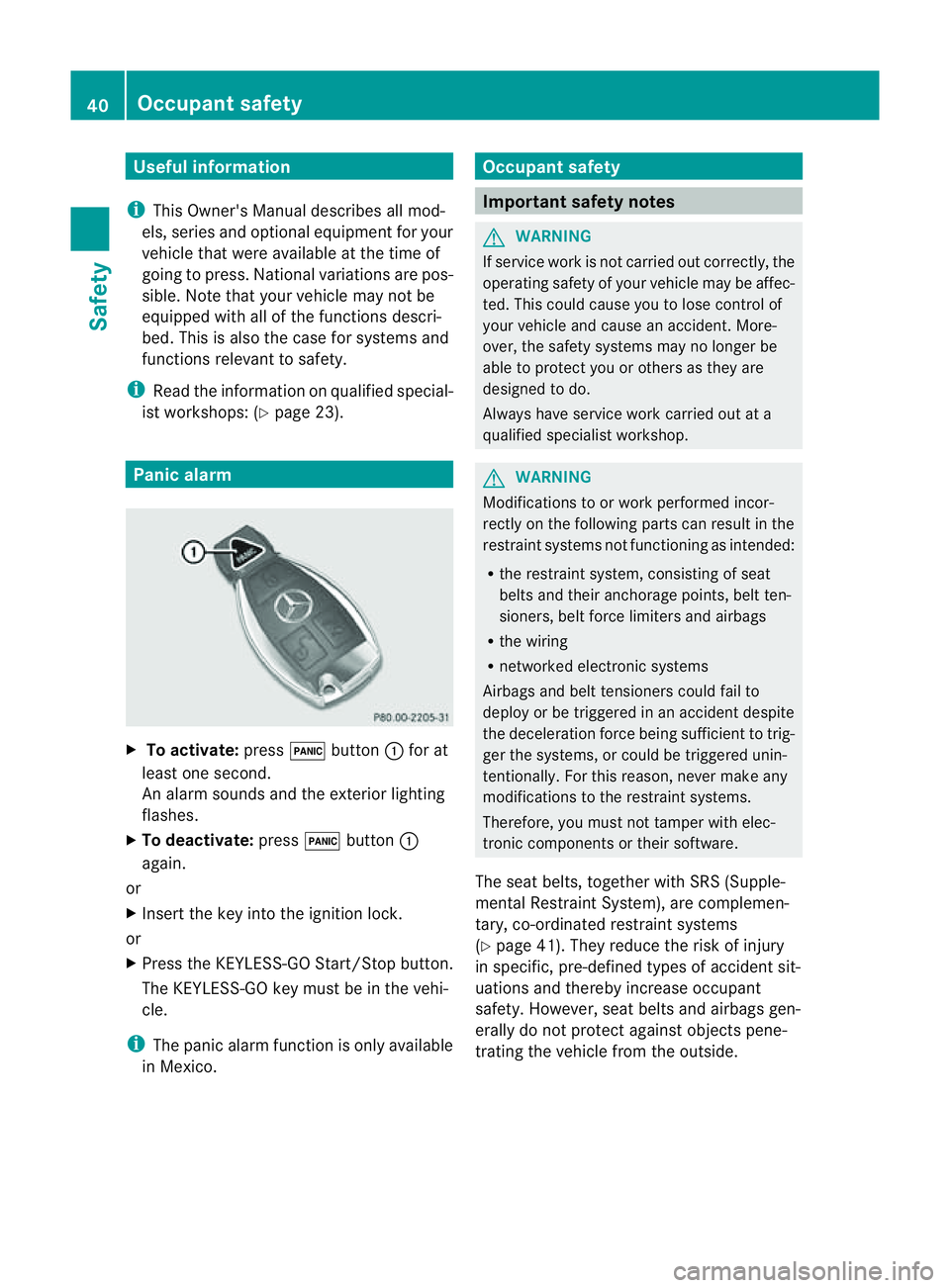
X
To activate: press!button :for at
least one second.
An alarm sounds and the exterior lighting
flashes.
X To deactivate: press!button :
again.
or
X Insert the key int othe ignition lock.
or
X Press the KEYLESS-GO Start/Stop button.
The KEYLESS-GO key must be in the vehi-
cle.
i The panic alarm function is only available
in Mexico. Occupant safety
Important safet
ynotes G
WARNING
If servic ework is not carried out correctly, the
operatin gsafet yofy our vehicle may be affec-
ted. This could cause you to lose contro lof
your vehicle and cause an accident. More-
over, the safet ysystem smay no longer be
able to protect you or other sastheya re
designed to do.
Always have servic ework carried out at a
qualified specialist workshop. G
WARNING
Modification stoorwork performed incor-
rectly on th efollowin gpartsc an result in the
restraint systems no tfunctionin gasintended:
R ther estraint system, consisting of seat
belt sand their anchorage points ,belt ten-
sioners ,belt force limiters and airbags
R thew iring
R networked electronic systems
Airbags and belt tensioners could fail to
deplo yorbet riggered in an acciden tdespite
the deceleration forc ebeing sufficien ttotrig-
ger the systems, or could be triggered unin-
tentionally. For this reason, never make any
modifications to the restraint systems.
Therefore, you must not tamper with elec-
tronic components or their software.
The seat belts, together with SRS (Supple-
mental Restraint System), are complemen-
tary, co-ordinated restraint systems
(Y page 41). They reduce the risk of injury
in specific, pre-defined types of accident sit-
uations and thereby increase occupant
safety. However, seat belts and airbags gen-
erally do not protect against object spene-
tratin gthe vehicle from the outside. 40
Occupant safetySafety
Page 44 of 373
To ensure that the restraint systems can
deliver their full potential protection, make
sure that:
R
the seat and head restraint are adjusted
properly (Y page 96).
R the seat belt has been fastened properly
(Y page 48).
R the airbags can inflate unrestricted if
deployed (Y page 42).
R the steerin gwheel is adjusted properly
(Y page 102).
R the restraint systems have not been modi-
fied.
An airbag increases the protection of vehicle
occupant swearing aseat belt. However, air-
bags are only an additional restraint system
which complements, but does not replace,
the seat belt. All vehicle occupant smust wear
their seat belt correctly at all times, even if
the vehicle is equipped with airbags. The air-
bags are not deployed in all types of acci-
dents .For example, if the protective capacity
of correctly fastened seat belts is not
increased by deploying the airbags, the air-
bags will not deploy.
Airbag deployment only provides increased
protection if the seat belt is worn correctly.
First,t he seat belt helps to keep the vehicle
occupant in the best position in relation to the
airbag. Second, in ahead-on collision, for
example, the seat belt prevent sthe vehicle
occupant from being propelled towards the
point of impact. SRS (Supplemental Restraint System)
Introduction SRS consist
sof:
R the 6 SRS warning lamp
R airbags
R the airbag control unit with crash sensors
R belt tensioners
R belt force limiters SRS reduces the risk of occupant
scoming
into contact with the vehicle's interior in the
event of an accident .Itcan also reduce the
forces to which occupant sare subjected dur-
ing an accident.
SRS warnin glamp G
WARNING
If SRS is malfunctioning, individuals ystems
may be triggere dunintentionally or might not
be triggere dinthe event of an accident with
ah igh rate of vehicl edeceleration.
Am alfunction has occurred if:
R the 6 SRS warning lamp does not light
up when the ignitio nisswitched on.
R the engine is running and the 6SRS
warning lamp does not go out after afew
seconds.
R the engine is running and the 6SRS
warning lamp lights up again.
In this case, have SRS checked immediately
at aq ualified specialist workshop.
SRS functionsa re checked regularly when
you switch on the ignition and when the
engine is running. Therefore, malfunctions
can be detected in good time.
The 6 SRS warning lamp in the instrument
cluster lights up when the ignition is switched
on. It goes out no later than afew seconds
after the engine is started.
Triggering of belt tensioners, belt force
limiters and airbags During the first stage of
acollision, the airbag
control unit evaluates important physical
data relating to vehicle deceleration or accel-
eration, such as:
R duration
R direction
R magnitude
Based on the evaluation of this data, the air-
bag control unit pre-emptively triggers the
belt tensioners in the first stage. Occupant safety
41Safety Z
Page 47 of 373
Have the airbags replaced at
aqualifie dspe-
cialist workshop .Otherwise, occupants are
not protecte dbythe airbags in the event of
anothe raccident.
Airba gdeployme nt slowsdowna nd restricts
the movement of the vehicl eoccupant.
If the airbags ar edeployed, you will hear a
bang ,and asmall amount of powder may also
be released. Only in rare cases will the bang
affect your hearing. The powder that is
released generally does not constitute a
health hazard. The 6SRS warning lamp
lights up.
The airbag installation locations are identified
by the AIRBAGs ymbol.
Front airbags !
Do not place heavy object sonthe front-
passenger seat. The system may then
detect that the seat is occupied and if there
is an accident ,the restraint systems on the
front-passenger side could be deployed.
Have restraint systems that have been trig-
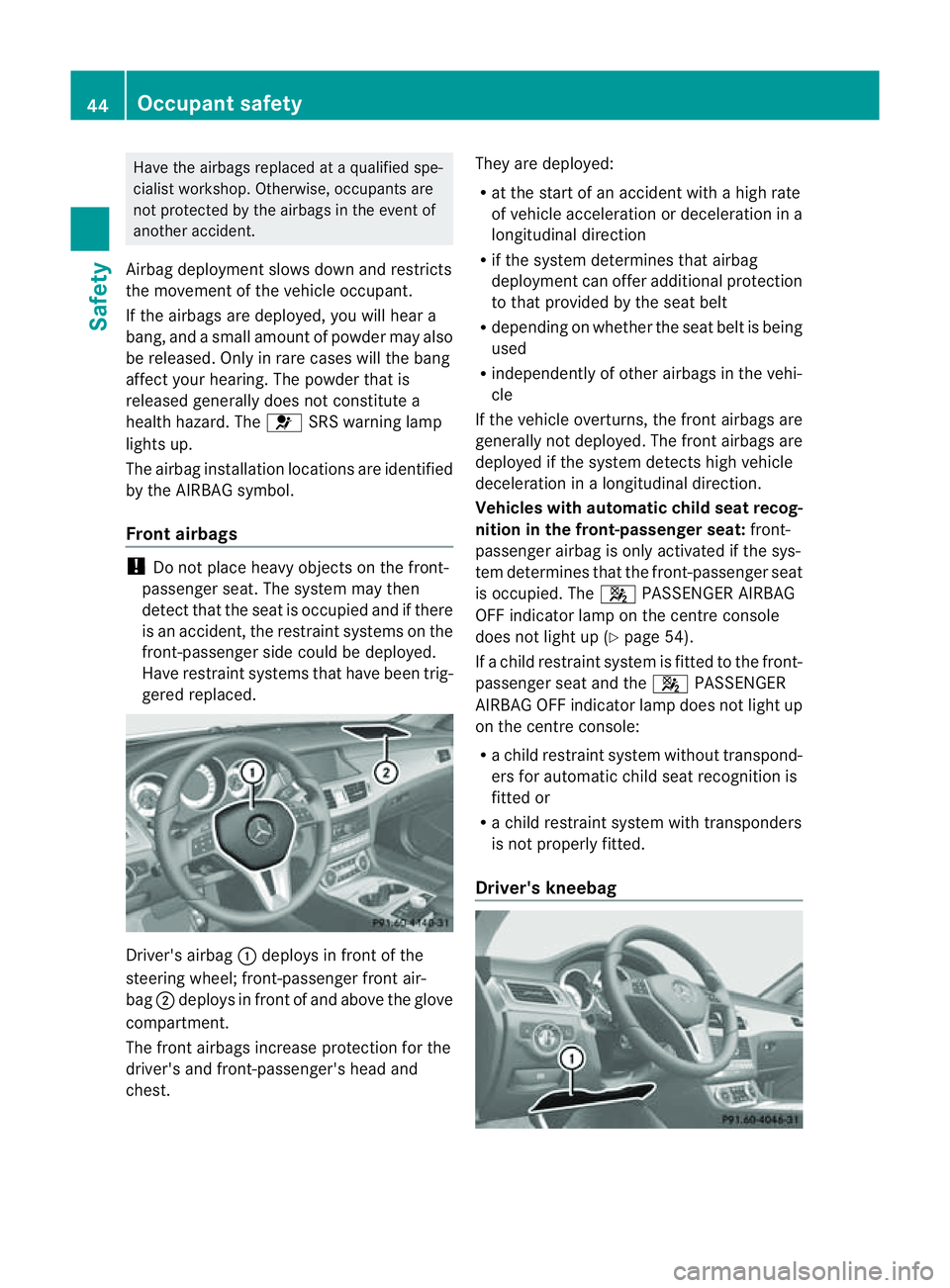
gered replaced. Driver'
sairbag :deploys in front of the
steerin gwheel; front-passenger front air-
bag ;deploys in front of and above the glove
compartment.
The front airbags increase protection for the
driver's and front-passenger's head and
chest. They are deployed:
R
at the start of an accident with ahigh rate
of vehicle acceleration or deceleration in a
longitudinal direction
R if the system determines that airbag
deployment can offer additional protection
to that provided by the seat belt
R depending on whether the seat belt is being
used
R independently of other airbags in the vehi-
cle
If the vehicle overturns, the front airbags are
generally not deployed. The front airbags are
deployed if the system detect shigh vehicle
deceleration in alongitudinal direction.
Vehicles with automatic child seat recog-
nition in the front-passenger seat: front-
passenger airbag is only activated if the sys-
tem determines that the front-passenger seat
is occupied. The 4PASSENGER AIRBAG
OFF indicator lamp on the centre console
does not light up (Y page 54).
If ac hild restraint system is fitted to the front-
passenger seat and the 4PASSENGER
AIRBAGO FF indicator lamp does not light up
on the centre console:
R ac hild restraint system without transpond-
ers for automatic child seat recognition is
fitted or
R ac hild restraint system with transponders
is not properly fitted.
Driver's kneebag 44
Occupant safetySafety
Page 51 of 373
PRE-SAFE
®
(preventative occupant
protection) G
WARNING
When adjusting the seat, make sure that
nobody can become trapped.
! Make sure that there are no objectsint he
footwell or behind the seats when moving
the seat back. There is arisk that the seats
and/or the objectsc ould be damaged.
PRE-SAFE ®
takes pre-emptive measures to
protect occupants in certain hazardous sit-
uations.
PRE-SAFE ®
intervenes:
R when BAS activates, e.g. in emergency
braking situations
R when BAS PLUS intervenes powerfully on
vehicles with DISTRONIC PLUS
R if, on vehicles with DISTRONIC PLUS, the
radar sensor system detectsani mminent
dange rofcollision in certain situations
R in critical driving situations, e.g. when phys-
ical limits are exceeded and the vehicle
understeers or oversteers severely
PRE-SAFE ®
takes the following measures
depending on the hazardous situation detec-
ted:
R the front seat belts are pre-tensioned.
R vehicles with the memory function: the
front-passenger seat is adjusted if it is in an
unfavourable position.
R vehicles with amulticontour seat or active
multicontour seat: the air pressure in the
side bolsters of the seat cushion and back-
rest is increased.
R if the vehicle skids, the sliding sunroof/
panorama sliding sunroof and the side win-
dows are closed so that only asmall gap
remains.
If the hazardous situation passes without
resulting in an accident ,PRE-SAFE ®
slackens
the belt pretensioning. The air pressure in the
side bolsters on the multicontour seat/active
multicontour seat is reduced again. All set- tings made by PRE-SAFE
®
can then be
reversed.
If the seat belts are not released:
X Move the backrest or seat back slightly, but
only when the vehicle is stationary.
The belt pretensioning is reduced and the
lockin gmechanism is released.
More information about seat belt adjustment,
ac onvenienc efunction integrated into PRE-
SAFE ®
,c an be found under "Seat belt adjust-
ment"( Ypage 50). Seat belts
Important safety notes G
WARNING
As eat belt which is not worn correctly, or
which has not been engaged in the seat belt
buckle correctly, cannot provide the intended
level of protection. Under certain circumstan-
ces, this could cause severe or even fatal inju-
ries in the event of an accident.
Therefore, make sure that all occupant s—in
particular, pregnan twomen —wear their seat
belts correctly at all times.
R The seat belt must fit snugly on your body
and must not be twisted.Therefore, avoid
wearing bulky clothing, e.g. awinter coat.
The shoulder section of the belt must be
routed across the centre of your shoulder
—onnoa ccount across your neck or under
your arm —and pulled tight against your
uppe rbody. The lap belt must alwaysp ass
across your lap as low down as possible, i.e.
over your hip joints—n ot across your abdo-
men. If necessary, push the seat belt
slightly downwards and adjust it by pulling
it in the direction the seat belt retracts.
R Do not route the seat belt strap over sharp
or fragile objects. Please make sure that
such object sare not on or in your clothing,
e.g. spectacles, pens or keys etc. The seat
belt strap could become damaged and tear 48
Occupant safetySafety
Page 53 of 373
automaticall
yadjust to th eupper body
(Y page 50).
X If necessary, adjust the seat belt to the
appropriate height (Y page 50).
X If necessary, pull upwards on the shoulder
section of the seat belt to tighten the belt
across your body.
For more information about releasing the seat
belt with release button ?,see "Releasing
seat belts" (Y page 50).
Seat belt adjustment The seat-belt adjustment function adjusts the
driver' sand front-passenger seat belt to the
upper body of the occupants.
The belt strap is tightened slightly when:
R you engage the belt tongue in the belt
buckle and you then turn the key to position
2in the ignition lock.
R the key is in position 2in the ignition lock
and you then engage the belt tongue in the
buckle.
The seat-belt adjustment will apply acertain
tightenin gforc eifa ny slack is detected
between the occupant and the seat belt. Do
not hold on to the seat belt tightly while it is
adjusting. You can switc hthe belt adjustment
on and off in the on-board computer
(Y page 227).
The seat-belt adjustment is an integral part of
the PRE-SAFE ®
convenience function. More
information about PRE-SAFE ®
can be found
under "PRE-SAFE ®
(preventative occupant
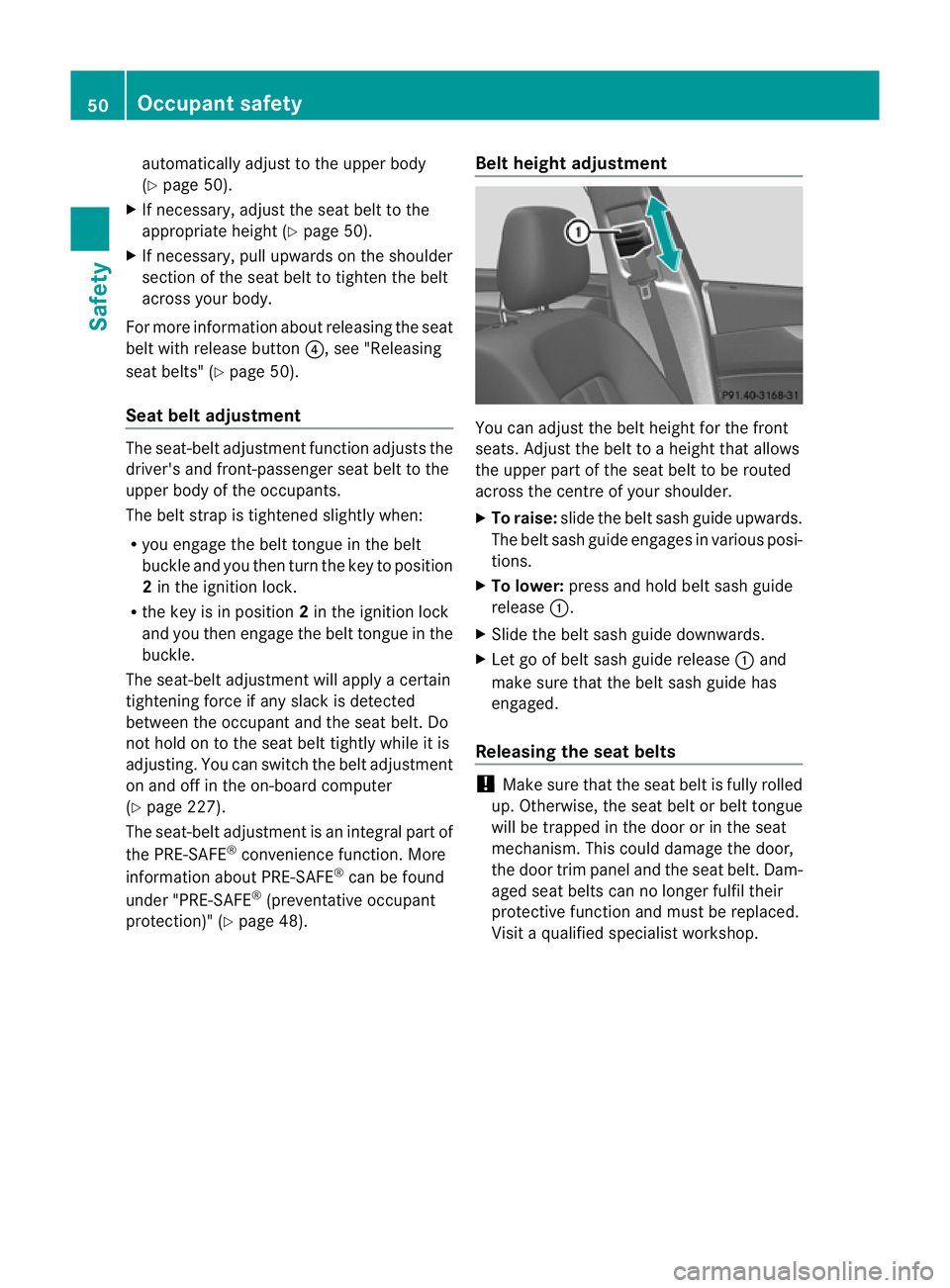
protection)" (Y page 48). Belt height adjustment You can adjust the belt height for the front
seats. Adjust the belt to
aheight that allows
the upper part of the seat belt to be routed
across the centre of your shoulder.
X To raise: slide the belt sash guide upwards.
The belt sash guide engages in various posi-
tions.
X To lower: press and hold belt sash guide
release :.
X Slide the belt sash guide downwards.
X Let go of belt sash guide release :and
make sure that the belt sash guide has
engaged.
Releasing the seat belts !
Make sure that the seat belt is fully rolled
up. Otherwise, the seat belt or belt tongue
will be trapped in the door or in the seat
mechanism. This could damage the door,
the door trim panel and the seat belt. Dam-
aged seat belts can no longer fulfil their
protective function and must be replaced.
Visit aqualified specialist workshop. 50
Occupant safetySafety