lock MERCEDES-BENZ CLS COUPE 2014 User Guide
[x] Cancel search | Manufacturer: MERCEDES-BENZ, Model Year: 2014, Model line: CLS COUPE, Model: MERCEDES-BENZ CLS COUPE 2014Pages: 417, PDF Size: 14.15 MB
Page 24 of 417
Tyre size (data) .............................. 378
Tyre tread ...................................... 365
Wheel and tyre combinations ........ 380
see Flat tyre U
Unlocking Emergency unlocking ....................... 90
From inside the vehicle (central
unlocking button )............................. 89 V
Vanity mirror (in sun visor) .............. 315
Variable SPEEDTRONIC
see SPEEDTRONIC
Vehicle
Correct use ...................................... 26
Data acquisition ............................... 27
Display message ............................ 282
Electronics ..................................... 396
Equipment ....................................... 24
Implied warranty .............................. 27
Individual settings .......................... 251
Leaving parked up ......................... 182
Locking (in an emergency) ............... 90
Locking (key) ................................... 83
Lowering ........................................ 378
Pulling away ................................... 162
Raising ........................................... 375
Registration ..................................... 26
Securing from rolling away ............ 375
Towing away .................................. 357
Transporting .................................. 359
Unlocking (in an emergency) ........... 90
Unlocking (key) ................................ 83
Vehicle data ................................... 407
Vehicle data ....................................... 407
Vehicle dimensions ........................... 407
Vehicle emergency locking ................ 90
Vehicle identification number
see VIN
Vehicle identification plate .............. 398
Vehicle level
AIRMATIC ...................................... 202
Vehicle level (display message) ....... 274Vehicle maintenance
see ASSYST PLUS
Vehicle tool kit .................................. 345
Vehicle weights ................................. 407
Video
Operating the DVD ......................... 247
VIN ...................................................... 398 W
Warning and indicator lamps ABS ................................................ 289
Brakes ........................................... 288
Distance warning signal ................. 297
ESP® ............................................. 291
ESP® OFF ...................................... 292
LIM (cruise control) ........................ 186
LIM (DISTRONIC PLUS) .................. 193
LIM (variable SPEEDTRONIC) ......... 189
Overview .......................................... 34
PASSENGER AIR BAG OFF ............... 43
Reserve fue l................................... 295
Seat belt ........................................ 287
Tyre pressure monitor ................... 298
Warning triangle ................................ 344
Washer fluid
Display message ............................ 285
Wheel and tyre combinations
see Tyres
Wheel bolt tightening torque ........... 378
Wheel chock ...................................... 375
Wheels
Changing a whee l.......................... 373
Changing/replacing ....................... 373
Checking ........................................ 365
Cleaning ......................................... 336
Cleaning (warning) ......................... 374
Emergency spare wheel ................. 390
Fitting a new wheel ........................ 377
Fitting a wheel ............................... 374
Important safety notes .................. 364
Removing a whee l.......................... 377
Storing ........................................... 374
Tightening torque ........................... 378
Wheel size/tyre size ...................... 378
Windowbag
Operation ......................................... 50 Index
21
Page 29 of 417
G
WARNING
If you connect equipment to a diagnostics
connection in the vehicle, it can affect the
operation of the vehicle systems. This may
affect the operating safety of the vehicle.
There is a risk of an accident.
Do not connect any equipment to a diagnos-
tics connection in the vehicle. G
WARNING
Objects in the driver's footwell may restrict
the clearance around the pedals or block a
depressed pedal. This jeopardises the oper-
ating and road safety of the vehicle. There is a risk of an accident.
Stow all objects securely in the vehicle so that
they do not get into the driver's footwell.
Always fit the floormats securely and as pre-
scribed in order to ensure that there is always sufficient room for the pedals. Do not use
loose floormats and do not place several floor- mats on top of one another.
! If the engine is switched off and equip-
ment on the diagnostics connection is
used, the starter battery may discharge.
Connecting equipment to the diagnostics
connection can lead to emissions monitoring information being reset, for example. This
may lead to the vehicle failing to meet the
requirements of the next emissions test dur-
ing the main inspection. Qualified specialist workshop
A qualified specialist workshop has the nec-
essary special skills, tools and qualifications
to correctly carry out any necessary work on
your vehicle. This particularly applies to work
relevant to safety.
Observe the notes in the Service Booklet.
Always have the following work carried out at a qualified specialist workshop:
R work relevant to safety
R service and maintenance work R
repair work
R modifications, installations and conver-
sions
R work on electronic components
Mercedes-Benz recommends that you use a
Mercedes-Benz Service Centre. Vehicle registration
Mercedes-Benz may ask its Service Centres
to carry out technical inspections on certain
vehicles. The quality or safety of the vehicle is
improved as a result of the inspection.
Mercedes-Benz can only inform you about
vehicle checks if it has your registration data.
It is possible that your vehicle has not yet
been registered in your name in the following
cases:
R if your vehicle was not purchased at an
authorised specialist dealer.
R if your vehicle has not yet been examined at
a Mercedes-Benz Service Centre.
It is advisable to register your vehicle with a
Mercedes-Benz Service Centre.
Inform Mercedes-Benz as soon as possible
about any change in address or vehicle own-
ership. You can do this at a Mercedes-Benz
Service Centre, for example. Correct use
If you remove any warning stickers, you or
others could fail to recognise certain dangers.
Leave warning stickers in position.
Observe the following information when driv- ing your vehicle:
R the safety notes in this manual
R the technical data in this manual
R traffic rules and regulations
R laws and safety standards pertaining to
motor vehicles 26
Introduction
Page 33 of 417
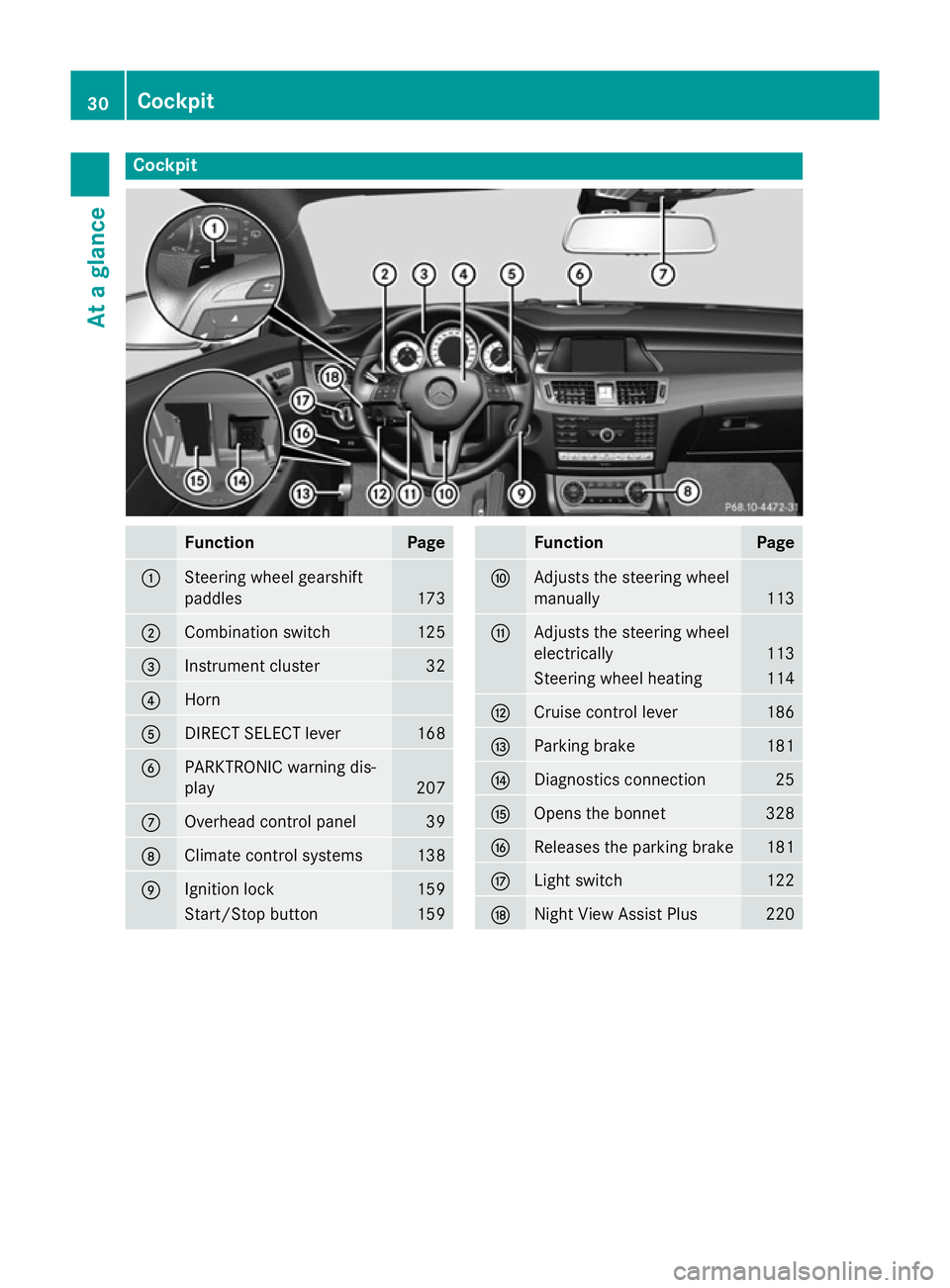
Cockpit
Function Page
:
Steering wheel gearshift
paddles
173
;
Combination switch 125
=
Instrument cluster 32
?
Horn
A
DIRECT SELECT lever 168
B
PARKTRONIC warning dis-
play
207
C
Overhead control panel 39
D
Climate control systems 138
E
Ignition lock 159
Start/Stop button 159 Function Page
F
Adjusts the steering wheel
manually
113
G
Adjusts the steering wheel
electrically
113
Steering wheel heating 114
H
Cruise control lever 186
I
Parking brake 181
J
Diagnostics connection 25
K
Opens the bonnet 328
L
Releases the parking brake 181
M
Light switch 122
N
Night View Assist Plus 22030
CockpitAt a glance
Page 34 of 417
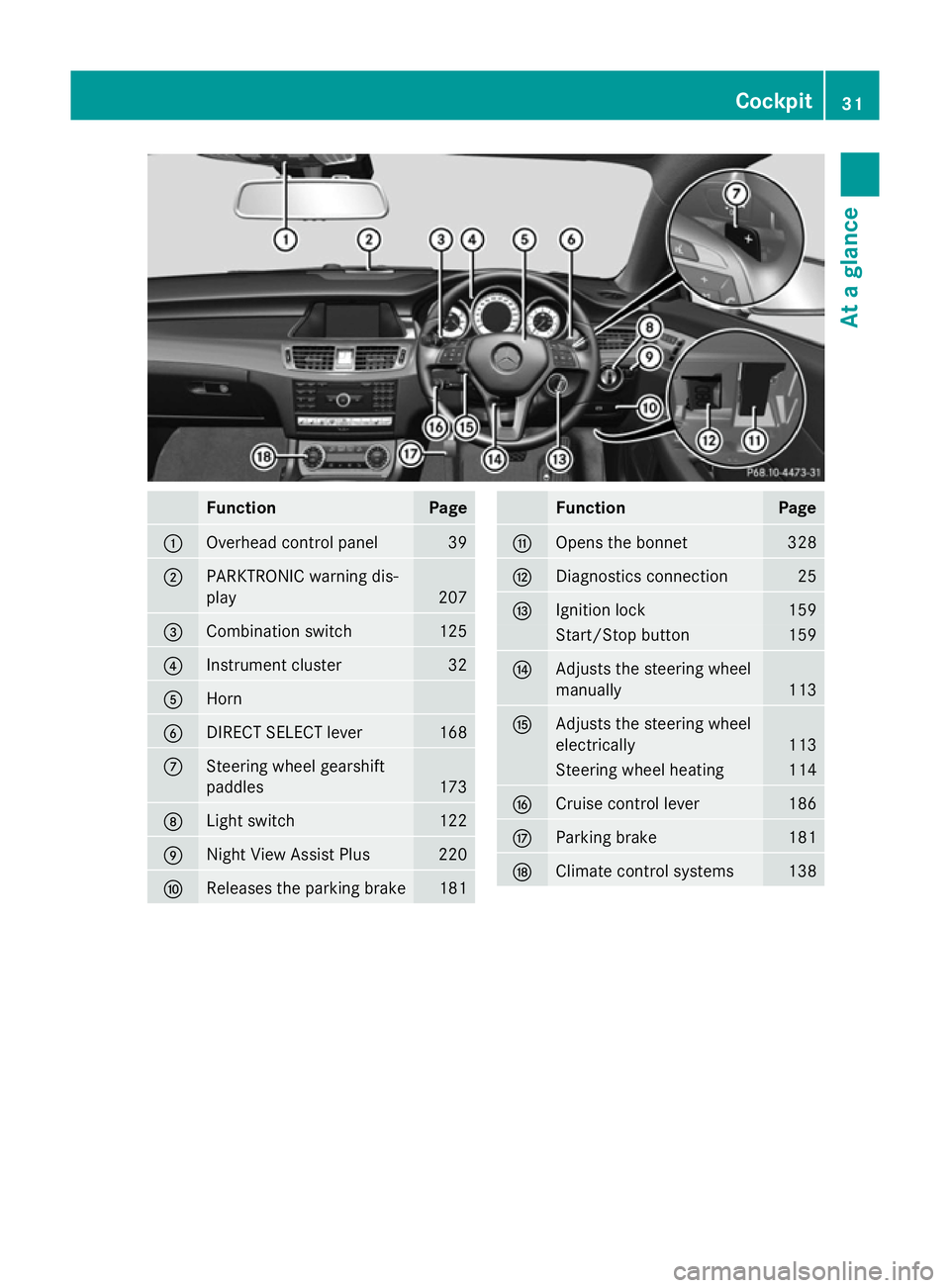
Function Page
:
Overhead control panel 39
;
PARKTRONIC warning dis-
play 207
=
Combination switch 125
?
Instrument cluster 32
A
Horn
B
DIRECT SELECT lever 168
C
Steering wheel gearshift
paddles
173
D
Light switch 122
E
Night View Assist Plus 220
F
Releases the parking brake 181 Function Page
G
Opens the bonnet 328
H
Diagnostics connection 25
I
Ignition lock 159
Start/Stop button 159
J
Adjusts the steering wheel
manually
113
K
Adjusts the steering wheel
electrically
113
Steering wheel heating 114
L
Cruise control lever 186
M
Parking brake 181
N
Climate control systems 138Cockpit
31At a glance
Page 43 of 417
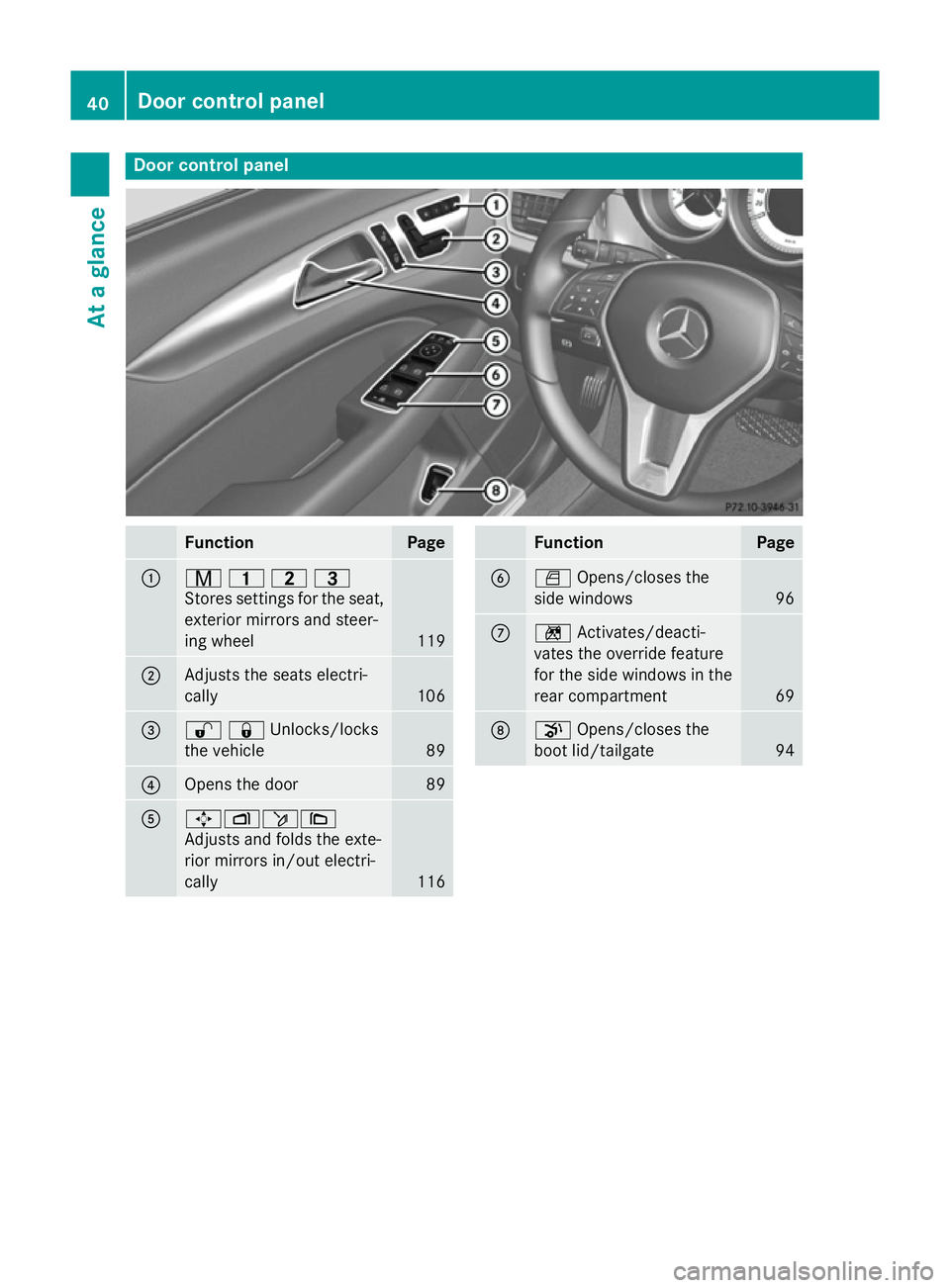
Door control panel
Function Page
:
r
45=
Stores settings for the seat, exterior mirrors and steer-
ing wheel 119
;
Adjusts the seats electri-
cally
106
=
%&Unlocks/locks
the vehicle 89
?
Opens the door 89
A
7Zö\
Adjusts and folds the exte-
rior mirrors in/out electri-
cally
116 Function Page
B
W
Opens/closes the
side windows 96
C
n
Activates/deacti-
vates the override feature
for the side windows in the
rear compartment 69
D
p
Opens/closes the
boot lid/tailgate 9440
Door control panelAt a glance
Page 45 of 417
Useful information
i This Owner's Manual describes all mod-
els, series and optional equipment for your
vehicle that were available at the time of
going to press. National variations are pos- sible. Note that your vehicle may not be
equipped with all of the functions descri-
bed. This is also the case for systems and
functions relevant to safety.
i Read the information on qualified special-
ist workshops: (Y page 26). Panic alarm
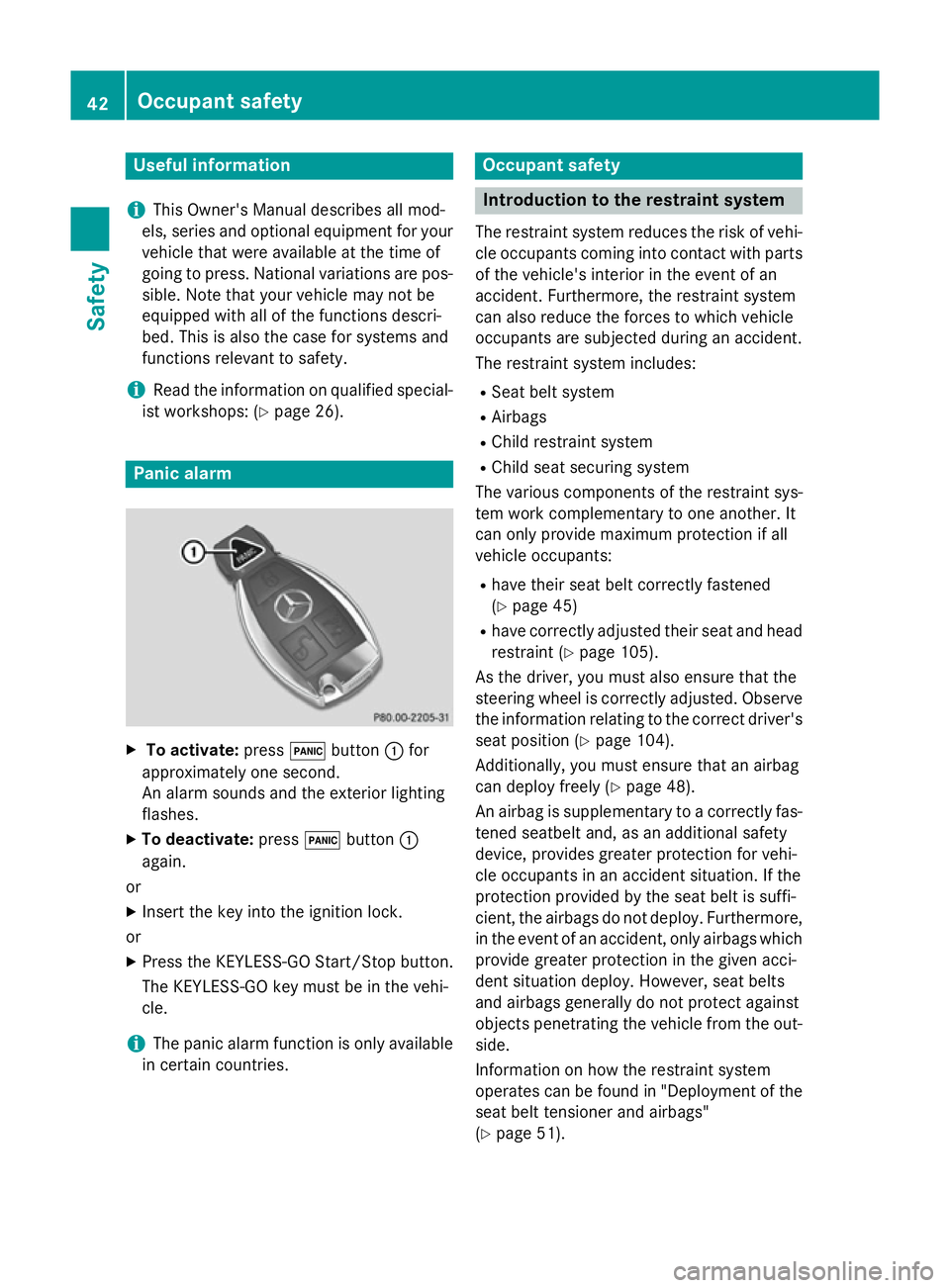
X
To activate: press!button :for
approximately one second.
An alarm sounds and the exterior lighting
flashes.
X To deactivate: press!button :
again.
or
X Insert the key into the ignition lock.
or X Press the KEYLESS-GO Start/Stop button.
The KEYLESS-GO key must be in the vehi-
cle.
i The panic alarm function is only available
in certain countries. Occupant safety
Introduction to the restraint system
The restraint system reduces the risk of vehi- cle occupants coming into contact with parts
of the vehicle's interior in the event of an
accident. Furthermore, the restraint system
can also reduce the forces to which vehicle
occupants are subjected during an accident.
The restraint system includes:
R Seat belt system
R Airbags
R Child restraint system
R Child seat securing system
The various components of the restraint sys-
tem work complementary to one another. It
can only provide maximum protection if all
vehicle occupants:
R have their seat belt correctly fastened
(Y page 45)
R have correctly adjusted their seat and head
restraint (Y page 105).
As the driver, you must also ensure that the
steering wheel is correctly adjusted. Observe
the information relating to the correct driver's
seat position (Y page 104).
Additionally, you must ensure that an airbag
can deploy freely (Y page 48).
An airbag is supplementary to a correctly fas- tened seatbelt and, as an additional safety
device, provides greater protection for vehi-
cle occupants in an accident situation. If the
protection provided by the seat belt is suffi-
cient, the airbags do not deploy. Furthermore,
in the event of an accident, only airbags which
provide greater protection in the given acci-
dent situation deploy. However, seat belts
and airbags generally do not protect against
objects penetrating the vehicle from the out- side.
Information on how the restraint system
operates can be found in "Deployment of the
seat belt tensioner and airbags"
(Y page 51). 42
Occupant safetySafety
Page 47 of 417
facing child restraint systems on the front-
passenger seat.
R All other persons: the PASSENGER AIR
BAG OFF indicator lamp must be off. Be
sure to observe the notes on "Seat belts"
(Y page 44) and "Airbags" (Y page 48).
There you can also find information on the
correct seat position.
Observe the information on automatic child
seat recognition in the front-passenger seat
(Y page 59). Seat belts
Introduction A correctly fastened seat belt is the most
effective means of limiting the movement of a
vehicle occupant during a collision or in the
event that the vehicle overturns. This reduces
the risk of vehicle occupants coming into con- tact with parts of the vehicle interior or being
ejected from it. Furthermore, the seat belt
helps to keep the vehicle occupant in the best position in relation to a deployed airbag.
The seat belt system consists of:
R seat belts
R belt tensioners for the front seat belts and
the outer seat belts in the rear
R seat belt force limiters for the front seat
belts and the outer seat belts in the rear
If the seat belt is pulled quickly or suddenly
from the belt sash guide, the inertia reel
locks. The belt strap cannot be pulled out fur- ther.
In an impact, the belt tensioner tightens the
belt to pull it close to the body. It does not pullthe vehicle occupant back in the direction of
the seat backrest, however.
In addition, the belt tensioner cannot com-
pensate for the seat position being incorrect
or for an incorrectly worn seat belt.
If the seat belt is also fitted with a belt force
limiter and this is triggered, the force exerted by the seat belt on the vehicle occupant is
reduced.
The belt force limiters on the front seats are
synchronised with the front airbags, which
take on a part of the deceleration force. This
helps to reduce the forces to which vehicle
occupants are subjected during an accident.
! If the co-driver's seat is not occupied, do
not engage the seat belt tongue in the
buckle on the co-driver's seat. Otherwise,
the belt tensioner could be triggered in the
event of an accident and would have to be
replaced.
Important safety notes G
WARNING
The seat belt cannot perform its intended pro- tective function if it is not fastened correctly. Also, an improperly fastened seat belt can
cause additional injuries in the event of an
accident, sudden braking or abrupt changes
of direction. There is an increased risk of
injury, possibly even fatal.
Always make sure that all vehicle occupants
are wearing their seat belt and positioned cor-
rectly. G
WARNING
The seat belt does not offer the intended level of protection if you have not moved the back-
rest to an almost vertical position. When brak-
ing or in the event of an accident, you could
slide underneath the seat belt and sustain
abdomen or neck injuries, for example. This
poses an increased risk of injury or even fatal injury.
Adjust the seat properly before beginning
your journey. Always ensure that the backrest
is in an almost vertical position and that the
shoulder section of your seatbelt is routed
across the centre of your shoulder. G
WARNING
Persons under 1.50 mtall cannot wear the
seat belts correctly without a suitable, addi- 44
Occupant safetySafety
Page 49 of 417
R
only one person is using a seat belt.
Infants and children must never travel sit-
ting on the lap of a vehicle occupant. In the
event of an accident, they could be crushed between the vehicle occupant and seat
belt.
R objects are never secured with a seat belt if
the seat belt is also being used by one of the vehicle's occupants.
Seat belts are only intended to secure and
restrain vehicle occupants. Always observe
the "Loading guidelines" for securing objects,
luggage or loads (Y page 300).
Fastening and adjusting the seat belts Observe the safety notes on the seat belt
(Y page 44) and the notes on correct use of
seat belts (Y page 45).
If the centre rear seat belt is being used, also
observe the information about the seat belt
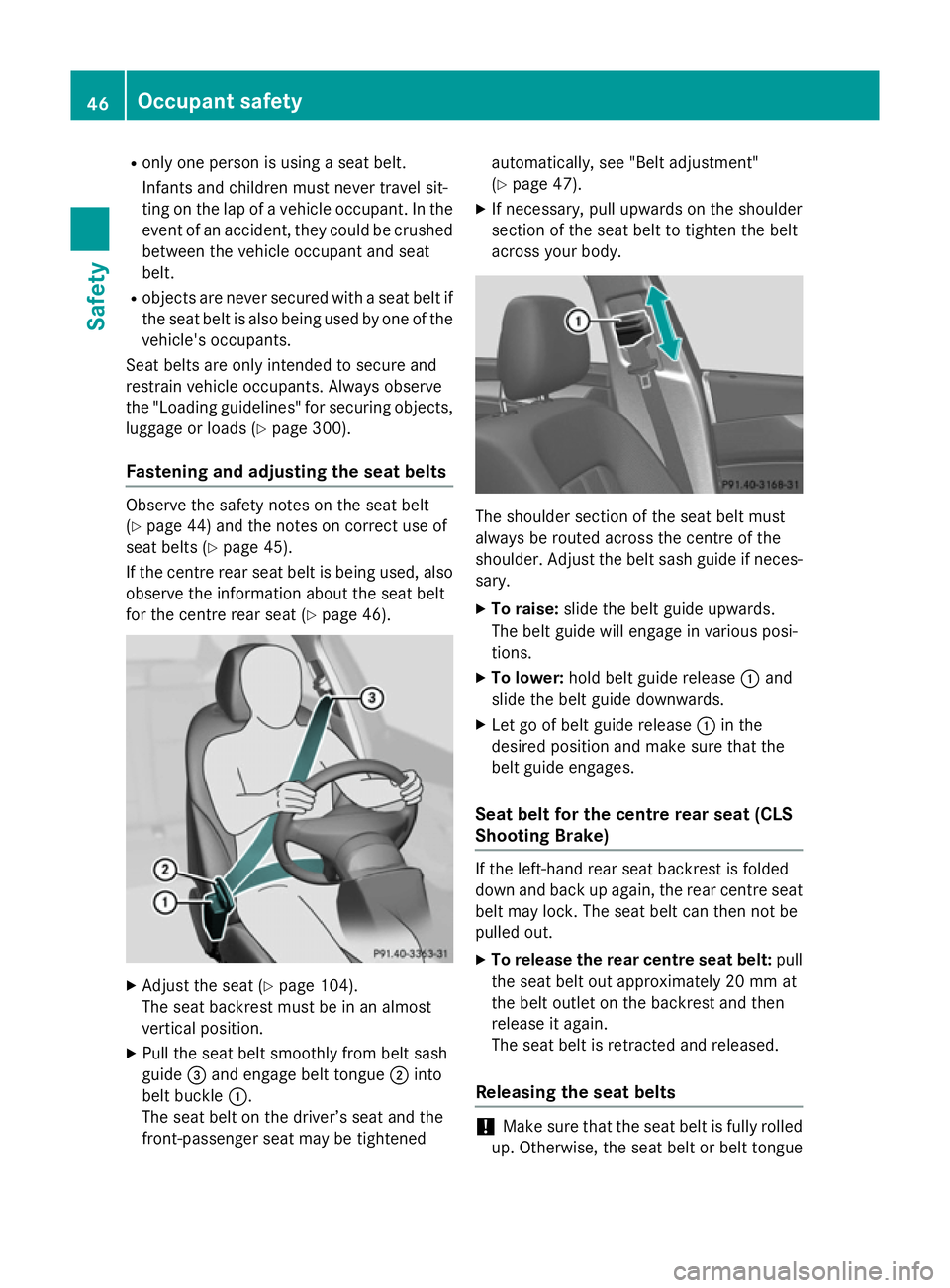
for the centre rear seat (Y page 46).X
Adjust the seat (Y page 104).
The seat backrest must be in an almost
vertical position.
X Pull the seat belt smoothly from belt sash
guide =and engage belt tongue ;into
belt buckle :.
The seat belt on the driver’s seat and the
front-passenger seat may be tightened automatically, see "Belt adjustment"
(Y
page 47).
X If necessary, pull upwards on the shoulder
section of the seat belt to tighten the belt
across your body. The shoulder section of the seat belt must
always be routed across the centre of the
shoulder. Adjust the belt sash guide if neces-
sary.
X To raise: slide the belt guide upwards.
The belt guide will engage in various posi-
tions.
X To lower: hold belt guide release :and
slide the belt guide downwards.
X Let go of belt guide release :in the
desired position and make sure that the
belt guide engages.
Seat belt for the centre rear seat (CLS
Shooting Brake) If the left-hand rear seat backrest is folded
down and back up again, the rear centre seat
belt may lock. The seat belt can then not be
pulled out.
X To release the rear centre seat belt: pull
the seat belt out approximately 20 mm at
the belt outlet on the backrest and then
release it again.
The seat belt is retracted and released.
Releasing the seat belts !
Make sure that the seat belt is fully rolled
up. Otherwise, the seat belt or belt tongue 46
Occupant safetySafety
Page 54 of 417
When deployed, the windowbag enhances the
level of protection for the head. However, it
does not protect the chest or arms.
In the event of a side impact, the windowbag
is deployed on the side on which the impact
occurs.
If the system determines that they can offer
additional protection to that provided by the
seat belt, a windowbag may be deployed in
other accident situations (Y page 51).Deployment of belt tensioners and air-
bags
Important safety notes G
WARNING
After the airbag deploys, the airbag parts are
hot. There is a risk of injury.
Do not touch the airbag parts. Have a
deployed airbag replaced at a qualified spe-
cialist workshop as soon as possible. G
WARNING
Pyrotechnic seat belt tensioners that have
been deployed are no longer operational and
are unable to perform their intended protec-
tive function. This poses an increased risk of
injury or even fatal injury.
Therefore, have pyrotechnic belt tensioners
which have been triggered immediately
replaced at a qualified specialist workshop.
Mercedes-Benz recommends that after an
accident, you have your vehicle towed to a
qualified specialist workshop. This is particu- larly important after the seat belt tensioners
have been triggered or after airbags have
been deployed.
An electric motor is used by PRE-SAFE ®
to
trigger the tightening of the seat belt in haz-
ardous situations. This procedure is reversi-
ble.
If belt tensioners are triggered or the airbags
are deployed, you will hear a bang, and a small amount of powder may also be released. The
6 restraint system warning lamp lights up.
Only in rare cases will the bang affect your
hearing. The powder that is released gener-
ally does not constitute a health hazard but
can cause short-term breathing difficulties for people with asthma or breathing problems. If
it is safe to do so, leave the vehicle immedi-
ately or open a window to avoid experiencing potential breathing difficulties.
Mode of operation During the first stage of a collision, the
restraint system control unit evaluates impor-
tant physical data relating to vehicle deceler- ation or acceleration, such as:
R duration
R direction
R intensity
Based on the evaluation of this data, the seat belt tensioner is triggered by the restraint
system control unit in the event of a frontal or
rear collision.
The belt tensioner can only be triggered if:
R the ignition is switched on
R the components of the restraint system are
operational; see the "Restraint system
warning lamp" section (Y page 43)
R the seat belt buckle tongue is engaged in
the belt buckle on your front seat
The belt tensioners in the rear compartment
are triggered independently of the lock status of the seat belts.
In certain frontal collision situations, further
components of the restraint system are acti-
vated independently of each other if the
restraint system control unit determines that the accident is severe:
R front airbags and driver's kneebag
R windowbag, if it is determined that it can
offer additional protection to the seat belt
for vehicle occupants
Depending on the classification of the person in the front-passenger seat, the front- Occupant safety
51Safety Z
Page 58 of 417
R
vehicles with the memory function: the
front-passenger seat is adjusted if it is in an unfavourable position.
R Vehicles with a multicontour seat or active
multicontour seat: the air pressure in the
side bolsters of the backrest is increased.
If the hazardous situation passes without
resulting in an accident, PRE-SAFE ®
slackens
the belt pre-tensioning. On vehicles with mul-
ticontour seats/active multicontour seats,
the air pressure in the side bolsters is reduced
again. All settings made by PRE-SAFE ®
can
then be reversed.
If the seat belt pre-tensioning is not reduced:
X Move the seat backrest or seat back
slightly when the vehicle is stationary.
Seat belt pre-tensioning is reduced and the
locking mechanism is released.
The seat-belt adjustment is an integral part of
the PRE-SAFE ®
convenience function. Fur-
ther information can be found under "Belt
adjustment" (Y page 47). Automatic measures after an acci-
dent
Immediately after an accident, the following
measures are implemented, depending on
the type and severity of the impact:
R the hazard warning lamps are activated
R the emergency lighting is activated
R the vehicle doors are unlocked
R the front side windows are lowered
R the electrically adjustable steering wheel is
raised
R the engine is switched off
R vehicles with the Mercedes-Benz emer-
gency call system: automatic emergency
call Children in the vehicle
Important safety notes
Accident statistics show that children
secured in the rear seats are safer than chil-
dren secured in the front-passenger seat. For this reason, Mercedes-Benz strongly advises
that you install a child restraint system on a
rear seat. Children are generally better pro-
tected there.
If a child younger than 12 years old and under
1.50 m in height is travelling in the vehicle:
R always secure the child in a child restraint
system suitable for Mercedes-Benz vehi-
cles. The child restraint system must be
appropriate to the age, weight and size of
the child.
R be sure to observe the instructions and
safety notes in this section in addition to
the child restraint system manufacturer's
installation instructions G
WARNING
If you leave children unattended in the vehi-
cle, they may be able to set the vehicle in
motion if, for example, they:
R release the parking brake
R shift the automatic transmission out of park
position P
R start the engine
In addition, they may operate vehicle equip-
ment and become trapped. There is a risk of
an accident and injury.
When leaving the vehicle, always take the key
with you and lock the vehicle. Never leave
children unattended in the vehicle. G
WARNING
If persons (particularly children) are exposed
to heat or cold for a prolonged period, there is a risk of serious or even fatal injuries. Never
leave persons (particularly children) unatten-
ded in the vehicle. Children in the vehicle
55Safety Z