technical data MERCEDES-BENZ CLS COUPE 2014 Owner's Manual
[x] Cancel search | Manufacturer: MERCEDES-BENZ, Model Year: 2014, Model line: CLS COUPE, Model: MERCEDES-BENZ CLS COUPE 2014Pages: 417, PDF Size: 14.15 MB
Page 407 of 417
Assuring the purity of AdBlue
®
is particularly
important with respect to avoiding malfunc-
tions in the BlueTEC exhaust gas aftertreat-
ment system.
If AdBlue ®
is pumped out of the AdBlue ®
tank,
e.g. during repair work, do not use this fluid to refill the tank. The purity of the fluid can no
longer be guaranteed.
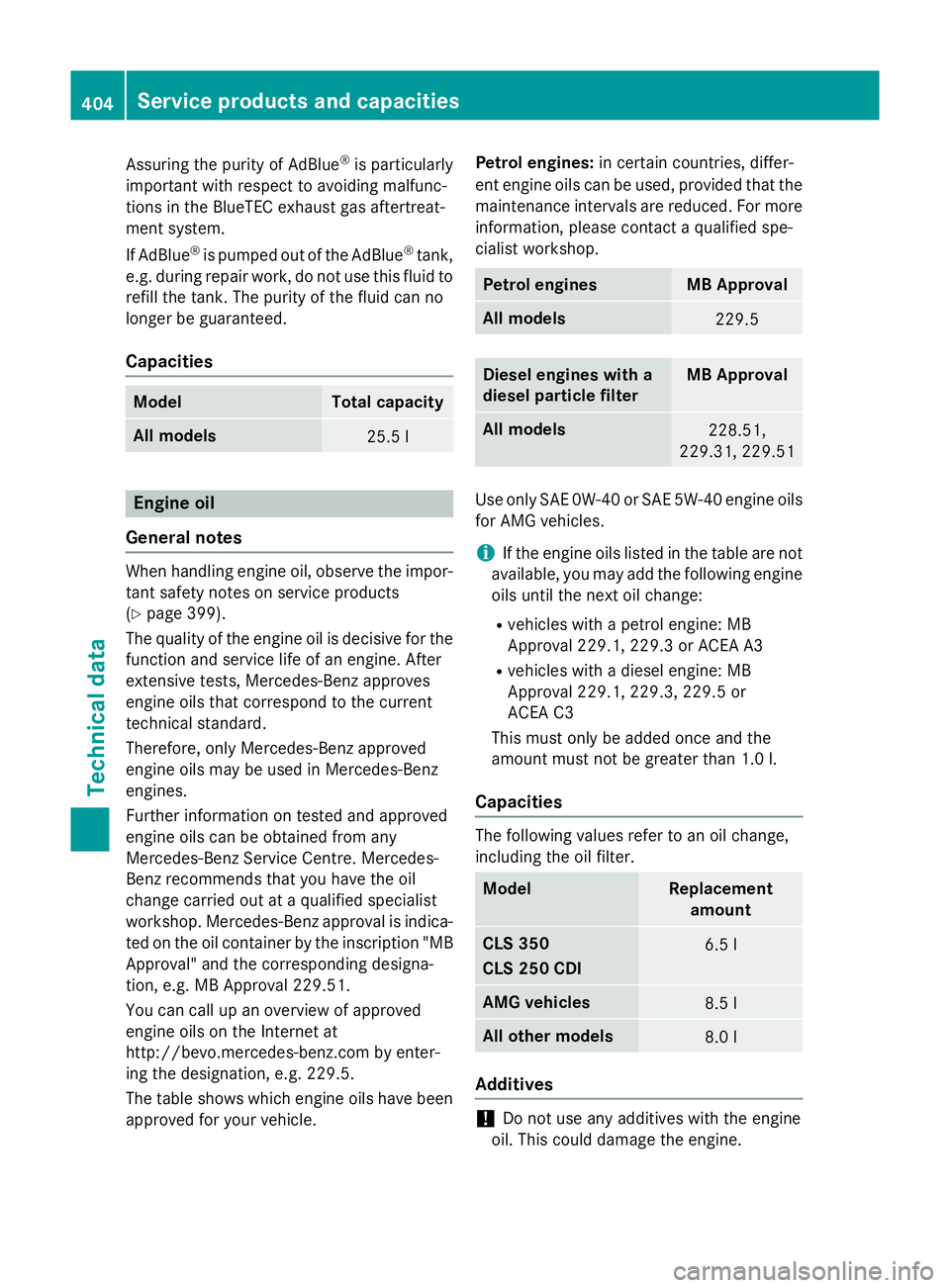
Capacities Model Total capacity
All models
25.5 l
Engine oil
General notes When handling engine oil, observe the impor-
tant safety notes on service products
(Y page 399).
The quality of the engine oil is decisive for the function and service life of an engine. After
extensive tests, Mercedes-Benz approves
engine oils that correspond to the current
technical standard.
Therefore, only Mercedes-Benz approved
engine oils may be used in Mercedes-Benz
engines.
Further information on tested and approved
engine oils can be obtained from any
Mercedes-Benz Service Centre. Mercedes-
Benz recommends that you have the oil
change carried out at a qualified specialist
workshop. Mercedes-Benz approval is indica-
ted on the oil container by the inscription "MB Approval" and the corresponding designa-
tion, e.g. MB Approval 229.51.
You can call up an overview of approved
engine oils on the Internet at
http://bevo.mercedes-benz.co mby enter-
ing the designation, e.g. 229.5.
The table shows which engine oils have been
approved for your vehicle. Petrol engines:
in certain countries, differ-
ent engine oils can be used, provided that the
maintenance intervals are reduced. For more information, please contact a qualified spe-
cialist workshop. Petrol engines MB Approval
All models
229.5
Diesel engines with a
diesel particle filter MB Approval
All models
228.51,
229.31, 229.51 Use only SAE 0W-4
0or SAE 5W-40 engine oils
for AMG vehicles.
i If the engine oils listed in the table are not
available, you may add the following engine
oils until the next oil change:
R vehicles with a petrol engine: MB
Approval 229.1, 229.3 or ACEA A3
R vehicles with a diesel engine: MB
Approval 229.1, 229.3, 229.5 or
ACEA C3
This must only be added once and the
amount must not be greater than 1.0 l.
Ca pacities The following values refer to an oil change,
including the oil filter.
Model Replacement
amount CLS 350
CLS 250 CDI
6.5 l
AMG vehicles
8.5 l
All other models
8.0 l
Additives
!
Do not use any additives with the engine
oil. This could damage the engine. 404
Service products and capacitiesTechnical data
Page 408 of 417
Engine oil viscosity
Viscosity describes the flow characteristics
of a fluid. If an engine oil has a high viscosity
rating, it flows slowly; the lower the viscosity,
the faster it flows.
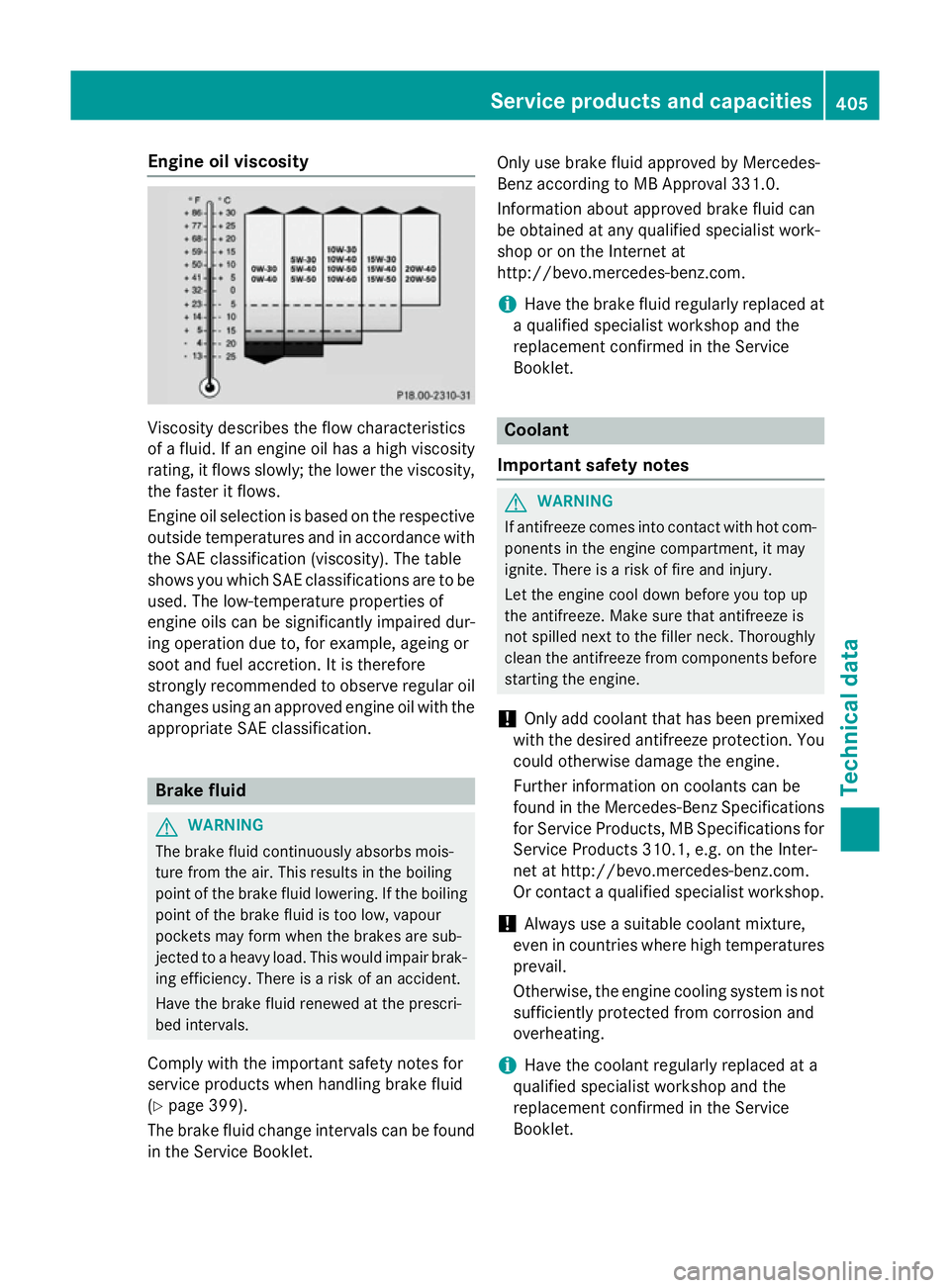
Engine oil selection is based on the respective outside temperatures and in accordance with
the SAE classification (viscosity). The table
shows you which SAE classifications are to be
used. The low-temperature properties of
engine oils can be significantly impaired dur-
ing operation due to, for example, ageing or
soot and fuel accretion. It is therefore
strongly recommended to observe regular oil changes using an approved engine oil with the
appropriate SAE classification. Brake fluid
G
WARNING
The brake fluid continuously absorbs mois-
ture from the air. This results in the boiling
point of the brake fluid lowering. If the boiling
point of the brake fluid is too low, vapour
pockets may form when the brakes are sub-
jected to a heavy load. This would impair brak- ing efficiency. There is a risk of an accident.
Have the brake fluid renewed at the prescri-
bed intervals.
Comply with the important safety notes for
service products when handling brake fluid
(Y page 399).
The brake fluid change intervals can be found in the Service Booklet. Only use brake fluid approved by Mercedes-
Benz according to MB Approval 331.0.
Information about approved brake fluid can
be obtained at any qualified specialist work-
shop or on the Internet at
http://bevo.mercedes-benz.com.
i Have the brake fluid regularly replaced at
a qualified specialist workshop and the
replacement confirmed in the Service
Booklet. Coolant
Important safety notes G
WARNING
If antifreeze comes into contact with hot com- ponents in the engine compartment, it may
ignite. There is a risk of fire and injury.
Let the engine cool down before you top up
the antifreeze. Make sure that antifreeze is
not spilled next to the filler neck. Thoroughly
clean the antifreeze from components before
starting the engine.
! Only add coolant that has been premixed
with the desired antifreeze protection. You
could otherwise damage the engine.
Further information on coolants can be
found in the Mercedes-Benz Specifications for Service Products, MB Specifications for Service Products 310.1, e.g. on the Inter-
net at http://bevo.mercedes-benz.com.
Or contact a qualified specialist workshop.
! Always use a suitable coolant mixture,
even in countries where high temperatures prevail.
Otherwise, the engine cooling system is not
sufficiently protected from corrosion and
overheating.
i Have the coolant regularly replaced at a
qualified specialist workshop and the
replacement confirmed in the Service
Booklet. Service products and capacities
405Technical data Z
Page 409 of 417
Comply with the important safety precautions
for service products when handling coolant
(Y page 399).
The coolant is a mixture of water and anti-
freeze/corrosion inhibitor. It is responsible
for the following:
R anti-corrosion protection
R antifreeze protection
R raising the boiling point
If antifreeze/corrosion inhibitor is present in
the correct concentration, the boiling point of
the coolant during operation will be approx-
imately 130 †.
The antifreeze/corrosion inhibitor concentra- tion in the engine cooling system should:
R be at least 50%. This will protect the engine
cooling system against freezing down to
approximately -37 †.
R not exceed 55% (antifreeze protection
down to -45 †). Heat will otherwise not be
dissipated as effectively.
Mercedes-Benz recommends an antifreeze/
corrosion inhibitor concentrate in accord-
ance with
MB Specifications for Service Products 310.1 .
i When the vehicle is first delivered, it is fil-
led with a coolant mixture that ensures
adequate antifreeze and corrosion protec-
tion.
i The coolant is checked at every mainte-
nance interval at a qualified specialist
workshop. Windscreen washer system and head-
lamp cleaning system
Important safety notes G
WARNING
If windscreen washer concentrate comes into contact with hot components of the engine or
the exhaust system, it can ignite. There is a
risk of fire and injury. Make sure the windscreen washer concen-
trate does not come into contact with the filler neck.
! Only use washer fluid that is suitable for
plastic lamp lenses, e.g. MB SummerFit or
MB WinterFit. Unsuitable washer fluid
could damage the plastic lenses of the
headlamps.
! Do not use distilled or de-ionised water in
the washer fluid reservoir. Otherwise, the
level sensor may be damaged.
! Only the washer fluids SummerFit and
WinterFit can be mixed. Otherwise, the
spraying nozzles could become blocked.
Comply with the important safety notes for
service products when handling washer fluid
(Y page 399).
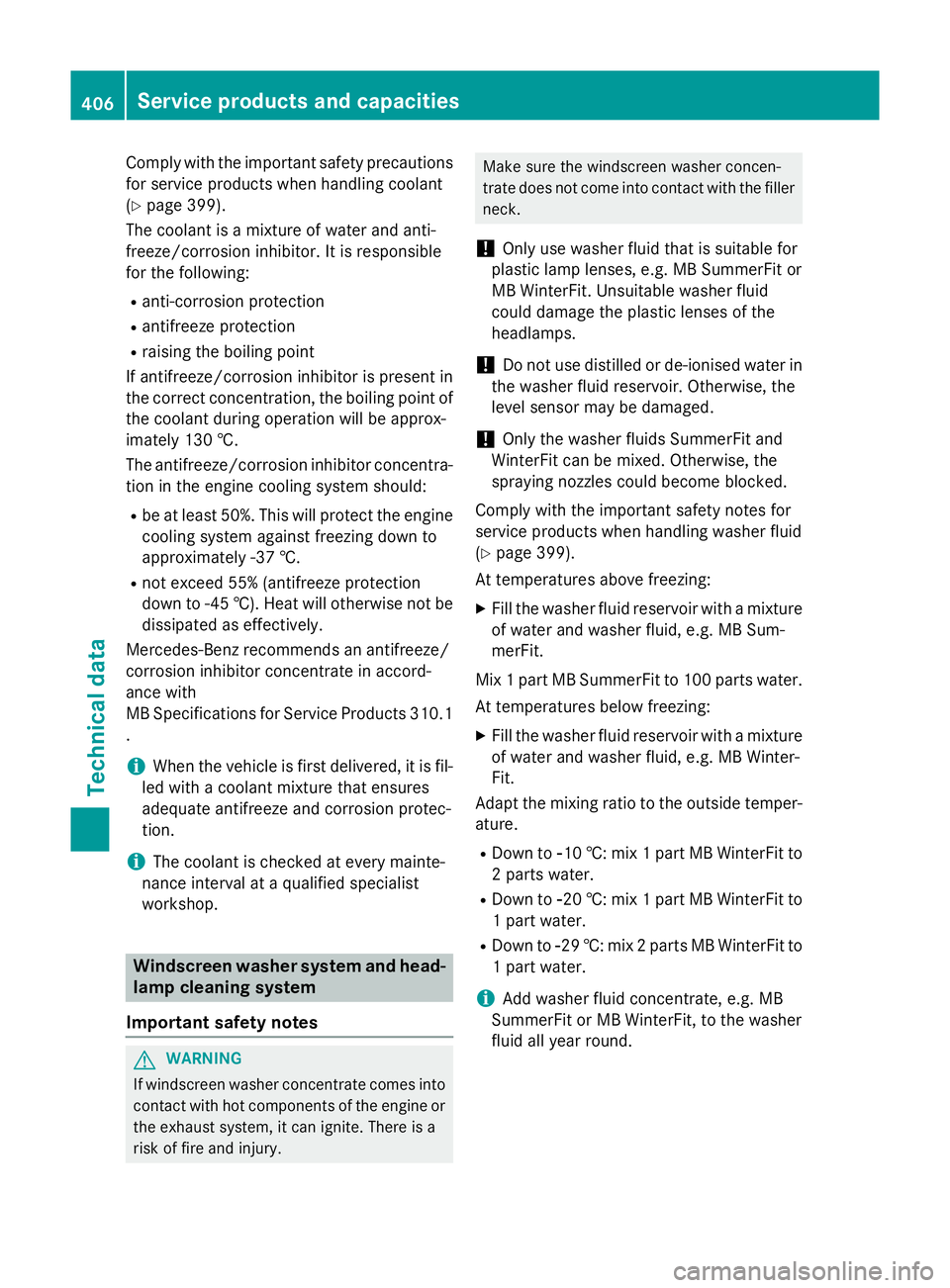
At temperatures above freezing:
X Fill the washer fluid reservoir with a mixture
of water and washer fluid, e.g. MB Sum-
merFit.
Mix 1 part MB SummerFit to 100 parts water.
At temperatures below freezing:
X Fill the washer fluid reservoir with a mixture
of water and washer fluid, e.g. MB Winter-
Fit.
Adapt the mixing ratio to the outside temper-
ature.
R Down to Ò10 †: mix 1 part MB WinterFit to
2 parts water.
R Down to Ò20 †: mix 1 part MB WinterFit to
1 part water.
R Down to Ò29 †: mix 2 parts MB WinterFit to
1 part water.
i Add washer fluid concentrate, e.g. MB
SummerFit or MB WinterFit, to the washer
fluid all year round. 406
Service products and capacitiesTechnical data
Page 410 of 417
Vehicle data
General notes
Please note that for the specified vehicle
data:
R the heights specified may vary as a result
of:
- tyres
- load
- condition of the suspension
- optional equipment
R optional equipment reduces the maximum
payload.
R vehicle-specific weight information can be
found on the vehicle identification plate
(Y page 398).
R only for certain countries: you can find vehi-
cle-specific vehicle data in the COC docu-
ments (CERTIFICATE OF CONFORMITY).
These documents are delivered with your
vehicle. Dimensions and weights (CLS Coupé)
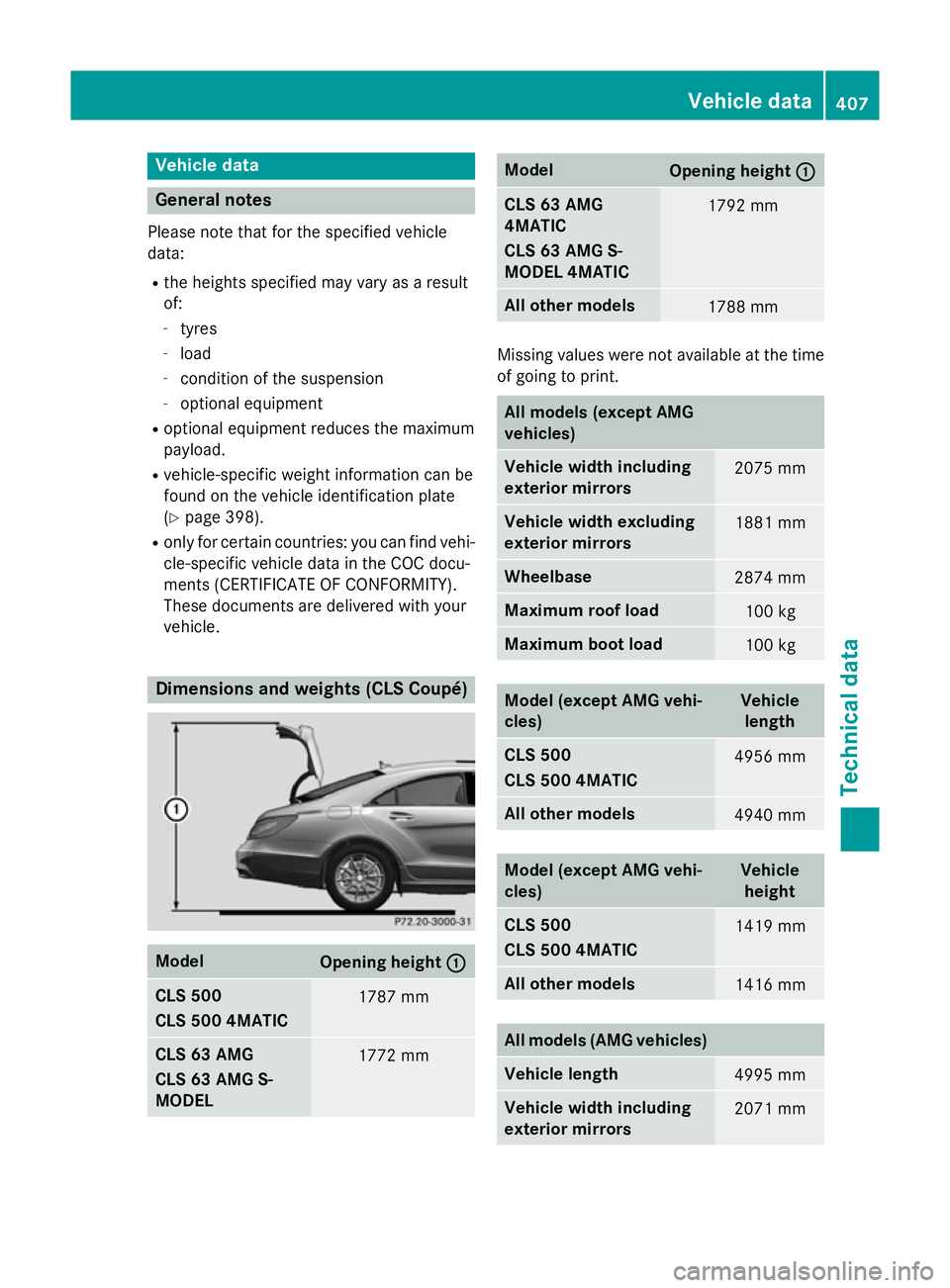
Model
Opening height
: : CLS 500
CLS 500 4MATIC
1787 mm
CLS 63 AMG
CLS 63 AMG S-
MODEL
1772 mm Model
Opening height
: : CLS 63 AMG
4MATIC
CLS 63 AMG S-
MODEL 4MATIC
1792 mm
All other models
1788 mm
Missing values were not available at the time
of going to print. All models (except AMG
vehicles)
Vehicle width including
exterior mirrors
2075 mm
Vehicle width excluding
exterior mirrors
1881 mm
Wheelbase
2874 mm
Maximum roof load
100 kg
Maximum boot load
100 kg
Model (except AMG vehi-
cles) Vehicle
length CLS 500
CLS 500 4MATIC
4956 mm
All other models
4940 mm
Model (except AMG vehi-
cles) Vehicle
height CLS 500
CLS 500 4MATIC
1419 mm
All other models
1416 mm
All models (AMG vehicles)
Vehicle length
4995 mm
Vehicle width including
exterior mirrors
2071 mmVehicle data
407Technical data Z
Page 411 of 417
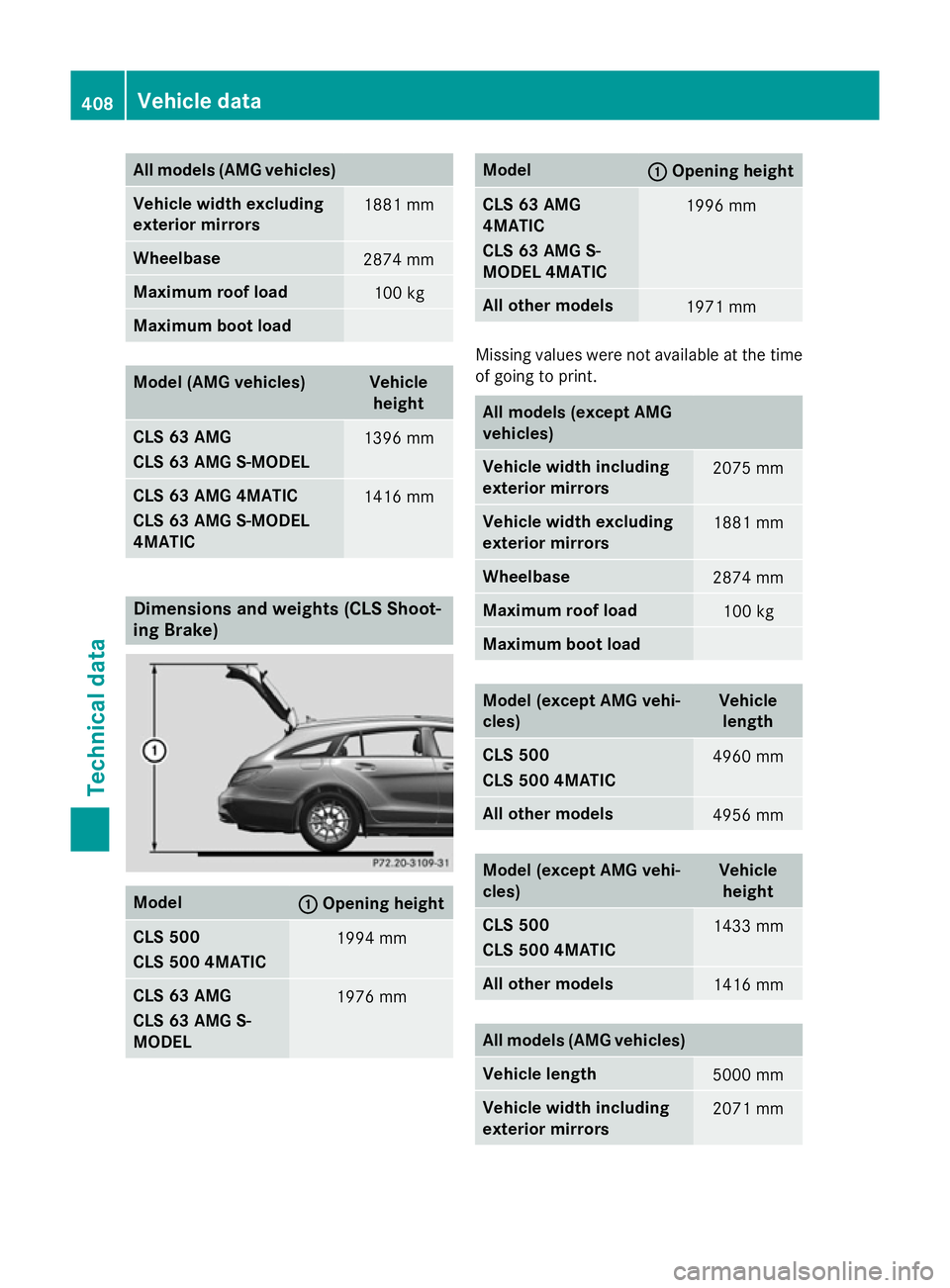
All models (AMG vehicles)
Vehicle width excluding
exterior mirrors
1881 mm
Wheelbase
2874 mm
Maximum roof load
100 kg
Maximum boot load
Model (AMG vehicles) Vehicle
height CLS 63 AMG
CLS 63 AMG S-MODEL
1396 mm
CLS 63 AMG 4MATIC
CLS 63 AMG S-MODEL
4MATIC
1416 mm
Dimensions and weights (CLS Shoot-
ing Brake)
Model
: :
Opening height CLS 500
CLS 500 4MATIC
1994 mm
CLS 63 AMG
CLS 63 AMG S-
MODEL
1976 mm Model
: :
Opening height CLS 63 AMG
4MATIC
CLS 63 AMG S-
MODEL 4MATIC
1996 mm
All other models
1971 mm
Missing values were not available at the time
of going to print. All models (except AMG
vehicles)
Vehicle width including
exterior mirrors
2075 mm
Vehicle width excluding
exterior mirrors
1881 mm
Wheelbase
2874 mm
Maximum roof load
100 kg
Maximum boot load
Model (except AMG vehi-
cles) Vehicle
length CLS 500
CLS 500 4MATIC
4960 mm
All other models
4956 mm
Model (except AMG vehi-
cles) Vehicle
height CLS 500
CLS 500 4MATIC
1433 mm
All other models
1416 mm
All models (AMG vehicles)
Vehicle length
5000 mm
Vehicle width including
exterior mirrors
2071 mm408
Vehicle dataTechnical data
Page 412 of 417
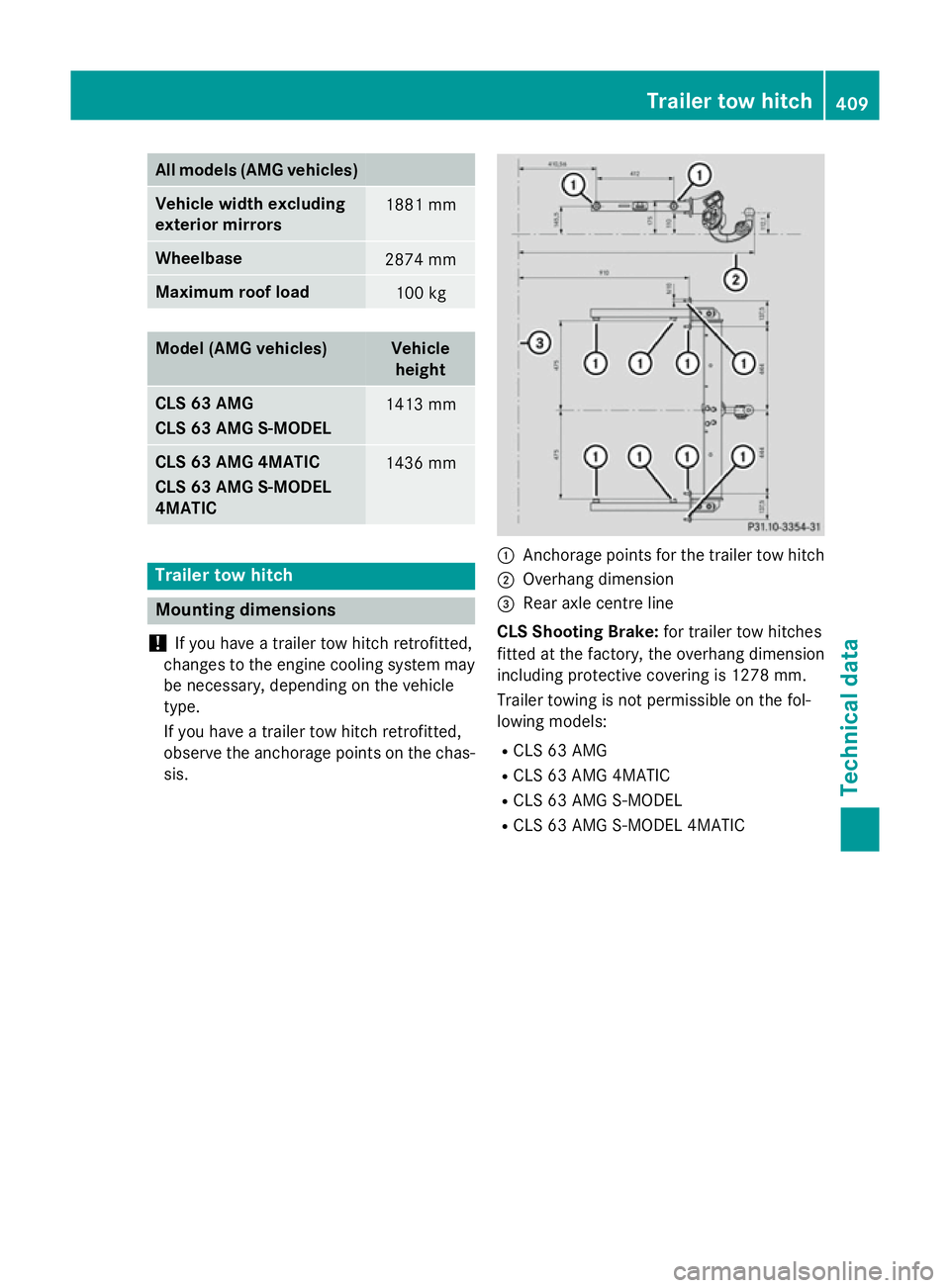
All models (AMG vehicles)
Vehicle width excluding
exterior mirrors
1881 mm
Wheelbase
2874 mm
Maximum roof load
100 kg
Model (AMG vehicles) Vehicle
height CLS 63 AMG
CLS 63 AMG S-MODEL
1413 mm
CLS 63 AMG 4MATIC
CLS 63 AMG S-MODEL
4MATIC
1436 mm
Trailer tow hitch
Mounting dimensions
! If you have a trailer tow hitch retrofitted,
changes to the engine cooling system may
be necessary, depending on the vehicle
type.
If you have a trailer tow hitch retrofitted,
observe the anchorage points on the chas- sis. :
Anchorage points for the trailer tow hitch
; Overhang dimension
= Rear axle centre line
CLS Shooting Brake: for trailer tow hitches
fitted at the factory, the overhang dimension
including protective covering is 1278 mm.
Trailer towing is not permissible on the fol-
lowing models:
R CLS 63 AMG
R CLS 63 AMG 4MATIC
R CLS 63 AMG S-MODEL
R CLS 63 AMG S-MODEL 4MATIC Trailer tow hitch
409Technical data Z
Page 413 of 417
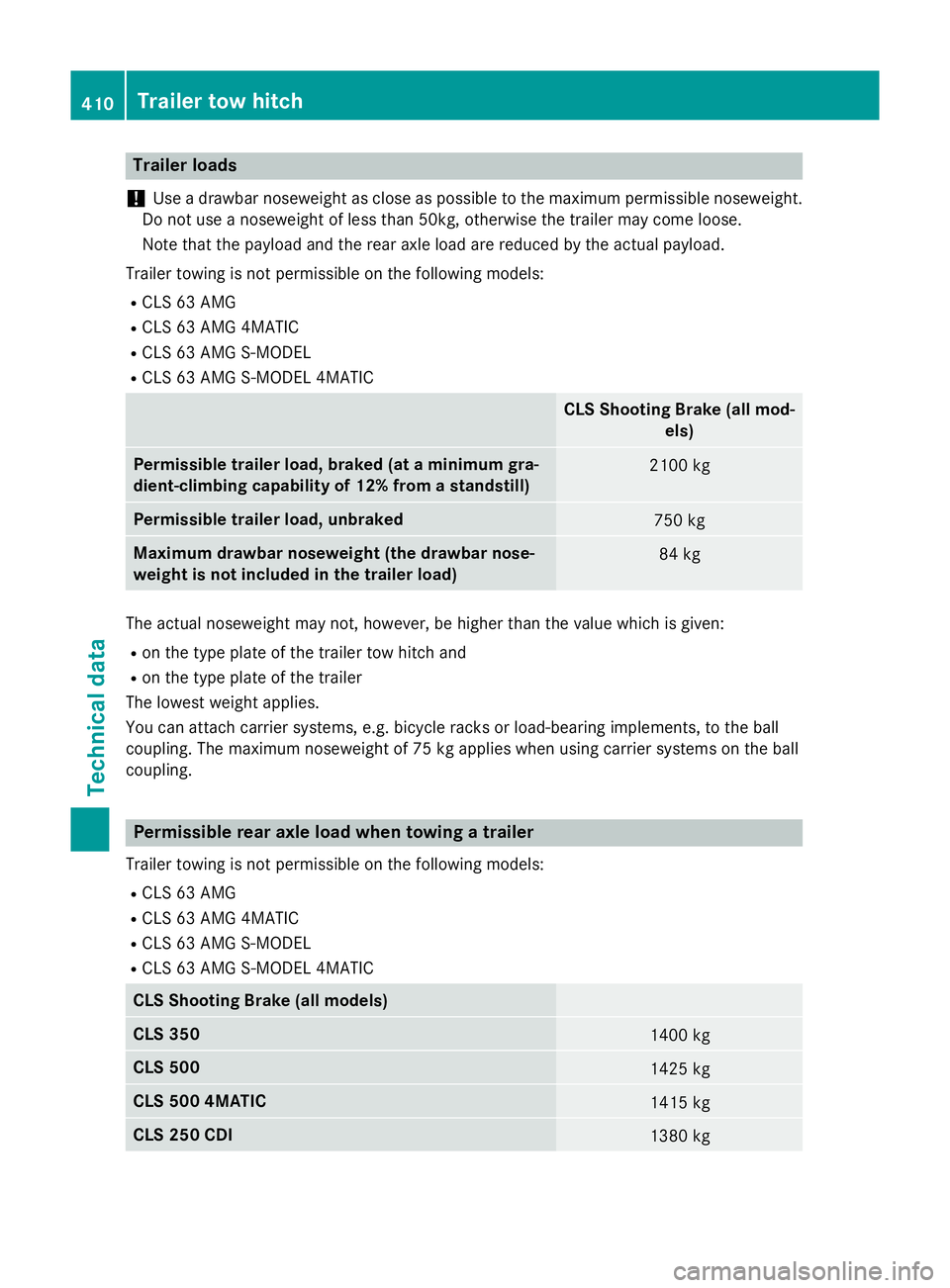
Trailer loads
! Use a drawbar noseweight as close as possible to the maximum permissible noseweight.
Do not use a noseweight of less than 50kg, otherwise the trailer may come loose.
Note that the payload and the rear axle load are reduced by the actual payload.
Trailer towing is not permissible on the following models:
R CLS 63 AMG
R CLS 63 AMG 4MATIC
R CLS 63 AMG S-MODEL
R CLS 63 AMG S-MODEL 4MATIC CLS Shooting Brake (all mod-
els) Permissible trailer load, braked (at a minimum gra-
dient-climbing capability of 12% from a standstill)
2100 kg
Permissible trailer load, unbraked
750 kg
Maximum drawbar noseweight (the drawbar nose-
weight is not included in the trailer load)
84 kg
The actual noseweight may not, however, be higher than the value which is given:
R on the type plate of the trailer tow hitch and
R on the type plate of the trailer
The lowest weight applies.
You can attach carrier systems, e.g. bicycle racks or load-bearing implements, to the ball
coupling. The maximum noseweight of 75 kg applies when using carrier systems on the ball
coupling. Permissible rear axle load when towing a trailer
Trailer towing is not permissible on the following models:
R CLS 63 AMG
R CLS 63 AMG 4MATIC
R CLS 63 AMG S-MODEL
R CLS 63 AMG S-MODEL 4MATIC CLS Shooting Brake (all models)
CLS 350
1400 kg
CLS 500
1425 kg
CLS 500 4MATIC
1415 kg
CLS 250 CDI
1380 kg410
Trailer tow hitchTechnical data
Page 414 of 417
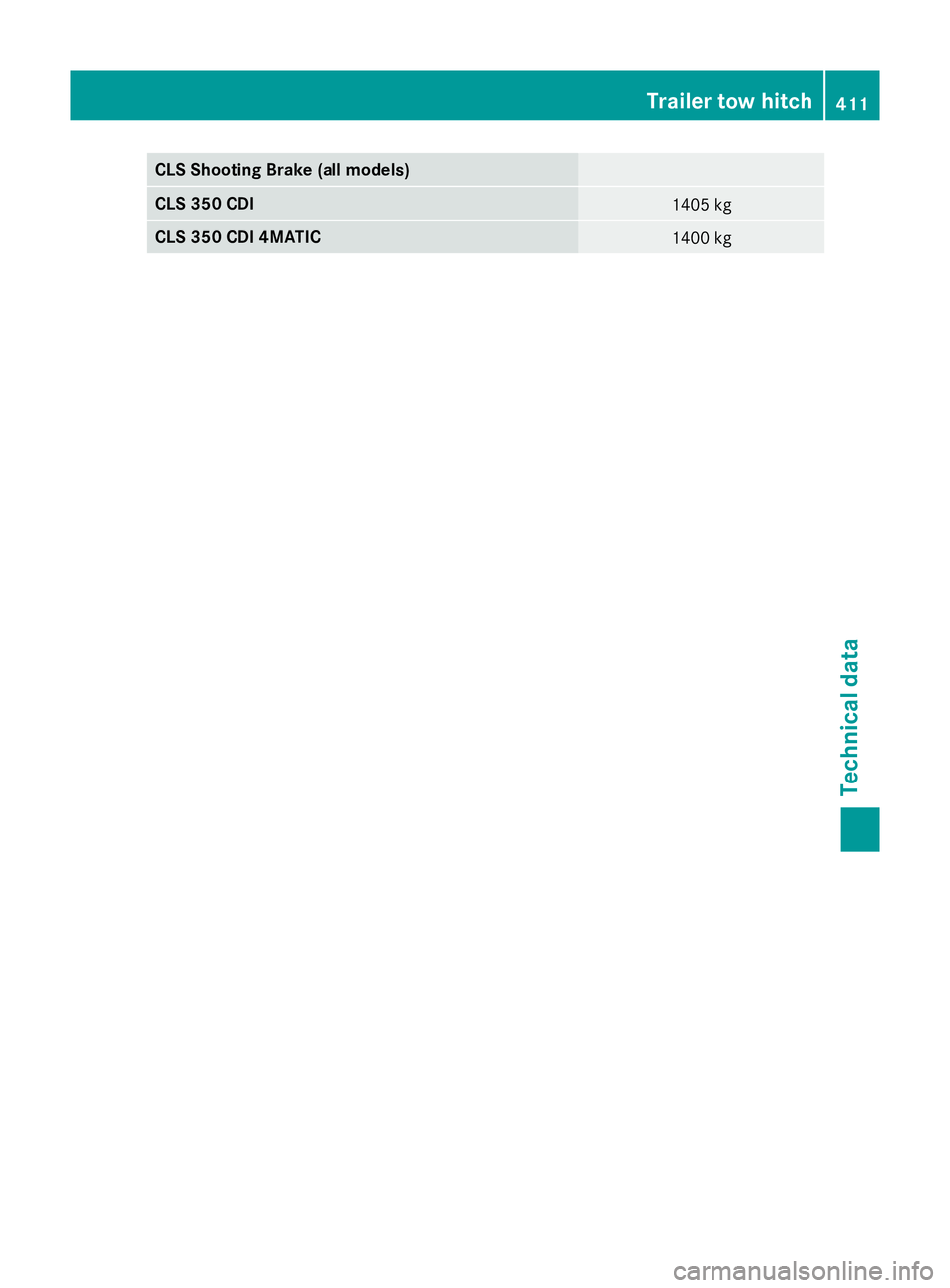
CLS Shooting Brake (all models)
CLS 350 CDI
1405 kg
CLS 350 CDI 4MATIC
1400 kgTrailer tow hitch
411Technical data Z