warning MERCEDES-BENZ CLS COUPE 2018 User Guide
[x] Cancel search | Manufacturer: MERCEDES-BENZ, Model Year: 2018, Model line: CLS COUPE, Model: MERCEDES-BENZ CLS COUPE 2018Pages: 589, PDF Size: 10.95 MB
Page 29 of 589
C) A 639 580 02
18
Ye ar of manufacture: 20 15
Fu lfils all releva nt conditions
Directi veNo. 2006/42/EC
b)
Desc ript ion and purpose of use:
The jack is only intended forra ising the specified
ve hicle in accordance with the operating instruc‐
tions af fixe dto the jac k.
3.
Refe rence da taofthe harmonised standards or
specifications
A) ISO 4063, EN ISO 14341- A,DBL 7382.20,
MBN 10435, AS 2693
B) ISO 4063, ISO 14341- A,DBL 7392. 10, MBN
10 435
C) DBL 7392. 10, DBL 8230. 10
The tech nical documentation of the product is
st ored at the manufacturer's plant. Representa‐
tive forth e compilation of thete ch nical docu‐
mentation: Director of theTe ch nical Department
Brano a.s. 4.
Hradec nad Mor
avicí
City
5.
05.05.20 15
Date
Signed by
Director of Quality TIREFIT kit
Co
py and translation of the original declaration
of confo rmity:
EC declaration of conformity
In accordance with EC Directive 2006/42/EC
We hereby declare that the product
Product designation: Daimler electric air pump
Model designation: 0851ve, DT/UW 200046
MB pa rtno.: A 000 583 8200
complies wi th thefo llowing releva nt regulations:
2004/108/EC Applied harmonised
standards, in particular:
DIN EN 55 014-1
DIN EN 550 14-2:2009-06
Manufactu rer: Dunlop Tech GmbH
Ad dress: Bir kenhaine rstrasse 77, 63450 Hanau,
Germany
Auth orised representative: IMS dept.
Date: June 20 15
Signatu re: IMS-AM, IMS-AE-L Diagnostics connection
The diagnostics connection is only intended for
th e connection of diagnostic devices at a quali‐
fi ed specialist workshop. &
WARNING Risk of accident due tocon‐
necting devices tothe diagnostics con‐
nection
If yo u connect equipment toa diagnostics
connection in theve hicle, it may af fect the
operation of vehicle sy stems. 26
General no tes
Page 30 of 589
As a
result, the operating saf ety of theve hi‐
cle could be af fected. #
Only connect equipment toa diagnos‐
tics connection in theve hicle which is
appr ovedfo ryo ur vehicle byMercedes-
Benz. &
WARNING Risk of accident due to
objects in the driver's foot we ll
Objects in the driver's foot we ll may impede
pedal tr avel or block a depressed pedal.
This jeopardises the operating and road
saf ety of theve hicle. #
Stow all objects in theve hicle securely
so that they cannot getinto the driver's
fo ot we ll. #
Alw aysfit th efloor mats securely and
as prescribed in order toensure that
th ere is alw ays suf ficient room forthe
pedals. #
Do not use loose floor mats and do not
place floor mats on top of one ano ther. *
NO
TEBattery discharging from using
devices connected tothe diagnostics
connection Using devices at
the diagnostics connection
drains the batter y. #
Check thech arge leve l of the batter y. #
Ifth ech arge leve l is lo w,charge the
batter y,e.g. bydriving a considerable
dis tance. Connecting equipment
tothe diagnostics con‐
nection can lead toemissions monitoring infor‐
mation being reset, forex ample. This may lead
to theve hicle failing tomeet therequ irements of
th e next emissions inspection during the main
inspection. Qualified specialist
workshop
A qu alified specialist workshop has the neces‐
sary special skills, tools and qualifications to
cor rectly car ryout any necessary workon your
ve hicle. This particularly applies tosaf ety-re le‐
va nt wo rks. Alw
ays ha vethefo llowing workcar ried out on
yo ur vehicle at a qualified specialist workshop:
R safety-re leva nt wo rks
R service and maintenance work
R repair work
R modifications as well as ins tallations and
con versions
R workon electronic components
R vehicles with 48 V on-board electrical
sy stem (EQ-boost tech nology): workon
high voltage components of the 48 V on-
board electrical sy stem
Mercedes‑Benz recommends a Mercedes‑Benz
service centre. Ve
hicle registration
Mercedes-Benz may ask its service centres to
car ryout tech nical inspections on cer tain vehi‐
cles. The quality or saf ety of theve hicle is
impr oved as a result of the inspection. General no
tes27
Page 31 of 589
Mercedes-Benz can only inform
you about vehi‐
cle checks if Mercedes-Benz has your registra‐
tion data.
It is possible that your vehicle has not yet been
re gis tere d in your name in thefo llowing cases:
R ifyo ur vehicle was not pur chased at an
authorised specialist dealer.
R ifyo ur vehicle has not yet been examined at
a Mercedes-Benz service centre.
It is advisable toregis teryo ur vehicle with a
Mercedes-Benz service centre.
Inform Mercedes-Benz as soon as possible
about any change in address or vehicle owner‐
ship. You can do this at a Mercedes-Benz service
centre, forex ample. Cor
rect use of theve hicle
If yo ure mo veany warning sticke rs,yo u or others
could failto recognise cer tain dangers. Lea ve
wa rning sticke rs in position. When using
theve hicle, obser vethefo llowing
information:
R the saf ety no tes in this manual
R tech nical da taforth eve hicle
R traf fic ru les and regulations
R laws and saf etyst andards per taining to
mo torve hicles Implied
warranty
* NO
TEDama getotheve hicle arising
from violation of these operating instruc‐
tions. Damage
totheve hicle can arise from viola‐
tion of these operating instructions.
This damage is not co vered either bythe
Mercedes-Benz implied warranty or bythe
New‑ or Used- Vehicle Warrant y. #
Follow the instructions in these operat‐
ing instructions on proper operation of
yo ur vehicle as well as on possible vehi‐
cle damage. QR code
forre scue card
The QR code is secured in the fuel filler flap and
on the opposite side on the B-pillar. In theeve nt
of an accident, rescue services can use the QR
code toquickly find the appropriate rescue card
fo ryo ur vehicle. The cur rent rescue card con‐
ta ins the most impor tant information about your
ve hicle in a compact form , e.g. thero uting of the
electric lines.
Fu rther information can be obtained at http://
www.mercedes-benz.de/qr-code. Data
storage Electronic control units
Elect
ronic control units are fitted in your vehicle.
Some of these are necessary forth e safe opera‐
tion of your vehicle, while some assist you when
driving (driver assis tance sy stems). In addition,
yo ur vehicle pr ovides com fort and enter tainment
functions, which are also made possible byelec‐
tronic control units.
Elect ronic control units contain da tamemories
which can temp orarily or permanently store 28
General no tes
Page 35 of 589
Re
stra int sy stem Pr
otection pr ovided bythere stra int sy stem The
restra int sy stem comprises thefo llowing
components:
R Seat belt sy stem
R Airbags
R Child restra int sy stem
R Child seat securing sy stems
The restra int sy stem can reduce therisk of vehi‐
cle occupants coming into contact with parts of
th eve hicle's interior in theeve nt of an accident.
The restra int sy stem can also reduce thefo rc es
to which vehicle occupants are subjected in the
ev ent of an accident.
Only a seat belt which is worncor rectly can pro‐
vide the intended le vel of pr otection. Depending
on the de tected accident situation, seat belt ten‐
sioners and/or airbags supplement a cor rectly
wo rnseat belt. Seat belt tensioners and/or air‐
bags are not depl oyed in everyaccident. Fo
rth ere stra int sy stem toprov ide its full pr otec‐
tion, each occupant must obser vethefo llowing:
R Fasten the seat belt cor rectl y.
R Be in an almost up right position with their
back against the seat backrest.
R Sit with their feet resting on thefloor, if pos‐
sible.
R Alw ays secure persons under 1.50 m tall in
an additional restra int sy stem suitable for
Mercedes-Benz vehicles.
Ho wever,no sy stem available today can com‐
ple tely eliminate injuries and fata lities in every
accident situation. In particular, the seat belt
and airbag general lydo not pr otect against
objects penetrating theve hicle from the outside.
The risk of an injury resulting from airbag
deployment also cannot be ruled out entirel y. Re
duced restra int sy stem pr otection &
WARNING Risk of inju ryor death from
modifications tothere stra int sy stem
The restra int sy stem can no longer function
cor rectly af ter alterations ha vebeen made.
The restra int sy stem may then not pr otect
th eve hicle occupants as intended byfailing
in an accident or triggering unexpec tedly, for
ex ample #
Never alter the parts of there stra int
sy stem. #
Neverta mp er with the wiring or any
electronic component parts or their
software. If it is necessary
tomodify theve hicle toaccom‐
modate a person with disabilities, con tact a
qu alified specialist workshop.
Mercedes-Benz recommends that you use driv‐
ing aids which ha vebeen appr ovedfo ryo ur vehi‐
cle byMercedes-Benz. 32
Occupant saf ety
Page 36 of 589
Re
stra int sy stem functionality When
the ignition is switched on, a self-test is
per form ed, during which the6 restra int sys‐
te m wa rning lamp lights up. It goes out no later
th an a few seconds af terth eve hicle is star ted.
The components of there stra int sy stem are then
functional. Malfunctioning
restra int sy stem A malfunction has occur
red in there stra int sys‐
te m if:
R the6 restra int sy stem warning lamp does
not light up when the ignition is switched on
R the6 restra int sy stem warning lamp
lights up continuously or repeatedly during a
journey &
WARNING Risk of inju ryor fata l injury
due toa malfunction in there stra int sys‐
tem
If th ere stra int sy stem is malfunctioning,
re stra int sy stem components may be trig‐ ge
red unintentionally or might not be trig‐
ge red at all in theev ent of an accident. This
may af fect the seat belt tensioner or airbag,
fo rex ample. #
Have there stra int sy stem checked and
re paired immediately at a qualified spe‐
cialist workshop. Fu
nction of there stra int sy stem in an acci‐
dent How
there stra int sy stem works is de term ined by
th e se verity of the impact de tected and the type
of accident anticipated:
R Frontal impact
R Rear impact
R Side impact
R Rollover
The activation thre sholds forth e components of
th ere stra int sy stem are de term ined based on
th eev aluation of the sensor values measured at
va rious points in theve hicle. This process is pre-
em ptive in nature. The triggering/deployment of th
e components of there stra int sy stem must
ta ke place in good time at thest art of the colli‐
sion.
Fa ctors whi chcan only be seen and measu red
af te r a collision has occur red cann otplay a deci‐
sive role in airbag deployment, nor do they pro‐
vide an indication of airbag deployment.
The vehicle may be deformed significantly with‐
out an airbag being deplo yed. This is the case if
only parts which are relatively easily deformed
are af fected and thera te ofvehicle deceleration
is not high. Con versely, an airbag may be
deplo yedev en though theve hicle suf fers only
minor deformation. If very rigid vehicle parts
such as longitudinal members are hit, forex am‐
ple, this may result in suf ficiently high le vels of
ve hicle deceleration. Occupant saf
ety33
Page 37 of 589
The co
mponents of there stra int sy stem can
be activated or deplo yed independently of
each other: Component De
tected deploy‐
ment situation
Seat belt tensioner sFrontal impact, rear
impact, side impact,
ro llo ver Driver's airbag, front
passenger front air‐
bag
Fr
ontal impact Knee airbag
Frontal impact Side impact airbag Side impact
Wi ndow airba gS ide impact,rollo ver,
frontal impact PRE-SAFE
®
Impulse
Side Side impactThe front passenger front airbag can only be
depl oyed in an accident if thePA SSENGER AIR
BA G OFF indicator lamp is off. If the front passenger seat is occupied, make sure, bo
th
before and during the journe y,that thest atus of
th e front passenger front airbag is cor rect
(→ page 43). &
WARNING Rick of burns from hot airbag
components
The airbag parts are hot af ter an airbag has
been depl oyed. #
Do not touch the airbag parts. #
Have a deplo yed airbag replaced at a
qu alified specialist workshop as soon
as possible. Mercedes-Benz
recommends that you ha vethe
ve hicle towe dto aqu alified specialist workshop
af te r an accident. Take this into account, partic‐
ularly if a seat belt tensioner is trig gered or an
airbag deplo yed.
If th e seat belt tensioners are trig gered or an air‐
bag is deplo yed, you will hear a bang, and a
small amount of powder may also be released:
R The bang will not generally af fect your hear‐
ing. R
Ingeneral, the powder released is not haz‐
ardous tohealth but may cause short-term
breathing dif ficulties topersons suf fering
from as thma or other pulmonary conditions.
Pr ov ided it is safe todo so, lea vetheve hicle
immediately or open the window in order to
pr eve nt brea thing dif ficulties. Seat belts
Pr
otection pr ovided bythe seat belt Alw
aysfast enyour seat belt co rrectly before
st arting a journe y.A seat belt can only pr ovide
th e best le vel of pr otection if it is worncor rectly. &
WARNING Risk of inju ryor death due to
incor rectly fastened seat belt
If th e seat belt is not worncor rectly, it can‐
not per form its intended pr otective function.
In addition, an incor rectly fastened seat belt
can also cause injuries, forex ample, in the
ev ent of an accident or when braking or
ch anging direction sudden ly.34
Occupant saf ety
Page 38 of 589
#
Alw ays ensure that all vehicle occu‐
pants ha vetheir seat belts fastened
cor rectly and are sitting prope rly. Alw
ays obser vethe instructions about the cor‐
re ct driver's seat position and adjusting the seat
(→ page 92).
In order forth e cor rectly wornseat belt topro‐
vide the intended le vel of pr otection, each vehi‐
cle occupant must obser vethefo llowing infor‐
mation:
R The seat belt must not be twis ted and must
fi t tightly and snu gly across the body.
R The seat belt must be routed across the
centre of the shoulder and as low down
across the hips as possible.
R The shoulder section of the seat belt should
not touch your ne cknor be routed under
yo ur arm or behind your bac k.
R Avoid wearing bulky clo thing, e.g. a winter
coat.
R Push the lap belt down as far as possible
across your hips and pull tight with the shoul‐ der section of
the belt. Ne verro ute the lap
belt across your abdomen.
R Neverro ute the seat belt across sharp, poin‐
te d, abrasive or fragile objects.
R Only one person should use each seat belt at
any one time. Ne ver allow babies and chil‐
dren totrave l sitting on the lap of ano ther
ve hicle occupant.
R Never secure objects with a seat belt if the
seat belt is also being used byone of the
ve hicle's occupants. Alw ays obser vethe
instructions for loading theve hicle when
securing objects, luggage or loads
(→ page 105).
Also ensu rethat no objects, e.g. a cushion,
are ever placed between a person and the
seat.
If ch ildren are tra velling in theve hicle, be sure to
obser vethe instructions and saf ety no tes on
"Children in theve hicle" (→ page47). Re
duced seat belt pr otection &
WARNING Risk of inju ryor death due to
incor rect seat position
The seat belt does not of ferth e intended
le ve l of pr otection if you ha venot mo vedthe
seat backrest toan almost vertical position.
When braking or in theeve nt of an accident,
yo u could slide underneath the seat belt and
sus tain abdominal or neck injuries, forex am‐
ple. #
Adjust the seat proper lybefore begin‐
ning your journe y. #
Alw ays ensure that the seat backrest is
in an almost vertical position and that
th e shoulder section of your seat belt is
ro uted across the cent reofyour shoul‐
der. Occupant saf
ety35
Page 39 of 589
&
WARNING Risk of inju ryor death when
additional restra int sy stems are not used
fo r persons with a smaller build
Pe rsons under 1.50 m tall cannot wearthe
seat belt cor rectly wi thout a suitable addi‐
tional restra int sy stem.
If th e seat belt is not worncor rectly, it can‐
not per form its intended pr otective function.
In addition, an incor rectly fastened seat belt
can also cause injuries, forex ample, in the
ev ent of an accident or when braking or
ch anging direction sudden ly.#
Alw ays secure persons under 1.50 m
ta ll in a suitable restra int sy stem. &
WARNING Risk of inju ryor death due to
damaged or modified seat belts
Seat belts cann otprov ide pr otection in the
fo llowing situations:
R Ifth e seat belts are damaged, modified,
ex treme lydirty, bleached or dyed R
Ifth e seat belt buckle is damaged or
ex treme lydirty
R Ifth e seat belt tensioners, seat belt
anchorages or seat belt retractors ha ve
been modified
Seat belts may be damaged in an accident,
although the damage may not be visible, e.g.
due tosplinters of glass.
Modified or damaged seat belts may tear or
fa il, e.g. in an accident.
Modified seat belt tensioners could acciden‐
ta lly trigger or failto function as intended. #
Never modify the seat belts, seat belt
te nsioners, seat belt anchorages or seat
belt retractors. #
Makesure that the seat belts are
undamaged, not wornand clean. #
Alw ays ha vethe seat belts checked
immediately af ter an accident at a
qu alified specialist workshop. Mercedes-Benz
recommends that you use seat
belts which ha vebeen appr ovedfo ryo ur vehicle
by Mercedes-Benz. &
WARNING Risk of inju ryor death from
deplo yedpy rotech nic seat belt tension‐
ers
Py rotech nic seat belt tensioners that ha ve
been deplo yed are no longer operational and
are unable toper form their intended pr otec‐
tive function. #
Therefore, ha vedeplo yedpy rotech nic
seat belt tensioners immedia tely
re placed at a qualified specialist work‐
shop. Mercedes-Benz
recommends that you ha vethe
ve hicle towe dto aqu alified specialist workshop
af te r an accident. 36
Occupant saf ety
Page 41 of 589
also deploy in
theev ent of an accident along
with other sy stems. #
Only one person should use each seat
belt at any one time. Seat belt adjustment function
Ve
hicles with PRE-SAFE ®
:if th e front seat belt
is not pulled tight across your body, the seat belt
adjustment may automatically apply a cer tain
tigh tening forc e. Do not hold the seat belt tightly
while it is adjusting.
Yo u can activate and deactivate the seat belt
adjustment function using the multimedia sys‐
te m (→ page 38). Re
leasing a seat belt #
Press there lease button in the seat belt
buckle and guide the seat belt back with the
seat belt tongue. Ac
tivating/deactivating seat belt adjustment
via the multimedia sy stem Multimedia sy
stem:
, Vehicle .
î Vehicle settings .
Belt
adjustment #
Activate Oor deacti vate ª the function. Seat belt
warning function for the driver and
front passen ger The
ü seat belt warning lamp in the instru‐
ment display is a reminder that all vehicle occu‐
pants must weartheir seat belts cor rectly.
In addition, a warning tone may sound.
As soon as the driver and front passenger fasten
th eir seat belts, the seat belt warning goes out. Fu
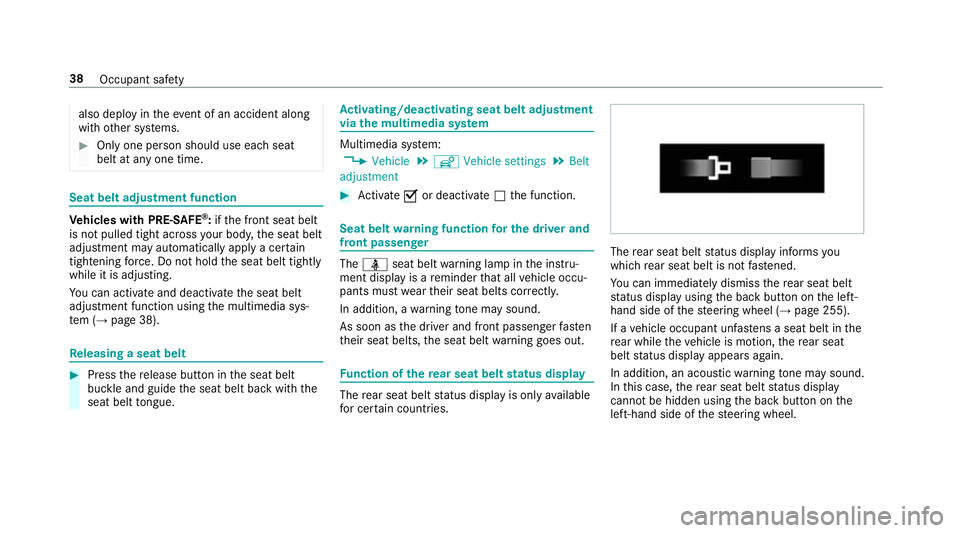
nction of there ar seat belt status display The
rear seat belt status display is on lyavailable
fo r cer tain countries. The
rear seat belt status display informs you
which rear seat belt is not fastened.
Yo u can immediately dismiss there ar seat belt
st atus display using the back button on the left-
hand side of thesteering wheel (→ page 255).
If a vehicle occupant unfas tens a seat belt in the
re ar while theve hicle is motion, there ar seat
belt status display appears again.
In addition, an acoustic warning tone may sound.
In this case, there ar seat belt status display
cannot be hidden using the back button on the
left-hand side of thesteering wheel. 38
Occupant saf ety
Page 43 of 589
&
WARNING Risk of inju ryor death due to
incor rect seat position
If yo u deviate from the cor rect seat position,
th e airbag cann otper form its intended pro‐
te ctive function and deployment may even
cause fur ther injuries.
To avo id hazardous situations, alw ays make
sure that all vehicle occupants:
R Have their seat belt fastened cor rectly,
including pregnant women.
R Are seated properly and keep as faraw ay
as possible from the airbags.
R Obser vethefo llowing information. #
Alw ays make sure that there are no
objects between the airbag and vehicle
occupant. To
avo idtherisks resulting from the deployment
of an airbag, each vehicle occupant must
obser vethefo llowing information:
R Before starting your journe y,adjust your seat
co rrectly ;th e driver's seat and front passenger seat should be mo
ved as far back
as possible.
When doing so, alw ays obser vethe informa‐
tion on the cor rect driver's seat position
(→ page 92).
R Only hold thesteering wheel bythesteering
wheel rim. This allow sth e airbag tobe fully
deplo yed.
R Alw ays lean against the seat backrest when
th eve hicle is in motion. Do not lean forw ards
or against the door or side windo w.You may
ot herwise be in the deployment area of the
airbags.
R Alw ayske ep your feet on thefloor. Do not
put your feet on the cockpit, forex ample.
Yo ur feet may otherwise be in the deploy‐
ment area of the airbag.
R Ifch ildren are tra velling in theve hicle,
obser vethe additional no tes (→ page 47).
R Alw aysstow and secure objects cor rectl y. Objects in
theve hicle interior may pr event an
airbag from functioning cor rectl y.Each vehicle
occupant must alw ays make sure of thefo llow‐
ing:
R There are no people, animals or objects
between theve hicle occupants and an air‐
bag.
R There are no objects between the seat, door
and door pillar (B-pillar).
R There are no hard objects, e.g. coat hangers,
hanging on the grab handles or coat hooks.
R There are no accessory parts, such as PNDs
(Personal Navigation Devices), mobile
phones or cup holders attached totheve hi‐
cle within the deployment area of an airbag,
e.g. on the cockpit, on doors, side windo ws
or side panelling.
In addition, no connecting cable, tensioning
st ra p or retai ning stra p may be routed
th ro ugh or attached in the deployment area
of an airbag. Alw ays obser vethe accessory
manufacturer's ins tallation instructions, in
particular the information on suitable places
fo r ins tallation. 40
Occupant saf ety