tires MERCEDES-BENZ E-CLASS 2000 Owner's Manual
[x] Cancel search | Manufacturer: MERCEDES-BENZ, Model Year: 2000, Model line: E-CLASS, Model: MERCEDES-BENZ E-CLASS 2000Pages: 341, PDF Size: 15.37 MB
Page 277 of 341
274 Tires, Wheels
Te ch n ica l
data Instruments
and controlsOperation DrivingInstrument
cluster displayPractical hintsCar care Index
Important!
E 320 (except sport package) only:
When installing steel spare wheel rim, make certain to
use the correct wheel bolts, supplied in the vehicle tool
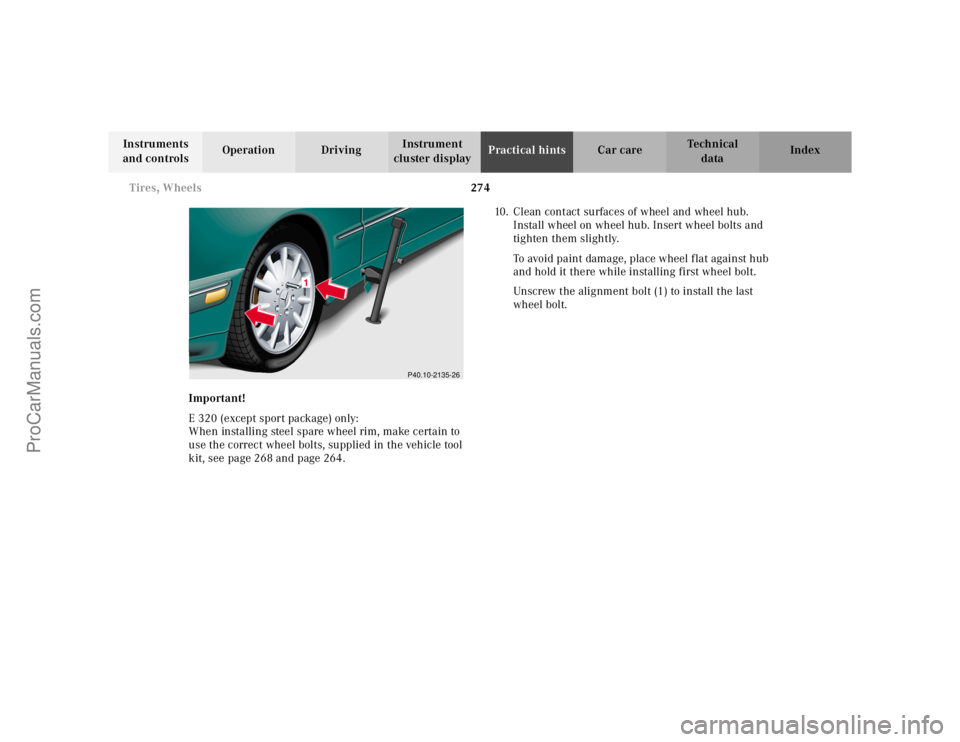
kit, see page 268 and page 264.10. Clean contact surfaces of wheel and wheel hub.
Install wheel on wheel hub. Insert wheel bolts and
tighten them slightly.
To avoid paint damage, place wheel flat against hub
and hold it there while installing first wheel bolt.
Unscrew the alignment bolt (1) to install the last
wheel bolt.
P40.10-2135-26
1
ProCarManuals.com
Page 278 of 341
275 Tires, Wheels
Te ch n ica l
data Instruments
and controlsOperation DrivingInstrument
cluster displayPractical hintsCar care Index 11. Lower vehicle. Remove jack and insert jack tube
cover.
Before storing the jack, the jack arm must be
lowered almost to the base of the jack.
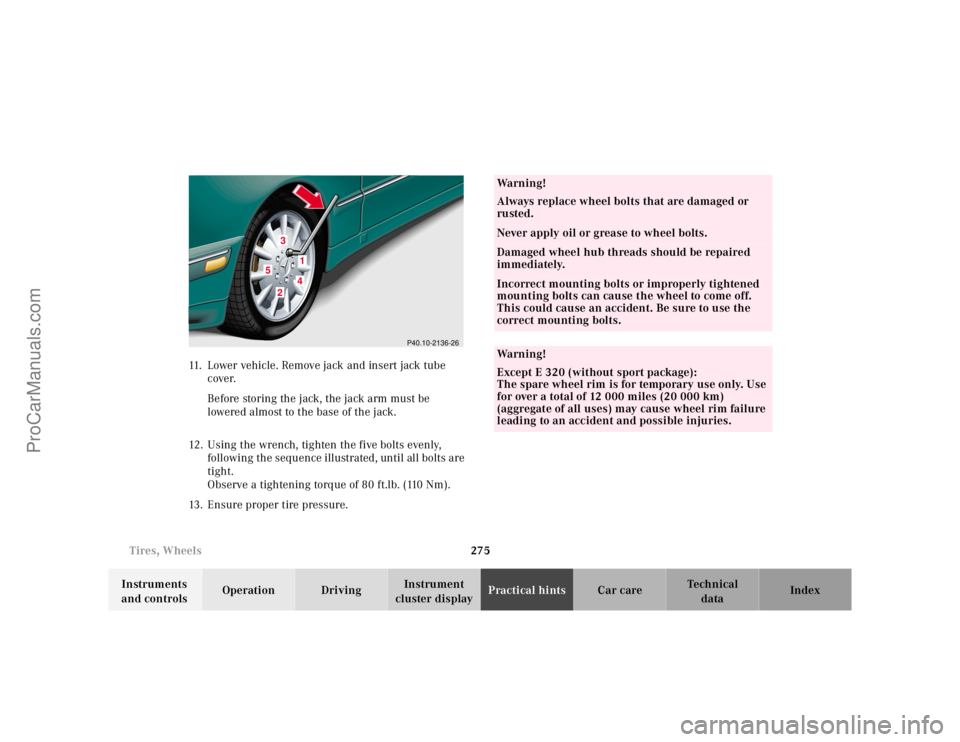
12. Using the wrench, tighten the five bolts evenly,
following the sequence illustrated, until all bolts are
tight.
Observe a tightening torque of 80 ft.lb. (110 Nm).
13. Ensure proper tire pressure.
P40.10-2136-26
32
41
5
Wa r n i n g !
Always replace wheel bolts that are damaged or
rusted.Never apply oil or grease to wheel bolts.Damaged wheel hub threads should be repaired
immediately.Incorrect mounting bolts or improperly tightened
mounting bolts can cause the wheel to come off.
This could cause an accident. Be sure to use the
correct mounting bolts.Wa r n i n g !
Except E 320 (without sport package):
The spare wheel rim is for temporary use only. Use
for over a total of 12 000 miles (20 000 km)
(aggregate of all uses) may cause wheel rim failure
leading to an accident and possible injuries.
ProCarManuals.com
Page 279 of 341
276 Tires, Wheels
Te ch n ica l
data Instruments
and controlsOperation DrivingInstrument
cluster displayPractical hintsCar care Index
Tire inflation pressure
A table (see fuel filler flap) lists the tire inflation
pressures specified for Mercedes-Benz recommended
tires as well as for the varying operating conditions.
Important!
Tire pressure changes by approximately 1.5 psi (0.1 bar)
per 18°F (10°C) of air temperature change. Keep this in
mind when checking tire pressure inside a garage -
especially in the winter.
Example:
If garage temperature = approximately +68°F (+20°C)
and ambient temperature = approximately +32°F (0°C)
then the adjusted air pressure = specified air pressure
+3 psi (+0.2 bar).Tire pressures listed for light loads are minimum values
offering high driving comfort. Increased inflation
pressures for heavy loads produce favorable handling
characteristics with lighter loads and are perfectly
permissible. The ride of the vehicle, however, will
become somewhat harder.
Tire temperature and pressure increase with the vehicle
speed. Tire pressure should therefore only be checked
and corrected on cold tires. Correct tire pressure in
warm tires only if pressure has dropped below the
pressure listed in the table and the respective operating
conditions are taken into consideration.
An underinf lated tire due to a slow leak (e.g. due to a
nail in the tire) may cause damage such as tread
separation, bulging etc.. Regular tire pressure checks
(including the spare tire) at intervals of no more than
14 days are therefore essential.
ProCarManuals.com
Page 280 of 341
277 Battery
Te ch n ica l
data Instruments
and controlsOperation DrivingInstrument
cluster displayPractical hintsCar care Index If a tire constantly loses air, it should be inspected for
damage.
The spare tire should be checked periodically for
condition and inflation. Spare tire will age and become
worn over time even if never used, and thus should be
inspected and replaced when necessary.Battery
Important!
Battery replacement information:
The maintenance-free battery is located under the rear
seat cushion. To minimize the chance for acid leakage
which could cause severe burns during a crash or
rollover, a special acid leakage resistant battery was
factory installed. A replacement battery for the vehicle
Wa r n i n g !
Do not overinflate tires. Overinflating tires can
result in sudden deflation (blowout) because they
are more likely to become punctured or damaged
by road debris, potholes etc.. Follow recommended
inflation pressures.Do not overload the tires by exceeding the specified
vehicle capacity weight (as indicated by the label
on the driver’s door latch post). Overloading the
tires can overheat them, possibly causing a
blowout.
Wa r n i n g !
Failure to follow these instructions can result in
severe injury or death.Never lean over batteries while connecting, you
might get injured.Battery fluid contains sulfuric acid. Do not allow
this fluid to come in contact with eyes, skin or
clothing. In case it does, immediately flush affected
area with water and seek medical help if necessary.A battery will also produce hydrogen gas, which is
flammable and explosive. Keep flames or sparks
away from battery, avoid improper connection of
jumper cables, smoking etc..
ProCarManuals.com
Page 304 of 341
301 Cleaning and care of the vehicle
Te ch n ica l
data Instruments
and controlsOperation DrivingInstrument
cluster displayPractical hintsCar careIndex Scratches, corrosive deposits, corrosion or damage due
to negligent or incorrect care cannot always be removed
or repaired with the car-care products recommended
here. In such cases it is best to seek aid at your
authorized Mercedes-Benz Center.
The following topics deal with the cleaning and care of
your vehicle and give important “how-to” information as
well as references to Mercedes-Benz approved car-care
products.
Additional information can be found in the booklet titled
“Vehicle Car Guide”.
Power washer
When using a power washer for cleaning the vehicle
always observe manufacturers’ operating instructions.
Caution!
Never use a round nozzle to power wash tires. The
intense jet of water can result in damage to the tire.
Always replace a damaged tire.
Always keep the jet of water moving across the surface.
Do not aim directly at electrical parts, electrical
connectors, seals, or other rubber parts.Ta r st a in s
Quickly remove tar stains before they dry and become
more difficult to remove. A tar remover is
recommended.
Paintwork, painted body components
Mercedes-Benz approved Paint Care should be applied
when water drops on the paint surface do not “bead up”,
normally in 3 to 5 months, depending on climate and
washing detergent used.
Mercedes-Benz approved Paint Cleaner should be
applied if paint surface shows signs of dirt embedding
(i.e. loss of gloss).
Do not apply any of these products or wax if your
vehicle is parked in the sun or if the hood is still hot.
Use the appropriate MB-Touch-Up Stick for quick and
provisional repairs of minor paint damage (i.e. chips
from stones, vehicle doors etc.).
ProCarManuals.com
Page 316 of 341
313 Technical data
Te ch n ica l
data Instruments
and controlsOperation DrivingInstrument
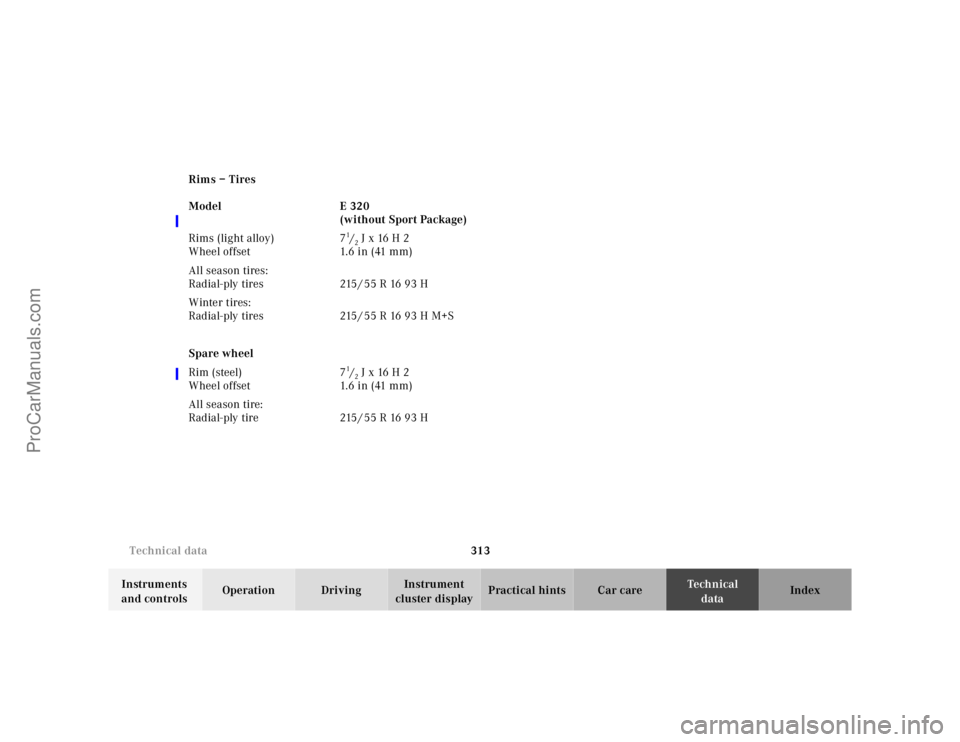
cluster displayPractical hints Car care Index Rims – Tires
Model E 320
(without Sport Package)
Rims (light alloy)
Wheel offset7
1/2 J x 16 H 2
1.6 in (41 mm)
All season tires:
Radial-ply tires 215 / 55 R 16 93 H
Winter tires:
Radial-ply tires 215 / 55 R 16 93 H M+S
Spare wheel
Rim (steel)
Wheel offset7
1/2 J x 16 H 2
1.6 in (41 mm)
All season tire:
Radial-ply tire 215 / 55 R 16 93 H
ProCarManuals.com
Page 317 of 341
314 Technical data
Te ch n ica l
data Instruments
and controlsOperation DrivingInstrument
cluster displayPractical hints Car care Index
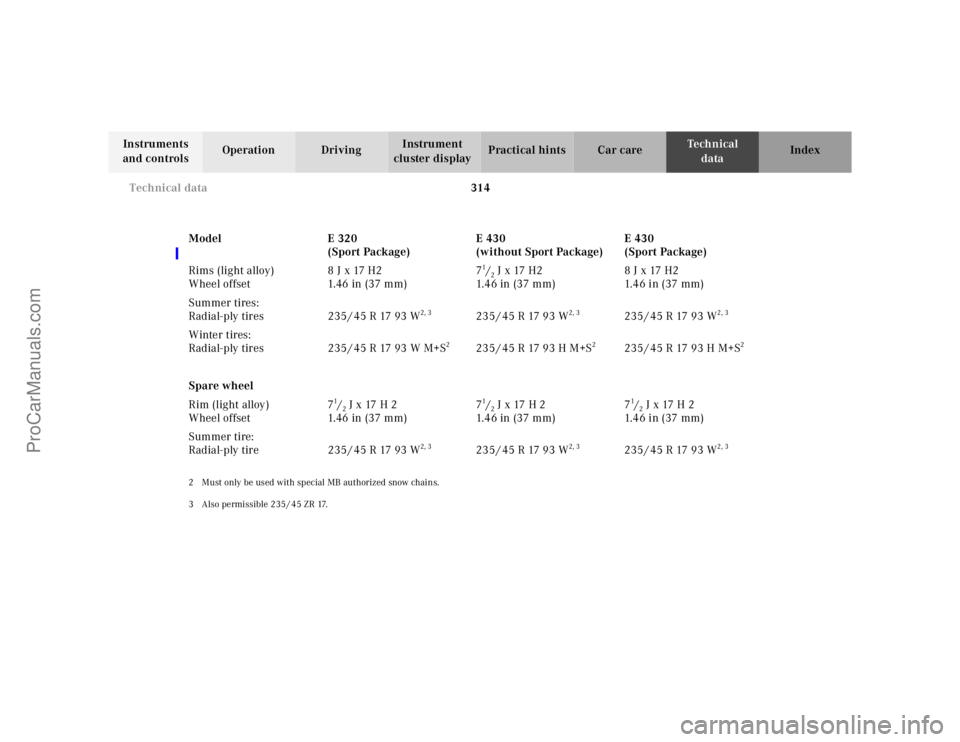
2 Must only be used with special MB authorized snow chains.
3 Also permissible 235 / 45 ZR 17.Model E 320
(Sport Package)E 430
(without Sport Package)E 430
(Sport Package)
Rims (light alloy)
Wheel offset8 J x 17 H2
1.46 in (37 mm)7
1/2 J x 17 H2
1.46 in (37 mm)8 J x 17 H2
1.46 in (37 mm)
Summer tires:
Radial-ply tires 235 / 45 R 17 93 W
2, 3
235 / 45 R 17 93 W
2, 3
235 / 45 R 17 93 W
2, 3
Winter tires:
Radial-ply tires 235 / 45 R 17 93 W M+S
2
235 / 45 R 17 93 H M+S
2
235 / 45 R 17 93 H M+S
2
Spare wheel
Rim (light alloy)
Wheel offset7
1/2 J x 17 H 2
1.46 in (37 mm)7
1/2 J x 17 H 2
1.46 in (37 mm)7
1/2 J x 17 H 2
1.46 in (37 mm)
Summer tire:
Radial-ply tire 235 / 45 R 17 93 W
2, 3
235 / 45 R 17 93 W
2, 3
235 / 45 R 17 93 W
2, 3
ProCarManuals.com
Page 318 of 341
315 Technical data
Te ch n ica l
data Instruments
and controlsOperation DrivingInstrument
cluster displayPractical hints Car care Index
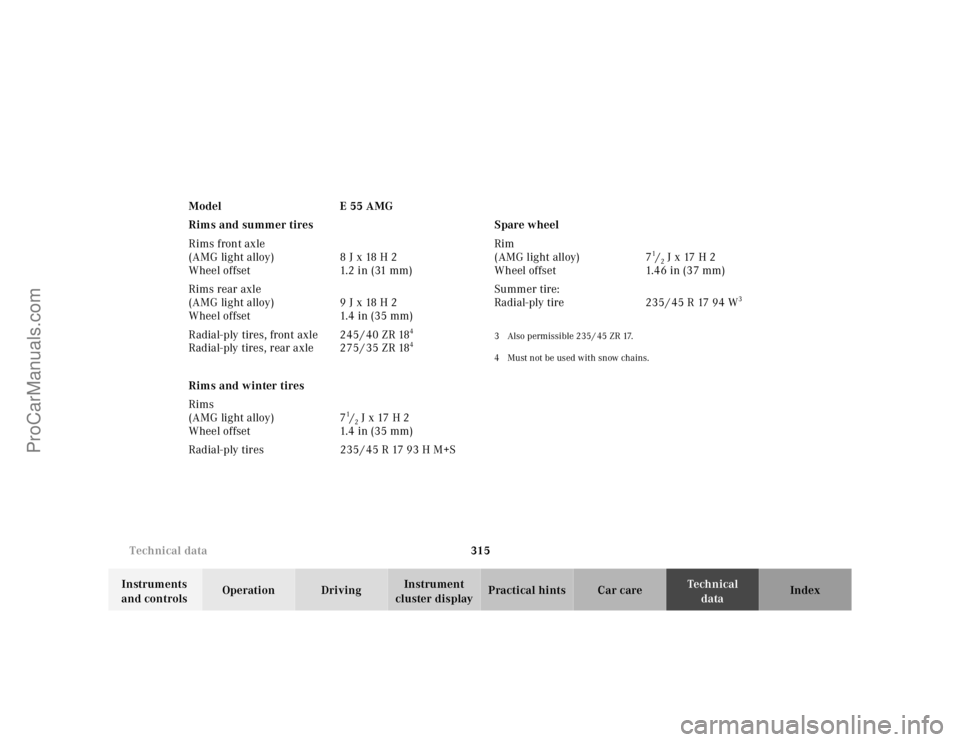
3 Also permissible 235 / 45 ZR 17.
4 Must not be used with snow chains.
Model E 55 AMG
Rims and summer tires
Rims front axle
(AMG light alloy)
Wheel offset8 J x 18 H 2
1.2 in (31 mm)
Rims rear axle
(AMG light alloy)
Wheel offset9 J x 18 H 2
1.4 in (35 mm)
Radial-ply tires, front axle
Radial-ply tires, rear axle245 / 40 ZR 18
4
275 / 35 ZR 18
4
Rims and winter tires
Rims
(AMG light alloy)
Wheel offset7
1/2 J x 17 H 2
1.4 in (35 mm)
Radial-ply tires 235 / 45 R 17 93 H M+SSpare wheel
Rim
(AMG light alloy)
Wheel offset7
1/2 J x 17 H 2
1.46 in (37 mm)
Summer tire:
Radial-ply tire 235 / 45 R 17 94 W
3
ProCarManuals.com
Page 327 of 341
324 Consumer information
Te ch n ica l
data Instruments
and controlsOperation DrivingInstrument
cluster displayPractical hints Car care Index
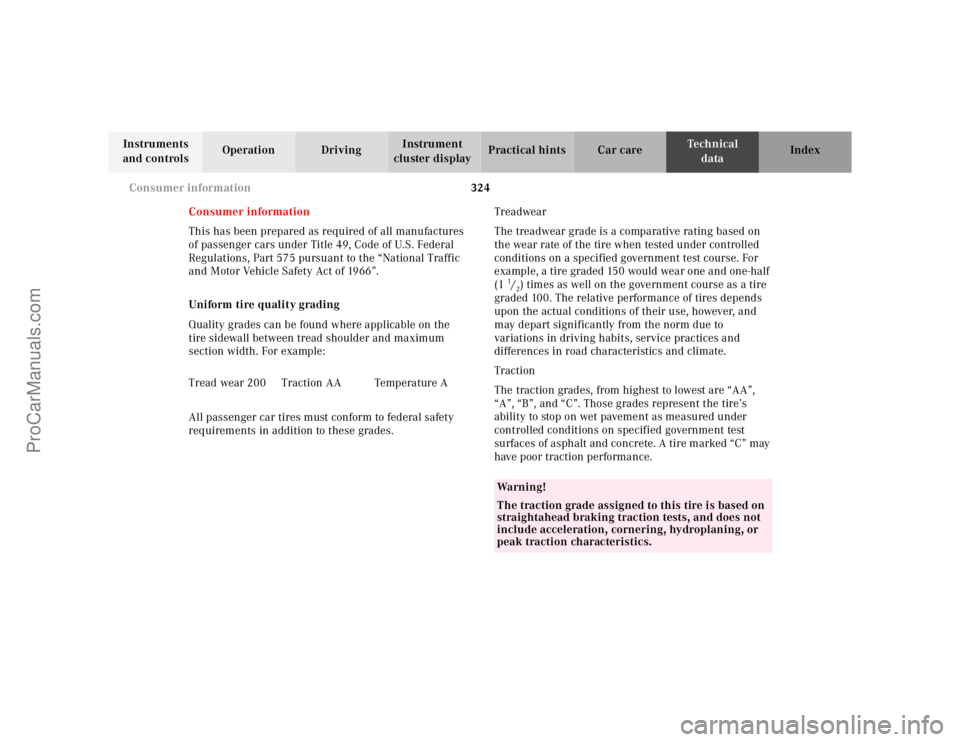
Consumer information
This has been prepared as required of all manufactures
of passenger cars under Title 49, Code of U.S. Federal
Regulations, Part 575 pursuant to the “National Traffic
and Motor Vehicle Safety Act of 1966”.
Uniform tire quality grading
Quality grades can be found where applicable on the
tire sidewall between tread shoulder and maximum
section width. For example:
All passenger car tires must conform to federal safety
requirements in addition to these grades.Treadwear
The treadwear grade is a comparative rating based on
the wear rate of the tire when tested under controlled
conditions on a specified government test course. For
example, a tire graded 150 would wear one and one-half
(1
1/2) times as well on the government course as a tire
graded 100. The relative performance of tires depends
upon the actual conditions of their use, however, and
may depart significantly from the norm due to
variations in driving habits, service practices and
differences in road characteristics and climate.
Traction
The traction grades, from highest to lowest are “AA”,
“A”, “B”, and “C”. Those grades represent the tire’s
ability to stop on wet pavement as measured under
controlled conditions on specified government test
surfaces of asphalt and concrete. A tire marked “C” may
have poor traction performance. Tread wear 200 Traction AA Temperature A
Wa r n i n g !
The traction grade assigned to this tire is based on
straightahead braking traction tests, and does not
include acceleration, cornering, hydroplaning, or
peak traction characteristics.
ProCarManuals.com
Page 328 of 341
325 Consumer information
Te ch n ica l
data Instruments
and controlsOperation DrivingInstrument
cluster displayPractical hints Car care Index Temp era tur e
The temperature grades are “A” (the highest), “B”, and
“C”, representing the tire‘s resistance to the generation
of heat and its ability to dissipate heat when tested
under controlled conditions on a specified indoor
laboratory test wheel. Sustained high temperature can
cause the material of the tire to degenerate and reduce
tire life, and excessive temperature can lead to sudden
tire failure. The grade “C” corresponds to a level of
performance which all passenger car tires must meet
under the Federal Motor Vehicle Safety Standard
No. 109. Grades B and A represent higher levels of
performance on the laboratory test wheel than the
minimum required by law.
Wa r n i n g !
The temperature grade for this tire is established
for a tire that is properly inflated and not
overloaded. Excessive speed, underinflation, or
excessive loading, either separately or in
combination, can cause excessive heat build up
and possible tire failure.
ProCarManuals.com