air condition MERCEDES-BENZ E-CLASS CABRIOLET 2010 Owner's Manual
[x] Cancel search | Manufacturer: MERCEDES-BENZ, Model Year: 2010, Model line: E-CLASS CABRIOLET, Model: MERCEDES-BENZ E-CLASS CABRIOLET 2010Pages: 333, PDF Size: 7.64 MB
Page 279 of 333
tha
tyou additionally equip your vehicle
with the TIREFI Tkit if you fit tyres that do
not featur erun-flat properties ,e.g. winter
tyres .You can obtain aTIREFIT kit from a
Mercedes-Benz Service Centre ,for exam-
ple.
X Stop the vehicle as far away as possible
from traffic on solid, non-slipper yand level
ground.
X Switch on the hazard warning lamps.
X Firmly depress the parking brake.
X Bring the front wheels into the straight-
ahead position.
X Vehicles with manua ltran smission:
engage first or reverse gear.
X Vehicles with au tomatic transmission:
move the selector lever to P.
X Switch off the engine.
X Vehicles without KEYLESS-GO: remove
the key from the ignition lock.
X Vehicles with KEYLESS-GO: openthe
driver's door.
The on-boar delectronics have status 0,
which is the same as the key having been
removed.
X Vehicles with KEYLESS-GO: removethe
Star t/Stop butto nfrom th eignition lock
(Y page 135).
X All occupan ts must get out of the vehicle.
Make sur ethat they ar enot endangered as
they get out of the vehicle.
X Make sure that no one is near the danger
area whilst awheel is being changed. Any-
one who is not directly assisting in the
wheel change should, for example, stand
behind the barrier.
X Get out of the vehicle. Pay attention to traf-
fic conditions when doing so.
X Close the driver's door.
X Plac ethe warnin gtriangl e(Ypage 273) a
suitable distanc eaway .Observ elegal
requirements. TIREFIT kit
Using th eTIREFIT kit You can use the TIREFIT kit to seal small
punctures, particularly those in the tyre tread.
You can use TIREFIT at outside temperatures
down to -20 †.
G
Risk of accident
In the following situations, your safety is at
particular risk and tyre sealant is unable to
provide breakdown assistance if:
R ther eare cuts or punctures in th etyre
greater than 4mm
R the whee lrim is damaged
R you have driven at very low tyre pressures
or on aflat tyre
Do not drive any fur ther. Consult aqualified
specialist workshop which has the necessary
specialist knowledg eand tool stocarry out
the work required.
Mercedes-Benz recommends that you use a
Mercedes-Benz Service Centr efor this pur-
pose. In particular ,work relevant to safet yor
on safety-related system smust be carried out
at aq ualified specialist workshop.
X Do not remov eany foreig nobjects which
have penetrated the tyre, e.g. screw sor
nails.
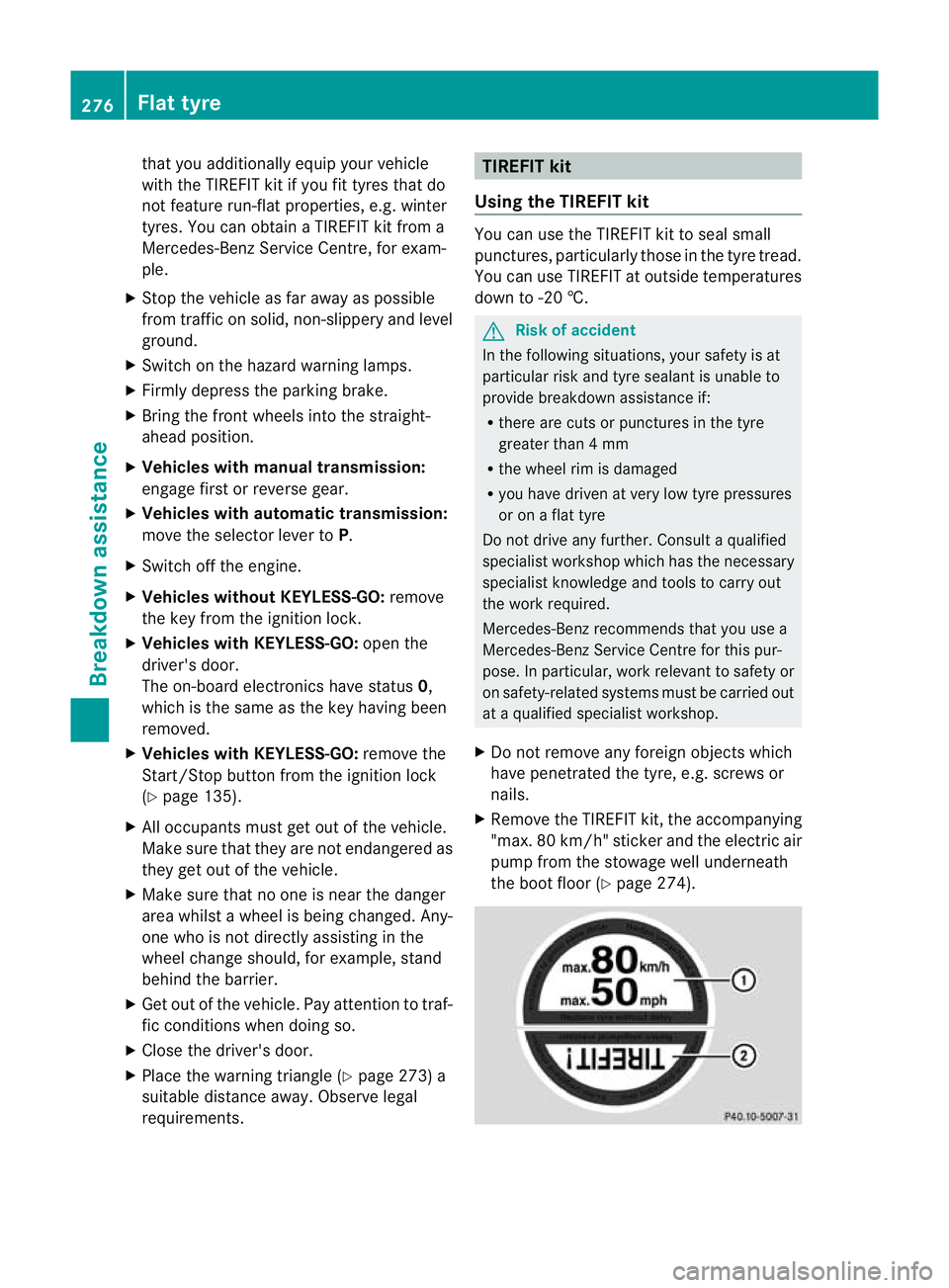
X Remove the TIREFI Tkit,t he accompanying
"max. 80 km /h"sticker and the electric air
pump from the stowage well underneath
the boo tfloor (Y page 274). 276
Flat tyreBreakdown assis
tance
BA 207ECE ÄJ 2010/1a; 1; 2, en-GB
mkalafa Version:3.0.2.11
2010-01-26T13:03:22+01:0
0-Seite 276
Page 287 of 333
X
Tighten the wheel bolts until they are fin-
ger- tight.
X Unscrew the cen tring pin.
X Tighten the last wheel bolt until it is finger-
tight.
Lowering the vehicle X
Turn the cran kofthe jac kanti-clockwise
until the vehicl eisonce agai nstanding
firmly on the ground.
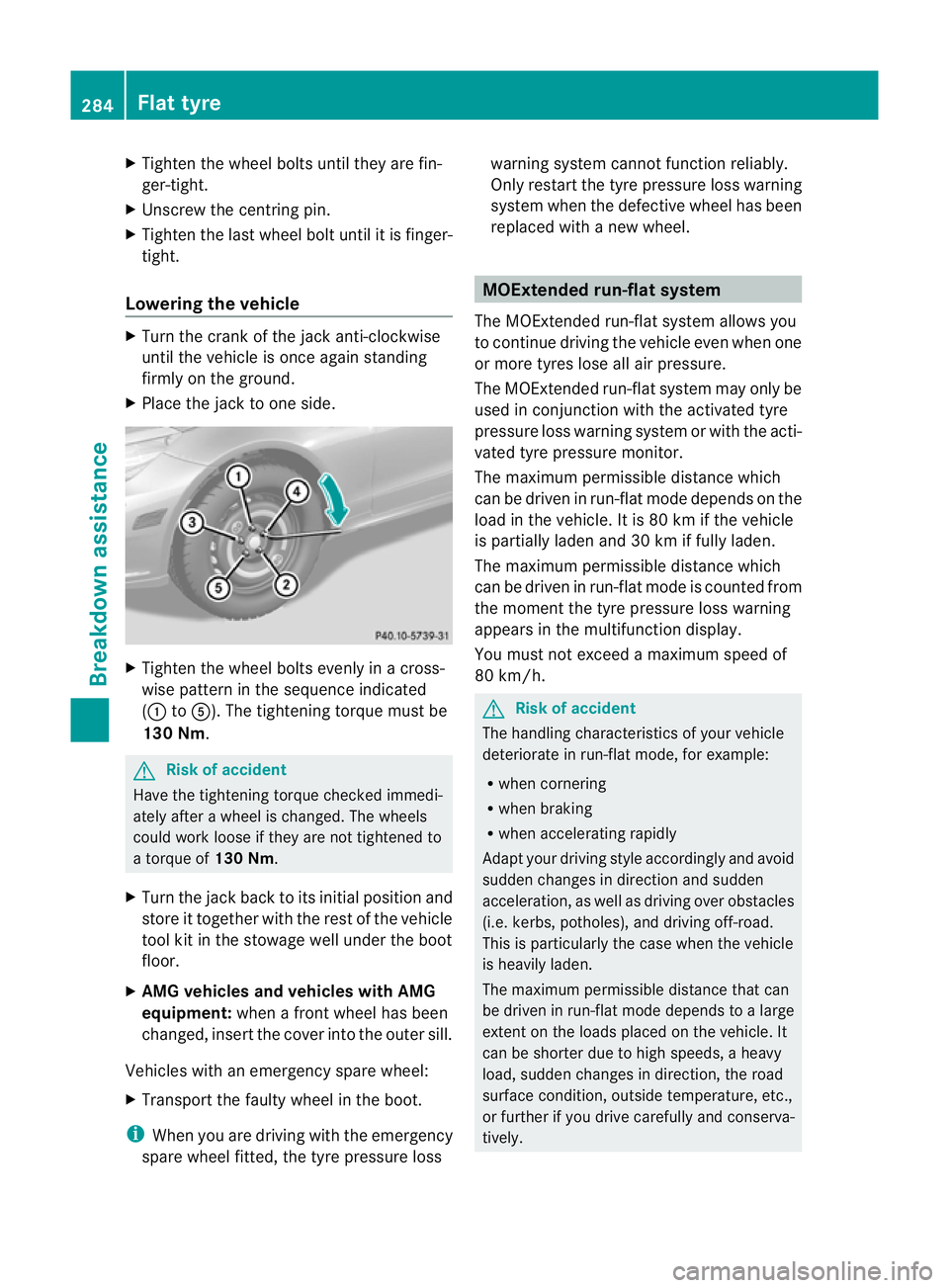
X Place the jack to one side. X
Tighten the whee lbolts evenly in across-
wis epattern in the sequence indicated
(: toA). The tightening torque must be
130 Nm. G
Risk of accident
Have the tightening torque checked immedi-
ately after awheel is changed. The wheels
coul dwork loose if they are not tightened to
at orqu eof130 Nm.
X Turn the jack back to its initia lposition and
stor eitt ogether with the rest of the vehicle
tool kit in the stowage well under the boot
floor.
X AM Gvehicles and vehicles with AMG
equipment: whenafront whee lhas been
changed, insert the cover into the outer sill.
Vehicles with an emergency spare wheel:
X Transport the faulty wheel in the boot.
i When you are driving with the emergency
spare wheel fitted, the tyre pressure loss warning system cannot function reliably.
Only restart the tyre pressure loss warning
system when the defective wheel has been
replaced with
anew wheel. MOExtended run-
flat system
Th eM OEx tended run-flat system allo wsyou
to continue driving the vehicle even when one
or more tyres los eall air pressure.
The MOExtended run-flat system may only be
used in conjunction with the activated tyre
pressure loss warnin gsystem or with the acti-
vated tyre pressure monitor.
The maximum permissible distance which
can be driven in run-flat mode depends on the
load in the vehicle. It is 80 km if the vehicle
is partially laden and 30 km if fully laden.
The maximum permissible distance which
can be driven in run-flat mode is counted from
the moment the tyre pressure los swarning
appears in the multifunction displ ay.
Yo um ust not exceed amaximum spee dof
80 km/h. G
Ris
kofa ccident
The handling characteristics of your vehicle
deteriorate in run-flat mode, for example:
R when cornering
R when braking
R when accelerating rapidly
Adapt your driving style accordingly and avoid
sudden changes in direction and sudden
acceleration, as well as driving over obstacles
(i.e. kerbs, potholes), and driving off-road.
This is particularly the case when the vehicle
is heavily laden.
The maximum permissible distance that can
be driven in run-flat mode depends to alarge
exten tonthe loads placed on the vehicle. It
can be shorter due to high speeds, aheavy
load, sudden changes in direction, the road
surface condition, outside temperature, etc.,
or further if you driv ecarefully and conserva-
tively. 284
Flat tyreBreakdown assistance
BA 207 ECE ÄJ 2010/1a; 1; 2, en-GB
mkalaf
aV ersion: 3.0.2.11
2010-01-26T13:03:22+01:0
0-Seite 284
Page 303 of 333
The applicable value for the maximum load on
the rea raxle during trailer towing is state don
the tyre pressure information label on the
insid eofy our vehicle' sfuel filler flap.
The load condition "partially laden" or "fully
laden" is defined in the table by the differing
number of passengers and amount of lug-
gage. The actual number of seats may vary
from this –more information can be found on
the vehicle' sregistra tion document.
If no other data is stated, the tyr epressures
specifie donthe fuel filler fla papply for all
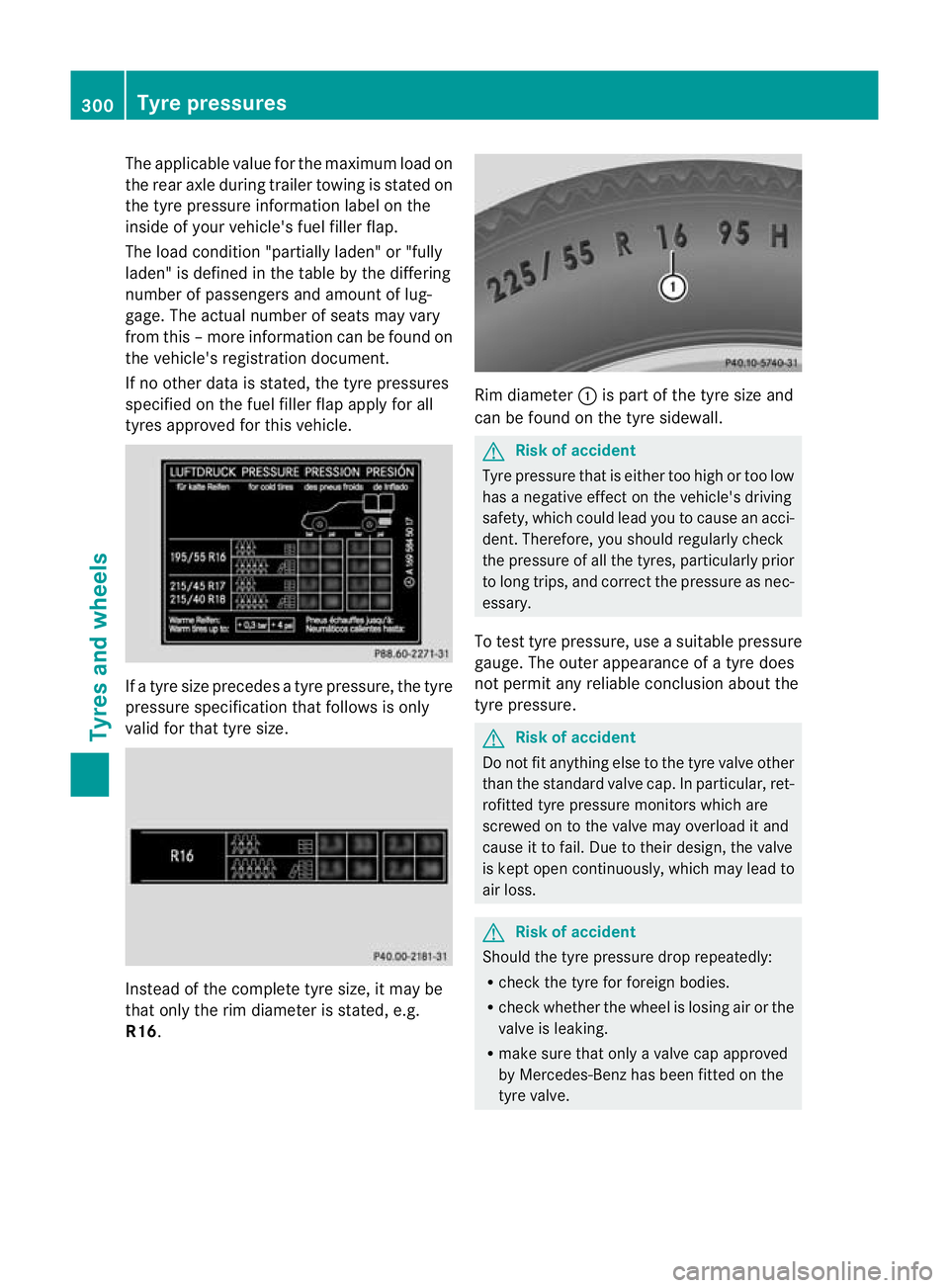
tyres approved for this vehicle. If
at yre size precede satyre pressure, the tyre
pressure specification that follows is only
valid for that tyre size. Instead of the complete tyre size, it may be
that only the rim diameter is stated ,e.g.
R16. Rim diameter
:is part of the tyre size and
can be found on the tyre sidewall. G
Risk of accident
Tyre pressure that is either too hig hortoo low
has anegativ eeffect on the vehicle's driving
safety ,which coul dlead you to cause an acci-
dent. Therefore, you should regularly check
the pressur eofall the tyres, particularly prior
to long trips, and correc tthe pressure as nec-
essary.
To test tyr epressure, us easuitable pressure
gauge. The outer appearance of atyre does
not permit any reliabl econclusion about the
tyr ep ressure. G
Ris
kofa ccident
Do not fit anything else to the tyre valve other
than the standard valve cap. In particular, ret-
rofitted tyre pressure monitors which are
screwed on to the valve may overload it and
cause it to fail. Due to their design, the valve
is kept open continuously ,which ma ylead to
air loss. G
Risk of accident
Should the tyr epressure dro prepeatedly:
R check the tyr efor foreign bodies.
R chec kwhether the wheel is losing air or the
valve is leaking.
R make sur ethat only avalve cap approved
by Mercedes-Benz has been fitte donthe
tyre valve. 300
Tyre pressuresTyres and wheels
BA 20
7ECE ÄJ 2010/1a; 1; 2, en-GB
mkalafa Version: 3.0.2.11 2010-01-26T13:03:22+01:00-Seite 300