change wheel MERCEDES-BENZ E-CLASS CABRIOLET 2010 Owner's Manual
[x] Cancel search | Manufacturer: MERCEDES-BENZ, Model Year: 2010, Model line: E-CLASS CABRIOLET, Model: MERCEDES-BENZ E-CLASS CABRIOLET 2010Pages: 333, PDF Size: 7.64 MB
Page 279 of 333
tha
tyou additionally equip your vehicle
with the TIREFI Tkit if you fit tyres that do
not featur erun-flat properties ,e.g. winter
tyres .You can obtain aTIREFIT kit from a
Mercedes-Benz Service Centre ,for exam-
ple.
X Stop the vehicle as far away as possible
from traffic on solid, non-slipper yand level
ground.
X Switch on the hazard warning lamps.
X Firmly depress the parking brake.
X Bring the front wheels into the straight-
ahead position.
X Vehicles with manua ltran smission:
engage first or reverse gear.
X Vehicles with au tomatic transmission:
move the selector lever to P.
X Switch off the engine.
X Vehicles without KEYLESS-GO: remove
the key from the ignition lock.
X Vehicles with KEYLESS-GO: openthe
driver's door.
The on-boar delectronics have status 0,
which is the same as the key having been
removed.
X Vehicles with KEYLESS-GO: removethe
Star t/Stop butto nfrom th eignition lock
(Y page 135).
X All occupan ts must get out of the vehicle.
Make sur ethat they ar enot endangered as
they get out of the vehicle.
X Make sure that no one is near the danger
area whilst awheel is being changed. Any-
one who is not directly assisting in the
wheel change should, for example, stand
behind the barrier.
X Get out of the vehicle. Pay attention to traf-
fic conditions when doing so.
X Close the driver's door.
X Plac ethe warnin gtriangl e(Ypage 273) a
suitable distanc eaway .Observ elegal
requirements. TIREFIT kit
Using th eTIREFIT kit You can use the TIREFIT kit to seal small
punctures, particularly those in the tyre tread.
You can use TIREFIT at outside temperatures
down to -20 †.
G
Risk of accident
In the following situations, your safety is at
particular risk and tyre sealant is unable to
provide breakdown assistance if:
R ther eare cuts or punctures in th etyre
greater than 4mm
R the whee lrim is damaged
R you have driven at very low tyre pressures
or on aflat tyre
Do not drive any fur ther. Consult aqualified
specialist workshop which has the necessary
specialist knowledg eand tool stocarry out
the work required.
Mercedes-Benz recommends that you use a
Mercedes-Benz Service Centr efor this pur-
pose. In particular ,work relevant to safet yor
on safety-related system smust be carried out
at aq ualified specialist workshop.
X Do not remov eany foreig nobjects which
have penetrated the tyre, e.g. screw sor
nails.
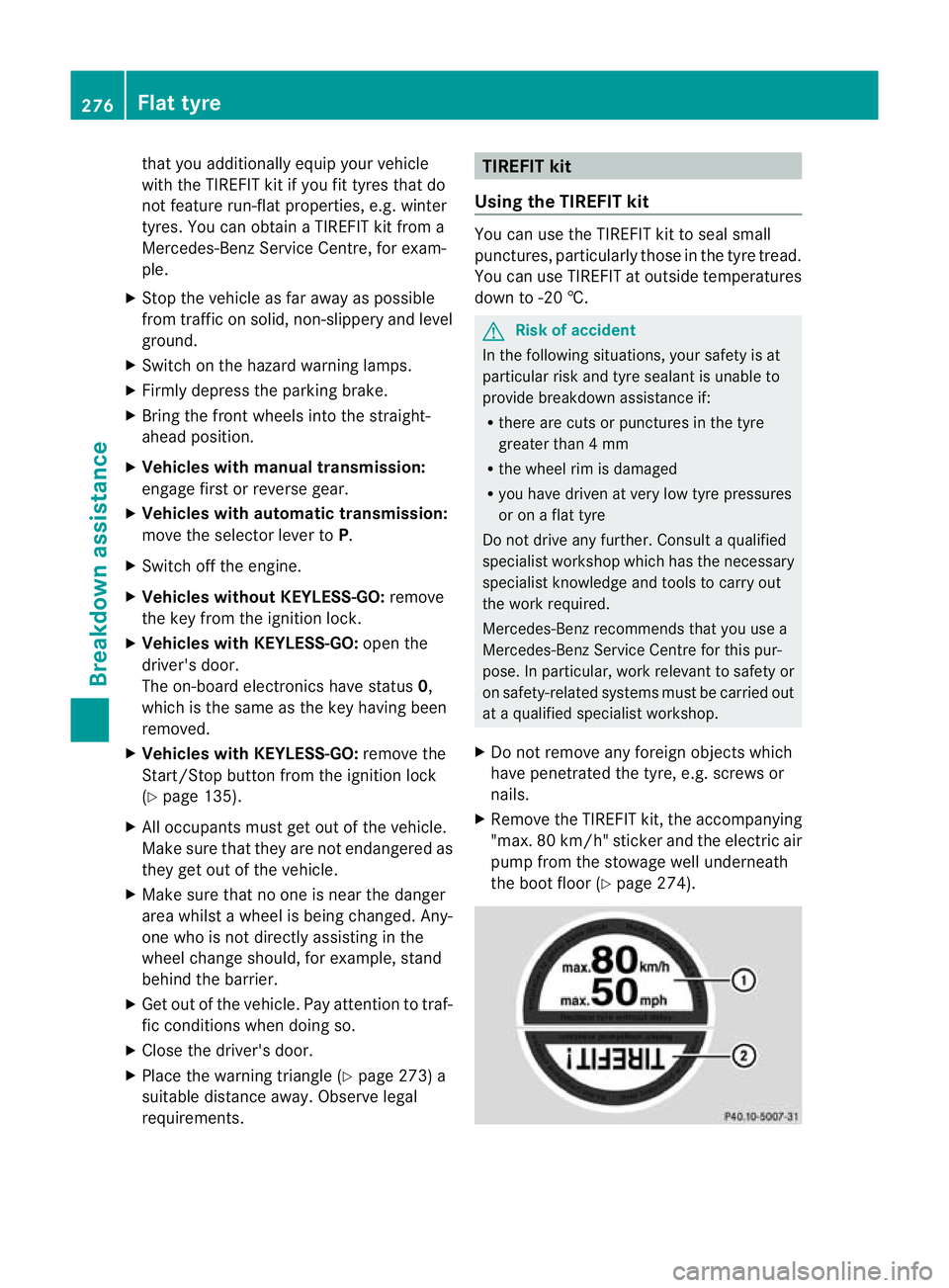
X Remove the TIREFI Tkit,t he accompanying
"max. 80 km /h"sticker and the electric air
pump from the stowage well underneath
the boo tfloor (Y page 274). 276
Flat tyreBreakdown assis
tance
BA 207ECE ÄJ 2010/1a; 1; 2, en-GB
mkalafa Version:3.0.2.11
2010-01-26T13:03:22+01:0
0-Seite 276
Page 283 of 333
systems must be carried out at
aqualified
specialist workshop.
X Correct the tyre pressure if it is at least
130 kPa(1.3 bar/26 psi) (for the value ssee
the fuel filler flap).
X To increase th etyre pressure: switch on
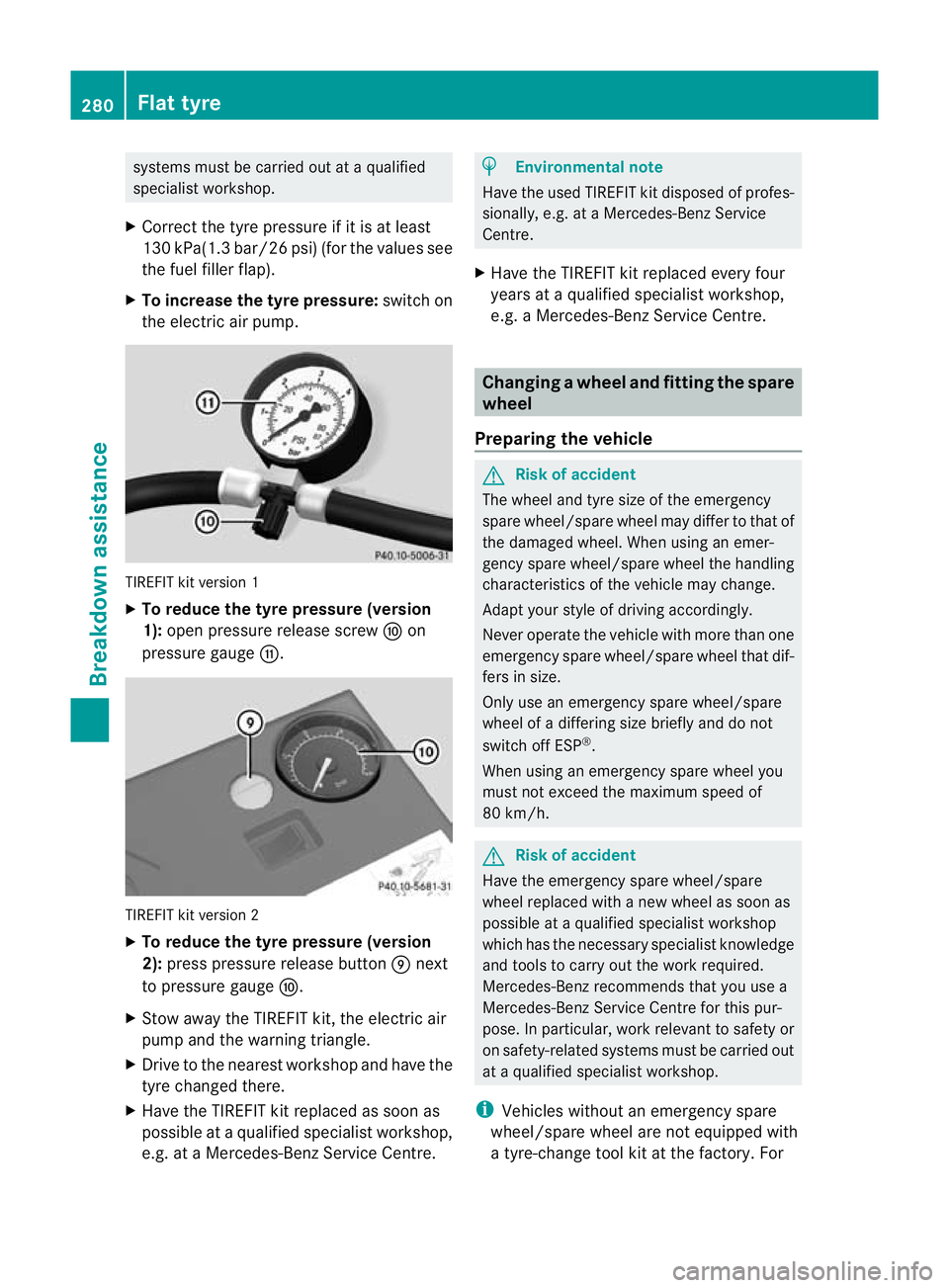
th ee lectric air pump. TIREFIT kit version 1
X
To reduce the tyr epressure (version
1): ope npressure release screw Fon
pressure gauge G. TIREFIT kit versio
n2
X To reduce the tyre pressure (version
2): pres spressure release button Enext
to pressure gauge F.
X Sto wa waythe TIREFIT kit ,the electric air
pum pand the warning triangle.
X Drive to the neares tworkshop and have the
tyr ec hange dthere.
X Hav ethe TIREFIT kit replaced as soon as
possible at aqualified special istworkshop,
e.g. at aMercedes-Ben zService Centre. H
Environmenta
lnote
Have the used TIREFI Tkit dispose dofprofes-
sionall y, e.g. ataM ercedes-Ben zService
Centre.
X Hav ethe TIREFIT kit replaced ever yfour
year sataq ualified special istworkshop,
e.g. aMercedes-Ben zService Centre. Changing
awhee land fitting th espare
wheel
Preparing the vehicle G
Risk of accident
The wheel and tyre size of the emergency
spare wheel/s pare wh eelm ay differ to tha tof
the damaged wheel. Whe nusing an emer-
genc yspare wheel/spar ewheel the handling
characteristic softhe vehicle ma ychange.
Adap tyour style of driving accordingly.
Never operate the vehicle with mor ethan one
emergenc yspare wheel/spar ewheel that dif-
fer sins ize.
Only use an emergenc yspare wheel/spare
wheel of adiffering size briefly and do not
switch off ESP ®
.
When using an emergenc yspare wheel you
must not exceed the maximum speed of
80 km/h. G
Risk of accident
Hav ethe emergenc yspare wheel/spare
wheel replaced with anew wheel as soon as
possible at aqualified specialist workshop
which has the necessary specialist knowledge
and tools to carry out the work required.
Mercedes-Benz recommends that you use a
Mercedes-Benz Service Centre for this pur-
pose .Inp articular, work relevant to safety or
on safety-related systems must be carried out
at aq ualified specialist workshop.
i Vehicles withou tanemergency spare
wheel/spare whee lare not equippe dwith
at yre-change tool kit at the factory. For 280
Flat tyreBreakdown assistance
BA 207 ECE ÄJ 2010
/1a; 1; 2, en-GB
mkalafa Version: 3.0.2.11 2010-01-26T13:03:22+01:00 -Seite 280
Page 284 of 333
more informati
on on which tools are
required to perfor mawheel change on your
vehicle, e.g. wheel chock ,wheel wrenc hor
centring pin, consult aMercedes-Benz
Servic eCentre.
X Prepar ethe vehicle as described
(Y page 275).
X Ifat railer is coupled to th evehicle, uncou-
ple it.
X Remov ethe followin gitems from the stow-
age well under the boo tfloor:
R the emergenc yspare wheel
R the vehicle tool kit
R the foldin gwheel chock
R the jack
X Secur ethe vehicle to preven titfrom rolling
awa y.
Se curing the vehicle to prevent it from
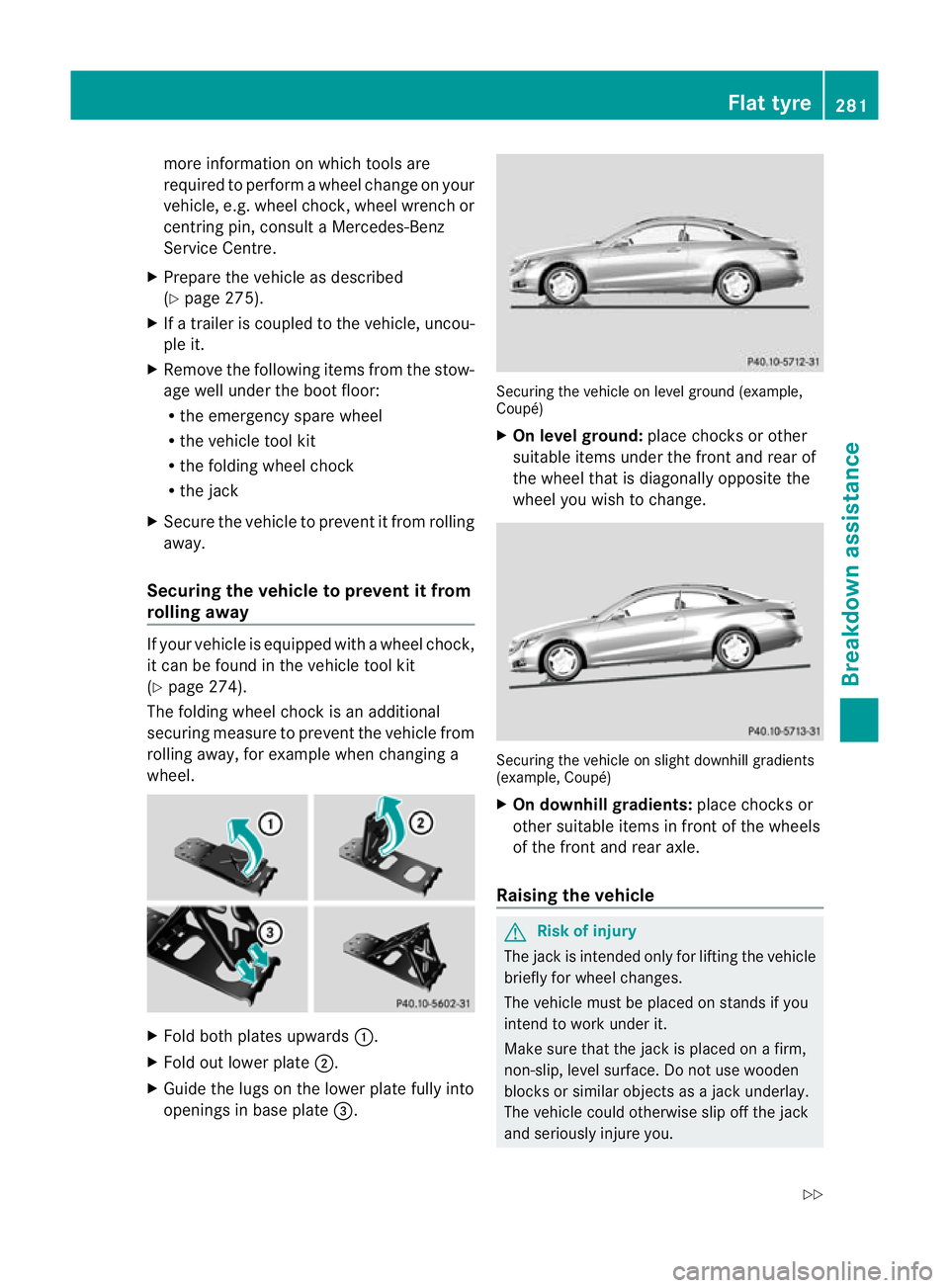
rolling away If your vehicle is equipped with
awheel choc k,
it can be found in the vehicle tool kit
(Y page 274).
The folding wheel chock is an additional
securing measure to prevent the vehicle from
rolling away, for example when changing a
wheel. X
Fold both plates upwards :.
X Fold out lower plate ;.
X Guide the lugs on the lower plate fully into
openings in base plate =. Securing the vehicle on level ground (example,
Coupé)
X
On level ground: place chocksorother
suitable items under the front and rear of
the whee lthat is diagonally opposit ethe
wheel you wish to change. Securing the vehicl
eonslight downhill gradients
(example, Coupé)
X On downhill gradients: place chocksor
other suitable item sinfront of th ewheels
of the front and rea raxle.
Raisin gthe vehicle G
Ris
kofi njury
The jac kisintende donly for lifting the vehicle
briefly for wheel changes.
The vehicl emust be placed on stands if you
intend to work under it.
Make sure that the jack is placed on afirm,
non-slip, level surface. Do not use wooden
blocks or similar object sasajack underlay.
The vehicle could otherwise slip off the jack
and seriousl yinjure you. Flat tyre
281Breakdown assistance
BA 207 ECE ÄJ 2010/1a; 1; 2, en-GB
mkalafa Version: 3.0.2.11 2010-01-26T13:03:22+01:00-Seite 281 Z
Page 285 of 333
Do not start the engine at any time whil
ethe
whee lisbeing changed.
Do not li eunder the vehicl ewheniti sbeing
supporte dbythe jack. If you do not raise the
vehicle as described, it could slip off the jack
(e.g. if the engine is started or adoorort he
boot lid is opene dorclosed)and seriously
injure you. G
Ris
kofa ccident
If you fail to position the jac kcorrectly, the
vehicle may:
R slip off th ejack
R injure you or others
R be damaged.
Therefore, mak esure that the jac kisposi-
tioned correc tlyint he respective jacking
points. Before positionin gthe jack, remove
any dir tthat ma yhave collected in the jacking
points. Please note that you must positio nthe
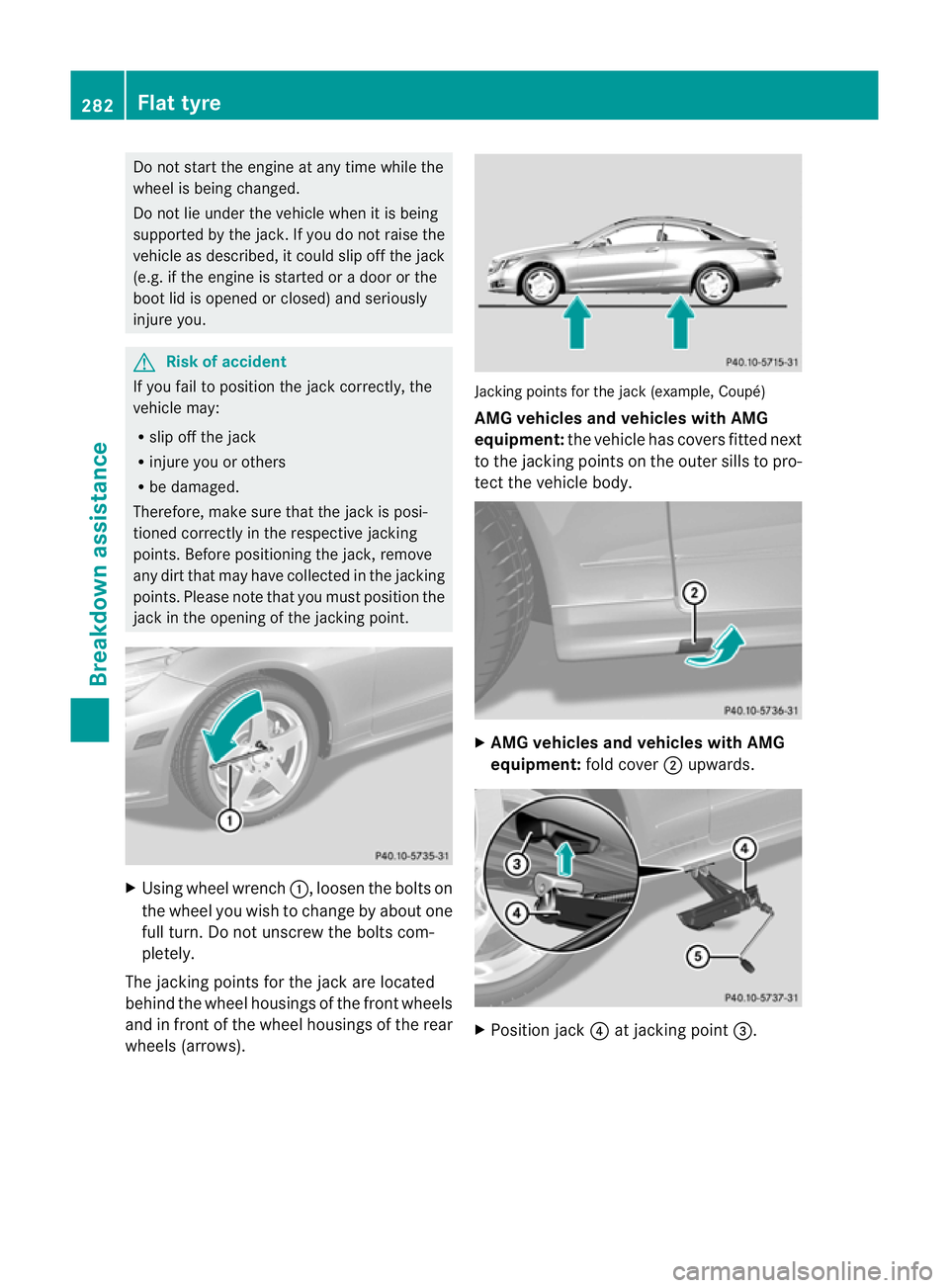
jac kint he openin gofthe jackin gpoint. X
Usin gwheel wrench :,loosen the bolts on
the wheel you wish to change by about one
full turn. Do not unscrew th ebolts com-
pletely.
The jacking points for the jack are located
behind the whee lhousings of the front wheels
and in front of the whee lhousings of the rear
wheels (arrows). Jackin
gpoints for the jack (examp le,C oupé)
AMG vehicles an dvehicles with AMG
equipment: the vehicle has covers fitted next
to the jackin gpoints on th eouter sills to pro-
tec tthe vehicle body. X
AM Gvehicles and vehicle swith AMG
equipment: fold cover;upwards. X
Position jack ?at jackin gpoint =. 282
Flat ty
reBreakdown assistance
BA 207 ECE ÄJ 2010/1a; 1; 2, en-GB
mkalafaV ersion: 3.0.2.11
2010-01-26T13:03:22+01:0
0-Seite 282
Page 287 of 333
X
Tighten the wheel bolts until they are fin-
ger- tight.
X Unscrew the cen tring pin.
X Tighten the last wheel bolt until it is finger-
tight.
Lowering the vehicle X
Turn the cran kofthe jac kanti-clockwise
until the vehicl eisonce agai nstanding
firmly on the ground.
X Place the jack to one side. X
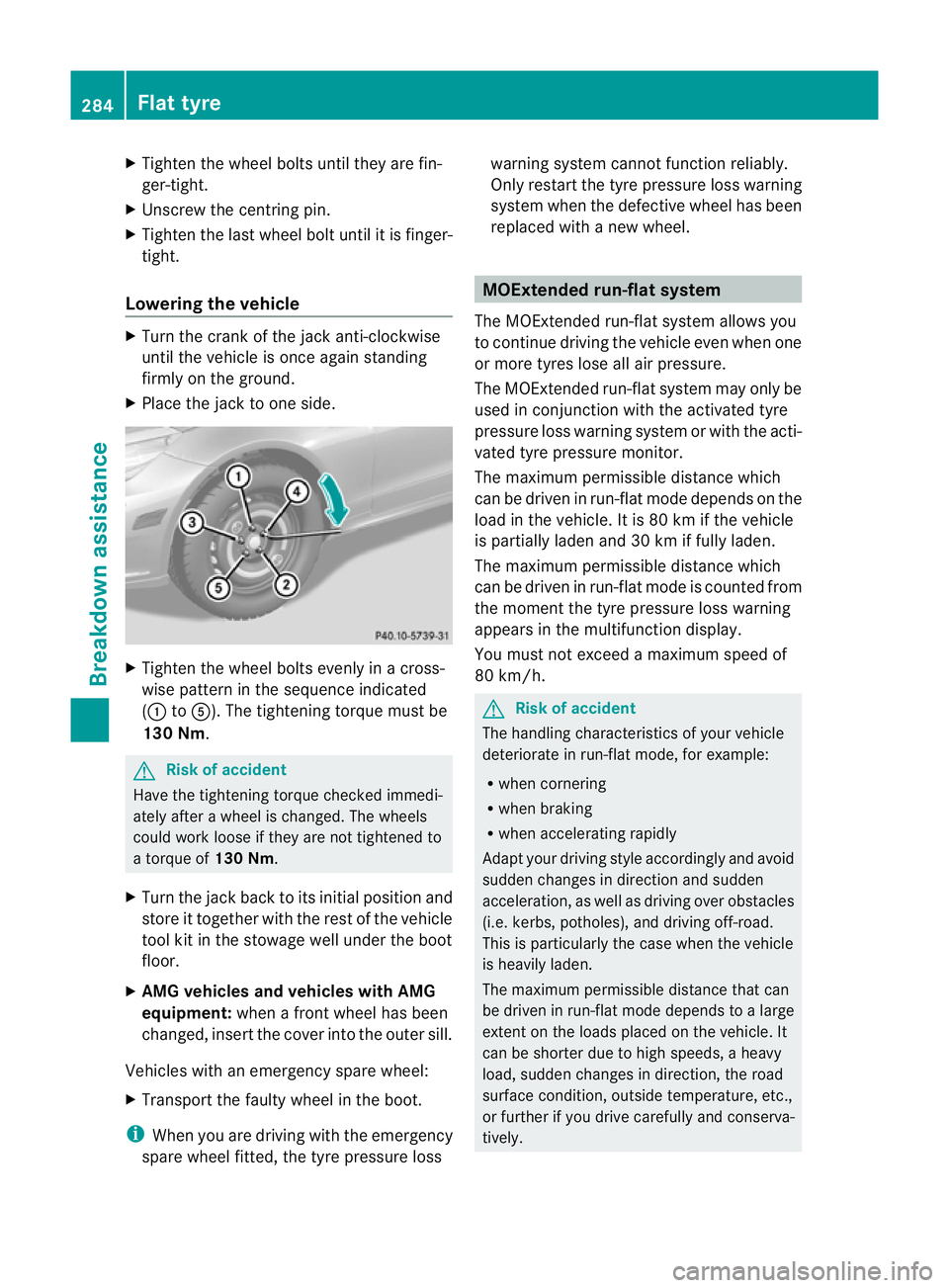
Tighten the whee lbolts evenly in across-
wis epattern in the sequence indicated
(: toA). The tightening torque must be
130 Nm. G
Risk of accident
Have the tightening torque checked immedi-
ately after awheel is changed. The wheels
coul dwork loose if they are not tightened to
at orqu eof130 Nm.
X Turn the jack back to its initia lposition and
stor eitt ogether with the rest of the vehicle
tool kit in the stowage well under the boot
floor.
X AM Gvehicles and vehicles with AMG
equipment: whenafront whee lhas been
changed, insert the cover into the outer sill.
Vehicles with an emergency spare wheel:
X Transport the faulty wheel in the boot.
i When you are driving with the emergency
spare wheel fitted, the tyre pressure loss warning system cannot function reliably.
Only restart the tyre pressure loss warning
system when the defective wheel has been
replaced with
anew wheel. MOExtended run-
flat system
Th eM OEx tended run-flat system allo wsyou
to continue driving the vehicle even when one
or more tyres los eall air pressure.
The MOExtended run-flat system may only be
used in conjunction with the activated tyre
pressure loss warnin gsystem or with the acti-
vated tyre pressure monitor.
The maximum permissible distance which
can be driven in run-flat mode depends on the
load in the vehicle. It is 80 km if the vehicle
is partially laden and 30 km if fully laden.
The maximum permissible distance which
can be driven in run-flat mode is counted from
the moment the tyre pressure los swarning
appears in the multifunction displ ay.
Yo um ust not exceed amaximum spee dof
80 km/h. G
Ris
kofa ccident
The handling characteristics of your vehicle
deteriorate in run-flat mode, for example:
R when cornering
R when braking
R when accelerating rapidly
Adapt your driving style accordingly and avoid
sudden changes in direction and sudden
acceleration, as well as driving over obstacles
(i.e. kerbs, potholes), and driving off-road.
This is particularly the case when the vehicle
is heavily laden.
The maximum permissible distance that can
be driven in run-flat mode depends to alarge
exten tonthe loads placed on the vehicle. It
can be shorter due to high speeds, aheavy
load, sudden changes in direction, the road
surface condition, outside temperature, etc.,
or further if you driv ecarefully and conserva-
tively. 284
Flat tyreBreakdown assistance
BA 207 ECE ÄJ 2010/1a; 1; 2, en-GB
mkalaf
aV ersion: 3.0.2.11
2010-01-26T13:03:22+01:0
0-Seite 284
Page 304 of 333
Tyr
ep ressures that are too lo whave anega-
tiv ee ffect on vehicl esafety, which could lead
to your causing an accident.
If possible, you should only correc ttyre pres-
sures when the tyres are cold. Depending on
the ambien ttemperature, the speed you are
driving at and the load on the tyres, the tyre
temperatur eand thus the tyre pressure may
chang ebyapproximately 10 kPa (0. 1bar,
1.5 psi) per 10 †. Take this int oaccount
whe ncheckin gthe pressur eofwarm tyres
and only correct it if it is too low for the cur-
rent operating conditions.
Driving with tyre pressure that is too high or
too low can:
R shorten the servic elife of the tyres
R cause increased tyre damage
R have anegativ eeffect on handling charac-
teristi csand thus the driving safet y(e.g. by
causing aquapla ning)
i The tyr epressure values given for low
load sare minimum values which offe ryou
good rid ecomfor tcharacteristics.
However ,you can also use the values given
for higher loads. These ar epermissible and
will not adversely affect the running of the
vehicle. H
Environmenta
lnote
Check the tyre pressure regularly, at least
every 14 days. Tyr
epressure loss warning
Important safety notes Whil
ethe vehicle is in motion, the tyr epres-
sure loss warning system monitors th eset
tyr ep ressure using th erotational speed of
the wheels. This enables the system to detect
significant pressure loss in atyre. If the speed
of rotation of awheel changes as aresult of
al oss of pressure, acorrespondin gwarning
message will appea rinthe multifunction dis-
play. G
Risk of accident
The tyr epressure loss warning system does
not warn you of an incorrectly se ttyre pres-
sure. The table on the insid eofthe fuel filler
fla pw ill help you decide whether the tyre
pressures should be corrected.
The tyre pressure loss warnin gsystem does
not replace the need to regularly check your
vehicle's tyre pressures, since an even loss of
pressure on several tyres at the same time
cannot be detecte dbythe tyr epressure loss
warning system.
Th et yre pressure monitor is not able to warn
you of asudden loss of pressure, e.g. if the
tyre is penetrated by aforeign objec t.
In the event of asudden loss of pressure, bring
the vehicle to ahalt by braking carefully. Do
not make any sudden steering movements
when doing so.
The function of the tyre pressure loss warning
system is limited or delayed if:
R snow chains are fitted to your vehicle's
tyres.
R road conditions are wintry.
R you are driving on sand or gravel.
R you adopt avery sporty driving style (cor-
nering at high speeds or driving with high
rates of acceleration).
R you are towin gavery heavy or large trailer.
R you are driving with aheavy load (in the
vehicle or on the roof).
Resta rting the ty re pressur eloss warn-
ing system Restart the tyre pressure loss warnin
gsystem
if you have:
R changed the tyre pressure
R changed the wheels or tyres
R fitted new wheels or tyres
X Before restarting, consult the table of tyre
pressures on the insid eofthe fuel filler flap
to ensur ethat the tyr epressure in all four Tyre pressures
301Tyres andwheels
BA 207 ECE ÄJ 2010/1a; 1; 2, en-GB
mkalafa Version: 3.0.2.11 2010-01-26T13:03:22+01:00-Seite 301 Z
Page 305 of 333
tyre
siss etcorrectl yfor the respective
operating con ditions.
X Observe the note sinthe sectio nontyre
pressures (Y page 299). G
Ris
kofa ccident
The tyr epressure loss warning system can
only give reliable warnings if you have se tthe
co rrec ttyrep ressure.
If an incorrect tyre pressure is se t,these
incorrect values will be monitored.
At yre with insufficient pressure results in
vehicle instability when driving, thu sincreas-
ing the risk of an accident.
X Make sure that the key is in pos i-
tion 2(Ypage135) in the igniti onlock.
In the multifunction display you wil lsee the
standard display (Y page 197).
X Press the =or; button to select the
Service menu.
X Press the 9or: button to select
Tyre pressure.
X Press the abutton.
The multifunction display show sthe mes-
sage:
Ru nF lat Indicator active Restart
with OK
If you wish to confirm the restart:
X Press the abutton.
Th em ultifunction displa yshows the mes-
sage:
Tyre press. no wOK?
X Press 9or: to select Yes.
X Press the abutton.
Th em ultifunction displa yshows the mes-
sage:
Ru nF lat Indicator restarted
After ateach-in period, the tyr epressure
loss warning system wil lmonitor the set
tyr ep ressures of all fou rtyres. If you wish to cancel the restart:
X
Press the %button.
or
X If the Tyrepress. now OK? message
appe ars,use9 or: to select Can‐
cel.
X Press the abutton.
The tyre pressure values stored at the last
restart will continue to be monitored. Direction of rotation
Tyres with aspecified direction of rotation
have additional benefits, e.g. if there is arisk
of aquaplaning. You will only gain these ben-
efits if the correct direction of rotation is
observed.
An arrow on the sidewall of the tyre indicates
its correct direction of rotation.
You may fit an emergenc yspare wheel/spare
wheel against the direction of rotation.
Observe the tim erestric tion on use as well as
the speed limitation specified on the emer-
genc yspare wheel/spar ewheel. Interchanging th
ewheels G
Ris
kofa ccident
Interchange the front and rear wheels only if
they have the same dimensions: for example
size, offset, etc.
After every wheel interchange/change, have
the tightening torque checked at aqualified
specialist workshop that has the necessary
specialist knowledg eand tool stocarry out
the work required. Mercedes-Benz recom-
mends that you use aMercedes-Ben zService
Centr efor this purpose. In particular ,work
relevant to safet yoronsafety-related sys-
tems must be carried out at aqualified spe-
cialist workshop.
The wheel scould work loose if they are not
tightened to atorqu eof130 Nm. 302
Interchanging th
ewheelsTyres and wheels
BA 207 ECE ÄJ 2010/1a; 1; 2, en-GB
mkalafa Version: 3.0.2.11 2010-01-26T13:03:22+01:00-Seite 302
Page 306 of 333
For safety reasons, Mercedes-Benz recom-
mends that yo
uonly use wheel bolts of the
correct size which hav ebeena pproved for
Mercedes-Benz vehicles.
The wear patterns on the fron tand rea rtyres
differ ,dependin gonthe opera tingconditions.
Interchange the wheels befor eaclear wear
pattern ha sform edon the tyr es.F ront tyres
typicall ywearm ore on the shoulder sand the
rea rtyre sint he centre.
On vehicles that have the same size front and
rear wheels, you can interchange the wheels
every 500 0kmto10,000 km depending on
the degre eoftyre wear. Do not reverse the
direction of tyre rotation.
Clea nthe con tact surface softhe wheel and
the brake disc thoroughly ever ytime awheel
is interchanged. Chec kthe tyr epressure and,
if necessary, restart th etyre pressure loss
warning system. Wheel and tyr
ecombinations Please bear the followin
ginmind
! For safety reasons, Mercedes-Ben zrec-
ommends that you only use tyres, wheels
and accessories which have been approved
by Mercedes-Ben zspecifically for your
vehicle. These tyres have been specially
adapted for use with the contro lsystems,
such as AB SorESP®
,a nd are marked as
follows:
R MO =Mercedes-Ben zOriginal
R MOE =Mercedes-Ben zOriginal Extended
(tyres with run-flat characteristics)
R MO1 =Mercedes-Ben zOriginal (AMG)
Only use Mercedes-Benz Original Extended
tyres on wheels that have been specifically
approved by Mercedes-Benz.
If you use other tyres, wheels and acces-
sories, Mercedes-Benz cannot accept any
responsibility for damage that may result
from this. Further informat ionabout tyres,
wheels and approved combinations can be obtained from any Mercedes-Benz Service
Centre.
! If you fit tyres other than those tested and
recommended by Mercedes-Benz, charac-
teristics such as handling, noise levels and
fuel consumption, etc. may be adversely
affected. In addition, when driving with a
load, tyre dimensional variations could
caus ethe tyres to com einto contact with
the bod ywork and axle components. This
could result in dam agetot he tyres or the
vehicle.
i Further information about tyres and
wheels can be obtained from any
Mercedes-Benz Servic eCentre.
i You will fin datable of tyre pressures on
the insid eofyourv ehicle' sfuel filler flap.
For further information on tyre pressure,
see (Y page 299).
i Notes on the vehicle equipment:
Always fit the vehicle:
R with tyres of the same size on agiven axle
(left/right)
R with the same type of tyres at agiven
time (summer tyres, winter tyres,
MOExtended tyres)
i Vehicles featurin gthe MOExtended run-
fla ts ystem are not equipped with the
TIREFIT kit.
It is therefore recommended that you addi-
tionally equip your vehicle with the TIREFIT
kit if you fit tyres that do not feature run-
flat properties, e.g. winter tyres.
AT IREFIT kit is availa blef rom any qu alified
specialist workshop, e.g. aMercedes-Benz
Ser vice Centre. Wheel and tyr
ecombinations
303Tyres and wheels
BA 207ECE ÄJ 2010/1a; 1; 2, en-GB
mkalafa Version:3.0.2.11
2010-01-26T13:03:22+01:0
0-Seite 303 Z