airbag MERCEDES-BENZ E-CLASS CABRIOLET 2011 User Guide
[x] Cancel search | Manufacturer: MERCEDES-BENZ, Model Year: 2011, Model line: E-CLASS CABRIOLET, Model: MERCEDES-BENZ E-CLASS CABRIOLET 2011Pages: 353, PDF Size: 8.42 MB
Page 47 of 353
G
WARNING
If you wishtou se seat covers, Mercedes-Benz
recommends that, for safety reasons, you
only use seat covers that have been approved
for Mercedes-Benz vehicles.
The seat covers must have aspecial tear seam
for sidebags/pelvisbags. Otherwise, the side-
bag/pelvisbag cannot deploy correctly and
would fail to provid ethe intended protection
in the event of an accident. Appropriate seat
covers can be obtained, for example, from a
Mercedes-Benz Service Centre.
Pelvisbagd eployment enhances the leve lof
protection of the vehicl eoccupants on the
side of the vehicl eonwhich the impact
occurs. Pelvisbags
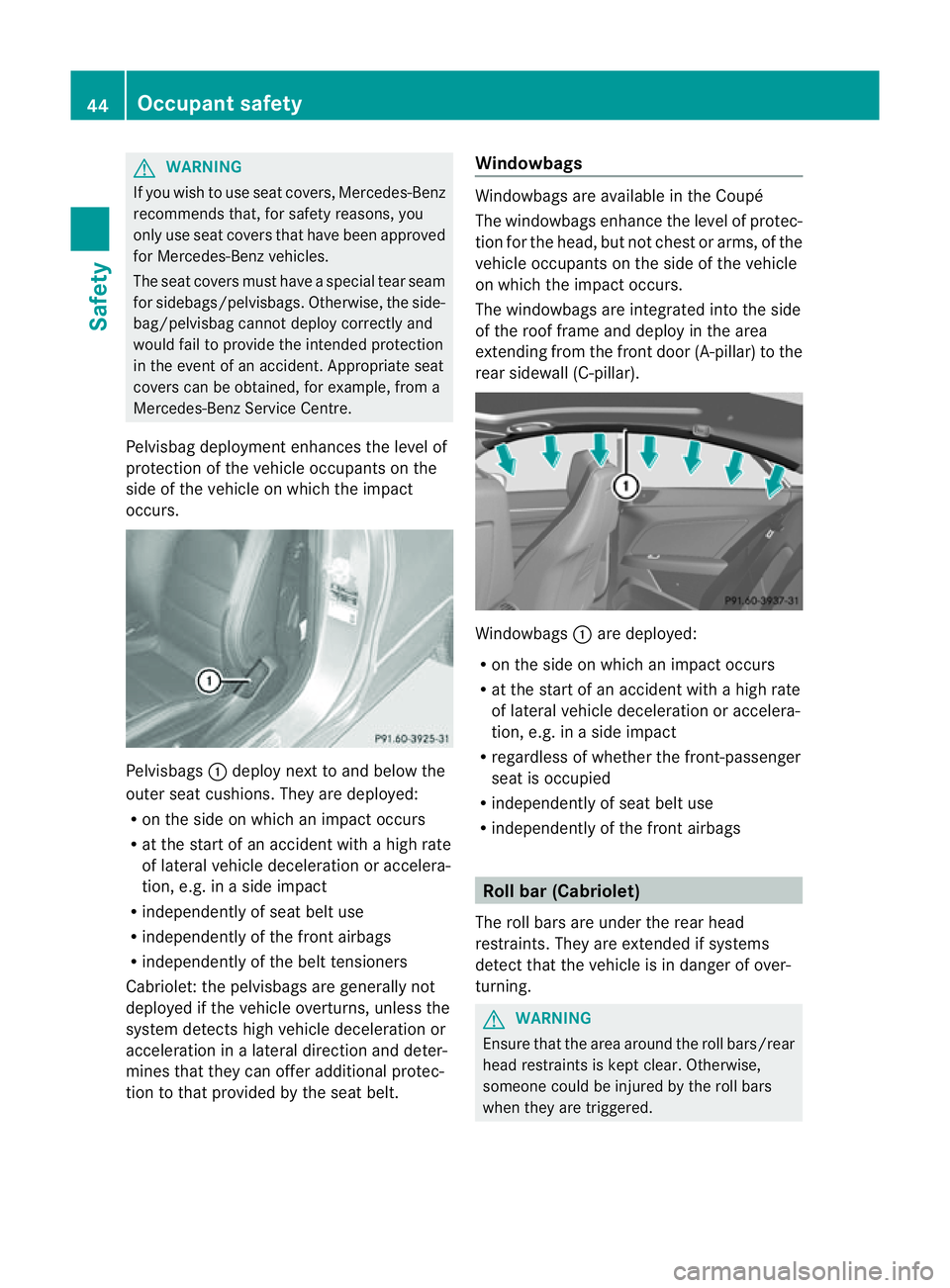
:deploy next to and below the
outer seat cushions. They are deployed:
R on the side on which an impact occurs
R at the start of an accident with ahigh rate
of latera lvehicl edeceleratio noraccelera-
tion, e.g. in asidei mpact
R independentl yofseatb elt use
R independently of the fron tairbags
R independently of the belt tensioners
Cabriolet :the pelvisbagsa re generally not
deployed if the vehicle overturns,u nless the
system detects high vehicle deceleration or
acceleration in alateral direction and deter-
mines that they can offer additional protec-
tion to that provided by the seat belt. Windowbags Windowbags are available in the Coupé
The windowbags enhance the level of protec-
tion for the head, but not chest or arms, of the
vehicle occupants on the side of the vehicle
on which the impact occurs.
The windowbags are integrated into the side
of the roof frame and deploy in the area
extending from the front door (A-pillar) to the
rear sidewall (C-pillar).
Windowbags
:are deployed:
R on the side on which an impact occurs
R at the start of an accident with ahigh rate
of lateral vehicle deceleration or accelera-
tion, e.g. in aside impact
R regardless of whether the front-passenger
seat is occupied
R independently of seat belt use
R independently of the front airbags Roll bar (Cabriolet)
The roll bars are under the rear head
restraints. They are extended if systems
detect that the vehicle is in danger of over-
turning. G
WARNING
Ensure that the area around the roll bars/rear
head restraintsisk ept clear. Otherwise,
someone could be injured by the roll bars
when they are triggered. 44
Occupant safetySafety
Page 53 of 353
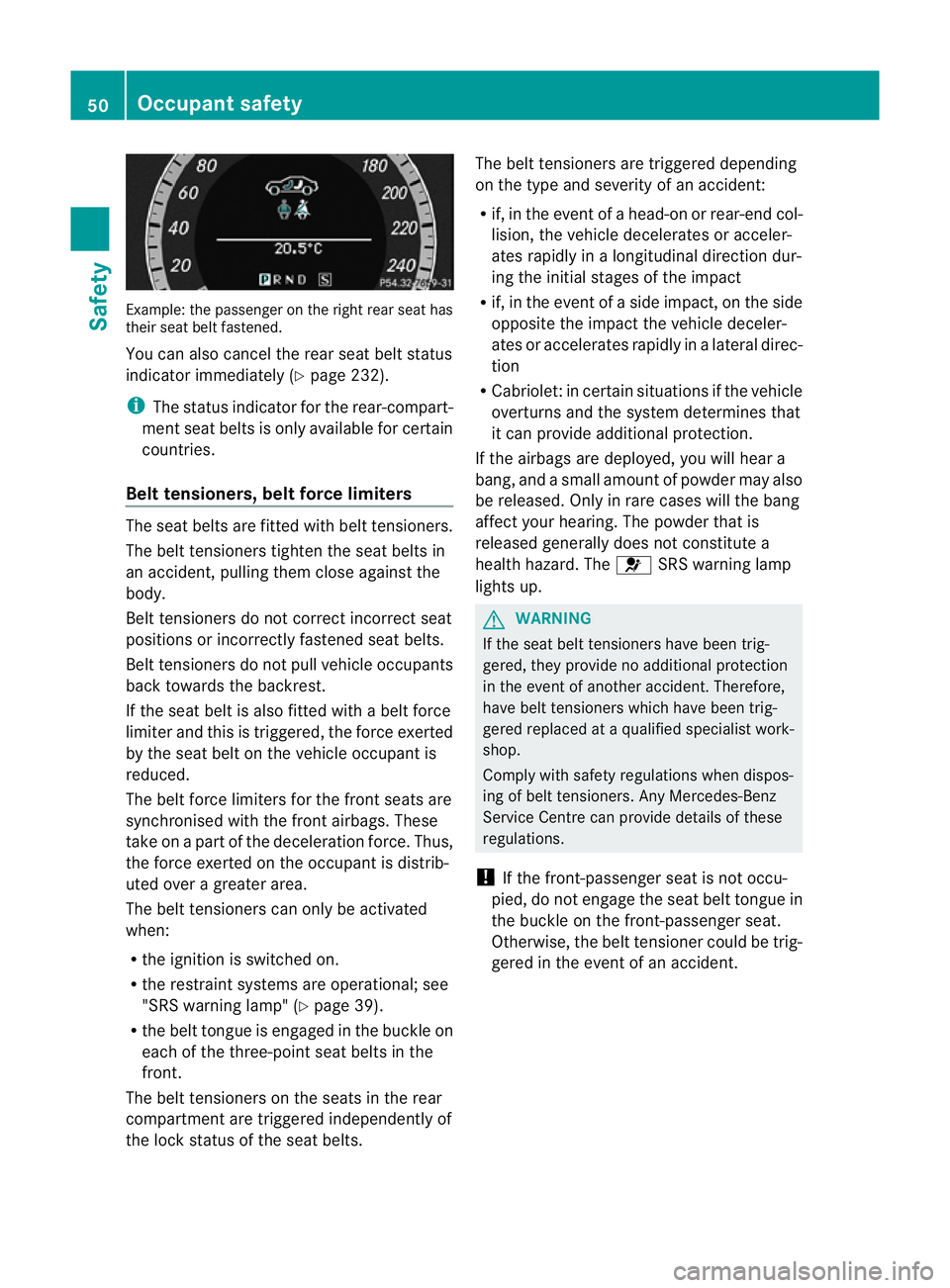
Example: the passenge
ronthe right rear seat has
their seat belt fastened.
You can also cancel the rear seat belt status
indicator immediately (Y page 232).
i The status indicator for the rear-compart-
ment seat belts is only available for certain
countries.
Belt tensioners, belt force limiters The seat belts are fitted with belt tensioners.
The belt tensionerst ighten the seat belts in
an accident, pulling them close against the
body.
Belt tensionersdon ot correct incorrects eat
positions or incorrectly fastened seat belts.
Belt tensionersdon ot pull vehicle occupants
back towards the backrest.
If the seat belt is also fitted with abelt force
limiter and this is triggered, the force exerted
by the seat belt on the vehicle occupant is
reduced.
The belt force limiters for the front seats are
synchronised with the front airbags. These
take on apart of the deceleration force. Thus,
the force exerted on the occupant is distrib-
uted over agreater area.
The belt tensionersc an only be activated
when:
R the ignition is switched on.
R the restraint systems are operational; see
"SRS warning lamp" (Y page 39).
R the belt tongue is engaged in the buckle on
each of the three-point seat belts in the
front.
The belt tensionersont he seats in the rear
compartmenta re triggeredindependently of
the lock status of the seat belts. The beltt
ensioners are triggered depending
on the type and severit yofanaccident:
R if, in the event of ahead-on or rear-en dcol-
lision, the vehicle decelerates or acceler-
ates rapidly in alongitudinal direction dur-
ing the initial stages of the impact
R if, in the event of aside impact, on the side
opposite the impact the vehicle deceler-
ates or accelerates rapidly in alateral direc-
tion
R Cabriolet: in certain situation sifthe vehicle
overturns and the system determines that
it can provide additional protection.
If the airbags are deployed, you will hear a
bang, and asmall amount of powder may also
be released. Only in rare cases will the bang
affect your hearing. The powder that is
released generally does not constitute a
health hazard. The 6SRS warning lamp
lights up. G
WARNING
If the seat belt tensioners have been trig-
gered, they provide no additional protection
in the event of another accident. Therefore,
have belt tensioners which have been trig-
gered replaced at aqualified specialist work-
shop.
Comply with safety regulations when dispos-
ing of belt tensioners .Any Mercedes-Benz
Service Centr ecan provide details of these
regulations.
! If the front-passenger seat is not occu-
pied, do not engage the seat belt tongue in
the buckle on the front-passenger seat.
Otherwise, the belt tensioner could be trig-
gered in the event of an accident. 50
Occupant safetySafety
Page 55 of 353
tem could heat up and the child could burn
herself/himself on them.
If ac hild opens adoor, the child or othe rper-
sons could be injured as aresult. They could
get out and injure themselves or be injured by
ap assing vehicle.
Also observe the notes on HOLD .Relevant
information can be found in the index. G
WARNING
Unsecured or incorrectly positioned loads
increase the risk of injury for children and all
other occupant sinthe event of:
R an accident
R ab raking manoeuvre
R as udden change of direction
Do not carry heavy or hard objects in the vehi-
cle interior unless they are secured. You will
find further information under "Loading guide-
lines" in the index.
Child seat lock The seat belts on the rear seats are fitted with
ac
hild seat lock. When enabled, the child-
seat lock function ensures that the belt does
not slacken oncet he child seat is secured.
Installing achild restraint system:
X Always comply with the manufacturer's
installation instructions.
X Pull the seat belt smoothly from the inertia
reel.
X Engage the seat belt tongue in the belt
buckle.
Activating the child seat lock:
X Pull the seat belt out fully and let the inertia
reel retract it again.
While the seat belt is retracting, you should
hear aratchetin gsound. The child-seat lock
function is enabled.
X Push down on the child restraint system to
take up any slack. Removing
achild restraint system/deactivat-
ing the child seat lock:
X Always comply with the manufacturer's
installation instructions.
X Press the seat belt release button and
guide the belt tongue to the belt outlet.
The child-seat lock function is deactivated.
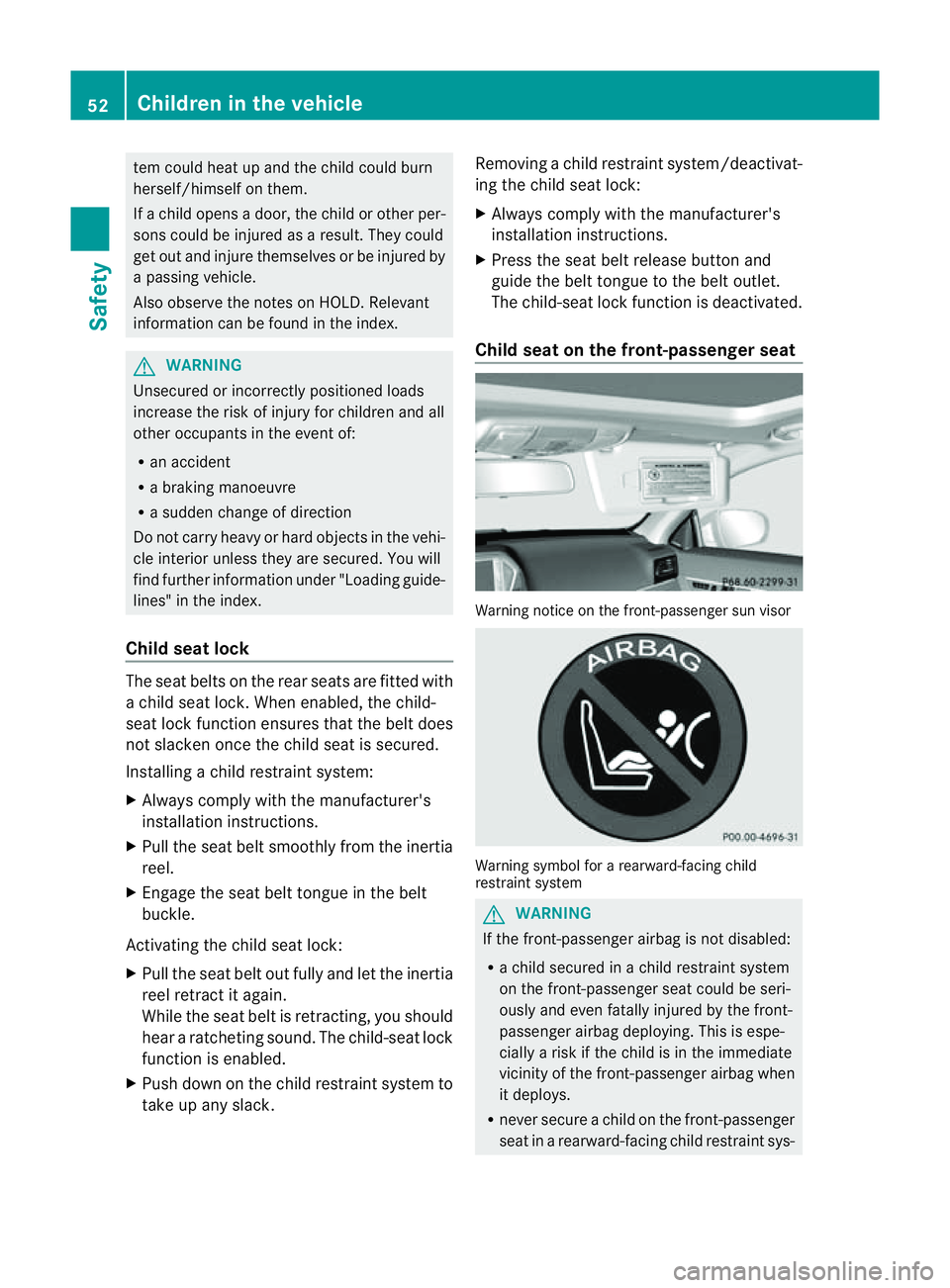
Child seat on the front-passenger seat Warning notice on the front-passenger sun visor
Warning symbol for
arearward-facing child
restraint system G
WARNING
If the front-passenger airbag is not disabled:
R ac hild secured in achild restraint system
on the front-passenger seat could be seri-
ously and even fatally injured by the front-
passenger airbag deploying. This is espe-
cially arisk if the child is in the immediate
vicinit yofthe front-passenger airbag when
it deploys.
R never secure achild on the front-passenger
seat in arearward-facing child restraint sys- 52
Children in thev
ehicleSafety
Page 56 of 353
tem. Onl
ysecurear earward-facing child
restraint syste monasuitablerear seat.
R always move the front-passenger seat to
the rearmost position if you secure achild
in af orward-facing child restraint system
on the front-passenger seat.
The front-passenger airbag is not disabled:
R on vehicles without automatic child seat
recognition on the front-passenger seat
R in vehicles with automatic child seat rec-
ognition in the front-passenger seat, if no
special child restraint system with trans-
ponders for automatic child seat recogni-
tion in the front-passenger seat has been
fitted
R on vehicles with automatic child seat rec-
ognition on the front-passenger seat, if the
PASSENGER AIRBAG OFF indicator lamp
4 is not lit.
To make you aware of this danger, acorre-
sponding warning sticker has been affixed on
the dashboard and on both sides of the sun
visor on the front-passenger side.
Information about recommended child
restraint systems is available at any
Mercedes-Benz Service Centre.
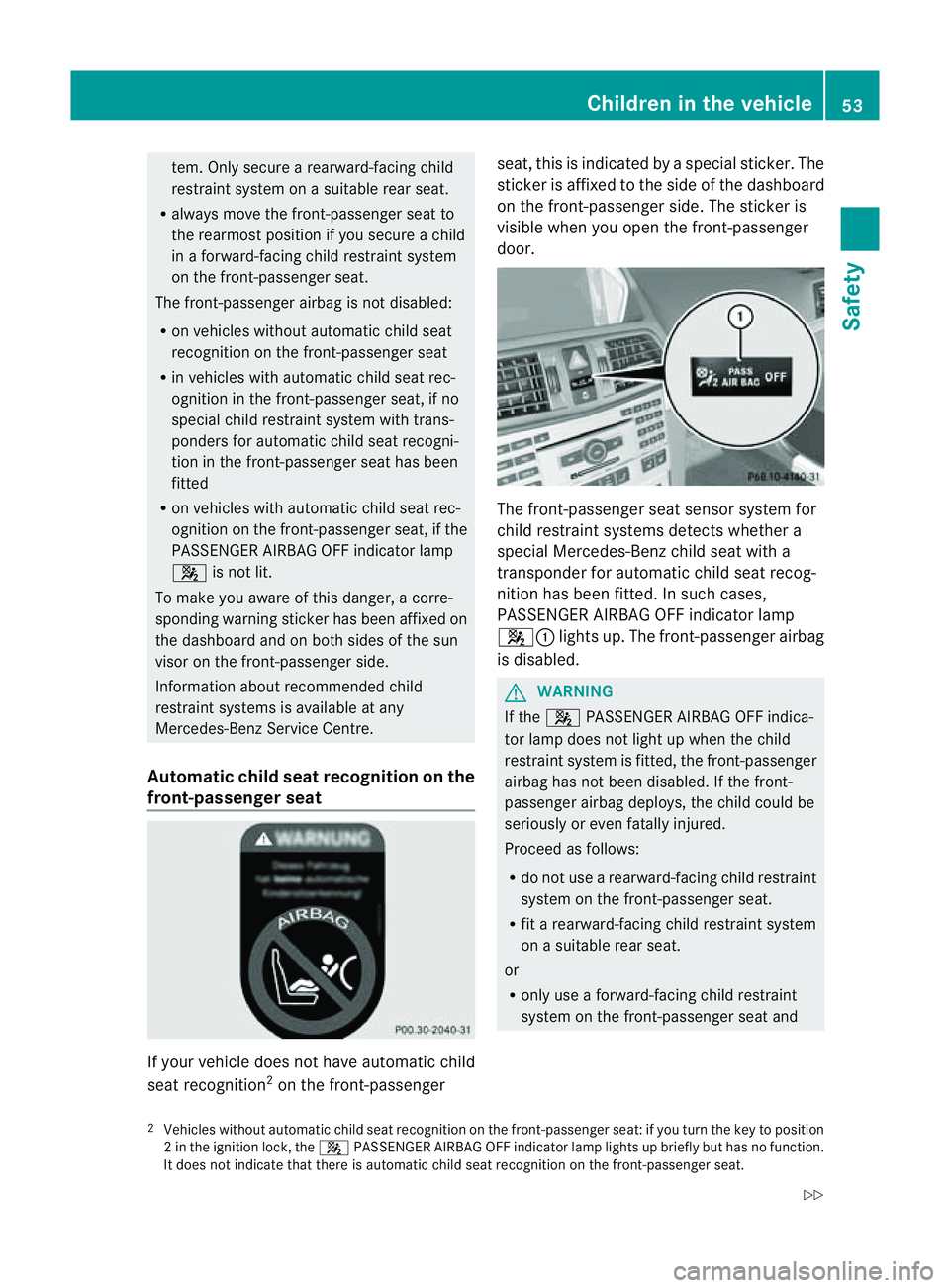
Automatic child seat recognition on the
front-passengers eatIf your vehicle does no
thave automatic child
seat recognition 2
on th efront-pa ssenger seat
,thisisi ndicated by aspecial sticker. The
sticker is affixe dtotheside of th edashboard
on th efront-pa ssenger side. The sticker is
visible when you open th efront-pa ssenger
door. The front-passenger seat sensor system for
child restraint systems detect swhether a
special Mercedes-Ben zchild seat with a
transponder for automatic child seat recog-
nition has been fitted. In such cases,
PASSENGER AIRBAG OFF indicator lamp
4: lights up. The front-passenger airbag
is disabled. G
WARNING
If the 4 PASSENGER AIRBAG OFF indica-
tor lamp does not light up when the child
restraint system is fitted, the front-passenger
airbag has not been disabled. If the front-
passenger airbag deploys, the child could be
seriously or even fatally injured.
Proceed as follows:
R do not use arearward-facing child restraint
system on the front-passenger seat.
R fit arearward-facing child restraint system
on asuitable rear seat.
or
R only use aforward-facing child restraint
system on the front-passenger seat and
2 Vehicles without automatic child seat recognition on the front-passenger seat: if you turn the key to position
2int he ignition lock, the 4PASSENGER AIRBAG OFF indicator lamp lights up briefly but has no function.
It does not indicate that there is automatic child seat recognition on the front-passenger seat. Children in the vehicle
53Safety
Z
Page 57 of 353
move the front-passenger seat to the rear-
most position.
R have the automatic child seat recognition
checked at aqualified specialist workshop.
To ensure that the automatic child seat rec-
ognition on the front-passenger seat func-
tions/communicates correctly, never place
objects, e.g. acushion, under the child
restraint system. The entire base of the child
restraint system must alwaysr est on the seat
cushion. An incorrectly fitted child restraint
system cannot perform its intended protec-
tive function in the event of an accident, and
could leadtoi njuries.
i If the front-passenger airbag is disabled
by the automatic child seat recognition, the
following remai nenable dont he front-
passenge rside:
R the sidebag
R the pelvisbag
R Cabriolet :the headbag
R Coupé:t he windowbag
R the belt tensioner G
WARNING
Do not place electronic devices on the front-
passenger seat, e.g.:
R laptops, when switched on
R mobile phones
R cards with transponders, e.g. ski passes or
access cards
Signals from electronic equipment can cause
interference in the automatic child seat rec-
ognition sensor system. This can lead to a
system malfunction. This may cause the
4 PASSENGER AIRBAG OFF indicator
lamp to light up without there being achild
seat with transponders for automatic child
seat recognition fitted. The front-passenger
airbag will not then deploy during an accident.
It is also possible that the 6SRS warning
lamp lights up and/or the 4PASSENGER
AIRBAG OFF indicator lamp does not light up briefly when you turn the key in the ignition
lock to position 2.
ISOFIXc hild seat securing system for
the rear seats ISOFIXisas
tandardised securing system for
specially designed child restraint systems on
the rear seats. Securing rings for two ISOFIX
child restraint systems are fitted on the left
and right of the rear seats.
Mercedes-Ben zrecommends the use of ISO-
FIX child restraint systems listed on
(Y page 59) together with the insertion
guides included. Using insertion guides
makes it easier to fit ISOFIXc hild restraint
systems. G
WARNING
Ac hild restraint system secured by the ISOFIX
child seat securing system does not provide
sufficient protection for children weighing
more than 22 kg. For this reason, do not
secure children weighing more than 22 kg in
ac hild restraint system secured by the ISOFIX
child seat securing system. If the child weighs
more than 22 kg, secure the child restraint
system using athree-point seat belt. G
WARNING
The child restraint system cannot perform its
protective function if it is not correctly fitted
to as uitable vehicle seat. The child cannot be
restrained in the event of an accident, heavy
braking or sudden changes of direction. The
child could be seriously or even fatally injured.
For this reason, when fittingac hild restraint
system, observe the manufacturer's installa-
tion instructions and the correct use of the
child restraint system.
For reasons of safety, only use child restraint
systems with the ISOFIX child seat securing
system on the rear seats.
We recommendt hat you use the ISOFIX child
restraint systems that have been recommen-
ded for Mercedes-Benz. 54
Children in the vehicleSafety
Page 60 of 353
Problems with child seat recognition
Problem Possible causes/consequences and
M Solutions
The
4 PASSENGER
AIRBAGO FF indicator
lamp on the centre con-
sole is lit. As
pecial Mercedes-Benz child seat with atransponder for auto-
matic child seat recognition has been fitted to the front-passenger
seat. The front-passenger airbag has therefore been disabled as
desired. G
Risk of injury
There is no child seat fitted to the front-passenger seat. Automatic
child seat recognition is malfunctioning.
It is also possible that the 6SRS warning lamp lights up and/
or the 4PASSENGER AIRBAG OFF indicator lamp does not light
up briefly when you switc hthe ignition on.
X Remove electronic equipment from the front-passenger seat,
e.g.
R
laptop
R mobile phone
R cards with transponders, such as ski passes or access cards
If the 4 PASSENGER AIRBAG OFF indicator lamp is still lit:
X Visit aqualified specialist workshop. Suitable positioning of the child restraint systems
Key to the letters used in the table:
XS
eat which is unsuitable for children in this weight category.
US uitable for child restraint systems in th eUniversal categor ytha ta re approve dfor use in
this weigh tcategory.
UF Suitable for forward-facing child restraint systems that belon gtothe"Universal" category
and are approved for use in this weigh tcategory.
LS uitable for child restraint systems as recommended, see th efollowin gtable of "Recom-
mended child restraint systems "(Ypage 59). Children in th
evehicle
57Safety Z
Page 61 of 353
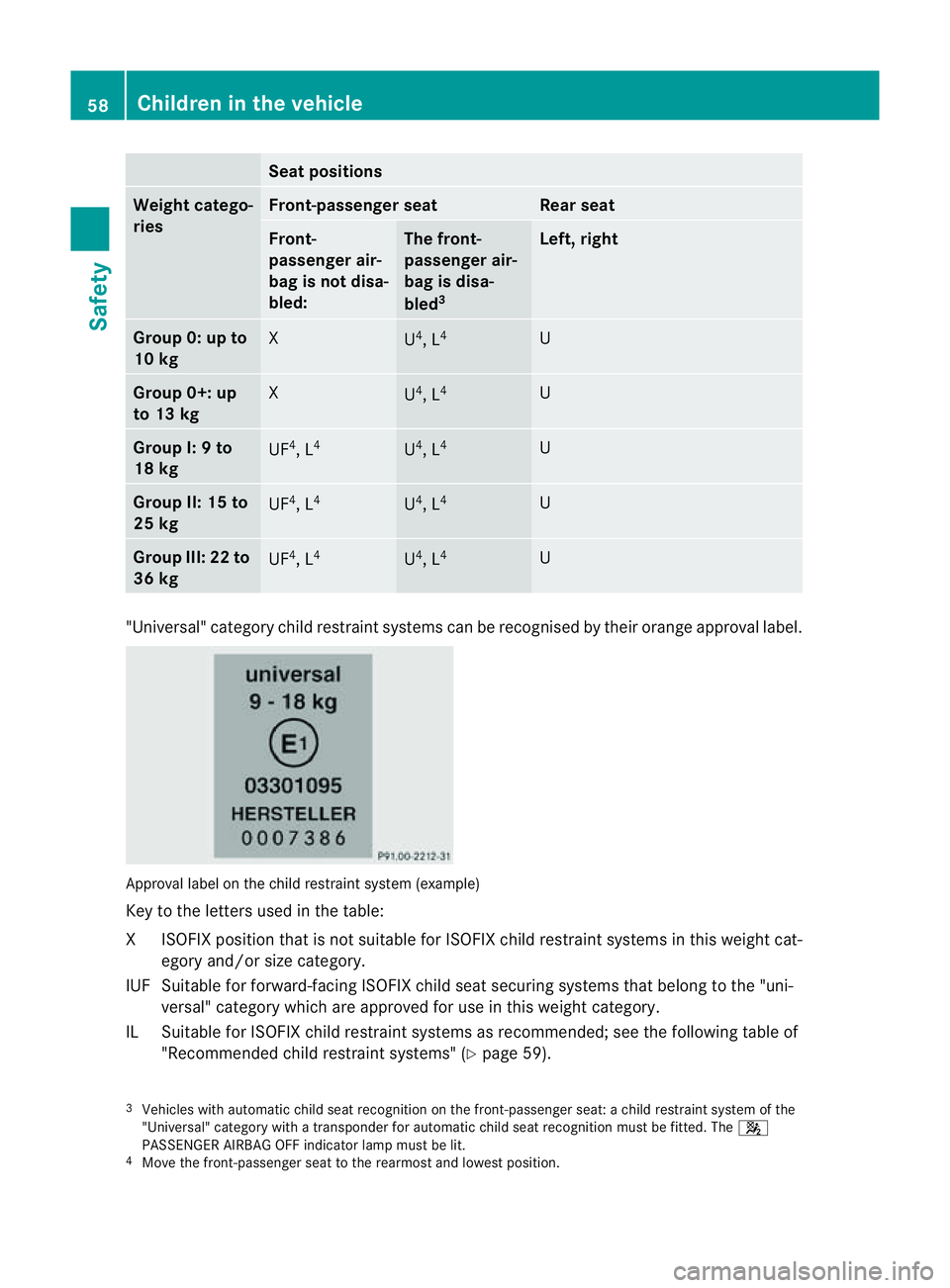
Seat positions
Weight catego-
ries Front-passenger seat Rear seat
Front-
passenger air-
bag is not disa-
bled: The front-
passenger air-
bag is disa-
bled
3 Left, right
Group 0: up to
10 kg
X
U
4
,L 4 U
Group 0+: up
to 13 kg
X
U
4
,L 4 U
Group I:
9to
18 kg UF
4
,L 4 U
4
,L 4 U
Group II: 15 to
25 kg
UF
4
,L 4 U
4
,L 4 U
Group III:22to
36 kg
UF
4
,L 4 U
4
,L 4 U
"Universal" category child restraint systems can be recognised by their orange approval label.
Approval label on the child restraint system (example)
Key to the letters used in the table:
XI
SOFIX position tha tisnot suitablef or ISOFIX child restraint systems in this weight cat-
egory and/or size category.
IUF Suitable for forward-facing ISOFIX child seat securing systems that belong to the "uni- versal" category which are approved for use in this weight category.
IL Suitable for ISOFIX child restraint systems as recommended; see the following table of "Recommended child restraint systems" (Y page 59).
3 Vehicles with automatic child seat recognition on the front-passenger seat: achild restraint system of the
"Universal" category with atransponder for automatic child seat recognition must be fitted. The 4
PASSENGER AIRBAG OFF indicator lamp must be lit.
4 Move the front-passenger seat to the rearmost and lowest position. 58
Children in the vehicleSafety
Page 104 of 353
The seat belt should:
R
fit snugly across your body
R be routed across the middle of your
shoulder
R be routed in your pelvic area across the
hip joints
X Before starting off, adjust the rear-view mir-
ror and the exterior mirrors (Y page 109)
in such away that you have agood view of
road and traffic conditions.
X Vehicles with amemor yfunction: save
the seat, steerin gwheel and exterior mirror
settings (Y page 112). Seats
Important safety notes
G
WARNING
The seats can still be adjusted when there is
no key in the ignition lock. For this reason,
children should never be left unsupervised in
the vehicle. They could adjust the seats and
become trapped. G
WARNING
Only adjust the driver's seat when the vehicle
is stationary. You will otherwise be distracted
from the road and traffic conditions and you
could lose control of the vehicle as aresult of
the seat moving. This could cause an acci-
dent. G
WARNING
If you adjust the seat height carelessly, you or
others could be trapped and thereby injured.
Children in particular could unintentionally
press the button stoelectrically adjust the
seats and become trapped.
Take care that:
R while moving the seats, your hands do not
get under the lever assembly of the seat
adjustmen tsystem.
R children in th evehicl edon ot slide their
hands under the levers. G
WARNING
Make sure that nobody can becom etrapped
when adjusting the seats.
Observe the notes on airbags.
Secure children as recommended; see the
"Children in the vehicle" section. G
WARNING
Make sure that the back of your head is sup-
ported at eye level by the central area of the
head restraint .Ifyour head is not supported
correctly by the head restraint ,you could suf-
fer asevere neck injury in the event of an
accident .Never drive if the head restraints are
not engaged and set correctly. G
WARNING
As eat belt can only offer its intended degree
of protection when the backrest is almost ver-
tical and the occupant is sitting upright. Avoid
seat position sthat do not allow the seat belt
to be routed correctly. Adjust the backrest so
that it is as upright as possible. Never travel
with the backrest reclined too far backwards.
You could otherwise be seriously or even
fatally injured in the event of an acciden tor
sudden braking.
! To avoid damage to the seats and the seat
heating, observe the following information:
R do not spill any liquids on the seats. If
liquid is spilled on the seats, dry them as
soon as possible.
R if the seat cover sare damp or wet, do not
switch on the seat heating. The seat
heating should also not be used to dry
the seats.
R clean the seat cover sasrecommended;
see the "Interior care" section.
R do not transport heavy loads on the
seats. Do not place sharp objects on the
seat cushions ,e.g. knives, nails or tools.
The seats should only be occupied by
passengers, if possible.
R when the seat heating is in operation ,do
not cover the seats with insulating mate- Seats
101Seats, steering wheel and mirrors Z
Page 120 of 353
X
To indicate briefly: press the combination
switch briefl ytothe pressure point in the
direction of arrow ;or?.
The corresponding tur nsignal flashes three
times.
X To indicate: press the combination switch
beyond the pressure point in the direction
of arrow ;or?.
Main-bea mheadlamps X
To switch on th emain-bea mhead-
lamps: turnthe key in the ignition lock to
position 2or start the engine.
X Turn the light switc htoLorÃ.
X Press the combination switc hbeyond the
pressure point in the direction of
arrow :.
In the Ãposition ,the main-beam head-
lamps are only switched on when it is dark
and the engin eisrunning.
The K indicator lamp in the instrument
cluster lights up when the main-beam head-
lamps are switched on.
X To switch off the main-beam head-
lamps: move the combination switch back
to its normal position.
The K indicator lamp in the instrument
cluster goes out.
Headlamp flasher X
To switch on: turn the key in the ignition
lock to position 1or 2or start the engine.
X Pull the combination switch in the direction
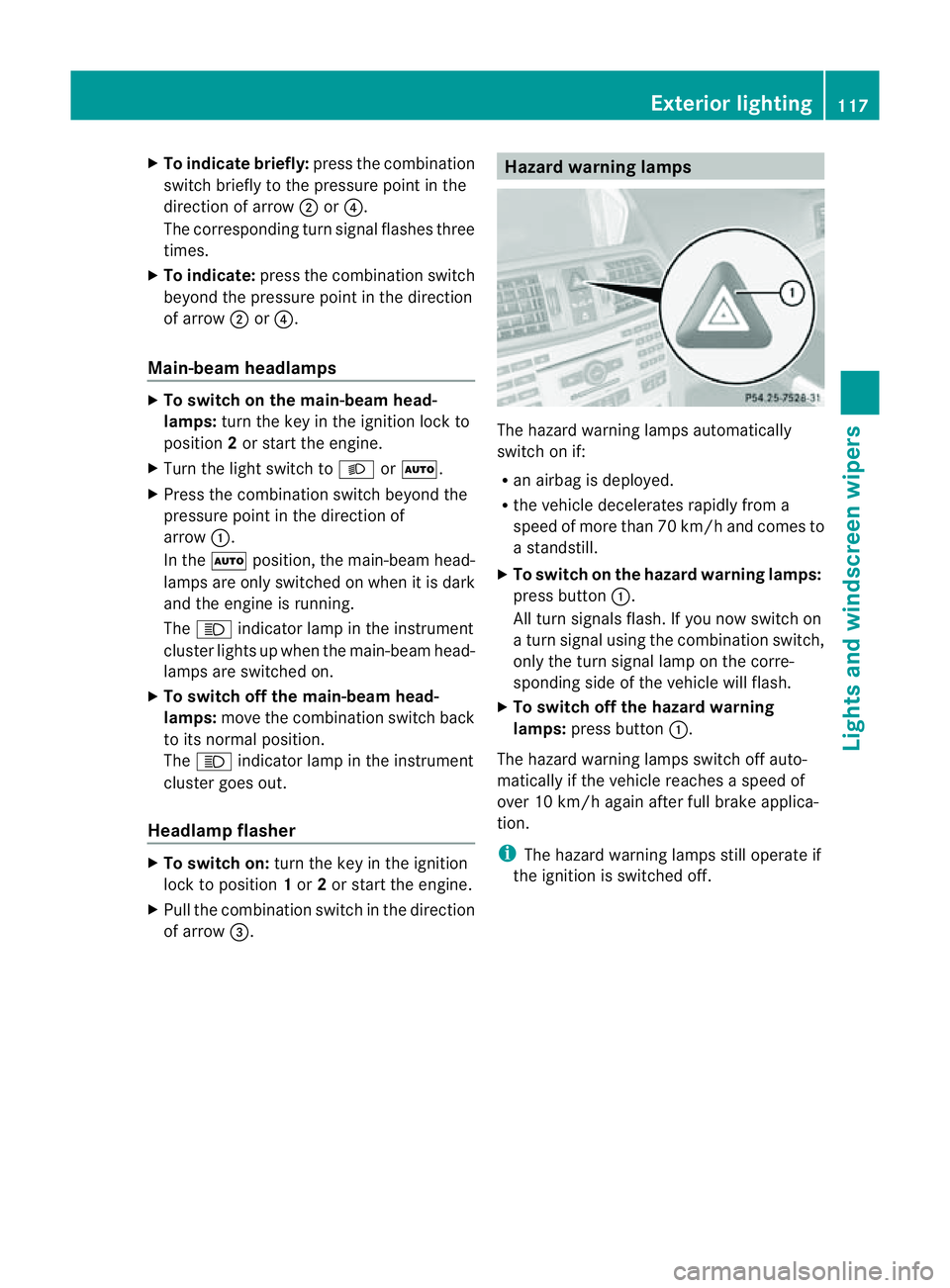
of arrow =. Hazard warning lamps
The hazard warning lamps automatically
switch on if:
R
an airbag is deployed.
R the vehicle decelerates rapidly from a
speed of more than 70 km/ha nd comesto
as tandstill.
X To switc honthe hazard warning lamps:
press button :.
All tur nsignals flash. If you now switc hon
at urns ignal using the combination switch,
only the tur nsignal lamp on the corre-
sponding side of the vehicle will flash.
X To switch off th ehazar dwarning
lamps: press button :.
The hazar dwarnin glamps switc hoff auto-
matically if the vehicle reaches aspeed of
over 10 km/h again after full brak eapplica-
tion.
i The hazar dwarnin glamps still operat eif
the ignition is switched off. Exterior lighting
117Lightsand windscreen wipers Z
Page 238 of 353
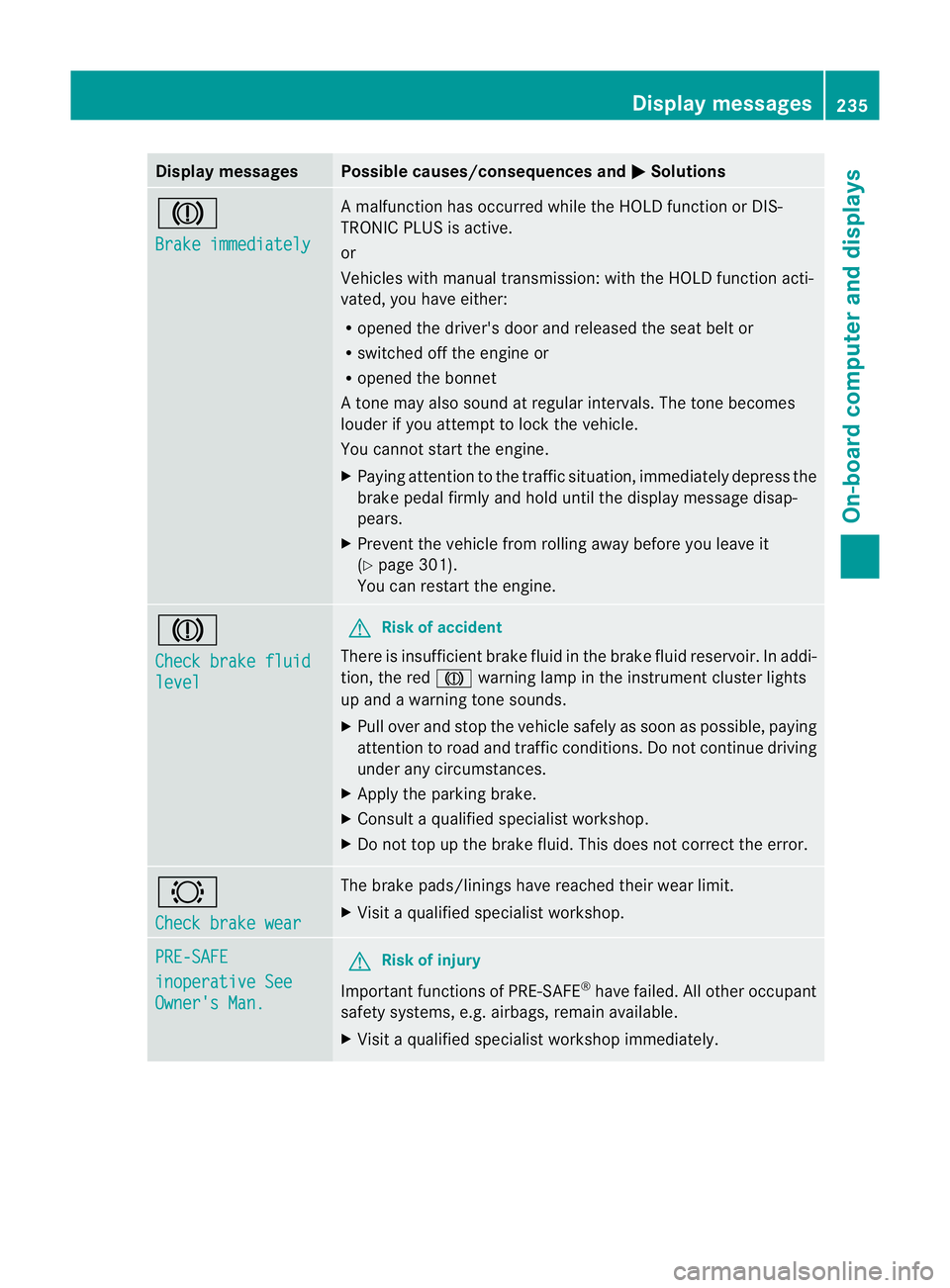
Display messages Possible causes/consequences and
M Solutions
J
Brake immediately Am
alfunction has occurred while th eHOLDf unction or DIS-
TRONIC PLU Sisactive.
or
Vehicles wit hmanual transmission: wit hthe HOLD function acti-
vated, you hav eeither:
R opened th edriver's doo rand released the sea tbelt or
R switched off the engin eor
R opened the bonnet
At one may also sound at regular intervals. The toneb ecomes
louder if you attempt to lock the vehicle.
You cannot start the engine.
X Paying attention to the traffic situation, immediately depress the
brake pedal firmly and hold until the display message disap-
pears.
X Prevent the vehicle from rolling away before you leave it
(Y page 301).
You can restart the engine. J
Check brake fluid
level G
Risk of accident
There is insufficient brake fluid in the brake fluid reservoir. In addi-
tion, the red Jwarning lamp in the instrument cluster lights
up and awarning tone sounds.
X Pullo ver and stop the vehicl esafel yass oon as possible,p aying
attention to road and traffic conditions. Do not continue driving
under any circumstances.
X Apply the parking brake.
X Consult aqualified specialist workshop.
X Do not top up the brake fluid. This does not correct the error. #
Check brake wear The brake pads/linings have reache
dtheir wearl imit.
X Visit aqualified specialist workshop. PRE-SAFE
inoperative See
Owner's Man. G
Risk of injury
Important function sofPRE-SAFE ®
have failed .All other occupant
safet ysystems, e.g. airbags, remain available.
X Visit aqualified specialist workshop immediately. Display messages
235On-board computer and displays Z