tow MERCEDES-BENZ E-CLASS CABRIOLET 2011 User Guide
[x] Cancel search | Manufacturer: MERCEDES-BENZ, Model Year: 2011, Model line: E-CLASS CABRIOLET, Model: MERCEDES-BENZ E-CLASS CABRIOLET 2011Pages: 353, PDF Size: 8.42 MB
Page 22 of 353
Trip meter
Calling up ....................................... 217
Resetting (on-boar dcomputer) ......218
Trip odometer
see Trip meter
Turn signals
Changing bulbs (front) ...................123
Switching on/off ........................... 116
TV
Operating (on-board computer) .....220
see Separate operating instructions
Two-way radio
Frequencies ................................... 331
Installatio n..................................... 331
Transmission output (maximum ).... 331
Type identification plate
see Vehicle identification plate
Tyre pressure
Display message ............................ 249
Not reached (TIREFIT) ....................299
Pressure loss warning ....................322
Reached (TIREFIT) ..........................300
Recommended ............................... 321
Tyres
Checking ........................................ 318
Directio nofrotation ...................... 324
Display message ............................ 249
Gri p................................................ 168
Important safety notes ..................318
Replacing ....................................... 323
Service life ..................................... 319
Storing ........................................... 324
Tyr esize (data) .............................. 324
Tyr etread ...................................... 319
see Flat tyre U
Unladen weight see Technical data
Unlocking
Emergency unlocking .......................79
From insid ethe vehicle (central
unlocking button) ............................. 78 V
Vanity mirror (in sun visor) ..............271
Vehicle Correct use ...................................... 23
Data acquisition ............................... 23
Display message ............................ 250
Electronics ..................................... 331
Equipment ....................................... 21
Implied warranty .............................. 23
Individua lsettings .......................... 224
Leaving parked up .........................166
Locking (in an emergency) ...............79
Locking (key )................................... 72
Lowering ........................................ 304
Pulling away ................................... 149
Raising ........................................... 302
Registration ..................................... 22
Towing away .................................. 310
Tow-starting ................................... 310
Transporting .................................. 313
Unlocking (in an emergency) ...........79
Unlocking (key )................................ 72
Vehicle battery
see Battery (vehicle)
Vehicle data
see Technical data
Vehicle dimensions
see Technical data
Vehicle emergency locking ................79
Vehicle identification number see VIN
Vehicle identification plate ..............333
Vehicle tool kit .................................. 295
Vehicle weights see Technical data
Vents
see Air vents
Video DVD (on-board computer) ......220
VIN ...................................................... 333 W
Warning and indicator lamps ABS ................................................ 257
Brakes ........................................... 257
Distance warning signa l................. 262
ESP ®
.............................................. 258 Index
19
Page 35 of 353
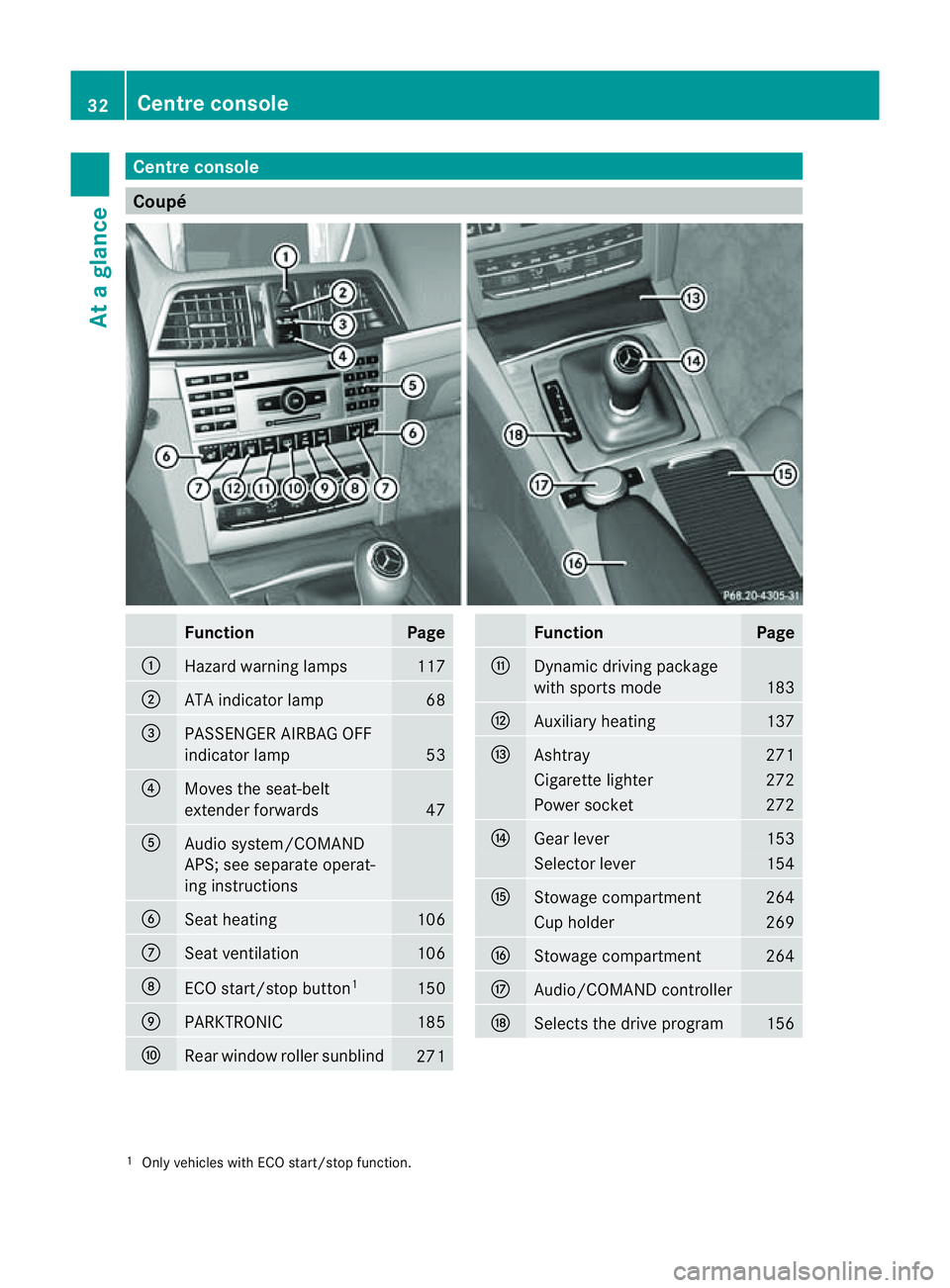
Centre console
Coupé
Function Page
:
Hazard warning lamps 117
;
AT
Ai ndicator lamp 68
=
PASSENGER AIRBA
GOFF
indicator lamp 53
?
Moves th
eseat-belt
extender forwards 47
A
Audi
osystem/COMAND
APS; see separate operat-
ing instructions B
Seat heating 106
C
Seat ventilation 106
D
ECO start/sto
pbutton 1 150
E
PARKTRONIC 185
F
Rear window roller sunblind
271 Function Page
G
Dynamic driving package
wit
hsports mode 183
H
Auxiliary heating 137
I
Ashtray 271
Cigarett
elighter 272
Power socket 272
J
Gear lever 153
Selector lever 154
K
Stowage compartment 264
Cup holder 269
L
Stowage compartment 264
M
Audio/COMAND controller
N
Select
sthe driv eprogram 156
1
Only vehicle swithE CO start/sto pfunction. 32
Centre consoleAt
ag lance
Page 36 of 353
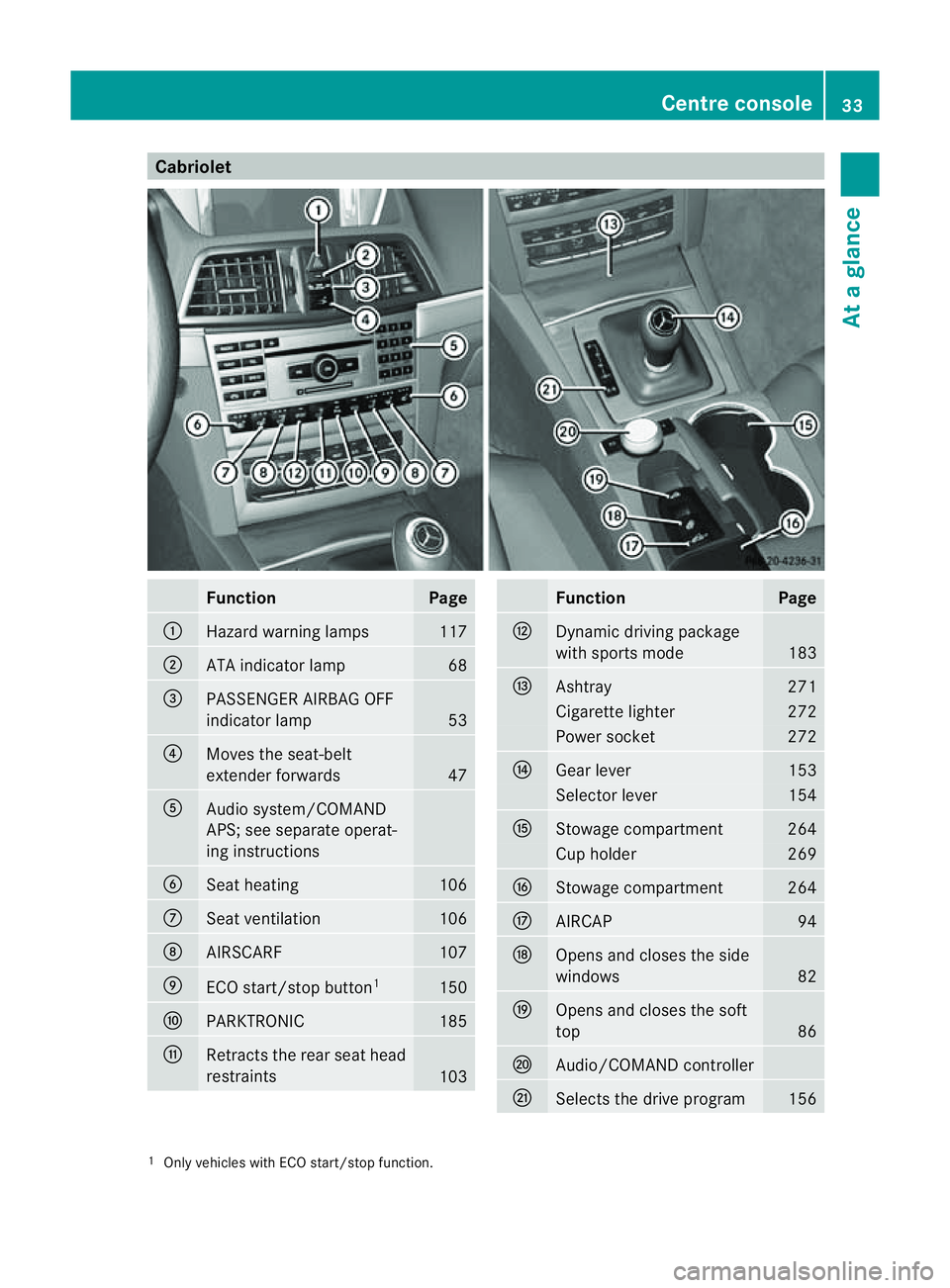
Cabriolet
Function Page
:
Hazard warning lamps 117
;
AT
Ai ndicator lamp 68
=
PASSENGER AIRBA
GOFF
indicator lamp 53
?
Moves th
eseat-belt
extender forwards 47
A
Audi
osystem/COMAND
APS; see separate operat-
ing instructions B
Seat heating 106
C
Seat ventilation 106
D
AIRSCARF 107
E
ECO start/sto
pbutton 1 150
F
PARKTRONIC 185
G
Retracts th
erear seat head
restraints 103 Function Page
H
Dynamic driving package
wit
hsports mode 183
I
Ashtray 271
Cigarett
elighter 272
Power socket 272
J
Gear lever 153
Selector lever 154
K
Stowage compartment 264
Cup holder 269
L
Stowage compartment 264
M
AIRCAP 94
N
Open
sand closes th eside
windows 82
O
Open
sand closes th esoft
top 86
P
Audio/COMAND controller
Q
Select
sthe driv eprogram 156
1
Only vehicle swithE CO start/sto pfunction. Centre console
33Atag lance
Page 37 of 353
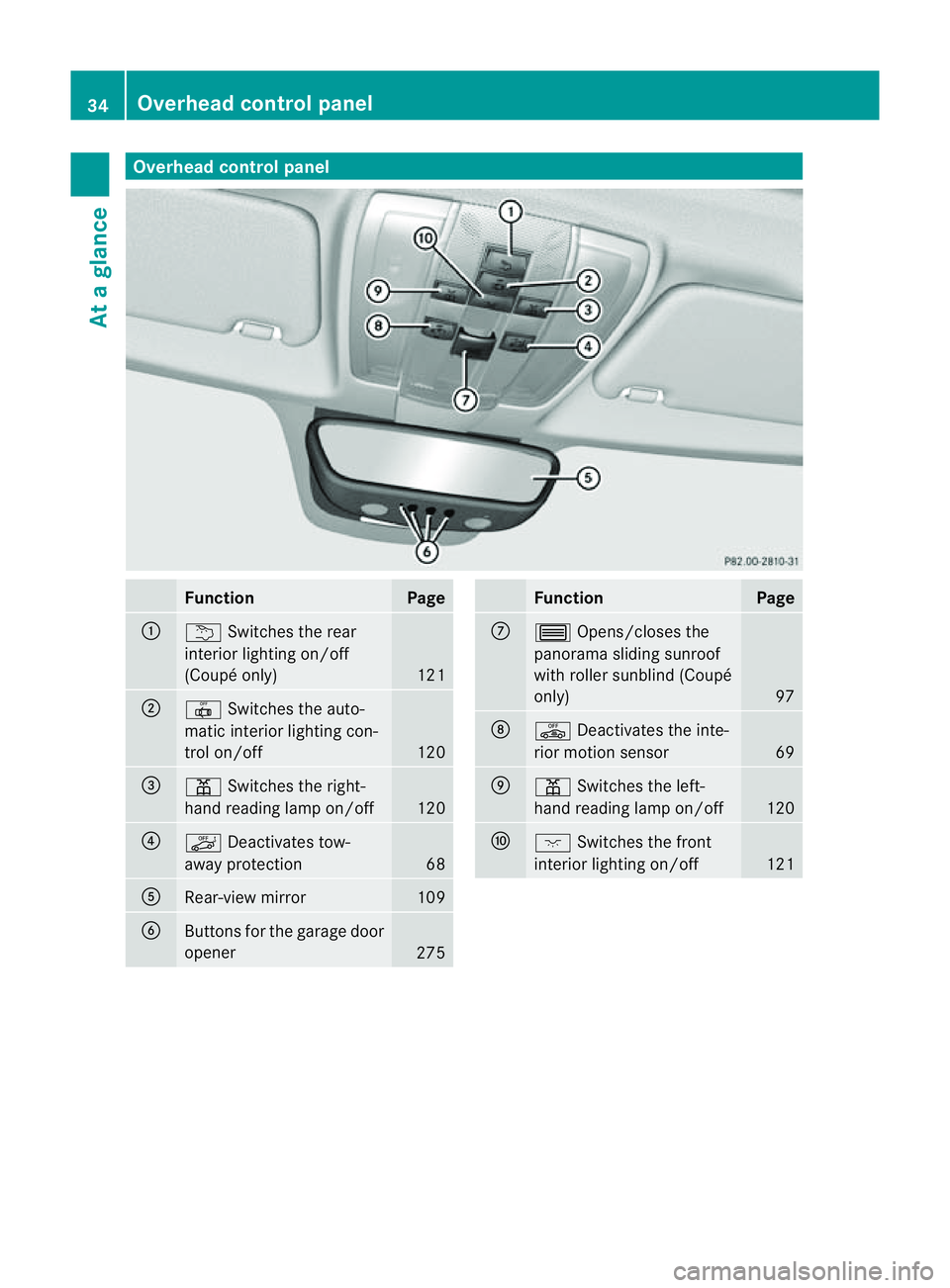
Overhea
dcontrol panel Function Page
:
u
Switche sthe rear
interio rlighting on/off
(Coupé only) 121
;
|
Switches the auto-
matic interior lighting con-
trol on/off 120
=
p
Switches the right-
hand readin glamp on/off 120
?
ë
Deactivates tow-
away protection 68
A
Rear-view mirror 109
B
Button
sfor the garage door
opener 275 Function Page
C
3
Opens/closes the
panorama slidin gsunroof
with roller sunblin d(Coupé
only) 97
D
ê
Deactivates the inte-
rior motion sensor 69
E
p
Switches the left-
hand readin glamp on/off 120
F
c
Switches the front
interior lighting on/off 12134
Overhead control panelAt
ag lance
Page 41 of 353
Useful information
i This Owner's Manual describes all models
and all standard and optional equipment
available to your vehicle at the time of pub-
lication of the Owner's Manual. Country-
specific deviation sare possible. Please
not ethat your vehicle may not be equipped
with all feature sdescribed. This also
applies to safety-relevan tsystems and
functions.
i Pleas ereadt he information on qualified
specialist workshop s(Ypage 22). Occupant safety
Important safet
ynotes
Seat belts, together wit hthe Supplemental
Restrain tSyste m–S RS (Y page 39), are
complementary, co-ordinated restrain tsys-
tems .They reduce the risk of injury in spe-
cific, pre-defined types of accident situations
and thereby increase occupant safety. How-
ever, seat belts and airbags generally do not
protect against objectsp enetratingthe vehi-
cle from the outside.
To ensure that the restraint systems can
deliver their full potential protection, make
sure that:
R the seat and head restraint are adjusted
properly (Y page 100).
R the seat belt has been fastened properly
(Y page 47).
R the airbags can inflate unrestricted if
deployed (Y page 40).
R the steering wheel is adjusted properly
(Y page 100).
R the restraint systems have not been modi-
fied.
i An airbag increases the protection of
vehicle occupants wearing aseat belt. As
such, they are only an additional restraint
system which complements, but does not
replace, the seat belt. All vehicle occupants must wear their seat belt correctly at all
times, even if the vehicle is equipped with
airbags. The airbags are not deployed in all
types of accidents. For example, if the pro-
tective capacity of correctly fastened seat
belts is not increased by deploying the air-
bags, the airbags will not deploy.A
irbag
deploymen tonly provides increased pro-
tection if the sea tbeltisw ornc orrectly
because:
R the sea tbelt helps to keep the vehicle
occupan tinthe best position in relation
to the airbag.
R in ah ead-on collision, for example, the
seat belt prevents the vehicle occupant
from being propelled towards the point
of impact. It can thus reduce the risk of
injury.
In accidents in which an airbag is deployed,
it provides increased protection only if the
seat belt is worn correctly. G
WARNING
If service work is not carried out correctly, the
operating safety of your vehicle may be affec-
ted. This could cause you to lose control of
your vehicle and cause an accident. More-
over, the safety systems may no longer be
able to protect you or others as they are
designed to do.
Always have service work carried out at a
qualified specialist workshop. The workshop
must have the necessary specialist knowl-
edge and tools to carry out the work required.
Mercedes-Ben zrecommends that you use a
Mercedes-Benz Service Centr efor this pur-
pose. In particular, work relevant to safety or
on safety-related systems must be carried out
at aq ualified specialist workshop. 38
Occupant safetySafety
Page 52 of 353
seat belt and guide the belt tongue to the belt
sash guide.
For more information aboutr eleasing the seat
belt with release button ?,see "Releasing
seat belts" (Y page 49).
Seat belt adjustment The seat-belt adjustment function adjusts the
driver's and front-passenger seat belt to the
upper body of the occupants.
The belt strap is tightened slightly when:
R you engage the belt tongue in the belt
buckle and you then turn the key to position
2 in the ignition lock.
R the key is in position 2in the ignition lock
and you then engage the belt tongue in the
buckle oncet he seat-belt extender has
retracted.
The seat-belt adjustment will apply acertain
tightening forc eifany slack is detected
between the occupan tand the sea tbelt. Do
not hold on to the seat belt tightly while it is
adjusting. You can switch the seat-belt
adjustment on and off in the on-board com-
puter (Y page 230).
The seat-belt adjustment is an integral part of
the PRE-SAFE ®
convenience function .More
information about PRE-SAFE ®
can be found
in the "PRE-SAFE ®
(preventativ eoccupant
protection)" section (Y page 45).
Releasing seat belts X
Press release button ?(Ypage 47) and
guide belt tongue ;back towards seat
belt extender :.
! Make sure that the seat belt is fully rolled
up. Otherwise, the seat belt or belt tongue
will be trapped in the door or in the seat
mechanism. This could damage the door,
the door trim panel and the seat belt. Dam-
aged seat belts can no longer fulfil their
protective function and must be replaced.
Consult aMercedes-BenzS ervice Centre. Belt warning for driver and front
passenger The
7 seat belt warning lamp in the instru-
ment cluster is areminder for all occupants
to fasten their seat belts. It may light up con-
tinuously or flash. In addition, ther emay be a
warning tone.
The 7 seat belt warning lamp goes out and
the warning tonec eases when the driver and
the fron tpassenger have fastened their seat
belt.
For certain countries only: regardless of
whether th edriver or th efront passenger
have fastened their seat belts, the 7seat
beltw arning lamp light supfor six seconds
after th eengineiss tarted. It then goes out if
th ed river and th efront pa ssenger have fas-
tene dtheir seat belts.
i For mor einformatio nonthe7 seat
belt warning lamp, see "Warning and indi-
cator lamps in th einstrumen tcluster, seat
belt" (Y page 255).
Rea rseat belt statu sindicator The rear-compartmen
tseat belt status indi-
cator tells you if the rear passengers have
their seat belts fastened.
The rear-compartment seat belt status indi-
cator indicates the rear seat on which the belt
is fastened.
The rear-compartment seat belt status indi-
cator appears in the multifunction display for
around 30 seconds if:
R you drive off and reach aspeed of approx-
imately 10 km/h.
R the rear passengers fasten or unfasten
their seat belts while the vehicle is in
motion.
R someon egets in or out of the vehicle and
the vehicle drives off again. Occupant safety
49Safety Z
Page 53 of 353
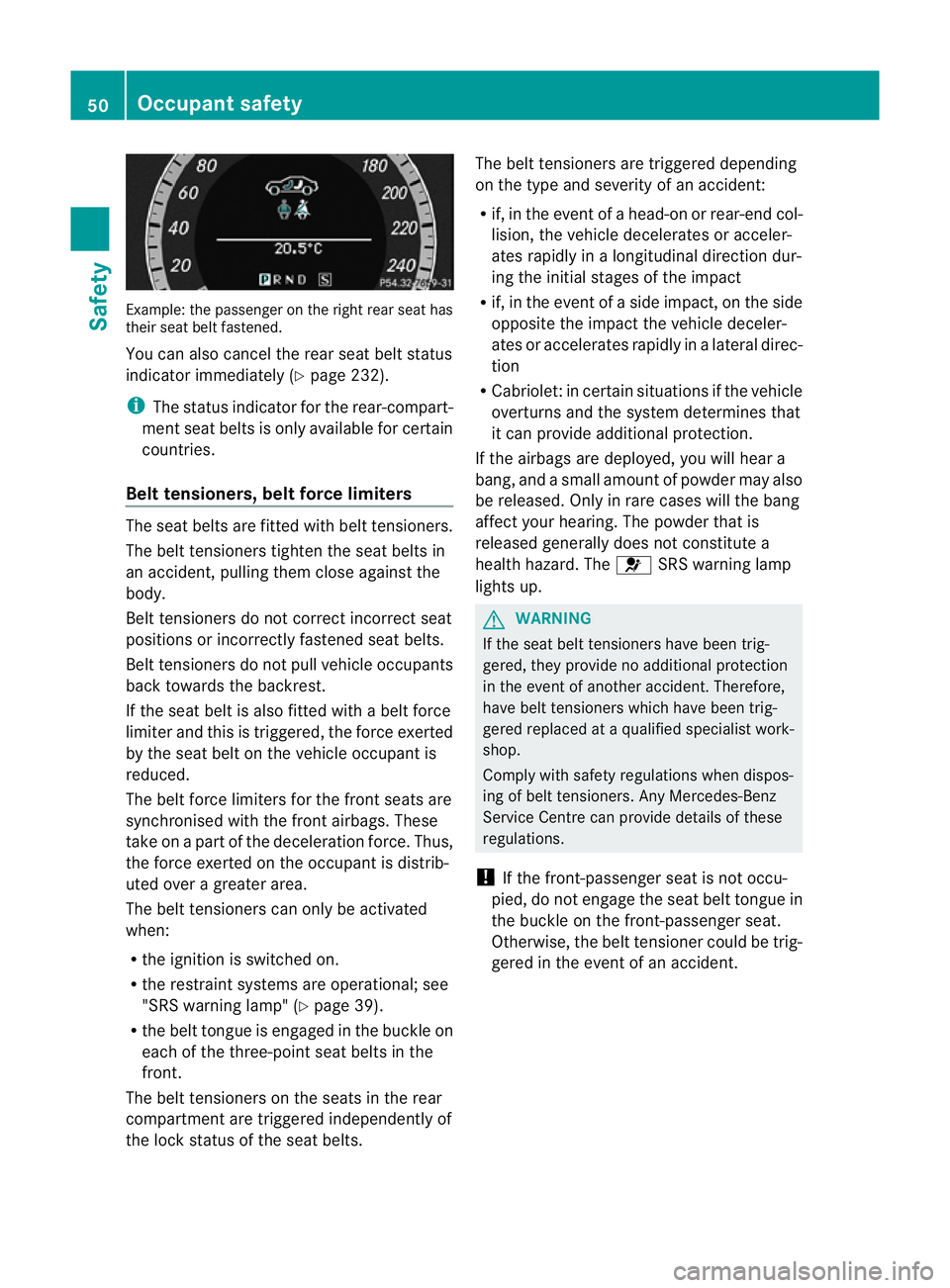
Example: the passenge
ronthe right rear seat has
their seat belt fastened.
You can also cancel the rear seat belt status
indicator immediately (Y page 232).
i The status indicator for the rear-compart-
ment seat belts is only available for certain
countries.
Belt tensioners, belt force limiters The seat belts are fitted with belt tensioners.
The belt tensionerst ighten the seat belts in
an accident, pulling them close against the
body.
Belt tensionersdon ot correct incorrects eat
positions or incorrectly fastened seat belts.
Belt tensionersdon ot pull vehicle occupants
back towards the backrest.
If the seat belt is also fitted with abelt force
limiter and this is triggered, the force exerted
by the seat belt on the vehicle occupant is
reduced.
The belt force limiters for the front seats are
synchronised with the front airbags. These
take on apart of the deceleration force. Thus,
the force exerted on the occupant is distrib-
uted over agreater area.
The belt tensionersc an only be activated
when:
R the ignition is switched on.
R the restraint systems are operational; see
"SRS warning lamp" (Y page 39).
R the belt tongue is engaged in the buckle on
each of the three-point seat belts in the
front.
The belt tensionersont he seats in the rear
compartmenta re triggeredindependently of
the lock status of the seat belts. The beltt
ensioners are triggered depending
on the type and severit yofanaccident:
R if, in the event of ahead-on or rear-en dcol-
lision, the vehicle decelerates or acceler-
ates rapidly in alongitudinal direction dur-
ing the initial stages of the impact
R if, in the event of aside impact, on the side
opposite the impact the vehicle deceler-
ates or accelerates rapidly in alateral direc-
tion
R Cabriolet: in certain situation sifthe vehicle
overturns and the system determines that
it can provide additional protection.
If the airbags are deployed, you will hear a
bang, and asmall amount of powder may also
be released. Only in rare cases will the bang
affect your hearing. The powder that is
released generally does not constitute a
health hazard. The 6SRS warning lamp
lights up. G
WARNING
If the seat belt tensioners have been trig-
gered, they provide no additional protection
in the event of another accident. Therefore,
have belt tensioners which have been trig-
gered replaced at aqualified specialist work-
shop.
Comply with safety regulations when dispos-
ing of belt tensioners .Any Mercedes-Benz
Service Centr ecan provide details of these
regulations.
! If the front-passenger seat is not occu-
pied, do not engage the seat belt tongue in
the buckle on the front-passenger seat.
Otherwise, the belt tensioner could be trig-
gered in the event of an accident. 50
Occupant safetySafety
Page 67 of 353
or BAS PLUS, the brake lamps flash rapidly.
In this way, traffic travelling behind you is
warned in an even more noticeable manner.
If you brake sharply from aspeed of more
than 70 km/htoa standstill, the hazard warn-
ing lamps are activated automatically. If the
brakes are applied again, the brake lamps
light up continuously. The hazard warning
lamps switch off automaticallyify ou travel
faster than 10 km/h .You can also switch off
the hazard warning lamps using the hazard
warning switch button (Y page 117).ESP
®
(Electronic Stability Program)
Important safety notes i
See the "Important safety notes" section
(Y page 61).
If ESP ®
detect sthat the vehicle is deviating
from the direction desired by the driver, one
or more wheels are braked to stabilise the
vehicle. If necessary, the engine output is also
modified to keep the vehicle on the desired
course within physical limits. ESP ®
assists
the driver when pulling away on wet or slip-
pery roads. ESP ®
can also stabilise the vehi-
cle during braking.
If ESP ®
intervenes, the ÷ESP®
warning
lamp flashes in the instrument cluster. G
WARNING
If the ÷ warning lamp in the instrument
cluster flashes, proceed as follows:
R do not deactivate ESP ®
under any circum-
stances.
R only depress the accelerator pedal as far as
necessary when pulling away.
R adapt your driving style to suit the prevail-
ing road and weather conditions.
Otherwise, the vehicle could go into askid.
ESP ®
cannot reduce the risk of an accident if
you drive too fast. ESP ®
cannot override the
laws of physics. !
Switch the ignition off when:
R the parking brake is being tested using a
dynamometer
R the vehicle is being towed with the front/
rear axle raised
Application of the brakes by ESP ®
may oth-
erwise destroy the brake system.
i Only use wheels with the recommended
tyre sizes. Only then will ESP ®
function
properly.
ETS (Electronic Traction Support) Traction control is part of ESP
®
.
Traction control brakes the drive wheels indi-
viduall yifthey spin. This enables you to pull
away and accelerate on slippery surfaces, for
example if the road surface is slippery on one
side.
Traction control remains active if you deacti-
vate ESP ®
. G
WARNING
Traction control cannot reduce the risk of an
accident if you drive too fast. Traction control
cannot override the laws of physics.
Deactivating/activating ESP ® i
Observe the "Important safety notes" sec-
tion (Y page 61).
ESP ®
is activated automatically when the
engine is started.
i Vehicles with ECO start/stop function:
the ECO start/stop function switches the
engine off automatically when the vehicle
comes to astop. The engine startsa uto-
matically when the driver wants to pull
away again. ESP ®
remains in its previously
selected status. Example: if ESP ®
was
deactivated before the engine was
switched off, ESP ®
remains deactivated
when the engine is switched on again. 64
Driving safety systemsSafety
Page 71 of 353
Anti-thef
tsystems Immobiliser
The immobiliser prevents your vehicl efrom
bein gstarted without th ecorrect key.
X To activat ewith the key: remove the key
from the ignition lock.
X To activate with KEYLESS-GO: switch the
ignition off and open the driver's door.
X To deactivate: switch on the ignition.
i The immobiliser is alway sdeactivated
when you start the engine. ATA (Anti-Theft Alarm system)
Av isual and audible alarm is triggere difthe
alarm system is prime dand you open:
R ad oor
R the vehicle with the emergency key ele-
ment
R the boot lid
R the bonnet
The alarm is not switched off ,even if you
clos ethe open door that has triggere dit, for
example. X
To prime: lock the vehicle with the key or
KEYLESS-GO.
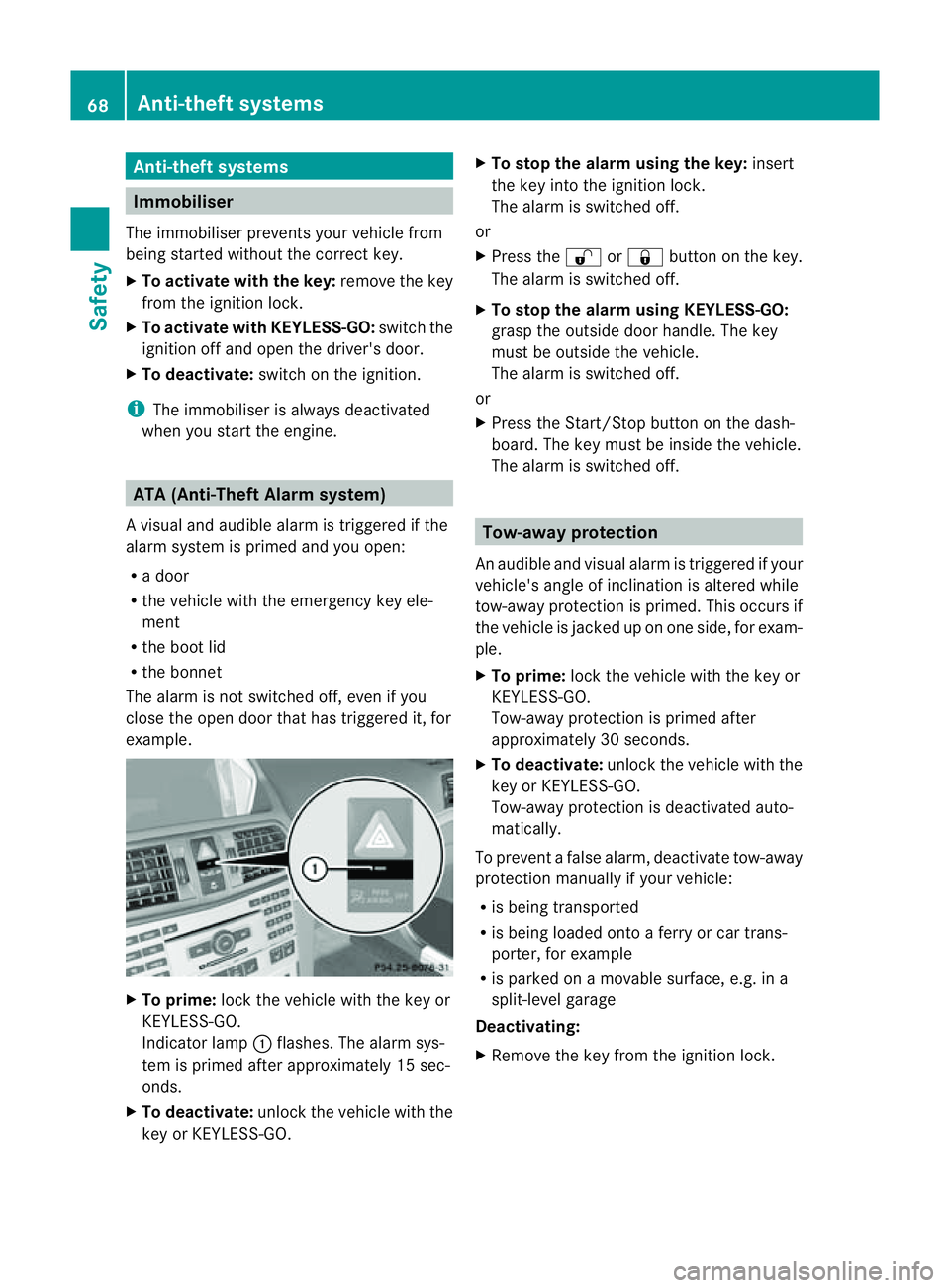
Indicator lamp :flashes .The alarm sys-
tem is primed after approximately 15 sec-
onds.
X To deactivate: unlock the vehicle with the
key or KEYLESS-GO. X
To stop the alarm using the key: insert
the key into the ignition lock.
The alarm is switched off.
or
X Press the %or& button on the key.
The alarm is switched off.
X To stop the alarm using KEYLESS-GO:
grasp the outside door handle. The key
must be outside the vehicle.
The alarm is switched off.
or
X Press the Start/Stop button on the dash-
board. The key must be inside the vehicle.
The alarm is switched off. Tow-away protection
An audible and visual alarm is triggered if your
vehicle's angle of inclination is altered while
tow-away protection is primed. This occurs if
the vehicle is jacked up on one side, for exam-
ple.
X To prime: lock the vehicle with the key or
KEYLESS-GO.
Tow-away protection is primed after
approximately 30 seconds.
X To deactivate: unlock the vehicle with the
key or KEYLESS-GO.
Tow-away protection is deactivated auto-
matically.
To prevent afalse alarm, deactivate tow-away
protection manually if your vehicle:
R is being transported
R is being loaded onto aferry or car trans-
porter, for example
R is parked on amovable surface, e.g. in a
split-level garage
Deactivating:
X Remove the key from the ignition lock. 68
Anti-theft systemsSafety
Page 72 of 353
X
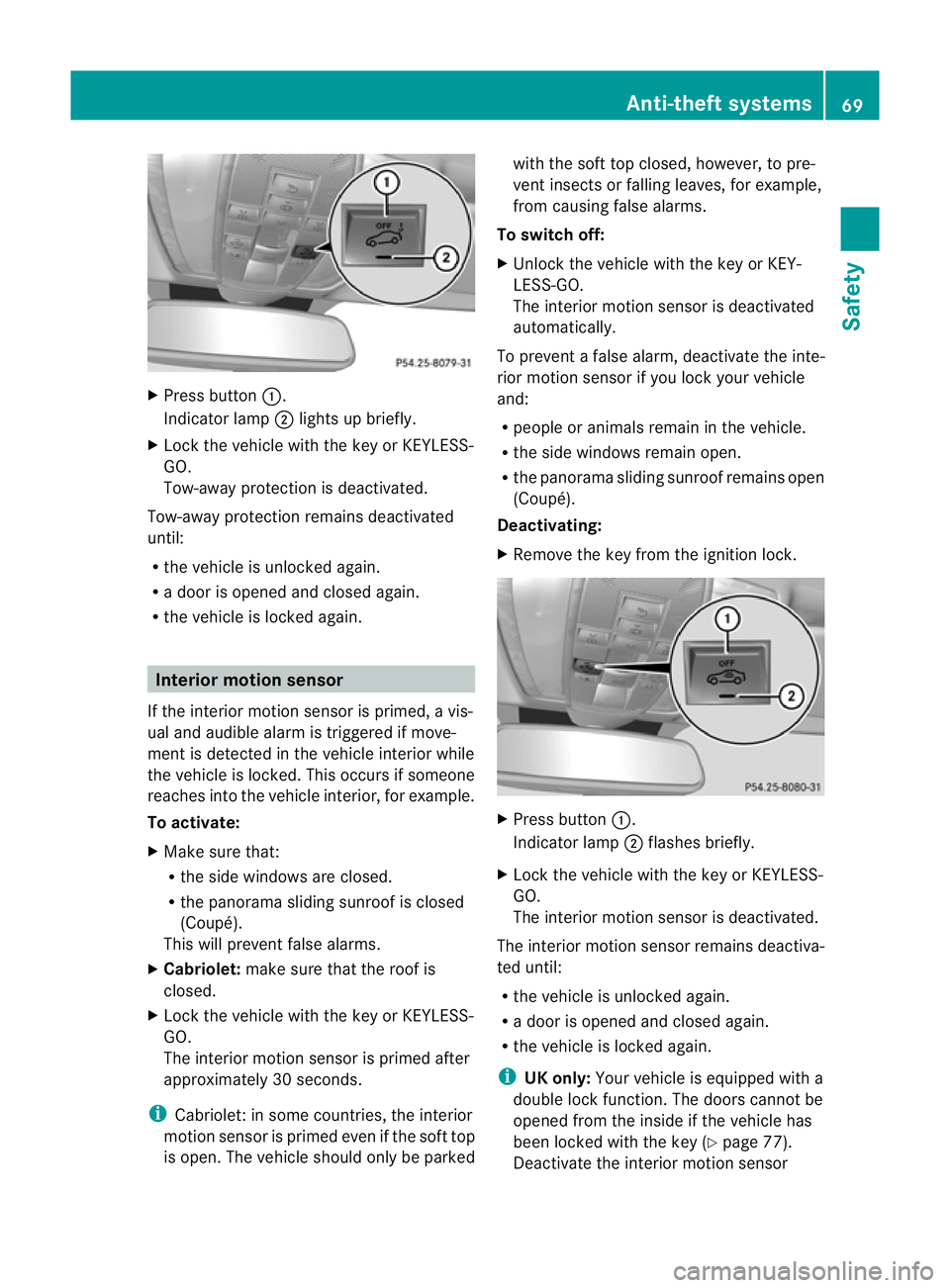
Press button :.
Indicator lamp ;lights up briefly.
X Lock the vehicle with the key or KEYLESS-
GO.
Tow-away protection is deactivated.
Tow-away protection remains deactivated
until:
R the vehicle is unlocked again.
R ad oor is opened and closed again.
R the vehicle is locked again. Interior motion sensor
If the interior motion sensor is primed, avis-
ual and audibl ealarm is triggered if move-
ment is detected in the vehicle interior while
the vehicle is locked. This occurs if someone
reaches into the vehicle interior, for example.
To activate:
X Make sure that:
R
the side windows are closed.
R the panorama sliding sunroof is closed
(Coupé).
This will prevent false alarms.
X Cabriolet: make sure that the roof is
closed.
X Lock the vehicle with the key or KEYLESS-
GO.
The interior motion sensor is primed after
approximately 30 seconds.
i Cabriolet: in some countries, the interior
motion sensor is primed even if the soft top
is open. The vehicle should only be parked with the soft top closed, however, to pre-
vent insect
sorfalling leaves, for example,
from causing false alarms.
To switch off:
X Unlock the vehicle with the key or KEY-
LESS-GO.
The interior motion sensor is deactivated
automatically.
To prevent afalse alarm, deactivat ethe inte-
rior motion sensor if you lock your vehicle
and:
R people or animals remain in the vehicle.
R the side windows remain open.
R the panorama sliding sunroof remains open
(Coupé).
Deactivating:
X Remove the key from the ignition lock. X
Press button :.
Indicator lamp ;flashes briefly.
X Lock the vehicle with the key or KEYLESS-
GO.
The interior motion sensor is deactivated.
The interior motion sensor remains deactiva-
ted until:
R the vehicle is unlocked again.
R ad oor is opened and closed again.
R the vehicle is locked again.
i UK only: Your vehicle is equipped with a
double lock function. The doors cannot be
opened from the inside if the vehicle has
been locked with the key (Y page 77).
Deactivate the interior motion sensor Anti-theft systems
69Safety Z