Sport MERCEDES-BENZ E-CLASS CABRIOLET 2011 Owner's Manual
[x] Cancel search | Manufacturer: MERCEDES-BENZ, Model Year: 2011, Model line: E-CLASS CABRIOLET, Model: MERCEDES-BENZ E-CLASS CABRIOLET 2011Pages: 353, PDF Size: 8.42 MB
Page 316 of 353
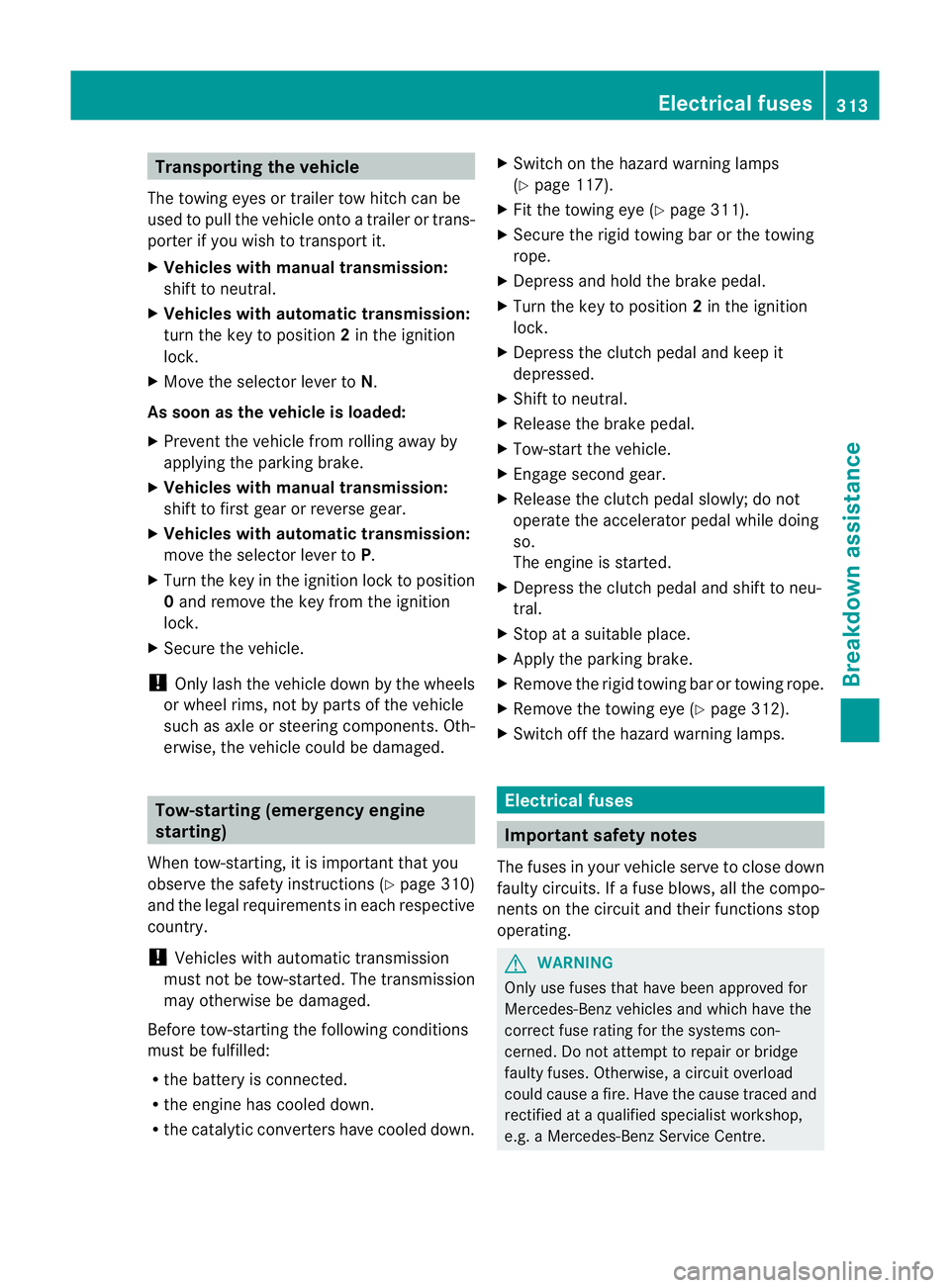
Transporting the vehicle
The towing eyes or trailer tow hitch can be
used to pull the vehicl eonto atrailer or trans-
porter if yo uwishtot ransport it.
X Vehicle swithm anual transmission:
shift to neutral.
X Vehicle switha utomatic transmission:
tur nthe key to position 2in the ignition
lock.
X Move the selector lever to N.
As soon as the vehicle is loaded:
X Prevent the vehicle from rolling away by
applying the parking brake.
X Vehicles with manualt ransmission:
shift to first gear or reverse gear.
X Vehicles with automatic transmission:
move the selector lever to P.
X Turn the key in the ignition lock to position
0 and remove the key from the ignition
lock.
X Secure the vehicle.
! Only lash the vehicle down by the wheels
or wheel rims, not by parts of the vehicle
such as axle or steering components. Oth-
erwise, the vehicle could be damaged. Tow-starting (emergency engine
starting)
When tow-starting, it is important that you
observe the safety instructions (Y page 310)
and the legal requirements in each respective
country.
! Vehicles with automatic transmission
must not be tow-started. The transmission
may otherwise be damaged.
Before tow-starting the following conditions
must be fulfilled:
R the battery is connected.
R the engine has cooled down.
R the catalytic converters have cooled down. X
Switch on the hazard warning lamps
(Y page 117).
X Fit the towing eye (Y page 311).
X Secure the rigid towing bar or the towing
rope.
X Depress and hold the brake pedal.
X Turn the key to position 2in the ignition
lock.
X Depress the clutch pedal and keep it
depressed.
X Shift to neutral.
X Release the brake pedal.
X Tow-start the vehicle.
X Engage second gear.
X Release the clutch pedal slowly;don ot
operate the accelerator pedal while doing
so.
The engine is started.
X Depress the clutch pedal and shift to neu-
tral.
X Stop at asuitable place.
X Apply the parking brake.
X Remove the rigid towing bar or towing rope.
X Remove the towing eye (Y page 312).
X Switch off the hazard warning lamps. Electrical fuses
Important safety notes
The fuses in your vehicle serve to close down
faulty circuits. If afuse blows ,all th ecom po-
nent sont hecircuit and their function sstop
operating. G
WARNING
Only use fuses that have been approve dfor
Mercedes-Ben zvehicles and which have the
correct fuse ratin gfor the systems con-
cerned. Do not attempt to repair or bridge
faulty fuses. Otherwise, acircuit overload
could cause afire. Have the cause traced and
rectified at aqualified specialist workshop,
e.g. aMercedes-Benz Service Centre. Electrical fuses
313Breakdown assistance Z
Page 325 of 353
is kept open continuously, which may lead to
air loss. G
WARNING
Should the tyre pressure drop repeatedly:
R chec kthe tyre for foreign bodies.
R check whether the wheel is losing air or the
valve is leaking.
R make sure that only avalve cap approved
by Mercedes-Ben zisfitted on the tyre
valve.
Tyre pressures that are too low have anega-
tive effect on vehicle safety, which could lead
you to cause an accident.
If possible, only correct tyre pressures when
the tyres are cold. The tyres are cold when
the vehicle has been parked for at least three
hours or has been driven less than 1.5 km.
Depending on the ambient temperature, the
speed you are driving at and the load on the
tyres, the tyre temperature and thus the tyre
pressure may change by approximately
10 kPa (0.1 bar/1.5 psi) per 10 †. Take this
into account when checking the pressure of
warm tyres and only correct it if it is too low
for the current operating conditions.
Driving with tyre pressure that is too high or
too low can:
R shorten the service life of the tyres
R cause increased tyre damage
R have anegative effect on handling charac-
teristics and thus the driving safety (e.g. by
causing aquaplaning)
i The tyre pressure values given for low
loads are minimum values which offer you
good ride comfort characteristics.
However, you can also use the values given
for higher loads. These are permissible and
will not adversely affect the running of the
vehicle. H
Environmental note
Check the tyre pressure regularly,atl east
every 14 days. Tyrep
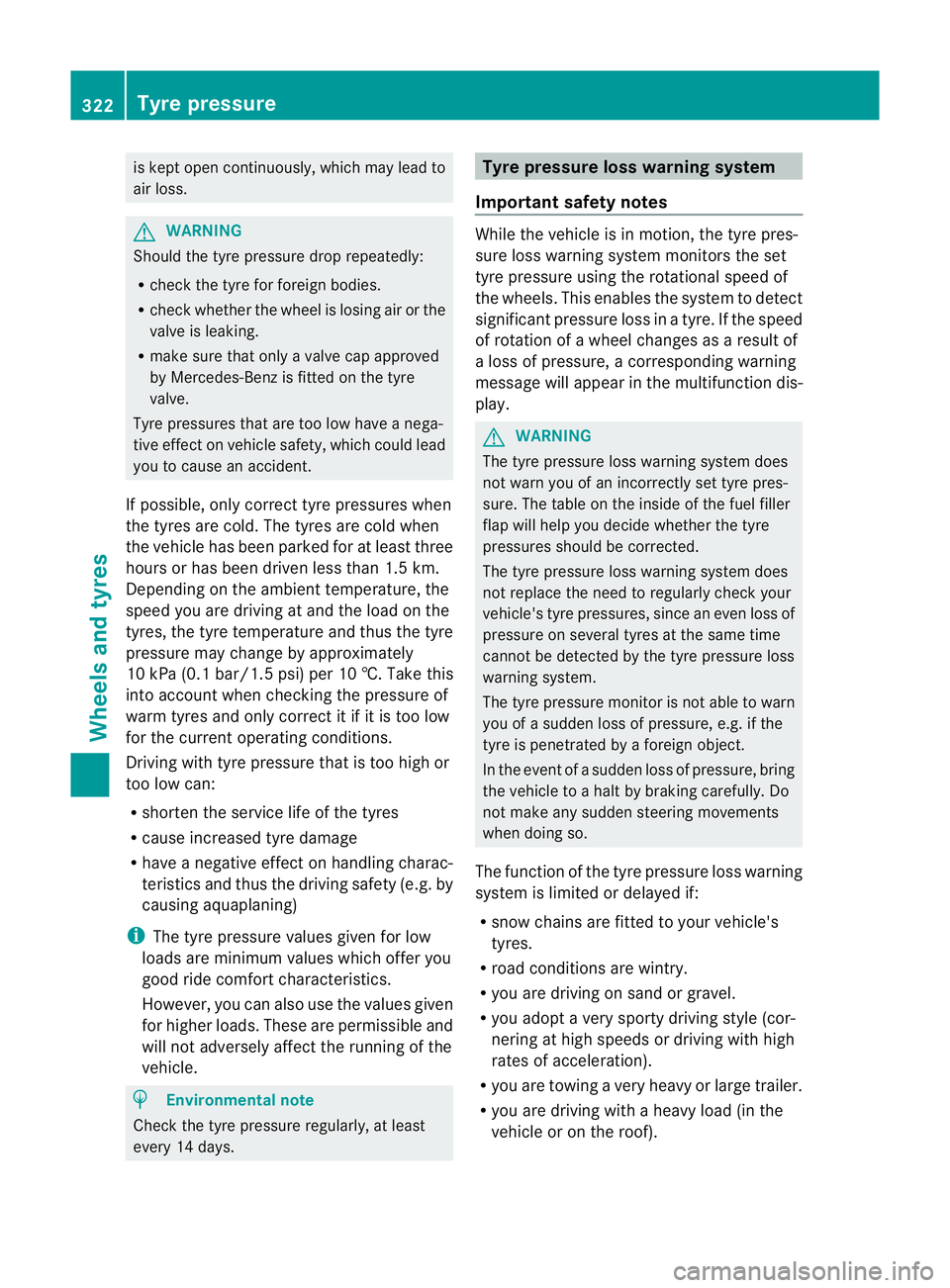
ressur eloss warning system
Important safety notes While the vehicle is in motion, the tyre pres-
sure loss warning system monitors the set
tyre pressure using the rotational speed of
the wheels. This enables the system to detect
significant pressure loss in
atyre. If the speed
of rotation of awheel changes as aresult of
al oss of pressure, acorresponding warning
message will appearint he multifunction dis-
play. G
WARNING
The tyre pressure loss warning system does
not warn you of an incorrectly set tyre pres-
sure. The table on the inside of the fuel filler
flap will help you decide whether the tyre
pressures should be corrected.
The tyre pressure loss warning system does
not replace the need to regularly check your
vehicle's tyre pressures, since an even loss of
pressure on several tyres at the same time
cannot be detected by the tyre pressure loss
warning system.
The tyre pressure monitor is not able to warn
you of asudden loss of pressure, e.g. if the
tyre is penetrated by aforeign object.
In the event of asudden loss of pressure, bring
the vehicle to ahalt by braking carefully. Do
not make any sudden steering movements
when doing so.
The function of the tyre pressure loss warning
system is limited or delayed if:
R snow chains are fitted to your vehicle's
tyres.
R road conditionsa re wintry.
R you are driving on sand or gravel.
R you adopt avery sporty driving style (cor-
nering at high speeds or driving with high
rates of acceleration).
R you are towing avery heavy or large trailer.
R you are driving with aheavy load (in the
vehicle or on the roof). 322
Tyrep
ressureWheels and tyres
Page 329 of 353
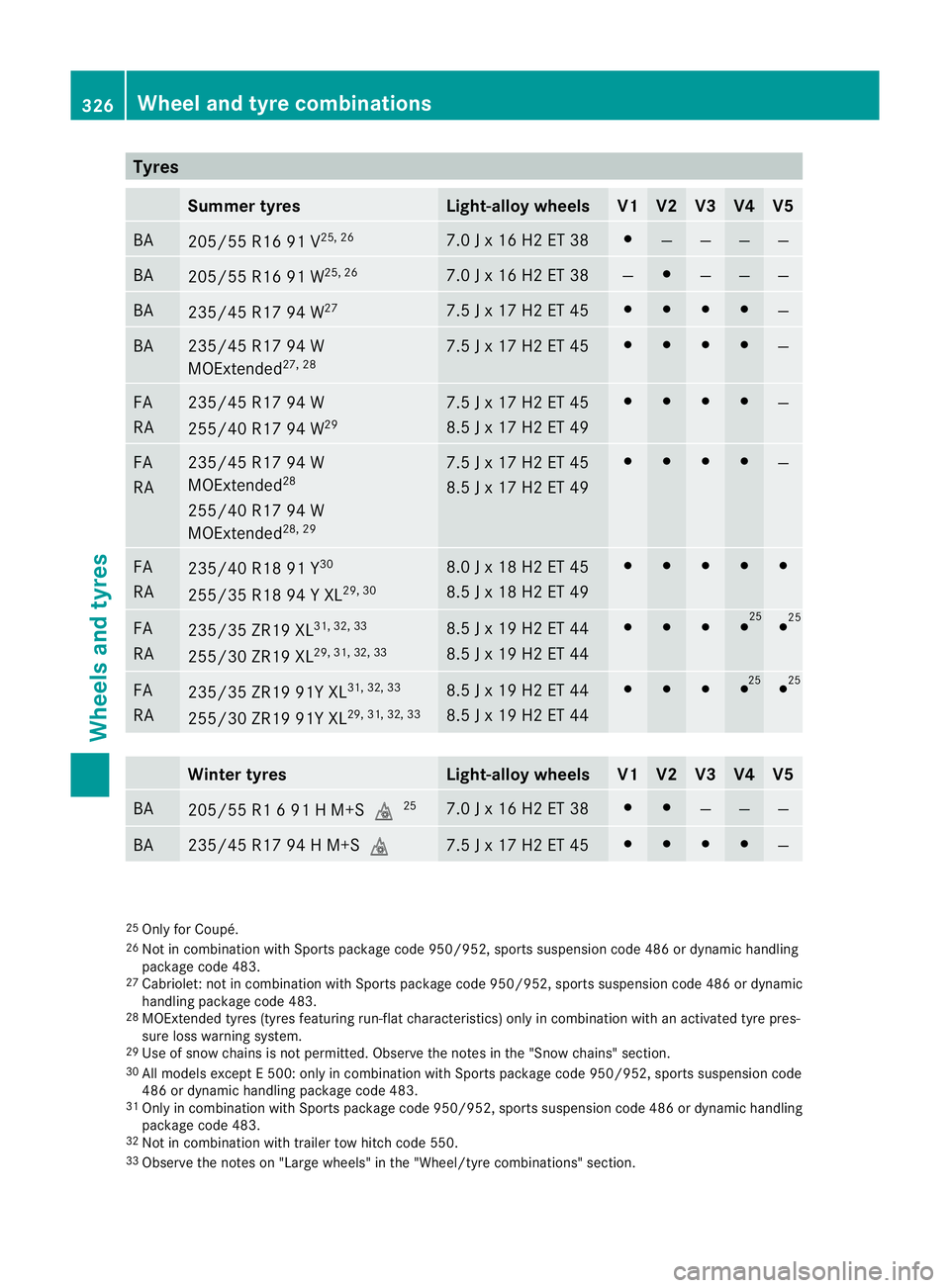
Tyres
Summe
rtyres Light-alloy wheels V1 V2 V3 V4 V5
BA
205/5
5R1691 V 25
,26 7.
0Jx16H2ET38 #
— — — —
BA
205/55 R1
691W25, 26 7.0
Jx16H2ET38 — #
— — —
BA
235/45 R1
794W27 7.5
Jx17H2ET45 # # # #
—
BA 235/45 R1
794W
MOExtended 27, 28 7.5
Jx17H2ET45 # # # #
—
FA
RA 235/45 R1
794W
255/40 R1 794W29 7.5
Jx17H2ET45
8.5 Jx17H2ET49 # # # #
—
FA
RA 235/45 R1
794W
MOExtended 28
255/40 R1 794W
MOExtended 28, 29 7.5
Jx17H2ET45
8.5 Jx17H2ET49 # # # #
—
FA
RA
235/40 R1
891Y30
255/35 R1 894YXL29, 30 8.0
Jx18H2ET45
8.5 Jx18H2ET49 # # # # #
FA
RA
235/35 ZR19 XL
31, 32, 33
255/30 ZR19 XL 29, 31, 32, 33 8.5
Jx19H2ET44
8.5 Jx19H2ET44 # # # # #
FA
RA
235/35 ZR19 91Y XL
31, 32, 33
255/30 ZR19 91Y XL 29, 31, 32, 33 8.5
Jx19H2ET44
8.5 Jx19H2ET44 # # # # #
Winter tyres Light-alloy wheels V1 V2 V3 V4 V5
BA
205/55 R1
691HM+Si 25 7.0
Jx16H2ET38 # #
— — —
BA 235/45 R1
794HM+Si 7.5
Jx17H2ET45 # # # #
—
25
Onl yfor Coupé.
26 Not in combinatio nwithS ports packag ecode9 50/952, sports suspension cod e486 or dynamic handling
packag ecode4 83.
27 Cabriolet: not in combinatio nwith Sports package code 950/952, sport ssuspension code 486 or dynamic
handlin gpackage code 483.
28 MOExtended tyres (tyres featuring run-flat characteristics) only in combination with an activated tyre pres-
sure loss warnin gsystem.
29 Use of snow chain sisnot permitted. Observe the notes in the "Sno wchains" section.
30 All models except E500:only in combination with Sports package code 950/952, sport ssuspension code
486 or dynamic handlin gpackage code 483.
31 Only in combination with Sports package code 950/952, sport ssuspension code 486 or dynamic handling
package code 483.
32 Not in combination with trailer tow hitc hcode 550.
33 Observe the notes on "Large wheels" in the "Wheel/tyre combinations" section. 326
Wheel and tyre combinationsWheels and tyres
25
25
25
25