ignition MERCEDES-BENZ E-CLASS CABRIOLET 2011 Owners Manual
[x] Cancel search | Manufacturer: MERCEDES-BENZ, Model Year: 2011, Model line: E-CLASS CABRIOLET, Model: MERCEDES-BENZ E-CLASS CABRIOLET 2011Pages: 353, PDF Size: 8.42 MB
Page 15 of 353
Engine diagnostics
.........................260
Fuel tank ........................................ 260
Indicator lamps
Display message ............................ 239
see Warning and indicator lamps
Indicators
see Turn signals
Instrument cluster
Overview .......................................... 28
Settings ......................................... 225
Warning and indicator lamps ...........30
Instrument cluster lighting ................28
Instrument lighting see Instrument cluster lighting
Intelligen tLight System
Activating/deactivatin g................. 226
Display message ............................ 241
Setting the dipped-bea mhead-
lamps for driving on the right/left .227
Interior lighting
Automatic control system ..............120
Delayeds witch-off (on-board
computer) ...................................... 228
Emergency lighting ........................121
Manual control ............................... 121
Overview ........................................ 120
Reading lamp ................................. 120
see Interior lighting
Interior motio nsensor ........................ 69
ISOFIXc hild seat securing system ....54 J
Jack Storage location ............................ 295
Using ............................................. 302
Jump starting (engine) ......................309 K
Key Changing the battery .......................75
Checking the battery .......................74
Convenience closing feature ............84
Convenience opening feature ..........83
Display message ............................ 253
Door central locking/unlocking .......72
Emergency key element ................... 74 Loss
................................................. 76
Modifying the programming .............73
Opening/closing soft top .................87
Positions (ignition lock) .................147
Problem (malfunction) .....................76
Starting the engine ........................148
KEYLESS-GO
Convenience closing ........................84
Display message ............................ 253
Locking ............................................ 73
Start/Stop button .......................... 147
Starting the engine ........................149
Unlocking ......................................... 73
Keyp ositions
Key ................................................ 147
KEYLESS GO .................................. 147
Kickdown
Driving tips .................................... 156
Manual drive program ....................159
Kneebag ............................................... 42 L
Lamps see Warning and indicator lamps
Lane-chang eassistant
see Blind Spot Assist
Lane Keepin gAssist
Activating/deactivating .................224
Display message ............................ 245
Function/informatio n.................... 198
Lane package ..................................... 196
Lashing eyelets ................................. 267
Licenc eplate lamp (display mes-
sage) ................................................... 240
Lighting see Lights
Lights
Activating/deactivating the Intel-
ligent Ligh tSystem ........................ 226
Activating/deactivating the inte-
rior lighting delayed switch-off .......228
Active light function .......................118
Automatic headlamp mode ............115
Cornering light function .................118
Dipped-bea mheadlamps ............... 115
Display message ............................ 238
Driving abroad ............................... 11412
Index
Page 29 of 353
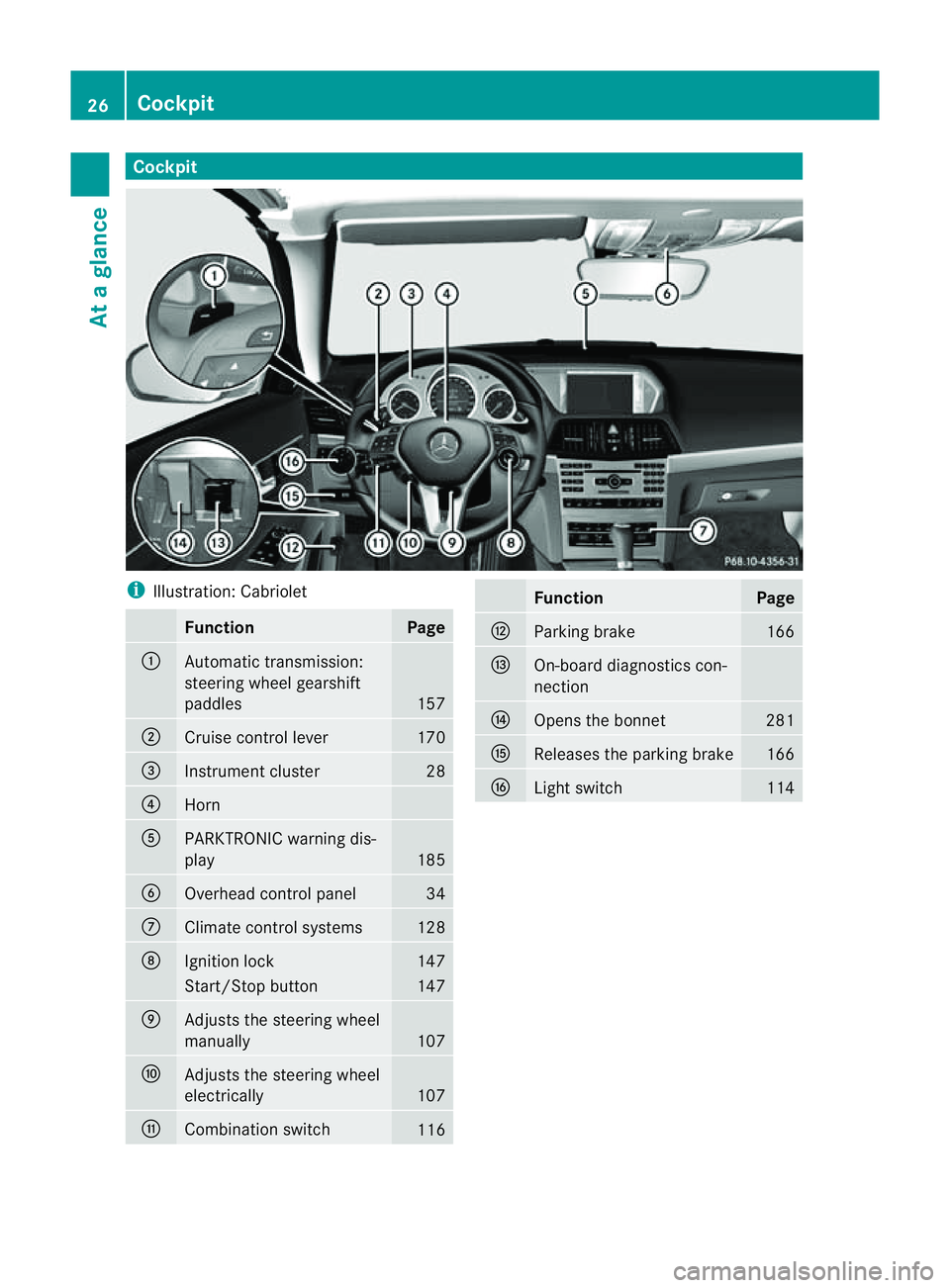
Cockpit
i
Illustration: Cabriolet Function Page
:
Automatic transmission:
steering wheel gearshift
paddles
157
;
Cruise control lever 170
=
Instrumen
tcluster 28
?
Horn
A
PARKTRONIC warning dis-
play
185
B
Overhead control panel 34
C
Climat
econtro lsystems 128
D
Ignition lock 147
Start/Sto
pbutton 147
E
Adjusts th
esteering wheel
manually 107
F
Adjusts th
esteering wheel
electrically 107
G
Combination switch
116 Function Page
H
Parking brake 166
I
On-board diagnostics con-
nection
J
Open
sthe bonnet 281
K
Release
sthe parking brake 166
L
Ligh
tswitch 11426
CockpitAt
ag lance
Page 30 of 353
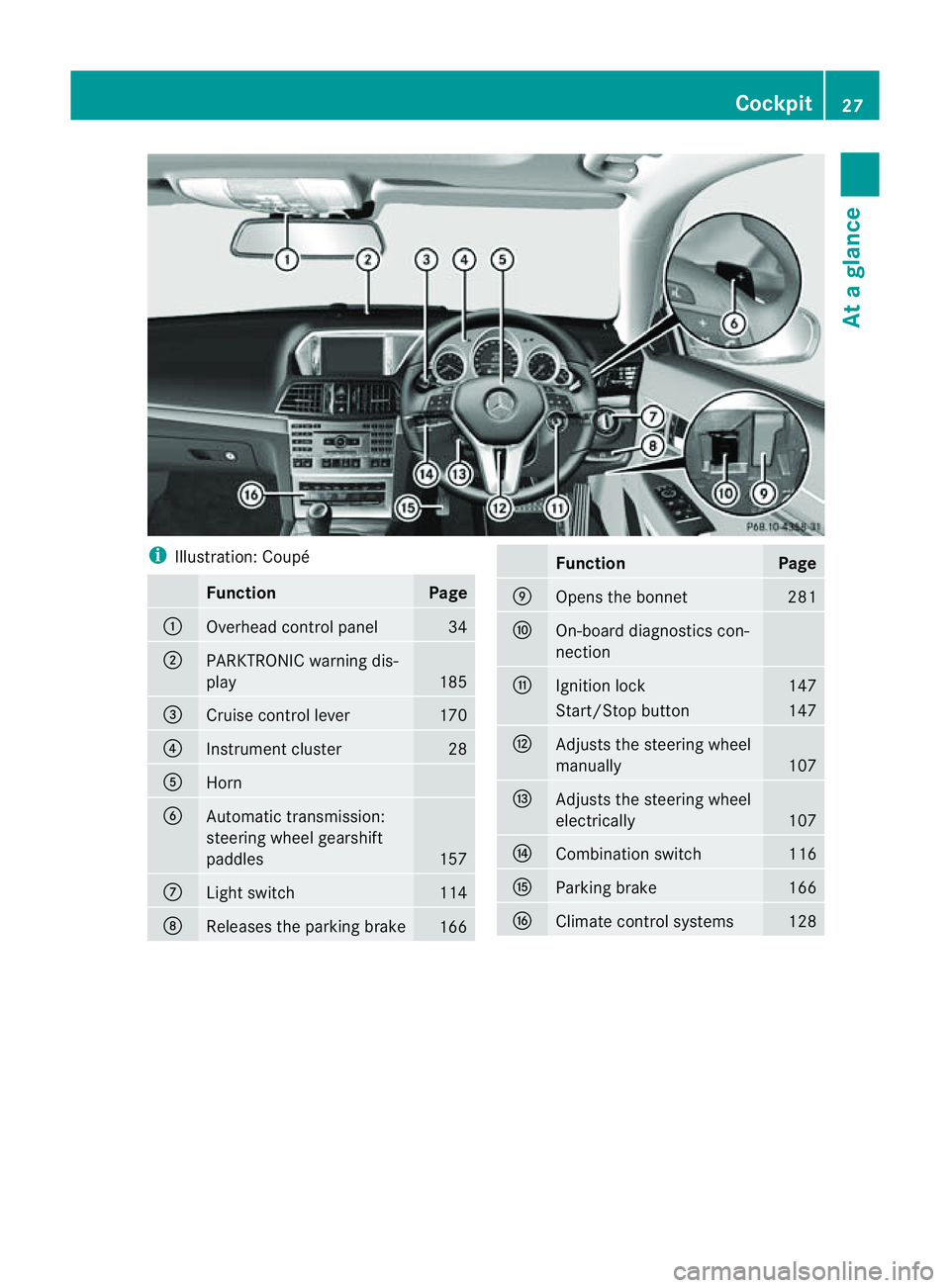
i
Illustration: Coupé Function Page
:
Overhea
dcontrol panel 34
;
PARKTRONIC warning dis-
play
185
=
Cruise control lever 170
?
Instrument cluster 28
A
Horn
B
Automatic transmission:
steering wheelg
earshift
paddles 157
C
Light switch 114
D
Releasest
he parking brake 166 Function Page
E
Opens the bonnet 281
F
On-board diagnostics con-
nection
G
Ignition lock 147
Start/Stop button 147
H
Adjusts the steering wheel
manually
107
I
Adjusts the steering wheel
electrically
107
J
Combination switch 116
K
Parking brake 166
L
Climate control systems 128Cockpit
27Atag lance
Page 42 of 353
G
WARNING
Modifications to or work performe dincor-
rectly on the following parts can result in the
restraint systems not functioning as intended:
R the restraint system, consisting of seat
belts and their anchorage points, beltt en-
sioners, belt forc elimiters and airbags
R the wiring
R networked electronic systems
Airbags and belt tensioners could fail to
deploy or be triggered in an acciden tdespite
the deceleration forc ebeing sufficien ttotrig-
ger the systems, or could be triggered unin-
tentionally. For this reason, never make any
modifications to the restraint systems.
Therefore, you must not tamper with elec-
tronic components or their software. SRS (Supplemental Restraint System)
Introduction SRS consist
sof:
R the 6 SRS warning lamp
R airbags
R airbag control unit (with crash sensors)
R belt tensioners
R belt force limiters
SRS reduces the risk of occupant scoming
into contact with the vehicle's interior in the
event of an accident .Itcan also reduce the
effect of the forces to which occupant sare
subjected during an accident.
SRS warning lamp SRS functions are checked regularly when
you switch on the ignition and when the
engine is running. Therefore, malfunctions
can be detected in good time.
The 6 SRS warning lamp in the instrument
cluster lights up when the ignition is switched
on. It goes out no later than afew seconds
after the engine is started. G
WARNING
If SRS is malfunctioning, individual systems
may be activated unintentionally or may not
be triggered in the event of an accident with
ah igh rate of vehicle deceleration.
Am alfunction has occurred if:
R the 6 SRS warning lamp does not light
up when the ignition is switched on.
R the engine is runnin gand the 6SRS
warning lamp does not go out after afew
seconds.
R the engine is runnin gand the 6SRS
warning lamp lights up again.
In this case, have SRS checked immediately
at aq ualified specialist workshop. Mercedes-
Benz recommends that you use aMercedes-
Benz Service Centre for this purpose.
In particular, work relevant to safety or on
safety-related systems must be carried out at
aq ualified specialist workshop.
Triggering of belt tensioners, belt force
limiters and airbags During the first stage of
acollision, the airbag
control unit evaluates important physical
data relating to vehicle deceleration or accel-
eration, such as:
R duration
R direction
R magnitude
Based on the evaluation of this data, the air-
bag control unit pre-emptively triggers the
belt tensioners in the first stage.
i The belt tensioners can only be triggered
if the seat belt tongues are correctly
engaged in the seat belt buckles.
If there is an even higher rate of vehicle decel-
eration or acceleration in alongitudinal direc-
tion, the front airbags are also deployed.
Your vehicle has adaptive, two-stage front air-
bags. The airbag control unit evaluates vehi-
cle deceleration or acceleration in the event
of ac ollision. In the first deployment stage, Occupant safety
39Safety Z
Page 51 of 353
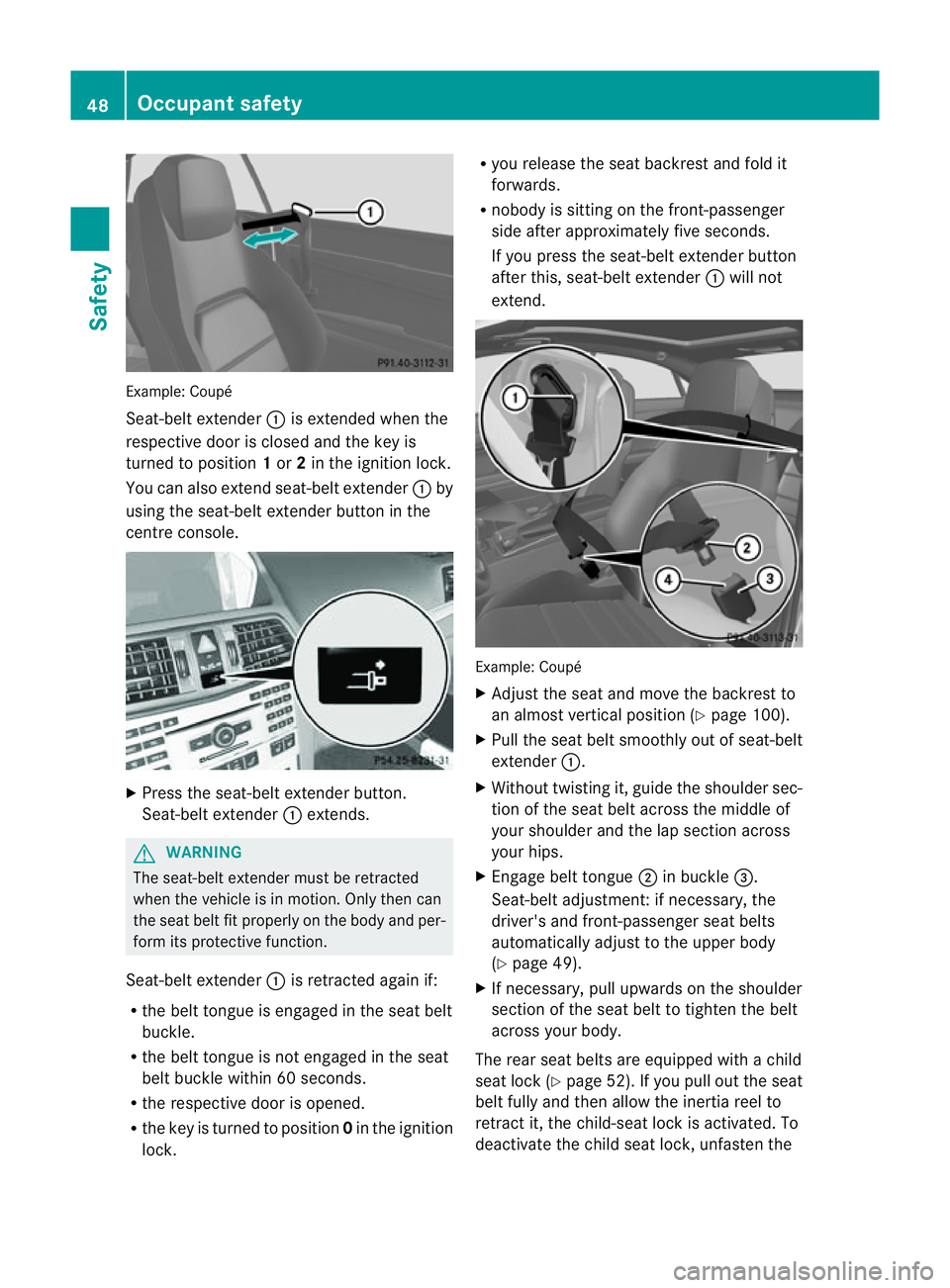
Example: Coupé
Seat-belt extender
:is extende dwhent he
respective door is closed and the key is
turned to position 1or 2in the ignition lock.
Yo uc an also extend seat-belt extender :by
using the seat-belt extende rbutton in the
centre console. X
Press th eseat-belt extender button.
Seat-belt extender :extends. G
WARNING
The seat-belt extender must be retracted
when th evehicl eisinm otion.Only then can
the sea tbelt fit properly on the body and per-
form its protective function.
Seat-belt extender :is retracted again if:
R the belt tongue is engaged in the seat belt
buckle.
R the belt tongue is not engaged in the seat
belt buckle within 60 seconds.
R the respective door is opened.
R the key is turned to position 0in the ignition
lock. R
you release the seat backrest and fold it
forwards.
R nobody is sitting on the front-passenger
side after approximately five seconds.
If you press the seat-belt extender button
after this, seat-belt extender :will not
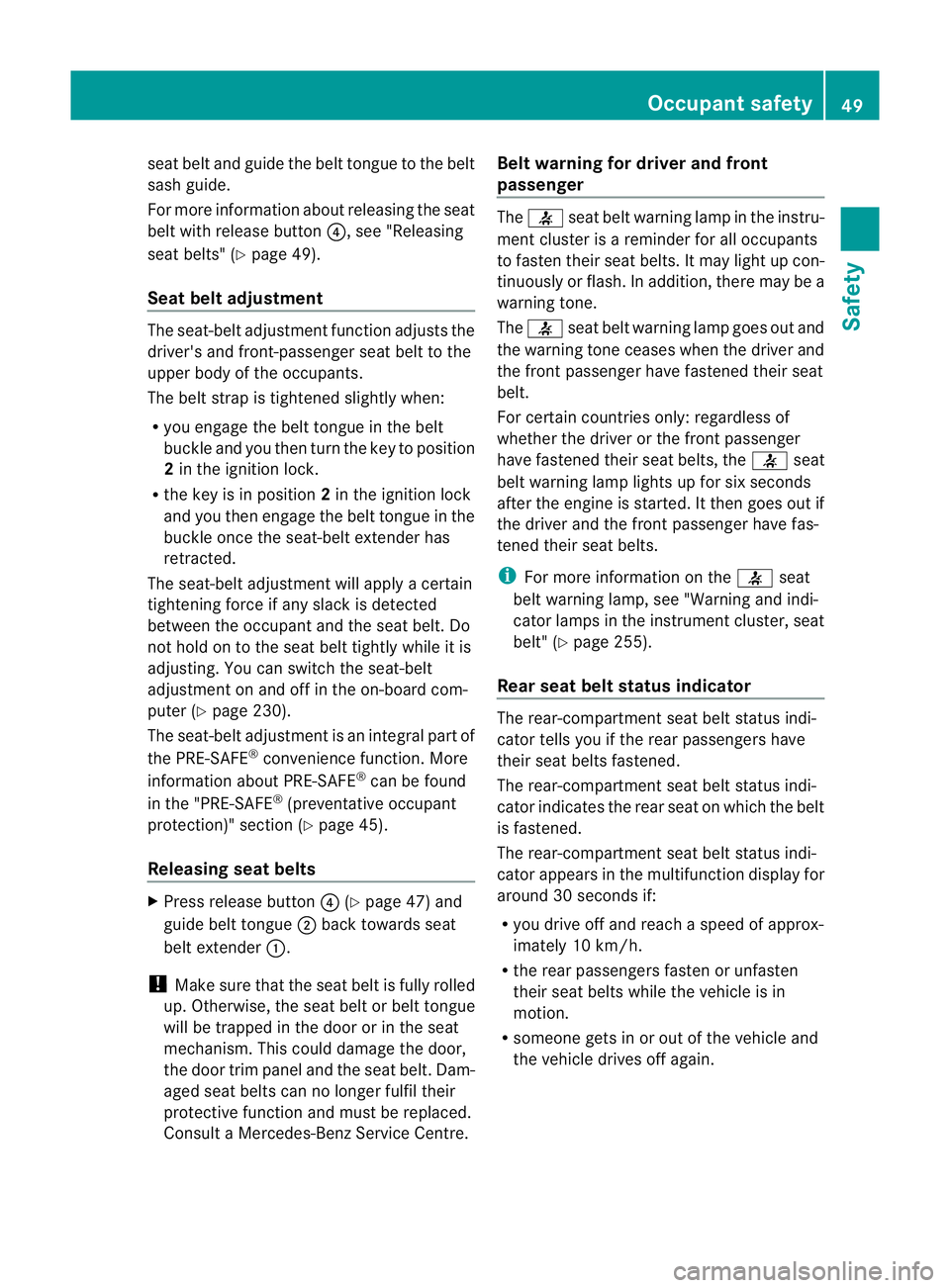
extend. Example: Coupé
X
Adjust the seat and move the backrest to
an almost vertical position (Y page 100).
X Pull the seat belt smoothly out of seat-belt
extender :.
X Without twistin git, guide the shoulder sec-
tion of the seat belt across the middle of
your shoulder and the lap section across
your hips.
X Engage belt tongue ;in buckle =.
Seat-belt adjustment:ifn ecessary, the
driver's and front-passenger seat belts
automatically adjust to the upper body
(Y page 49).
X If necessary, pull upwards on the shoulder
section of the seat belt to tighten the belt
across your body.
The rear seat belts are equipped with achild
seat lock (Y page 52). If you pull out the seat
belt fully and then allow the inertia reel to
retract it, the child-seat lock is activated. To
deactivat ethe child seat lock, unfasten the 48
Occupant safetySafety
Page 52 of 353
seat belt and guide the belt tongue to the belt
sash guide.
For more information aboutr eleasing the seat
belt with release button ?,see "Releasing
seat belts" (Y page 49).
Seat belt adjustment The seat-belt adjustment function adjusts the
driver's and front-passenger seat belt to the
upper body of the occupants.
The belt strap is tightened slightly when:
R you engage the belt tongue in the belt
buckle and you then turn the key to position
2 in the ignition lock.
R the key is in position 2in the ignition lock
and you then engage the belt tongue in the
buckle oncet he seat-belt extender has
retracted.
The seat-belt adjustment will apply acertain
tightening forc eifany slack is detected
between the occupan tand the sea tbelt. Do
not hold on to the seat belt tightly while it is
adjusting. You can switch the seat-belt
adjustment on and off in the on-board com-
puter (Y page 230).
The seat-belt adjustment is an integral part of
the PRE-SAFE ®
convenience function .More
information about PRE-SAFE ®
can be found
in the "PRE-SAFE ®
(preventativ eoccupant
protection)" section (Y page 45).
Releasing seat belts X
Press release button ?(Ypage 47) and
guide belt tongue ;back towards seat
belt extender :.
! Make sure that the seat belt is fully rolled
up. Otherwise, the seat belt or belt tongue
will be trapped in the door or in the seat
mechanism. This could damage the door,
the door trim panel and the seat belt. Dam-
aged seat belts can no longer fulfil their
protective function and must be replaced.
Consult aMercedes-BenzS ervice Centre. Belt warning for driver and front
passenger The
7 seat belt warning lamp in the instru-
ment cluster is areminder for all occupants
to fasten their seat belts. It may light up con-
tinuously or flash. In addition, ther emay be a
warning tone.
The 7 seat belt warning lamp goes out and
the warning tonec eases when the driver and
the fron tpassenger have fastened their seat
belt.
For certain countries only: regardless of
whether th edriver or th efront passenger
have fastened their seat belts, the 7seat
beltw arning lamp light supfor six seconds
after th eengineiss tarted. It then goes out if
th ed river and th efront pa ssenger have fas-
tene dtheir seat belts.
i For mor einformatio nonthe7 seat
belt warning lamp, see "Warning and indi-
cator lamps in th einstrumen tcluster, seat
belt" (Y page 255).
Rea rseat belt statu sindicator The rear-compartmen
tseat belt status indi-
cator tells you if the rear passengers have
their seat belts fastened.
The rear-compartment seat belt status indi-
cator indicates the rear seat on which the belt
is fastened.
The rear-compartment seat belt status indi-
cator appears in the multifunction display for
around 30 seconds if:
R you drive off and reach aspeed of approx-
imately 10 km/h.
R the rear passengers fasten or unfasten
their seat belts while the vehicle is in
motion.
R someon egets in or out of the vehicle and
the vehicle drives off again. Occupant safety
49Safety Z
Page 53 of 353
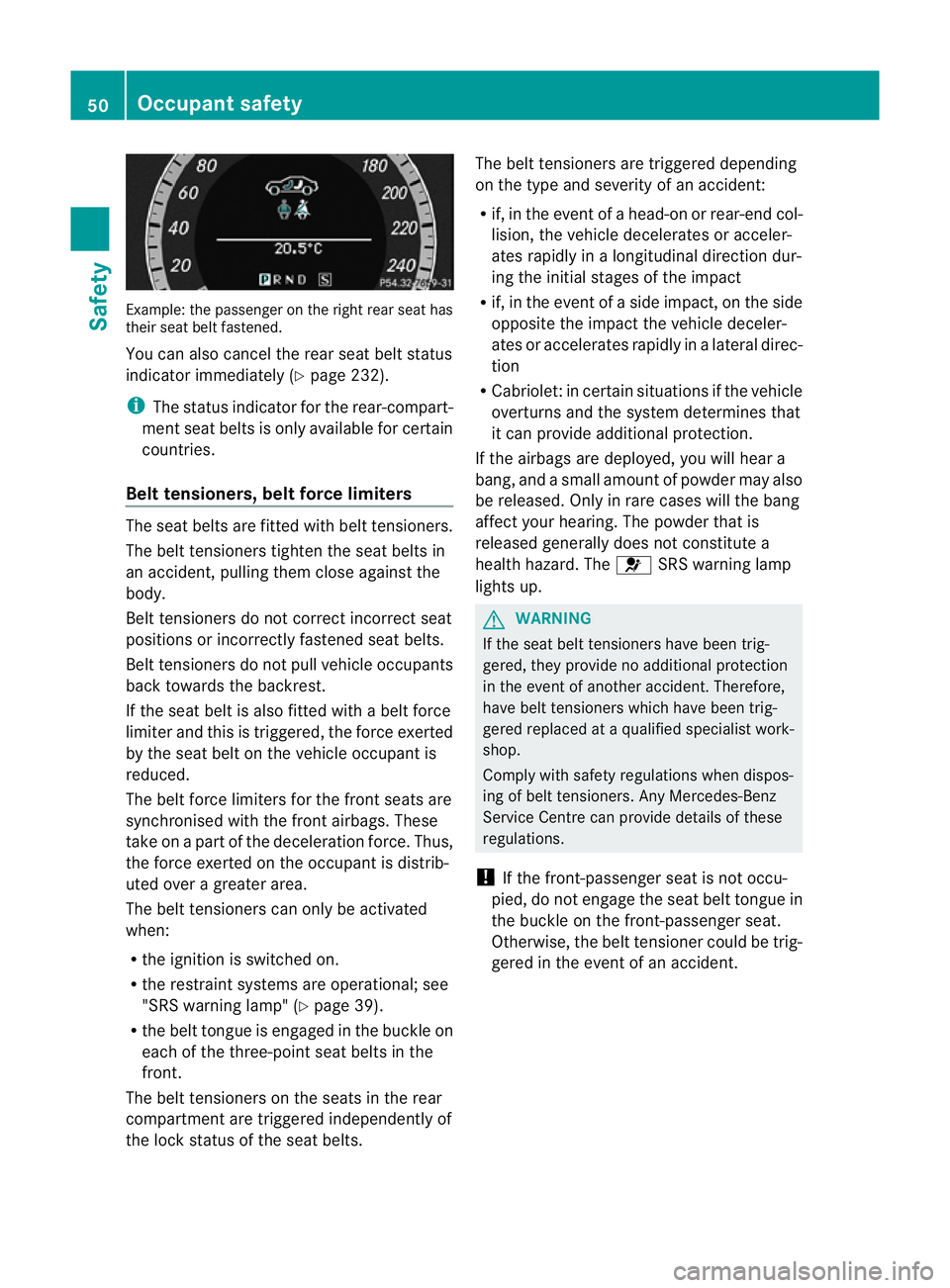
Example: the passenge
ronthe right rear seat has
their seat belt fastened.
You can also cancel the rear seat belt status
indicator immediately (Y page 232).
i The status indicator for the rear-compart-
ment seat belts is only available for certain
countries.
Belt tensioners, belt force limiters The seat belts are fitted with belt tensioners.
The belt tensionerst ighten the seat belts in
an accident, pulling them close against the
body.
Belt tensionersdon ot correct incorrects eat
positions or incorrectly fastened seat belts.
Belt tensionersdon ot pull vehicle occupants
back towards the backrest.
If the seat belt is also fitted with abelt force
limiter and this is triggered, the force exerted
by the seat belt on the vehicle occupant is
reduced.
The belt force limiters for the front seats are
synchronised with the front airbags. These
take on apart of the deceleration force. Thus,
the force exerted on the occupant is distrib-
uted over agreater area.
The belt tensionersc an only be activated
when:
R the ignition is switched on.
R the restraint systems are operational; see
"SRS warning lamp" (Y page 39).
R the belt tongue is engaged in the buckle on
each of the three-point seat belts in the
front.
The belt tensionersont he seats in the rear
compartmenta re triggeredindependently of
the lock status of the seat belts. The beltt
ensioners are triggered depending
on the type and severit yofanaccident:
R if, in the event of ahead-on or rear-en dcol-
lision, the vehicle decelerates or acceler-
ates rapidly in alongitudinal direction dur-
ing the initial stages of the impact
R if, in the event of aside impact, on the side
opposite the impact the vehicle deceler-
ates or accelerates rapidly in alateral direc-
tion
R Cabriolet: in certain situation sifthe vehicle
overturns and the system determines that
it can provide additional protection.
If the airbags are deployed, you will hear a
bang, and asmall amount of powder may also
be released. Only in rare cases will the bang
affect your hearing. The powder that is
released generally does not constitute a
health hazard. The 6SRS warning lamp
lights up. G
WARNING
If the seat belt tensioners have been trig-
gered, they provide no additional protection
in the event of another accident. Therefore,
have belt tensioners which have been trig-
gered replaced at aqualified specialist work-
shop.
Comply with safety regulations when dispos-
ing of belt tensioners .Any Mercedes-Benz
Service Centr ecan provide details of these
regulations.
! If the front-passenger seat is not occu-
pied, do not engage the seat belt tongue in
the buckle on the front-passenger seat.
Otherwise, the belt tensioner could be trig-
gered in the event of an accident. 50
Occupant safetySafety
Page 56 of 353
tem. Onl
ysecurear earward-facing child
restraint syste monasuitablerear seat.
R always move the front-passenger seat to
the rearmost position if you secure achild
in af orward-facing child restraint system
on the front-passenger seat.
The front-passenger airbag is not disabled:
R on vehicles without automatic child seat
recognition on the front-passenger seat
R in vehicles with automatic child seat rec-
ognition in the front-passenger seat, if no
special child restraint system with trans-
ponders for automatic child seat recogni-
tion in the front-passenger seat has been
fitted
R on vehicles with automatic child seat rec-
ognition on the front-passenger seat, if the
PASSENGER AIRBAG OFF indicator lamp
4 is not lit.
To make you aware of this danger, acorre-
sponding warning sticker has been affixed on
the dashboard and on both sides of the sun
visor on the front-passenger side.
Information about recommended child
restraint systems is available at any
Mercedes-Benz Service Centre.
Automatic child seat recognition on the
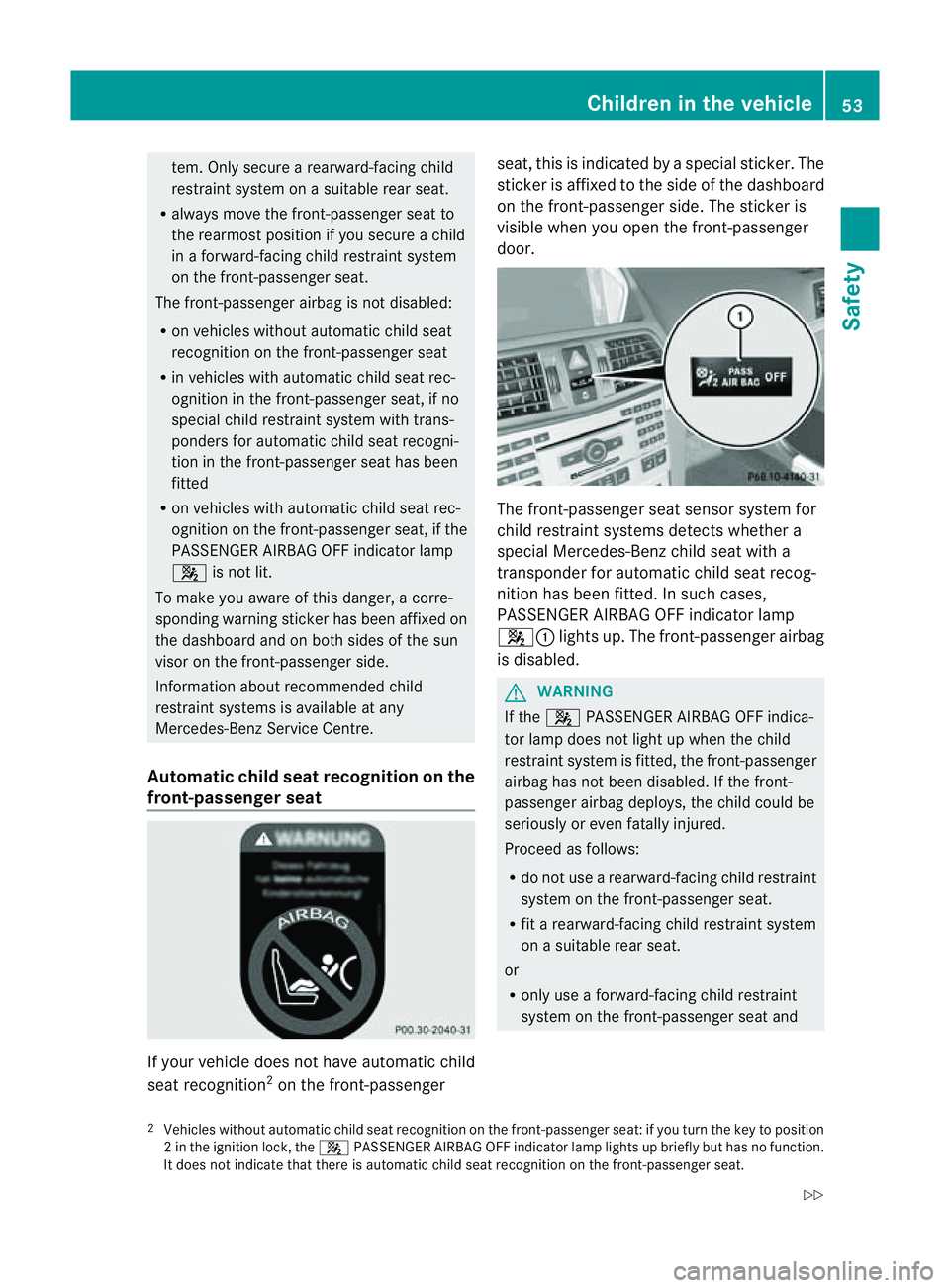
front-passengers eatIf your vehicle does no
thave automatic child
seat recognition 2
on th efront-pa ssenger seat
,thisisi ndicated by aspecial sticker. The
sticker is affixe dtotheside of th edashboard
on th efront-pa ssenger side. The sticker is
visible when you open th efront-pa ssenger
door. The front-passenger seat sensor system for
child restraint systems detect swhether a
special Mercedes-Ben zchild seat with a
transponder for automatic child seat recog-
nition has been fitted. In such cases,
PASSENGER AIRBAG OFF indicator lamp
4: lights up. The front-passenger airbag
is disabled. G
WARNING
If the 4 PASSENGER AIRBAG OFF indica-
tor lamp does not light up when the child
restraint system is fitted, the front-passenger
airbag has not been disabled. If the front-
passenger airbag deploys, the child could be
seriously or even fatally injured.
Proceed as follows:
R do not use arearward-facing child restraint
system on the front-passenger seat.
R fit arearward-facing child restraint system
on asuitable rear seat.
or
R only use aforward-facing child restraint
system on the front-passenger seat and
2 Vehicles without automatic child seat recognition on the front-passenger seat: if you turn the key to position
2int he ignition lock, the 4PASSENGER AIRBAG OFF indicator lamp lights up briefly but has no function.
It does not indicate that there is automatic child seat recognition on the front-passenger seat. Children in the vehicle
53Safety
Z
Page 57 of 353
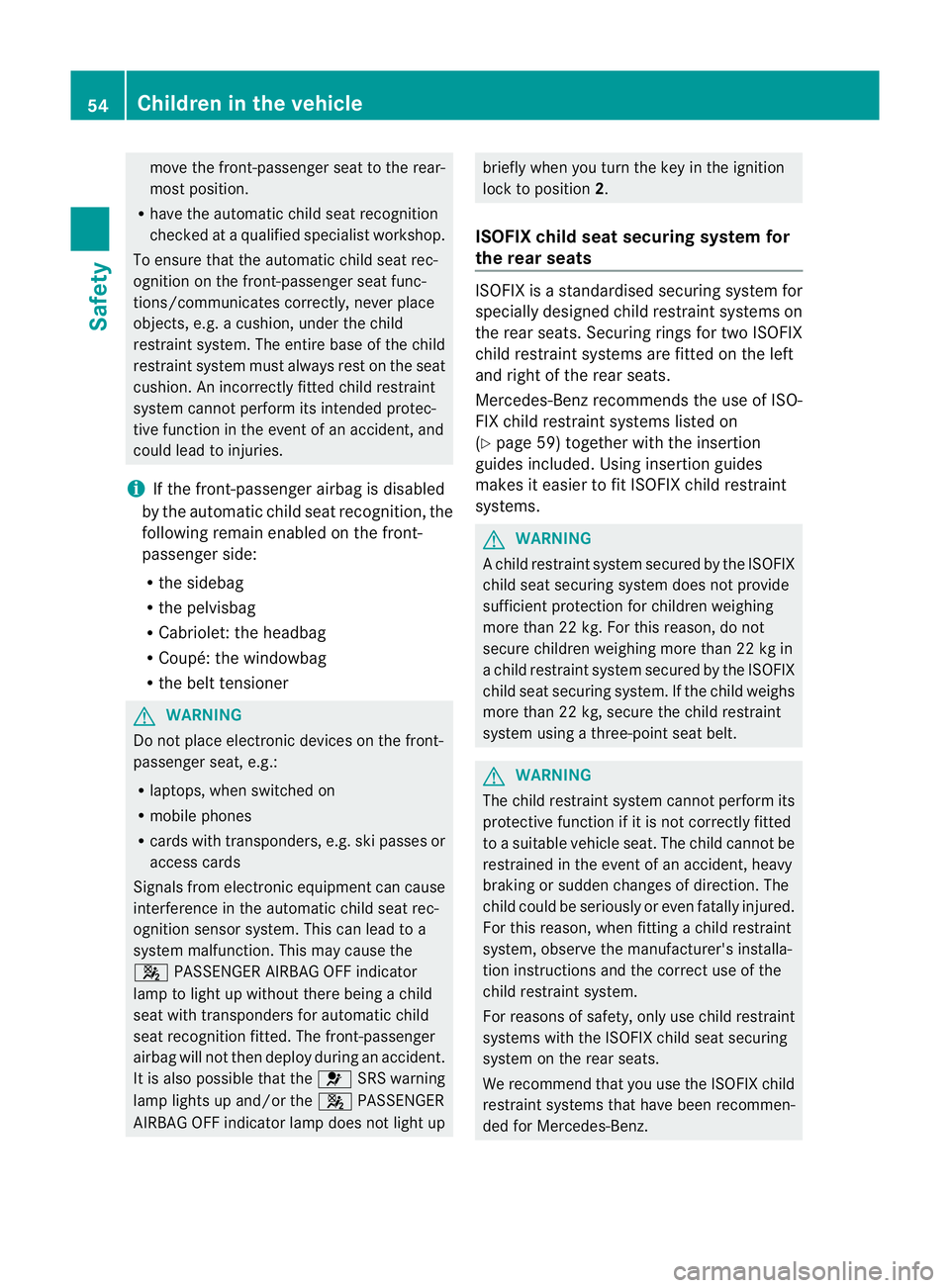
move the front-passenger seat to the rear-
most position.
R have the automatic child seat recognition
checked at aqualified specialist workshop.
To ensure that the automatic child seat rec-
ognition on the front-passenger seat func-
tions/communicates correctly, never place
objects, e.g. acushion, under the child
restraint system. The entire base of the child
restraint system must alwaysr est on the seat
cushion. An incorrectly fitted child restraint
system cannot perform its intended protec-
tive function in the event of an accident, and
could leadtoi njuries.
i If the front-passenger airbag is disabled
by the automatic child seat recognition, the
following remai nenable dont he front-
passenge rside:
R the sidebag
R the pelvisbag
R Cabriolet :the headbag
R Coupé:t he windowbag
R the belt tensioner G
WARNING
Do not place electronic devices on the front-
passenger seat, e.g.:
R laptops, when switched on
R mobile phones
R cards with transponders, e.g. ski passes or
access cards
Signals from electronic equipment can cause
interference in the automatic child seat rec-
ognition sensor system. This can lead to a
system malfunction. This may cause the
4 PASSENGER AIRBAG OFF indicator
lamp to light up without there being achild
seat with transponders for automatic child
seat recognition fitted. The front-passenger
airbag will not then deploy during an accident.
It is also possible that the 6SRS warning
lamp lights up and/or the 4PASSENGER
AIRBAG OFF indicator lamp does not light up briefly when you turn the key in the ignition
lock to position 2.
ISOFIXc hild seat securing system for
the rear seats ISOFIXisas
tandardised securing system for
specially designed child restraint systems on
the rear seats. Securing rings for two ISOFIX
child restraint systems are fitted on the left
and right of the rear seats.
Mercedes-Ben zrecommends the use of ISO-
FIX child restraint systems listed on
(Y page 59) together with the insertion
guides included. Using insertion guides
makes it easier to fit ISOFIXc hild restraint
systems. G
WARNING
Ac hild restraint system secured by the ISOFIX
child seat securing system does not provide
sufficient protection for children weighing
more than 22 kg. For this reason, do not
secure children weighing more than 22 kg in
ac hild restraint system secured by the ISOFIX
child seat securing system. If the child weighs
more than 22 kg, secure the child restraint
system using athree-point seat belt. G
WARNING
The child restraint system cannot perform its
protective function if it is not correctly fitted
to as uitable vehicle seat. The child cannot be
restrained in the event of an accident, heavy
braking or sudden changes of direction. The
child could be seriously or even fatally injured.
For this reason, when fittingac hild restraint
system, observe the manufacturer's installa-
tion instructions and the correct use of the
child restraint system.
For reasons of safety, only use child restraint
systems with the ISOFIX child seat securing
system on the rear seats.
We recommendt hat you use the ISOFIX child
restraint systems that have been recommen-
ded for Mercedes-Benz. 54
Children in the vehicleSafety
Page 60 of 353
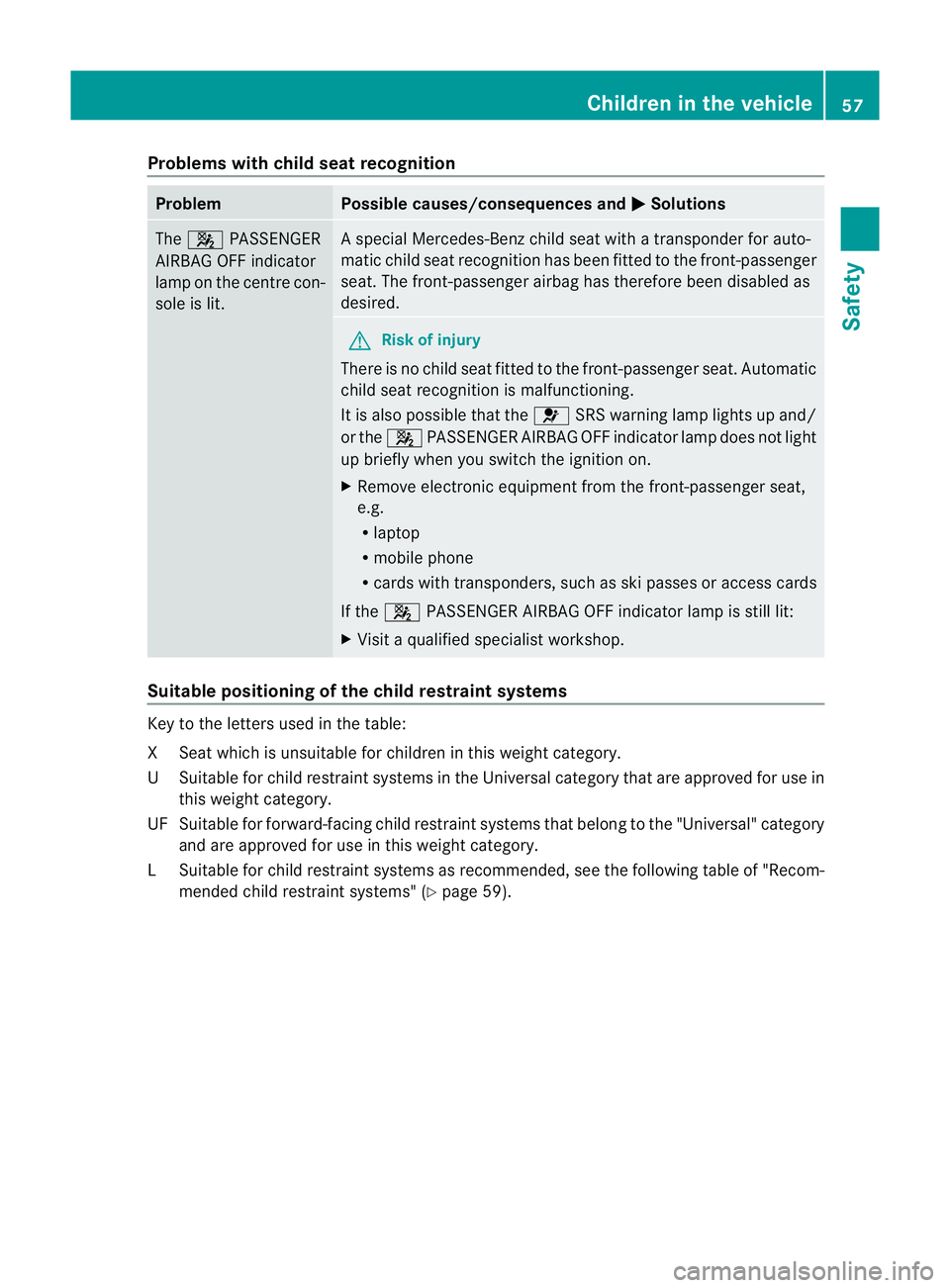
Problems with child seat recognition
Problem Possible causes/consequences and
M Solutions
The
4 PASSENGER
AIRBAGO FF indicator
lamp on the centre con-
sole is lit. As
pecial Mercedes-Benz child seat with atransponder for auto-
matic child seat recognition has been fitted to the front-passenger
seat. The front-passenger airbag has therefore been disabled as
desired. G
Risk of injury
There is no child seat fitted to the front-passenger seat. Automatic
child seat recognition is malfunctioning.
It is also possible that the 6SRS warning lamp lights up and/
or the 4PASSENGER AIRBAG OFF indicator lamp does not light
up briefly when you switc hthe ignition on.
X Remove electronic equipment from the front-passenger seat,
e.g.
R
laptop
R mobile phone
R cards with transponders, such as ski passes or access cards
If the 4 PASSENGER AIRBAG OFF indicator lamp is still lit:
X Visit aqualified specialist workshop. Suitable positioning of the child restraint systems
Key to the letters used in the table:
XS
eat which is unsuitable for children in this weight category.
US uitable for child restraint systems in th eUniversal categor ytha ta re approve dfor use in
this weigh tcategory.
UF Suitable for forward-facing child restraint systems that belon gtothe"Universal" category
and are approved for use in this weigh tcategory.
LS uitable for child restraint systems as recommended, see th efollowin gtable of "Recom-
mended child restraint systems "(Ypage 59). Children in th
evehicle
57Safety Z