spare wheel MERCEDES-BENZ E-CLASS CABRIOLET 2011 Owners Manual
[x] Cancel search | Manufacturer: MERCEDES-BENZ, Model Year: 2011, Model line: E-CLASS CABRIOLET, Model: MERCEDES-BENZ E-CLASS CABRIOLET 2011Pages: 353, PDF Size: 8.42 MB
Page 13 of 353
Electronic Brak
eforce Distribution
see EB D(Electronic Brake force
Distribution)
Electronic Stability Program
see ESP ®
(Electronic Stabilit yProgram)
Electronic Traction System
see ET S(Electronic Tractio nSystem)
Emergency closing (soft top) .............87
Emergency key Unlocking the driver's door ..............79
Emergency key element
Function/notes ................................ 74
Locking vehicle ................................ 79
Emergency release
Driver's door .................................... 79
Emergency spare wheel
Notes/data .................................... 326
Storage location ............................ 296
Emergency unlocking
Boot ................................................. 81
Vehicle ............................................. 79
Engine
Display message ............................ 242
ECO start/stop function ................150
Emergency starting ........................313
Engine numbe r............................... 333
Running irregularl y......................... 152
Starting problems ..........................152
Starting the engine with the key ....148
Starting with KEYLESS GO .............149
Stopping ........................................ 165
Warning lamp (engine diagnos-
tics) ............................................... 260
Engine electronics
Notes ............................................. 331
Problem (fault) ............................... 152
Engine oil
Additives ........................................ 336
Checking the oil leve l..................... 282
Display message ............................ 243
Filling capacity ............................... 335
Notes about oil grades ................... 335
Notes on oil level/consumption ....282
Topping up ..................................... 283
Viscosity ........................................ 336Environmental protection
Note ................................................ .21
Returnin ganend-of-life vehicl e....... 21
ESP ®
(Electronic Stability Pro-
gram) Deactivating/activating .................223
Deactivating/activating (notes) .......64
Display message ............................ 233
ETS .................................................. 64
Function/notes ................................ 64
Important safety guidelines .............64
Trailer stabilisatio n.......................... 65
Warning lamp ................................. 258
ETS (Electronic Traction System) ....... 64
Exhaus ttail pipe (cleaning instruc-
tions) .................................................. 291
Exterior lighting see Lights
Exterior mirrors
Adjusting ....................................... 109
Anti-dazzle mode (automatic) ........111
Folding in/ou t(automatically) .......110
Folding in/ou t(electrically) ...........110
Folding in whe nlocking( on-board
computer) ...................................... 230
Out of position (troubleshooting) ...110
Parking position ............................. 111
Resetting ....................................... 110
Storing settings (memory func-
tion) ............................................... 112 F
Fatigue Assist see ATTENTION ASSIST
Faul tmessage
see Display messages
Filler cap
see Fuel filler flap
Fire extinguisher ............................... 294
First-aid kit ......................................... 294
Flat tyre Changing awheel/fitting the
spare wheel ................................... 301
MOExtended run-fla tsystem ......... 305
Preparing the vehicle .....................296
Raising the vehicle .........................302
TIREFIT kit ...................................... 297 10
Index
Page 20 of 353
Opening/closing
.............................. 82
Opening/closing all( Cabriolet) ........83
Problem (malfunction) .....................85
resetting .......................................... 84
Sliding sunroof
see Panorama sliding sunroof
Sno wchains ...................................... 320
Socket Centre console .............................. 273
Glove compartment .......................273
Points to observe before use .........272
Rea rcompartmen t......................... 273
Soft top
AIRCAP ............................................ 92
Cleaning ......................................... 288
Closing manually in an emergency ... 87
Display message ............................ 252
Draught stop .................................... 92
Fitting/removing the AIRCAP
draugh tstop .................................... 94
Important safety notes ....................85
Opening/closing (with key) .............. 87
Opening/closing (with soft-top
switch) ............................................. 86
Problem (malfunction) .....................96
Re-locking ........................................ 91
Soft-top switch .................................... 86
Spare wheel Storage location ............................ 296
see Emergency spare wheel
Specialist workshop ............................ 22
Speed, controlling see Cruise control
Spee dLimit Assist
Activating/deactivatin gthe warn-
ing function .................................... 222
Displayin g...................................... 222
Display message ............................ 244
Display message in the multifunc-
tion displa y.................................... 195
Important safety notes ..................195
Speedometer
Activating/deactivating the addi-
tional speedometer ........................225
Digita l............................................ 217
In the Instrument cluster .................28Segments
...................................... 213
Selecting the unit of measure-
ment .............................................. 225
see Instrument cluster
Speedtronic
Display message ............................ 248
SPEEDTRONIC
Deactivating variabl e..................... 182
Function/notes ............................. 180
Important safety notes ..................180
LIM indicator lamp .........................181
Permanent ..................................... 183
Selecting ........................................ 181
Storing the current spee d.............. 182
Variabl e......................................... 181
SRS (Supplemental Restrain tSys-
tem) Display message ............................ 237
Introduction ..................................... 39
Warning lamp ................................. 259
Warning lamp (function) ................... 39
Starting (engine) ................................ 148
Station see Radio
Steering (display message) ..............251
Steering wheel Adjusting (electrically). ..................108
Adjusting (manually). .....................108
Button overview ............................... 31
Gearshift paddle s........................... 157
Important safety notes ..................107
Storing settings (memory func-
tion) ............................................... 112
Steering wheel gearshift paddles ....157
Stowage compartments Armrest (under) ............................. 265
Centre console .............................. 265
Cuph older..................................... 269
Glove compartment .......................265
Important safety information .........264
Luggage net ................................... 266
Stowage well beneath the boot
floor .................................................... 268
Summer opening see Convenience opening feature
Summer tyres .................................... 319
Sun visor ............................................ 270 Index
17
Page 193 of 353
might therefore issu
esteering instructions
too soon. This may leadtoac ollision. For this
reason, you should avoi dusing Parking Guid-
ance in such situations. G
WARNING
Make sure that no persons or animals are in
the manoeuvring range. Otherwise, they
could be injured.
When PARKTRONIC is deactivated, Parking
Guidance is alsou navailable.
Use Parking Guidance for parking spaces:
R that are paralleltot he directionoftravel
R that are on straight roads, not bends
R that are on the same leve lasthe road ,i.e.
not on the pavement, for example. Parking
Guidance may not detect flat kerbs
Parking tips:
R on narrow roads, drive pastt he parking
space as close as possible.
R parking spaces that are littered, overgrown
or partially occupied by trailer drawbars
might be identified incorrectly or not at all.
R snowfall or heavy rain may lead to aparking
space being measured inaccurately.
R pay attention to the PARKTRONIC
(Y page 187) warning messages during the
parking procedure.
R when transporting aload which protrudes
from your vehicle, you must not use Parking
Guidance.
R never use Parking Guidance with snow
chains or an emergency spare wheel fitted.
R make sure that the tyre pressures are
always correct.T his hasadirec teffect on
the steering instructions.
R the wayy ourv ehicle is positioned in the
parkin gspace after parkin gisdependent
on various factors. These include the posi-
tion and shape of the vehicles parked in
front and behind it and the conditions of the
location. In some cases, Parking Guidance
may guide you too far or not far enough into
ap arking space. In some cases, it may also lead you across or onto the kerb. If neces-
sary, cancel the parking procedure with
Parking Guidance.
! If unavoidable, you should drive over
obstacles such as kerbs slowly and not at
as harp angle. Otherwise, you may damage
the wheels or tyres.
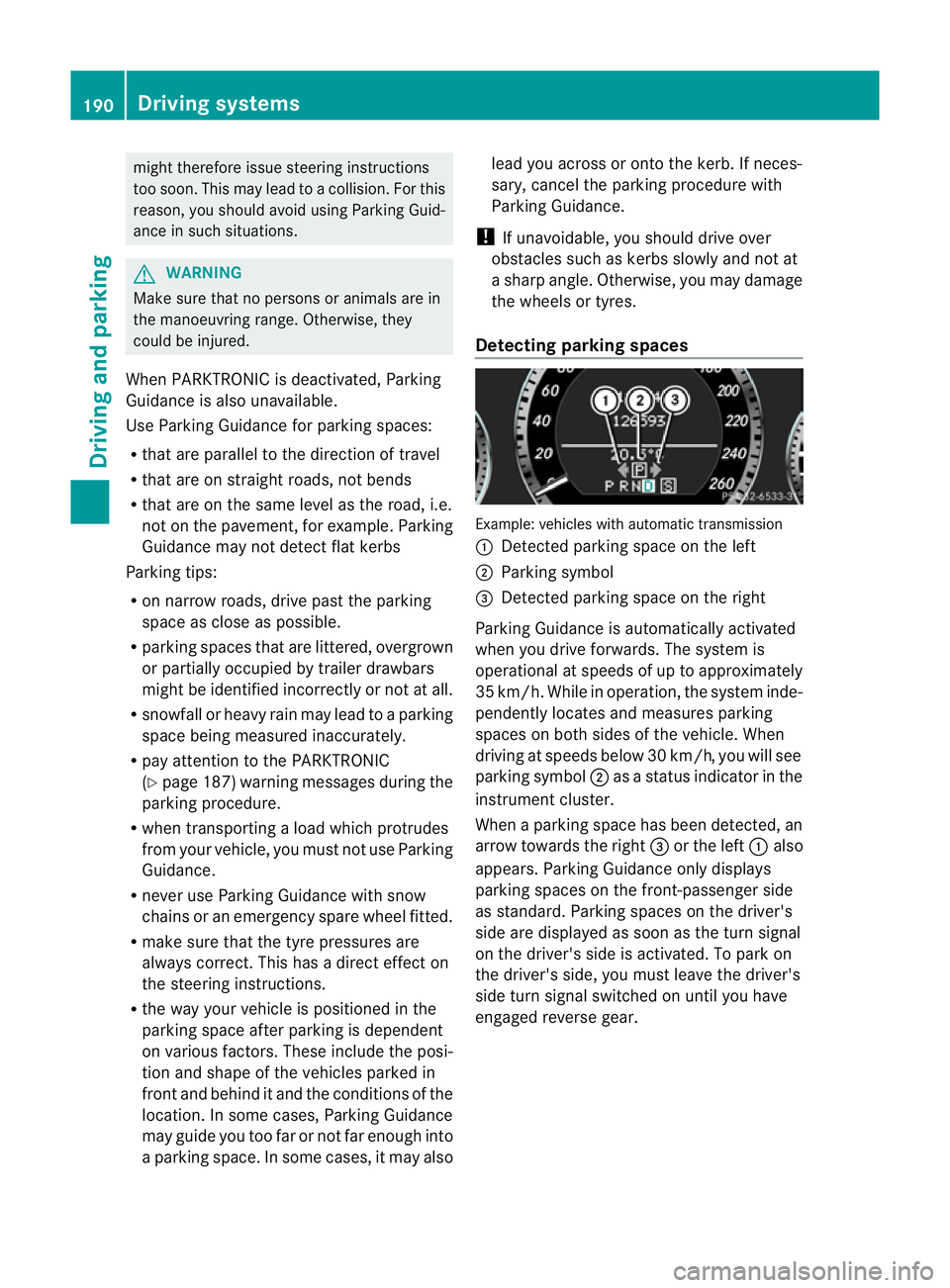
Detecting parking spaces Example: vehicles with automatic transmission
:
Detected parking space on the left
; Parking symbol
= Detected parking space on the right
Parking Guidance is automaticallya ctivated
when you drive forwards. The system is
operational at speeds of up to approximately
35 km/h. While in operation, the system inde-
pendently locates and measures parking
spaces on both sides of the vehicle. When
driving at speeds below 30 km/h ,you will see
parking symbol ;asastatus indicator in the
instrument cluster.
When aparking space has been detected, an
arrow towards the right =or the left :also
appears. Parking Guidance only displays
parking spaces on the front-passenger side
as standard. Parking spaces on the driver's
side are displayed as soon as the turn signal
on the driver's side is activated. To park on
the driver's side, you must leave the driver's
side turn signal switched on until you have
engaged reverse gear. 190
Driving systemsDriving and parking
Page 298 of 353
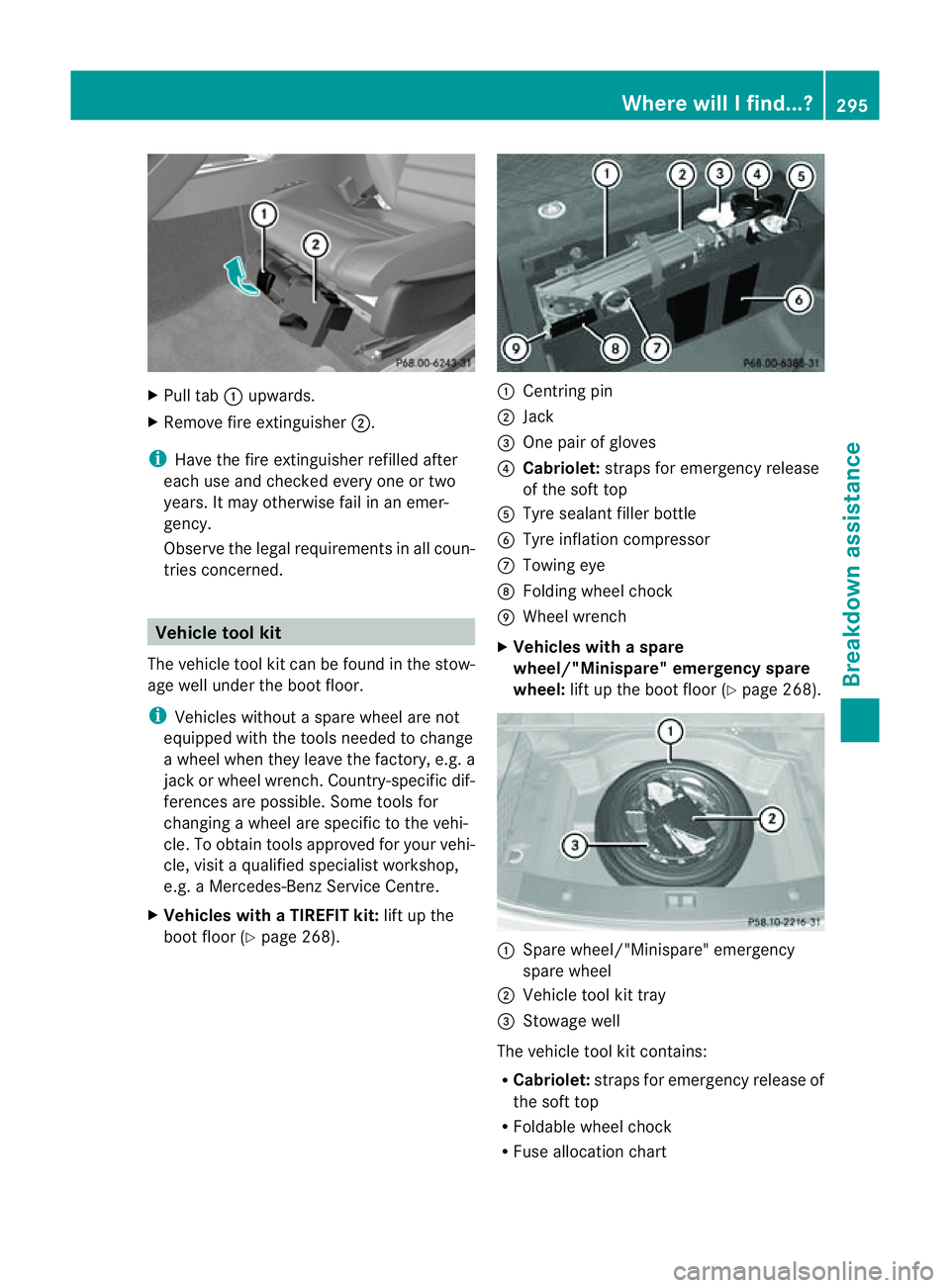
X
Pull tab :upwards.
X Remove fire extinguisher ;.
i Have the fire extinguisher refilled after
each use and checked every one or two
years. It may otherwise fail in an emer-
gency.
Observe the legal requirement sinall coun-
tries concerned. Vehicle tool kit
The vehicle too lkit can be foun dinthe stow-
age well under the boot floor.
i Vehicles without aspare wheel are not
equipped with the tools needed to change
aw heel when the yleave the factory, e.g. a
jac korw heel wrench. Country-specific dif-
ferences are possible. Some tools for
changing awheel are specific to the vehi-
cle. To obtain tools approved for your vehi-
cle, visit aqualified specialist workshop,
e.g. aMercedes-Ben zService Centre.
X Vehicles with aTIREFIT kit: lift up the
boot floor (Y page 268). :
Centring pin
; Jack
= One pair of gloves
? Cabriolet: straps for emergency release
of the soft top
A Tyre sealant filler bottle
B Tyre inflation compressor
C Towing eye
D Folding wheel chock
E Wheel wrench
X Vehicles with aspare
wheel/"Minispare" emergency spare
wheel: lift up the boot floor (Y page 268). :
Spare wheel/"Minispare" emergency
spare wheel
; Vehicle tool kit tray
= Stowage well
The vehicle tool kit contains:
R Cabriolet: straps for emergency release of
the soft top
R Foldable wheel chock
R Fuse allocation chart Where willIf
ind...?
295Breakdown assistance
Page 299 of 353
R
Jack
R Centrin gpin
R On ep air of gloves
R Whee lwrench
R Towin geye "Minispare" emergency spare wheel
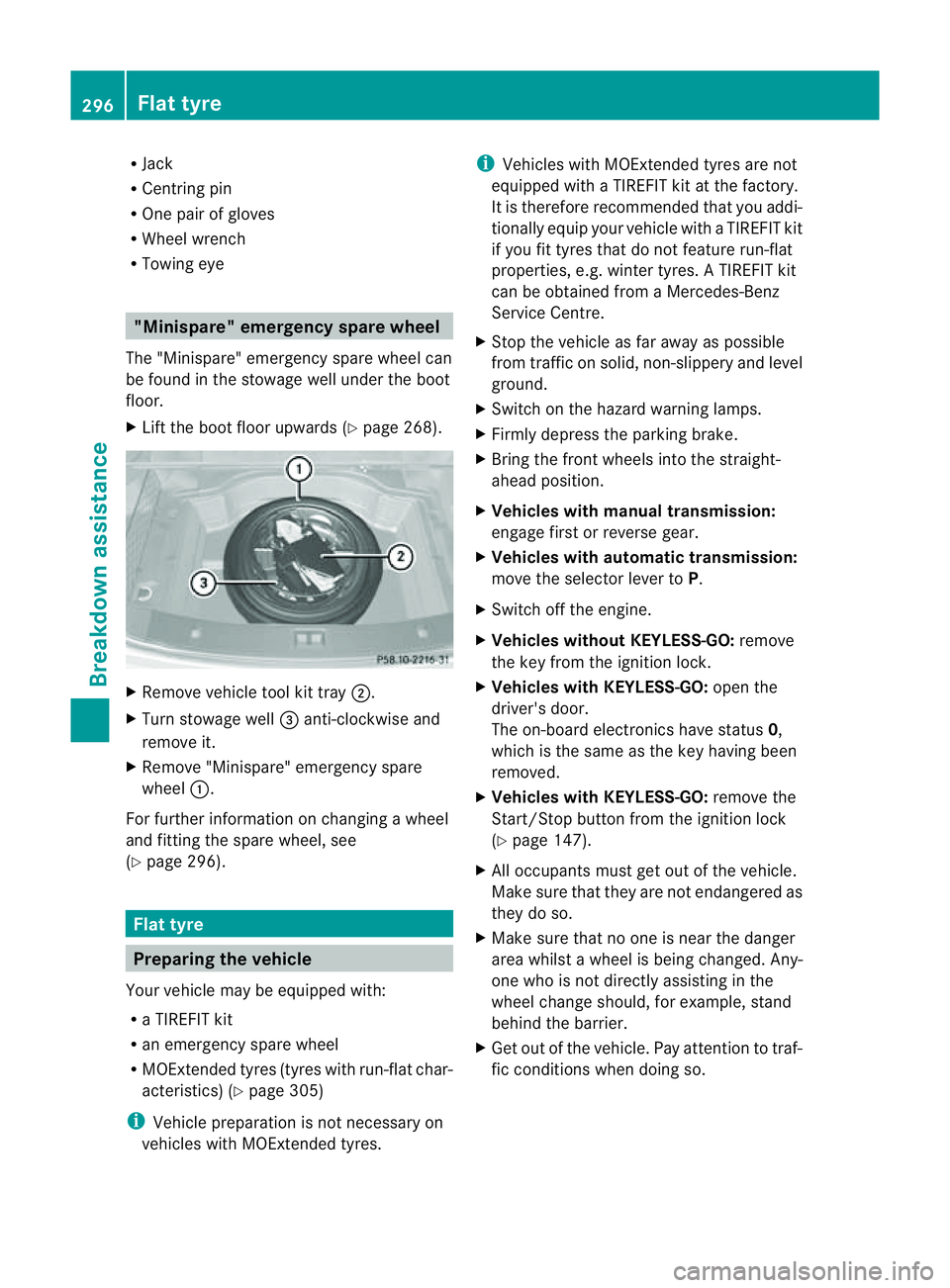
The "Minispare" emergency spar ewheel can
be foun dinthestowage well unde rthe boot
floor.
X Lift the boot floor upwards (Y page 268).X
Remove vehicle tool kit tray ;.
X Turn stowage well =anti-clockwise and
remove it.
X Remove "Minispare" emergency spare
wheel :.
For further information on changing awheel
and fittingt he spare wheel, see
(Y page 296). Flat tyre
Preparing the vehicle
Your vehicle may be equipped with:
R aT IREFIT kit
R an emergency spare wheel
R MOExtended tyres (tyres with run-flat char-
acteristics) (Y page 305)
i Vehicle preparation is not necessary on
vehicles with MOExtended tyres. i
Vehicles with MOExtended tyres are not
equipped with aTIREFIT kit at the factory.
It is therefore recommended that you addi-
tionally equip your vehicle with aTIREFIT kit
if you fit tyres that do not feature run-flat
properties, e.g. winter tyres. ATIREFIT kit
can be obtained from aMercedes-Benz
Service Centre.
X Stop the vehicle as far away as possible
from traffic on solid, non-slippery and level
ground.
X Switch on the hazard warning lamps.
X Firmly depress the parking brake.
X Bring the front wheels into the straight-
ahead position.
X Vehicles with manualt ransmission:
engage first or reverse gear.
X Vehicles with automatic transmission:
move the selector lever to P.
X Switch off the engine.
X Vehicles without KEYLESS-GO: remove
the key from the ignition lock.
X Vehicles with KEYLESS-GO: open the
driver's door.
The on-board electronicsh ave status0,
which is the same as the key having been
removed.
X Vehicles with KEYLESS-GO: remove the
Start/Stop button from the ignition lock
(Y page 147).
X All occupants must get out of the vehicle.
Make sure that they are not endangered as
they do so.
X Make sure that no one is near the danger
area whilst awheel is being changed. Any-
one who is not directly assisting in the
wheel change should, for example, stand
behind the barrier.
X Get out of the vehicle. Pay attention to traf-
fic conditionsw hen doing so.296
Flat tyreBreakdown assistance
Page 304 of 353
workshop
,e.g.ataM ercedes-Benz Service
Centre. H
Environmental note
Have the used tyre sealant bottle disposed of
professionally, e.g. at aMercedes-Benz
Service Centre.
X Have the tyre sealant bottle replaced every
four years at aqualified specialist work-
shop, e.g. aMercedes-Benz Service
Centre. Changing
awhee land fitting the spare
wheel
Preparing the vehicle G
WARNING
The wheel and tyre size of the emergency
spare wheel/spare wheel may diffe rtothat of
the damaged wheel. When using an emer-
gency spare wheel/spare wheel the handling
characteristics of the vehicle may change.
Adapt your style of driving accordingly.
Never operate the vehicle with more than one
emergenc yspare wheel/spare wheel that dif-
fers in size.
Only use an emergenc yspare wheel/spare
wheel of adiffering size briefly and do not
switch off ESP ®
.
When using an emergenc yspare wheel you
must not exceed the maximum speed of
80 km/h. G
WARNING
Have the emergenc yspare wheel/spare
wheel replaced with anew wheel as soon as
possible at aqualified specialist workshop
which has the necessary specialist knowledge
and tools to carry out the work required.
Mercedes-Benz recommends that you use a
Mercedes-Benz Service Centre for this pur-
pose. In particular, work relevant to safety or
on safety-related systems must be carried out
at aq ualified specialist workshop. i
Vehicles without an emergenc yspare
wheel/spare wheel are not equipped with
wheel-changing tools at the factory. For
more information on which tools are
required to perform awheel change on your
vehicle, e.g. wheel chock,w heel wrench or
centring pin, consult aMercedes-Benz
Servic eCentre.
X Prepare the vehicle as described
(Y page 296).
X Ifat railer is coupled to the vehicle, uncou-
ple it.
X Remove the following items (depending on
the vehicle's equipment) from the stowage
well under the boot floor:
R
the emergenc yspare wheel
R the vehicle tool kit
R the folding wheel chock
R the jack
X Secure the vehicle to prevent it from rolling
away.
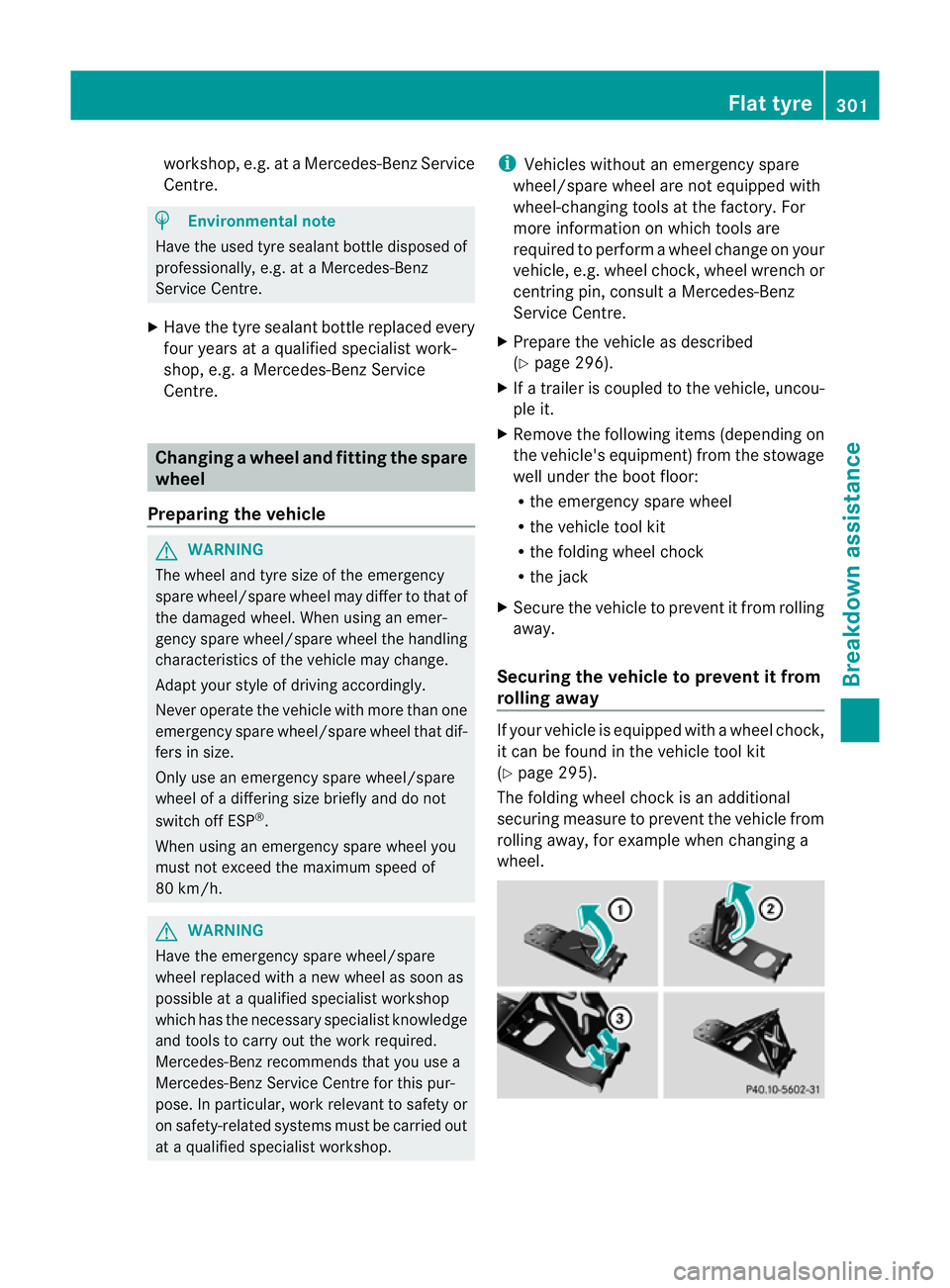
Securing the vehicle to prevent it from
rolling away If your vehicle is equipped with
awheel chock,
it can be found in the vehicle tool kit
(Y page 295).
The folding wheel chock is an additional
securing measure to prevent the vehicle from
rolling away,f or example when changing a
wheel. Flat tyre
301Breakdown assistance Z
Page 307 of 353
Fitting
anew wheel G
WARNING
Replac edamage dorcorrode dwheel bolts.
Never oil or greas ewheel bolts. This could
cause th eboltstol oosenint he wheel hub. G
WARNING
If aw heel hub thread is damaged, you must
not drive the vehicle any further. Consult a
qualified specialist workshop which has the
necessary specialist knowledge and tools to
carry out the work required. Mercedes-Benz
recommends that you use aMercedes-Benz
Service Centr eorService 24h for this pur-
pose. In particular, work relevant to safety or
on safety-related systems must be carried out
at aq ualified specialist workshop. G
WARNING
Only use wheel bolts that have been designed
for the wheel and the vehicle. For safety rea-
sons, Mercedes-Benz recommends that you
only use wheel bolts which have been
approved for Mercedes-Benz vehicles and the
respective wheel. Other wheel bolts could
work loose or damage the brake system.
Do not tighten the wheel bolts completely
while the vehicle is still jacked up. The vehicle
could topple off the jack.
X Clean the wheel and wheel hub contact
surfaces. X
Slide the emergency spare wheel ontot he
centring pin and push it on. X
Tighten the wheel bolts until they are fin-
ger-tight.
X Unscrew the centring pin.
X Tighten the last wheel bolt until it is finger-
tight.
Lowering the vehicle X
Turn the cran kofthe jack anti-clockwise
until the vehicle is oncea gain standing
firmly on the ground.
X Place the jack to one side. X
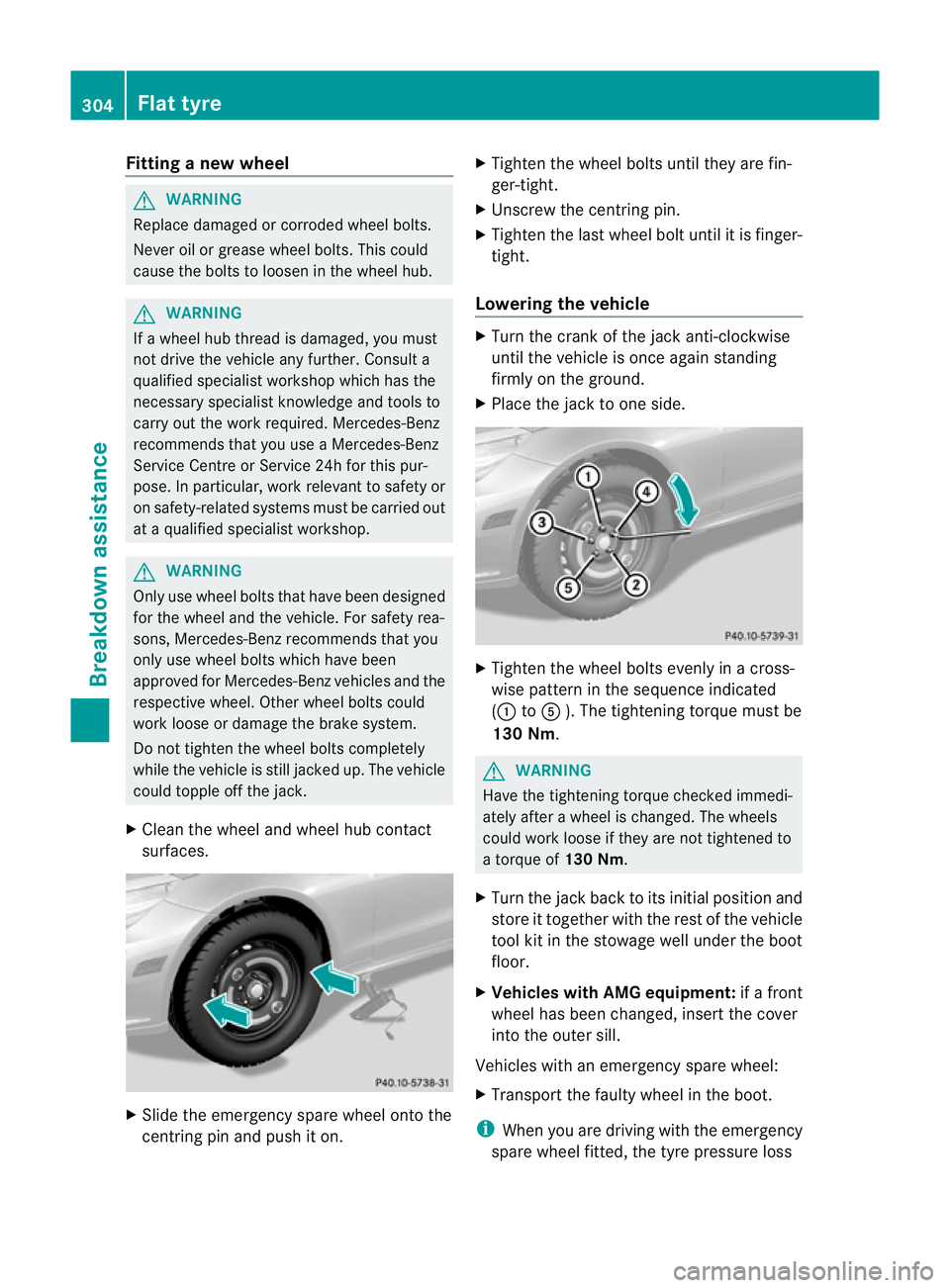
Tighten the wheel bolts evenly in across-
wise patter ninthe sequence indicated
(: toA ). The tightening torque must be
130 Nm. G
WARNING
Have the tightening torque checked immedi-
ately after awheel is changed. The wheels
could work loose if they are not tightened to
at orque of 130 Nm.
X Turn the jack back to its initial position and
store it together with the rest of the vehicle
tool kit in the stowage well under the boot
floor.
X Vehicles with AMG equipment: ifaf ront
wheel has been changed, insert the cover
into the outer sill.
Vehicles with an emergency spare wheel:
X Transport the faulty wheel in the boot.
i When you are driving with the emergency
spare wheel fitted, the tyre pressure loss 304
Flat tyreBreakdown assistance
Page 321 of 353
Useful information
i This Owner's Manual describes all models
and all standard and optional equipment
available to your vehicle at the time of pub-
lication of the Owner's Manual. Country-
specific deviation sare possible. Please
not ethat your vehicle may not be equipped
with all feature sdescribed. This also
applies to safety-relevan tsystems and
functions.
i Pleas ereadt he information on qualified
specialist workshop s(Ypage 22). Important safet
ynotes G
WARNING
Tyres, wheels or accessories whic hhaven ot
been approved by Mercedes-Ben zfor your
vehicle or are not used as they should be, can
impair driving safety. As aresult, you could
cause an accident .Before purchasing and
using them, enquire about their suitability,
legal stipulations and factory recommenda-
tion sataM ercedes-Benz Service Centre.
Modification work on the brake system and
wheels is not permitted, nor is the use of
spacer plates or brake dust shields. This inva-
lidates the General Operatin gPermit for the
vehicle.
i Further information about tyres and
wheels can be obtained from any
Mercedes-Benz Service Centre. Operation
Notes on driving
R While driving, pay attention to vibrations,
noises and unusual handling characteris-
tics ,e.g. pulling to one side. This may indi-
cate that the wheels or tyres are damaged.
If you suspect that atyre is defective,
reduce your speed immediately. Stop the vehicle as soon as possible to chec
kthe
wheels and tyres for damage. Hidden tyre
damage could also be causing the unusual
handling characteristics. If you find no
signs of damage, have the wheels and tyres
examined at aqualified specialist work-
shop, e.g. aMercedes-Ben zService
Centre.
R When parkin gyour vehicle, make sure that
the tyres do not get deformed by the kerb
or other obstacles. If it is necessary to drive
over kerbs, speed humps or similar eleva-
tions, try to do so slowly and at an obtuse
angle. Otherwise, the tyres, particularly the
sidewalls, can get damaged. Notes on regularly inspecting wheels
and tyres
R Regularly chec kthe wheels and tyres of
your vehicle for damage (e.g. cuts, punctu-
res, tears, bulges on tyres and deformation,
cracksors evere corrosion on wheels), at
least every 14 days, as well as after driving
off-road or on rough roads. Damaged
wheels can cause aloss of tyre pressure.
R Regularly check the tyre tread depth and
the condition of the tread across the whole
width of the tyre (Y page 319). If neces-
sary, turn the front wheels to full lock in
order to inspect the inner side of the tyre
surface.
R All wheels must have avalve cap to protect
the valve against dirt and moisture. Do not
fit anything onto the valve (such as tyre
pressure monitorings ystems) other than
the standard valve cap or other valve caps
approved by Mercedes-Ben zfor your vehi-
cle.
R Regularly check the pressure of all the tyres
including the emergenc yspare wheel or the
spare wheel, particularly prior to long trips,
and correc tthe pressure as necessary
(Y page 321). 318
OperationWheels and tyres
Page 322 of 353
Tyre tread
G
WARNING
Bea rinm indt hat:
R tyr eg ripd ecreases rapidl yonwetroads
when the tread depth is less than 3mm.
Thus ,you should replace tyres that have
insufficient tread.
R winter tyres should be replaced when the
tread depth is 4mmorless as they no lon-
ger provide adequate grip.
R the tread on atyre may not wear evenly.
Thus, you should regularly check the tread
depth and the condition of the tread across
the entire width of all tyres. If necessary,
turn the fron twheels to full lock in order to
inspect the tyre tread more easily.
Otherwise, you could lose control of the vehi-
cle and cause an accident due to the reduced
grip of the tyres on the road. Notes on selecting, fitting and replac-
ing tyres
R Only fit tyres and wheels of the same type
and make.
R Only fit tyres of the correct size onto the
wheels.
R After fittingn ew tyres, run them in at mod-
erate speeds for the first 100 km, as they
only reach their full performance after this
distance.
R Do not drive with tyres which have too little
tread depth, as this significantly reduces
the traction on wet roads (aquaplaning).
R Replace the tyres after six years at the lat-
est, regardless of wear. This also applies to
the emergency spare wheel/spare wheel. MOExtended tyres (tyres with run-flat
characteristics)
MOExtended tyres (tyres with run-flat char-
acteristics )allow you to continue driving the vehicle even when one or more tyres lose all
air pressure.
MOExtended tyres may only be used in con-
junction with the tyre pressure loss warning
system or with the tyre pressure monitor and
on wheels specifically tested by Mercedes-
Benz.
i
Vehicles with MOExtended tyres are not
equipped with aTIREFIT kit at the factory.
It is therefore recommended that you addi-
tionally equip your vehicle with the TIREFIT
kit if you fit tyres that do not feature run-
flat properties, e.g. winter tyres. ATIREFIT
kit can be obtained from aMercedes-Benz
Service Centre.
You will find notes on driving with aflat tyre
in the "Breakdown assistance" section
(Y page 305). Winter operation
Please bear the following in mind
At the onset of winter ,have your vehicle win-
terproofed at aqualified specialist workshop,
e.g. at aMercedes-BenzS ervice Centre.
Observe the notes in the "Changing awheel"
section (Y page 323). Driving with summer tyres
At temperatures below +7 †, summer tyres
lose elasticit yand therefore traction and
brakin gpower; change the tyres on your vehi-
cle to M+S tyres .Using summer tyres at very
cold temperatures could cause tears to form,
thereby damaging the tyres permanently.
Mercedes-Benzc annot accept responsibility
for this type of damage. M+S tyres
At temperatures below +7 †, use winter tyres
or all-season tyres. Bot htype soft yrea re
identified by th eM+S marking. Winter operation
319Wheels and tyres Z
Page 323 of 353
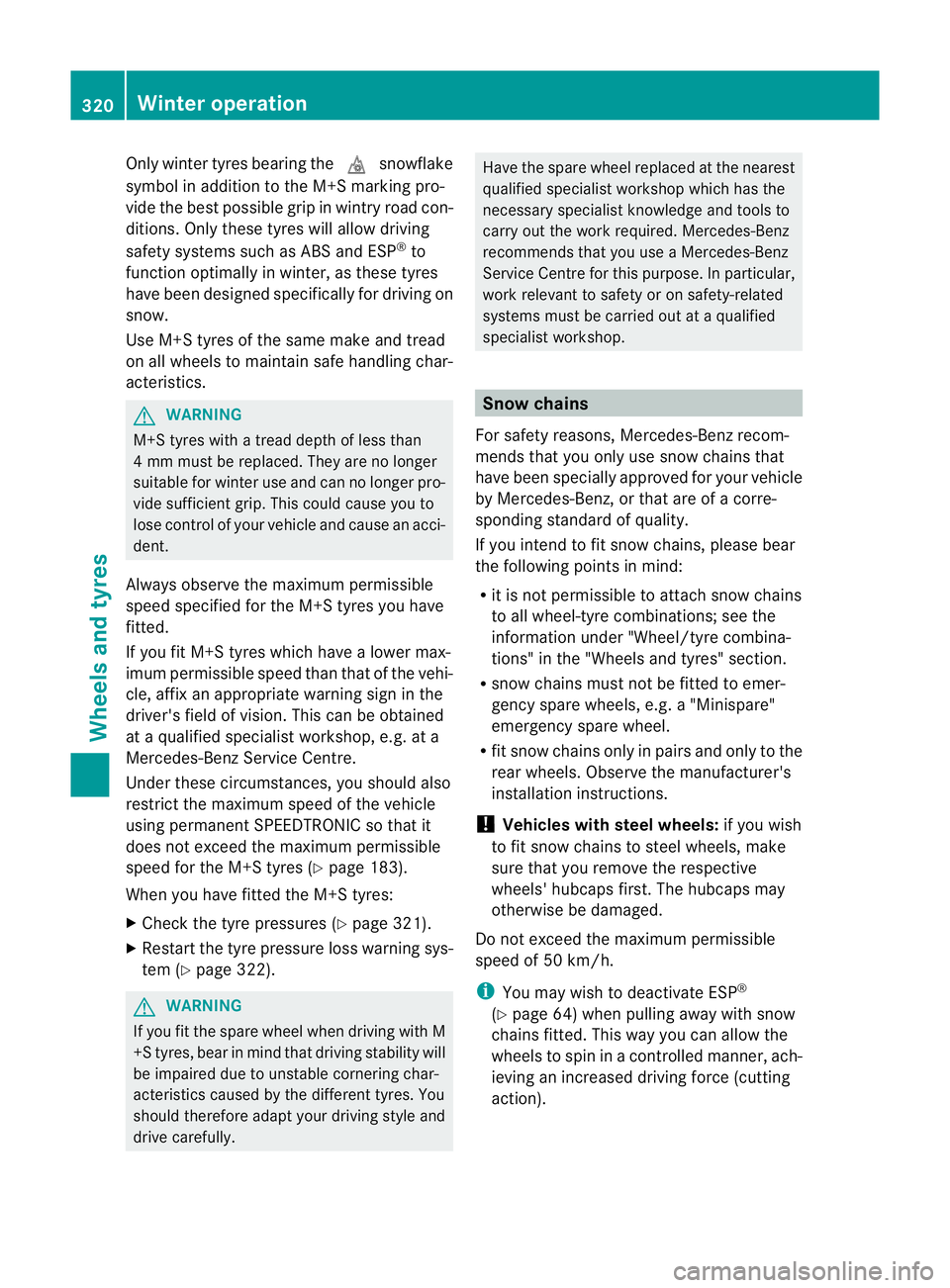
Only winter tyres bearing the
isnowflake
symbol in addition to the M+S marking pro-
vide the best possibleg rip in wintry road con-
ditions. Only these tyres will allowd riving
safety systems such as ABS and ESP ®
to
function optimally in winter, as these tyres
have been designed specificallyf or driving on
snow.
Use M+S tyres of the same make and tread
on all wheels to maintain safe handling char-
acteristics. G
WARNING
M+S tyres with atread depth of less than
4mmm ust be replaced. They are no longer
suitable for winter use and can no longer pro-
vide sufficient grip .This could cause you to
lose control of your vehicle and cause an acci-
dent.
Always observe the maximum permissible
speed specified for the M+S tyres you have
fitted.
If you fit M+S tyres which have alower max-
imum permissible speed than that of the vehi-
cle, affix an appropriate warning sign in the
driver's field of vision. This can be obtained
at aq ualified specialist workshop, e.g. at a
Mercedes-Ben zService Centre.
Under these circumstances, you should also
restrict the maximum speed of the vehicle
using permanent SPEEDTRONIC so that it
does not exceed the maximum permissible
speed for the M+S tyres (Y page 183).
When you have fitted the M+S tyres:
X Check the tyre pressures (Y page 321).
X Restart the tyre pressure loss warning sys-
tem (Y page 322). G
WARNING
If you fit the spare wheel when driving with M
+S tyres, bear in mind that driving stability will
be impaired due to unstable corneringc har-
acteristics caused by the different tyres. You
should therefore adapt your driving style and
drive carefully. Have the spare wheel replaced at the nearest
qualified specialist workshop which has the
necessary specialist knowledge and tools to
carry out the work required. Mercedes-Benz
recommends that you use
aMercedes-Benz
Service Centr efor this purpose. In particular,
work relevant to safety or on safety-related
systems must be carried out at aqualified
specialist workshop. Snow chains
For safety reasons, Mercedes-Benz recom-
mends that you only use snow chains that
have been specially approved for your vehicle
by Mercedes-Benz ,orthat are of acorre-
spondin gstandard of quality.
If you inten dtofit snow chains, please bear
the following point sinmind:
R it is not permissible to attac hsnow chains
to all wheel-tyre combinations; see the
information under "Wheel/tyre combina-
tions" in the "Wheels and tyres" section.
R snow chains must not be fitted to emer-
genc yspare wheels, e.g. a"Minispare"
emergency spare wheel.
R fit snow chains only in pairs and only to the
rear wheels. Observe the manufacturer's
installation instructions.
! Vehicles with steel wheels: if you wish
to fit snow chains to steel wheels, make
sure that you remove the respective
wheels' hubcaps first .The hubcaps may
otherwise be damaged.
Do not exceed the maximum permissible
speed of 50 km/h.
i You may wish to deactivate ESP ®
(Y page 64) when pulling away with snow
chains fitted. This way you can allow the
wheels to spin in acontrolled manner, ach-
ieving an increased driving force (cutting
action). 320
Winter operationWheels and tyres