weight MERCEDES-BENZ E-CLASS CABRIOLET 2012 User Guide
[x] Cancel search | Manufacturer: MERCEDES-BENZ, Model Year: 2012, Model line: E-CLASS CABRIOLET, Model: MERCEDES-BENZ E-CLASS CABRIOLET 2012Pages: 389, PDF Size: 9.32 MB
Page 289 of 389
Useful information
i This Owner's Manual describes all mod-
els, series and optional equipment for your
vehicle that were available at the time of
going to press. National variations are pos-
sible. Note that your vehicle may not be
equipped with all of the functions descri-
bed. This is also the case for systems and
functions relevant to safety.
i Read the information on qualified special-
ist workshops: (Y page 23). Stowage areas
Loading guidelines (Coupé)
G
WARNING
Secure and position the load as described in
the loading guidelines.
Otherwise, vehicle occupants could
be injured by the load being thrown around in
the even tofsharp braking, a sudden change
in direction or an accident.
You will find further information in the "Secur-
ing a load" section.
Even if you follow all the loading guidelines,
the load will increase the risk of injury in the
event of an accident. G
WARNING
Keep the boot lid closed while the vehicle is
in operation. Otherwise, you could be pois-
oned by exhaust fumes entering the vehicle.
The handling characteristics of a laden vehi-
cle are dependent on the distribution of the
load within the vehicle. For this reason, you
should observe the following notes when
transporting a load:
R when transporting a load, never exceed the
maximum permissible gross vehicle weight or the permissible axle loads for the vehicle
(including occupants).
R position heavy loads as far forwards as pos-
sible and as low down in the boot as pos-
sible.
R the load must not protrude above the upper
edge of the seat backrests.
R always place the load against the rear or
front seat backrests. Make sure that the
seat backrests are securely locked into
place.
R always place the load behind unoccupied
seats if possible.
R secure the load with sufficiently strong and
wear-resistant lashing material. pad sharp
edges for protection.
i Load restraints are available at any quali-
fied specialist workshop, e.g. a Mercedes-
Benz Service Centre. Stowage compartments
Important safety notes G
WARNING
The stowage compartments must be closed
when items are stored in them. Luggage nets
are not designed to secure heavy items of
luggage.
You or other vehicle occupants could be
injured by objects being thrown around if you:
R brake sharply
R change direction suddenly
R are involved in an accident
Sharp-edged and fragile objects must not be
placed in the luggage net.
Do not place hard objects in the map pockets.
Objects must not protrude from the map
pockets. 286
Stowage areasStowing and features
Page 291 of 389
up the preinstalled mobile phon
eholder
(see the separate Audio or COMAND Online
Operating Instructions). Stowage nets
G
WARNING
Only place lightweight items in the luggage
net. Do not use it to transport heavy, bulky,
sharp-edged or fragile objects. In the event of
an accident, the luggage net will not secure
the transported goods.
Luggage nets are located in the front-
passenger footwell and on the left-hand side
of the boot (Coupé) or left and right-hand
sides of the boot (Cabriolet). Through-loading facility in the rear
compartment
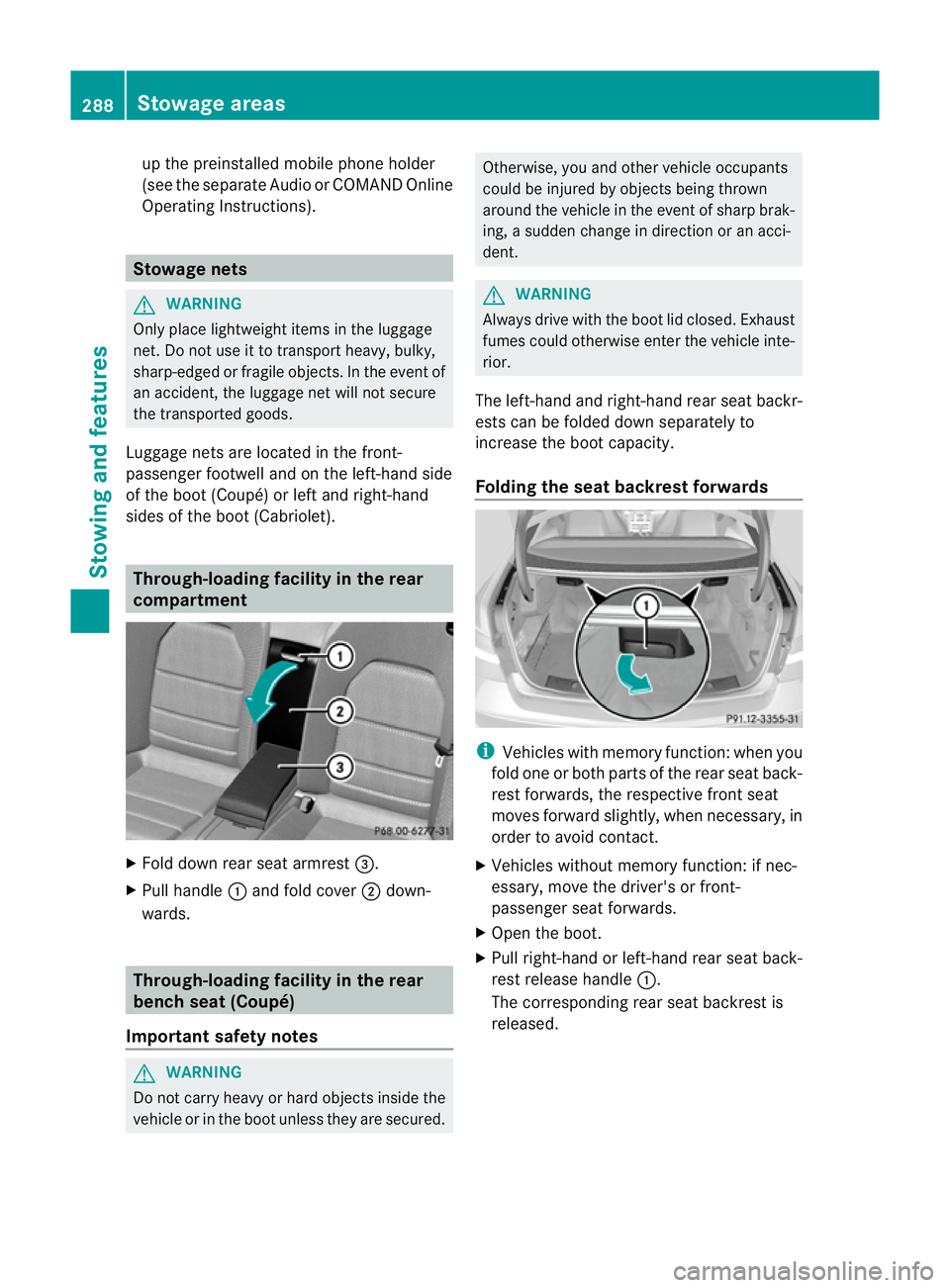
X
Fold down rear seat armrest =.
X Pull handle :and fold cover ;down-
wards. Through-loading facility in the rear
bench seat (Coupé)
Important safety notes G
WARNING
Do not carry heavy or hard objects inside the
vehicle or in the boot unless they are secured. Otherwise, you and other vehicle occupants
could be injured by object
sbeing thrown
around the vehicle in the event of sharp brak-
ing, a sudden change in direction or an acci-
dent. G
WARNING
Always drive with the boot lid closed. Exhaust
fumes could otherwise enter the vehicle inte-
rior.
The left-hand and right-hand rear seat backr-
ests can be folded down separately to
increase the boot capacity.
Folding the seat backrest forwards i
Vehicles with memory function :when you
fold one or both parts of the rear seat back-
rest forwards, the respective front seat
moves forward slightly, when necessary, in
order to avoid contact.
X Vehicles without memory function: if nec-
essary, move the driver's or front-
passenger seat forwards.
X Open the boot.
X Pull right-hand or left-hand rear seat back-
rest release handle :.
The corresponding rear seat backrest is
released. 288
Stowage areasStowing and features
Page 336 of 389
Towing and tow-starting
Important safety notes
G
WARNING
If you tow the vehicle, you must use a rigid
towing ba rif:
R the engine is not running.
R there is a brake system malfunction.
R there is a malfunction in the power supply
or the vehicle's electrical system.
The power assistance for the steering and the
brake force booster do not work when the
engine is not running. You will need more
force to steer and brake, you may have to
depress the brake pedal with maximu mforce.
Before towing away, make sure that the steer-
ing can be moved and is not locked.
If you tow or tow-start another vehicle, its
weight must not exceed the maximum per-
missible gross vehicle weight of your vehicle. G
WARNING
The vehicle is braked when the HOLD function
or DISTRONIC PLUS is activated. Therefore,
deactivate HOLD and DISTRONIC PLUS if the
vehicle is to be towed.
! Only secure the tow rope or towing bar to
the towing eyes. The vehicle may otherwise
be damaged.
! Observe the following points when towing
with a tow rope:
R secure the tow rope on the same side on
both vehicles.
R the tow rope must not be longer than is
legally permitted. It should be marked in
the middle, e.g. with a white cloth
(30 x30c m) so thatothe rroad users are
aware that a vehicle is being towed.
R the tow rope may only be attached to the
towing eyes.
R observe the brake lamps of the towing
vehicle while driving. Always maintain a distance so that the tow rope does not
sag.
R do not use steel cables or chains to tow
your vehicle. The vehicle could be dam-
aged.
! Do not use the towing eye for recovery,
this could damage the vehicle. If in doubt,
recover the vehicle with acrane.
! Pull away smoothly when towing away or
tow-starting a vehicle. If the tractive power
is too high, the vehicles could be damaged.
! On vehicles with KEYLESS-GO, use the
key instead of the Start/Stop button. Turn
the key to position 2in the ignitio nlock and
shift the automatic transmission to N.
Then, turn the key back to 0and leave it in
the ignition lock.
! You may tow the vehicle for a maximum
of 50km. A towing speed of 50 km/h must
not be exceeded.
For towing distances over 50 km, the entire
vehicle must be lifted up and transported.
! If you tow or tow-start another vehicle, its
weight must not exceed the maximu mper-
missible gross vehicle weight of your vehi-
cle.
Information on your vehicle's gross vehicle
weight rating can be found on the vehicle
identification plate (Y page 371).
Observe the legal requirement sfor the rele-
vant countries when towing and tow-starting.
It is better to have the vehicle transported
than to have it towed.
If the vehicle has suffered transmission dam-
age, have it transported on a transporter or
trailer.
When towing a vehicle with an automatic
transmission, the transmission must be in
position N. Towing and tow-starting
333Breakdown assistance Z
Page 381 of 389
At temperatures below freezing:
X
Fill the washe rfluid reservoir with a mixture
of water and washer fluid, e.g. MB Winter-
Fit.
Adapt the mixing ratio to the outside temper-
ature.
R Down to Ò10 †: mix 1 part MB WinterFit
with 2parts water.
R Down to Ò20 †: mix 1 part MB WinterFit
with 1 part water.
R Down to Ò29 †: mix 2 parts MB WinterFit
with 1 part water.
i Add washe rfluid concentrate, e.g. MB
SummerFit or MB WinterFit, to the washer
fluid all year round. Vehicle data
General notes
Please note that for the specified vehicle
data:
R the heights specified may vary as a result
of:
-tyres
- load
- conditio nofthe suspension
- optional equipment
R items of optional equipment increase the
unladen weight and reduce the maximum
payload. The unladen weight is specified in
accordance with EC directive and includes:
-driver (68 kg)
- luggage (7 kg)
- all fluids (fuel tank 90 % full)
R vehicle-specific weight information can be
found on the vehicle identification plate
(Y page 371).
R only for certain countries: you can find vehi-
cle-specific vehicle data in the COC docu-
ments (CERTIFICATE OF CONFORMITY).
These documents are delivered with your
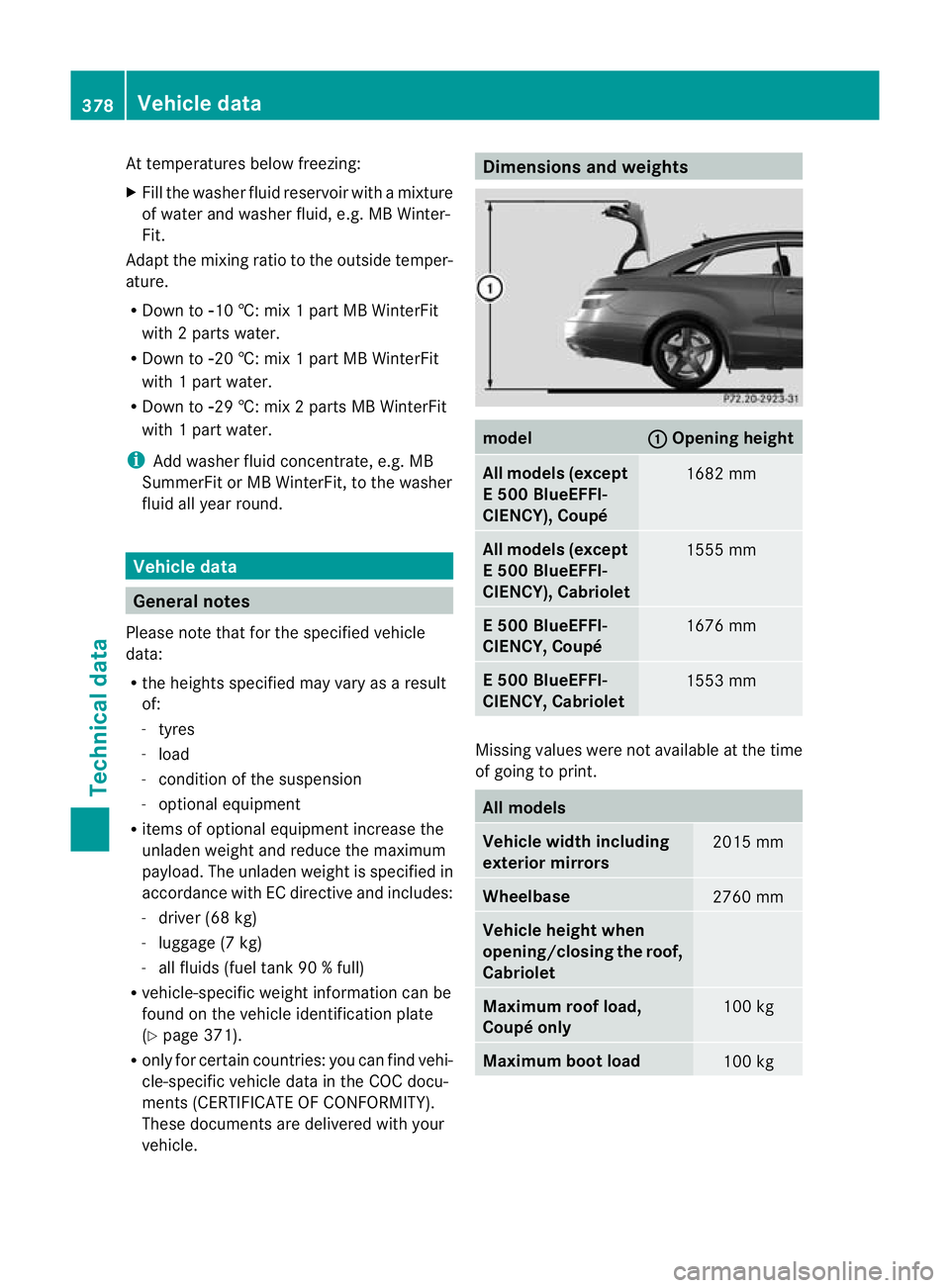
vehicle. Dimensions and weights
model : Opening height
All models (except
E 500 BlueEFFI-
CIENCY), Coupé
1682 mm
All models (except
E 500 BlueEFFI-
CIENCY), Cabriolet
1555 mm
E 500 BlueEFFI-
CIENCY, Coupé
1676 mm
E 500 BlueEFFI-
CIENCY, Cabriolet
1553 mm
Missing values were not available at the time
of going to print.
All models
Vehicle width including
exterior mirrors
2015 mm
Wheelbase
2760 mm
Vehicle height when
opening/closing the roof,
Cabriolet
Maximum roof load,
Coupé only
100 kg
Maximum boot load
100 kg378
Vehicle dataTechnical data
Page 382 of 389
E 200 BlueEFFICIENCY
Vehicle length
4698 mm
Vehicle widt
hexcluding
exterior mirrors 1786 mm
Vehicle height, Coupé
1397 mm
Vehicle height, Cabriolet
1398 mm
Unladen weight, manual
transmission, Coupé
1560 kg
Unladen weight, manual
transmission, Cabriolet
1685 kg
Unladen weight, auto-
matic transmission,
Coupé
1585 kg
Unladen weight, auto-
matic transmission, Cab-
riolet
1710 kg
E 250 BlueEFFICIENCY
Vehicle length
4698 mm
Vehicle width excluding
exterior mirrors
1786 mm
Vehicle height, Coupé
1397 mm
Vehicle height, Cabriolet
1398 mm
Unladen weight, Coupé
1600 kg
Unladen weight, Cabriolet
1725 kg
E 300 BlueEFFICIENCY
E 350 BlueEFFICIENCY
Vehicle length
4698 mm
Vehicle width excluding
exterior mirrors
1786 mm
Vehicle height, Coupé
1397 mm
Vehicle height, Cabriolet
1398 mm E 300 BlueEFFICIENCY
E 350 BlueEFFICIENCY
Unladen weight, Coupé
1660 kg
Unladen weight, Cabriolet
1785 kg
E 500 BlueEFFICIENCY
Vehicle length
4717 mm
Vehicle width excluding
exterior mirrors
Vehicle height, Coupé
1395 mm
Vehicle height, Cabriolet
1397 mm
Unladen weight, Coupé
1795 kg
Unladen weight, Cabriolet
1920 kg
E 220 CDI BlueEFFI-
CIENCY
Vehicle length
4698 mm
Vehicle width excluding
exterior mirrors
1786 mm
Vehicle height, Coupé
1397 mm
Vehicle height, Cabriolet
1398 mm
Unladen weight, manual
transmission, Coupé
1670 kg
Unladen weight, manual
transmission, Cabriolet
1795 kg
Unladen weight, auto-
matic transmission,
Coupé
1680 kg
Unladen weight, auto-
matic transmission, Cab-
riolet
1805 kgVehicle data
379Technical data Z
Page 383 of 389
E 250 CDI BlueEFFI-
CIENCY
Vehicle length
4698 mm
Vehicle widt
hexcluding
exterior mirrors 1786 mm
Vehicle height, Coupé
1397 mm
Vehicle height, Cabriolet
1398 mm
Unladen weight, manual
transmission
1700 kg
Unladen weight, auto-
matic transmission
1825 kg
E 350 CDI BlueEFFI-
CIENCY
Vehicle length
4698 mm
Vehicle width excluding
exterior mirrors
1786 mm
Vehicle height, Coupé
1397 mm
Vehicle height, Cabriolet
1398 mm
Unladen weight, Coupé
1735 kg
Unladen weight, Cabriolet
1865 kg
Trailer tow hitch
Mounting dimensions
! If you have a trailer tow hitch retrofitted,
changes to the cooling system may be nec-
essary, depending on the vehicle type.
If you have a trailer tow hitch retrofitted,
observe the anchorage points on the chas-
sis frame. Example: anchorage points for the trailer tow hitch
:
Anchorage points
; Overhang dimension
= Rear axle centre line
For trailer tow hitches fitted at the factory, the
overhang dimension including the protective
covering is 1181 mm. Missing values for the
E5 00 BlueEFFICIENCY model were not avail-
able at the time of going to print. 380
Trailer tow hitchTechnical data
Page 384 of 389
Trailer loads
Missing values for the E500 BlueEFFICIENCY were not available at the time of going to print. All models (except the
E 500 BlueEFFICIENCY model) Permissible trailer load, unbraked
750 kg
Permissible trailer load, braked (at minimum gra-
dient-climbing capability of 12 % from astandstill. 1800 kg
Maximum drawbar noseweight (the drawbar
noseweight is no tincluded in the trailer load) 75 kg
Permissible rear axle load when towing
atrailer
Coupé Manual transmission Automatic transmission
E 200 BlueEFFICIENCY
1135 kg 1145 kg
E 250 BlueEFFICIENCY
– 1155 kg
E 300 BlueEFFICIENCY
– 1175 kg
E 350 BlueEFFICIENCY
– 1175 kg
E 500 BlueEFFICIENCY
– Missing values were not availa-
ble at the time of going to print.
E 220 CDI BlueEFFI-
CIENCY
1155 kg 1160 kg
E 250 CDI BlueEFFI-
CIENCY
1170 kg 1170 kg
E 350 CDI BlueEFFI-
CIENCY
– 1175 kg
Cabriolet
Manual transmission Automatic transmission
E 200 BlueEFFICIENCY
1205 kg 1215 kg
E 250 BlueEFFICIENCY
– 1225 kg
E 300 BlueEFFICIENCY
– 1245 kg
E 350 BlueEFFICIENCY
– 1245 kgTrailer tow hitch
381Technical data Z