ECU MERCEDES-BENZ E-CLASS CABRIOLET 2017 User Guide
[x] Cancel search | Manufacturer: MERCEDES-BENZ, Model Year: 2017, Model line: E-CLASS CABRIOLET, Model: MERCEDES-BENZ E-CLASS CABRIOLET 2017Pages: 521, PDF Size: 10.64 MB
Page 46 of 521
#
Make sure that the entire base of the
ch ild restra int sy stem alw aysre sts on
th e sitting sur face of the seat. #
Never place objects under or behind
th ech ild restra int sy stem, e.g. cush‐
ions. #
Alw ays use child restra int sy stems with
th e original co ver designed forth em. #
Alw aysre place damaged co vers with
ge nuine co vers. &
WARNING Risk of accident caused by
incor rectly ins talled child restra int sys‐
te ms
If th ech ild restra int sy stem is not cor rectly
ins talled or secured, it could release in the
ev ent of an accident, sudden braking or a
sudden change in direction.
The child restra int sy stem could be flung
around and hit vehicle occupants. This poses
an increased risk of injury or even death! #
Alw ays ins tallch ild restra int sy stems
cor rectl y,eve n when not in use. #
Alw ays comply with thech ild restra int
sy stem manufacturer's ins tallation
instructions. &
WARNING Risk of inju ryor death caused
by the use of damaged child restra int
sy stems
Child restra int sy stems or their retaining sys‐
te ms that ha vebeen subjec tedto a load in
an accident may then not be able toper form
th eir intended pr otective function.
The child cannot be restra ined in theeve nt of
an accident, heavy braking or a sudden
ch ange of direction. #
Alw aysre place child restra int sy stems
immediately that ha vebeen damaged or
in vo lved in an accident. #
Have the securing sy stems forth ech ild
re stra int sy stems checked at a qualified
specialist workshop before ins talling a
ch ild restra int sy stem again. %
Use Mercedes-Benz care products recom‐
mended byMercedes-Benz toclean child
re stra int sy stems. Further information can
be obtained at a qualified specialist work‐
shop.
The following no tes must be obser ved:
R When ins talling a child restra int sy stem on
th e front passenger seat, the information on
ins talling a child restra int sy stem on the front
passenger seat (→ page47).
R Notes on attaching suitable child restra int
sy stems (→ page 49).
R Notes on recommended child restra int sys‐
te ms (→ page 55).
R Instructions and saf ety no tes on the auto‐
matic front passenger airbag shutoff
(→ page 35).
R Safety no tes on the seat belt (→ page27).
R Information on the cor rect use of the seat
belt (→ page31). Occupant saf
ety43
Page 47 of 521
ISOFIX and i-Size
child seat securing sy stems Information on
the ISOFIX and i-Size child
seat securing sy stems &
WARNING Risk of inju ryor fata l injury if
th ech ild secured weighs more than the
permissible weight forth e ISOFIX or
i‑Size child restra int sy stem
ISOFIX child restra int sy stems or i-Size child
re stra int sy stems do not of fer suf ficient pro‐
te ction forch ildren weighing more than
22 kg, who are secured using the seat belt
integrated in thech ild restra int sy stem.
Fo rex ample. thech ild may not be restra ined
cor rectly in theeve nt of an accident. #
Ifth ech ild weighs more than 22 kg,
only use ISOFIX or i‑Size child restra int
sy stems with which thech ild is secured
with theve hicle seat belt. #
Also secure thech ild restra int sy stem
with theTo pTe ther belt, if available. When
fitting a child restra int sy stem, be sure to
obser vethe manufacturer's ins tallation instruc‐ tions and
the instructions for cor rect use of the
ch ild restra int sy stem.
ISOFIX and i-Size are standardised securing sys‐
te ms for special restra int sy stems. ISOFIX child
re stra int sy stems are appr oved in accordance
with ECE R44, i‑Size child restra int sy stems are
appr oved in accordance with ECE R129.
Only child restra int sy stems that ha vebeen
appr oved in accordance with ECE R44 may be
attached toISOFIX mounting brac kets.
The following child restra int sy stems can be
attached toi-Size securing rings:
R ISOFIX child restra int sy stems that are
appr oved in accordance with ECE R44
R i‑Size child restra int sy stems that are
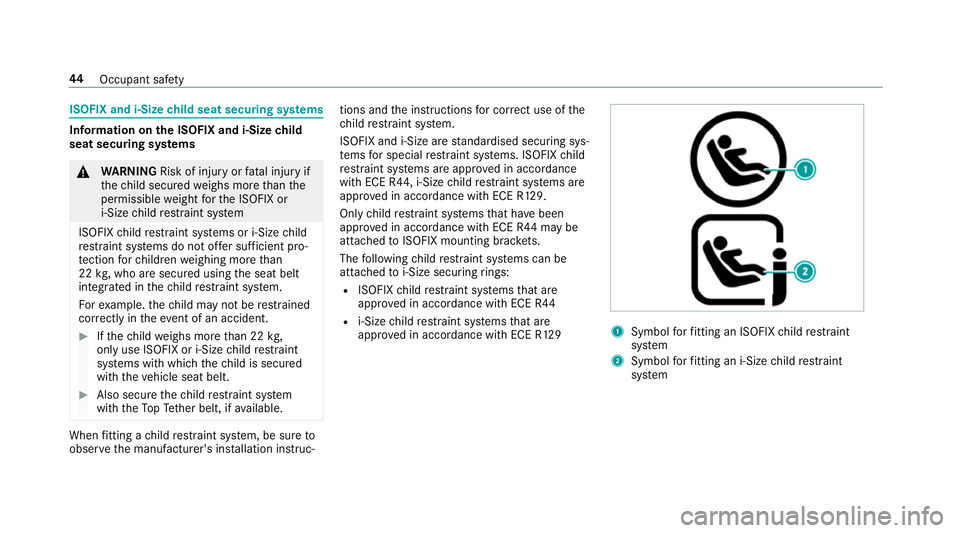
appr oved in accordance with ECE R129 1
Symbol forfitting an ISOFIX child restra int
sy stem
2 Symbol forfitting an i-Size child restra int
sy stem 44
Occupant saf ety
Page 48 of 521
Fi
tting ISOFIX and i-Size child seat securing
sy stems &
WARNING Risk of inju ryor fata l injury if
th ech ild secured weighs more than the
permissible weight forth e ISOFIX or
i‑Size child restra int sy stem
ISOFIX child restra int sy stems or i-Size child
re stra int sy stems do not of fer suf ficient pro‐
te ction forch ildren weighing more than
22 kg, who are secured using the seat belt
integrated in thech ild restra int sy stem.
Fo rex ample. thech ild may not be restra ined
cor rectly in theeve nt of an accident. #
Ifth ech ild weighs more than 22 kg,
only use ISOFIX or i‑Size child restra int
sy stems with which thech ild is secured
with theve hicle seat belt. #
Also secure thech ild restra int sy stem
with theTo pTe ther belt, if available. When
fitting a child restra int sy stem, be sure to
obser vethe manufacturer's ins tallation instruc‐ tions and
the instructions for cor rect use of the
ch ild restra int sy stem.
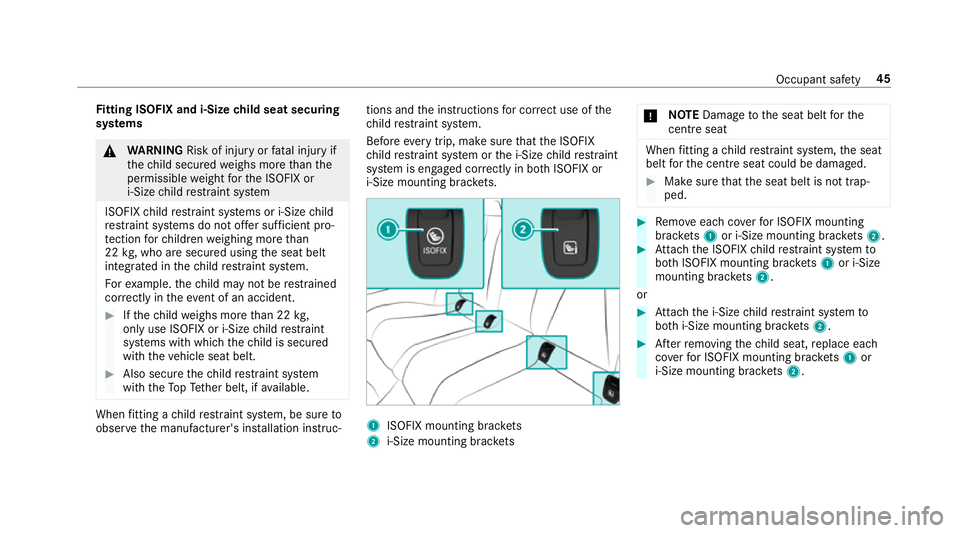
Before every trip, make sure that the ISOFIX
ch ild restra int sy stem or the i-Size child restra int
sy stem is engaged cor rectly in bo thISOFIX or
i‑Size mounting brac kets. 1
ISOFIX mounting brac kets
2 i-Size mounting brac kets *
NO
TEDama getothe seat belt forthe
centre seat When
fitting a child restra int sy stem, the seat
belt forth e cent reseat could be damaged. #
Make sure that the seat belt is not trap‐
ped. #
Remo veeach co verfo r ISOFIX mounting
brac kets 1 or i‑Size mounting brac kets 2. #
Attach the ISOFIX child restra int sy stem to
bo th ISOFIX mounting brac kets 1 or i‑Size
mounting brac kets 2.
or #
Attach the i‑Size child restra int sy stem to
bo th i‑Size mounting brac kets 2. #
Afterre moving thech ild seat, replace each
co verfo r ISOFIX mounting brac kets 1 or
i‑Size mounting brac kets 2. Occupant sa
fety 45
Page 49 of 521
Securing
TopTe ther &
WARNING Risk of inju ryor death if the
re ar seat backrests are not loc ked af ter
fi tting TopTe ther belts
If th ere ar seat backrests are not loc ked, they
could fold forw ards in theeve nt of an acci‐
dent, heavy braking or sudden changes of
direction.
As a result, child restra int sy stems cann ot
per form their intended pr otective function.
Re ar seat backrests that are not loc ked can
also cause additional injuries, e.g. in the
ev ent of an accident. #
Alw ays lock rear seat backrests af ter
fi tting TopTe ther belts. #
Obser vethe lock verification indicator. If
th e seat backrest is not engaged and loc ked,
th is will be shown in the multifunction display in
th e instrument clus ter.
The risk of injury can be reduced byTopTe ther
as TopTe ther pr ovides an additional connection between
thech ild restra int sy stem secured with
ISOFIX or i-Size and theve hicle.
The child restra int sy stem must be equipped
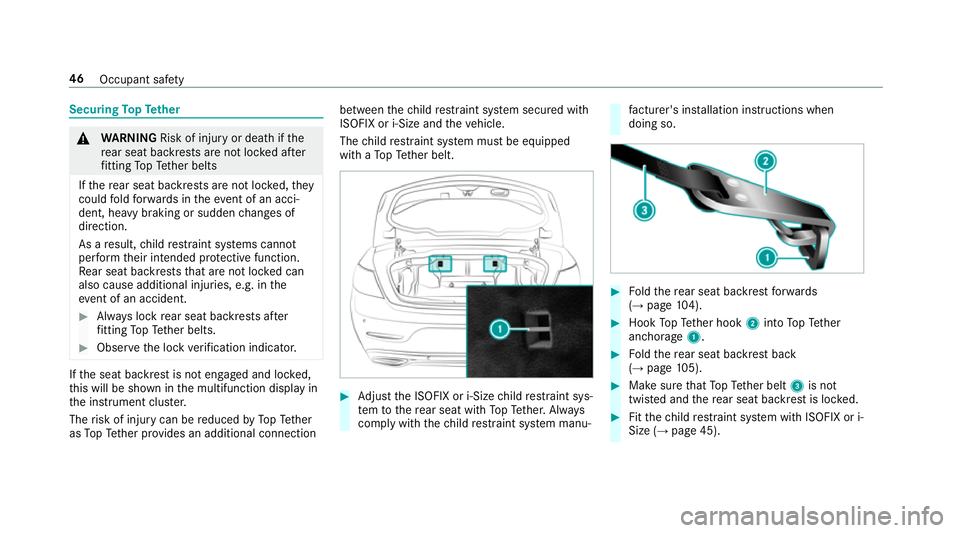
with a TopTe ther belt. #
Adjust the ISOFIX or i-Size child restra int sys‐
te m to there ar seat with TopTe ther. Alw ays
comply wi th thech ild restra int sy stem manu‐ fa
cturer's ins tallation instructions when
doing so. #
Foldthere ar seat backrest forw ards
(→ page 104). #
Hook TopTe ther hook 2into TopTe ther
anchorage 1. #
Foldthere ar seat backrest back
(→ page 105). #
Make sure that TopTe ther belt 3is not
twis ted and there ar seat backrest is loc ked. #
Fitthech ild restra int sy stem with ISOFIX or i-
Size (→ page 45). 46
Occupant saf ety
Page 50 of 521
#
Tension TopTe ther belt 3from the boot. #
Make sure that there is enough seat belt
av ailable forfast ening. #
Alw ays comply with thech ild restra int sys‐
te m manufacturer's ins tallation instructions
when doing so. Child
restra int sy stems on the front
passenger seat Note
s onchild restra int sy stems on the front
passenger seat
Ac cident statistics show that children secured in
th ere ar seats are safer than children secured in
th e front seats. Forth is reason, Mercedes-Benz
stro ngly advises that you ins tall a child restra int
sy stem on a rear seat.
If it is absolutely necessary toins tall a child
re stra int sy stem on the front passenger seat,
alw ays obser vethe information on the automatic
front passenger airbag shutoff (→ page 35).By doing
this, you can avoidrisks caused by:
R Ach ild restra int sy stem that is not de tected
by the automatic front passenger airbag
shutoff.
R The unintentionally disabled front passenger
airbag.
R Incor rect positioning of thech ild restra int
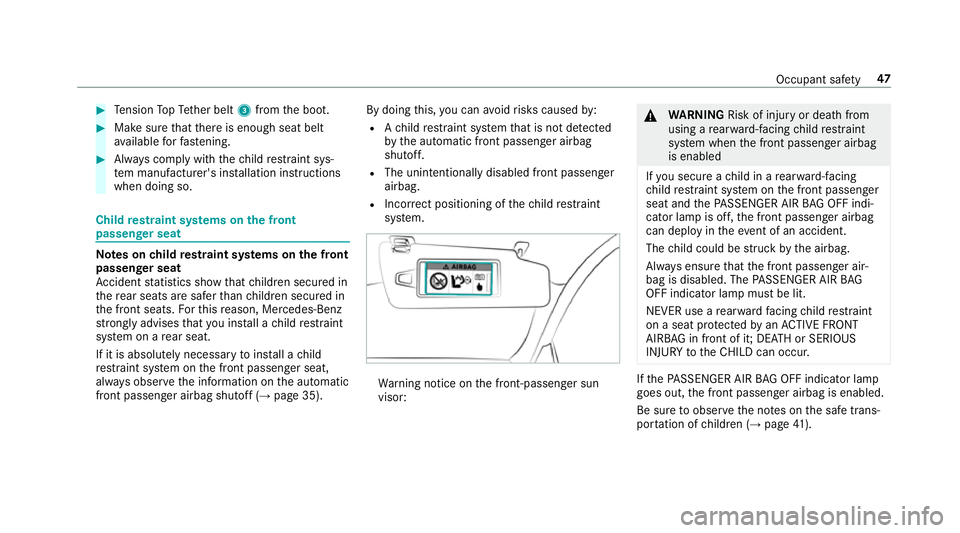
sy stem. Wa
rning notice on the front-passen ger sun
visor: &
WARNING Risk of inju ryor death from
using a rear wa rd-facing child restra int
sy stem when the front passenger airbag
is enabled
If yo u secure a child in a rear wa rd-facing
ch ild restra int sy stem on the front passenger
seat and thePA SSENGER AIR BAG OFF indi‐
cator lamp is off, the front passenger airbag
can deploy in theev ent of an accident.
The child could be stru ck bythe airbag.
Alw ays ensure that the front passenger air‐
bag is disabled. The PASSENGER AIR BAG
OFF indicator lamp must be lit.
NEVER use a rear wa rdfacing child restra int
on a seat pr otected byan ACTIVE FRONT
AIRB AGin front of it; DE ATH or SERIOUS
INJU RYtotheCH ILD can occur. If
th ePA SSENGER AIR BAG OFF indicator lamp
goes out, the front passenger airbag is enabled.
Be sure toobser vethe no tes on the safe trans‐
por tation of children (→ page41). Occupant sa
fety 47
Page 53 of 521
Semi-uni
versal ch ild restra int sy stems are indi‐
cated bythete xt "semi-uni versal" on the
appr oval label. They can on ly beused if theve hi‐
cle and the seat are lis ted in thech ild restra int
sy stem manufacturer's vehicle model list.
Suitability of seats for attaching belt-
secu redch ild restra int sy stems
Obser vethefo llowing information:
R When using a baby car seat of the cate‐
gory 0/0+ and a rear wa rd-facing child
re stra int sy stem on a rear seat: adjustthe
driver's and front passenger seat such that
th e seat does not touch thech ild restra int
sy stem.
R When using a forw ard-facing child
re stra int sy stem of category I: remo vethe
head restra int from there spective seat, if
possible (→ page 93). In addition, the seat
backrest of thech ild restra int sy stem must,
as far as possible, lie flat against the back‐
re st of theve hicle seat. R
When youre mo vethech ild restra int sy stem,
fi t th e head restra int immediately
(→ page 93) and adjust all the head
re stra ints again cor rectly.
R For cer tain child restra int sy stems in weight
categories II or III, there might be restrictions
in the maximum size setting, e.g. due topos‐
sible con tact wi th thero of.
R Make sure that thech ild's feet do not touch
th e front seat. If necessar y,mo vethe front
seat forw ard slightl y.
R The child restra int sy stem must not touch the
ro of or be put under stra in by the head
re stra ints. Adjust the head restra ints accord‐
ing ly.
R When opening or closing the soft top, the
ch ild restra int sy stems in weight categories II
or III must be remo ved or the head restra ints
of thech ild restra int sy stems must be mo ved
to the lo westposition. R
Obser vethe manufacturer's ins tallation
instructions forth ech ild restra int sy stem.
Legend for the table:
X Not suitable forch ildren in this we ight
categor y.
U Suitable forch ild restra int sy stems of
th e "Universal" category in this we ight
categor y.
UF Suitable forfo rw ard-facing child
re stra int sy stems of the "Universal" cat‐
egory in this we ight categor y.
L Suitable for semi-universal child
re stra int sy stems according totheta ble
in "Recommended child restra int sys‐
te ms", or if theve hicle and the seat are
lis ted in thech ild restra int sy stem man‐
ufacturer's vehicle model list. 50
Occupant saf ety
Page 61 of 521
R
With indicator lamp 1off: via the switch
on the cor responding rear door or driv‐
er's door. Pe
ts in the vehicle &
WARNING Risk of accident and inju ry
due toanimals left unsecured or unat‐
te nded in theve hicle
If yo u lea veanimals in theve hicle unatten‐
ded or unsecured, they could possib lypress
down buttons or switches.
Thereby an animal may:
R activate vehicle equipment and become
trapped, forex ample
R swit chsystems on or off and endanger
ot her road users
Uns ecured animals may be throw n around in
th eve hicle in theeve nt of an accident or
sudden steering and braking manoeuvres
and injure vehicle occupants in the process. #
Never lea veanimals in theve hicle unat‐
te nded. #
Alw ays cor rectly secu reanimals while
driving, e.g. using a suitable animal car‐
ri er. 58
Occupant saf ety
Page 67 of 521
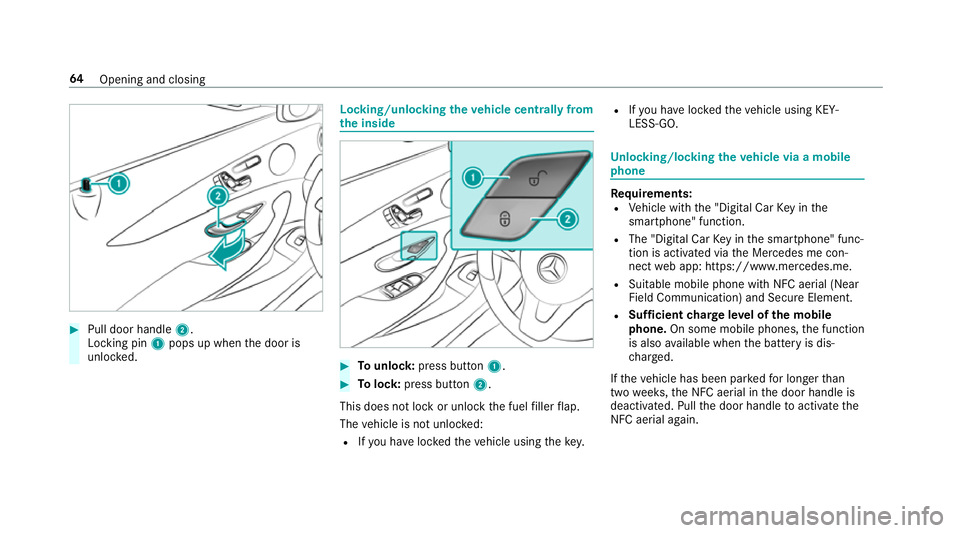
#
Pull door handle 2.
Locking pin 1pops up when the door is
unloc ked. Locking/unlocking
theve hicle centrally from
th e inside #
Tounlo ck:press button 1. #
Tolock: press button 2.
This does not lock or unlock the fuel filler flap.
The vehicle is not unloc ked:
R Ifyo u ha veloc kedth eve hicle using thekey. R
Ifyo u ha veloc kedth eve hicle using KEY‐
LESS-GO. Un
locking/locking theve hicle via a mobile
phone Re
quirements:
R Vehicle with the "Digital Car Key in the
smartphone" function.
R The "Digital Car Key in the smartphone" func‐
tion is activated via the Mercedes me con‐
nect web app: https://www.mercedes.me.
R Suitable mobile phone with NFC aerial (Near
Field Communication) and Secure Element.
R Suf ficient charge leve l of the mobile
phone. On some mobile phones, the function
is also available when the battery is dis‐
ch arge d.
If th eve hicle has been par kedfo r longer than
two weeks, the NFC aerial in the door handle is
deactivated. Pull the door handle toactivate the
NFC aerial again. 64
Opening and closing
Page 72 of 521

*
NO
TEDama getothe boot lid byobs ta‐
cles ab ovetheve hicle The boot lid swings upwards when it is
opened. #
Therefore, make sure that there is suf fi‐
cient clearance ab ovethe boot lid. Yo
u ha vethefo llowing options toopen the boot
lid: #
With th e boot lid unloc ked, press theto p of
th est ar. #
Vehicles with boot lid conve nience clos‐
ing feature: withthe boot lid stopped in an
intermediate position, pull it upwards and
re lease as soon as it begins toopen.
% Toopen the boot lid, pull on thefo lded-out
st ar when there ve rsing camera is activated. #
Press and hold thep button on thekey. #
Pull boot lid remo teoperating switch 1. #
Vehicles with HANDS-FREE ACCESS: move
yo ur foot below the bumper (→ page71).
Ve hicles with boot lid conve nience closing:if
an object restricts the boot lid during the auto‐
matic opening process, the obs tacle de tection
st ops the boot lid. The obs tacle de tection func‐
tion is only an aid and is not a substitu teforyo ur
attentiveness. Closing
the boot lid &
WARNING Risk of inju ryfrom unsecu red
items in theve hicle
If objects, luggage or loads are not secured
or not secured suf ficientl y,they could slip,
tip ove r or be throw n around and thereby hit
ve hicle occupants.
There is a risk of injur y,particularly in the
ev ent of sudden braking or a sudden change
in direction. #
Alw aysstow objects in such a wayth at
th ey cannot be thro wn around. #
Before the journe y,secure objects, lug‐
ga ge or loads against slipping or tipping
ove r. &
WARNING Risk of becoming trapped
du ring au tomatic closing of the boot lid
Pa rts of the body could become trapped dur‐
ing automatic closing of the boot lid. More‐
ove r,people, e.g. children, may be standing Opening and closing
69
Page 75 of 521

&
WARNING Risk of bu rns caused bya hot
ex haust sy stem
The vehicle exhaust sy stem can become very
hot. If you use HANDS-FREE ACCESS, you
could bu rnyourself by touching theex haust
sy stem. #
Alw ays ensure that you on ly ma ke a
kicking mo vement within the de tection
ra nge of the sensors. *
NO
TEDama getotheve hicle caused by
unin tentional lyopening the boot lid: R
when using an automatic car wash
R when using a high pressure cleaner #
Deactivate KEYLESS-GO or make sure
th at theke y located is at least 3 m
aw ay from theve hicle in such situa‐
tions. When making
the kicking mo vement, make sure
th at your feet are firm ly on the ground, other‐
wise you could lose your balance, e.g. on ice. Re
quirements:
R The key is behind theve hicle.
R Stand at least 30 cm away from theve hicle
while per form ing the kicking mo vement.
R Do not come into contact with the bumper
while making the kicking mo vement.
R Do not car ryout the kicking mo vement too
slowl y.
R The kicking mo vement must be towa rdsthe
ve hicle and bac k. 1
Sensor de tection range If se
veral consecutive kicking mo vements are
not successful, waitte n seconds.
Sy stem limitations
The sy stem may be impaired or may not function
if:
R Snow or dirt, e.g. from road salt, co vers the
sensor area.
R The kicking mo vement is made using a pros‐
th etic leg.
The boot lid could be opened or closed unin ten‐
tional ly, in thefo llowing situations:
R If a person's arms or legs are moving in the
sensor de tection range, e.g. when polishing
th eve hicle, sitting on the edge of the boot,
or picking up objects.
R If objects are mo ved or placed behind the
ve hicle, e.g. tensioning stra ps or luggage
R When working on the trailer coupling, trailers
or rear bicycle rack s.
Deactivate KEYLESS-GO (→ page 60) or do not
car rytheke y about your person in such situa‐
tions. 72
Opening and closing