warning lights MERCEDES-BENZ E-CLASS CABRIOLET 2018 User Guide
[x] Cancel search | Manufacturer: MERCEDES-BENZ, Model Year: 2018, Model line: E-CLASS CABRIOLET, Model: MERCEDES-BENZ E-CLASS CABRIOLET 2018Pages: 498, PDF Size: 6.28 MB
Page 114 of 498
Theexterior lighting (e xcept parking and stand‐
ing lights) switch es off automatically when the
driver's door is opened.
RObser vethe no tes on sur round lighting
(→page 115).
Au tomatic driving lights function
The pa rking lights, low beam and daytime run‐
ning lights are switched on au tomatically
depending on the ignition status, whe ther the
engine is running and the light conditions.
0071
WARNING Risk of accident when the low
beam is switched off in poor visibility
When the light switch is set to0058, the low
beam may not be switched on automatically
if th ere is fog, snow or other causes of poor
visibility such as spr ay.
00BBIn such cases, turn the light switch to
0058.
The automatic driving lights are only an aid. You
are responsible forve hicle lighting. Ac
tivating/deactivating the rear fog light
Re quirements
RThe light switch is in the 0058 or0058 posi‐
tion.
00BBPress the 005E button.
Please obser vethe count ry-specific la wsonthe
use of rear fog lights.
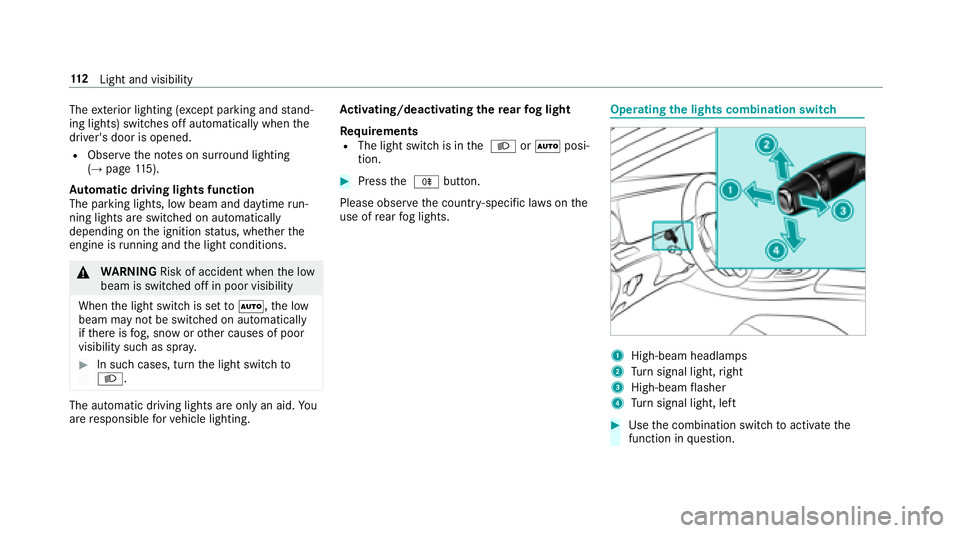
Operating the lights combination switch
1High-beam headlamps
2Turn signal light, right
3High-beam flasher
4Tu rn signal light, left
00BBUse the combination switch toactivate the
function in question.
112
Light and visibility
Page 116 of 498
RAtspeeds between 25 mph(4 0 km/h) and
45 mph(7 0 km/h) when thesteering wheel
is turned.
Tr af fic circle and intersection function: the
cornering light is acti vated on bo thsides thro ugh
an eva luation of the cur rent GPS position of the
ve hicle. It remains active until af terth eve hicle
has left the tra ffic circle or the intersection.
Ad aptive Highbeam Assist
Function of Adaptive Highbeam Assist
0071
WARNING Risk of accident despite
Ad aptive Highbeam Assist
Ad aptive Highbeam Assist does not recog‐
nize thefo llowing road users:
RRo ad users without lights, e.g. pedes‐
trians
RRo ad users with poor lighting, e.g.
cyclists
RRo ad users whose lighting is obstructed,
e.g. bya bar rier
On very rare occasions, Adaptive Highbeam
Assist may failto recognize other road users
with their own lighting, or may recognize
th em too late.
In these or similar situations, the automatic
high beam is not deactivated or is activated
despite the presence of other road users.
00BBAlw ays obser vethe tra ffic carefully and
switch off the high beam in good time.
Sy stem limitations
Ad aptive Highbeam Assist cannot take into
account road, weather or traf fic conditions.
De tection may be restricted if:
RVi sibility is impaired, forex ample in fog,
heavy rain or sno w.
RThere is dirt on the sensors or the sensors
are obscured.
Ad aptive Highbeam Assist is only an aid.You are
re sponsible for adju sting theve hicle's lighting to
th e pr evailing light, visibility and traf fic condi‐
tions.
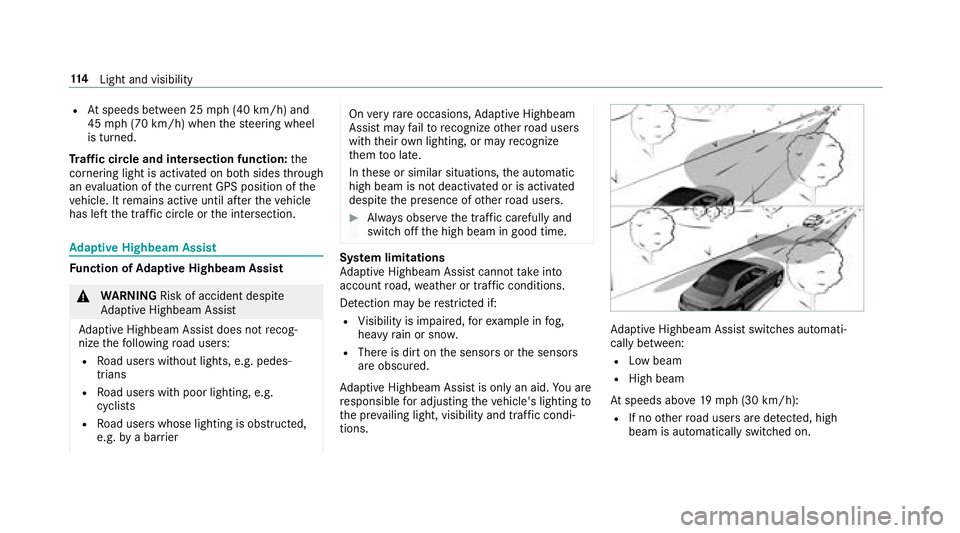
Ad aptive Highbeam Assist switch es automati‐
cally between:
RLow beam
RHigh beam
At speeds abo ve19 mp h (30 km/h):
RIf no other road users are de tected, high
beam is au tomatical lyswitched on.
11 4
Light and visibility
Page 135 of 498
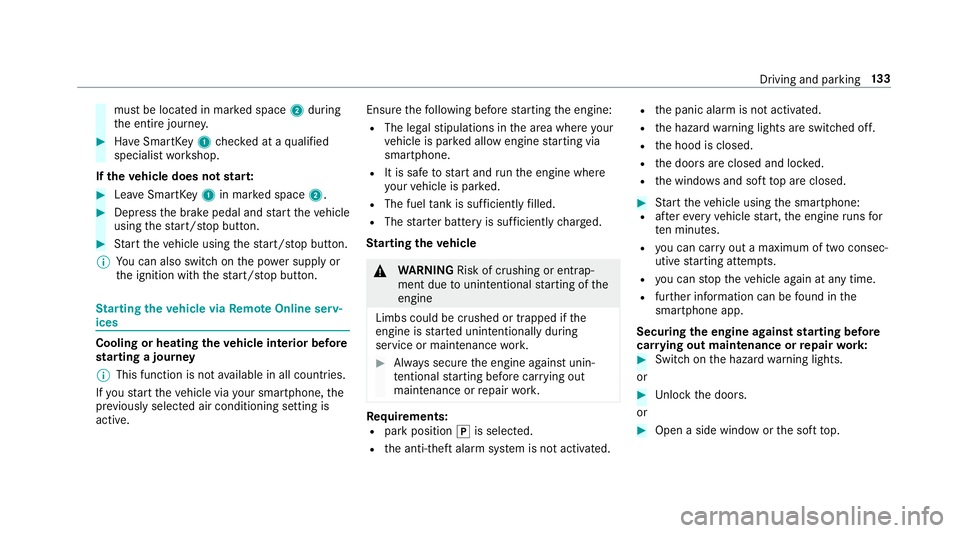
must be located in marked space 2during
th e entire journe y.
00BBHave SmartK ey1 checked at a qualified
specialist workshop.
If th eve hicle does not star t:
00BBLea veSmartK ey1 in mar ked space 2.
00BBDepress the brake pedal and start theve hicle
using thest art/ stop button.
00BBSt art theve hicle using thest art/ stop button.
00CE You can also switchon the po wer supp lyor
th e ignition with thest art/ stop button.
St arting theve hicle via Remo teOnline serv‐
ices
Cooling or heating theve hicle interior before
st arting a journey
00CE This function is not available in all countries.
If yo ustart theve hicle via your smartphone, the
pr ev iously selecte d air conditioning setting is
active. Ensure
thefo llowing before starting the engine:
RThe legal stipulations in the area where your
ve hicle is par ked allow engine starting via
smartphone.
RIt is safe tostart and runth e engine where
yo ur vehicle is par ked.
RThe fuel tank is suff icientlyfilled.
RThe star ter battery is suf ficiently charge d.
St arting theve hicle
0071
WARNING Risk of crushing or entrap‐
ment due tounin tentional starting of the
engine
Limbs could be crushed or trapped if the
engine is star ted unintentionally during
service or maintenance work.
00BBAlw ays secure the engine against unin‐
te ntional starting before car rying out
maintenance or repair work.
Re quirements:Rpark position 005Dis selected.
Rthe anti- theft alarm sy stem is not activated.
Rth e panic alarm is not activated.
Rthe hazard warning lights are switched off.
Rthe hood is closed.
Rthe doors are closed and loc ked.
Rthe windo wsand soft top are closed.
00BBSt art theve hicle using the smartphone:Rafte reve ryvehicle start, the engine runs for
te n minu tes.
Ryo u can car ryout a maximum of two consec‐
utive starting attem pts.
Ryo u can stop theve hicle again at any time.
Rfur ther information can be found in the
smartphone app.
Securing the engine against starting before
car rying out maintenance or repair work:
00BBSwitch on the hazard warning lights.
or
00BBUn lock the doors.
or
00BBOpen a side window or the soft top.
Driving and parking 13
3
Page 156 of 498
Overview of driving systems and driving
saf ety sy stems
In this section, youwill find information about
th efo llowing driving sy stems and driving saf ety
sy stems:
R360° Camera (→page 181)
RABS ( Anti-lock Braking Sys tem)
(→page 154)
RAc tive Dis tance Assist DISTRONIC
(→pa ge 162)
RAIR BODY CONTROL (→page 171)
RAc tive Brake Assi st(→page 156)
RAc tive Lane Keeping Assist (→page 195)
RATTENTION ASSIST (→page 189)
RBA S (Brak eAssist System) (→page 154)
REBD ( Electronic Brakeforc eDistribution)
(→page 155)
RESP®(E lectronic Sta bility Program)
RHill Start Assist
RHOLD function (→page 170)
RSTEER CONTROL (→page 155)
RAc tive Steering Assist (→page 167)
RAc tive Parking Assist (→page 184)
RParking Assist PARKTRONI C (→page17 5)
RRe ar view camera (→page 178)
RCruis e control (→page 160)
RBlind Spot Assist and Active Blind Spot Assi st
(→page 193)
RTraf fic Sign Assist (→page191)
Fu nctions of ABS (Anti-lock Brake Sy stem)
ABS regulates the brake pressure in critical driv‐
ing situations:
RDuring braking, e.g. at maximum full-s top
braking or insuf ficient traction of the tires,
th e wheels are pr evented from blocking.
RVehicle steerability while braking is ensured.
If ABS inter venes when braking, you will feel a
pulsing in the brake pedal. The pulsating brake
pedal can be an indication of hazardous road
conditions and can ser veas a reminder totake
ex tra care while driving. Sy
stem limitations
RABS is active from speeds of appr ox. 5 mph
(8 km/h).
RABS may be impaired or may not function if a
malfunction has occur red and theye l‐
low 0025 ABSwarning lamp lights up contin‐
uously in the instrument clus ter af terth e
engine is star ted.
Fu nction of BAS (Brake Assist Sy stem)
0071
WARNING Risk of an accident caused by
a malfunction in BAS (Brake Assist Sys‐
te m)
If BA S is malfunctioning, the braking dis tance
in an eme rgency braking situation is
increased.
00BBDepress the brake pedal with full forc e
in emer gency braking situations. ABS
pr eve nts the wheels from locking.
BA S suppo rts yo ur eme rgency braking situation
with additional brake forc e.
15 4
Driving and pa rking
Page 157 of 498
Ifyo udepr essthe brake pedal quickl y,BA S is
acti vated:
RBA S au tomatical lyboosts the brake pres‐
sure.
RBA S can short enthe braking dis tance.
RABS pr events the wheels from locking.
The brakes will function as usual once you
re lease the brake pedal. BAS is deactivated.
Activating/deactivating ESP®(Electronic Sta‐
bility Prog ram)
Multimedia sy stem:
00869HKLFOH00CFk $VVLVWDQFH00CF(63
00BBActivate 0073or deacti vate 0053 the function.
ESP
®is deactivated if the00BB ESP®OFFwarn‐
ing lamp lights up continuously in the instrument
clus ter.
Obser vethe information on warning lamps and
display messages which may be shown in the
instrument clus ter.
Fu nctions of ESP®Crosswind Assist
ESP®Crosswind Assist de tects sudden gust s of
side wind and helps the driver tokeep theve hi‐
cle in the lane:
RESP®Crosswind Assist is active at vehicle
speeds between 50 mph(8 0 km/h) and
12 5mp h(2 00 km/h) when driving stra ight
ahead or cornering slightly .
RThevehicle is stabilized bymeans of individ‐
ual brake application on one side.
Fu nction of EBD (Electronic Brake forc e Dis‐
tribution)
EBD is characterized bythefo llowing:
RMonitoring and regulating the brake pressure
on there ar wheels.
RImpr oved driving stability when braking,
especially on bends.
ST EER CONT ROL function
STEER CONTROL helps youby transmitting a
noticeable steering forc eto thesteering wheel in
th e direction requ ired forve hicle stabilization.
This steering recommendation is given part icu‐
larly in thefo llowing situations:
RBo th right wheels or bo thleft wheels are on
a we t or slippe ryroad sur face when you
brake.
RThe vehicle starts toskid.
Sy stem limitations
ST EER CONTROL may be impaire d or may not
function in thefo llowing situations:
RESP®is deactivated.
RESP®is malfunctioning.
RThe steering is malfunctioning.
If ESP
®is malfunctioning, youwill be assis ted
fur ther by the electric po werst eering.
Driving and parking 15
5
Page 158 of 498
Function of Active Brake Assi st
Active Brake Assi stconsist s of:
RDistance warning function
RAu tonomous braking function
RSituation-dependent braking assist ance
RVehicles with Driving Assistance Pack‐
age: Evasi veSteering Assist
Ac tive Brake Assi stcan help youto minimize the
ri sk of a collision with vehicles or pedestrians or
to reduce the ef fects of such a collision.
If Ac tive Brake Assi sthas de tected a risk of colli‐
sion, youwill be warned visually and acousti‐
cally.
If yo udo not react tothe visual and audible colli‐
sion warning, autonomous braking can be initi‐
ated in critical situations.
In especially critical situations, Active Brake
Assi stcan initiate autonomous braking direct ly.
In this case, the visual and acoustic warning
occurs simultaneously with the braking applica‐
tion. If
yo u apply the brake yourself ina critical situa‐
tion or apply the brake during autonomous brak‐
ing, situation-dependent braking assis tance
occurs . This increases the brake pressure up to
maximum full-s top braking if necessar y.
If th e autonomous braking function or the situa‐
tion-dependent braking assis tance is trig gered,
additional pr eventive measures for occupant
pr otection (PRE-SAFE
®) may also be initiated, if
th eve hicle is equipped with these.
0071
WARNING Risk of an accident caused by
limited de tection per form ance of Active
Brake Assi st
Ac tive Brake Assi stcannot al ways clearly
identify objects and complex traffic situa‐
tions.
In such cases,Active Brake Assi stmight:
RGive a warning or brake without reason
RNot give a warning or not brake
00BBAlw ays pay careful attention tothe traf‐
fi c situation; do not rely on Active Brake
Assi stalone. Active Brake Assi stis only
an aid. The driver is responsible for
maintaining a sui table dis tance tothe
ve hicle in front, vehicle speed and for
braking in good time.
00BBBe prepared tobrake or swer veif nec‐
essar y.
Also obser vethe sy stem limitations of Active
Brake Assi st.
The individual subfunctions are available in
th efo llowing speed ranges:
Distance warning function
The dis tance warning function issues a warning
at speeds:
RFr om appr oximately 4 mph (7 km/h), if your
ve hicle is critically close toave hicle or
pedestrian. An intermittent warning tone
sounds and the00BA distance warning lamp
lights up in the instrument clus ter.
Brake immediately or take evasive action, pr ovi‐
ded it is safe todo so and the traf fic situation
allo wsthis.
15 6
Driving and pa rking
Page 182 of 498
Wide-angle view
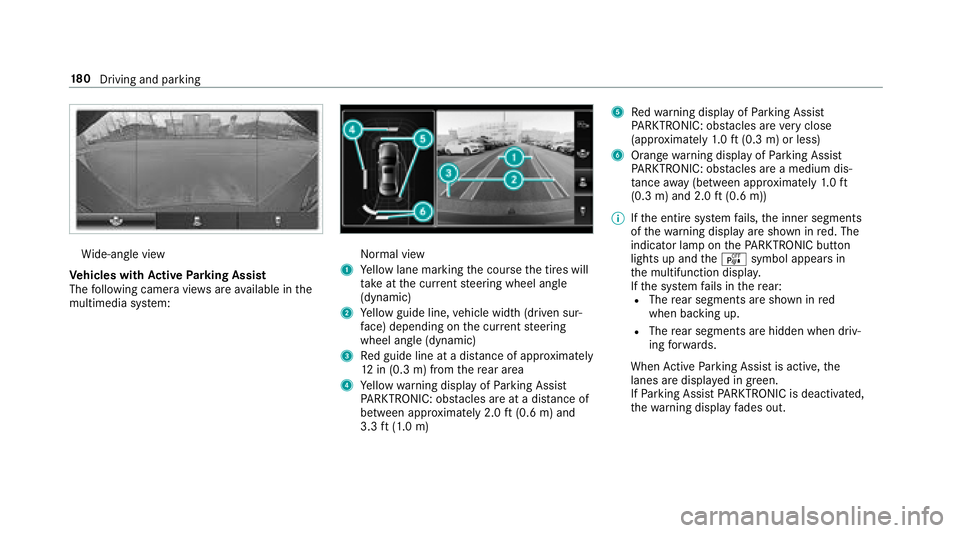
Ve hicles with Active Parking Assist
The following camera vie wsare available in the
multimedia sy stem:Normal view
1Ye llow lane marking the course the tires will
ta ke atthe cur rent steering wheel angle
(dynamic)
2Ye llow guide line, vehicle width (driven sur‐
fa ce) depending on the cur rent steering
wheel angle (dynamic)
3Re d guide line at a dis tance of appr oximately
12 in (0.3 m) from there ar area
4Ye llow warning display of Parking Assist
PA RKTRONIC: obstacles ar eat adis tance of
between appr oximately 2.0 ft(0.6 m) and
3.3 ft(1.0 m)
5Re dwa rning display of Parking Assist
PA RKTRONIC: obstacles ar eve ry close
(appr oximately 1.0 ft (0.3 m) or less)
6Orange warning display of Parking Assist
PA RKTRONIC: obstacles ar e amedium dis‐
ta nce away (between appr oximately 1.0 ft
(0.3 m) and 2.0 ft(0.6 m))
00CE Ifth e entire sy stem fails, the inner segments
of thewa rning display are shown in red. The
indicator lamp on thePA RKTRONI Cbut ton
lights up and theé symbol appears in
th e multifunction displa y.
If th e sy stem fails in there ar:
RThe rear segments are shown in red
when backing up.
RThe rear segments are hidden when driv‐
ing forw ards.
When Active Parking Assist is active, the
lanes are displa yed in green.
If Pa rking Assist PARKTRONI Cis deacti vate
d,
th ewa rnin
g display fades out.
18 0
Driving and pa rking
Page 184 of 498
Top view
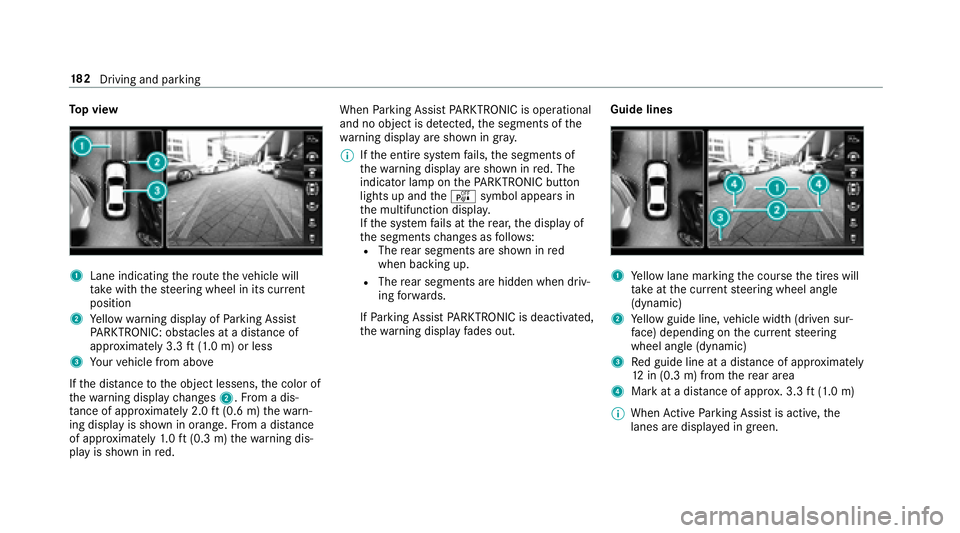
1Lane indicating thero ute theve hicle will
ta ke with thesteering wheel in its cur rent
position
2Ye llow warning display of Parking Assist
PA RKTRONIC: obstacles at adis tance of
appr oximately 3.3 ft(1.0 m) or less
3Yo ur vehicle from abo ve
If th e dis tance tothe object lessens, the color of
th ewa rning display changes 2.From a dis‐
ta nce of appr oximately 2.0 ft(0.6 m) thewa rn‐
ing display is shown in orange. From a dis tance
of appr oximately 1.0 ft (0.3 m) thewa rning dis‐
play is shown in red. When
Parking Assist PARKTRONI Cis operational
and no objec tis de tected, the segments of the
wa rning display are shown in gray .
00CE Ifth e entire sy stem fails, the segments of
th ewa rning display are shown in red. The
indicator lamp on thePA RKTRONI Cbut ton
lights up and theé symbol appears in
th e multifunction displa y.
If th e sy stem fails at there ar, the display of
th e segments changes as follo ws :
RThe rear segments are shown in red
when backing up.
RThe rear segments are hidden when driv‐
ing forw ards.
If Pa rking Assist PARKTRONI Cis deacti vated,
th ewa rning display fades out. Guide lines1Ye
llow lane marking the course the tires will
ta ke atthe cur rent steering wheel angle
(dynamic)
2Ye llow guide line, vehicle width (driven sur‐
fa ce) depending on the cur rent steering
wheel angle (dynamic)
3Re d guide line at a dis tance of appr oximately
12 in (0.3 m) from there ar area
4Mark at a distance of appr ox. 3.3 ft(1.0 m)
00CE When Active Parking Assist is active, the
lanes are displa yed in green.
18 2
Driving and pa rking
Page 195 of 498

Blind Spot AssistandActive Blind Spot
Assi st
Function of Blind Spot Assist and Active
Blind Spot Assi st
Blind Spot Assist uses two lateral,rear-facing
ra dar sensors tomonitor the area up to130ft
(40 m) behind your vehicle and 10ft(3 m)
directly next to yourvehicle.
If a vehicle is de tected at speeds ab ove appr ox‐
imately 8 mph (12 km/h) and this vehicle subse‐
qu ent lyenters the monitoring range di rectly next
to yo urvehicle, thewa rning lamp in the outside
mir ror lights up red.
If a vehicle is de tected close to yourvehicle in
th e lateral monitoring range and youswit chon
th e turn signal indicator in the cor responding
direction, a warning tone sounds once. The red
wa rning lamp in the outside mir rorflashes. If the
turn signal indica torre mains on, all other de tec‐
te dve hicles are indicated only bytheflashing of
th ere dwa rning lamp.
If yo uove rtake a vehicle quickl y,no warning is
given.
0071 WARNING Risk of accident despite Blind
Spot Assist
Blind Spot Assist does notreact tovehicles
approaching and overtaking you at a greatly
di fferent speed.
As a result, Blind Spot Assist cannot warn
drivers in this situation.
00BBAlw ays pay careful attention tothe traf‐
fi c situation and maintain a safe dis‐
ta nce at the side of theve hicle.
Blind Spot Assist and Active Blind Spot Assi st
are only aids. They may failto detect some vehi‐
cles and are no substitute for attentive driving.
Alw ays ensure that there is suf ficient dist anceto
th e side forot her road users and obs tacles.
Sy stem limitations
The sy stem may be limited in thefo llowing situa‐
tions:
Rth e sensors are dirty or co vered
Rpoor visibility, e.g. due tofog, heavy rain,
snow or spr ay
Rnarrow vehicles, e.g. bicycles, are within the
monitoring range
Wa rnings may be issued in er ror when driving
close tocrash barr iers or similar solid lane bor‐
ders. Warnings may be inter rupte d when driving
alongside long vehicles, e.g. truc ks,fo r a pro‐
longed time.
Blind Spot Assist is not operational when reve rse
ge ar is engaged.
Fu nction of braking applications (Active
Blind Spot Assist)
If Ac tive Blind Spot Assi stdetects a risk of a side
impact in the monitoring range, a cours e-cor‐
re cting brake application is car ried out. This is
designed tohelp youav oid a collision.
The course-cor recting brake application is availa‐
ble in the speed range between appr oximately
20 mph (30 km/h) and 125mp h (200 km/h).
Driving and parking 19
3
Page 359 of 498
Further related subjects:
RNo tes on tire pressure (→page 354)
RTire pressure table (→page 355)
RTire and Loading Info rmation placard
(→page 360)
Ti re pressure moni toring sy stem
Fu nction of the tire pressure moni toring sys‐
te m
0071
DANG ER Risk of accident due toincor‐
re ct tire pressure
Every tire, including the spare (if pr ovided),
should be checked when cold at least once a
month and inflated tothe pressure recom‐
mended bytheve hicle manufacturer (see
Ti re and Loading Info rmation placard on the
B-pillar on the driver ’sside or the tire pres‐
sure label on the inside of the fuel filler flap
of your vehicle). If your vehicle has tires of a
dif fere nt size than the size indicated on the
Ti re and Loading Info rmation placard or the
tire pressure table, you need todeterm ine
th e proper tire pressure forth ose tires.
As an added saf etyfe ature, your vehicle has
been equipped with a tire pressure monitor‐
ing sy stem (TPMS) that illuminates a low tire
pressure indicator lamp when one or more of
yo ur tires are signif icantly underinflated.
Ac cording ly, if the low tire pressure indicator
lamp lights up, you should stop and check
yo ur tires as soon as possible, and inflate
th em tothe proper pressure. Driving on a
significant lyunderinflated tire causes the tire
to ov erheat and can lead totire failure.
Un derinflation also increases fuel consump‐
tion and reduces tire tread life, and may
af fect theve hicle's handling and braking abil‐
ity. Please no tethat the TPMS is not a substi‐
tute for proper tire maintenance, and it is the
driver's responsibility tomaintain cor rect tire
pressure, even if underinflation has not
re ached the le velto trig ger illumination of
th e TPMS low tire pressure indicator lamp.
Yo ur vehicle has also been equipped with a
TPMS malfunction indicator toindicate whenthe sy stem is not operating proper ly. The
TPMS malfunction indica tor is combined with
th e low tire pressure indicator lamp. When
th e sy stem de tects a malfunction, the indica‐
to r lamp will flash for app roxima tely a minute
and then remain continuously illumina ted.
This sequence will continue upon subsequent
ve hicle start-ups as long as the malfunction
ex ists.
When the malfunction indicator is illumina‐
te d, the sy stem may not be able todetect or
signal low tire pressure as intended. TPMS
malfunctions may occur for a variet yof rea‐
sons, including the ins tallation of incompati‐
ble replacement or alternate tires or wheels
on theve hicle that pr eventthe TPMS from
functioning properly.
Alw aysch eck the TPMS malfunction warning
lamp af terre placing one or more tires or
wheels on your vehicle toensure that the
re placement or alternate tires and wheels
allow the TPMS tocontinue tofunction prop‐
erly.
Wheels and tires 357