tow MERCEDES-BENZ E-CLASS CABRIOLET 2020 User Guide
[x] Cancel search | Manufacturer: MERCEDES-BENZ, Model Year: 2020, Model line: E-CLASS CABRIOLET, Model: MERCEDES-BENZ E-CLASS CABRIOLET 2020Pages: 469, PDF Size: 8.47 MB
Page 48 of 469
fo
rm ed on the doors or door trim, or if the
doors are damaged. #
Never modify the doors or parts of the
doors. #
Alw ays ha vewo rkon the doors or door
trim car ried out at a qualified specialist
wo rkshop. &
WARNING Risk of inju rydue todeplo yed
airbag
A deplo yed airbag no longer of fers any pro‐
te ction. #
Have theve hicle towe dto aqu alified
specialist workshop in order tohave the
deplo yed airbag replaced. Ha
ve deplo yed airbags replaced immediately. St
atus of the front passenger front airbag Fu
nction of the automatic front passenger
airbag shu toff
The automatic front passenger front airbag shut‐
off is able todetect whe ther the front passenger seat is occupied
bya person or a child restra int
sy stem. The front passenger airbag is enabled or
disabled accordingly. &
WARNING Risk of inju ryor death due to
objects under the co-driver seat
Objects trapped under the co-driver seat can
inter fere with the function of the automatic
co-driver airbag shutoff or damage the sys‐
te m. #
Do not store any objects under the co-
driver seat. #
When the co-driver seat is occupied,
make sure that no objects are trapped
under the co-driver seat. When
fitting a child restra int sy stem tothe front
passenger seat, alw ays make sure of thefo llow‐
ing:
R Ensure that thech ild restra int sy stem is posi‐
tioned cor rectly (/ page 56).
R Alw ays comply with thech ild restra int sys‐
te m manufacturer's ins tallation instructions. R
Never place objects (e.g. cushions) under or
behind thech ild restra int sy stem.
R Fully retract the seat cushion length adjust‐
ment.
R The entire base of thech ild restra int sy stem
must alw aysre st on the sitting sur face of the
front passenger seat.
R The backrest of thefo rw ard-facing child
re stra int sy stem must, as far as possible, be
re sting on the seat backrest of the front
passenger seat.
R The child restra int sy stem must not touch the
ro of or be put under stra in by the head
re stra ints. Adjust the seat backrest inclina‐
tion and the head restra int setting accord‐
ing ly. &
WARNING Risk of inju ryor death due to
objects between the seat sur face and
th ech ild restra int sy stem
Objects between the sitting sur face and the
ch ild restra int sy stem could af fect the func‐
tion of the automatic front passenger airbag
shutoff. Occupant saf
ety45
Page 53 of 469
&
WARNING Danger of inju ryor death due
to obstructed roll bars
If yo u lea veobjects or items of clo thing on
th e co vers of thero ll bars, thero ll bars can‐
not pr otect as intended.
Fu rthermore, the objects may endanger vehi‐
cle occupants when thero ll bars extend. #
Alw ays make sure that theth ere is
no thing in the sweep of thero ll bars. #
Alw aysstow and secure objects in the
ve hicle cor rectl y. The
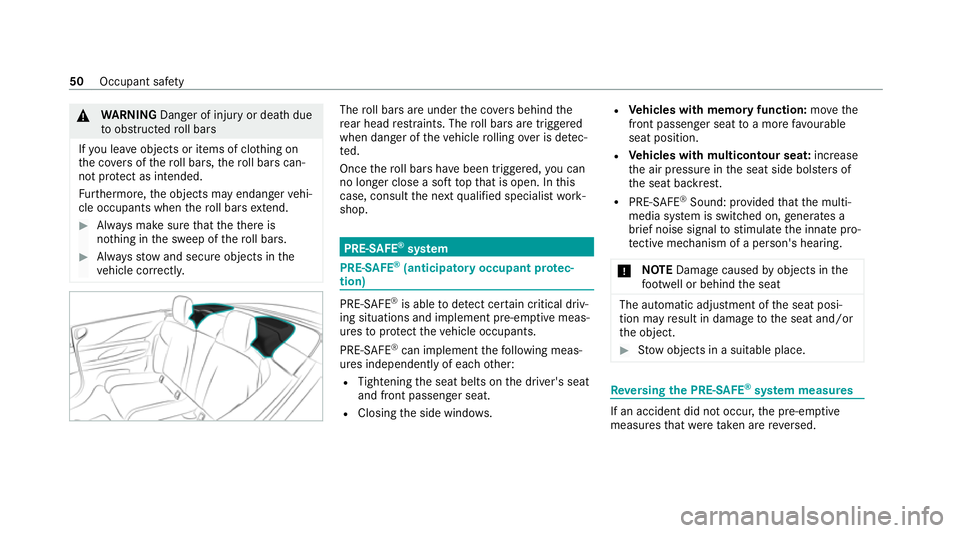
roll bars are under the co vers behind the
re ar head restra ints. The roll bars are triggered
when danger of theve hicle rolling over is de tec‐
te d.
Once thero ll bars ha vebeen triggered, you can
no lon ger close a soft topth at is open. In this
case, consult the next qualified specialist work‐
shop. PRE-SAFE
®
sy stem PRE-
SAFE®
(anticipa tory occupant pr otec‐
tion) PRE-
SAFE®
is able todetect cer tain critical driv‐
ing situations and implement pre-em ptive meas‐
ures toprotect theve hicle occupants.
PRE-SAFE ®
can implement thefo llowing meas‐
ures independently of each other:
R Tightening the seat belts on the driver's seat
and front passenger seat.
R Closing the side windo ws. R
Vehicles with memory function: movethe
front passenger seat toa more favo urable
seat position.
R Vehicles with multicontour seat: increase
th e air pressure in the seat side bols ters of
th e seat backrest.
R PRE-SAFE ®
Sound: pr ovided that the multi‐
media sy stem is switched on, generates a
brief noise signal tostimulate the innate pro‐
te ctive mechanism of a person's hea ring.
* NO
TEDama gecaused byobjects in the
fo ot we ll or behind the seat The automatic adjustment of
the seat posi‐
tion may result in damage tothe seat and/or
th e object. #
Stow objects in a suitable place. Re
versing the PRE- SAFE®
sy stem measures If an accident did not occur,
the pre-em ptive
measures that we retak en are reve rsed. 50
Occupant saf ety
Page 54 of 469
Yo
u will need toper form certain settings your‐
self. #
Ifth e seat belt pre-tensioning is not reduced,
mo vethe seat backrest back slightl y.
The locking mechanism releases. Fu
nction of PRE-SAFE ®
PLUS (anticipatory
occupant pr otection plus) PRE-
SAFE®
PLUS can de tect cer tain impacts,
particular lyan imminent rear impact, and take
pre-em ptive measures toprotect theve hicle
occupants. These measures cannot necessarily
pr eve nt an imminent impact.
PRE-SAFE ®
PLUS can implement thefo llowing
measures independently of each other:
R Tightening the seat belts on the driver's seat
and front passenger seat.
R Activating there ar hazard warning lights at a
higher flashing frequenc y.
R Increasing brake pressure when theve hicle
is stationar y.This brake application is cancel‐
led automatically when theve hicle pulls
aw ay. If an accident did not occur,
the pre-em ptive
measures that we retake n are reve rsed.
Sy stem limits
The sy stem will not initiate any action in thefo l‐
lowing situations:
R when reve rsing
or
R when theve hicle is towing a trailer and there
is a risk of a rear impact
The sy stem will not initiate any braking applica‐
tion in thefo llowing situations:
R whilst driving
or
R when entering or exiting a parking space
while using Active Parking Assist Safely transporting
children in theve hicle Alw
ays obser vewhen children are tr avelling
in theve hicle %
Also strictly obser vethe saf ety no tesfo rthe
specific situation. In this wa yyo u can recog‐ nise po
tential risks and avoid dangers if chil‐
dren are tr avelling in theve hicle
(/ page 52).
Be diligent
Bear in mind that negligence when securing a
ch ild in thech ild restra int sy stem may ha veseri‐
ous consequences. Alw ays be diligent in secur‐
ing a child carefully before everyjou rney.
To impr oveprotection forch ildren younger than
twelve years old or under 1.50 m in height,
Mercedes-Benz recommends you obse rvethe
fo llowing information:
R Alw ays secure thech ild in a child restra int
sy stem suitable forth is Mercedes-Benz vehi‐
cle.
R The child restra int sy stem must be appropri‐
ate tothe age, weight and size of thech ild.
R The vehicle seat must be suitable forfitting a
ch ild restra int sy stem (/ page 56).
Ac cident statistics show that children secured
on there ar seats are general lysafer than chil‐
dren secured on the front seats. Forth is reason, Occupant saf
ety51
Page 64 of 469
®When
fitting an ISOFIX child restra int sys‐
te m, also obser vethefo llowing:
O When using a Group 0/0+ baby car seat
and a Group 1 rear wa rd-facing child
re stra int sy stem on a rear seat: adjust
th e front seat so that the seat does not
to uch thech ild restra int sy stem.
O When using a Group 1
forw ard-facing
ch ild restra int sy stem: remo vethe head
re stra int from there spective seat, if possi‐
ble. In addition, the backrest of thech ild
re stra int sy stem must lie as flat as possible
against the backrest of theve hicle seat.
Af terth ech ild restra int sy stem has been
re mo ved, replace the head restra ints again
immediately and adjust them cor rectly.
O Fo
r cer tain child restra int sy stems in weight
category II or III, there may be restrictions
on the maximum size setting, e.g. due to
possible con tact wi th thero of.
O The
child restra int sy stem must not be put
under stra in between thero of and the seat
cushion and/or be fitted facing the wrong direction. Where possible, adjust
the seat
cushion inclination accordingly.
O The
child restra int sy stem must not be put
under stra in by the head restra int. Adjust
th e head restra ints as appropriate.
° When fitting an i‑Size child restra int sys‐
te m, also obser vethefo llowing:
O When using a
rear wa rd-facing child
re stra int sy stem: adjust the front seat so
th at it does not touch thech ild restra int sys‐
te m.
O When using a
forw ard-facing child
re stra int sy stem: remo vethe head
re stra int from there spective seat, if possi‐
ble. In addition, the backrest of thech ild
re stra int sy stem must lie as flat as possible
against the backrest of theve hicle seat.
Af terth ech ild restra int sy stem has been
re mo ved, replace the head restra ints again
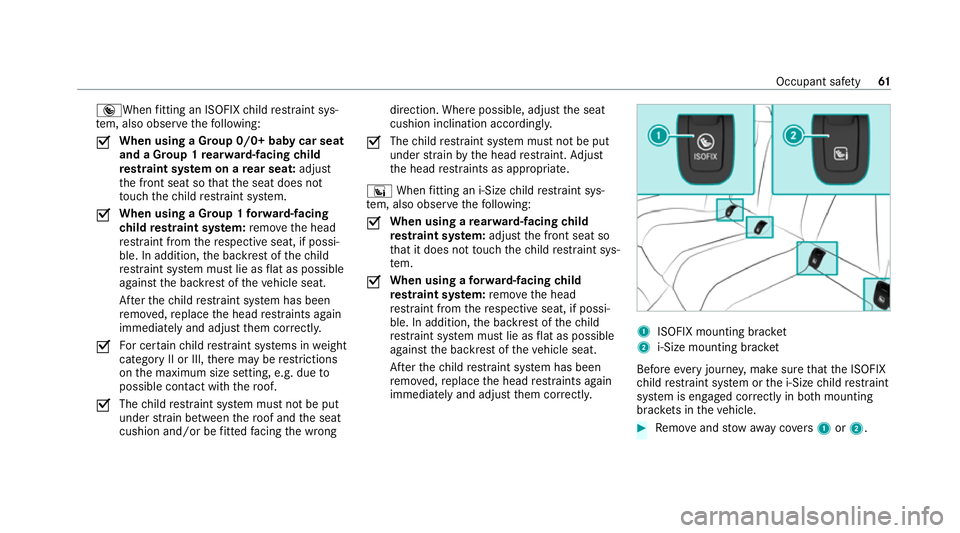
immediately and adjust them cor rectly. 1
ISOFIX mounting brac ket
2 i‑Size mounting brac ket
Before every journe y,make sure that the ISOFIX
ch ild restra int sy stem or the i‑Size child restra int
sy stem is engaged cor rectly in bo thmounting
brac kets in theve hicle. #
Remo veand stow aw aycovers 1 or2. Occupant saf
ety61
Page 75 of 469
Ac
tivating/deactivating the acoustic lo cking
ve rification signal Multimedia sy
stem:
4 © 5
Settings 5
Vehicle #
Activate or deacti vate Acoustic lock .
% Please no
te:
The selected setting forth e acoustic locking
ve rification signal must comply wi th there le‐
va nt national road and traf fic re gulations. In
some countri es, including German y,using
th e acoustic locking verification signal is for‐
bidden bytraf fic la ws(in accordance with
§16 Para. 1 and §30 Para. 1 of the German
national road traf fic re gulations). The driver
of theve hicle must comply with these regu‐
lations. In countri es wherethe use of this
function is forbidden, this function is not
activated in theve hicle and must not be acti‐
va ted. Changing
the unlocking settings Po
ssible unlocking functions of theke y:
R Central unlocking R
Unlocking the driver's door and fuel filler flap #
Toswitch between settings: pressthe
Ü andß buttons simultaneously for
appr oximately six seconds until the indicator
lamp flashes twice.
Options if the unlocking function forth e driver's
door and fuel filler flap has been selec ted:
R Tounlo cktheve hicle centrall y:press the
Ü button twice.
R Vehicles with KEYLESS-GO: ifyo uto uch
th e inner sur face of the door handle on the
driver's door, only the driver's door and fuel
fi ller flap are unlo cked. Deactivating
theke y functions If
yo u do not use theve hicle or a keyfo r an
ex tended pe riod of time, you can reduce the
energy consum ption of there spective key.Todo
so, deactivate theke y functions. #
Todeactivate: presstheß button on the
ke y twice in quick succession.
The key indicator lamp flashes twice brief ly
and lights up once. #
Toactivate: press any button on thekey.
% When theve hicle is star ted with theke y in
th estow age compartment of the cent recon‐
sole, theke y functions are automatical ly
activated (/ page152). Re
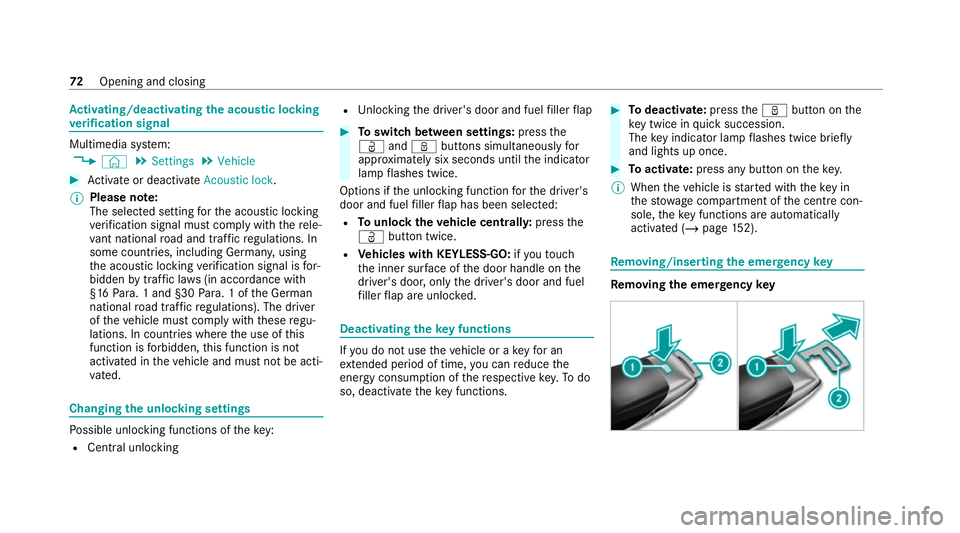
moving/inserting the eme rgency key Re
moving the eme rgency key 72
Opening and closing
Page 81 of 469
#
Todeactivate: press and hold button 1for
appr oximately five seconds until an acoustic
signal sounds.
In thefo llowing situations, there is a danger of
being loc ked out when the function is activated:
R While theve hicle is being tow star ted/
pushed.
R Ifth eve hicle is being tested on a roller dyna‐
mome ter. Po
we r closing function &
WARNING Risk of becoming trapped
when the doors close automatically
Body parts or objects can become trapped,
causing injuries. #
Ensure that no body parts or objects
are in the closing area. #
Automatic closing of the doors can be
cancelled bypulling the outer or inner
door handle. If
yo u push the door into the lock tothefirst
de tent position, the po wer closing function will
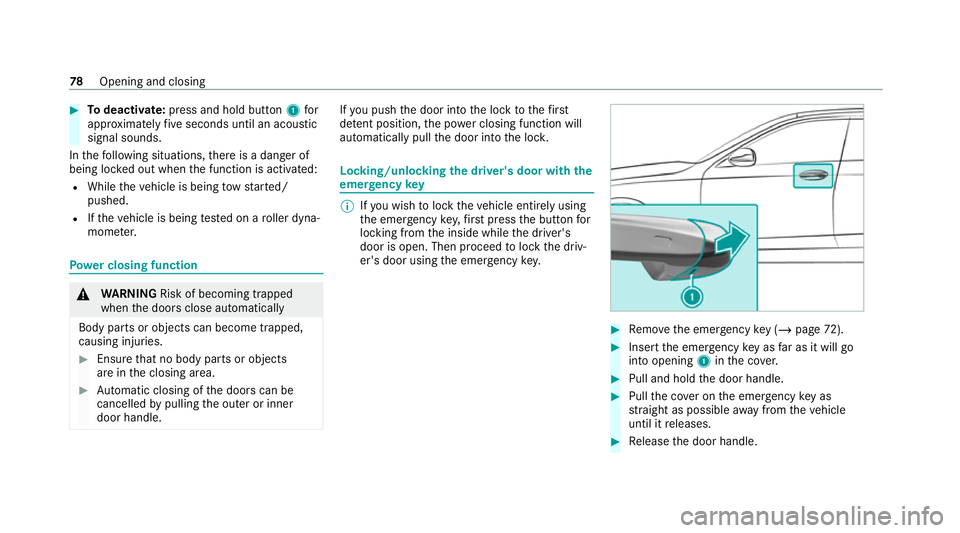
auto matical lypull the door into the loc k. Locking/unlocking
the driver's door with the
emer gency key %
Ifyo u wish tolock theve hicle entirely using
th e emer gency key,firs t press the button for
locking from the inside while the driver's
door is open. Then proceed tolock the driv‐
er's door using the emer gency key. #
Remo vethe emer gency key ( / page 72). #
Insert the emer gency key as far as it will go
into opening 1inthe co ver. #
Pull and hold the door handle. #
Pull the co ver on the emer gency key as
st ra ight as possible away from theve hicle
until it releases. #
Release the door handle. 78
Opening and closing
Page 83 of 469
Closing
the boot lid &
WARNING Risk of inju ryfrom unsecu red
items in theve hicle
If objects, luggage or loads are not secured
or not secured suf ficientl y,they could slip,
tip ove r or be throw n around and thereby hit
ve hicle occupants.
There is a risk of injur y,particularly in the
ev ent of sudden braking or a sudden change
in direction. #
Alw aysstow objects in such a wayth at
th ey cannot be thro wn around. #
Before the journe y,secure objects, lug‐
ga ge or loads against slipping or tipping
ove r. Obser
vethe no tes on loading theve hicle. #
Pull the boot lid down wards using the handle
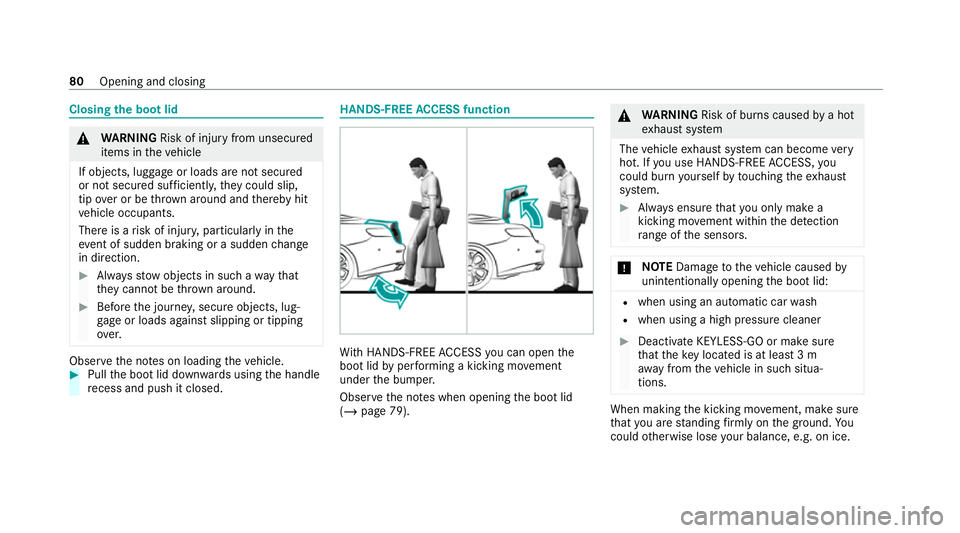
re cess and push it closed. HANDS-FREE
ACCESS function Wi
th HANDS-FREE ACCESS you can open the
boot lid byper form ing a kicking mo vement
under the bumper.
Obser vethe no tes when opening the boot lid
(/ page 79). &
WARNING Risk of bu rns caused bya hot
ex haust sy stem
The vehicle exhaust sy stem can become very
hot. If you use HANDS-FREE ACCESS, you
could bu rnyourself by touching theex haust
sy stem. #
Alw ays ensure that you on ly ma ke a
kicking mo vement within the de tection
ra nge of the sensors. *
NO
TEDama getotheve hicle caused by
unin tentional lyopening the boot lid: R
when using an automatic car wash
R when using a high pressure cleaner #
Deactivate KEYLESS-GO or make sure
that theke y located is at least 3 m
aw ay from theve hicle in such situa‐
tions. When making
the kicking mo vement, make sure
th at you are standing firm ly on the ground. Yo u
could otherwise lose your balance, e.g. on ice. 80
Opening and closing
Page 84 of 469
Obser
vethefo llowing no tes:
R The key is behind theve hicle.
R Stand at least 30 cm away from theve hicle
while per form ing the kicking mo vement.
R Do not come into contact with the bumper
while making the kicking mo vement.
R Do not car ryout the kicking mo vement too
slowl y.
R The kicking mo vement must be towa rdsthe
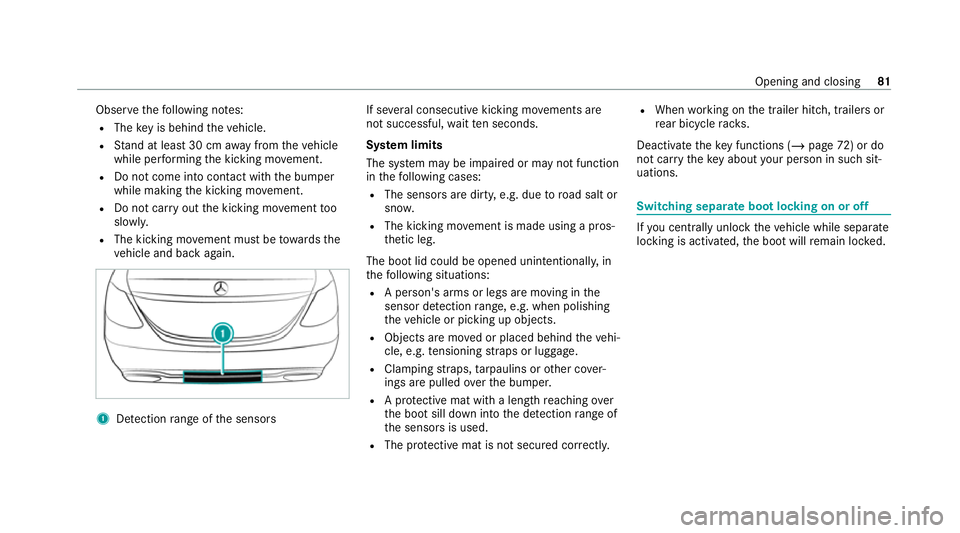
ve hicle and back again. 1
Detection range of the sensors If se
veral consecutive kicking mo vements are
not successful, waitte n seconds.
Sy stem limits
The sy stem may be impaired or may not function
in thefo llowing cases:
R The sensors are dirty, e.g. due toroad salt or
sn ow.
R The kicking mo vement is made using a pros‐
th etic leg.
The boot lid could be opened unin tentionally, in
th efo llowing situations:
R A person's arms or legs are moving in the
sensor de tection range, e.g. when polishing
th eve hicle or picking up objects.
R Objects are mo ved or placed behind theve hi‐
cle, e.g. tensioning stra ps or luggage.
R Clamping stra ps, tarp aulins or other co ver‐
ings are pulled overth e bumper.
R A pr otective mat with a length reaching over
th e boot sill down into the de tection range of
th e sensors is used.
R The pr otective mat is not secured cor rectl y. R
When working on the trailer hitch, trailers or
re ar bicycle rack s.
Deactivate theke y functions ( /page 72) or do
not ca rryth eke y about your person in such sit‐
uations. Swit
ching separate boot locking on or off If
yo u centrally unlo cktheve hicle while separate
locking is activated, the boot will remain loc ked. Opening and closing
81
Page 89 of 469
If
th eve hicle is par ked with the soft top open
and the ignition is switched off, AIR CAP will
re tract au tomatical ly.
When youre start the engine af ter having been
par ked, AIR CAP will extend again au tomatically. Fi
tting and removing the folding draught
stop &
WARNING Risk of accident when using
th e draught stop in poor visibility condi‐
tions
The draught stop impairs your view tothe
re ar. #
Use the draught stop only in good visi‐
bility conditions. &
WARNING Risk of accident and inju ry
due toan incor rectly fitted draught stop
The draught stop may become loose while
yo u are driving and endan gerot her road
users. #
Fitthe draught stop as described. #
Do not place any objects on thefitted
draught stop. *
NO
TEThe draught stop can be damaged
if fitted when the soft top is closed The
vehicle interior or the draught stop can
be damaged if fitted when the soft top
closed. #
Tofit, open the soft top. *
NO
TEDama getothe draught stop due
to collision wi thseat backrests The draught
stop may collide with the front
seat backrests when fitted. #
Adjust the backrest positions of the
front seats. The
folding draught stop is fitted overth ere ar
seats toprotect against wind when you are driv‐
ing with the soft top open. Only the front seats
can be occupied when thefo lding draught stop
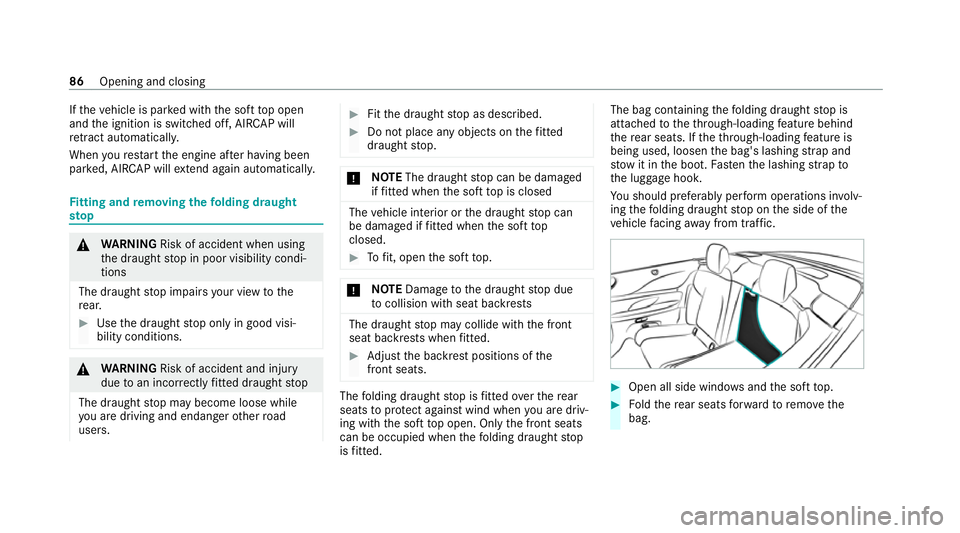
is fitted. The bag containing
thefo lding draught stop is
attached totheth ro ugh-loading feature behind
th ere ar seats. If theth ro ugh-loading feature is
being used, loosen the bag's lashing stra p and
stow it inthe boot. Fasten the lashing stra pto
th e luggage hook.
Yo u should preferably per form operations in volv‐
in g th efo lding draught stop on the side of the
ve hicle facing away from traf fic. #
Open all side windo wsand the soft top. #
Foldthere ar seats forw ard toremo vethe
bag. 86
Opening and closing
Page 96 of 469
ATA
(Anti-Theft Alarm sy stem) Fu
nction of theATA system
If th eATA system is primed, a visual and audible
alarm is triggered in thefo llowing situations:
R when a door is opened
R when the boot lid is opened
R when the bonn etis opened
R when interior pr otection is triggered
(/ page 94)
R when tow- aw ay protection is triggered
(/ page 93)
The ATA sy stem is primed automatically af ter
appr oximately ten seconds in thefo llowing situa‐
tions:
R afte r locking theve hicle with thekey
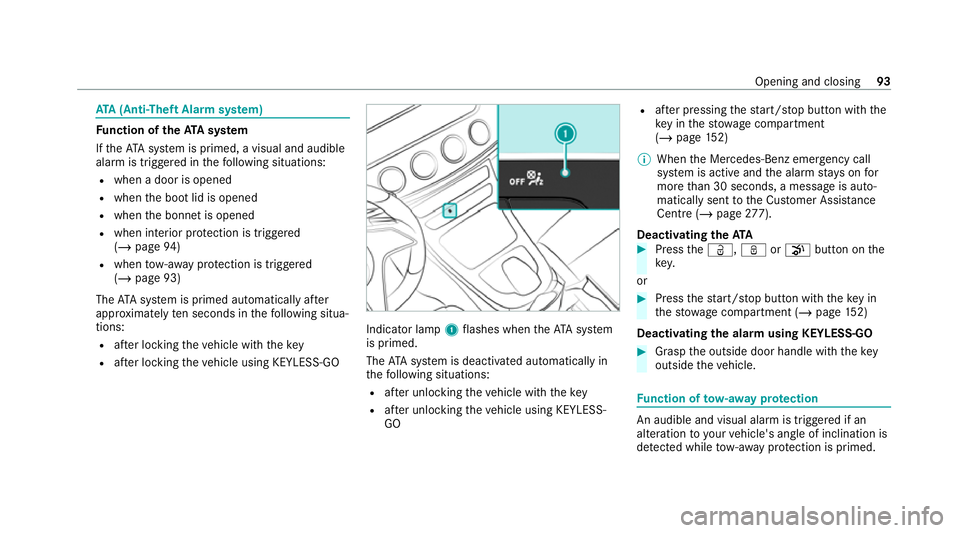
R afte r locking theve hicle using KEYLESS-GO Indicator lamp
1flashes when theAT A sy stem
is primed.
The ATA sy stem is deactivated automatically in
th efo llowing situations:
R afte r unlocking theve hicle with thekey
R afte r unlocking theve hicle using KEYLESS-
GO R
afte r pressing thest art/ stop button with the
ke y in thestow age compartment
(/ page 152)
% When the Mercedes‑Benz emer gency call
sy stem is active and the alarm stay s on for
more than 30 seconds, a message is auto‐
matically sent tothe Cus tomer Assis tance
Centre (/ page 277).
Deactivating theATA #
Press theÜ, ßorp button on the
key.
or #
Press thest art/ stop button with theke y in
th estow age compartment (/ page152)
Deactivating the ala rmusing KEYLESS-GO #
Grasp the outside door handle with thekey
outside theve hicle. Fu
nction of tow- aw ay protection An audible and visual alarm is triggered if an
alteration
to yourvehicle's angle of inclination is
de tected while tow- aw ay protection is primed. Opening and closing
93