warning light MERCEDES-BENZ E-CLASS COUPE 2009 User Guide
[x] Cancel search | Manufacturer: MERCEDES-BENZ, Model Year: 2009, Model line: E-CLASS COUPE, Model: MERCEDES-BENZ E-CLASS COUPE 2009Pages: 313, PDF Size: 7.76 MB
Page 38 of 313
Never tamper with electronic components
and their software.
SRS (Supplemental Restraint System)
SRS reduces the risk of occupants coming
into contact with the vehicle's interior in the
event of an accident. It can also reduce the
forces to which occupants are subjected dur-
ing an accident.
SRS consists of:
R the 0081 SRS warning lamp
R belt tensioners
R belt force limiters
R airbags
The 0081
0081 SRS warning lamp The SRS functions are checked regularly
when you turn on the ignition and when the
engine is running. Therefore, malfunctions
can be detected in good time.
The 0081 SRS warning lamp in the instrument
cluster lights up when the ignition is switched
on. It goes out no later than afew seconds
after the engine is started. G
Risk of injury
If SRS is malfunctioning, individual systems
may be activated unintentionally or not be
deployed in the event of an accident with
heavy braking.
Am alfunction has occurred if the 0081SRS
warning lamp:
R does not light up when you switch on the
ignition
R does not go out after the engine has been
running for afew seconds
R lights up again once the engine is running
In this case, have SRS checked immediately
at aq ualifieds pecialist workshop. Triggering of belt tensioners, belt force
limiters and airbags In the event of
acollision, the airbagc ontrol
unit evaluates important physical data such
as duration, direction and force of the vehicle
deceleration or acceleration. Based on the
evaluation of this data and in the event of lon-
gitudinal deceleration, in acollision, and
depending on the rate of deceleration, the
airbagc ontrol unit pre-emptively triggers the
belt tensioners in the first stage.
i The belt tensioners can only be triggered
if the belt tongue is correctly engaged in the
seat belt buckle.
The front airbags are only deployed if there is
an even higher rate of vehicle deceleration in
al ongitudinal direction.
Your vehicle has adaptive, duals tage front
airbags. When the first activation threshold is
reached, the front airbagisf illedwith enough
propellant gas to reduce the risk of injuries.
The front airbagiso nly fullydeployed if asec-
ond threshold is reached within afew milli-
seconds, due to the control unit having detec-
ted further deceleration.
Criteria for triggering belt tensioners and
airbags
In the first stage of acollision, the airbagc on-
trol unit evaluates the duration and direction
of vehicle acceleration or deceleration, in
order to determine whether it is necessary to
trigger abelt tensioner or an airbag.
The belt tensioner and airbagt riggering
thresholds are variable and are adapted to the
rate of deceleration of the vehicle. This proc-
ess is pre-emptive in nature as the airbag
must be deployed during –and not at the end
of –t he collision.
i Airbags are not deployed in all types of
accidents. They are controlled by complex
sensor technology and evaluation logic.
This process is pre-emptive in nature as
airbagd eployment must take place during
the impact and must be adapted to provide Occupant safety
35Safety
207_AKB; 2; 3, en-GB
mkalafa, Version: 2.11.8.1 2009-07-23T10:23:49+02:00-Seite 35 Z
Page 39 of 313
calculated, additiona
lprotectio nfor the
vehicle occupants. Not al lairbags are
deploye dinana ccident.
The different airba gsystems work inde-
pendently of each other. However, the
deployment of each individual system
depends on the typ eofaccident as deter-
mine dbyt he control system in the first
stages of the collisio n(head-on collision,
sid eimpact and rea rcollision) and the
severity of the accident (i nparticular, the
vehicle's rate of deceleration or accelera-
tion).
The rate of vehicle deceleration or accelera-
tion and the direction of the force are essen-
tiall ydetermine dby:
R the distribution of force sduring the colli-
sion
R the collisio nangle
R the deformation characteristics of the vehi-
cle
R the characteristics of the object with which
the vehicle collides ,e.g. the othe rvehicle
Factors which can only be see nand measured
afte rac ollisio nhasoccurred do not play a
decisiv eroleint he deployment of an airbag,
nor do they provid eanindication of it.
The vehicle may be deforme dsignificantly,
e.g. on the bonne torthe wing, withou tanair-
ba gb eing deployed. Thi sisthe cas eifonly
parts which are relativel yeasilyd eforme dare
affected and the deployment threshol disnot
reached .Conversely, airbags may be
deploye devent hough the vehicle suffers only
mino rdeformations .For example, this is the
cas eifv ery rigid vehicle parts such as longi-
tudina lbod ym embers are affected and suf-
ficient deceleration occurs as aresult.
Bel ttensioners, belt forc elim iters The sea
tbelts are fitted with bel ttensioners.
! Do not engage the sea tbeltt ongu einthe
buckle on the front-passenger sea tifthe
sea tisn ot occupied. The bel ttensioners could otherwise be triggered in the event
of an accident.
If the sea tbelti sa lsoe quipped with abelt
force limiter, the force exerted by the seat
bel tont he sea toccupant is reduced.
Bel ttensioners tighten the sea tbelts in an
accident, pulling them close against the body.
i Belttensioners do not correct incorrect
sea tpositions or incorrectl yfastened seat
belts.
Bel ttensioners do not pull occupants back
towards the backrest.
The front bel tforce limiters are synchronised
with the front airbags, which distribute apro-
portion of the deceleration force sexerted on
the occupant ove ragreate rarea.
Whe nthe ignition is switched on, the bel tten-
sioners cannot be triggered unless:
R the restraint systems are operational; see
the 0081 SRS warning lamp.
R the bel ttongu eise ngaged in the buckle on
each lap-shoulder bel tinthe front of the
vehicle.
Depending on the typ eand severity of an
accident, the bel ttensioners may be trig-
gered:
R in the event of ahead-on or rear-end colli-
sio nift he vehicle decelerate soracceler-
ate srapidly in alon gitudinal direction dur-
ing the initia lstages of impact
R in the event of asidei mpact if the vehicle
is subjecte dtohighl atera lacceleration/
deceleration
If the airbags are deployed, yo uwillh eara
bang and asmall amount of powder may also
be released .Only in rar ecases will the bang
affect your hearing .The powder that escapes
doe snot generally constitute ahealth hazard.
The 0081 SRS warning lamp lights up. G
Risk of injury
If the sea tbeltt ensioners have bee ntrig-
gered, they provid enoadditiona lprotection
in the event of another accident. Therefore, 36
Occupan
tsafetySafety
207_AKB; 2; 3, en-GB
mkalafa ,V ersion: 2.11.8.1
2009-07-23T10:23:49+02:00
-Seite 36
Page 40 of 313
have belt tensionersw
hich have been trig-
gered replaced at aqualified specialist work-
shop.
Comply with safety regulations when dispos-
ing of belt tensioners. Any Mercedes-Benz
Service Centre can provide details of these
regulations.
Airbags Airbag deployment slows down and restricts
the movement of the vehicle occupant.
If the airbags are deployed, you will hear a
bang and asmall amount of powder may also
be released. Only in rare cases will the bang
affect your hearing. The powder that escapes
does not generally constitute ahealth hazard.
The 0081 SRS warning lamp lights up.
The AIRBAG label indicates the location of the
airbags. G
Risk of injury
Airbags provide additional protection; they
are not, however, asubstitute for seat belts.
Observe the following notes to reduce the risk
of serious or even fatal injury caused by airbag
deployment:
R All vehicle occupants ―inparticular, preg-
nant women ―must wear their seat belt
correctly at all times and lean back against
the backrest, which should be positioned
as close to the vertical as possible. The
head restraint must support the back of the
head at about eye level.
R Always secure children less than 1.50 mtall
and under 12 years of age in suitable child
restraint systems.
R All vehicle occupants must select aseat
position that is as far away from the airbag
as possible. The driver's seat position must
allow the vehicle to be driven safely. The
driver's chest should be as far away from
the centre of the driver's front airbag cover
as possible. R
Move the front-passenger seat as far back
as possible. This is especially important if
you have secured achild in achild restraint
system on the front-passenger seat.
R Coupé: vehicle occupants —inparticular,
children —must not lean their head into the
area of the window in which the sidebag/
windowbag is deployed.
R Cabriolet: vehicle occupants —inparticular,
children —must not lean their head into the
area of the window in which the sidebag/
headbagisd eployed.
R Rearward-facing child restraint systems
must not be fitted to the front-passenger
seat unless the front-passenger front air-
bag has been disabled. On the front-
passenger seat, the front-passenger front
airbag is only disabledifac hild restraint
system with automatic child seat recogni-
tion is fitted to the front-passenger seat*.
The 007F PASSENGER AIRBAG OFF warn-
ing lamp must be continuously lit.
If the front-passenger seat of your vehicle
does not have automatic child seat recog-
nition*, or your rearward-facing child
restraint system does not have automatic
child seat recognition, children must be
secured in achild restraint system on a
suitable seat in the rear. If you secure a
forward-facing child restraint system to the
front-passenger seat, you must move the
front-passenger seat as far back as possi-
ble.
R Make sure there are no heavy or sharp-
edged objectsinp ockets of clothing.
R Do not lean forwards, e.g. over the cover of
the driver's/front-passenger front airbag,
particularly when the vehicle is in motion.
R Do not put your feet on the dashboard.
R Only hold the steering wheel by the rim.
This allowst he airbag to deploy fully.Y ou
could be injured if the airbag is deployed Occupant safety
37Safety
*optional
207_AKB; 2; 3, en-GB
mkalafa,
Version: 2.11.8.1 2009-07-23T10:23:49+02:00-Seite 37 Z
Page 47 of 313
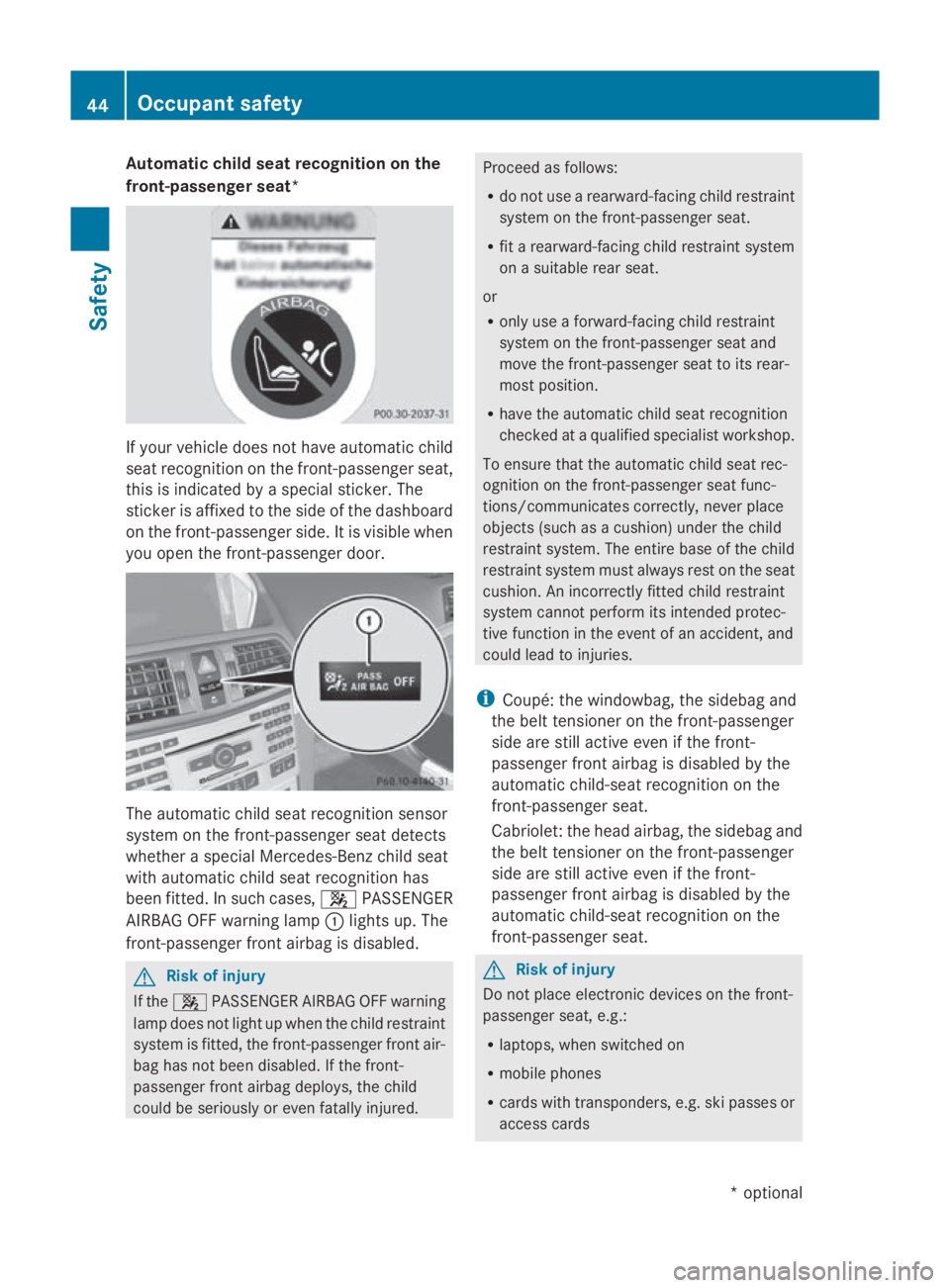
Automatic child seat recognition on the
front-passenger seat*
If your vehicle does no
thave automatic child
seat recognition on th efront-pa ssenger seat,
this is indicated by aspecial sticker. The
sticker is affixe dtotheside of th edashboard
on th efront-pa ssenger side .Itisvisible when
you open th efront-pa ssenger door. The automatic child seat recognition sensor
system on th
efront-pa ssenger seat detects
whether aspecial Mercedes-Ben zchild seat
wit ha utomatic child seat recognition has
been fitted. In suc hcases, 007F PASSENGER
AIRBA GOFFwarning lamp 0046light sup. The
front-passenger fron tairbag is disabled. G
Ris
kofi njury
If the 007F PASSENGER AIRBA GOFFwarning
lamp does no tligh tupw hen th echild restraint
system is fitted, th efront-pa ssenger fron tair-
bag has no tbeen disabled. If th efront-
passenger fron tairba gdeploys, th echild
could be seriousl yorevenf atally injured. Procee
dasfollows:
R do no tuse arearward-facing child restraint
system on th efront-pa ssenger seat.
R fit arearward-facing child restraint system
on asuitable rear seat.
or
R only use aforward-facing child restraint
system on th efront-pa ssenger seat and
mov ethe front-passenger seat to its rear-
mos tposition.
R have th eautomatic child seat recognition
checked at aqualified specialist workshop.
To ensure that th eautomatic child seat rec-
ognition on th efront-pa ssenger seat func-
tions/communicate scorrectly ,never place
object s(suc hasac ushion)under th echild
restraint system. The entir ebase of th echild
restraint system must always res tontheseat
cushion .Anincorrectly fitte dchild restraint
system canno tperfor mits intended protec-
tiv ef unction in th eevent of an accident, and
could lead to injuries.
i Coupé: th ewindowbag ,the sidebag and
th eb elt tensioner on th efront-pa ssenger
side are still active eve nifthefront-
passenger fron tairbag is disabled by the
automatic child-seat recognition on the
front-passenger seat.
Cabriolet :the head airbag ,the sidebag and
th eb elt tensioner on th efront-pa ssenger
side are still active eve nifthefront-
passenger fron tairbag is disabled by the
automatic child-seat recognition on the
front-passenger seat. G
Ris
kofi njury
Do no tplac ee lectronic device sonthefront-
passenger seat ,e.g.:
R laptops, when switched on
R mobile phones
R cards wit htransponders, e.g. sk ipasses or
access cards 44
Occupant safetySafety
*o
ptional
207_AKB
;2;3,en-GB
mkalafa, Version:2.11.8.1
2009-07-23T10:23:49+02:00
-Seite 44
Page 48 of 313
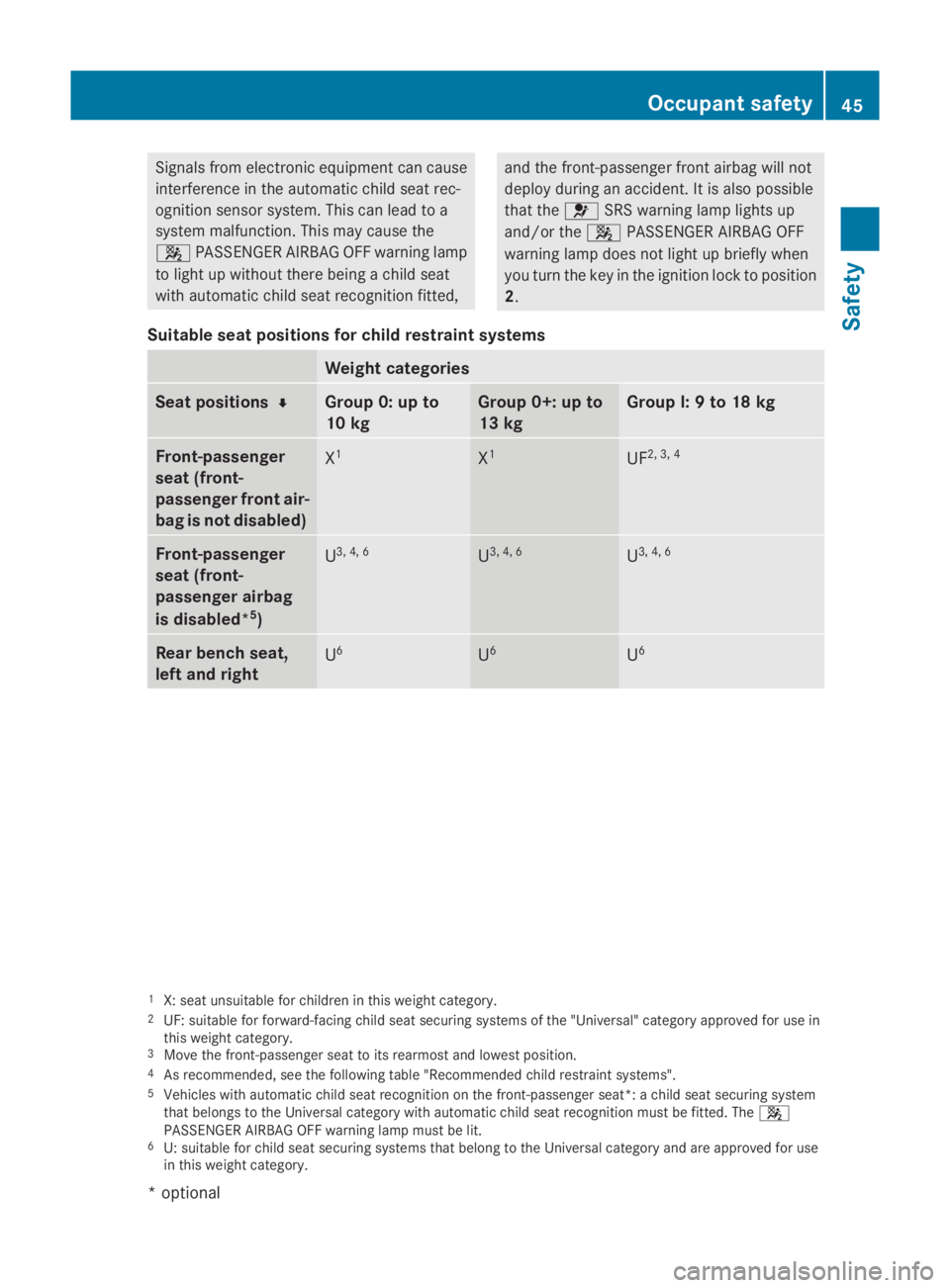
Signal
sfrom electronic equipment can cause
interference in the automatic chil dseatrec-
ognition sensor system. Thi scan lead to a
system malfunction. Thi smay cause the
007F PASSENGER AIRBAG OFF warning lamp
to light up withou tthere being achilds eat
with automatic chil dseatrecognition fitted, and the front-passenger front airba
gwilln ot
deplo yduring an accident. It is also possible
that the 0081SRS warning lamp lights up
and/or the 007FPASSENGER AIRBAG OFF
warning lamp doe snot light up briefl ywhen
yo ut urn the key in the ignition lock to position
2.
Suitabl eseatp osition sfor child restraint systems Weight categories
Seat positions
00CE
00CE Group 0: up to
10 kg Group 0+: up to
13 kg Group I:
9to18kg Front-passenger
seat (front-
passenge
rfron tair-
bag is no tdisabled) X
1 X
1 UF
2, 3, 4 Front-passenger
seat (front-
passenge
rairbag
is disabled* 5
) U
3, 4, 6 U
3, 4, 6 U
3, 4, 6 Rear benc
hseat,
left and right U
6 U
6 U
6 1
X: sea tunsuitable for childre ninthis weigh tcategory.
2 UF: suitabl efor forward-facing chil dseats ecuring systems of the "Universal" categor yapproved for us ein
this weigh tcategory.
3 Move the front-passenge rseattoi ts rearmos tand lowest position.
4 As recommended, see the following table "Recommended chil drestraint systems".
5 Vehicles with automatic chil dseatrecognition on the front-passenge rseat*: achilds eats ecuring system
that belongs to the Universa lcategor ywitha utomatic chil dseatrecognition mus tbefitted. The 007F
PASSENGER AIRBAG OFF warning lamp mus tbelit.
6 U: suitabl efor chil dseats ecuring systems that belong to the Universa lcategor yand are approved for use
in this weigh tcategory. Occupan
tsafety
45Safety
*optional
207_AKB; 2; 3, en-GB
mkalafa
,V ersion: 2.11.8.1
2009-07-23T10:23:49+02:00
-Seite 45 Z
Page 57 of 313
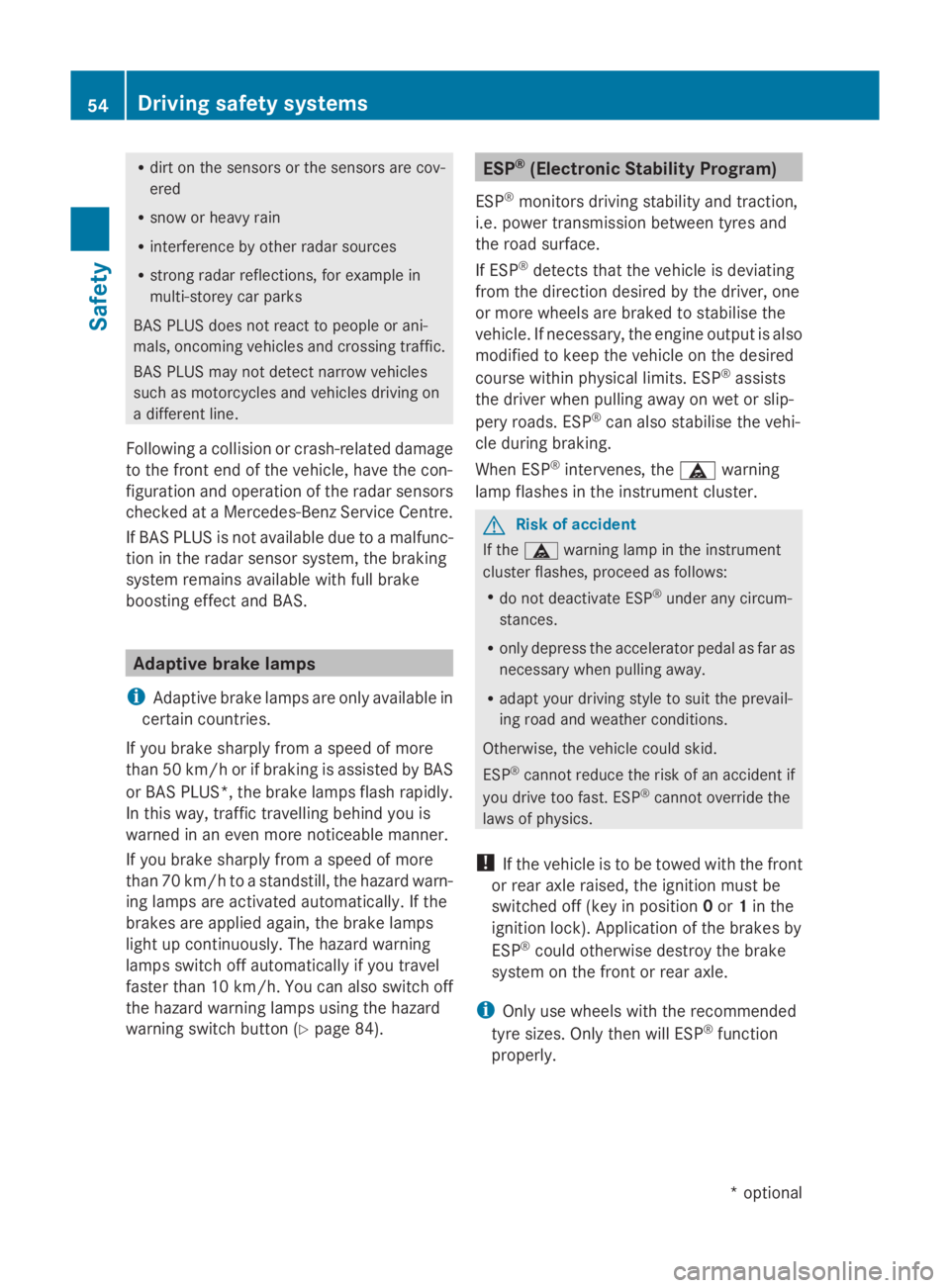
R
dirt on the sensor sorthe sensor sare cov-
ered
R snow or heavy rain
R interferencebyo ther radar sources
R strong radar reflections, for example in
multi-storey car parks
BASP LUS does not react to people or ani-
mals, oncoming vehicles and crossing traffic.
BASP LUS may not detec tnarro wvehicles
such as motorcycles and vehicles driving on
ad ifferen tline.
Following acollision or crash-related damage
to the fron tend of the vehicle, have the con-
figuration and operation of the radar sensors
checked at aMercedes-Benz Service Centre.
If BASP LUS is not available due to amalfunc-
tion in the radar sensor system, the braking
system remains available with full brake
boostin geffec tand BAS. Adaptive brake lamps
i Adaptiv ebrake lamps are only available in
certain countries.
If you brake sharply from aspeed of more
than 50 km/ horifb raking is assisted by BAS
or BAS PLUS* ,the brake lamp sflashr apidly.
In this way, traffic travelling behind you is
warned in an even more noticeable manner.
If you brake sharply from aspee dofm ore
than 70 km/h to astandstill, the hazard warn-
ing lamp sare activated automatically.Ift he
brakes are applieda gain, the brake lamps
light up continuously.T he hazard warning
lamp sswitch off automatically if you travel
faster than 10 km/h .You can alsos witch off
the hazard warning lamp susing the hazard
warning switch button (Y page84). ESP
®
(Electronic Stability Program)
ESP ®
monitors driving stability and traction,
i.e. power transmission between tyres and
the road surface.
If ESP ®
detects that the vehicl eisdeviating
from the direction desired by the driver, one
or more wheels are braked to stabilise the
vehicle. If necessary ,the engine outpu tisalso
modified to keep the vehicl eonthe desired
course withi nphysical limits. ESP ®
assists
the drive rwhen pulling away on wet or slip-
pery roads. ESP ®
can alsos tabilise the vehi-
cle during braking.
When ESP ®
intervenes, the 00C6warning
lamp flashes in the instrument cluster. G
Risk of accident
If the 00C6 warning lamp in the instrument
cluster flashes, proceed as follows:
R do not deactivate ESP ®
under any circum-
stances.
R only depress the accelerator peda lasfar as
necessary when pulling away.
R adapt yourd riving style to suitt he prevail-
ing road and weather conditions.
Otherwise, the vehicl ecoulds kid.
ESP ®
cannot reduce the risk of an accident if
you drive too fast. ESP ®
cannot overrid ethe
lawsofp hysics.
! If the vehicl eistobetowed with the front
or rear axle raised, the ignitio nmust be
switched off (key in position 0or 1in the
ignitio nlock). Application of the brakes by
ESP ®
coul dotherwise destroy the brake
system on the front or rear axle.
i Only use wheels with the recommended
tyre sizes. Only then willE SP®
function
properly. 54
Driving safety systemsSafety
*o
ptional
207_AKB; 2; 3, en-GB
mkalafa,
Version: 2.11.8.1 2009-07-23T10:23:49+02:00-Seite 54
Page 58 of 313
ESP
®
trailer stabilisation If your trailer begin
stolurch, you can only
stabilise th evehicle/trailer combinatio nby
depressing th ebrak efirmly.
In this situation, ESP ®
assists you and can
detect when th etrailer begin stolurch.
ESP ®
slows th evehicle down by braking and
limiting th eengineo utput until th evehicle/
trailer combinatio nhas stabilised.
Traile rstabilisation is active above speeds of
about 65 km/h. G
Ris
kofa ccident
If road and weather condition sare poor,
trailer stabilisation will no tbeable to prevent
th et railer from swervin gand will thus be
unabl etoreducethe risk of an accident. Trail-
ers with ahigh centr eofgravity can tip over
before ESP ®
can detect this.
Traile rstabilisation does no twork if ESP ®
is
deactivate dordisable dbecause of amal-
function.
ETS (Electronic Traction Support) Tractio
ncontrol is part of ESP ®
.
Tractio ncontrol brakes th edrivew heels indi-
vidually if they spin .This enables you to pull
away and accelerate on slippery surfaces ,for
example, if th eroad surface is slippery on one
side.
Tractio ncontrol remains active when you
deactivate ESP ®
. G
Ris
kofa ccident
Tractio ncontrol canno treduc ethe risk of an
acciden tifyou driv etoo fast .Tractio ncontrol
canno toverride th elaws of physics.
Activating/deactivatin gESP® ESP
®
is activated automatically when the
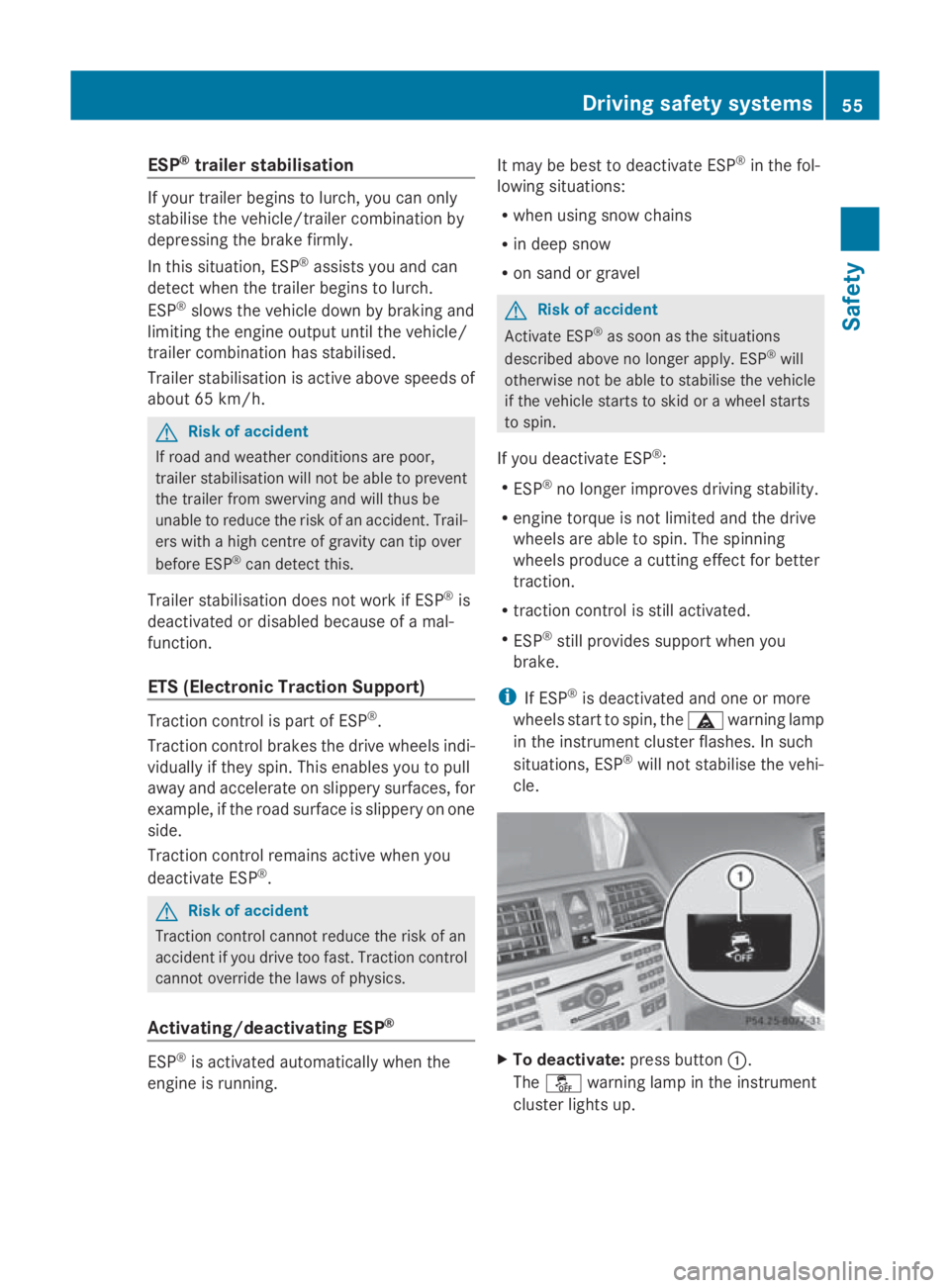
engin eisrunning. It may be best to deactivate ESP
®
in th efol-
lowin gsituations:
R when usin gsnowc hains
R in deep snow
R on san dorgravel G
Ris
kofa ccident
Activate ESP ®
as soon as th esituations
describe dabov enol onger apply. ESP ®
will
otherwise no tbeable to stabilise th evehicle
if th evehicle start stoskidoraw heel starts
to spin.
If you deactivate ESP ®
:
R ESP ®
no longer improve sdriving stability.
R engin etorque is no tlimited and th edrive
wheels are able to spin .The spinning
wheels produce acuttin geffect for better
traction.
R traction control is still activated.
R ESP ®
still provide ssupport when you
brake.
i If ESP ®
is deactivate dand on eorm ore
wheels start to spin ,the 00C6 warning lamp
in th einstrumen tcluste rflashes. In such
situations ,ESP ®
will no tstabilise th evehi-
cle. X
To deactivate: pressbutton 0046.
The 00C7 warning lamp in th einstrument
cluste rlight sup. Driving safety systems
55Safety
207_AKB;2;3,en-GB
mkalafa, Version:2.11.8.1
2009-07-23T10:23:49+02:00
-Seite 55 Z
Page 59 of 313
G
Risk of accident
If the 00C7 warning lamp in the instrument
cluster lights up whe nthe engine is running,
ESP ®
is deactivated or is unavailabl edueto a
malfunction. The ris kthat your vehicle may
star ttos kid then increase sincertain situa-
tions.
Alway sadapt your driving styl etothe prevail-
ing roa dand weathe rconditions.
X To activate: press button 0046.
The 00C7 warning lamp in the instrument
cluster goe sout. EBV (electroni
cbrake forc edistribu-
tion)
EBV monitors and control sthe brake pres-
sure on the rea rwheel stoi mprove driving
stability whe nbraking. G
Risk of accident
If EBV is malfunctioning ,the brake system is
stil lavailable with ful lbrake boosting effect.
However, the rea rwheel scan stil llock, e.g.
under ful lbraking. Thi scould cause yo uto
los econtrol of your vehicle and cause an acci-
dent. You shoul dtherefore adap tyou rd riving
styl etot he different handling characteristics. ADAPTIVE BRAKE
ADAPTIVE BRAKE enhances braking safety
and offers increased braking comfort. In addi-
tion to the braking function, ADAPTIVE BRAKE
also ha sthe HOLD function (Y page 135) and
hil lstar tassist( Ypage 100). For further
information, see Driving tips (Y page 191).PRE-SAFE
®
Brake (vehicle swithD IS-
TRONIC PLUS)*
PRE-SAFE ®
Brake can hel pyou to minimise
the ris kofafrontalcollision with avehicle ahea
dorr educe the effects of such acolli-
sion.
Thi sfunction will issue awarning at speeds of
around 30 km/h or more if:
R for aperiod of several seconds, the dis-
tance to the vehicle in front is too short for
the speed at which yo uare travelling. The
00BA distance warning lamp in the instru-
ment cluster lights up.
R yo ua re approaching the vehicle in front too
rapidly .Anintermittent warning tone
sounds and the 00BAdistance warning
lamp lights up in the instrument cluster.
Due to the nature of the system, particularly
complicated driving conditions may cause the
system to display an unnecessary warning. G
Risk of accident
Pa yp articula rattention to the traffi ccondi-
tions if the 00BAdistance warning lamp in the
instrument cluster lights up or an intermittent
warning tone sounds. If necessary, brake or
manoeuvre to avoid an obstacle.
If the driver and passengers have fastened
thei rseatb elts, PRE-SAFE ®
Brake can also
can also perform the following at speeds of
above approximately 30 km/h:
R brake the vehicle automaticall yfrom a
speed of up to approximately 200 km/h
R trigger preventative passenger protection
measures (PRE-SAFE ®
) G
Risk of accident
PRE-SAFE ®
Brake is only an ai dtoassist you
whe ndriving .You are responsibl efor main-
taining asafed istance from othe rvehicles,
the vehicle's speed and for braking in good
time .Alway spayattention to the traffi ccon-
ditions .Otherwise, yo umay recognise dan-
gers too late, cause an accident and injure
yoursel fand others.
With the hel pofthe radar senso rsystem,
PRE-SAFE ®
Brake can detect obstacles that
are in front of your vehicle for an extended 56
Drivin
gsafety systemsSafety
*optional
207_AKB
;2;3,en-GB
mkalafa ,V ersion: 2.11.8.1
2009-07-23T10:23:49+02:00
-Seite 56
Page 60 of 313
period of time. If you approach an obstacle
and PRE-SAFE ®
Brak edetects arisk of acol-
lision, the system will initially alert you both
visually and acoustically. If you do not brake
or steer ,the vehicle will at first automatically
brake slightly. In the event of an increased
risk of acollision, PRE-SAFE ®
is activated
(Y page 40). If the risk of collision persist sand
you do not brake, manoeuvr eoraccelerate
significantly yourself, an automatic full brake
application may be carried out. G
Risk of accident
Only clearly detected obstacles will trigger a
warning and initiat ebrakin gassistance by
PRE-SAFE ®
Brake.
In particular, the detection of obstacles can
be impaired if ther eis:
R dirt on the sensors or the sensors are cov-
ered
R snow or heavy rain
R interferenc ebyother radar sources
R the possibility of strong radar reflections,
for example in multi-storey car parks
PRE-SAFE ®
Brak edoes not react to persons,
animals, oncoming vehicles, crossing traffic
or when cornering.
PRE-SAFE ®
Brak emay not detec tnarrow
vehicles such as motorcycles and vehicles
drivin gonad ifferentline. G
Risk of accident
Depending on the curren tspeed, PRE-SAFE ®
Brak edecelerates your vehicle by up to
4m /s2
before performing possible emer-
genc ybraking. This is equivalent to approx-
imately 40 %ofthe maximum brakin gpower
of the vehicle. You must additionally apply the
brakes yourself in order to preven tacollision
or minimis eanimpact .Automatic emergency
brakin gisnot performed until immediately
prior to an acciden tinthe event that you are
unable to avoid one by, for instance, taking
evasive action. In order to maintain the appropriate distance
to the vehicle in fron
tand thus preven ta
crash, you must apply the brakes yourself.
At speeds up to approximately 70 km/h,
PRE-SAFE ®
Brak ecan also detec tstationary
obstacles, for example stopped or parked
vehicles. G
Risk of accident
If, in acritical drivin gsituation ,you do not
receiv eavisual and acoustic warning:
R PRE-SAFE ®
Brak edid not detec tthe risk of
ac ollision
R PRE-SAFE ®
Brak eiss witched off
R PRE-SAFE ®
Brak ehas failed
You must then brake to avoid acollision.
X To activate: activate PRE-SAFE ®
Brak ein
the on-board computer (Y page 116).
The 00C7 symbol appears in the lower
multi-function display, as long as the HOLD
function is not activated (Y page 135).
On vehicles with parkin gguidance* ,drive
range Pmust be engaged for the symbol to
be displayed.
The radar sensors are automatically deacti-
vated in the vicinity of radio telescope facili-
ties (Y page 304).
For PRE-SAFE ®
Brak etoa ssist you when driv-
ing, the radar senso rsystem must be
switched on and operational.
PRE-SAFE ®
Brak edoes not always detect
complex traffic situation sproperly. You can
terminate the brakin gaction of PRE-SAFE ®
Brak einan on-critical drivin gsituation at any
time if:
R an acoustic and visual warning occurs
R the vehicle brakes
To end this you can either depress the accel-
erator pedal further, activate kickdown or
release the brake pedal. Driving safet
ysystems
57Safety
*optional
207_AKB
;2;3,en-GB
mkalafa, Version:2.11.8.1
2009-07-23T10:23:49+02:0
0-Seite 57 Z
Page 82 of 313
Seat-belt adjustment
The belt adjustment function adjusts the driv-
er's and front-passenger seat belt to the
upper body of the occupants. The belt strap
is tightened slightly when:
R you engage the belt tongue in the buckle
and then turn the key to position 2in the
ignition lock.
R the key is in position 2in the ignition lock
and you then engage the belt tongue in the
buckle once the seat-belt extender has
retracted.
The seat-belt adjustment will apply acertain
tightening force if any slack is detected
between the occupant and the belt sash. The
belt should not be held during the adjust-
ment.Y ou can switch the belt adjustment on
and off in the on-board computer
(Y page 121).
Unfastening the belt X
Press release button 0088and guide belt
tongue 0047back towards seat-belt
extender 0046. Belt warning for driver and front
passenger
The 0082 seat belt warning lamp in the instru-
ment cluster reminds you that all occupants
should fasten their seat belts. It is either lit
continuously or flashes. Additionally, there
may be awarning tone.
The 0082 seat belt warning lamp goes out and
the warning tone ceases as soon as the driver
and front passenger have fastened their seat
belts.
For certain countries only: regardless of
whether the driver or the front passenger
already have their seat belt fastened, the
0082 seat belt warning lamp lights up for six
seconds after the engine has been started. It
then goes out if both the driver and the front
passenger have fastened their seat belt. i
Further information about the 0082seat
belt warning lamp (Y page 236). Rear seat belt status indicator
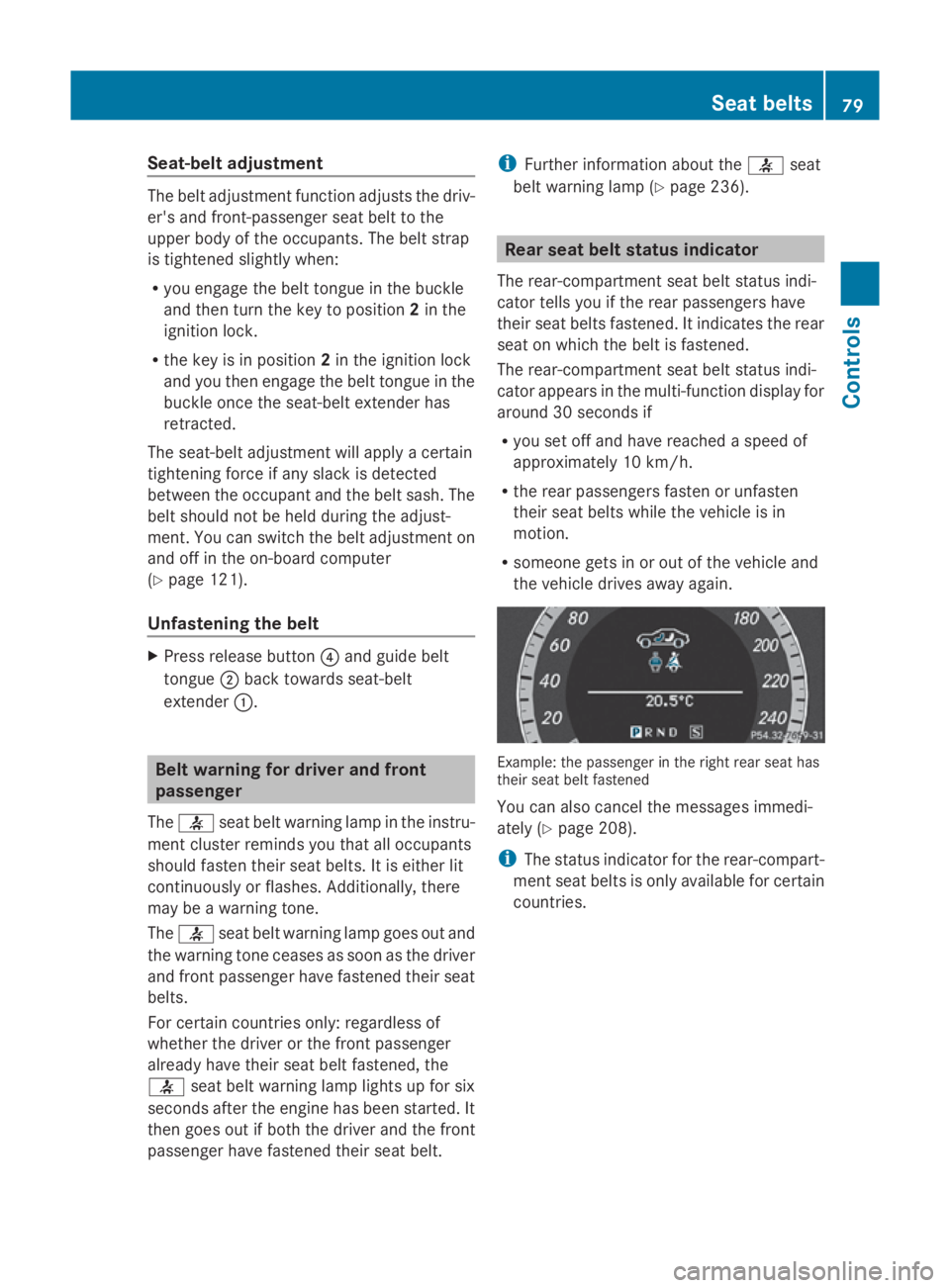
The rear-compartment seat belt status indi-
cator tells you if the rear passengers have
their seat belts fastened. It indicates the rear
seat on which the belt is fastened.
The rear-compartment seat belt status indi-
cator appears in the multi-function display for
around 30 seconds if
R you set off and have reached aspeed of
approximately 10 km/h.
R the rear passengers fasten or unfasten
their seat belts while the vehicle is in
motion.
R someone gets in or out of the vehicle and
the vehicle drives away again. Example: the passenger in the right rear seat has
their seat belt fastened
You can also cancel the messages immedi-
ately (Y
page 208).
i The status indicator for the rear-compart-
ment seat belts is only available for certain
countries. Seat belts
79Controls
207_AKB; 2; 3, en-GB
mkalafa, Version: 2.11.8.1 2009-07-23T10:23:49+02:00-Seite 79 Z