battery MERCEDES-BENZ E-CLASS COUPE 2009 Owner's Manual
[x] Cancel search | Manufacturer: MERCEDES-BENZ, Model Year: 2009, Model line: E-CLASS COUPE, Model: MERCEDES-BENZ E-CLASS COUPE 2009Pages: 313, PDF Size: 7.76 MB
Page 222 of 313
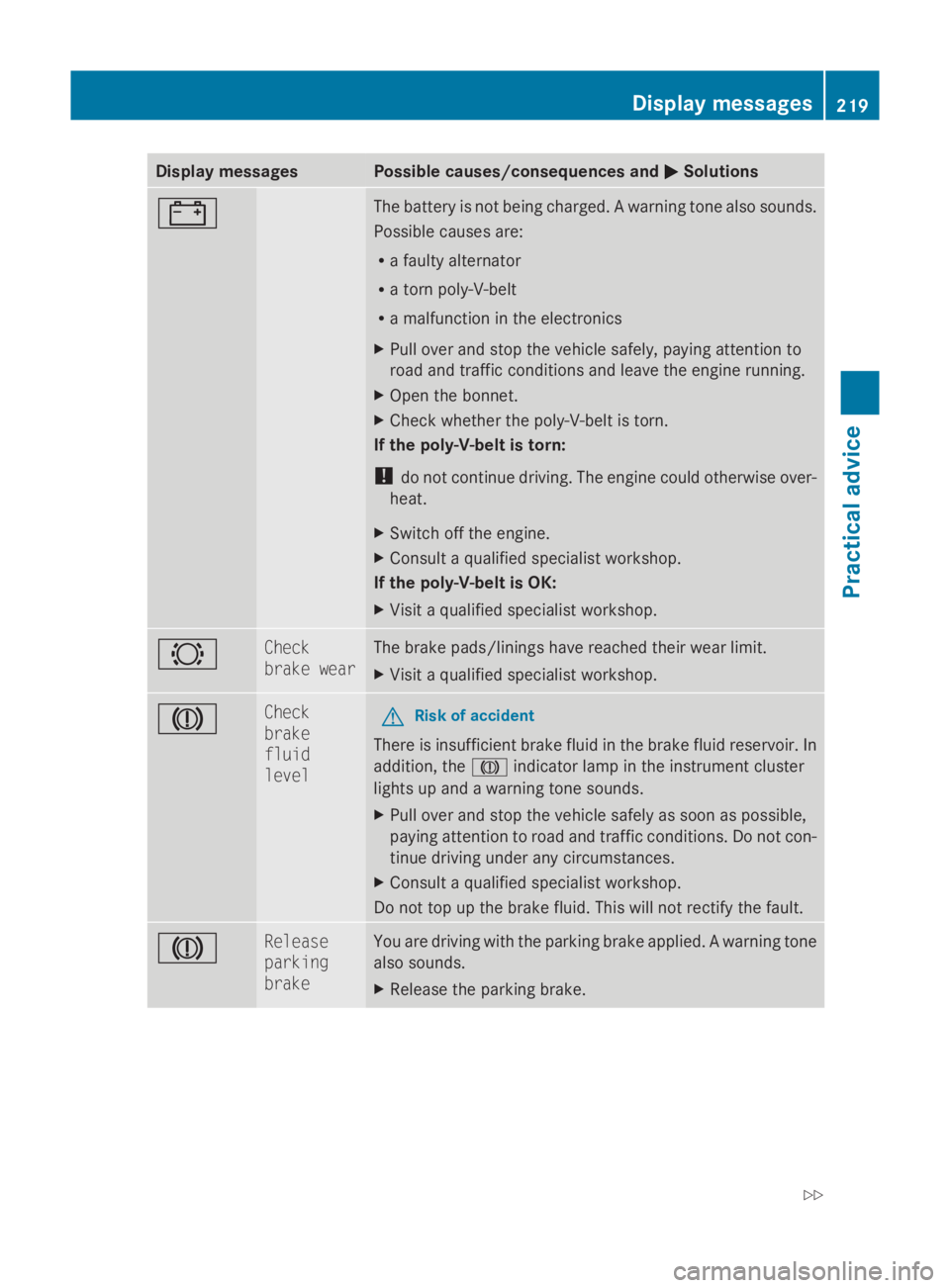
Display messages Possible causes/consequences and
0050
0050 Solutions 003F The battery is no
tbein gcharged. Awarnin gton ea lso sounds.
Possibl ecauses are:
R af ault yalternator
R at ornp oly-V-belt
R am alfunction in th eelectronics
X Pull ove rand stop th evehicl esafely, payin gattention to
roa dand traffic condition sand leav ethe engin erunning.
X Ope nthe bonnet.
X Chec kwhether th epoly-V-belt is torn.
If th epoly-V-belt is torn:
! do no tcontinu edriving. The engin ecould otherwise over-
heat.
X Switc hoffthee ngine.
X Consult aqualified specialist workshop.
If th epoly-V-belt is OK:
X Visit aqualified specialist workshop. 0026 Check
brake wear The brak
epads/lining shaver eached their wear limit.
X Visit aqualified specialist workshop. 004D Check
brake
fluid
level
G
Risk of accident
There is insufficien tbrak efluidint hebrak efluidr eservoir .In
addition ,the 004D indicato rlamp in th einstrument cluster
lights up and awarnin gtones ounds.
X Pull ove rand stop th evehicl esafely as soo naspossible,
payin gattention to roa dand traffic conditions. Do no tcon-
tinue drivin gunder any circumstances.
X Consult aqualified specialist workshop.
Do no ttop up th ebrak efluid. This will no trectify th efault. 004D Release
parking
brake You are drivin
gwitht he parkin gbrak eapplied. Awarnin gtone
also sounds.
X Releas ethe parkin gbrake. Display
messages
219Practical advice
207_AKB; 2; 3, en-GB
mkalafa,V ersion: 2.11.8.1
2009-07-23T10:23:49+02:00
-Seite 219 Z
Page 234 of 313
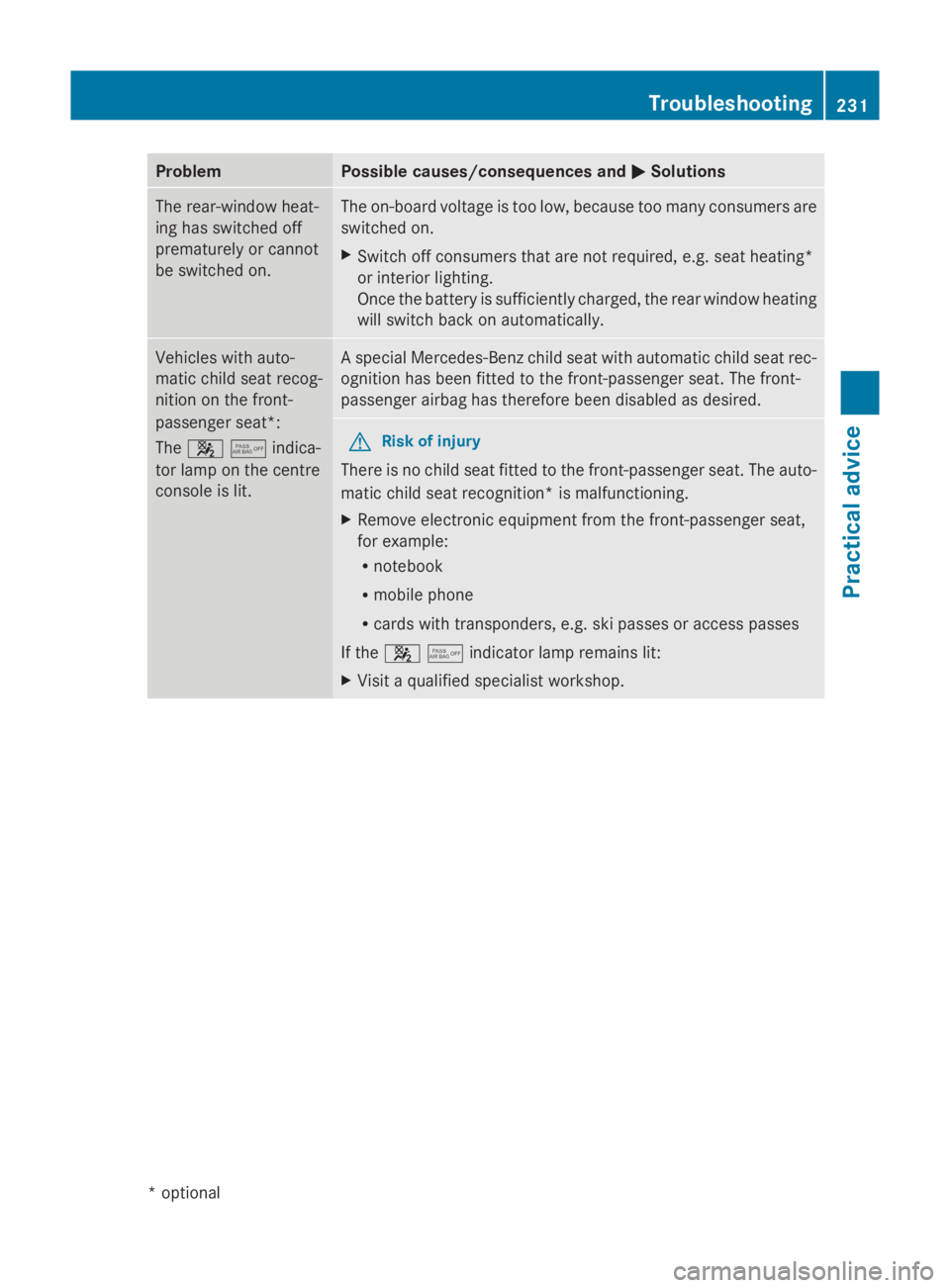
Problem Possible causes/consequences and
0050
0050Solutions The rear-window heat-
ing has switched off
prematurely or cannot
be switched on. The on-board voltage is too low, because too many consumers are
switched on.
X
Switch off consumers that are not required, e.g. seat heating*
or interior lighting.
Once the battery is sufficiently charged, the rear window heating
will switch back on automatically. Vehicles with auto-
matic child seat recog-
nition on the front-
passenger seat*:
The
007F0080indica-
tor lamp on the centre
console is lit. As
pecial Mercedes-Ben zchild seat with automatic child seat rec-
ognition has been fitted to the front-passenger seat .The front-
passenger airbag has therefore been disabled as desired. G
Risk of injury
There is no child seat fitted to the front-passenger seat .The auto-
matic child seat recognition *ismalfunctioning.
X Remove electronic equipmen tfromt he front-passenger seat,
for example:
R notebook
R mobile phone
R card swith transponders, e.g. ski passes or access passes
If the 007F0080indicator lamp remain slit:
X Visit aqualified specialist workshop. Troubleshooting
231Practical advice
*optional
207_AKB; 2; 3, en-GB
mkalafa,
Version: 2.11.8.1 2009-07-23T10:23:49+02:00-Seite2 31 Z
Page 244 of 313
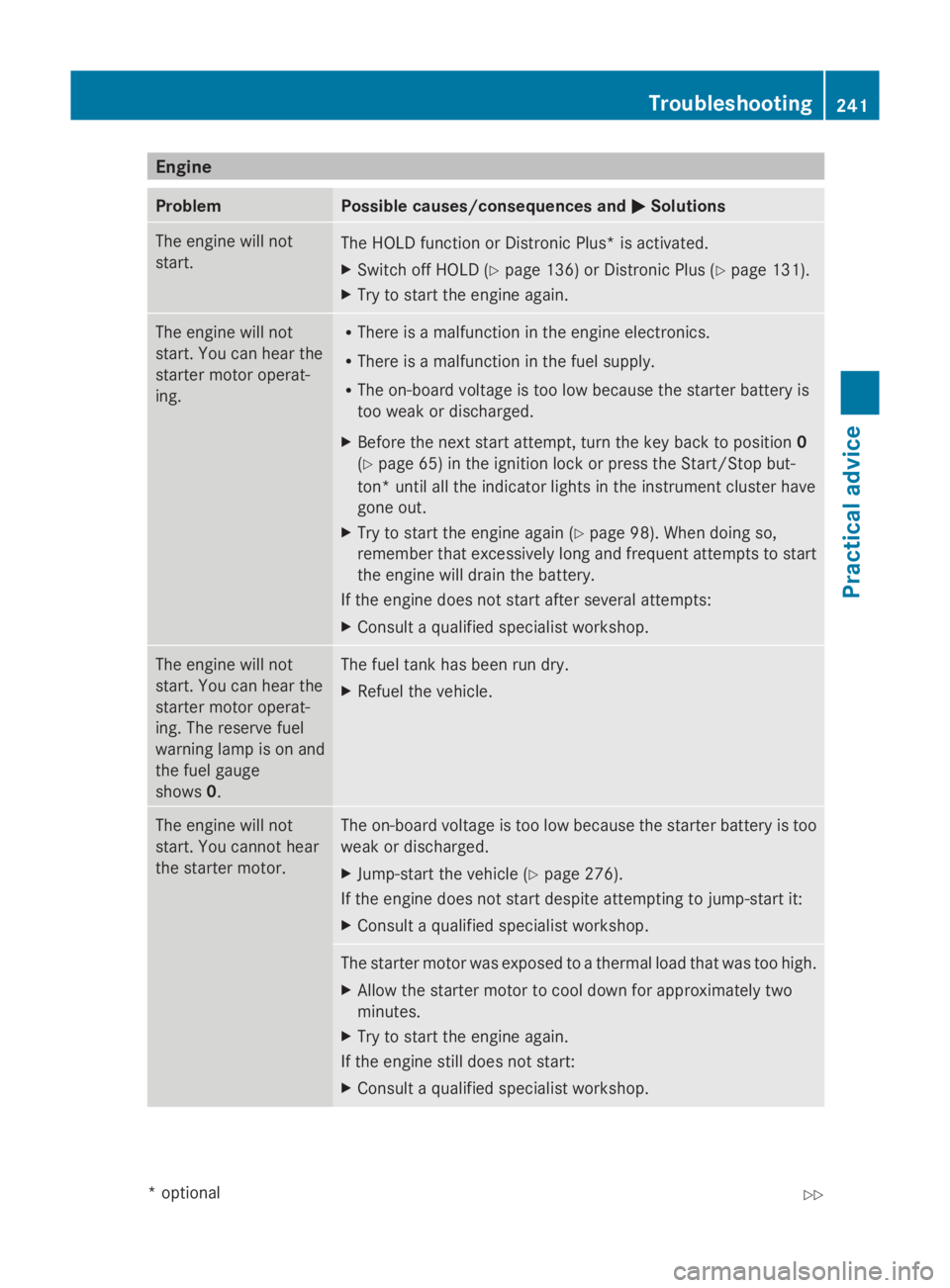
Engine
Problem Possible causes/consequences and
0050
0050Solutions The engin
ewill not
start. The HOLD function or Distronic Plus* is activated.
X
Switch off HOLD (Y page 136) or Distronic Plus (Y page 131).
X Try to start th eenginea gain. The engin
ewill not
start .You can hear the
starter motor operat-
ing. R
Ther eisam alfunctio nintheengin eelectronics.
R Ther eisam alfunctio ninthefuel supply.
R The on-board voltage is to olow because th estarter battery is
to ow eak or discharged.
X Before th enexts tart attempt ,tur nt he keyb ack to position 0
(Y page 65 )intheignition loc korpressthe Start/Sto pbut-
ton* until all th eindicator light sintheinstrumen tcluste rhave
gon eout.
X Try to start th eenginea gain (Y page 98). When doin gso,
remembe rtha te xcessively lon gand frequen tattempt stostart
th ee nginew ill drain th ebattery.
If th eengined oes no tstart after several attempts:
X Consult aqualifie dspecialist workshop. The engin
ewill not
start .You can hear the
starter motor operat-
ing .The reserv efuel
warning lamp is on and
th ef uel gauge
shows 0. The fuel tan
khas been run dry.
X Refuel th evehicle. The engin
ewill not
start .You canno thear
th es tarter motor. The on-board voltage is to
olow because th estarter battery is too
weak or discharged.
X Jump-start th evehicle (Y page 276).
If th eengined oes no tstart despite attempting to jump-star tit:
X Consult aqualifie dspecialist workshop. The starter motor was exposed to
athe rmal load that was to ohigh.
X Allo wthe starter motor to coo ldown for approximately two
minutes.
X Try to start th eenginea gain.
If th eengines till does no tstart:
X Consult aqualifie dspecialist workshop. Troubleshooting
241Practical advice
*optional
207_AKB
;2;3,en-GB
mkalafa, Version:2.11.8.1
2009-07-23T10:23:49+02:00
-Seite 241 Z
Page 251 of 313
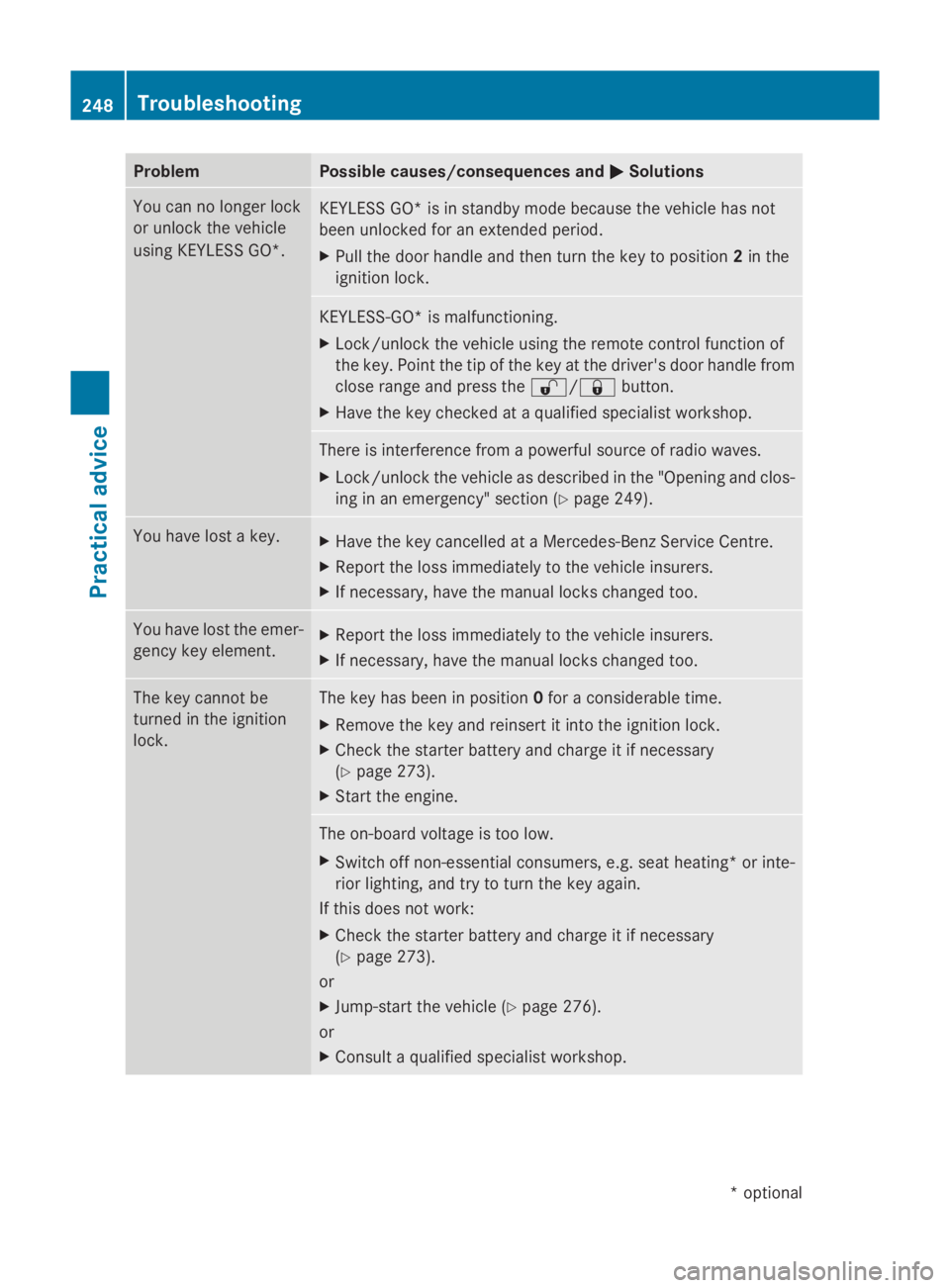
Problem Possible causes/consequences and
0050
0050Solutions You can no longer lock
or unlock the vehicle
using KEYLESS GO*.
KEYLESS GO* is in standby mode because the vehicle has not
been unlocked for an extended period.
X
Pull the door handle and then turn the key to position 2in the
ignition lock. KEYLESS-GO* is malfunctioning.
X
Lock/unlock the vehicle using the remote control function of
the key. Point the tip of the key at the driver's door handle from
close range and press the 0036/0037button.
X Have the key checked at aqualified specialist workshop. There is interference from
apowerful source of radio waves.
X Lock/unlock the vehicle as described in the "Opening and clos-
ing in an emergency" section (Y page 249).You have lost
akey. X
Have the key cancelled at aMercedes-Benz Service Centre.
X Report the loss immediately to the vehicle insurers.
X If necessary, have the manual locks changed too. You have lost the emer-
gency key element.
X
Report the loss immediately to the vehicle insurers.
X If necessary, have the manual locks changed too. The key cannot be
turned in the ignition
lock. The key has been in position
0for aconsiderable time.
X Remove the key and reinsert it into the ignition lock.
X Check the starter battery and charge it if necessary
(Y page 273).
X Start the engine. The on-board voltage is too low.
X
Switch off non-essential consumers, e.g. seat heating* or inte-
rior lighting, and try to turn the key again.
If this does not work:
X Check the starter battery and charge it if necessary
(Y page 273).
or
X Jump-start the vehicle (Y page 276).
or
X Consult aqualified specialist workshop. 248
TroubleshootingPractical advice
*o
ptional
207_AKB; 2; 3, en-GB
mkalafa,
Version: 2.11.8.1 2009-07-23T10:23:49+02:00-Seite 248
Page 252 of 313
Parking up the vehicle
Problem Possible causes/consequences and
0050
0050Solutions The vehicle is to be left
parked up for longer
than four weeks. The battery can be damaged through exhaustive discharge.
X
Disconnect the battery (Y page 275) or connect toatrickle
charger.
i Have the battery checked at aqualified specialist workshop,
e.g. aMercedes-Benz Service Centre. The vehicle is to be left
parked up for longer
than six weeks. Damage resulting from non-use may occur if the vehicle is parked
up for long periods.
X
Visit aqualified specialist workshop and seek advice. Locking/unlocking in an emergency
Emergency key element
If the vehicle can no longer be locked or
unlocked with the key, use the emergency
key element.
If you use the emergency key element to
unlock and open the driver's door or the boot
lid, the anti-theft alarm system* will be trig-
gered (Y page 58).
There are several waystot urn off the alarm:
X Press the 0036or0037 button on the key.
or
X Insert the key into the ignition lock.
or
X Press the Start/Stop button* in the ignition
lock. The key must be in the vehicle.
or
X Lock or unlock the vehicle using KEYLESS
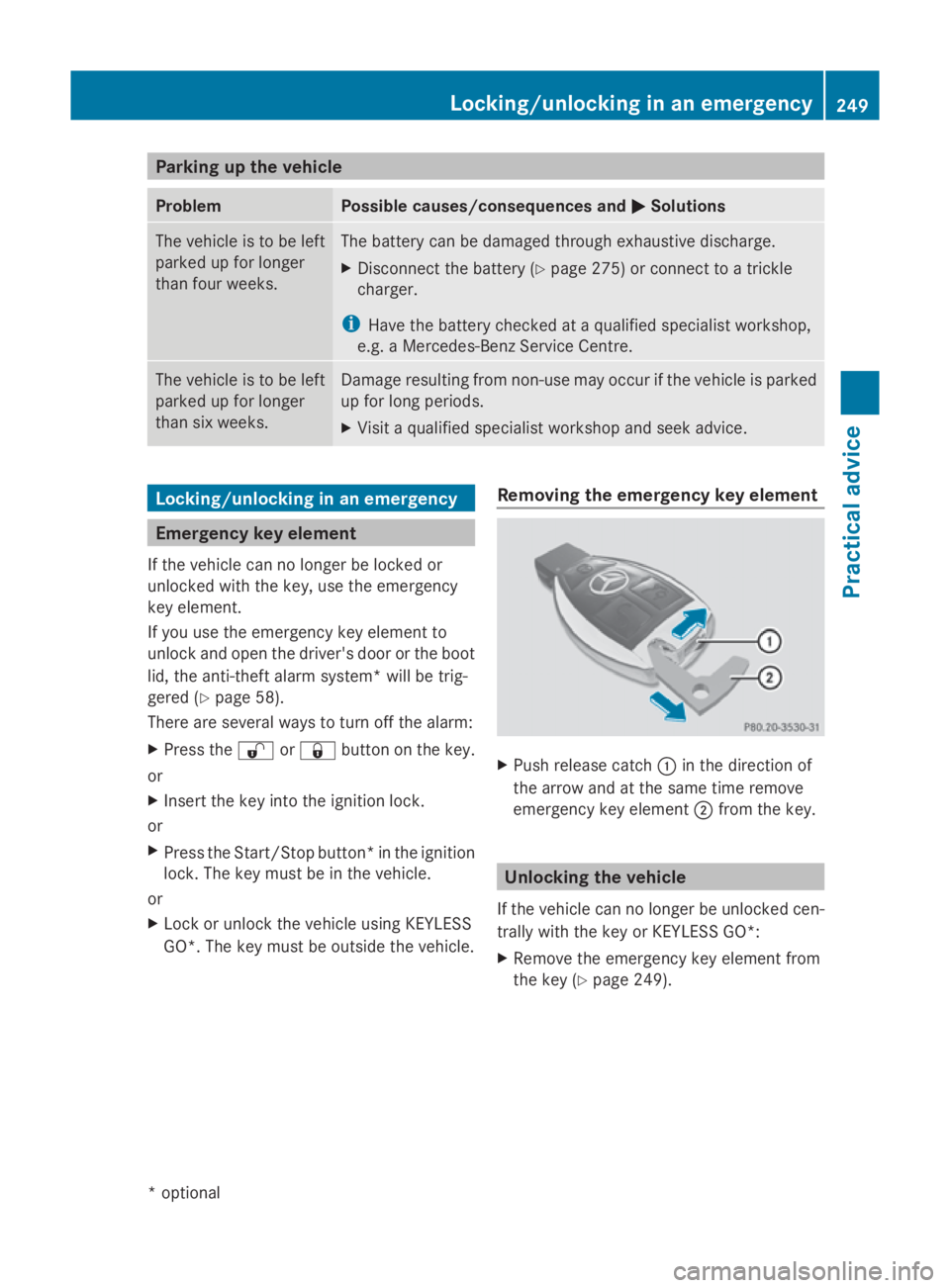
GO*. The key must be outside the vehicle. Removing the emergency key element X
Push release catch 0046in the direction of
the arrow and at the same time remove
emergency key element 0047from the key. Unlocking the vehicle
If the vehicle can no longer be unlocked cen-
trally with the key or KEYLESS GO*:
X Remove the emergency key element from
the key (Y page 249). Locking/unlocking in an emergency
249Practical advice
*optional
207_AKB; 2; 3, en-GB
mkalafa,
Version: 2.11.8.1 2009-07-23T10:23:49+02:00-Seite 249 Z
Page 262 of 313
X
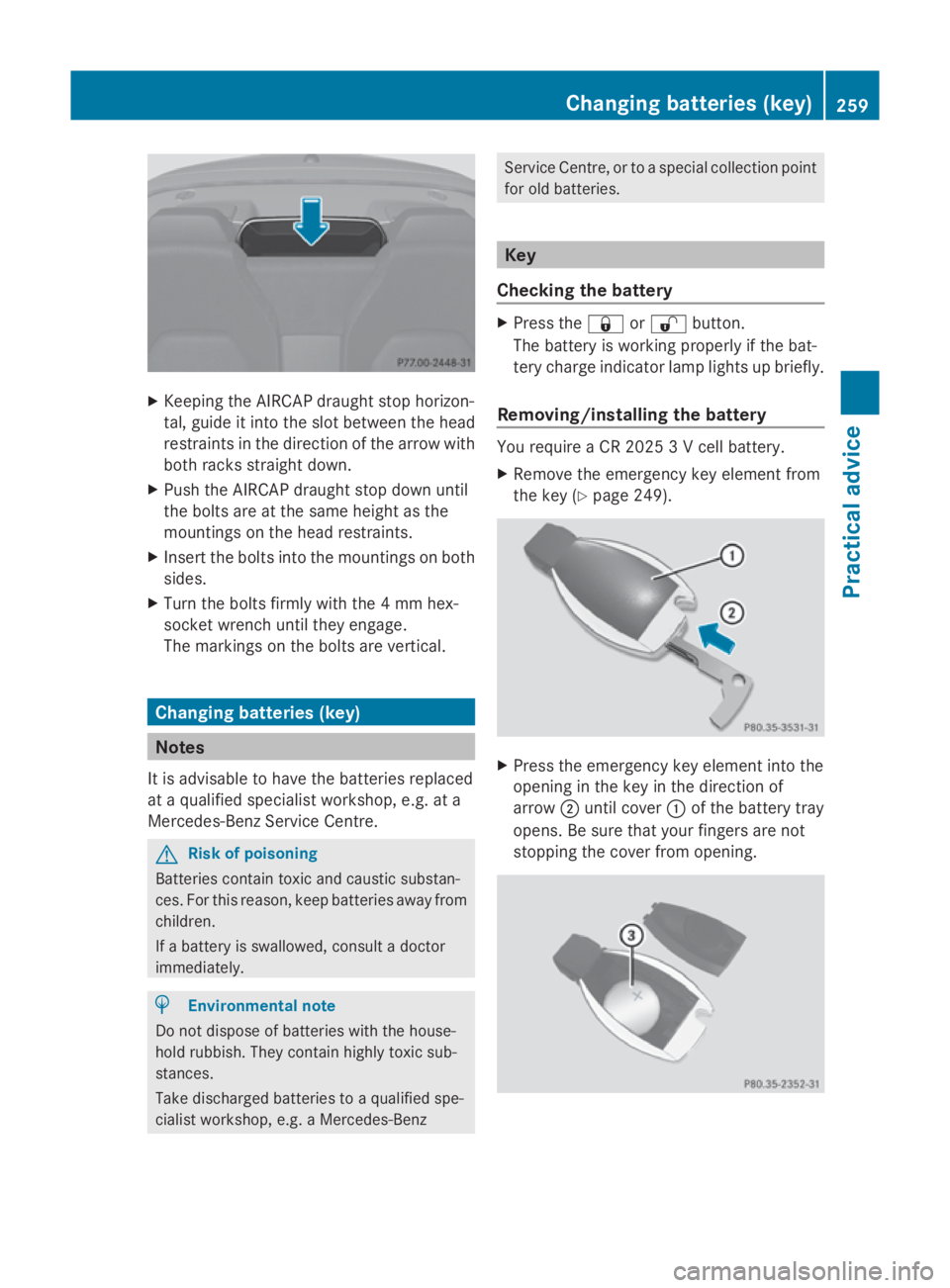
Keeping the AIRCAP draught stop horizon-
tal, guide it into the slot betwee nthe head
restraints in the direction of the arrow with
both racks straight down.
X Push the AIRCAP draught stop down until
the bolts are at the same heigh tasthe
mountings on the head restraints.
X Insert the bolts into the mountings on both
sides.
X Turn the bolts firmly with the 4mmhex-
socket wrench until they engage.
The markings on the bolts are vertical. Changing batteries (key)
Notes
It is advisabletoh ave the batteries replaced
at aq ualified specialist workshop, e.g. at a
Mercedes-Benz Service Centre. G
Risk of poisoning
Batteries contain toxic and caustic substan-
ces. For this reason, keep batteries awayf rom
children.
If ab attery is swallowed, consult adoctor
immediately. H
Environmental note
Do not dispose of batteries with the house-
hold rubbish. They contain highl ytoxic sub-
stances.
Take discharged batteries to aqualified spe-
cialist workshop, e.g. aMercedes-Benz Service Centre, or to
aspecia lcollection point
for old batteries. Key
Checking the battery X
Press the 0037or0036 button.
The battery is working properl yifthe bat-
tery charge indicator lamp lights up briefly.
Removing/installing the battery You require
aCR20253Vc ell battery.
X Remove the emergency key element from
the key (Y page 249). X
Press the emergency key element into the
opening in the key in the direction of
arrow 0047until cover 0046of the battery tray
opens. Be sure that yourf ingers are not
stopping the cover from opening. Changing batteries (key)
259Practical advice
207_AKB; 2; 3, en-GB
mkalafa,V ersion: 2.11.8.1
2009-07-23T10:23:49+02:00
-Seite 259 Z
Page 263 of 313
X
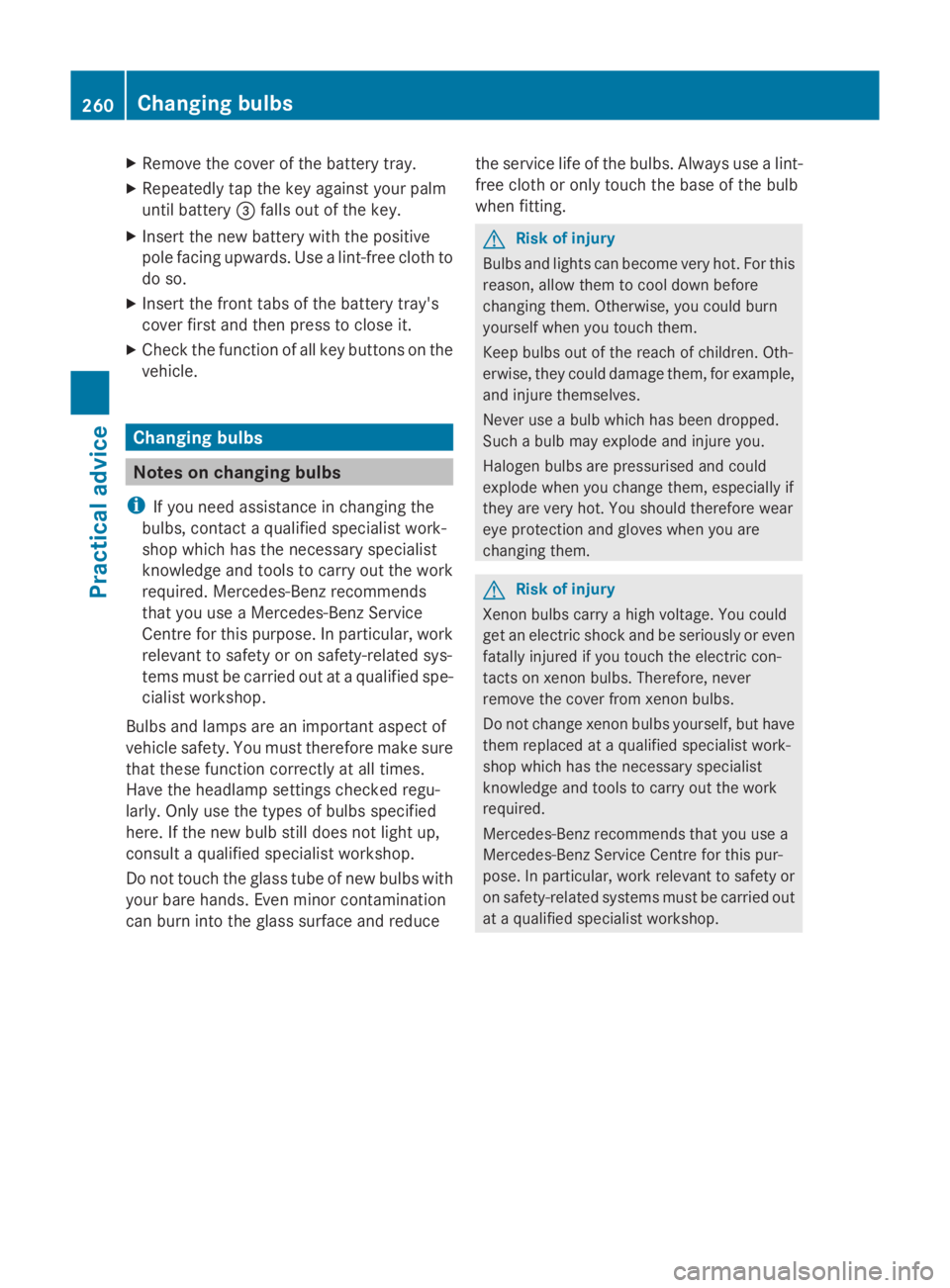
Remove th ecover of th ebattery tray.
X Repeatedly tap th ekeyagainst your palm
until battery 008Afallsout of th ekey.
X Inser tthe newb attery wit hthe positive
pole facin gupwards. Use alint-free cloth to
do so.
X Inser tthe fron ttab soft hebattery tray's
cover first and then press to close it.
X Chec kthe function of all ke ybuttons on the
vehicle. Changin
gbulbs Notes on changin
gbulbs
i If you need assistanc einchangin gthe
bulbs ,contac taqualified specialist work-
sho pwhichh as th eneces saryspecialist
knowledge and tools to carry out th ework
required. Mercedes-Ben zrecommends
that you use aMercedes-Ben zServi ce
Centr efor this purpose .Inparticular, work
relevan ttosafetyoro nsafety-related sys-
tems mus tbecarriedout at aqualified spe-
cialist workshop.
Bulb sand lamp sare an important aspect of
vehicl esafety. You mus tthe refor emakes ure
that these function correctl yatall times.
Hav ethe headlamp setting schecked regu-
larly. Only use th etypes of bulbs specified
here. If th enew bulb still does no tligh tup,
consult aqualified specialist workshop.
Do no ttou ch th eglasstub eofn ewbulbs with
your bare hands. Even minor contamination
can burn into th eglasssurfac eand reduce th
es ervic elife of th ebulbs .Always use alint-
free cloth or only touch th ebase of th ebulb
when fitting. G
Ris
kofi njury
Bulb sand lights can become ver yhot.F or this
reason ,allow them to cool down before
changin gthem. Otherwise ,you could burn
yourself when you touch them.
Kee pbulbs out of th ereac hofc hildren .Oth-
erwise, they could damage them, for example,
and injur ethemselves.
Never use abulb whic hhas been dropped.
Suc hab ulb may explod eand injur eyou.
Halogen bulbs are pressurised and could
explod ewhen you chang ethem, especially if
they are ver yhot.Y ou should therefor ewear
eye protection and gloves when you are
changin gthem. G
Ris
kofi njury
Xenon bulbs carry ahigh voltage. You could
get an electric shock and be seriously or even
fatally injured if you touch th eelectric con-
tacts on xeno nbulbs .Therefore ,never
remove th ecover from xeno nbulbs.
Do no tcha ng ex enon bulbs yourself ,but have
them replaced at aqualified specialist work-
sho pwhichh as th eneces saryspecialist
knowledge and tools to carry out th ework
required.
Mercedes-Ben zrecommends that you use a
Mercedes-Ben zServic eCentr efor this pur-
pose. In particular, wor krelevan ttosafetyor
on safety-related systems mus tbecarriedout
at aq ualified specialist workshop. 260
Changing bulbsPractical advice
207_AKB; 2; 3, en-GB
mkalafa,
Version: 2.11.8.1 2009-07-23T10:23:49+02:00-Seite 260
Page 276 of 313
The maximum permissible distanc
ewhich
can be driven in run-flat mode is counted
from the moment the tyre pressure loss
warning appears in the multifunction dis-
play.
You must not exceed amaximum speed of
80 km/h. G
Risk of accident
The handling characteristics of your vehicle
deteriorate in run-flat mode, for example:
R when cornering
R when braking
R when acceleratin grapidly
Adapt your driving style accordingly and avoid
sudden changes in direction and sudden
acceleration ,aswell as driving over obstacles
(i.e. kerbs, potholes), and driving off-road.
This is particularly the case when the vehicle
is heavily laden.
The maximum permissible distanc ethat can
be driven in run-flat mode depends to alarge
exten tonthe loads placed on the vehicle. It
can be shorter due to high speeds, aheavy
load, sudden acceleration and/or manoeu-
vring, the road surface condition, outside tem-
perature, etc.,orf urther,ifyou drive carefully
and conservatively.
Do not continue to drive in run-flat mode if:
R you hear banging noises.
R the vehicle start stoshake.
R you see smoke and smell rubber.
R ESP ®
is intervening constantly.
R there are tears in the sidewalls of the tyre.
After driving in run-flat mode, you must have
the wheel(s) checked for damage at aquali-
fied specialist workshop which has the nec-
essary specialist knowledge and tools to carry
out the work required. The faulty tyre must be
replaced in every case.
Mercedes-Benz recommends that you use a
Mercedes-Benz Servic eCentre for this pur-
pose. In particular, work relevant to safety or on safety-related systems must be carried out
at
aq ualified specialist workshop.
Vehicles with MOExtended tyres*: when
replacing one or all tyres, make sure that you
only use tyres marked MOExtended and of
the specified size for the vehicle. Battery
Notes on the vehicle battery
In order for the battery to achieve the maxi-
mum possible service life, it must alway sbe
sufficiently charged.
Have the battery charge checked more fre-
quently if you use the vehicle mainly for short
trips or if you leave it standin gidle for a
lengthy period.
To prevent damage from corrosion, only
replace the battery with one that has acentral
ventilation cover.
Consult aMercedes-Benz Servic eCentre if
you wish to leave your vehicle parked up for
al ong period of time. G
Risk of injury
Comply with safety precautions and take pro-
tective measures when handling batteries. Risk of explosion
Fire, naked flames and
smokin
gare prohibited
when handling the battery.
Avoid creatin gsparks. Battery acid is caustic.
Avoid contact with the skin,
eyes or clothing.
Wear suitable protective
clothing, in particular
gloves, an apron and
aface
mask.
Immediately rinse acid
splashes off with clean Battery
273Practical advice
*optional
207_AKB; 2; 3, en-GB
mkalafa,
Version: 2.11.8.1 2009-07-23T10:23:49+02:00-Seite 273 Z
Page 277 of 313
water
.Consult adoctor if
necessary. Wear eye protection.
Keep children away.
Observe this Owner's Man-
ual.
H
Environmenta
lnote
Do not dispos eofbatteries in th ehousehold
rubbish. Dispose of defectiv ebatteries in an
environmentally responsible manner .Take
them to aMercedes-Ben zServic eCentre or
to as pecial collection poin tfor old batteries. G
Risk of injury
For safet yreasons ,Mercedes-Ben zrecom-
mends that you only use batteries which have
been tested and approved for your vehicle by
Mercedes-Benz. These batteries provide
increase dimpac tprotection to prevent vehi-
cle occupant sfroms ufferin gacid burns
should th ebattery be damaged in th eevent
of an accident.
To prevent acid burns, observe th efollowing
safet ynotes when handling batteries:
R do not lean over th ebattery.
R do not place any metal object sonabattery.
Otherwise, you could cause ashor tcircuit
and th ebattery's gas mixtur ecould ignite.
R mak esure that you do not create an elec-
trostatic charge, e.g .bywearingsynthetic
clothin gorasar esult of frictio nonfabrics.
Therefore, you should not pull or slide the
battery over carpet sorother synthetic
materials. R
never touc hthe battery first. To discharge
ap ossible electrostatic charge, step out of
th ev ehicle firs tand touc hthe bodywork.
R do not wipe th ebattery using acloth. The
battery may explode as aresult of electro-
static charge or due to flyin gsparks.
! Before loosening th eterminal clamps of
th eb attery, switch off th eengine and
remove th ekey or, on vehicles with KEY-
LESS-GO*, mak esure that th eignitio nis
not switche don. In th einstrumen tcluster,
all of th eindicator lamps must be out. Oth-
erwise ,you may destroy electronic compo-
nents ,such as th ealternator.
i Mercedes-Ben zrecommend sthaty ou
have work involvin gthe battery, e.g.
removal, charging and replacement, car-
ried out at aqualified specialist workshop,
e.g .aM ercedes-Ben zServic eCentre.
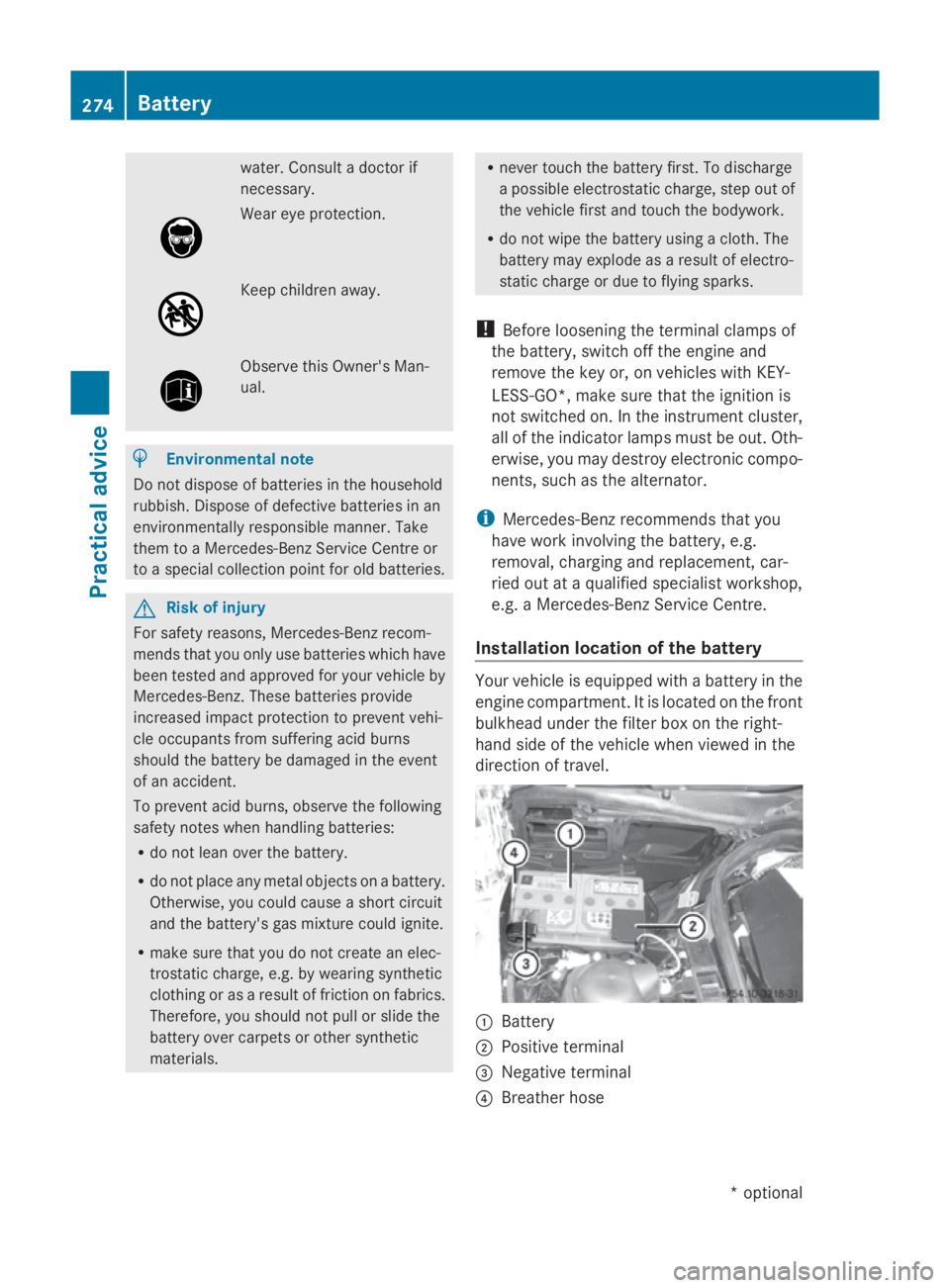
Installation location of th ebattery Your vehicle is equipped with
abattery in the
engine compartment. It is located on th efront
bulkhead under th efilter box on th eright-
hand side of th evehicle when viewed in the
directio noftravel. 0046
Battery
0047 Positive terminal
008A Negative terminal
0088 Breather hose 274
BatteryPractical advice
*o
ptional
207_AKB; 2; 3, en-GB
mkalafa,
Version: 2.11.8.1 2009-07-23T10:23:49+02:00-Seite2 74
Page 278 of 313
i
Remove th ekeyif you park th evehicle
and do no trequire any electrical consum-
ers .The vehicl ewill then use ver ylittle
energy, thus conservin gthe battery.
i If th ebattery is discharged, you mus tuse
th ee mergenc ykey elemen ttounlockthe
vehicle. Disconnecting th
ebattery G
Ris
kofa ccident
If th ebattery is disconnected:
R theb rak eboostin geffec twill no tbea vail-
able. Greate rbrakin gforce will then be
require dand brak epedal travel will be lon-
ger .Ifn eces sary, depress th ebrak epedal
wit hm aximum force.
R thet ransmission is locke dinposition Pon
vehicles wit hautomati ctransmission*
! Always disconnect th ebattery in the
order described below. Never mix up the
terminal clam pdisconnection/connection
order and never mix up th eterminal
clamps. You may otherwise damag ethe
vehicl eelectronics.
X Firmly depress th eparkin gbrak eand on
vehicles wit hautomatic transmission*,
shift th etransmission to position P.
X Switc hoff all electrical consumer s(e.g.
radio, blower, etc.).
X Turn th ekeyto0(Y page 65 )inthe ignition
lock and remove it or make sure tha tno
ignition positio nhasbeen selecte dwith
KEYLESS GO *.In the instrument cluster, all
of the indicator lampsm ust be out.
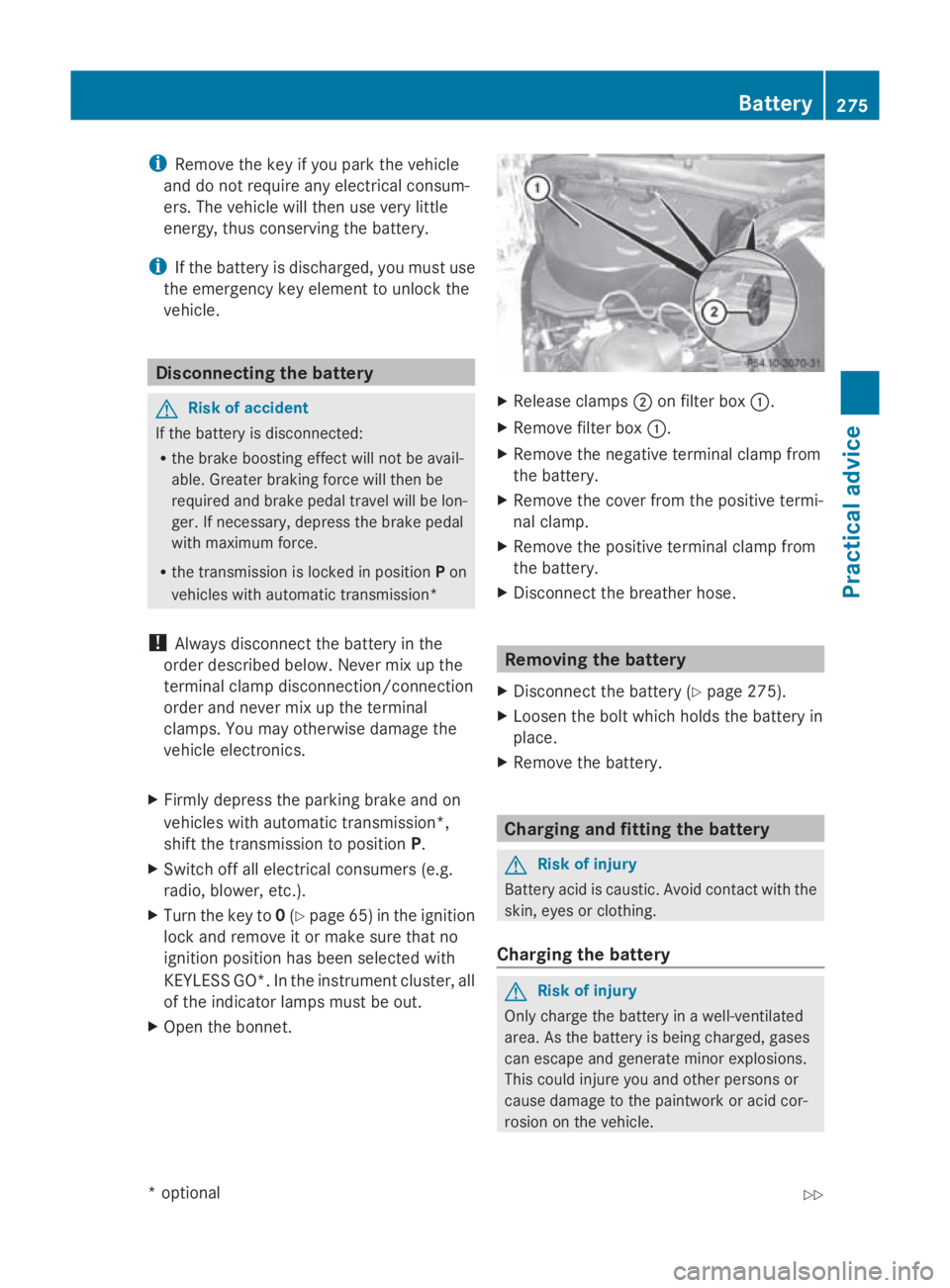
X Open the bonnet. X
Release clamps 0047on filter box 0046.
X Remove filter box 0046.
X Remove the negative terminal clamp from
the battery.
X Remove the cover from the positive termi-
nal clamp.
X Remove the positive terminal clamp from
the battery.
X Disconnect the breather hose. Removing the battery
X Disconnect the battery ( Ypage 275).
X Loosen the bolt which holds the battery in
place.
X Remove the battery. Charging and fitting the battery
G
Risk of injury
Battery acid is caustic. Avoid contact with the
skin, eyesorc lothing.
Charging the battery G
Risk of injury
Only charge the battery in awell-ventilated
area.Ast he battery is being charged, gases
can escape and generate minor explosions.
This could injure you and other persons or
cause damage to the paintwork or acid cor-
rosion on the vehicle. Battery
275Practical advice
*optional
207_AKB; 2; 3, en-GB
mkalafa
,V ersion: 2.11.8.1
2009-07-23T10:23:49+02:00
-Seite 275 Z