light MERCEDES-BENZ E-CLASS COUPE 2011 User Guide
[x] Cancel search | Manufacturer: MERCEDES-BENZ, Model Year: 2011, Model line: E-CLASS COUPE, Model: MERCEDES-BENZ E-CLASS COUPE 2011Pages: 353, PDF Size: 8.42 MB
Page 30 of 353
i
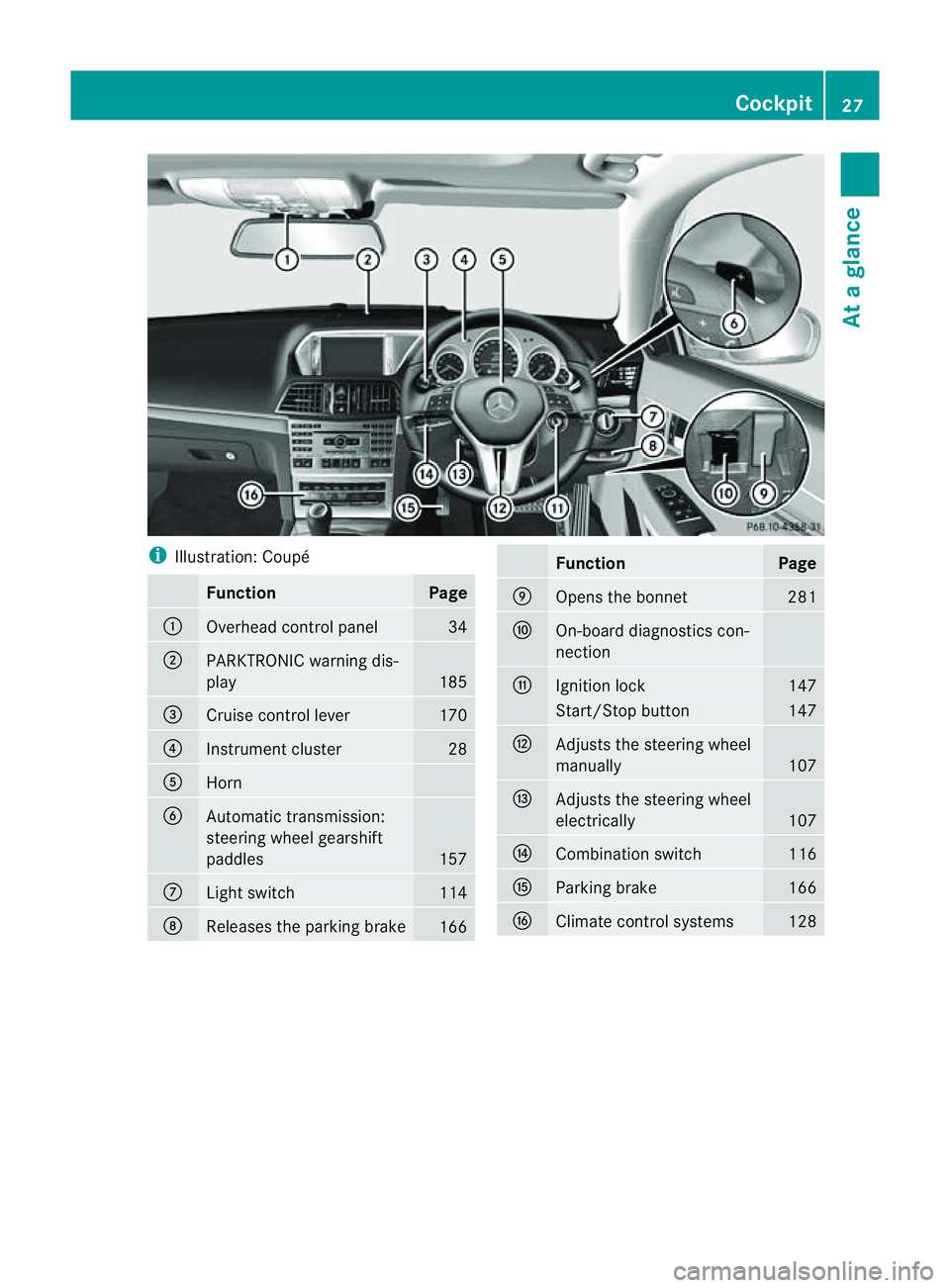
Illustration: Coupé Function Page
:
Overhea
dcontrol panel 34
;
PARKTRONIC warning dis-
play
185
=
Cruise control lever 170
?
Instrument cluster 28
A
Horn
B
Automatic transmission:
steering wheelg
earshift
paddles 157
C
Light switch 114
D
Releasest
he parking brake 166 Function Page
E
Opens the bonnet 281
F
On-board diagnostics con-
nection
G
Ignition lock 147
Start/Stop button 147
H
Adjusts the steering wheel
manually
107
I
Adjusts the steering wheel
electrically
107
J
Combination switch 116
K
Parking brake 166
L
Climate control systems 128Cockpit
27Atag lance
Page 31 of 353
Instrumen
tcluster Display
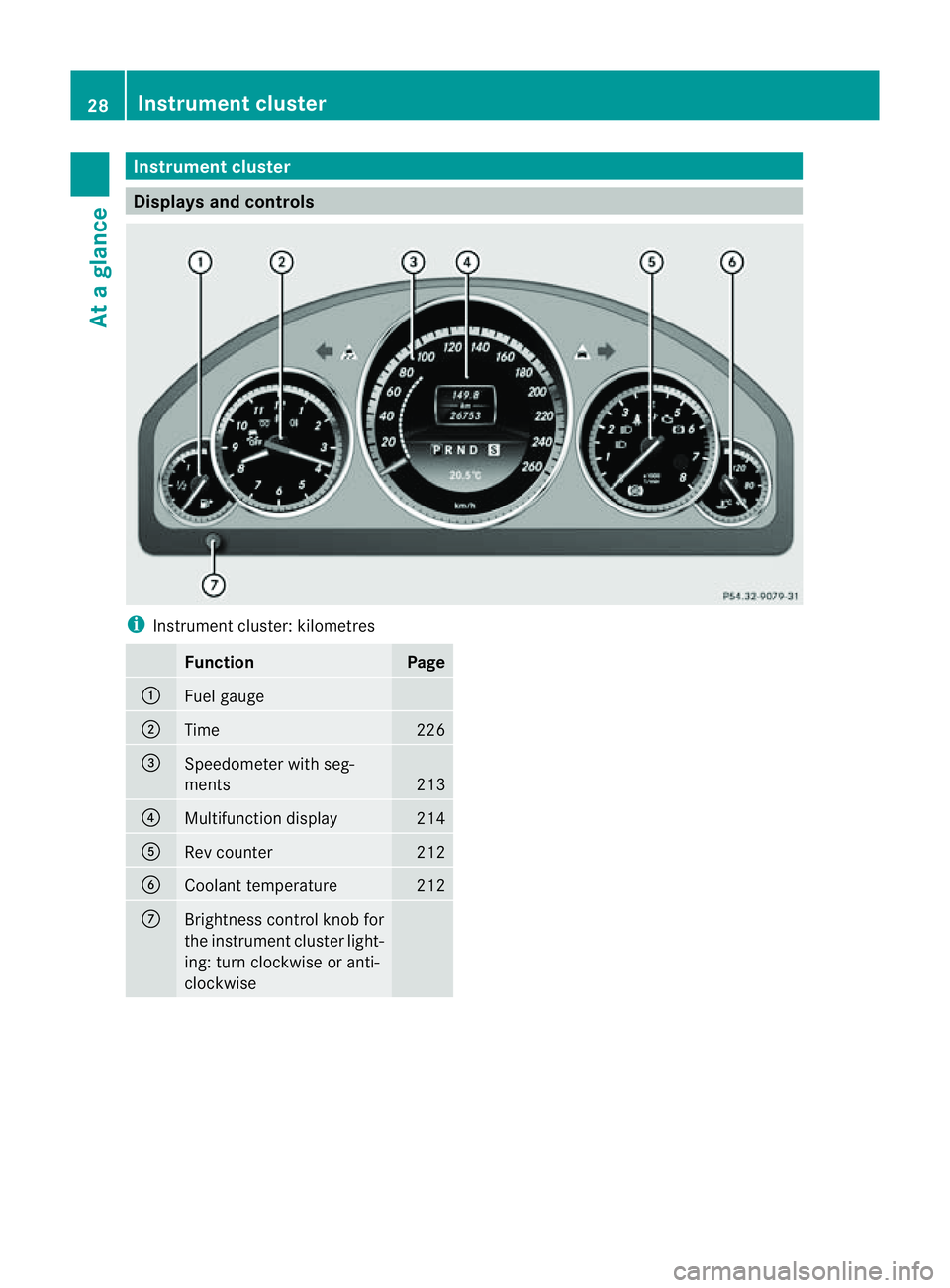
sand controls i
Instrument cluster: kilometres Function Page
:
Fuel gauge
;
Time 226
=
Speedometer with seg-
ments
213
?
Multifunction display 214
A
Rev counter 212
B
Coolant temperature 212
C
Brightness control knob for
the instrumen
tcluster light-
ing: tur nclockwise or anti-
clockwise 28
Instrument clusterAt
ag lance
Page 32 of 353
i
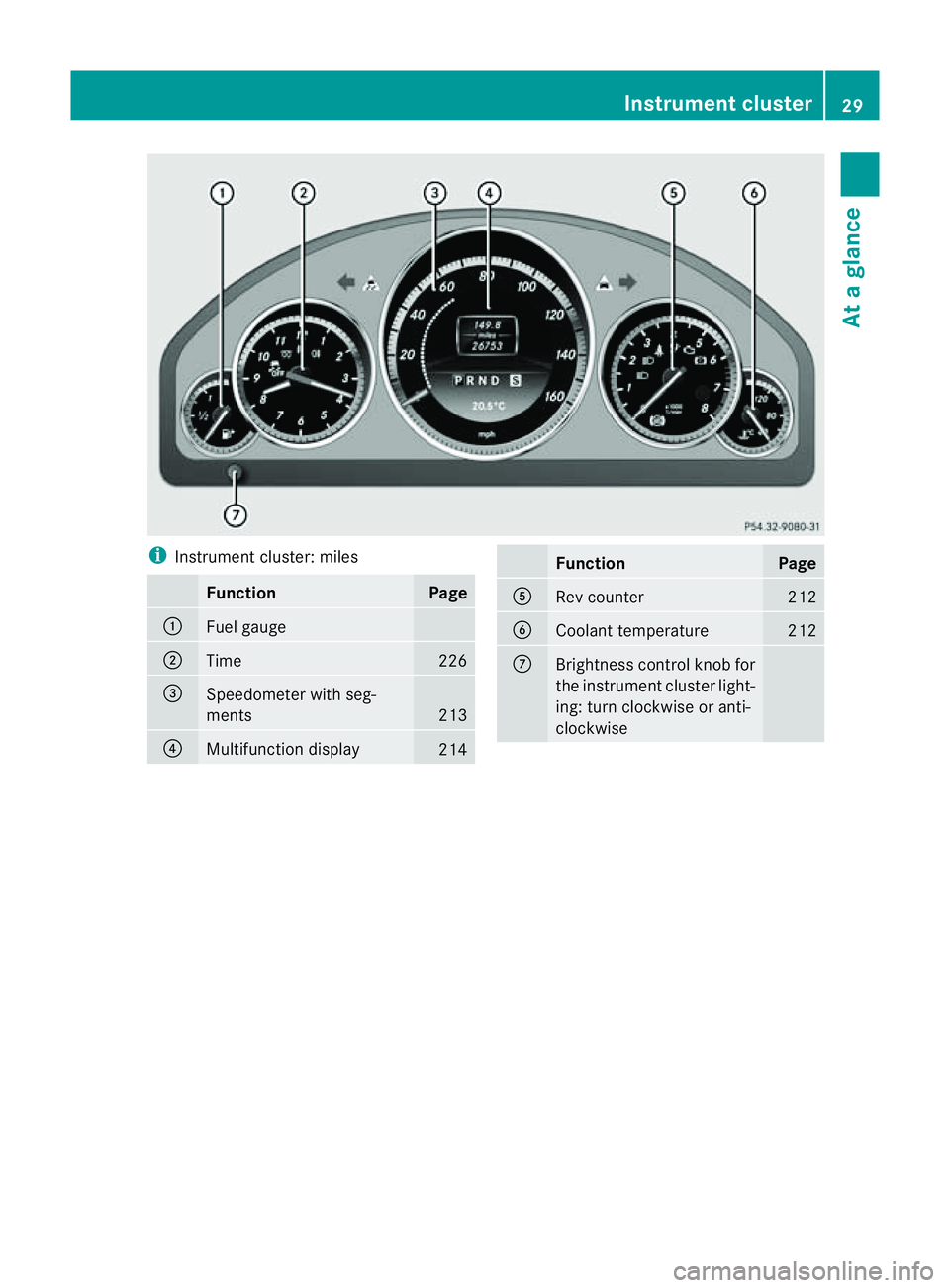
Instrument cluster: miles Function Page
:
Fuel gauge
;
Time 226
=
Speedometer with seg-
ments
213
?
Multifunction display
214 Function Page
A
Rev counter 212
B
Coolant temperature 212
C
Brightness control knob for
the instrument cluster light-
ing: turn clockwise or anti-
clockwise Instrument cluster
29Atag lance
Page 35 of 353
Centre console
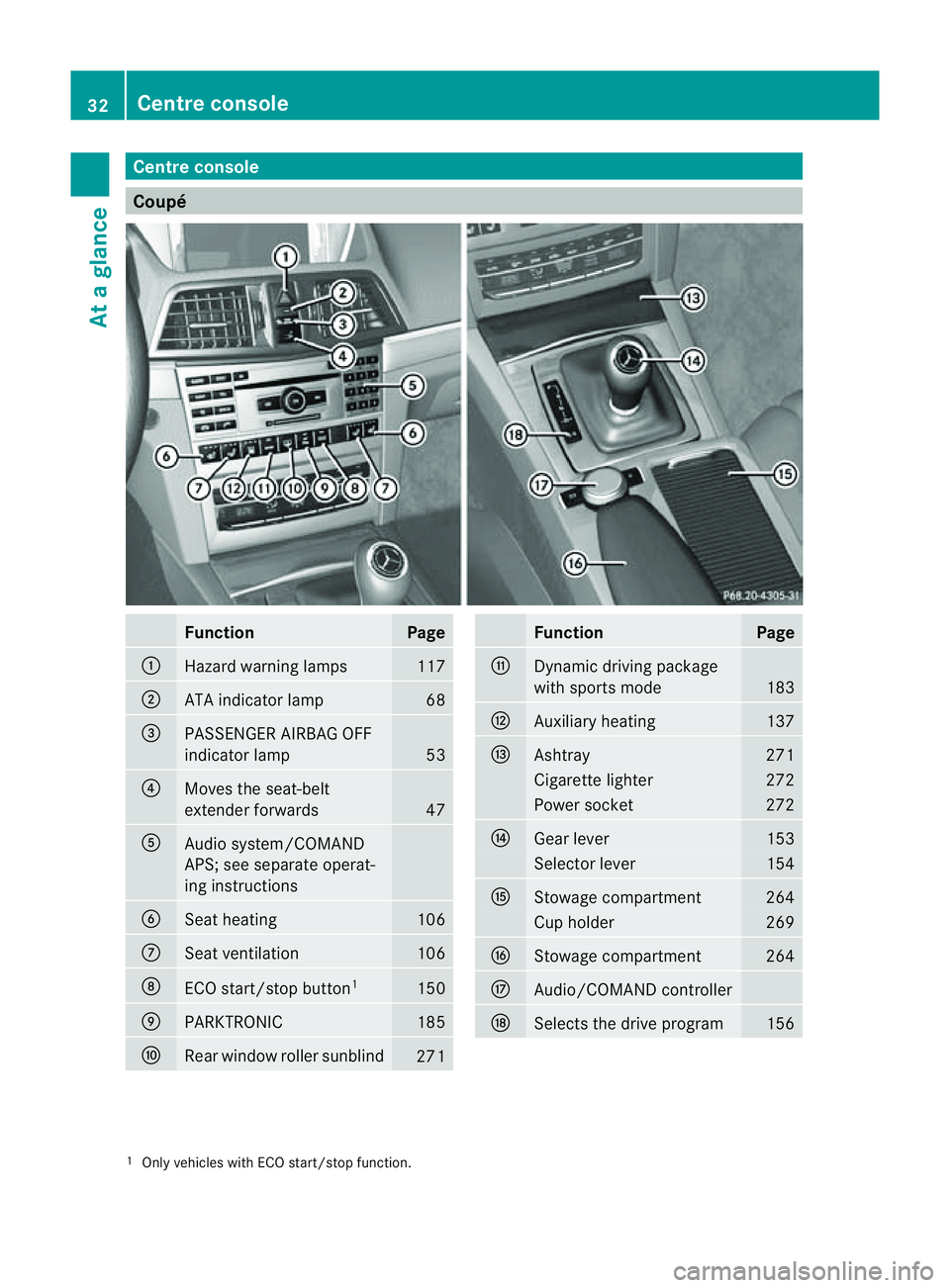
Coupé
Function Page
:
Hazard warning lamps 117
;
AT
Ai ndicator lamp 68
=
PASSENGER AIRBA
GOFF
indicator lamp 53
?
Moves th
eseat-belt
extender forwards 47
A
Audi
osystem/COMAND
APS; see separate operat-
ing instructions B
Seat heating 106
C
Seat ventilation 106
D
ECO start/sto
pbutton 1 150
E
PARKTRONIC 185
F
Rear window roller sunblind
271 Function Page
G
Dynamic driving package
wit
hsports mode 183
H
Auxiliary heating 137
I
Ashtray 271
Cigarett
elighter 272
Power socket 272
J
Gear lever 153
Selector lever 154
K
Stowage compartment 264
Cup holder 269
L
Stowage compartment 264
M
Audio/COMAND controller
N
Select
sthe driv eprogram 156
1
Only vehicle swithE CO start/sto pfunction. 32
Centre consoleAt
ag lance
Page 36 of 353
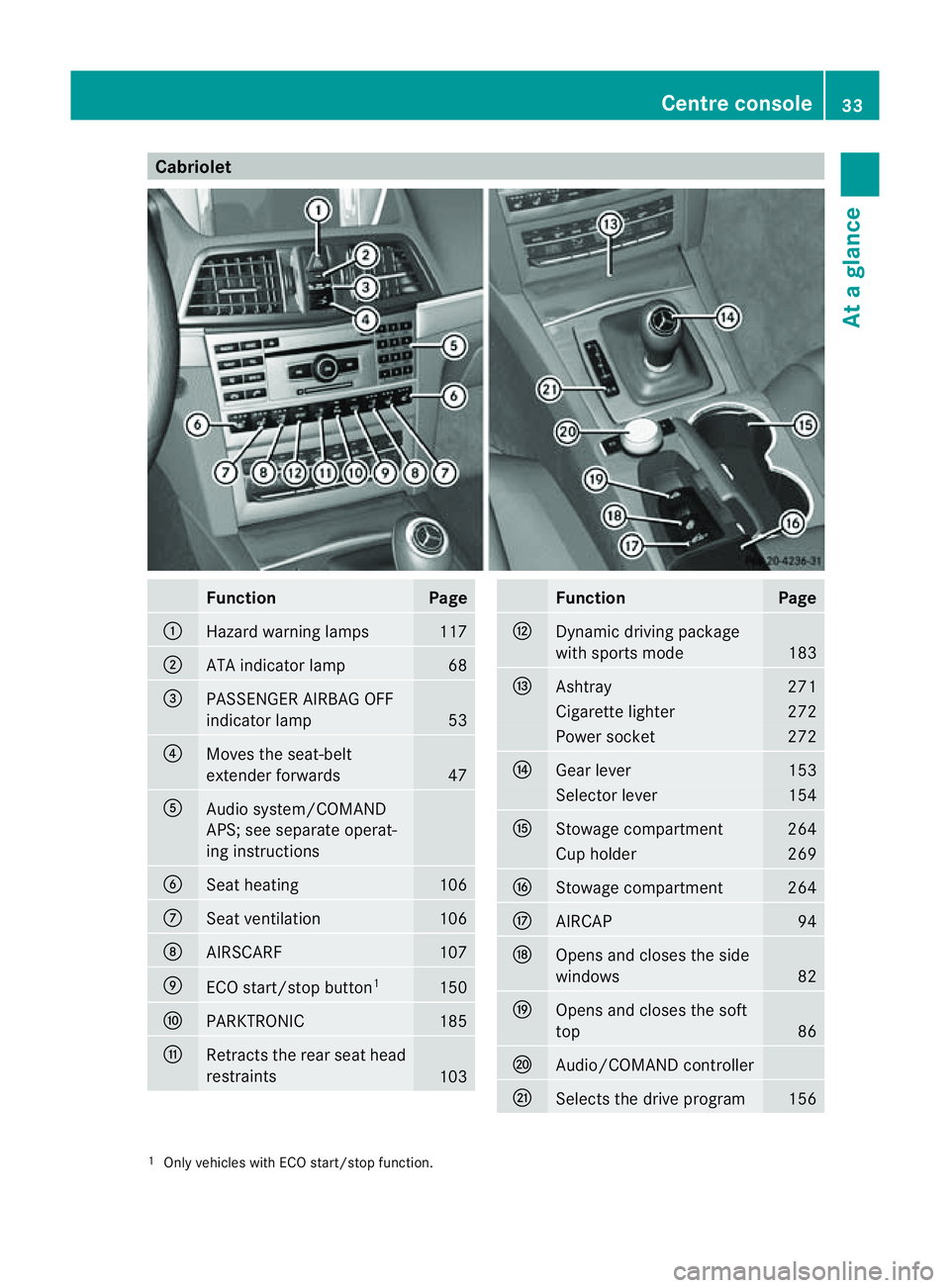
Cabriolet
Function Page
:
Hazard warning lamps 117
;
AT
Ai ndicator lamp 68
=
PASSENGER AIRBA
GOFF
indicator lamp 53
?
Moves th
eseat-belt
extender forwards 47
A
Audi
osystem/COMAND
APS; see separate operat-
ing instructions B
Seat heating 106
C
Seat ventilation 106
D
AIRSCARF 107
E
ECO start/sto
pbutton 1 150
F
PARKTRONIC 185
G
Retracts th
erear seat head
restraints 103 Function Page
H
Dynamic driving package
wit
hsports mode 183
I
Ashtray 271
Cigarett
elighter 272
Power socket 272
J
Gear lever 153
Selector lever 154
K
Stowage compartment 264
Cup holder 269
L
Stowage compartment 264
M
AIRCAP 94
N
Open
sand closes th eside
windows 82
O
Open
sand closes th esoft
top 86
P
Audio/COMAND controller
Q
Select
sthe driv eprogram 156
1
Only vehicle swithE CO start/sto pfunction. Centre console
33Atag lance
Page 37 of 353
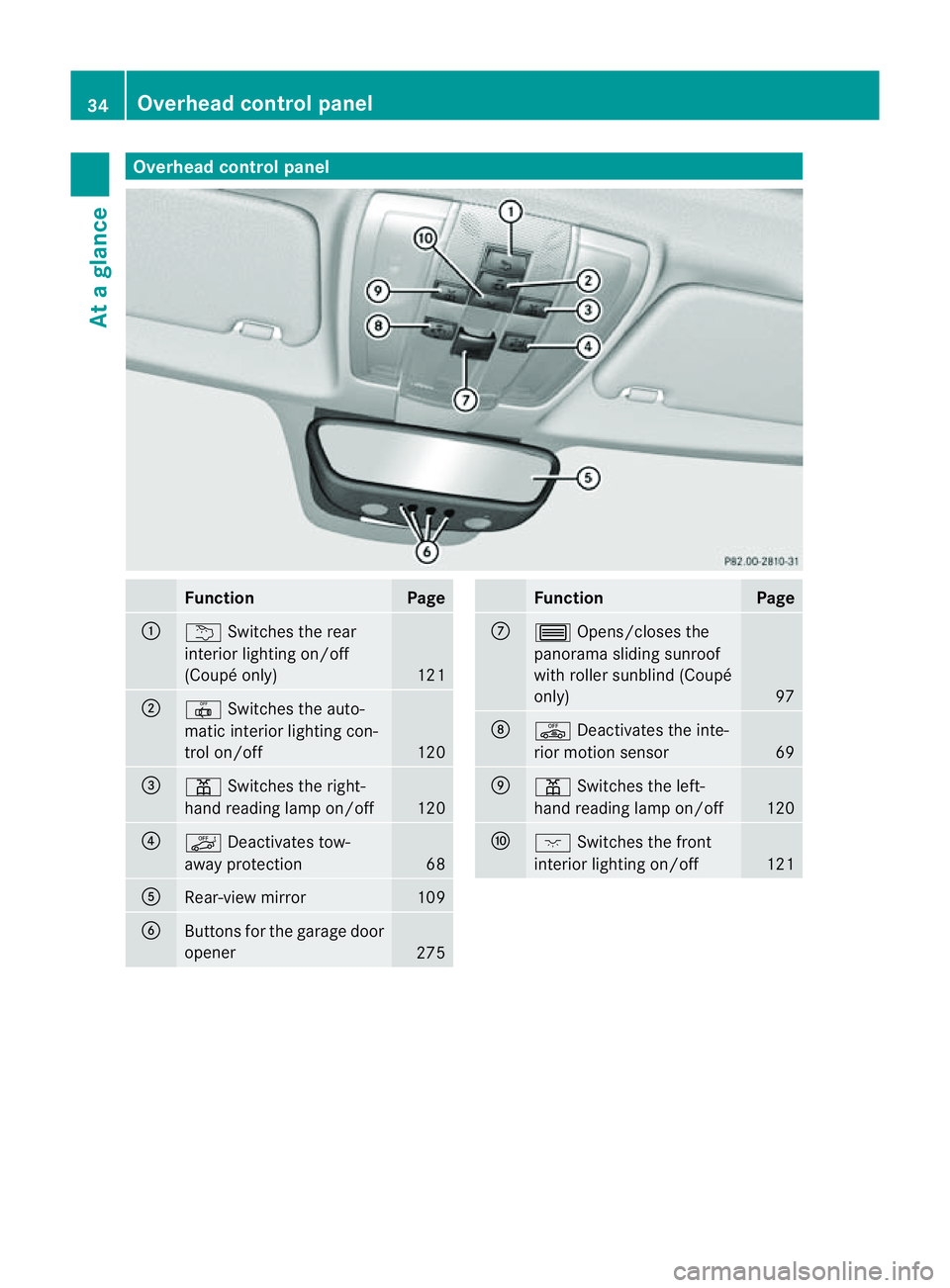
Overhea
dcontrol panel Function Page
:
u
Switche sthe rear
interio rlighting on/off
(Coupé only) 121
;
|
Switches the auto-
matic interior lighting con-
trol on/off 120
=
p
Switches the right-
hand readin glamp on/off 120
?
ë
Deactivates tow-
away protection 68
A
Rear-view mirror 109
B
Button
sfor the garage door
opener 275 Function Page
C
3
Opens/closes the
panorama slidin gsunroof
with roller sunblin d(Coupé
only) 97
D
ê
Deactivates the inte-
rior motion sensor 69
E
p
Switches the left-
hand readin glamp on/off 120
F
c
Switches the front
interior lighting on/off 12134
Overhead control panelAt
ag lance
Page 42 of 353
G
WARNING
Modifications to or work performe dincor-
rectly on the following parts can result in the
restraint systems not functioning as intended:
R the restraint system, consisting of seat
belts and their anchorage points, beltt en-
sioners, belt forc elimiters and airbags
R the wiring
R networked electronic systems
Airbags and belt tensioners could fail to
deploy or be triggered in an acciden tdespite
the deceleration forc ebeing sufficien ttotrig-
ger the systems, or could be triggered unin-
tentionally. For this reason, never make any
modifications to the restraint systems.
Therefore, you must not tamper with elec-
tronic components or their software. SRS (Supplemental Restraint System)
Introduction SRS consist
sof:
R the 6 SRS warning lamp
R airbags
R airbag control unit (with crash sensors)
R belt tensioners
R belt force limiters
SRS reduces the risk of occupant scoming
into contact with the vehicle's interior in the
event of an accident .Itcan also reduce the
effect of the forces to which occupant sare
subjected during an accident.
SRS warning lamp SRS functions are checked regularly when
you switch on the ignition and when the
engine is running. Therefore, malfunctions
can be detected in good time.
The 6 SRS warning lamp in the instrument
cluster lights up when the ignition is switched
on. It goes out no later than afew seconds
after the engine is started. G
WARNING
If SRS is malfunctioning, individual systems
may be activated unintentionally or may not
be triggered in the event of an accident with
ah igh rate of vehicle deceleration.
Am alfunction has occurred if:
R the 6 SRS warning lamp does not light
up when the ignition is switched on.
R the engine is runnin gand the 6SRS
warning lamp does not go out after afew
seconds.
R the engine is runnin gand the 6SRS
warning lamp lights up again.
In this case, have SRS checked immediately
at aq ualified specialist workshop. Mercedes-
Benz recommends that you use aMercedes-
Benz Service Centre for this purpose.
In particular, work relevant to safety or on
safety-related systems must be carried out at
aq ualified specialist workshop.
Triggering of belt tensioners, belt force
limiters and airbags During the first stage of
acollision, the airbag
control unit evaluates important physical
data relating to vehicle deceleration or accel-
eration, such as:
R duration
R direction
R magnitude
Based on the evaluation of this data, the air-
bag control unit pre-emptively triggers the
belt tensioners in the first stage.
i The belt tensioners can only be triggered
if the seat belt tongues are correctly
engaged in the seat belt buckles.
If there is an even higher rate of vehicle decel-
eration or acceleration in alongitudinal direc-
tion, the front airbags are also deployed.
Your vehicle has adaptive, two-stage front air-
bags. The airbag control unit evaluates vehi-
cle deceleration or acceleration in the event
of ac ollision. In the first deployment stage, Occupant safety
39Safety Z
Page 43 of 353
the front airba
gisfilledwith enoug hpropel-
lant ga storeducethe risk of injuries .The
front airbag is fully deployed if asecond
deployment threshold is exceeded within a
few milliseconds.
The belt tensioner and airbag triggering
thresholds are variable and are adapted to the
rate of deceleration or acceleration of the
vehicle. This process is pre-emptive in nature.
The triggering process must take place in
good time at the start of the collision.
i Airbags are not deployed in all types of
accidents. Also, not all airbags are
deployed together in an accident. The dif-
ferent airbag systems work independently
of each other.
How the airbag system works is deter-
mined by the severity of the collision detec-
ted, especiallyt he vehicle deceleration or
acceleration, and the apparent type of acci-
dent:
R head-on collision
R side impact
R rear impact
R Cabriolet: overturn
The rate of vehicle deceleration or accelera-
tion and the direction of the force are essen-
tially determined by:
R the distribution of forces during the colli-
sion
R the collision angle
R the deformation characteristics of the vehi-
cle
R the characteristics of the object with which
the vehicle has collided
Factors which can only be seen and measured
after acollision has occurred do not play a
decisive role in the deployment of an airbag,
nor do they provide an indication of airbag
deployment.
The vehicle may be deformed significantly,
e.g. the bonnet or the wing, without an airbag
being deployed. This is the case if only parts
which are relatively easily deformed are affec- ted and the rate of deceleration is not high.
Conversely, airbags may be deployed even
though the vehicle suffers only minor defor-
mation. This is the case if, for example, very
rigid vehicle parts such as longitudinal body
members are hit, and sufficient deceleration
occurs as
aresult. Airbags
Important safety notes Airbag deployment slows down and restricts
the movement of the vehicle occupant.
If the airbags are deployed, you will hear a
bang and asmall amount of powder may also
be released. Only in rare cases will the bang
affect your hearing. The powder that is
released generally does not constitute a
health hazard. The 6SRS warning lamp
lights up.
The airbag installation locations are identified
by the AIRBAG symbol. G
WARNING
Airbags provide additional protection; they
are not, however, asubstitute for seat belts.
Observe the following notes to reduce the risk
of serious or even fatal injury caused by airbag
deployment:
R All vehicle occupants –inparticular ,preg-
nan twome n–m ust wear their seat belt
correctly at all times and lean back against
th eb ackrest, whic hshoul dbep ositioned
as close to th evertical as possible. The
head restraint must support th eback of the
head at about eye level.
R Always secure childre nless than 1.50mt all
and unde r12years of age in suitable child
restraint systems.
R All vehicle occupant smust select aseat
position that is as far away from the airbag
as possible. The driver's seat position must
allow the vehicle to be driven safely. The
driver's chest should be as far away from 40
Occupant safetySafety
Page 48 of 353
When the roll bars are extended, the rear
head restraints also extend automatically.
Oncet he roll bars are extended, you can no
longer lower the rear head restraints. The soft
top can no longer be operated. In this case,
visit the nearest qualified specialist work-
shop. G
WARNING
If the roll bar is malfunctioning, the A
Malfunction Consult workshop message
appears in the multifunction display. The roll
bars will then not be extended in the event of
an accident .This could result in severe or
even fatal injuries to you and other occupants.
In this case, visit aqualified specialist work-
shop immediately and have the roll bar
checked. PRE-SAFE
®
(preventative occupant
protection)
PRE-SAFE ®
takes pre-emptive measures to
protect occupants in certain hazardous sit-
uations.
PRE-SAFE ®
intervenes:
R in emergency braking situations, e.g. if BAS
is activated or for vehicles with DISTRONIC
PLUS, BAS PLUS intervenes powerfully
R if the radar sensor system detects an immi-
nent danger of collision in certain situa-
tions (on vehicles with DISTRONIC PLUS)
R in critical driving situations, e.g. when phys-
ical limits are exceed and the vehicle under-
steers or oversteers severely
PRE-SAFE ®
takes the following measures
depending on the hazardous situation detec-
ted:
R the front seat belts are pre-tensioned.
R vehicles with the memory function: it
adjusts the front-passenger seat if it is in
an unfavourable position. R
vehicles with amulticontour seat: the air
pressure in the seat side cushions and in
the backrest side bolsters is increased.
R if the vehicle skids, the front side windows
and, on the Coupé,t he panorama sliding
sunroof, are closed so that only asmall gap
remains.
If the hazardous situation passes without
resulting in an accident, PRE-SAFE ®
slackens
the belt pretensioning. The air pressure in the
side bolsters on the multicontour seat is
reduced again. All settings made by PRE-
SAFE ®
can then be reversed.
If the seat belts are not released:
X Move the backrest or seat back slightly, but
only when the vehicle is stationary.
The belt pretensionin gisreduced and the
locking mechanism is released. G
WARNING
When adjusting the seat, make sure that
nobody can become trapped.
! Make sure that there are no objectsint he
footwell or behind the seats when moving
the seat back. There is arisk that the seats
and/or the objectsc ould be damaged.
More information about seat-belt adjust-
ment, aconvenience function integrated into
PRE-SAFE ®
,c an be found in the "Seat-belt
adjustment" section (Y page 49). NECK-PRO head restraints
The NECK-PRO head restraints increase pro-
tection to the driver's and front passenger's
head and neck.Tot his end, the NECK-PRO
head restraints on the driver's and front-
passenger seats are moved forwards and
upwards in the event of arear-end collision of
ac ertain severity. This provides better head
support. Occupant safety
45Safety Z
Page 50 of 353
wearin
gbulky clothing, e.g .awinter coat.
The shoulde rbelt section must be routed
across the centre of your shoulder –onno
account across your neck or under your
arm –and pulled tight against your upper
body .The lap belt must always pass across
your lap as low down as possible, i.e. over
your hip joints–n ot across your abdomen.
If necessary, push down the belt strap
slightly and then retighten it in the roll-up
direction.
R Do not route the belt strap across sharp
edges or fragile objects, especially if these
are located on or in your clothing, e.g. spec-
tacles, pens, keys, etc. The seat belt strap
could be damaged and tear in an accident,
and you or other vehicle occupant scould
be injured.
R Only one person should use each seat belt
at any one time. Children must never travel
sittin gont he lap of other occupants. It
would not be possible to restrain the child
in the event of asudden change in direc-
tion, braking or an accident .This could
result in severe or even fatal injuries to the
child and other occupants.
R Persons less than 1.50 mtall cannot wear
the seat belts correctly. For this reason,
secure persons less than 1.50 mtall in spe-
cially designed ,suitable restraint systems.
R Children less than 1.50 mtall or unde r12
years of age canno twear the seat belts
properly. Therefore, they should alway sbe
secured in asuitable child restraint system
on asuitable vehicle seat. You can find
more information under "Children in the
vehicle" in the "Safety" section of the Own-
er's Manual. Follow the manufacturer's
installation instructions when fitting achild
restraint system.
R Do not secure any objects with aseat belt
if the seat belt is also being used by one of
the vehicle's occupants. G
WARNING
The seat belt does not offer the intended level
of protection unless the backrest is almost
vertical. Under certain circumstances, this
could cause severe or even fatal injuries in the
event of an accident.
Befor estarting ajourney, make sure that the
seat is properly adjusted and that the back-
rest is almost vertical. G
WARNING
Ad irtyord amaged seat belt or aseat belt that
has been subjected to aload in an accident
or which has been modified no longer offers
the intended level of protection. Under certain
circumstances, this could cause sever eor
even fatal injuries in the even tofanaccident.
For this reason, check regularly that the seat
belts are not damaged or dirty.
Alway shaved am aged sea tbelts or seat belts
that have been subjected to aload in an acci-
dent replaced at aqualified specialist work-
shop. Consult aqualified specialist workshop
which has the necessary specialist knowledge
and tools to carry out the work required.
Mercedes-Benz recommends that you use a
Mercedes-Benz Service Centr efor this pur-
pose.
For safety reasons, Mercedes-Benz recom-
mends that you only use seat belts which have
been approved by Mercedes-Benz for your
vehicle.
Fastening seat belts The seat-belt extender for the driver and front
passenger helps you fasten your seat belt. Occupant safety
47Safety Z