light MERCEDES-BENZ E-Class COUPE 2012 C207 User Guide
[x] Cancel search | Manufacturer: MERCEDES-BENZ, Model Year: 2012, Model line: E-Class COUPE, Model: MERCEDES-BENZ E-Class COUPE 2012 C207Pages: 352, PDF Size: 14.48 MB
Page 28 of 352
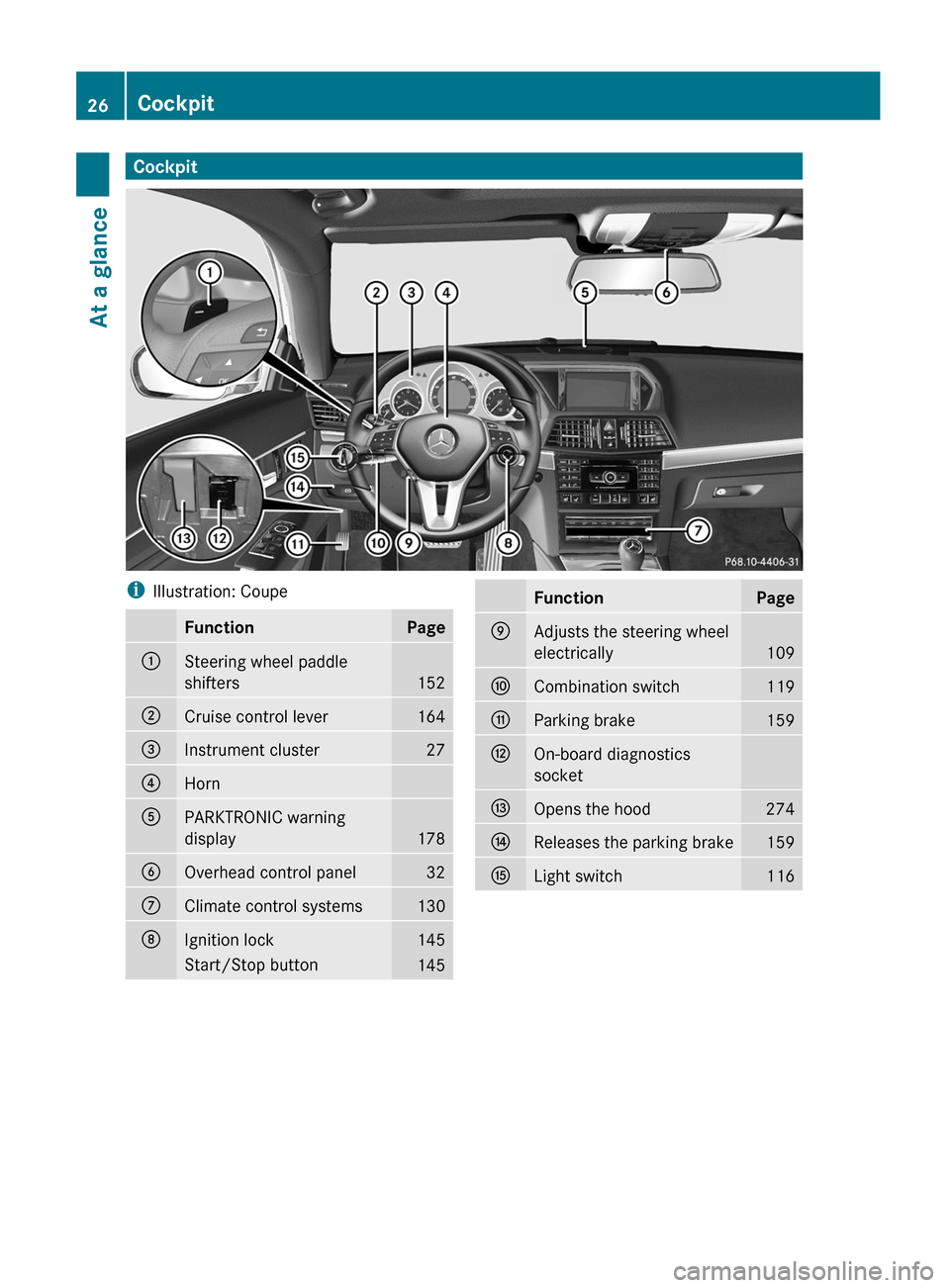
CockpitiIllustration: CoupeFunctionPage:Steering wheel paddle
shifters
152
;Cruise control lever164=Instrument cluster27?HornAPARKTRONIC warning
display
178
BOverhead control panel32CClimate control systems130DIgnition lock145Start/Stop button145FunctionPageEAdjusts the steering wheel
electrically
109
FCombination switch119GParking brake159HOn-board diagnostics
socketIOpens the hood274JReleases the parking brake159KLight switch11626CockpitAt a glance
Page 29 of 352
Instrument cluster
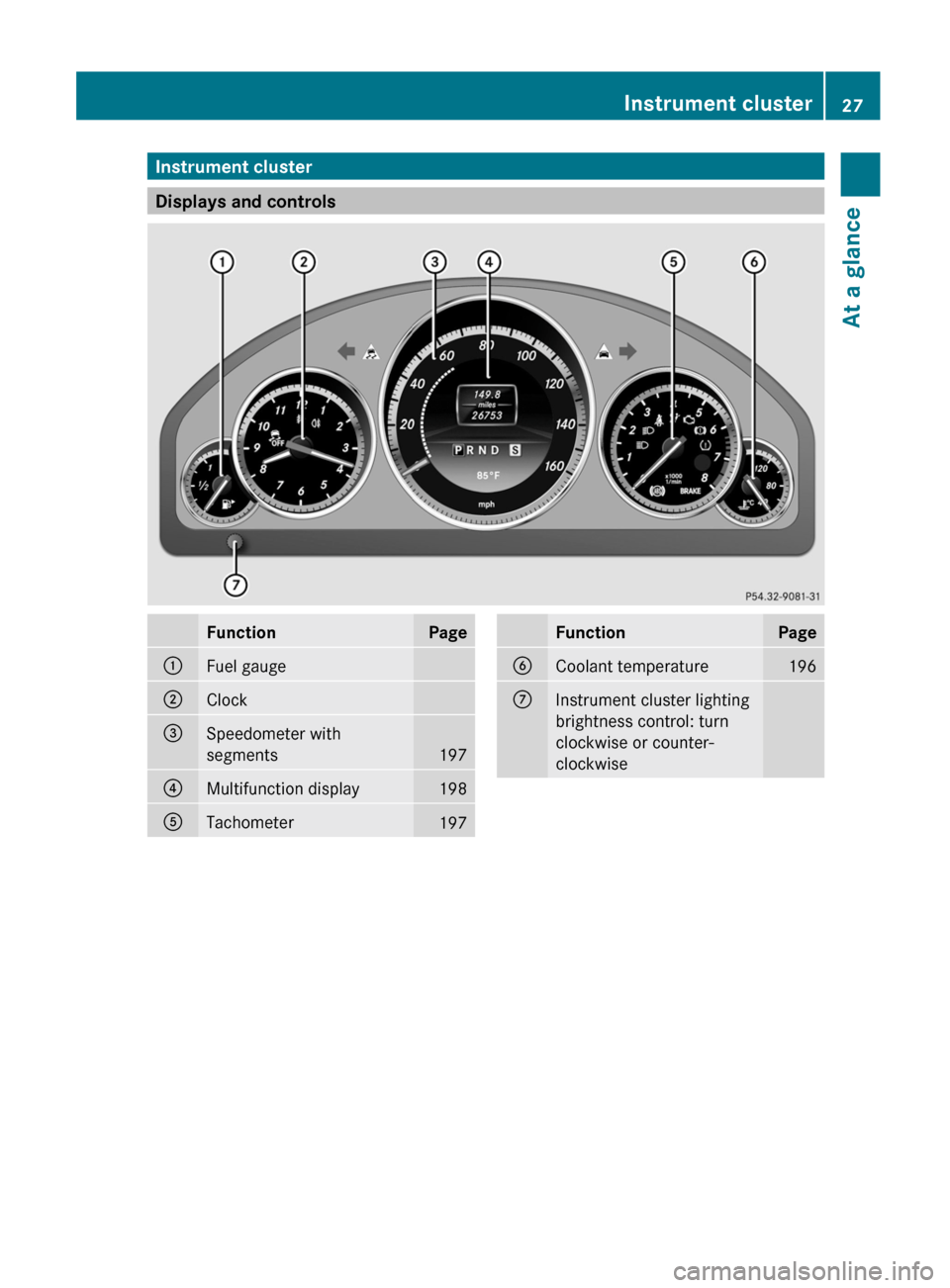
Displays and controls
FunctionPage:Fuel gauge;Clock=Speedometer with
segments
197
?Multifunction display198ATachometer197FunctionPageBCoolant temperature196CInstrument cluster lighting
brightness control: turn
clockwise or counter-
clockwiseInstrument cluster27At a glance
Page 32 of 352
Center console
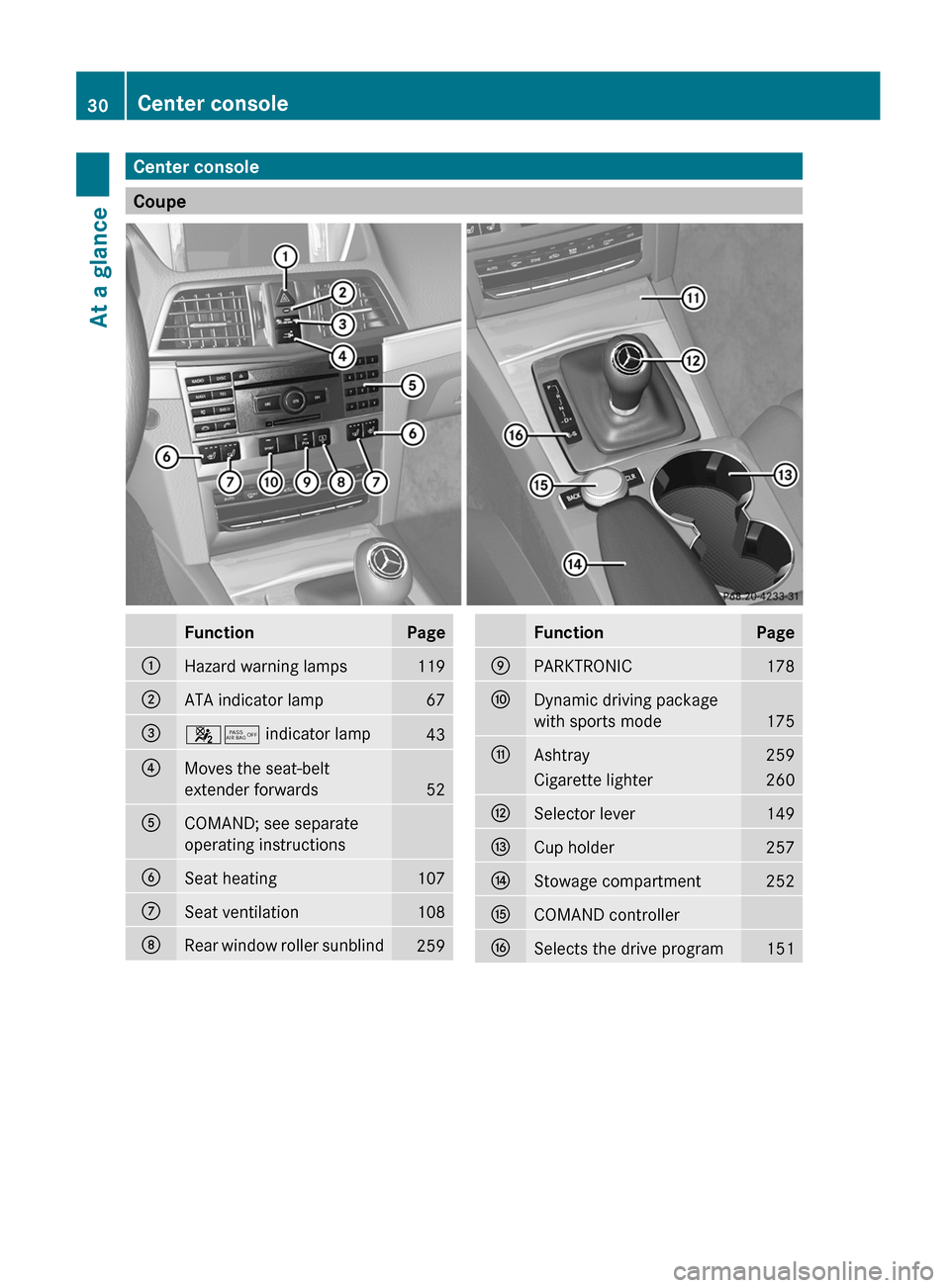
Coupe
FunctionPage:Hazard warning lamps119;ATA indicator lamp67=45 indicator lamp43?Moves the seat-belt
extender forwards
52
ACOMAND; see separate
operating instructionsBSeat heating107CSeat ventilation108DRear window roller sunblind259FunctionPageEPARKTRONIC178FDynamic driving package
with sports mode
175
GAshtray259Cigarette lighter260HSelector lever149ICup holder257JStowage compartment252KCOMAND controllerLSelects the drive program15130Center consoleAt a glance
Page 33 of 352
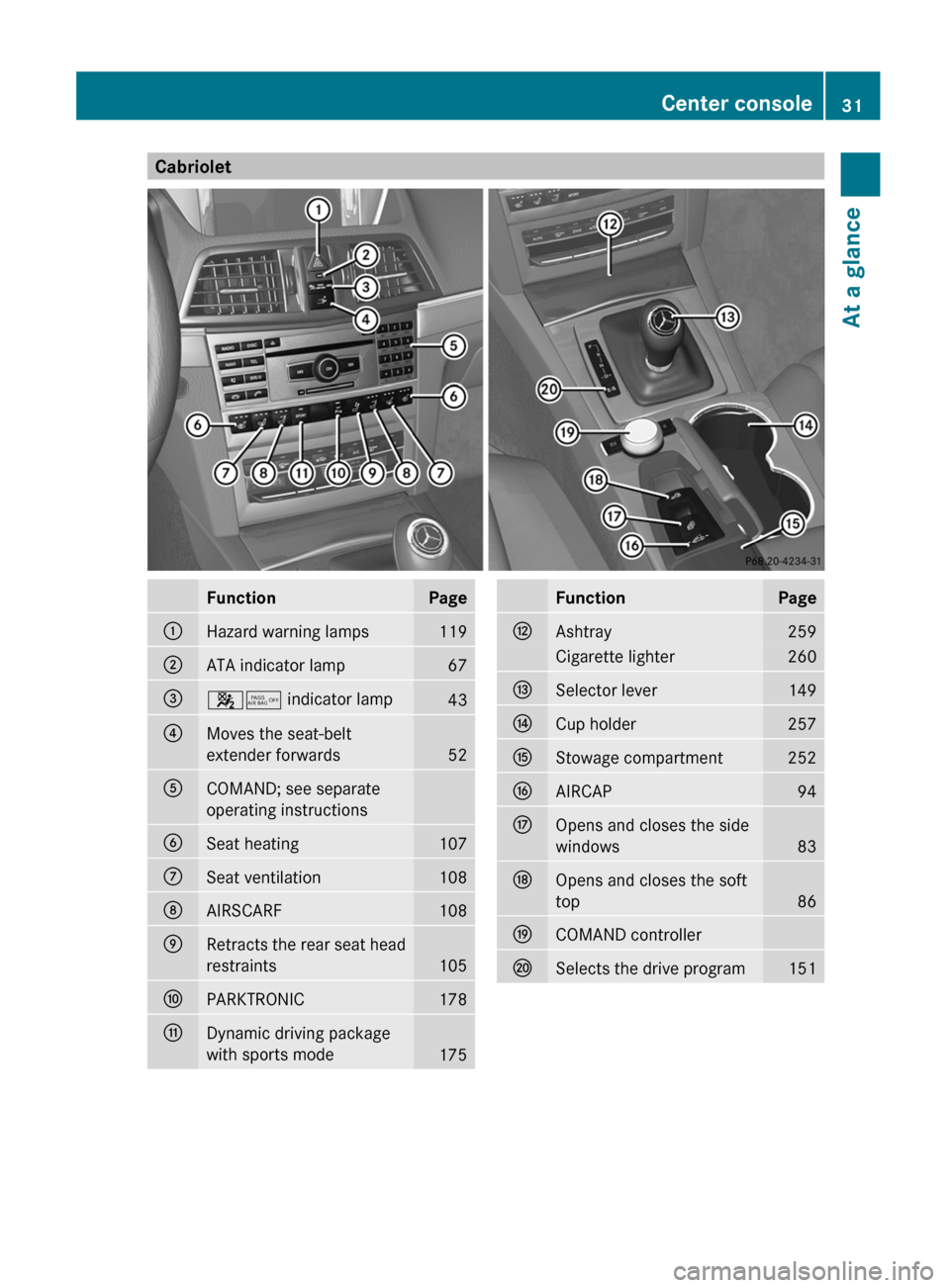
CabrioletFunctionPage:Hazard warning lamps119;ATA indicator lamp67=45 indicator lamp43?Moves the seat-belt
extender forwards
52
ACOMAND; see separate
operating instructionsBSeat heating107CSeat ventilation108DAIRSCARF108ERetracts the rear seat head
restraints
105
FPARKTRONIC178GDynamic driving package
with sports mode
175
FunctionPageHAshtray259Cigarette lighter260ISelector lever149JCup holder257KStowage compartment252LAIRCAP94MOpens and closes the side
windows
83
NOpens and closes the soft
top
86
OCOMAND controllerPSelects the drive program151Center console31At a glance
Page 34 of 352
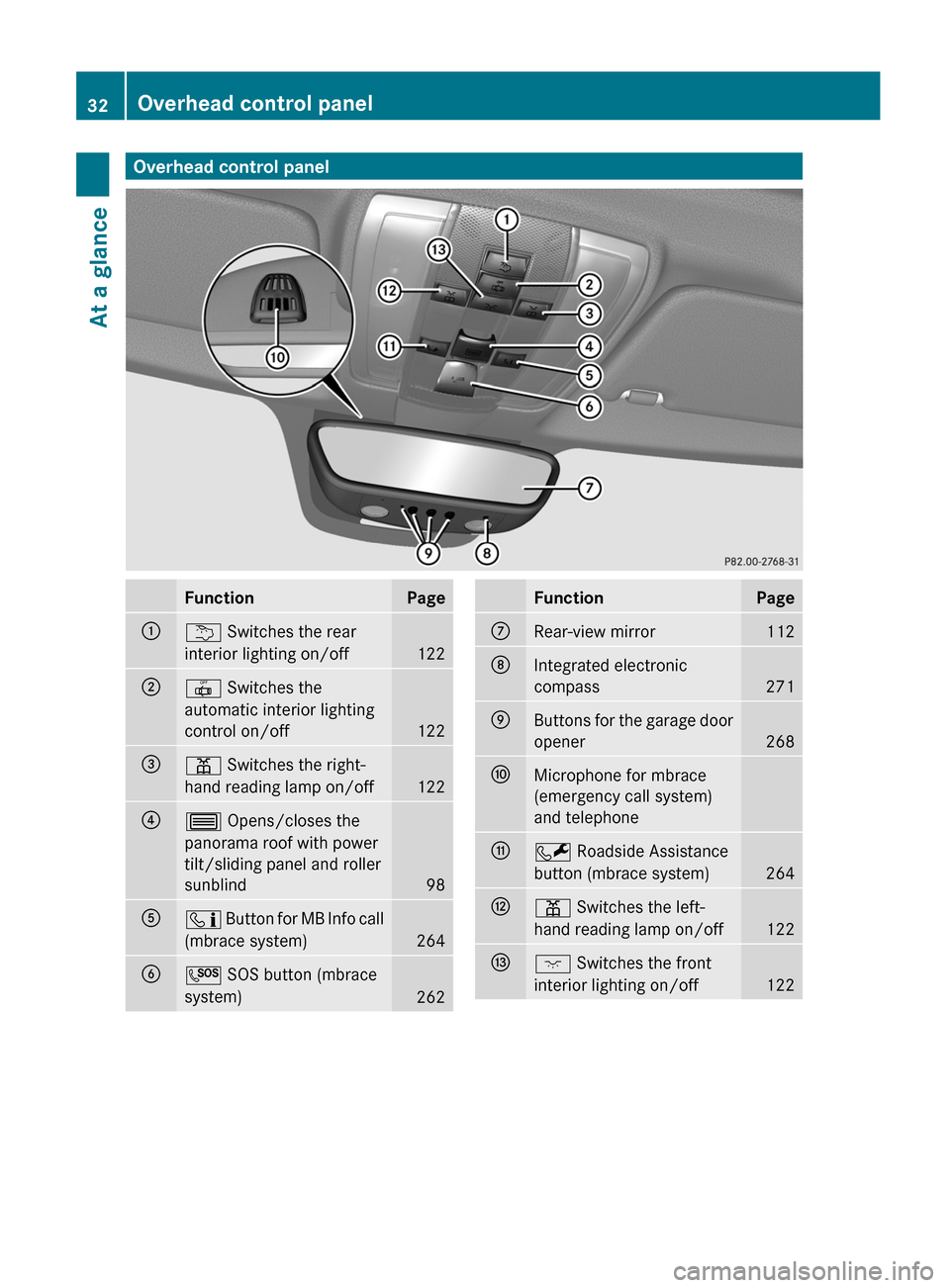
Overhead control panelFunctionPage:u Switches the rear
interior lighting on/off
122
;| Switches the
automatic interior lighting
control on/off
122
=p Switches the right-
hand reading lamp on/off
122
?3 Opens/closes the
panorama roof with power
tilt/sliding panel and roller
sunblind
98
Aï Button for MB Info call
(mbrace system)
264
BG SOS button (mbrace
system)
262
FunctionPageCRear-view mirror112DIntegrated electronic
compass
271
EButtons for the garage door
opener
268
FMicrophone for mbrace
(emergency call system)
and telephoneGF Roadside Assistance
button (mbrace system)
264
Hp Switches the left-
hand reading lamp on/off
122
Ic Switches the front
interior lighting on/off
122
32Overhead control panelAt a glance
Page 38 of 352
Useful information
i This Operator's Manual describes all
models and all standard and optional
equipment of your vehicle available at the
time of publication of the Operator's
Manual. Country-specific differences are
possible. Please note that your vehicle may
not be equipped with all features
described. This also applies to safety-
related systems and functions.
i Please read the information on qualified
specialist workshops ( Y page 23).
Occupant safety
Overview of occupant safety
In this section, you will learn the most
important facts about the restraint system
components of the vehicle.
The restraint system consists of:
R seat belts
R child restraint systems
R LATCH-type (ISOFIX) child seat anchors
Additional protection is provided by:
R SRS (Supplemental Restraint System)
R NECK-PRO head restraints
R PRE-SAFE ®
R Cabriolet: roll bar
R Air bag system components with:
- PASSENGER AIR BAG OFF indicator lamp
- front-passenger seat with Occupant
Classification System (OCS)
The different air bag systems work
independently of each other. The protective
functions of the system work in conjunction
with each other. Not all air bags are deployed
in an accident.
GWARNING
Modifications to or work improperly
conducted on restraint system components
or their wiring, as well as tampering with
interconnected electronic systems, can lead
to the restraint systems no longer functioning
as intended.
Air bags or Emergency Tensioning Devices
(ETDs), for example, could deploy
inadvertently or fail to deploy in accidents
although the deceleration threshold for air
bag deployment is exceeded. Therefore,
never modify the restraint systems. Do not
tamper with electronic components or their
software.
i See "Children in the vehicle"
( Y page 55) for more information on
infants and children traveling with you in
the vehicle and restraints for infants and
children.
SRS (Supplemental Restraint System)
Introduction
SRS consists of:
R the 6 SRS warning lamp
R air bags
R air bag control unit (with crash sensors)
R Emergency Tensioning Devices
R belt force limiters
SRS reduces the risk of occupants coming
into contact with the vehicle's interior in the
event of an accident. It can also reduce the
effect of the forces to which occupants are
subjected during an accident.
SRS warning lamp
SRS functions are checked regularly when
you switch on the ignition and when the
engine is running. Therefore, malfunctions
can be detected in good time.
The 6 SRS warning lamp in the instrument
cluster lights up when the ignition is switched
on. It goes out no later than a few seconds
after the engine is started.
36Occupant safetySafety
Page 42 of 352
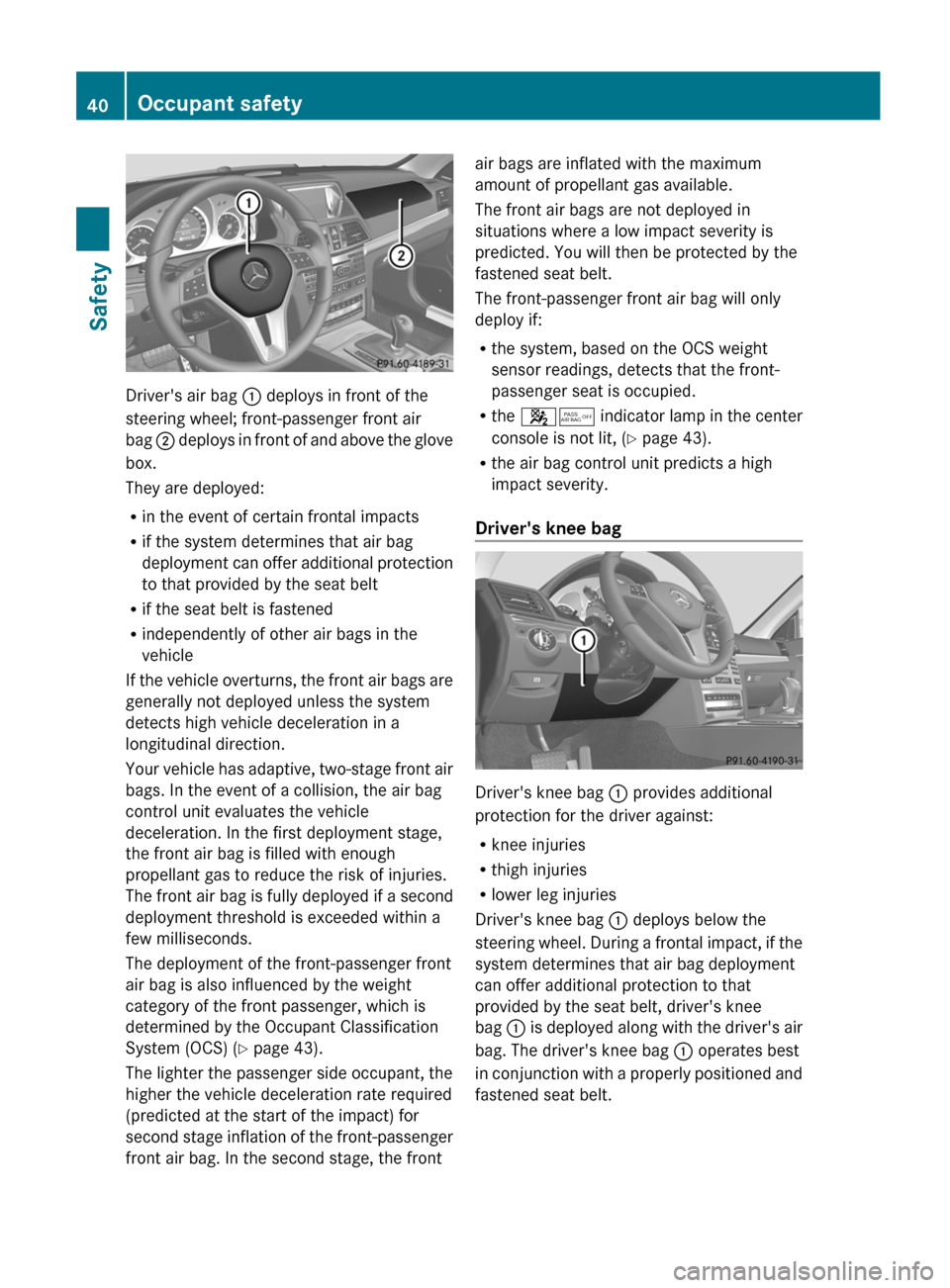
Driver's air bag : deploys in front of the
steering wheel; front-passenger front air
bag ; deploys in front of and above the glove
box.
They are deployed:
R in the event of certain frontal impacts
R if the system determines that air bag
deployment can offer additional protection
to that provided by the seat belt
R if the seat belt is fastened
R independently of other air bags in the
vehicle
If the vehicle overturns, the front air bags are
generally not deployed unless the system
detects high vehicle deceleration in a
longitudinal direction.
Your vehicle has adaptive, two-stage front air
bags. In the event of a collision, the air bag
control unit evaluates the vehicle
deceleration. In the first deployment stage,
the front air bag is filled with enough
propellant gas to reduce the risk of injuries.
The front air bag is fully deployed if a second
deployment threshold is exceeded within a
few milliseconds.
The deployment of the front-passenger front
air bag is also influenced by the weight
category of the front passenger, which is
determined by the Occupant Classification
System (OCS) ( Y page 43).
The lighter the passenger side occupant, the
higher the vehicle deceleration rate required
(predicted at the start of the impact) for
second stage inflation of the front-passenger
front air bag. In the second stage, the front
air bags are inflated with the maximum
amount of propellant gas available.
The front air bags are not deployed in
situations where a low impact severity is
predicted. You will then be protected by the
fastened seat belt.
The front-passenger front air bag will only
deploy if:
R the system, based on the OCS weight
sensor readings, detects that the front-
passenger seat is occupied.
R the 45 indicator lamp in the center
console is not lit, ( Y page 43).
R the air bag control unit predicts a high
impact severity.
Driver's knee bag
Driver's knee bag : provides additional
protection for the driver against:
R knee injuries
R thigh injuries
R lower leg injuries
Driver's knee bag : deploys below the
steering wheel. During a frontal impact, if the
system determines that air bag deployment
can offer additional protection to that
provided by the seat belt, driver's knee
bag : is deployed along with the driver's air
bag. The driver's knee bag : operates best
in conjunction with a properly positioned and
fastened seat belt.
40Occupant safetySafety
Page 48 of 352
If the SmartKey has been removed from the
ignition lock or is in position 0, indicator lamp
45 : does not light up.GWARNING
If the red 6 SRS warning lamp in the
instrument cluster and the 45
indicator lamp light up simultaneously, the
OCS is malfunctioning. The front passenger
front air bag will be deactivated in this case.
Have the system checked by qualified
technicians as soon as possible. Contact an
authorized Mercedes-Benz Center.
Only have the seat repaired or replaced at an
authorized Mercedes-Benz Center.
In order to ensure proper operation of the air
bag system and OCS:
R Sit with the seat belt properly fastened in a
position that is as upright as possible with
your back against the seat backrest.
R When seated, a passenger should not
position him/herself in such a way as to
cause the passenger's weight to be lifted
from the seat cushion as this may result in
the OCS being unable to correctly
approximate the passenger's weight
category.
R Read and observe all warnings in this
chapter.
System self-test
The 45 indicator lamp illuminates
when you:
R turn the SmartKey to position 1 or 2 in the
ignition lock
R on vehicles with KEYLESS-GO, press the
Start/Stop button once or twice
If an adult occupant is properly sitting on the
passenger seat and the OCS classifies the
occupant as an adult, the 45 indicator
lamp illuminates and goes out again after
approximately 6 seconds.
If the seat is not occupied and the OCS
classifies the front passenger seat as being
unoccupied, the 45 indicator lamp
will illuminate and not go out.GWARNING
If the 4 5 indicator lamp does not
illuminate, the system is not functioning. You
must contact an authorized Mercedes-Benz
Center before seating any child on the front
passenger seat.
For more information, see "Problems with the
Occupant Classification System"
( Y page 47).
GWARNING
Never place anything between seat cushion
and child seat (e.g. a pillow), since it reduces
the effectiveness of the OCS. The underside
and rear side child restraint system must be
placed entirely on the seat cushion and the
backrest of the front-passenger seat
backrest.
If necessary, adjust the tilt of the passenger
seat backrest.
An incorrectly mounted child seat could cause
injuries to the child in case of an accident,
instead of increasing protection for the child.
Follow the manufacturer's instructions for
installation of child restraint systems.
46Occupant safetySafety
Page 50 of 352
Roll bar (Cabriolet)
The roll bars are under the rear head
restraints. They are extended if systems
detect that the vehicle is in danger of
overturning.GWARNING
Ensure that the area around the roll bars/rear
head restraints is kept clear. Otherwise,
someone could be injured by the roll bars
when they are triggered.
When the roll bars are extended, the rear
head restraints also extend automatically.
Once the roll bars are extended, you can no
longer lower the rear head restraints. The soft
top can no longer be operated. In this case,
visit the nearest qualified specialist
workshop.
GWARNING
If the roll bar is malfunctioning, the A
Malfunction Service Required message
appears in the multifunction display. The roll
bars will then not be extended in the event of
an accident. This could result in severe or
even fatal injuries to you and other occupants.
In this case, visit a qualified specialist
workshop immediately and have the roll bar
checked.
PRE-SAFE ®
(preventative occupant
protection)
GWARNING
The PRE-SAFE ®
system reduces the impact of
an accident on vehicle occupants, as long as
their seat belts have been fastened correctly.
Although your vehicle is equipped with a PRE-
SAFE ®
system, the possibility of injury in the
event of an accident cannot be ruled out. You
should therefore always drive carefully and
adapt your driving style to the prevailing road,
weather and traffic conditions.
PRE-SAFE ®
takes preemptive measures to
protect occupants in certain hazardous
situations.
PRE-SAFE ®
intervenes:
R in emergency braking situations, e.g. if BAS
is activated or, in vehicles with DISTRONIC
PLUS, BAS PLUS intervenes powerfully
R if the radar sensor system detects an
imminent danger of collision in certain
situations (on vehicles with DISTRONIC
PLUS)
R in critical driving situations, e.g. when
physical limits are exceed and the vehicle
understeers or oversteers severely
PRE-SAFE ®
takes the following measures
depending on the hazardous situation
detected:
R the front seat belts are pre-tensioned.
R it adjusts the front-passenger seat if it is in
an unfavorable position.
R the air pressure in the side bolsters of the
seat cushion and seat backrest of the front
multicontour seats is increased.
R Coupe: if the vehicle skids, the panorama
roof with power tilt/sliding panel and the
front side windows are closed so that only
a small gap remains.
R Cabriolet: if the vehicle skids, the front side
windows are closed so that only a small gap
remains.
If the hazardous situation passes without
resulting in an accident, PRE-SAFE ®
slackens
the belt pretensioning. The air pressure in the
side bolsters on the multicontour seat is
reduced again. All settings made by PRE-
SAFE ®
can then be reversed.
If the seat belts are not released:XMove the backrest or seat back slightly, but
only when the vehicle is stationary.
The belt pretensioning is reduced and the
locking mechanism is released.48Occupant safetySafety
Page 55 of 352
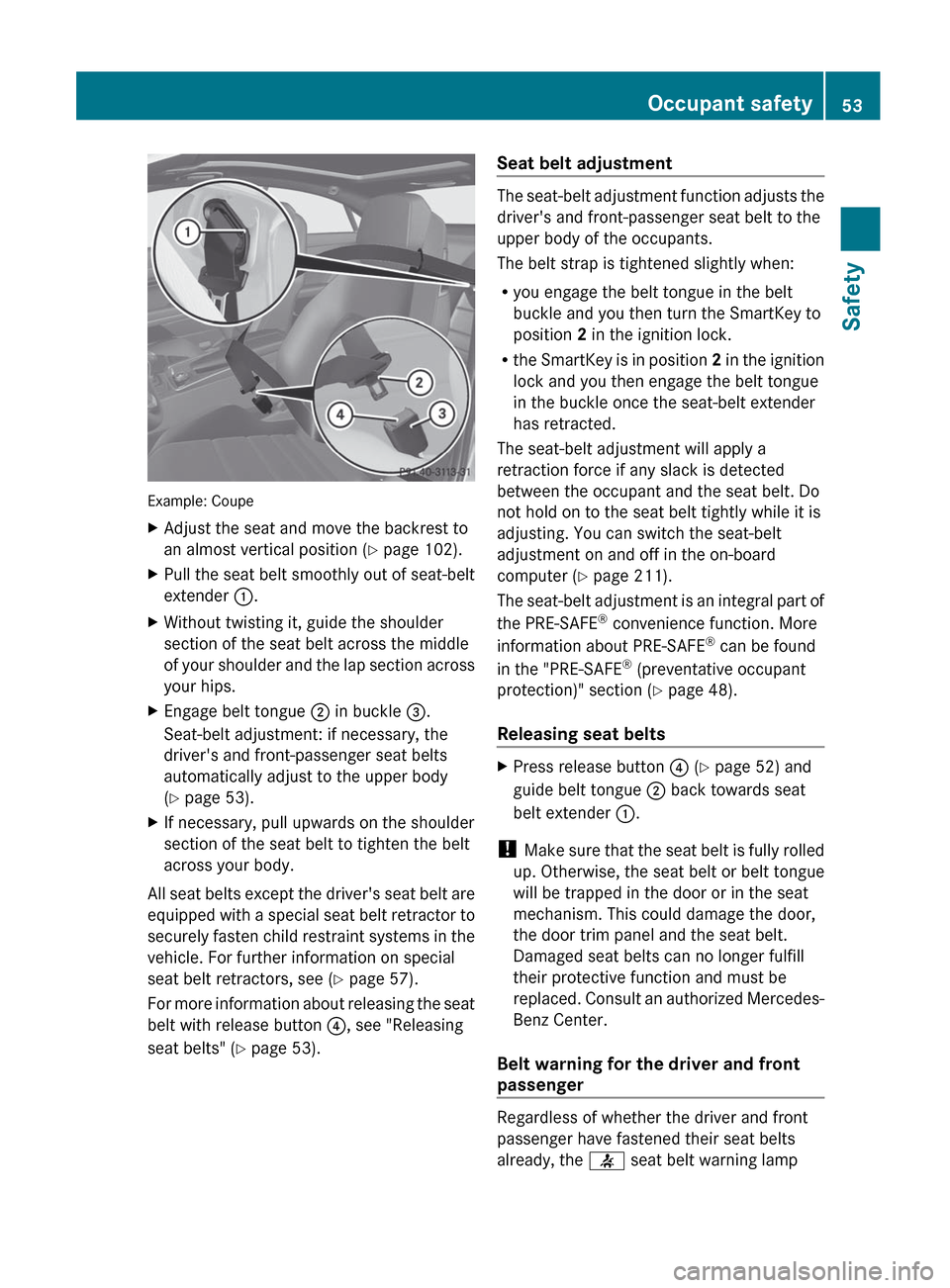
Example: Coupe
XAdjust the seat and move the backrest to
an almost vertical position ( Y page 102).XPull the seat belt smoothly out of seat-belt
extender :.XWithout twisting it, guide the shoulder
section of the seat belt across the middle
of your shoulder and the lap section across
your hips.XEngage belt tongue ; in buckle =.
Seat-belt adjustment: if necessary, the
driver's and front-passenger seat belts
automatically adjust to the upper body
( Y page 53).XIf necessary, pull upwards on the shoulder
section of the seat belt to tighten the belt
across your body.
All seat belts except the driver's seat belt are
equipped with a special seat belt retractor to
securely fasten child restraint systems in the
vehicle. For further information on special
seat belt retractors, see ( Y page 57).
For more information about releasing the seat
belt with release button ?, see "Releasing
seat belts" ( Y page 53).
Seat belt adjustment
The seat-belt adjustment function adjusts the
driver's and front-passenger seat belt to the
upper body of the occupants.
The belt strap is tightened slightly when:
R you engage the belt tongue in the belt
buckle and you then turn the SmartKey to
position 2 in the ignition lock.
R the SmartKey is in position 2 in the ignition
lock and you then engage the belt tongue
in the buckle once the seat-belt extender
has retracted.
The seat-belt adjustment will apply a
retraction force if any slack is detected
between the occupant and the seat belt. Do
not hold on to the seat belt tightly while it is
adjusting. You can switch the seat-belt
adjustment on and off in the on-board
computer ( Y page 211).
The seat-belt adjustment is an integral part of
the PRE-SAFE ®
convenience function. More
information about PRE-SAFE ®
can be found
in the "PRE-SAFE ®
(preventative occupant
protection)" section ( Y page 48).
Releasing seat belts
XPress release button ? (Y page 52) and
guide belt tongue ; back towards seat
belt extender :.
!
Make sure that the seat belt is fully rolled
up. Otherwise, the seat belt or belt tongue
will be trapped in the door or in the seat
mechanism. This could damage the door,
the door trim panel and the seat belt.
Damaged seat belts can no longer fulfill
their protective function and must be
replaced. Consult an authorized Mercedes-
Benz Center.
Belt warning for the driver and front
passenger
Regardless of whether the driver and front
passenger have fastened their seat belts
already, the 7 seat belt warning lamp
Occupant safety53SafetyZ