light MERCEDES-BENZ E-CLASS COUPE 2012 User Guide
[x] Cancel search | Manufacturer: MERCEDES-BENZ, Model Year: 2012, Model line: E-CLASS COUPE, Model: MERCEDES-BENZ E-CLASS COUPE 2012Pages: 389, PDF Size: 9.32 MB
Page 32 of 389
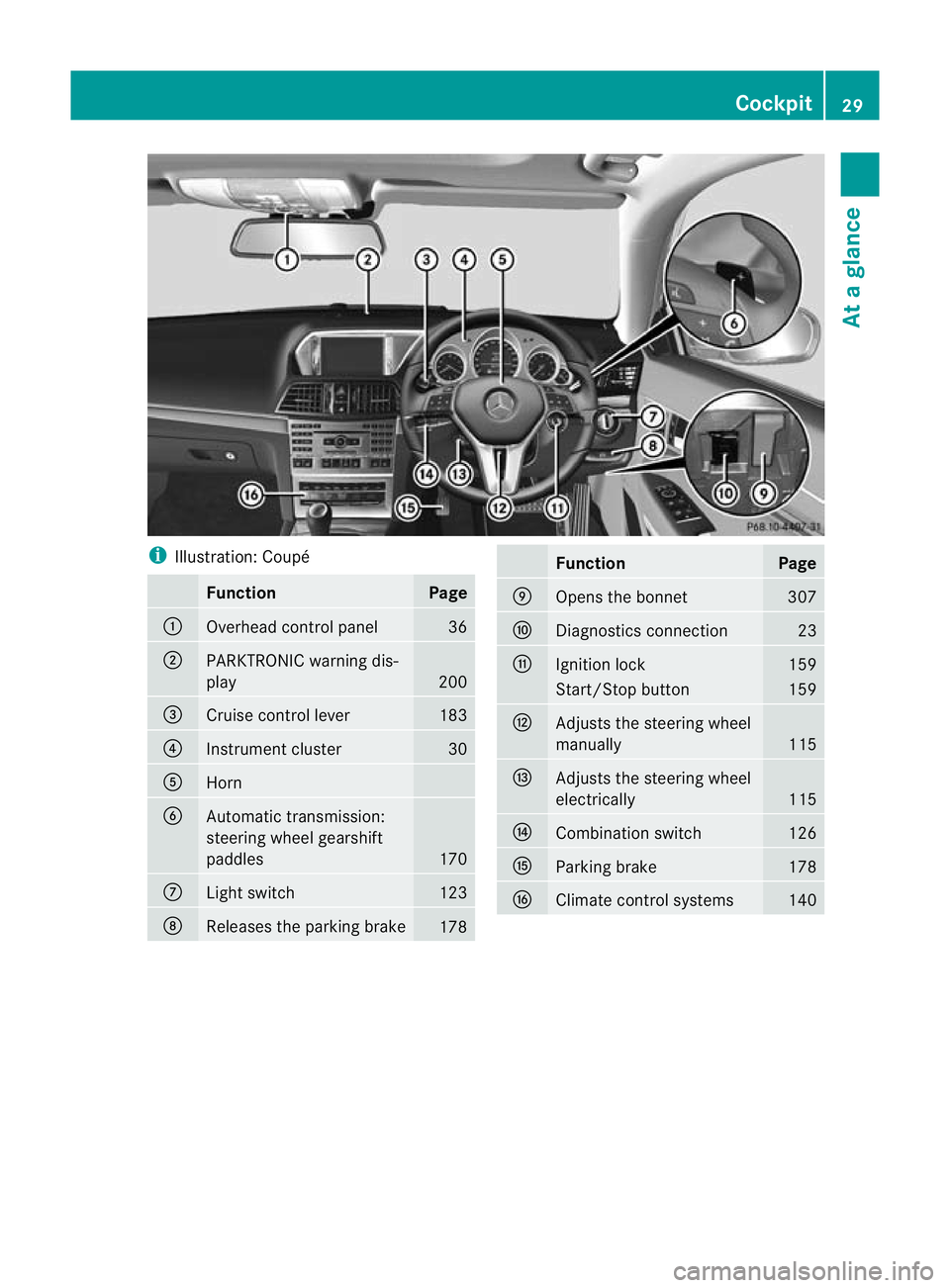
i
Illustration: Coupé Function Page
:
Overhead control panel 36
;
PARKTRONIC warning dis-
play
200
=
Cruise control lever 183
?
Instrument cluster 30
A
Horn
B
Automatic transmission:
steering wheel gearshift
paddles
170
C
Light switch 123
D
Releases the parking brake
178 Function Page
E
Opens the bonnet 307
F
Diagnostics connection 23
G
Ignition lock 159
Start/Stop button 159
H
Adjusts the steering wheel
manually
115
I
Adjusts the steering wheel
electrically
115
J
Combination switch 126
K
Parking brake 178
L
Climate control systems 140Cockpit
29At a glance
Page 33 of 389
Instrumen
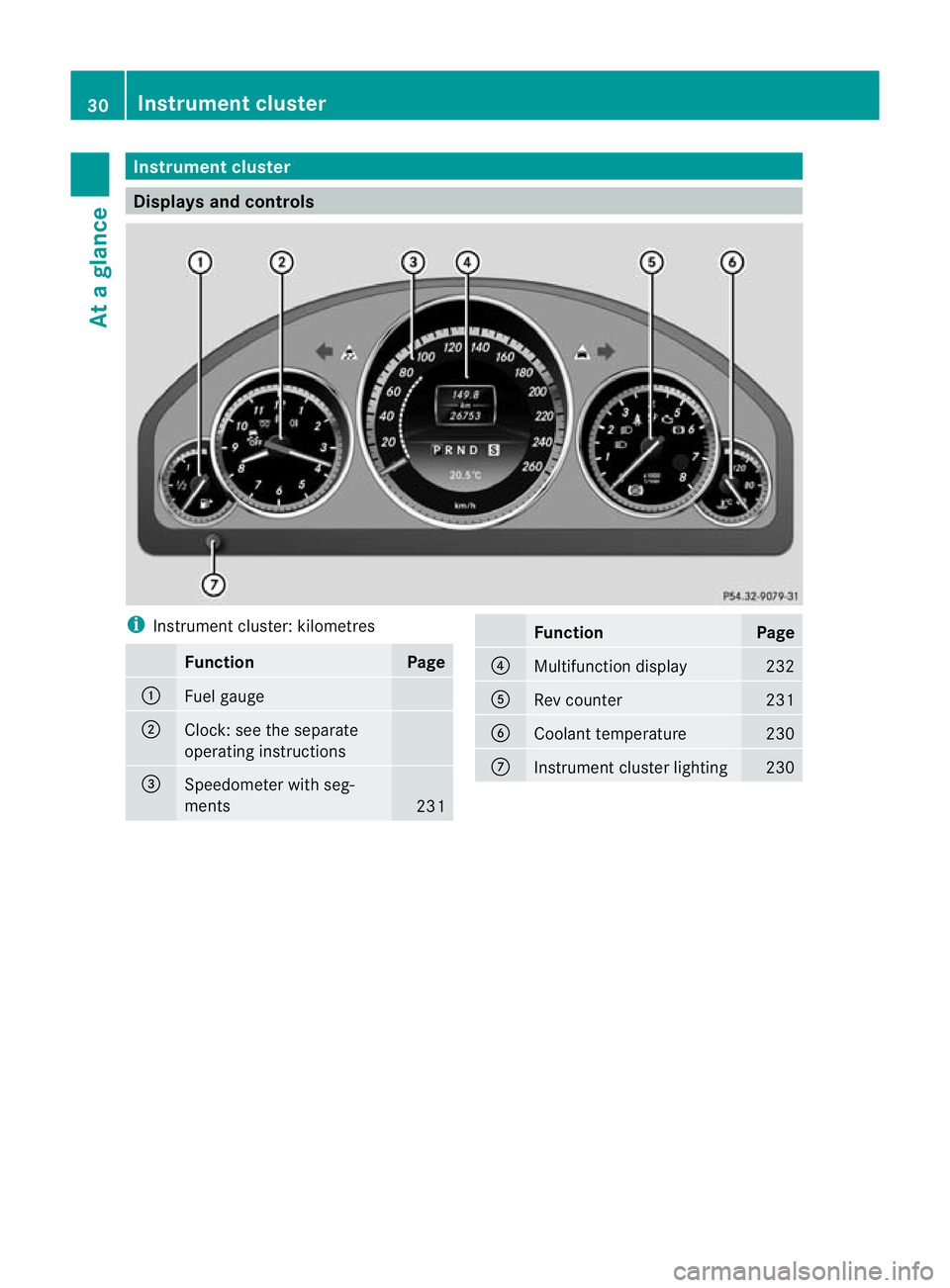
tcluster Displays and controls
i
Instrument cluster: kilometres Function Page
:
Fuel gauge
;
Clock
:see the separate
operating instructions =
Speedometer with seg-
ments
231 Function Page
?
Multifunction display 232
A
Rev counter 231
B
Coolant temperature 230
C
Instrument cluster lighting 23030
Instrument clusterAt a glance
Page 34 of 389
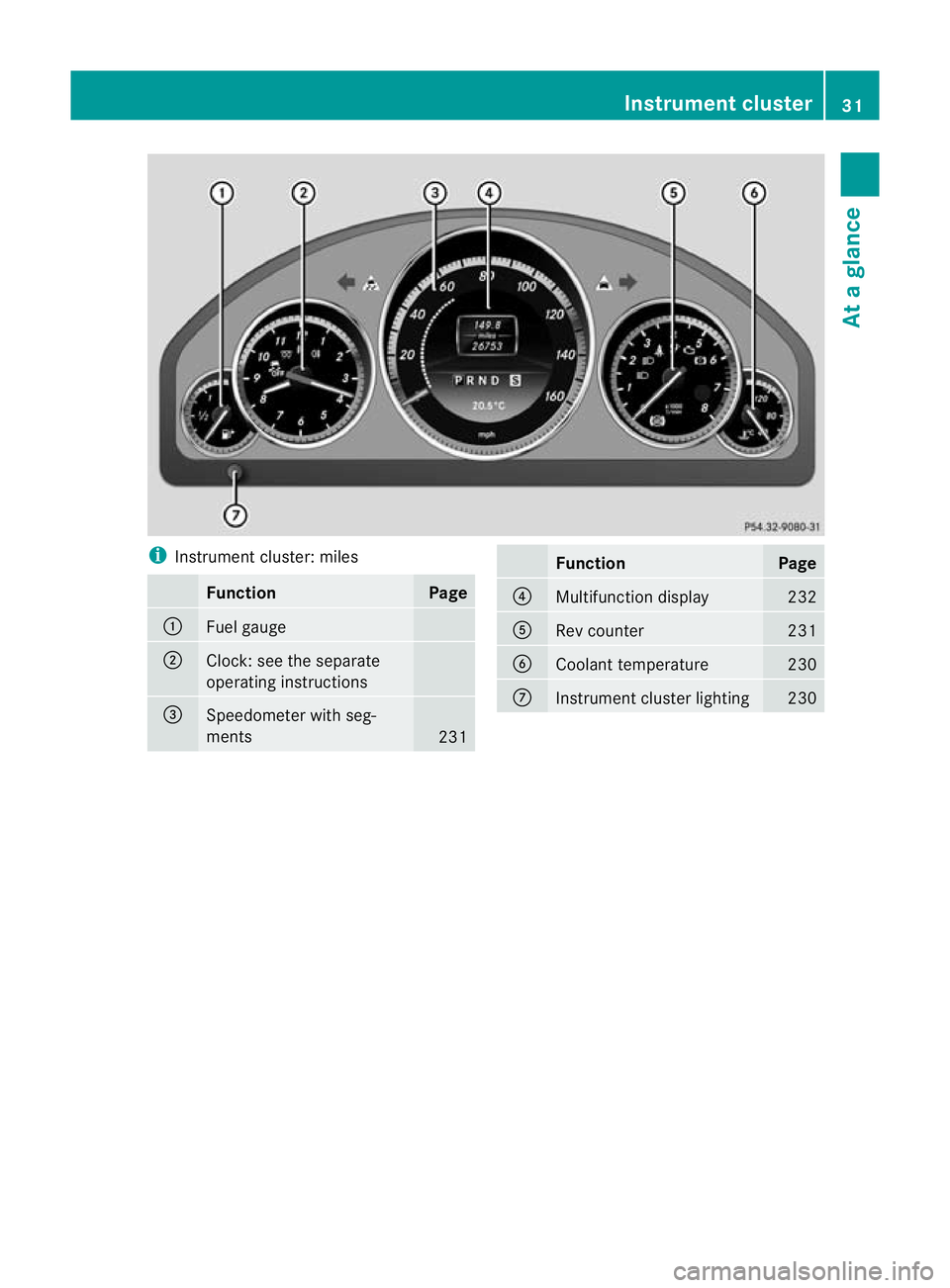
i
Instrument cluster: miles Function Page
:
Fuel gauge
;
Clock: see the separate
operating instructions
=
Speedometer with seg-
ments
231 Function Page
?
Multifunction display 232
A
Rev counter 231
B
Coolant temperature 230
C
Instrument cluster lighting 230Instrument cluster
31At a glance
Page 37 of 389
Centre console
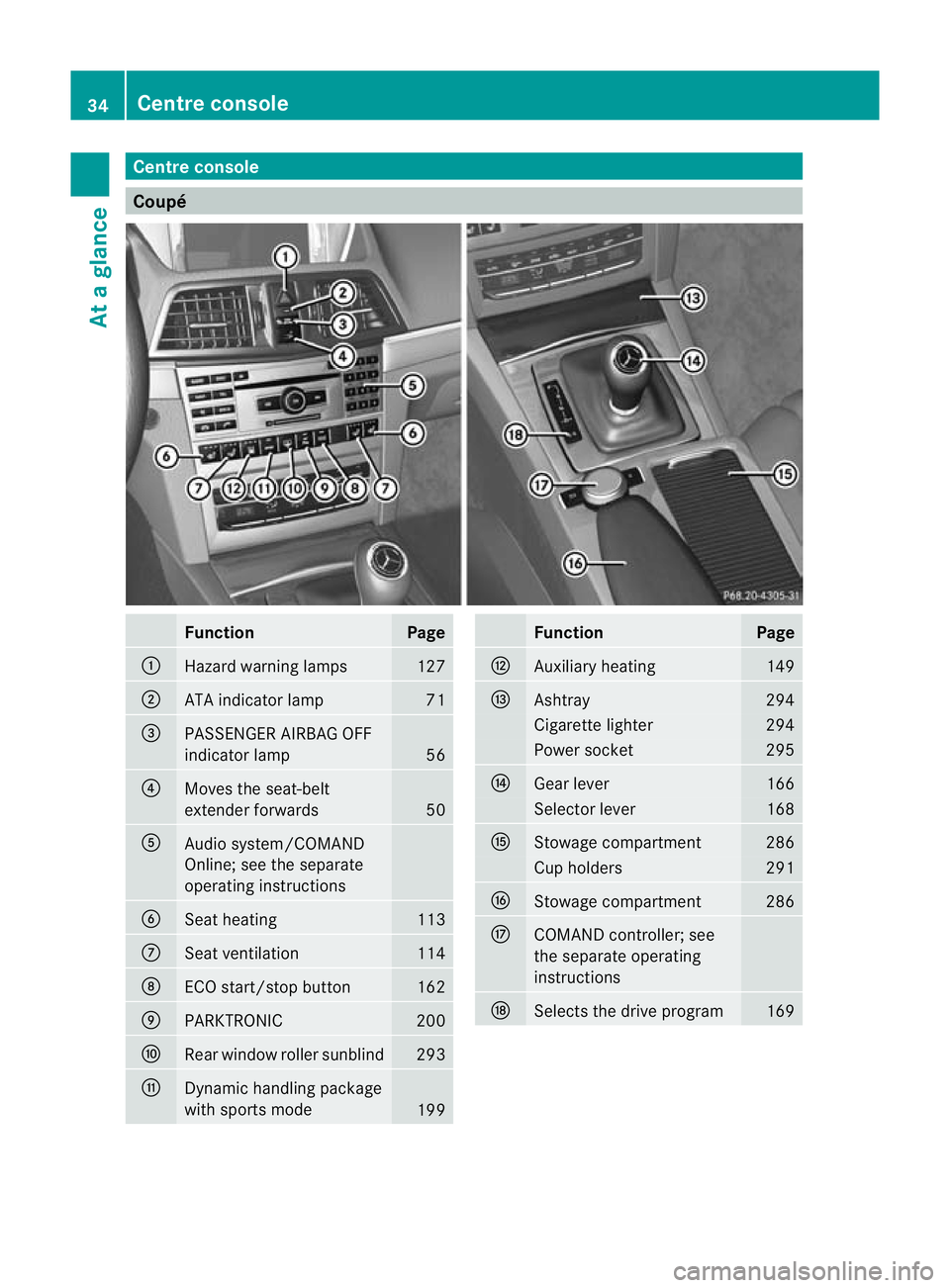
Coupé
Function Page
:
Hazard warning lamps 127
;
ATA indicator lamp 71
=
PASSENGER AIRBAG OFF
indicator lamp
56
?
Moves the seat-belt
extender forwards
50
A
Audio system/COMAND
Online; see the separate
operating instructions
B
Seat heating 113
C
Seat ventilation 114
D
ECO start/stop button 162
E
PARKTRONIC 200
F
Rear window roller sunblind 293
G
Dynamic handling package
with sports mode
199 Function Page
H
Auxiliary heating 149
I
Ashtray 294
Cigarette lighter 294
Power socket 295
J
Gear lever 166
Selector lever 168
K
Stowage compartment 286
Cup holders 291
L
Stowage compartment 286
M
COMAND controller; see
the separate operating
instructions N
Selects the drive program 16934
Centre consoleAt a glance
Page 38 of 389
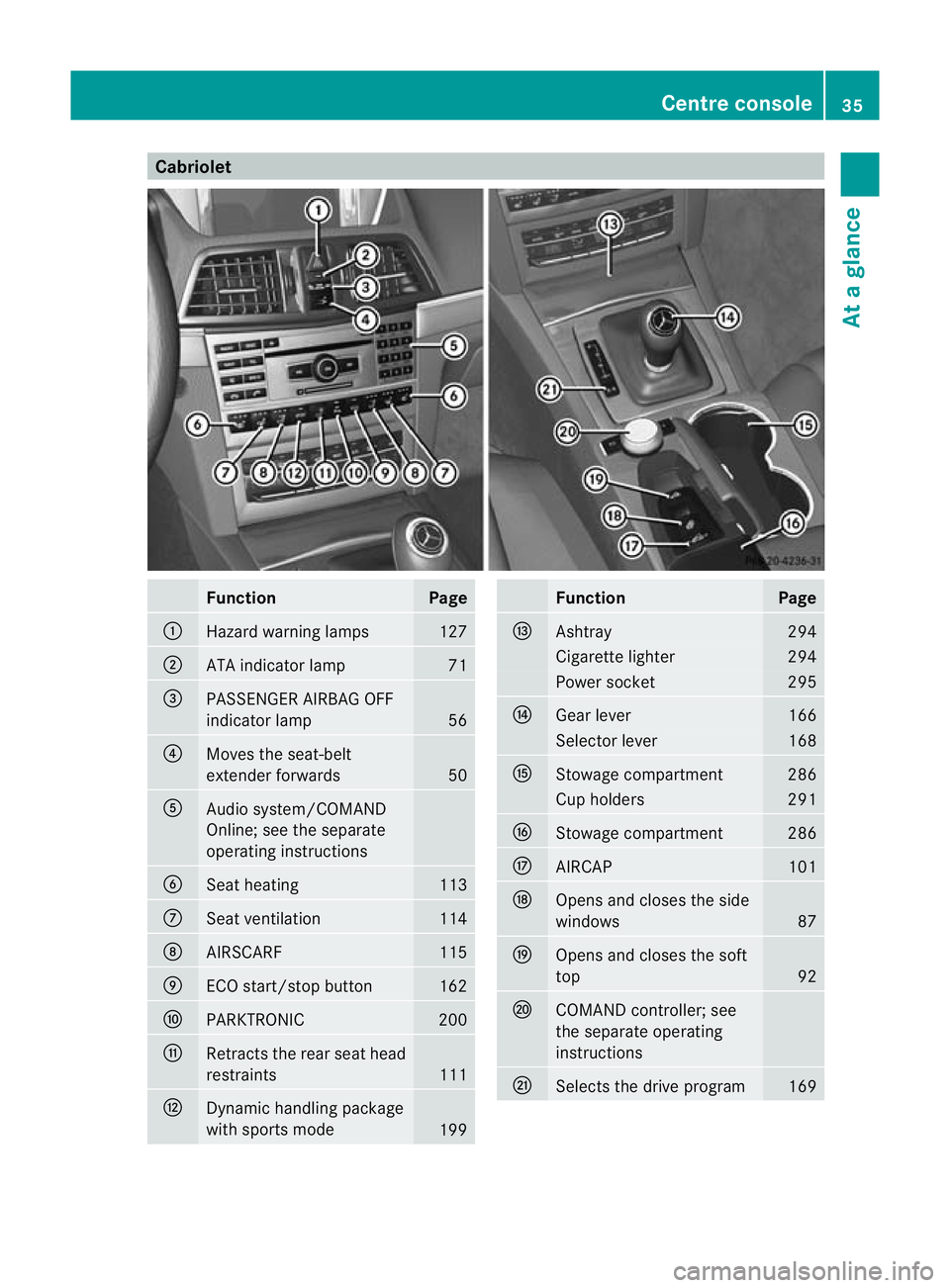
Cabriolet
Function Page
:
Hazard warning lamps 127
;
ATA indicator lamp 71
=
PASSENGER AIRBAG OFF
indicator lamp
56
?
Moves the seat-belt
extender forwards
50
A
Audio system/COMAND
Online; see the separate
operating instructions
B
Seat heating 113
C
Seat ventilation 114
D
AIRSCARF 115
E
ECO start/stop button 162
F
PARKTRONIC 200
G
Retracts the rear seat head
restraints
111
H
Dynamic handling package
with sports mode
199 Function Page
I
Ashtray 294
Cigarette lighter 294
Power socket 295
J
Gear lever 166
Selector lever 168
K
Stowage compartment 286
Cup holders 291
L
Stowage compartment 286
M
AIRCAP 101
N
Opens and closes the side
windows
87
O
Opens and closes the soft
top
92
P
COMAND controller; see
the separate operating
instructions
Q
Selects the drive program 169Centre console
35At a glance
Page 39 of 389
Overhea
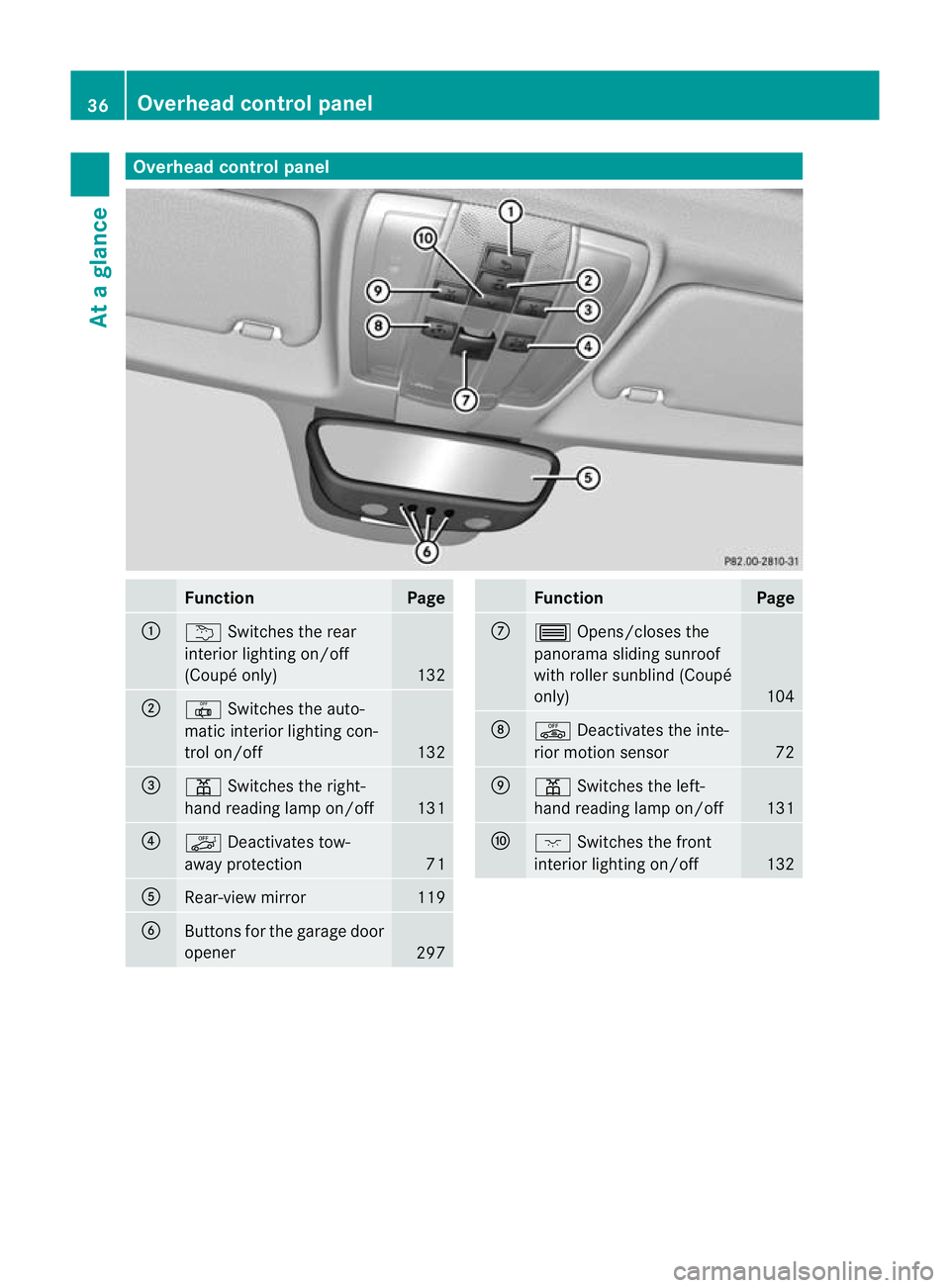
dcontrol panel Function Page
:
u
Switches the rear
interio rlighting on/off
(Coupé only) 132
;
|
Switches the auto-
matic interior lighting con-
trol on/off 132
=
p
Switches the right-
hand reading lamp on/off 131
?
ë
Deactivates tow-
away protection 71
A
Rear-view mirror 119
B
Buttons for the garage door
opener
297 Function Page
C
3
Opens/closes the
panorama sliding sunroof
with roller sunblind (Coupé
only) 104
D
ê
Deactivates the inte-
rior motion sensor 72
E
p
Switches the left-
hand reading lamp on/off 131
F
c
Switches the front
interior lighting on/off 13236
Overhead control panelAt a glance
Page 43 of 389
Useful information
i This Owner's Manual describes all mod-
els, series and optional equipment for your
vehicle that were available at the time of
going to press. National variations are pos-
sible. Note that your vehicle may not be
equipped with all of the functions descri-
bed. This is also the case for systems and
functions relevant to safety.
i Read the information on qualified special-
ist workshops: (Y page 23). Panic alarm
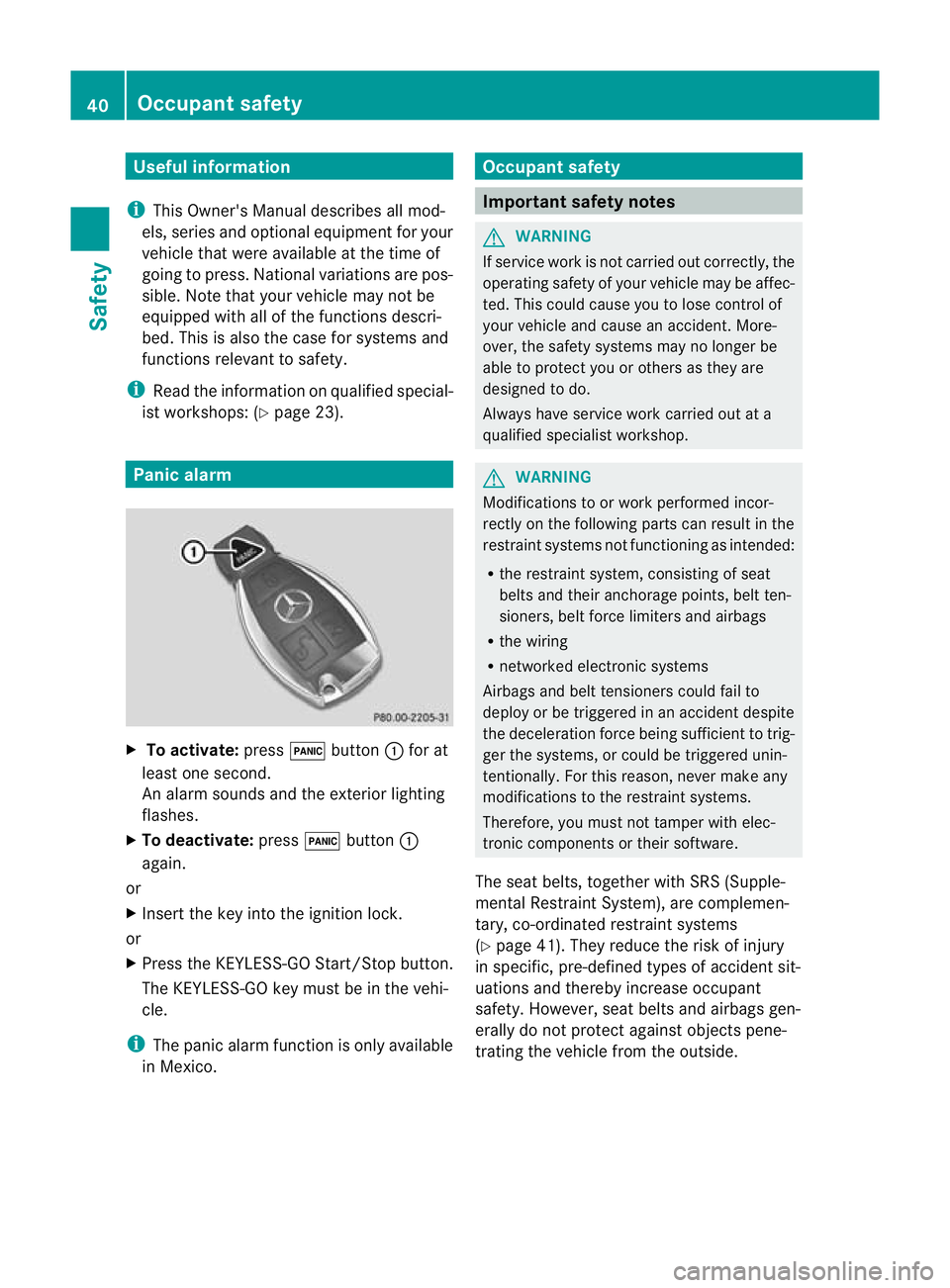
X
To activate: press!button :for at
least one second.
An alarm sounds and the exterior lighting
flashes.
X To deactivate: press!button :
again.
or
X Insert the key into the ignition lock.
or
X Press the KEYLESS-GO Start/Stop button.
The KEYLESS-GO key must be in the vehi-
cle.
i The panic alarm function is only available
in Mexico. Occupant safety
Important safety notes
G
WARNING
If service work is not carried out correctly, the
operating safety of your vehicle may be affec-
ted. This could cause you to lose control of
your vehicle and cause an accident. More-
over, the safety system smay no longer be
able to protect you or others as they are
designed to do.
Always have service work carried out at a
qualified specialist workshop. G
WARNING
Modifications to or work performed incor-
rectly on the following parts can result in the
restraint systems no tfunctioning as intended:
R the restraint system, consisting of seat
belts and their anchorage points, belt ten-
sioners, belt force limiters and airbags
R the wiring
R networked electronic systems
Airbags and belt tensioners could fail to
deploy or be triggered in an acciden tdespite
the deceleration force being sufficien tto trig-
ger the systems, or could be triggered unin-
tentionally. For this reason, never make any
modifications to the restraint systems.
Therefore, you must not tamper with elec-
tronic components or their software.
The seat belts, together with SRS (Supple-
mental Restraint System), are complemen-
tary, co-ordinated restraint systems
(Y page 41). They reduce the risk of injury
in specific, pre-defined types of accident sit-
uations and thereby increase occupant
safety. However, seat belts and airbags gen-
erally do not protect against objects pene-
trating the vehicle from the outside. 40
Occupant safetySafety
Page 44 of 389
To ensure that the restraint systems can
deliver their full potential protection, make
sure that:
R the seat and head restraint are adjusted
properly (Y page 108).
R the seat belt has been fastened properly
(Y page 49).
R the airbags can inflate unrestricted if
deployed (Y page 42).
R the steering wheel is adjusted properly
(Y page 115).
R the restraint systems have not been modi-
fied.
An airbag increases the protection of vehicle
occupants wearing a seat belt. However, air-
bags are only an additional restraint system
which complements, but does not replace,
the seat belt. All vehicle occupants must wear
their seat belt correctly at all times, even if
the vehicle is equipped with airbags. The air-
bags are not deployed in all types of acci-
dents .For example, if the protective capacity
of correctly fastened seat belts is not
increased by deploying the airbags, the air-
bags will not deploy.
Airbag deployment only provides increased
protection if the seat belt is worn correctly.
First, the seat belt helps to keep the vehicle
occupant in the best position in relation to the
airbag. Second, in a head-on collision, for
example, the seat belt prevents the vehicle
occupant from being propelled towards the
point of impact. SRS (Supplemental Restraint System)
Introduction SRS consists of:
R
the 6 SRS warning lamp
R airbags
R the airbag control unit with crash sensors
R belt tensioners
R belt force limiters SRS reduces the risk of occupants coming
into contact with the vehicle's interior in the
event of an accident. It can also reduce the
forces to which occupant
sare subjected dur-
ing an accident.
SRS warning lamp G
WARNING
If SRS is malfunctioning, individual systems
may be triggered unintentionally or might not
be triggered in the event of an accident with
a high rate of vehicle deceleration.
A malfunction has occurred if:
R the 6 SRS warning lamp does not light
up when the ignitio nis switched on.
R the engine is running and the 6SRS
warning lamp does not go out after a few
seconds.
R the engine is running and the 6SRS
warning lamp lights up again.
In this case, have SRS checked immediately
at a qualified specialist workshop.
SRS functions are checked regularly when
you switch on the ignition and when the
engine is running. Therefore, malfunctions
can be detected in good time.
The 6 SRS warning lamp in the instrument
cluster lights up when the ignition is switched
on. It goes out no later than a few seconds
after the engine is started.
Triggering of belt tensioners, belt force
limiters and airbags During the first stage of a collision, the airbag
control unit evaluates important physical
data relating to vehicle deceleration or accel-
eration, such as:
R
duration
R direction
R magnitude
Based on the evaluation of this data, the air-
bag control unit pre-emptively triggers the
belt tensioners in the first stage. Occupant safety
41Safety Z
Page 47 of 389
G
WARNING
The airbag parts are hot after the airbag has
been deployed. Do not touch them as you
could burn yourself.
Have the airbags replaced at a qualified spe-
cialist workshop. Otherwise, occupants are
not protected by the airbags in the event of
another accident.
Airbag deployment slows downa nd restricts
the movement of the vehicle occupant.
If the airbags are deployed ,you will hear a
bang, and a small amount of powder may also
be released. Only in rare cases will the bang
affect your hearing. The powder that is
released generally does not constitute a
health hazard. The 6SRS warning lamp
lights up.
The airbag installation locations are identified
by the AIRBAG symbol.
Front airbags !
Do not place heavy objects on the front-
passenger seat. The system may then
detect that the seat is occupied and if there
is an accident, the restraint systems on the
front-passenger side could be deployed.
Have restraint systems that have been trig-
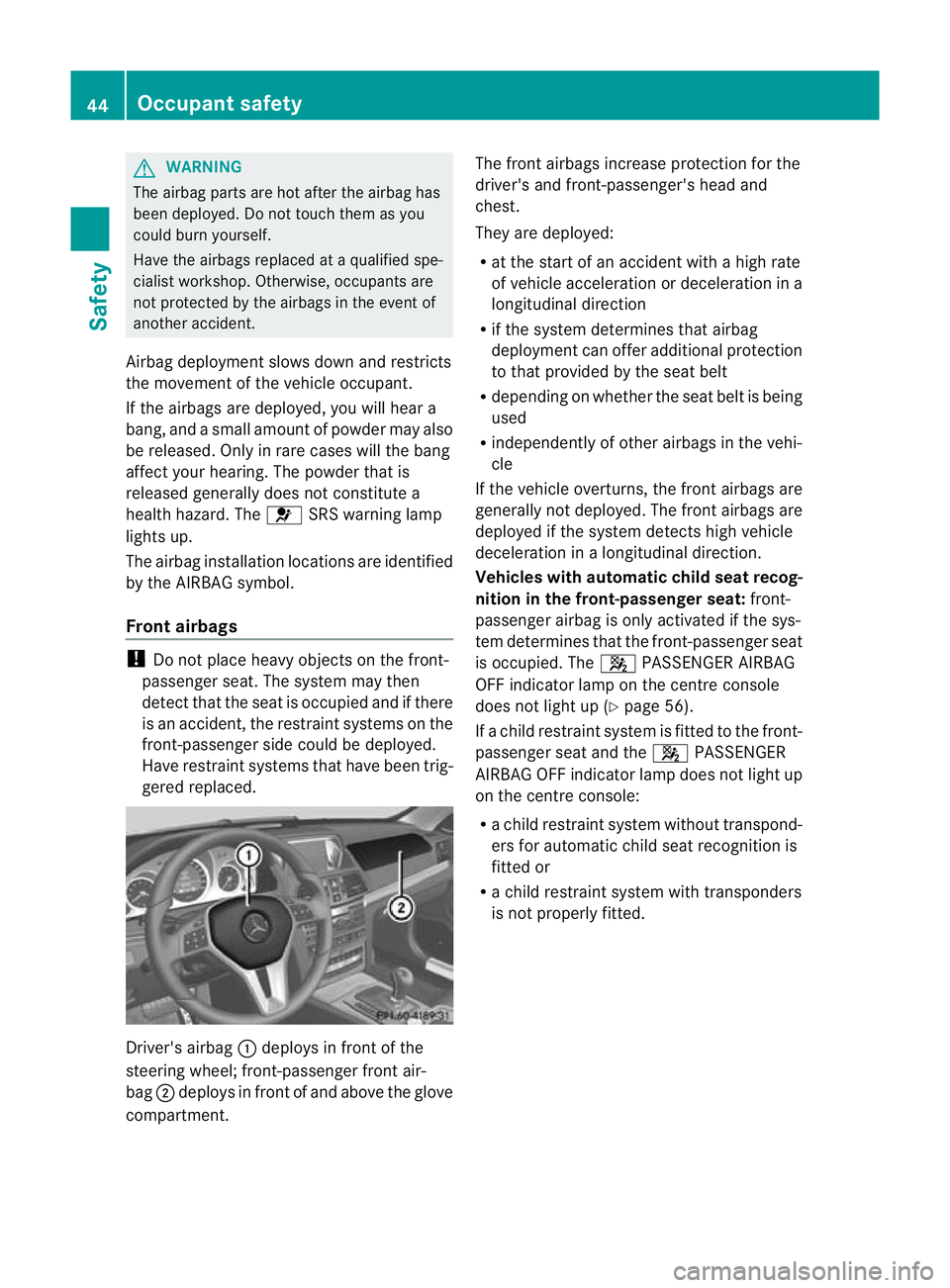
gered replaced. Driver's airbag
:deploys in front of the
steering wheel; front-passenger front air-
bag ;deploys in front of and above the glove
compartment. The front airbags increase protection for the
driver's and front-passenger's head and
chest.
They are deployed:
R
at the start of an accident with a high rate
of vehicle acceleration or deceleration in a
longitudinal direction
R if the system determines that airbag
deployment can offer additional protection
to that provided by the seat belt
R depending on whether the seat belt is being
used
R independently of other airbags in the vehi-
cle
If the vehicle overturns, the front airbags are
generally not deployed. The front airbags are
deployed if the system detects high vehicle
deceleration in a longitudinal direction.
Vehicles with automatic child seat recog-
nition in the front-passenger seat: front-
passenger airbag is only activated if the sys-
tem determines that the front-passenger seat
is occupied. The 4PASSENGER AIRBAG
OFF indicator lamp on the centre console
does not light up (Y page 56).
If a child restraint system is fitted to the front-
passenger seat and the 4PASSENGER
AIRBAG OFF indicator lamp does not light up
on the centre console:
R a child restraint system without transpond-
ers for automatic child seat recognition is
fitted or
R a child restraint system with transponders
is not properly fitted. 44
Occupant safetySafety
Page 52 of 389
If the seat belts are not released:
X
Move the backrest or seat back slightly, but
only when the vehicle is stationary.
The belt pretensioning is reduced and the
locking mechanism is released.
More information abouts eat belt adjustment,
a convenience function integrated into PRE-
SAFE ®
, can be found under "Seat belt adjust-
ment" (Y page 51). Seat belts
Important safety notes G
WARNING
A seat belt which is not worn correctly, or
which has not been engaged in the seat belt
buckle correctly, cannot provide the intended
level of protection. Under certain circumstan-
ces, this could cause severe or even fatal inju-
ries in the event of an accident.
Therefore, make sure that all occupants —in
particular, pregnan twomen —wear their seat
belts correctly at all times.
R The seat belt must fit snugly on your body
and must not be twisted.Therefore, avoid
wearing bulky clothing, e.g. a winter coat.
The shoulder section of the belt must be
routed across the centre of your shoulder
—onn o account across your neck or under
your arm —and pulled tight against your
uppe rbody. The lap belt must always pass
across your lap as low down as possible, i.e.
over your hip joints —not across your abdo-
men. If necessary, push the seat belt
slightly downwards and adjust it by pulling
it in the direction the seat belt retracts.
R Do not route the seat belt strap over sharp
or fragile objects. Please make sure that
such objects are not on or in your clothing,
e.g. spectacles, pens or keys etc. The seat
belt strap could become damaged and tear
during an accident and you or other vehicle
occupants could be injured. R
Only one person should use each seat belt
at any one time. Children must never travel
sitting on the lap of another occupant. The
child will not be secured in the event of an
accident, heavy braking or sudden change
of direction .This may result in the child or
other occupants being seriously or fatally
injured.
R Persons under 1.50 mtall cannot wear the
seat belts correctly. For this reason secure
persons less than 1.50 m tall in specially
designed, suitable restraint systems.
R Children unde r1.50 mtall and younger
than twelve years of age canno twear the
seat belts correctly. For this reason secure
them in special suitable child restraint sys-
tems installed on a suitable seat. Additional
information can be found in the Operating
Instructions in the chapter "Safety", "Chil-
dren in the Vehicle". Observe the installa-
tion instructions of the child restraint sys-
tem manufacturer.
R Do not secure an object with a seat belt if
the seat belt is also being used by one of
the vehicle's occupants. G
WARNING
The seat belt does not offer the intended level
of protection unless the backrest is almost
vertical. Under certain circumstances, this
could cause severe or even fatal injuries in the
event of an accident.
Before starting a journey, make sure that the
seat is properly adjusted and that the back-
rest is almost vertical. G
WARNING
Ad irty or damaged seat belt or one that has
been modified or subjected to a load in an
accident no longer offers the intended level of
protection. Under certain circumstances, this
could cause severe or even fatal injuries in the
event of an accident.
For this reason, chec kregularly that the seat
belts are not damaged or dirty. Occupant safety
49Safety
Z