spare wheel MERCEDES-BENZ E-CLASS COUPE 2012 User Guide
[x] Cancel search | Manufacturer: MERCEDES-BENZ, Model Year: 2012, Model line: E-CLASS COUPE, Model: MERCEDES-BENZ E-CLASS COUPE 2012Pages: 389, PDF Size: 9.32 MB
Page 345 of 389
Observe the notes on the emergency spare
wheel (Y
page 363). MOExtended tyres (tyres with run-flat
characteristics)
With MOExtended tyres (tyres with run-flat
characteristics), you can continue to drive
your vehicle even if there is a total loss of
pressure in one or more tyres.
MOExtended tyres may only be used in con-
junction with an active tyre pressure loss
warning system or with an active tyre pres-
sure monitor and on wheels specifically tes-
ted by Mercedes-Benz.
Notes on driving with MOExtended tyres with
a flat tyre (Y page 324).
i Vehicles with MOExtended tyres are not
equipped with a TIREFIT kit at the factory.
It is therefore recommended that you addi-
tionally equip your vehicle with a TIREFIT kit
if you fit tyres that do not feature run-flat
characteristics, e.g. winter tyres. A TIREFIT
kit can be obtained from a qualified spe-
cialist workshop. Winter operation
General notes
Have your vehicle winterproofed at a qualified
specialist workshop at the onset of winter.
Observe the notes in the "Changing a wheel"
section (Y page 346). Driving with summer tyres
At temperatures below +7 †, summer tyres
lose elasticity and therefore traction and
braking power. Change the tyres on your vehi-
cle to M+S tyres. Using summer tyres at very
cold temperatures could cause tears to form,
thereby damaging the tyres permanently.
Mercedes-Benz cannot accept responsibility
for this type of damage. M+S tyres
G
WARNING
M+S tyres with a tyre tread depth of less than
4mma re not suitable for use in winter as they
do not provide sufficient traction. There is a
risk of accident.
M+S tyres with a tread depth of less than
4 mm must be replaced.
At temperatures below +7 †, use winter tyres
or all-seaso ntyres .Both types of tyre are
identified by the M+S marking.
Only winter tyres bearing the isnowflake
symbol in addition to the M+S marking pro-
vide the best possible grip in wintry road con-
ditions.
Only these tyres will allow driving safety sys-
tems such as ABS and ESP ®
to function opti-
mally in winter. These tyres have been devel-
oped specifically for driving in snow.
Use M+S tyres of the same make and tread
on all wheels to maintain safe handling char-
acteristics.
Always observe the maximum permissible
speed specified for the M+S tyres you have
fitted.
If you fit M+S tyres that have a lower maxi-
mum permissible speed than that of the vehi-
cle, affix a corresponding warning label in the
driver's field of vision. This can be obtained
at a qualified specialist workshop.
Under these circumstances, you should also
restrict the maximum speed of the vehicle
using permanent SPEEDTRONIC so that it
does not exceed the maximum permissible
speed for the M+S tyres (Y page 188).
When you have fitted the M+S tyres:
X Check the tyre pressures (Y page 343).
X Restart the tyre pressure loss warning sys-
tem (Y page 345).
For more information on driving with an emer-
gency spare wheel, see (Y page 363).342
Winter operationWheels and tyres
Page 346 of 389
Snow chains
G
WARNING
If you have fitted snow chains to the front
wheels, they may scrape against the vehicle
body or chassis components. This could
cause damage to the vehicle or the tyres.
There is a risk of an accident.
To avoid hazardous situations:
R never fit snow chains on the front wheels
R fit snow chains to the rear wheels in pairs.
! Vehicles with steel wheels: if you wish
to fit snow chains to steel wheels, make
sure that you remove the respective
wheels' hubcaps first. The hubcaps may
otherwise be damaged.
For safety reasons, Mercedes-Benz recom-
mends that you only use snow chains that
have been specially approved for your vehicle
by Mercedes-Benz, or that are of a corre-
sponding standard of quality.
If you intend to fit snow chains, please bear
the following points in mind:
R snow chains cannot be fitted to all wheel-
tyre combinations. Permissible wheel-tyre
combinations (Y page 350).
R only use snow chains when the road sur-
face is completely snow-covered. Remove
the snow chains as soon as possible when
you come to a road that is not snow-cov-
ered.
R local regulations may restrictt he use of
snow chains. Observe the appropriate reg-
ulations if you wish to fit snow chains.
R do not exceed the maximum permissible
speed of 50 km/h.
i You may wish to deactivate ESP ®
when
pulling away with snow chains fitted
(Y page 67). This way you can allow the
wheels to spin in a controlled manner, ach-
ieving an increased driving force (cutting
action).
For more information on driving with an emer-
gency spare wheel, see (Y page 363). Tyre pressure
Tyre pressure specifications
G
WARNING
Tyres with too low or too high tyre pressure
contain the following hazards:
R they can burst, in particular if the vehicle is
heavily laden or when driven at high
speeds.
R the tyres can wear excessively and/or
unevenly, which can severely impair tyre
traction.
R the driving, steering and braking character-
istics may be severely impaired.
There is a risk of accident.
Follow recommended tyre inflation pressures
and check the pressure of all the tyres includ-
ing the spare wheel:
R at least every two weeks
R if the load changes
R before beginning a long journey
R for changed operating conditions, e.g. off-
road driving
If necessary, correct the tyre pressure. G
WARNING
If you fit unsuitable accessories onto tyre
valves, the tyre valves may be overloaded and
malfunction, which can cause tyre pressure
loss. Due to their design, retrofitted tyre pres-
sure monitors keep the tyre valve open. This
can also result in tyre pressure loss. There is
a risk of accident.
Only screw standard valve caps or valve caps
specifically provided by Mercedes-Ben zfor
your vehicle onto the tyre valve. G
WARNING
If the tyre pressure drops repeatedly, the
wheel, valve or tyre may be damaged. Tyre
pressure that is too low may result in a tyre
blow-out. There is a risk of accident. Tyre pressure
343Wheels and tyres
Z
Page 347 of 389
R
Check the tyre for foreign objects.
R Chec kwhether the wheel is losing air or the
valve is leaking.
If you are unable to rectify the damage, con-
tact a qualified specialist workshop. H
Environmental note
Check the tyre pressure regularly, at least
every 14 days.
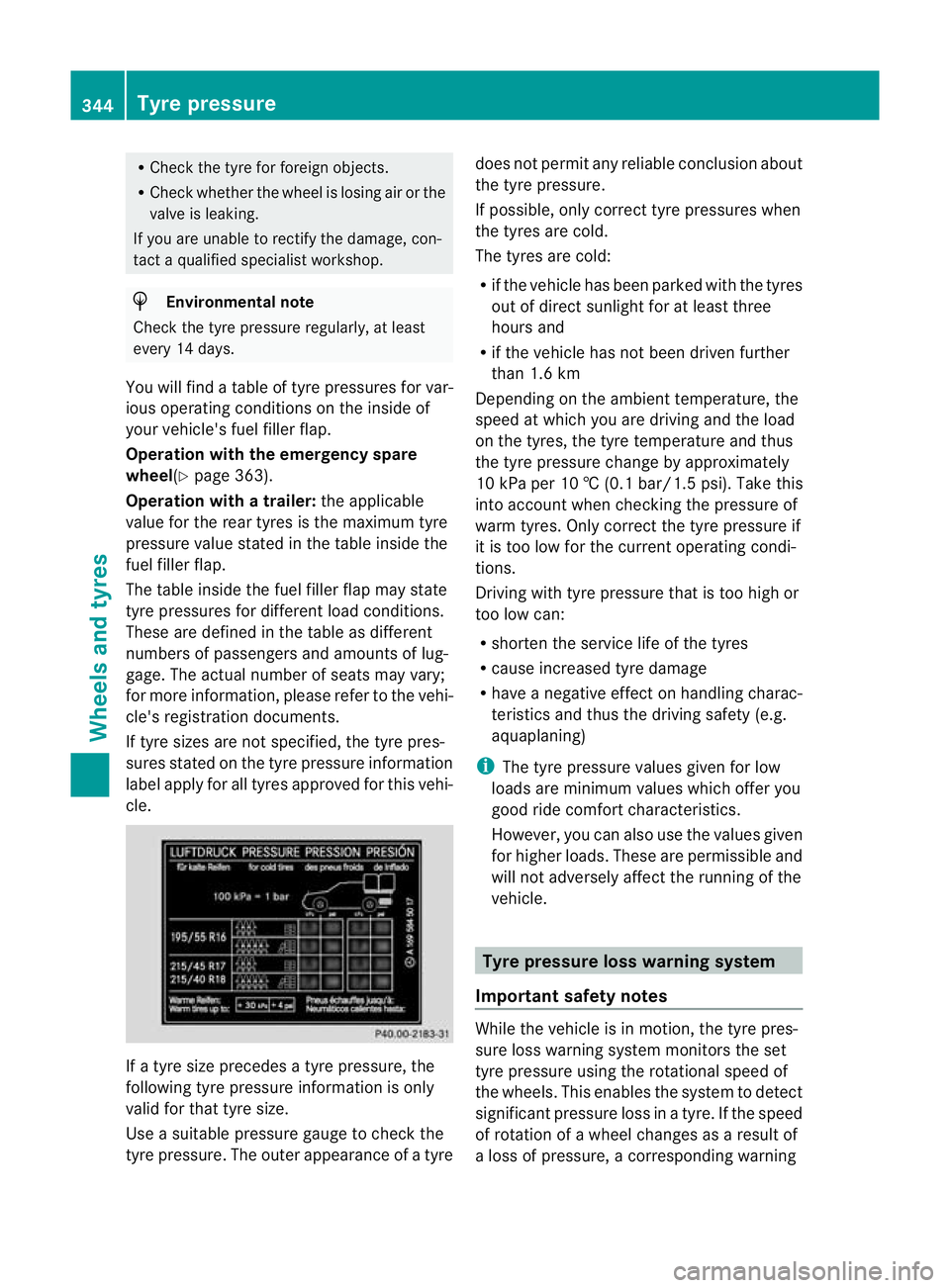
You will find a table of tyre pressures for var-
ious operating conditions on the inside of
your vehicle's fuel filler flap.
Operation with the emergency spare
wheel(Y page 363).
Operation with a trailer: the applicable
value for the rear tyres is the maximum tyre
pressure value stated in the table inside the
fuel filler flap.
The table inside the fuel filler flap may state
tyre pressures for different load conditions.
These are defined in the table as different
numbers of passengers and amounts of lug-
gage. The actual number of seats may vary;
for more information, please refer to the vehi-
cle's registration documents.
If tyre sizes are not specified, the tyre pres-
sures stated on the tyre pressure information
label apply for all tyres approved for this vehi-
cle. If a tyre size precedes a tyre pressure, the
following tyre pressure information is only
valid for that tyre size.
Use a suitable pressure gauge to check the
tyre pressure. The outer appearance of a tyre does not permit any reliable conclusion about
the tyre pressure.
If possible, only correct tyre pressures when
the tyres are cold.
The tyres are cold:
R
if the vehicle has been parked with the tyres
out of direct sunlight for at least three
hours and
R if the vehicle has not been driven further
than 1.6 km
Depending on the ambient temperature, the
speed at which you are driving and the load
on the tyres, the tyre temperature and thus
the tyre pressure change by approximately
10 kPa per 10 † (0.1 ba r/1.5 psi). Take this
into account whe nchecking the pressure of
warm tyres. Only correct the tyre pressure if
it is too low for the current operating condi-
tions.
Driving with tyre pressure that is too high or
too low can:
R shorten the service life of the tyres
R cause increased tyre damage
R have a negative effect on handling charac-
teristics and thus the driving safety (e.g.
aquaplaning)
i The tyre pressure values given for low
loads are minimum values which offer you
good ride comfort characteristics.
However, you can also use the values given
for higher loads. These are permissible and
will not adversely affect the running of the
vehicle. Tyre pressure loss warning system
Important safety notes While the vehicle is in motion, the tyre pres-
sure loss warning system monitors the set
tyre pressure using the rotational speed of
the wheels. This enables the system to detect
significant pressure loss in a tyre. If the speed
of rotation of a wheel changes as a result of
a loss of pressure, a corresponding warning344
Tyre pressureWheels and tyres
Page 353 of 389
Always pay attentio
nto the instructions and
safety notices in "Changing a wheel"
(Y page 346).
Only use wheel bolts that have been designed
for the wheel and the vehicle. For safety rea-
sons, Mercedes-Benz recommends that you
only use wheel bolts which have been
approved for Mercedes-Benz vehicles and the
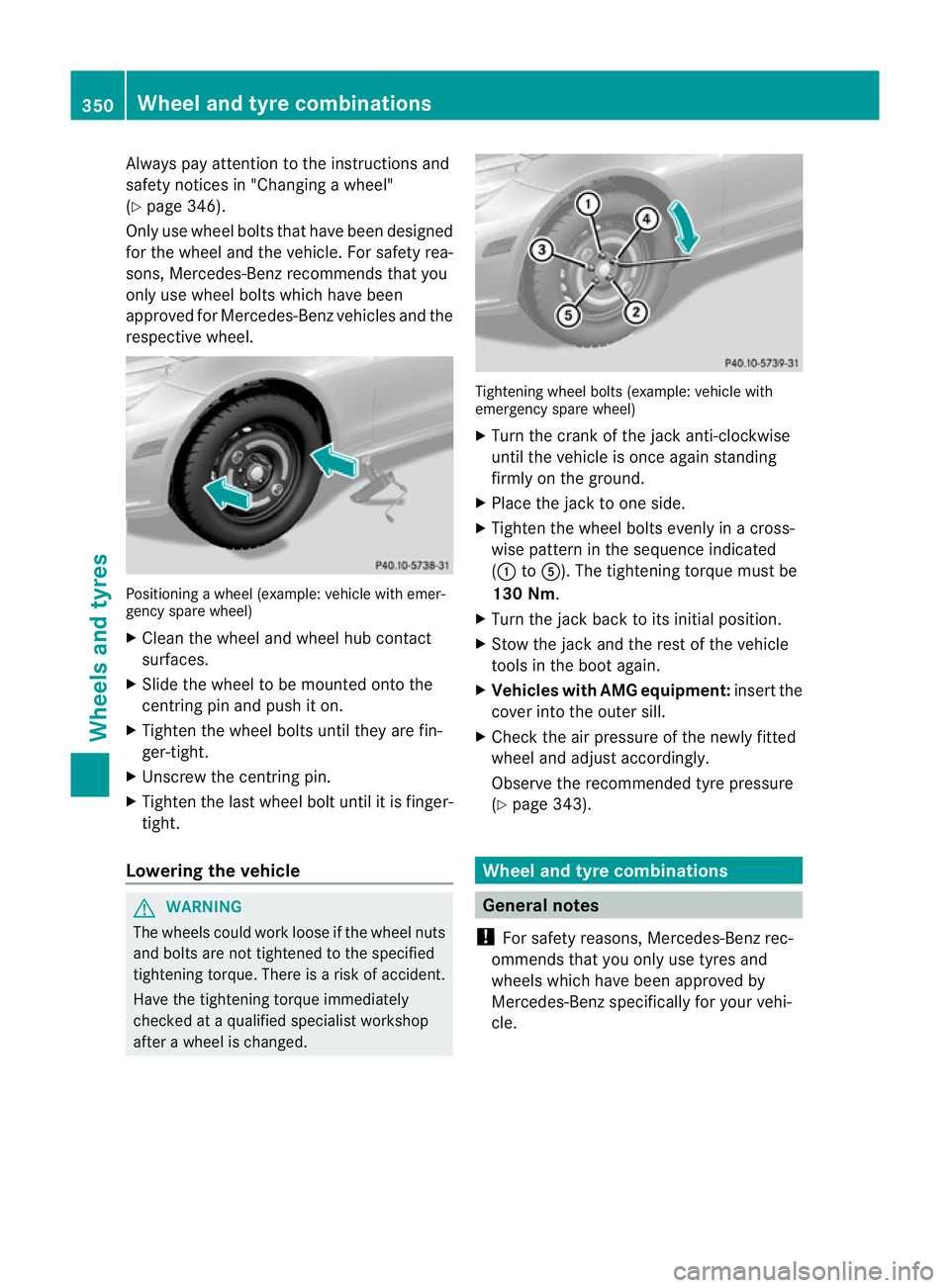
respective wheel. Positioning a wheel (example: vehicle with emer-
gency spare wheel)
X Clean the wheel and wheel hub contact
surfaces.
X Slide the wheel to be mounted onto the
centring pin and push it on.
X Tighten the wheel bolts until they are fin-
ger-tight.
X Unscrew the centring pin.
X Tighten the last wheel bolt until it is finger-
tight.
Lowering the vehicle G
WARNING
The wheels could work loose if the wheel nuts
and bolts are not tightened to the specified
tightening torque. There is a risk of accident.
Have the tightening torque immediately
checked at a qualified specialist workshop
after a wheel is changed. Tightening wheel bolts (example: vehicle with
emergency spare wheel)
X Turn the crank of the jack anti-clockwise
until the vehicle is once again standing
firmly on the ground.
X Place the jack to one side.
X Tighten the wheel bolts evenly in a cross-
wise pattern in the sequence indicated
(: toA). The tightening torque must be
130 Nm.
X Turn the jack back to its initial position.
X Stow the jack and the rest of the vehicle
tools in the boot again.
X Vehicles with AMG equipment: insert the
cover into the outer sill.
X Check the air pressure of the newly fitted
wheel and adjust accordingly.
Observe the recommended tyre pressure
(Y page 343). Wheel and tyre combinations
General notes
! For safety reasons, Mercedes-Benz rec-
ommends that you only use tyres and
wheels which have been approved by
Mercedes-Benz specifically for your vehi-
cle. 350
Wheel and tyre combinationsWheels and tyres
Page 366 of 389
Emergency spare wheel
Important safety notes
G
WARNING
The wheel/tyre dimensions and the tyre type
of the spare wheel/emergency spare wheel
and the wheel to be replaced may differ. Fit-
ting a spare wheel/emergency spare wheel
may severely impair the driving characteris-
tics. There is a risk of accident.
To prevent hazardous situations:
R Adap tyour driving style accordingly and
drive carefully.
R Never fit more than one spare wheel/emer-
gency spare wheel if the dimesions are dif-
ferent to those of the wheel being replaced.
R Only use a spare wheel/emergency spare
wheel briefly if the dimesions are different
to those of the wheel being replaced.
R Do not switch off ESP ®
.
R Have the spare wheel/emergency spare
wheel in question replaced at the nearest
qualified specialist workshop. Make sure
that the wheel/tyre dimensions and tyre
type are correct.
When using an emergency spare wheel or
spare wheel of a different size, you must not
exceed the maximum speed of 80 km/h.
Snow chains must not be fitted to emergency
spare wheels. General notes
You should regularly check the pressure of all
your tyres, including the emergency spare
wheel, particularly prior to long trips, and cor-
rect the pressure as necessary (Y page 343).
The applicable value is found on the wheel or
under "Technical data" (Y page 364).
An emergency spare wheel may also be fitted
against the direction of rotation .Observe the
time restriction on use as well as the speed
limitation specified on the emergency spare
wheel. Replace the tyres after six years at the latest,
regardless of wear. This also applies to the
emergency spare wheel.
i
When you are driving with the emergency
spare wheel fitted, the tyre pressure loss
warning system cannot function reliably.
Only restart the tyre pressure loss warning
system when the defective wheel has been
replaced with a new wheel. "Minispare" emergency spare wheel
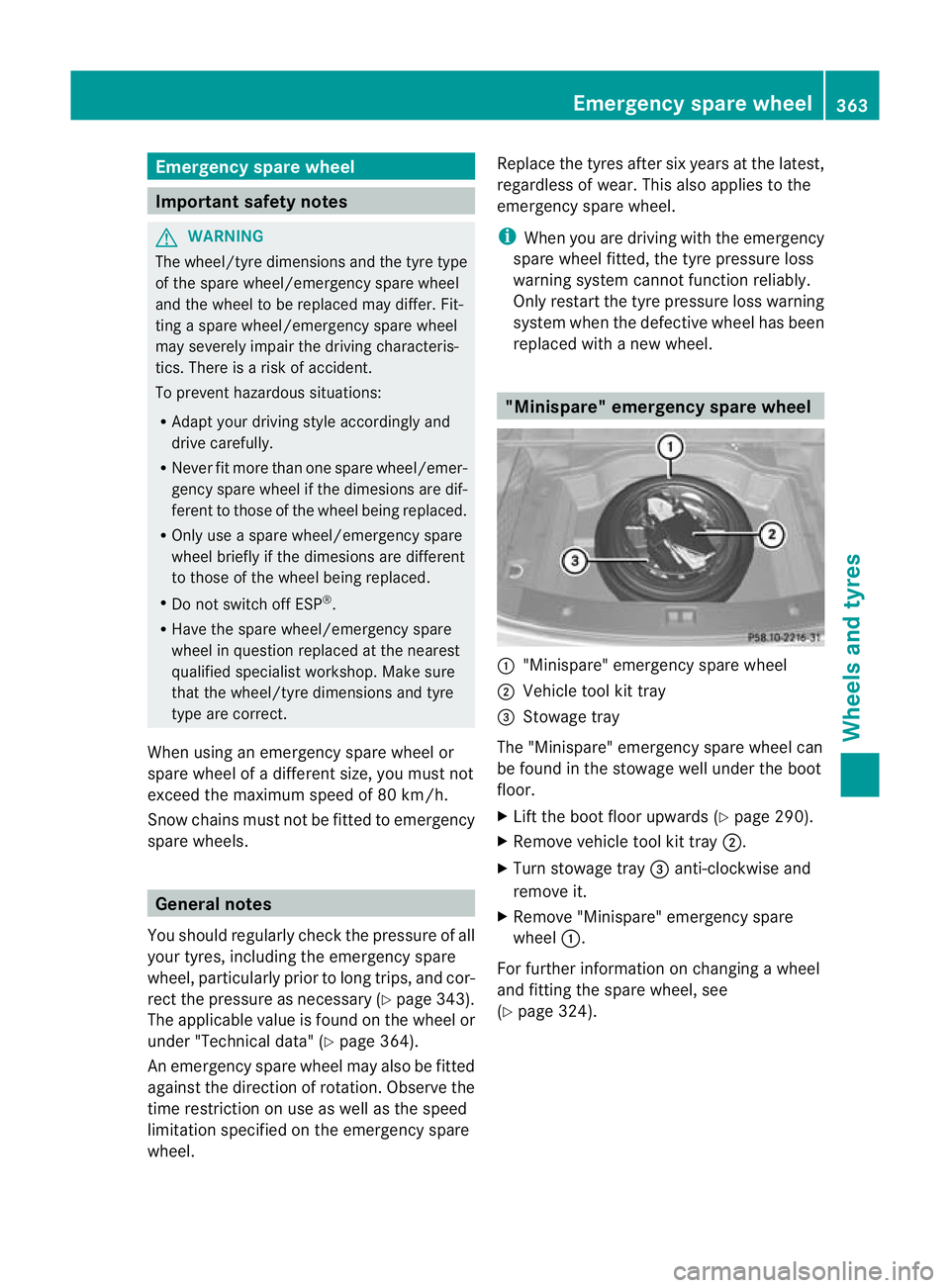
:
"Minispare" emergency spare wheel
; Vehicle tool kit tray
= Stowage tray
The "Minispare" emergency spare wheel can
be found in the stowage well under the boot
floor.
X Lift the boot floor upwards (Y page 290).
X Remove vehicle tool kit tray ;.
X Turn stowage tray =anti-clockwise and
remove it.
X Remove "Minispare" emergency spare
wheel :.
For further information on changing a wheel
and fitting the spare wheel, see
(Y page 324). Emergency spare wheel
363Wheels and tyres Z
Page 367 of 389
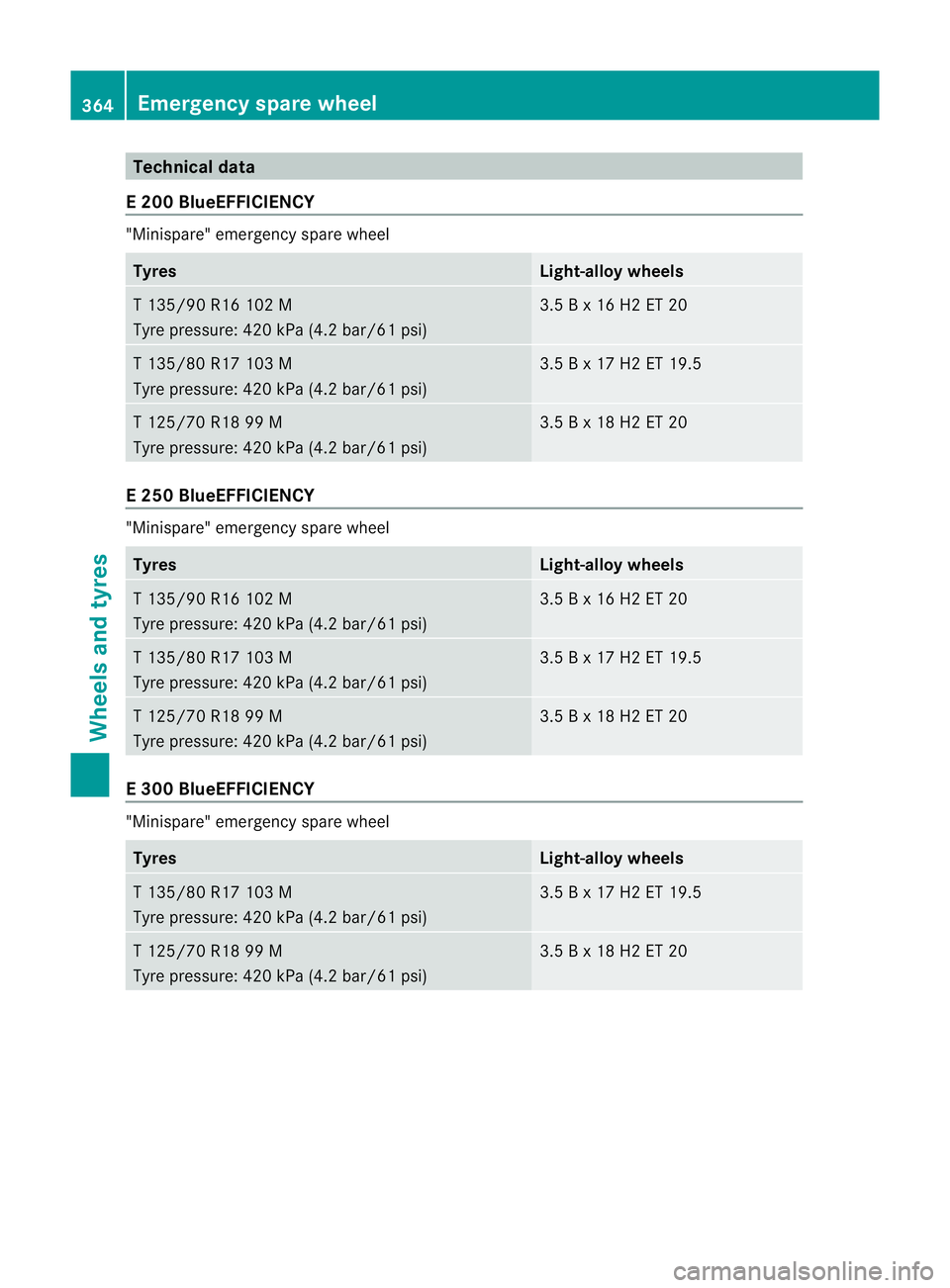
Technical data
E 200 BlueEFFICIENCY "Minispare" emergency spare wheel
Tyres Light-alloy wheels
T 135/9
0 R16 102 M
Tyre pressure : 420 kPa (4.2 bar/61 psi) 3.5 B x 16 H2 ET 20
T 135/80 R17 103 M
Tyre pressure: 420 kPa (4.2 bar/61 psi) 3.5 B x 17 H2 ET 19.5
T 125/70 R18 99 M
Tyre pressure: 420 kPa (4.2 bar/61 psi) 3.5 B x 18 H2 ET 20
E 250 BlueEFFICIENCY
"Minispare" emergency spare wheel
Tyres Light-allo
ywheels T 135/90 R16 102 M
Tyre pressure: 420 kPa (4.2 bar/61 psi) 3.5 B x 16 H2 ET 20
T 135/80 R17 103 M
Tyre pressure: 420 kPa (4.2 bar/61 psi) 3.5 B x 17 H2 ET 19.5
T 125/70 R18 99 M
Tyre pressure: 420 kPa (4.2 bar/61 psi) 3.5 B x 18 H2 ET 20
E 300 BlueEFFICIENCY
"Minispare" emergency spare wheel
Tyres Light-alloy wheels
T 135/80 R17 103 M
Tyre pressure: 420 kPa (4.2 bar/61 psi) 3.5 B x 17 H2 ET 19.5
T 125/70 R18 99 M
Tyre pressure: 420 kPa (4.2 bar/61 psi) 3.5 B x 18 H2 ET 20364
Emergencys
pare wheelWheels and tyres
Page 368 of 389
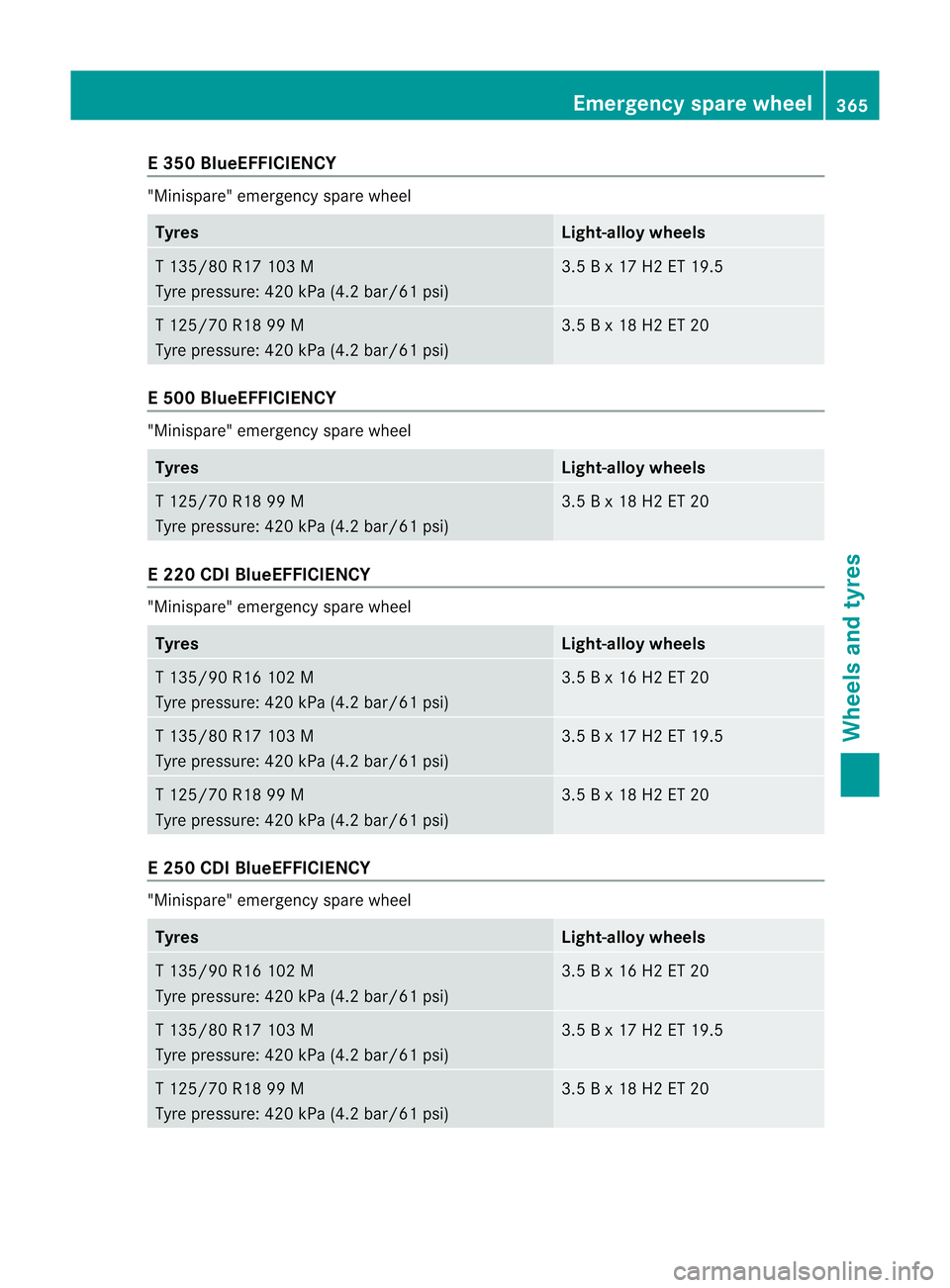
E 350 BlueEFFICIENCY
"Minispare" emergency spare wheel
Tyres Light-alloy wheels
T 135/80 R17 103 M
Tyre pressure: 420 kPa (4.2 bar/61 psi) 3.5 B x 17 H2 ET 19.5
T 125/70 R18 99 M
Tyre pressure: 420 kPa (4.2 bar/61 psi) 3.5 B x 18 H2 ET 20
E 500 BlueEFFICIENCY
"Minispare" emergency spare wheel
Tyres Light-alloy wheels
T 125/70 R18 99 M
Tyre pressure: 420 kPa (4.2 bar/61 psi) 3.5 B x 18 H2 ET 20
E 220 CDI BlueEFFICIENCY
"Minispare" emergency spare wheel
Tyres Light-alloy wheels
T 135/90 R16 102 M
Tyre pressure: 420 kPa (4.2 bar/61 psi) 3.5 B x 16 H2 ET 20
T 135/80 R17 103 M
Tyre pressure: 420 kPa (4.2 bar/61 psi) 3.5 B x 17 H2 ET 19.5
T 125/70 R18 99 M
Tyre pressure: 420 kPa (4.2 bar/61 psi) 3.5 B x 18 H2 ET 20
E 250 CDI BlueEFFICIENCY
"Minispare" emergency spare wheel
Tyres Light-alloy wheels
T 135/90 R16 102 M
Tyre pressure: 420 kPa (4.2 bar/61 psi) 3.5 B x 16 H2 ET 20
T 135/80 R17 103 M
Tyre pressure: 420 kPa (4.2 bar/61 psi) 3.5 B x 17 H2 ET 19.5
T 125/70 R18 99 M
Tyre pressure: 420 kPa (4.2 bar/61 psi) 3.5 B x 18 H2 ET 20 Emergency spare wheel
365Wheels and tyres Z
Page 369 of 389
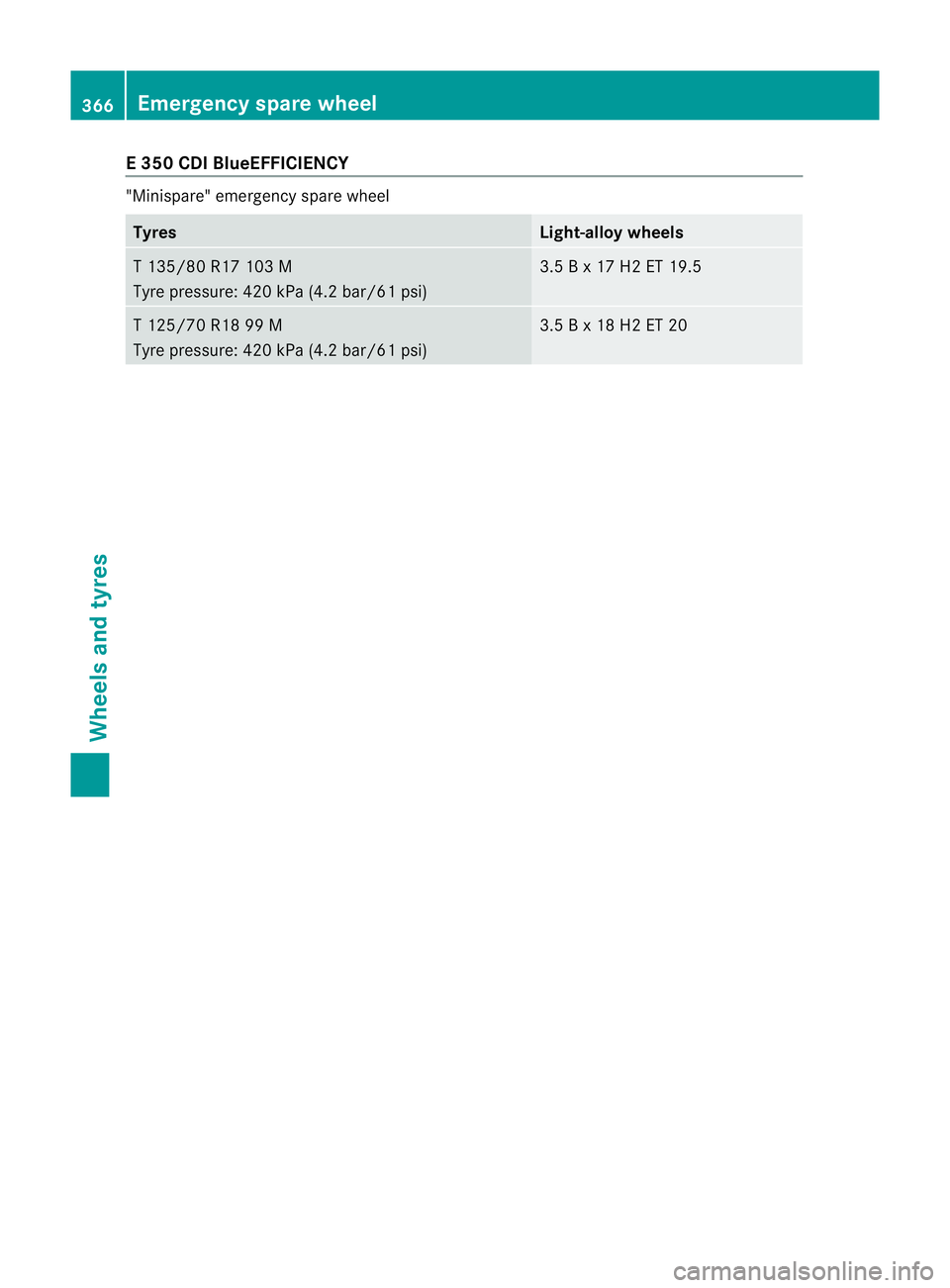
E 350 CDI BlueEFFICIENCY
"Minispare" emergency spare wheel
Tyres Light-alloy wheels
T 135/80 R17 103 M
Tyre pressure: 420 kPa (4.2 bar/61 psi) 3.5 B x 17 H2 ET 19.5
T 125/70 R18 99 M
Tyre pressure: 420 kPa (4.2 bar/61 psi) 3.5 B x 18 H2 ET 20366
Emergency spare wheelWheels and tyres