center console MERCEDES-BENZ E-Class COUPE 2013 C207 User Guide
[x] Cancel search | Manufacturer: MERCEDES-BENZ, Model Year: 2013, Model line: E-Class COUPE, Model: MERCEDES-BENZ E-Class COUPE 2013 C207Pages: 372, PDF Size: 12.69 MB
Page 99 of 372
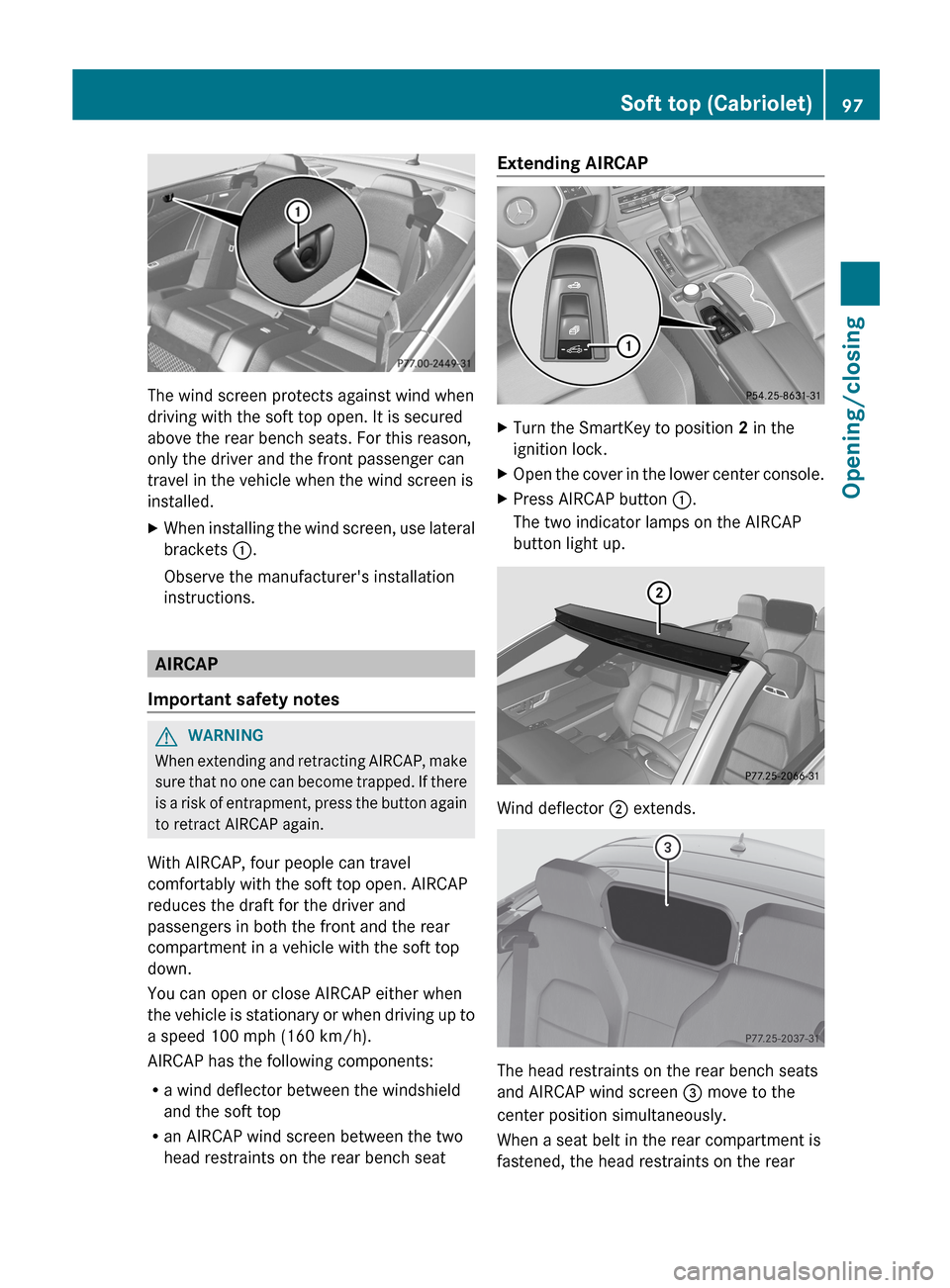
The wind screen protects against wind when
driving with the soft top open. It is secured
above the rear bench seats. For this reason,
only the driver and the front passenger can
travel in the vehicle when the wind screen is
installed.
X
When installing the wind screen, use lateral
brackets :.
Observe the manufacturer's installation
instructions. AIRCAP
Important safety notes G
WARNING
When extending and retracting AIRCAP, make
sure that no one can become trapped. If there
is a risk of entrapment, press the button again
to retract AIRCAP again.
With AIRCAP, four people can travel
comfortably with the soft top open. AIRCAP
reduces the draft for the driver and
passengers in both the front and the rear
compartment in a vehicle with the soft top
down.
You can open or close AIRCAP either when
the vehicle is stationary or when driving up to
a speed 100 mph (160 km/h).
AIRCAP has the following components:
R a wind deflector between the windshield
and the soft top
R an AIRCAP wind screen between the two
head restraints on the rear bench seat Extending AIRCAP
X
Turn the SmartKey to position 2 in the
ignition lock.
X Open the cover in the lower center console.
X Press AIRCAP button :.
The two indicator lamps on the AIRCAP
button light up. Wind deflector ; extends.
The head restraints on the rear bench seats
and AIRCAP wind screen = move to the
center position simultaneously.
When a seat belt in the rear compartment is
fastened, the head restraints on the rear Soft top (Cabriolet)
97
Opening/closing Z
Page 100 of 372
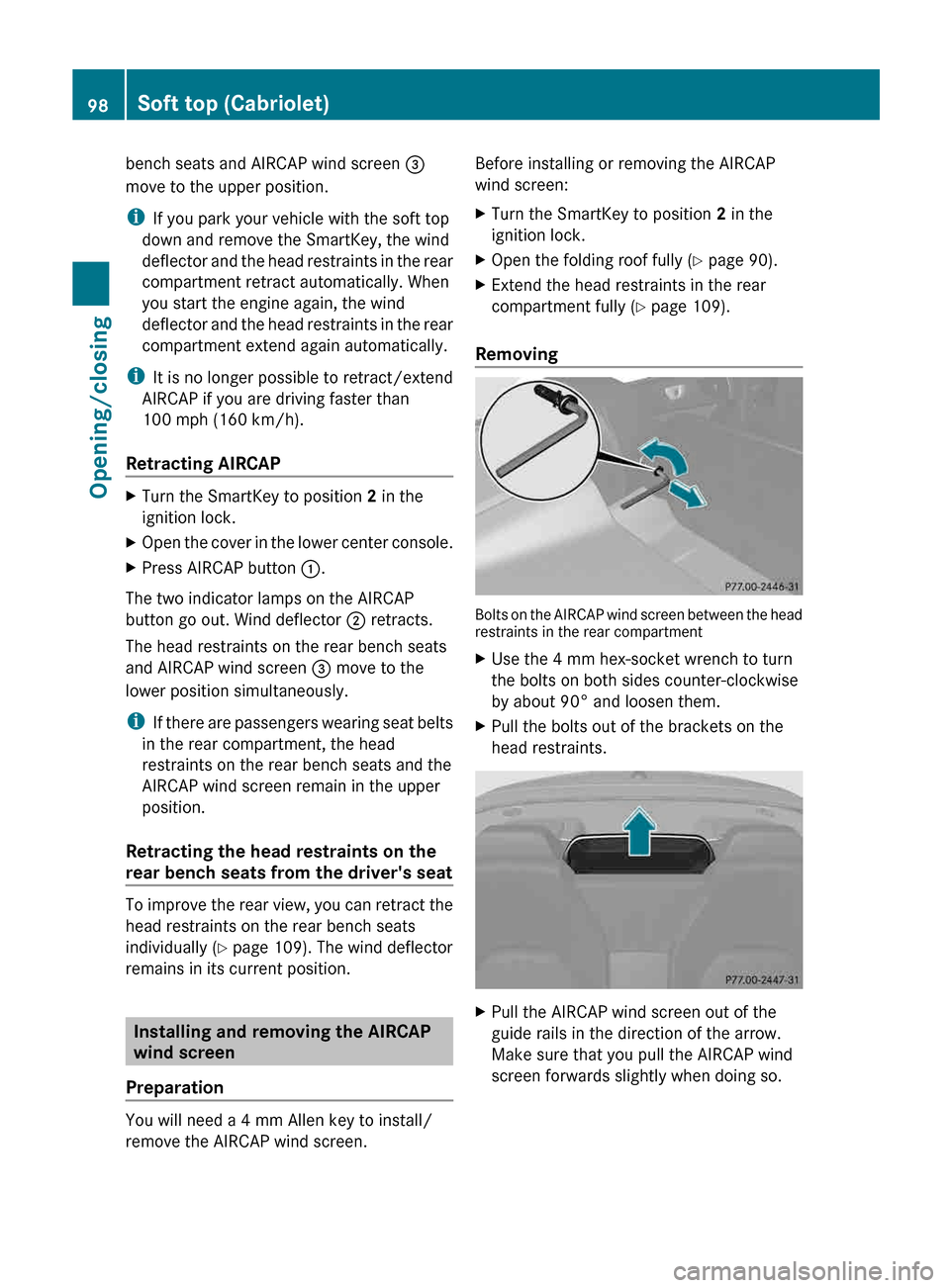
bench seats and AIRCAP wind screen =
move to the upper position.
i
If you park your vehicle with the soft top
down and remove the SmartKey, the wind
deflector
and the head restraints in the rear
compartment retract automatically. When
you start the engine again, the wind
deflector and the head restraints in the rear
compartment extend again automatically.
i It is no longer possible to retract/extend
AIRCAP if you are driving faster than
100 mph (160 km/h).
Retracting AIRCAP X
Turn the SmartKey to position 2 in the
ignition lock.
X Open the cover in the lower center console.
X Press AIRCAP button :.
The two indicator lamps on the AIRCAP
button go out. Wind deflector ; retracts.
The head restraints on the rear bench seats
and AIRCAP wind screen = move to the
lower position simultaneously.
i If
there are passengers wearing seat belts
in the rear compartment, the head
restraints on the rear bench seats and the
AIRCAP wind screen remain in the upper
position.
Retracting the head restraints on the
rear bench seats from the driver's seat To improve the rear view, you can retract the
head restraints on the rear bench seats
individually
(Y page 109). The wind deflector
remains in its current position. Installing and removing the AIRCAP
wind screen
Preparation You will need a 4 mm Allen key to install/
remove the AIRCAP wind screen. Before installing or removing the AIRCAP
wind screen:
X
Turn the SmartKey to position 2 in the
ignition lock.
X Open the folding roof fully ( Y page 90).
X Extend the head restraints in the rear
compartment fully (Y page 109).
Removing Bolts on the AIRCAP wind screen between the head
restraints in the rear compartment
X
Use the 4 mm hex-socket wrench to turn
the bolts on both sides counter-clockwise
by about 90° and loosen them.
X Pull the bolts out of the brackets on the
head restraints. X
Pull the AIRCAP wind screen out of the
guide rails in the direction of the arrow.
Make sure that you pull the AIRCAP wind
screen forwards slightly when doing so.98
Soft top (Cabriolet)
Opening/closing
Page 166 of 372
Problems with the transmission
Problem Possible causes/consequences and
M SolutionsThe transmission has
problems shifting gear. The transmission is losing oil.
X
Have the transmission checked at a qualified specialist
workshop immediately. The acceleration ability
is deteriorating.
The transmission no
longer changes gear. The transmission is in emergency mode.
It is only possible to shift into second
gear and reverse gear.
X Stop the vehicle.
X Shift the transmission to position P.
X Switch off the engine.
X Wait at least ten seconds before restarting the engine.
X Shift the transmission to position D or R.
If D
is selected, the transmission shifts into second gear; if R is
selected, the transmission shifts into reverse gear.
X Have the transmission checked at a qualified specialist
workshop immediately. Releasing the parking lock manually
! Do not use any sharp-edged objects to
remove the selector lever gaiter from the
center console. This could damage the
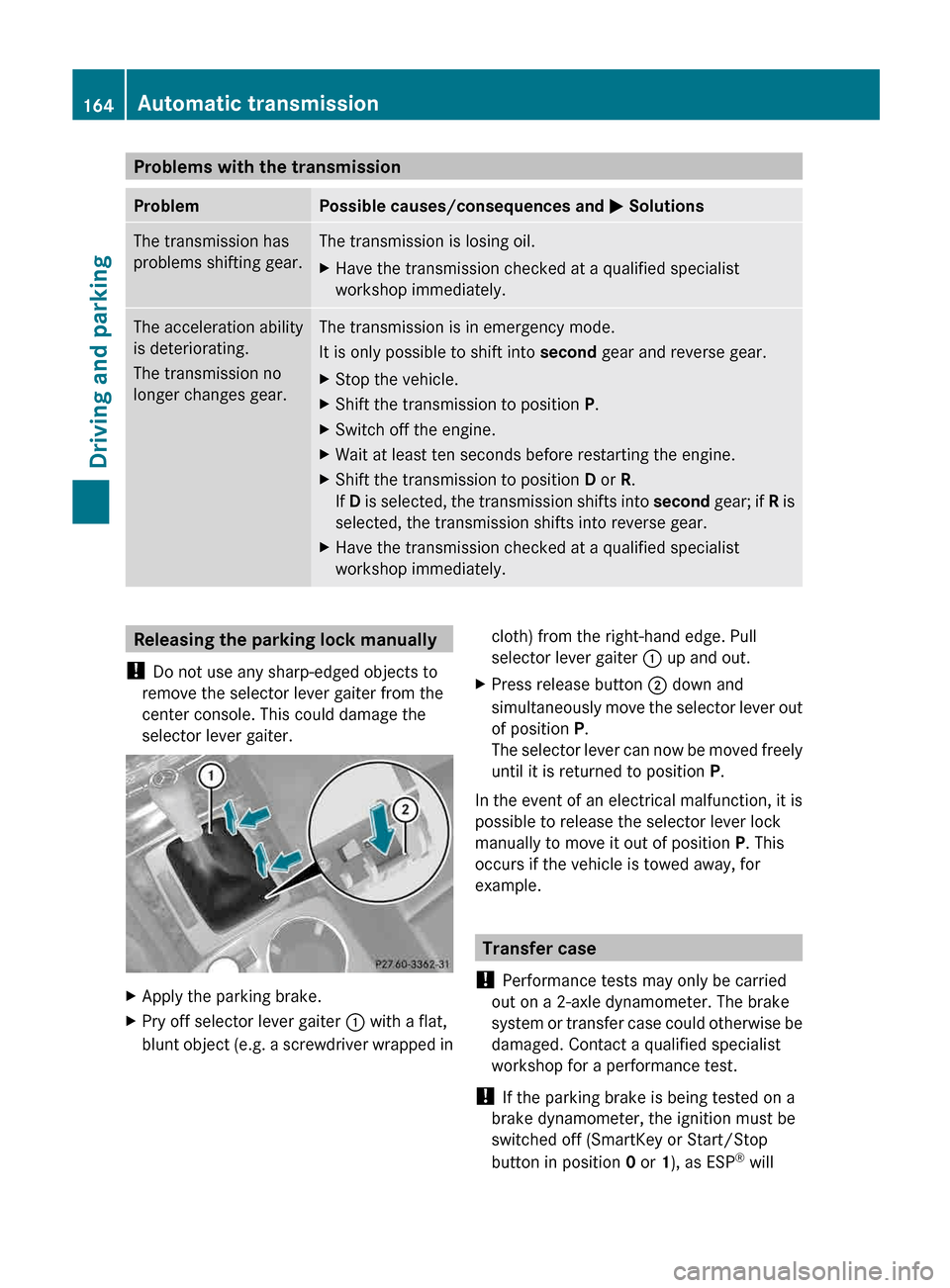
selector lever gaiter. X
Apply the parking brake.
X Pry off selector lever gaiter : with a flat,
blunt
object (e.g. a screwdriver wrapped in cloth) from the right-hand edge. Pull
selector lever gaiter : up and out.
X Press release button ; down and
simultaneously
move the selector lever out
of position P.
The selector lever can now be moved freely
until it is returned to position P.
In the event of an electrical malfunction, it is
possible to release the selector lever lock
manually to move it out of position P. This
occurs if the vehicle is towed away, for
example. Transfer case
! Performance tests may only be carried
out on a 2-axle dynamometer. The brake
system
or transfer case could otherwise be
damaged. Contact a qualified specialist
workshop for a performance test.
! If the parking brake is being tested on a
brake dynamometer, the ignition must be
switched off (SmartKey or Start/Stop
button in position 0 or 1), as ESP®
will 164
Automatic transmission
Driving and parking
Page 199 of 372
The Please Steer Wheel to the Left
or Please Steer Wheel to the Right
message appears in the multifunction
display.
X Countersteering: while the vehicle is
stationary, turn the steering wheel in the
specified direction until the arrow is white
and a warning tone sounds.
X To reverse into the parking space:
maintain the steering wheel angle and
reverse carefully.
X Stop as soon as you hear a warning tone,
at
the latest when PARKTRONIC sounds the
continuous warning tone.
The Parking Guidance Finished
message appears in the multifunction
display and a tone sounds. You may be
asked to steer in a different direction and
then change gear. In this case, further
displays in the multifunction display will
direct you to the final position.
X Maneuver if necessary.
X Always observe the warning messages
displayed by PARKTRONIC
(Y page 193).
Canceling Parking Guidance X
Press the PARKTRONIC button on the
center console
(Y page 193).
Parking Guidance is canceled immediately
and PARKTRONIC is deactivated.
Parking Guidance is canceled automatically if
it is no longer possible to guide you into the
parking space, or if a malfunction occurs.
The parking space symbol goes out and a
warning tone sounds. The Parking
Guidance
Canceled message appears in the
multifunction display. Rear view camera
Important safety notes G
WARNING
Make sure that no persons or animals are in
the maneuvering range. Otherwise, they
could be injured.
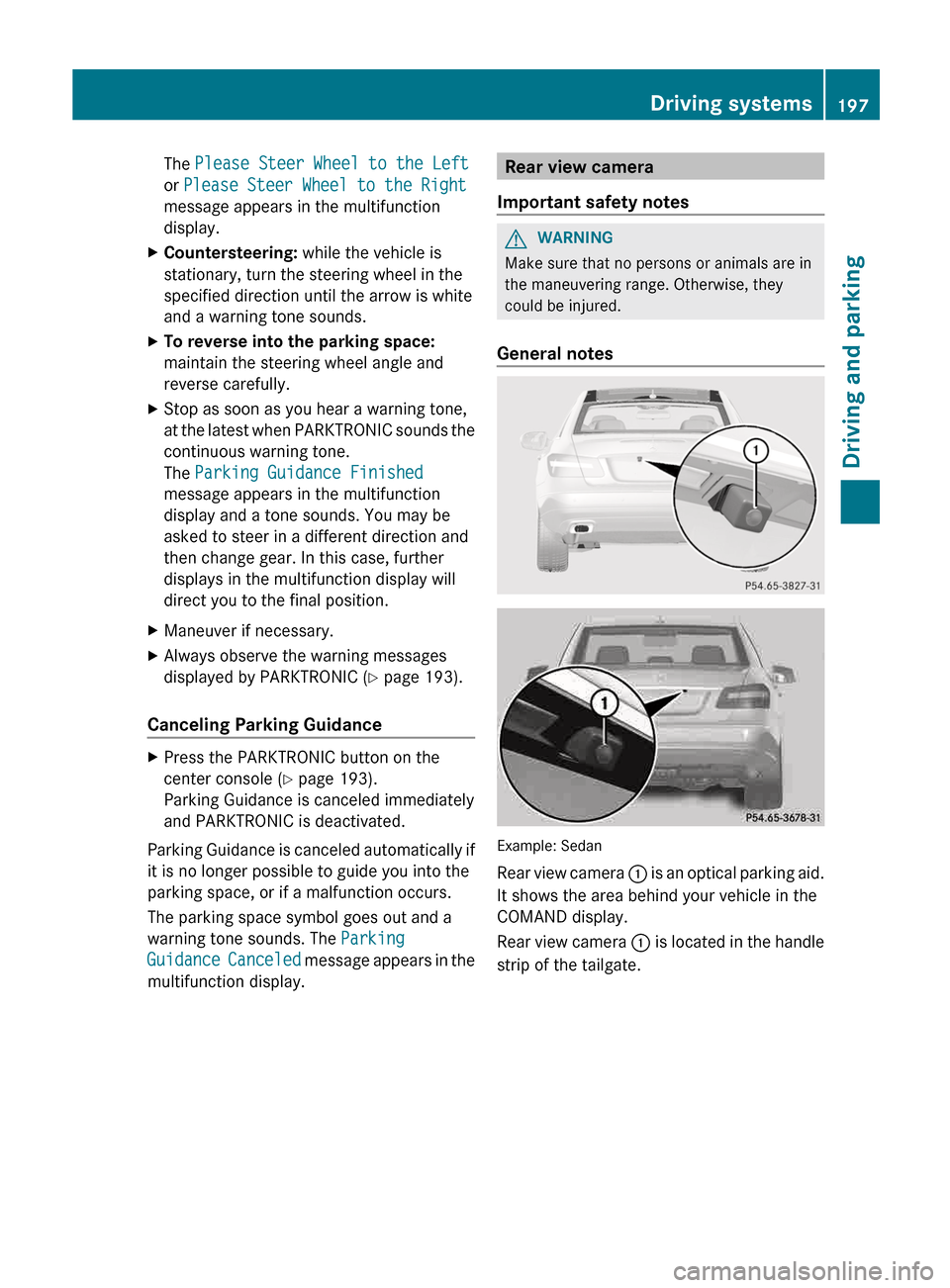
General notes Example: Sedan
Rear
view camera : is an optical parking aid.
It shows the area behind your vehicle in the
COMAND display.
Rear view camera : is located in the handle
strip of the tailgate. Driving systems
197
Driving and parking Z
Page 236 of 372
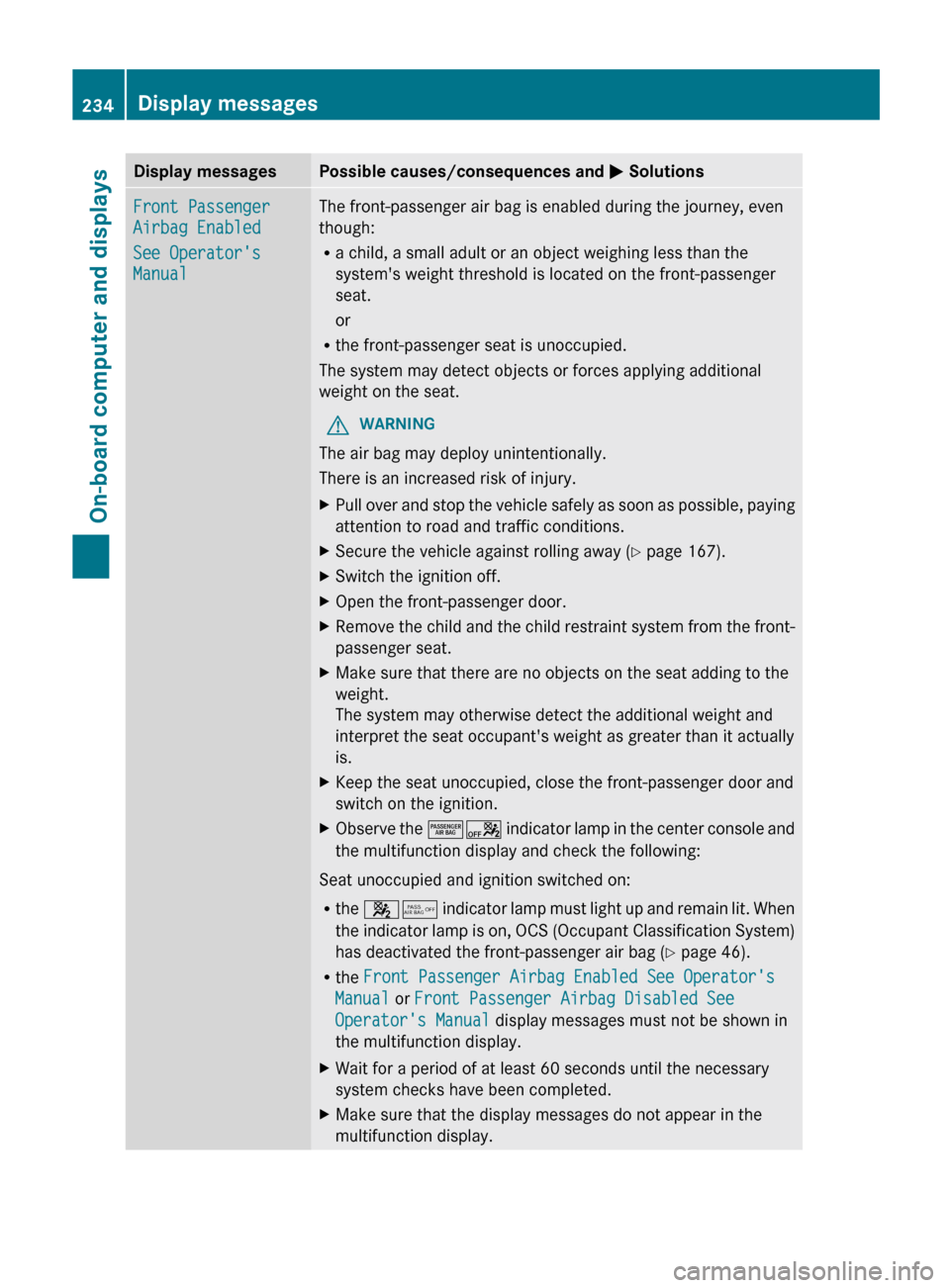
Display messages Possible causes/consequences and
M SolutionsFront Passenger
Airbag Enabled
See Operator's
Manual The front-passenger air bag is enabled during the journey, even
though:
R
a child, a small adult or an object weighing less than the
system's weight threshold is located on the front-passenger
seat.
or
R the front-passenger seat is unoccupied.
The system may detect objects or forces applying additional
weight on the seat.
G WARNING
The air bag may deploy unintentionally.
There is an increased risk of injury.
X Pull over and stop the vehicle safely as soon as possible, paying
attention to road and traffic conditions.
X Secure the vehicle against rolling away ( Y page 167).
X Switch the ignition off.
X Open the front-passenger door.
X Remove the child and the child restraint system from the front-
passenger seat.
X Make sure that there are no objects on the seat adding to the
weight.
The system may otherwise detect the additional weight and
interpret the seat occupant's weight as greater than it actually
is.
X Keep the seat unoccupied, close the front-passenger door and
switch on the ignition.
X Observe the ^a indicator lamp in the center console and
the multifunction display and check the following:
Seat unoccupied and ignition switched on:
R the 45
indicator lamp must light up and remain lit. When
the indicator lamp is on, OCS (Occupant Classification System)
has deactivated the front-passenger air bag ( Y page 46).
R the Front Passenger Airbag Enabled See Operator's
Manual or Front Passenger Airbag Disabled See
Operator's Manual display messages must not be shown in
the multifunction display.
X Wait for a period of at least 60 seconds until the necessary
system checks have been completed.
X Make sure that the display messages do not appear in the
multifunction display.234
Display messages
On-board computer and displays
Page 237 of 372
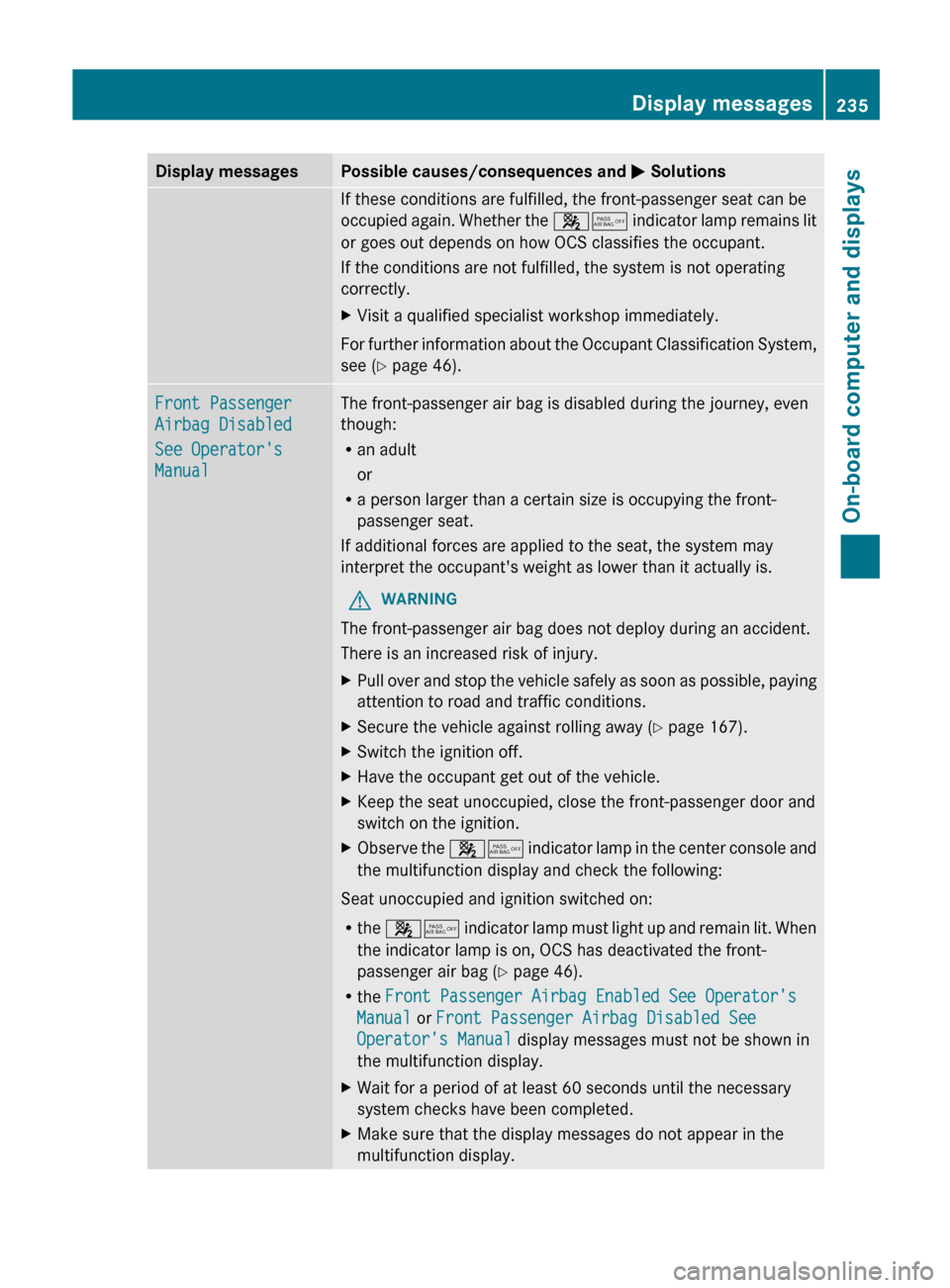
Display messages Possible causes/consequences and
M SolutionsIf these conditions are fulfilled, the front-passenger seat can be
occupied
again. Whether the 45 indicator lamp remains lit
or goes out depends on how OCS classifies the occupant.
If the conditions are not fulfilled, the system is not operating
correctly.
X Visit a qualified specialist workshop immediately.
For further information about the Occupant Classification System,
see ( Y page 46). Front Passenger
Airbag Disabled
See Operator's
Manual The front-passenger air bag is disabled during the journey, even
though:
R
an adult
or
R a person larger than a certain size is occupying the front-
passenger seat.
If additional forces are applied to the seat, the system may
interpret the occupant's weight as lower than it actually is.
G WARNING
The front-passenger air bag does not deploy during an accident.
There is an increased risk of injury.
X Pull over and stop the vehicle safely as soon as possible, paying
attention to road and traffic conditions.
X Secure the vehicle against rolling away ( Y page 167).
X Switch the ignition off.
X Have the occupant get out of the vehicle.
X Keep the seat unoccupied, close the front-passenger door and
switch on the ignition.
X Observe the 45
indicator lamp in the center console and
the multifunction display and check the following:
Seat unoccupied and ignition switched on:
R the 45
indicator lamp must light up and remain lit. When
the indicator lamp is on, OCS has deactivated the front-
passenger air bag ( Y page 46).
R the Front Passenger Airbag Enabled See Operator's
Manual or Front Passenger Airbag Disabled See
Operator's Manual display messages must not be shown in
the multifunction display.
X Wait for a period of at least 60 seconds until the necessary
system checks have been completed.
X Make sure that the display messages do not appear in the
multifunction display. Display messages
235
On-board computer and displays Z
Page 275 of 372
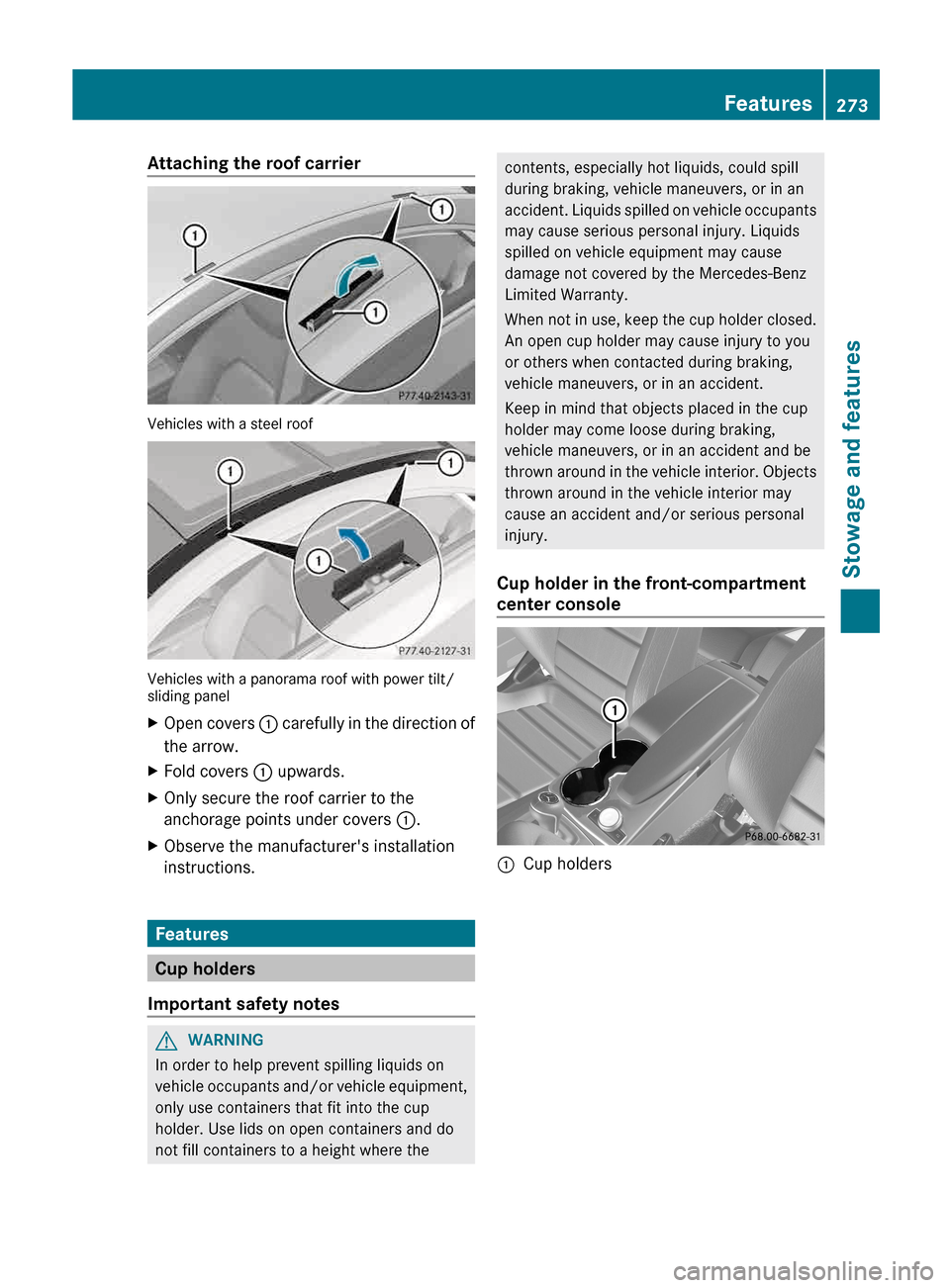
Attaching the roof carrier
Vehicles with a steel roof
Vehicles with a panorama roof with power tilt/
sliding panel
X
Open covers : carefully in the direction of
the arrow.
X Fold covers : upwards.
X Only secure the roof carrier to the
anchorage points under covers :.
X Observe the manufacturer's installation
instructions. Features
Cup holders
Important safety notes G
WARNING
In order to help prevent spilling liquids on
vehicle
occupants and/or vehicle equipment,
only use containers that fit into the cup
holder. Use lids on open containers and do
not fill containers to a height where the contents, especially hot liquids, could spill
during braking, vehicle maneuvers, or in an
accident.
Liquids spilled on vehicle occupants
may cause serious personal injury. Liquids
spilled on vehicle equipment may cause
damage not covered by the Mercedes-Benz
Limited Warranty.
When not in use, keep the cup holder closed.
An open cup holder may cause injury to you
or others when contacted during braking,
vehicle maneuvers, or in an accident.
Keep in mind that objects placed in the cup
holder may come loose during braking,
vehicle maneuvers, or in an accident and be
thrown around in the vehicle interior. Objects
thrown around in the vehicle interior may
cause an accident and/or serious personal
injury.
Cup holder in the front-compartment
center console :
Cup holders Features
273
Stowage and features Z
Page 279 of 372
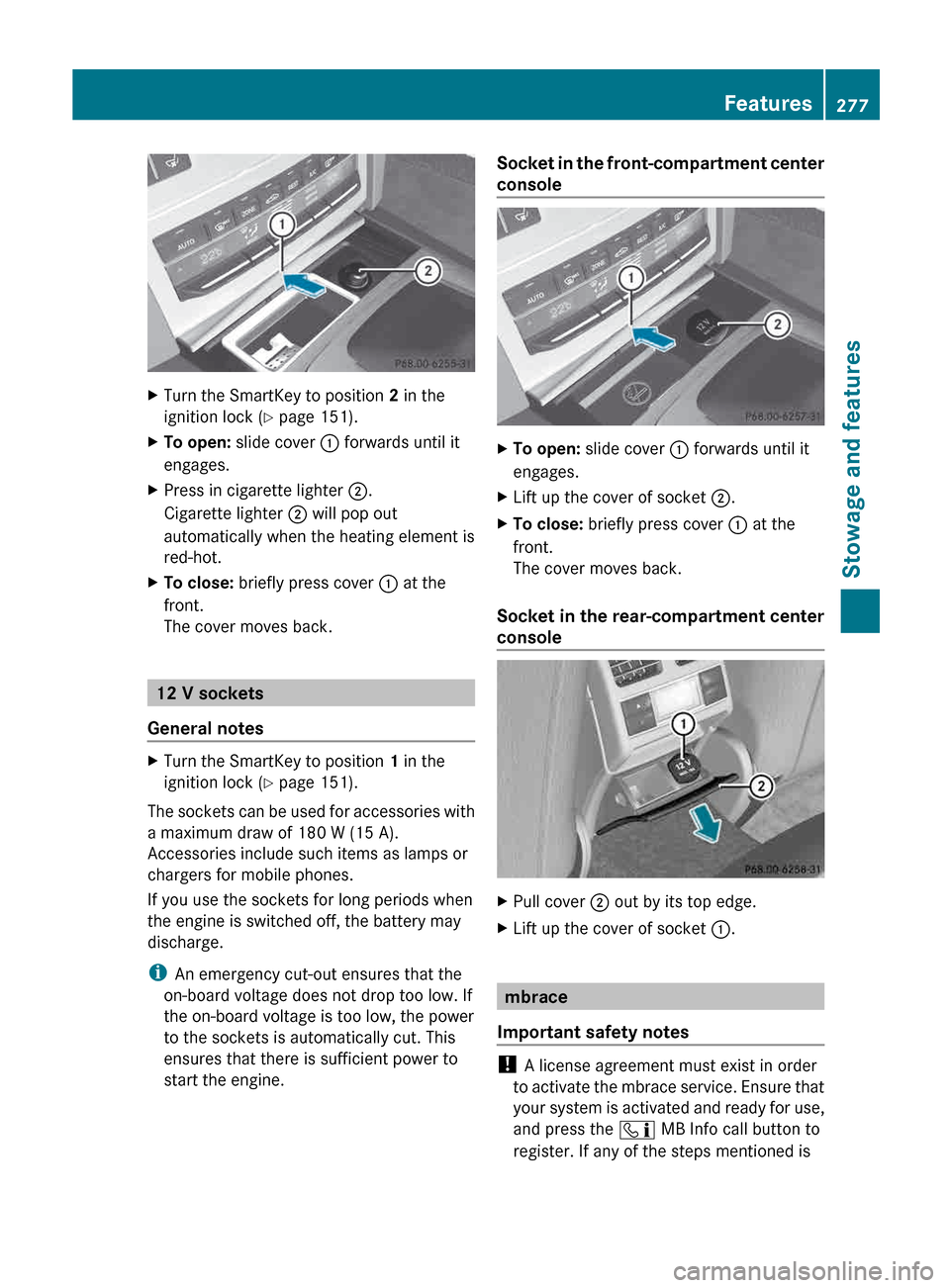
X
Turn the SmartKey to position 2 in the
ignition lock ( Y page 151).
X To open: slide cover : forwards until it
engages.
X Press in cigarette lighter ;.
Cigarette lighter ; will pop out
automatically when the heating element is
red-hot.
X To close: briefly press cover : at the
front.
The cover moves back. 12 V sockets
General notes X
Turn the SmartKey to position 1 in the
ignition lock ( Y page 151).
The sockets can be used for accessories with
a maximum draw of 180 W (15 A).
Accessories include such items as lamps or
chargers for mobile phones.
If you use the sockets for long periods when
the engine is switched off, the battery may
discharge.
i An emergency cut-out ensures that the
on-board voltage does not drop too low. If
the on-board voltage is too low, the power
to the sockets is automatically cut. This
ensures that there is sufficient power to
start the engine. Socket in the front-compartment center
console
X
To open: slide cover : forwards until it
engages.
X Lift up the cover of socket ;.
X To close: briefly press cover : at the
front.
The cover moves back.
Socket in the rear-compartment center
console X
Pull cover ; out by its top edge.
X Lift up the cover of socket :. mbrace
Important safety notes !
A license agreement must exist in order
to
activate the mbrace service. Ensure that
your system is activated and ready for use,
and press the ï MB Info call button to
register. If any of the steps mentioned is Features
277
Stowage and features Z
Page 304 of 372
Cleaning the vehicle parts
Cleaning the Cabriolet soft top !
Never use any of the following to clean the
soft top:
R gasoline
R thinner
R tar or stain remover
R other organic solvents
! Remove bird droppings immediately as
they are corrosive and, therefore, can make
the soft-top fabric leak. Do not use high-
pressure cleaning equipment to clean the
vehicle. Do not use sharp-edged equipment
to remove ice and snow.
X Light soiling: you can clean the soft top
while it is dry or rinse it with clear water.
X Normal to heavy soiling: clean the soft
top with a brush and clear water. Clean
stains and other dirt with a brush and soft
top cleaning agents that have been
recommended
and approved by Mercedes-
Benz. Always brush from front to back,
following the grain of the fabric.
Frequent cleaning reduces the soft top's
resistance to dirt.
To restore this resistance to dirt, clean the
soft top using soft top cleaning agents that
have been recommended and approved by
Mercedes-Benz.
Incorrect
cleaning and care, as well as aging,
can cause the soft-top seams to leak. Have
the soft-top seams sealed at a qualified
specialist workshop, e.g. at an authorized
Mercedes-Benz Center.
i Cover the soft top appropriately if you
plan to leave the vehicle outside for a long
period of time. Cleaning AIRCAP Cleaning the wind deflector
!
Do not use high-pressure cleaning
equipment to clean the net.
Clean the wind deflector on the windshield
with the soft top closed.
X Apply the parking brake firmly.
X Vehicles with SmartKey: turn the
SmartKey to position 2 in the ignition lock
(Y page 151).
X Vehicles with KEYLESS-GO: press the
Start/Stop button twice
(Y page 151).
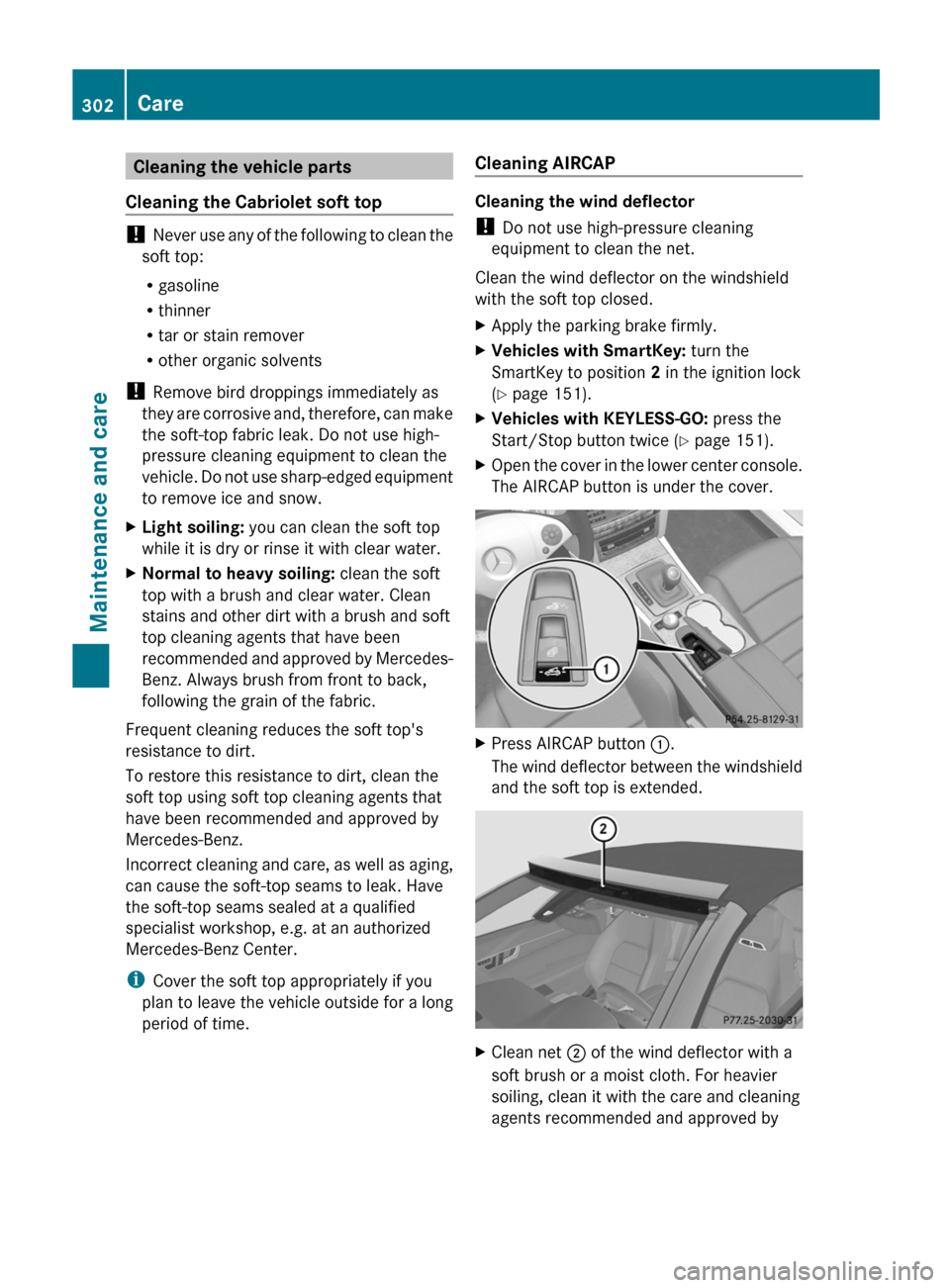
X Open the cover in the lower center console.
The AIRCAP button is under the cover. X
Press AIRCAP button :.
The
wind deflector between the windshield
and the soft top is extended. X
Clean net ; of the wind deflector with a
soft brush or a moist cloth. For heavier
soiling, clean it with the care and cleaning
agents recommended and approved by302
Care
Maintenance and care
Page 362 of 372
Useful information
i This Operator's Manual describes all
models and all standard and optional
equipment of your vehicle available at the
time of publication of the Operator's
Manual. Country-specific differences are
possible.
Please note that your vehicle may
not be equipped with all features
described. This also applies to safety-
related systems and functions.
i Read the information on qualified
specialist workshops: ( Y page 24).Information regarding technical data
i The
data stated here specifically refers to
a vehicle with standard equipment. Consult
an authorized Mercedes-Benz Center for
the data for all vehicle variants and trim
levels. Genuine Mercedes-Benz parts
G
WARNING
Driving safety may be impaired if non-
approved parts, tires and wheels or safety-
relevant accessories are used.
This could lead to malfunctions in safety-
relevant
systems, e.g. the brake system. This
could cause you to lose control of your vehicle
and cause an accident.
For this reason, Mercedes-Benz recommends
that you use genuine Mercedes-Benz parts or
parts of equal quality. Only use tires, wheels
and accessories that have been specifically
approved for your vehicle. H
Environmental note
Daimler AG also supplies reconditioned major
assemblies and parts which are of the same
quality
as new parts. They are covered by the
same Limited Warranty entitlements as new
parts. !
Air bags and Emergency Tensioning
Devices, as well as control units and
sensors
for these restraint systems, may be
installed in the following areas of your
vehicle:
R doors
R door pillars
R door sills
R seats
R cockpit
R instrument cluster
R center console
Do not install accessories such as audio
systems in these areas. Do not carry out
repairs or welding. You could impair the
operating efficiency of the restraint
systems.
Have aftermarket accessories installed at
a qualified specialist workshop.
Genuine Mercedes-Benz parts are subject to
strict quality control. Each part has been
specially developed, manufactured or
selected for Mercedes-Benz vehicles and
fine-tuned for them. Only genuine Mercedes-
Benz parts should therefore be used.
More than 300,000 different genuine
Mercedes-Benz parts are available for
Mercedes-Benz models.
All Mercedes-Benz Centers maintain a supply
of genuine Mercedes-Benz parts for
necessary service and repair work. In
addition, strategically located parts delivery
centers provide quick and reliable parts
service.
Always specify the vehicle identification
number (VIN) ( Y page 361) and the engine
number (Y page 362) when ordering genuine
Mercedes-Benz parts. Warranty
Your
vehicle is covered under the terms of the
warranties printed in the Service and
Warranty Information booklet. 360
Warranty
Technical data