head light MERCEDES-BENZ E-Class COUPE 2014 C207 User Guide
[x] Cancel search | Manufacturer: MERCEDES-BENZ, Model Year: 2014, Model line: E-Class COUPE, Model: MERCEDES-BENZ E-Class COUPE 2014 C207Pages: 394, PDF Size: 5.28 MB
Page 54 of 394
G
WARNING
If the red 001DSRS warning lamp in the
instrument cluster and the 0018001A
indicator lamp light up simultaneously, the
OCS is malfunctioning. The front passenger
front air bag will be deactivated in this case.
Have the system checked by qualified
technicians as soon as possible.C ontactan
authorized Mercedes-Ben zCenter.
Only have the seat repaired or replaced at an
authorized Mercedes-Benz Center.
In order to ensure proper operation of the air
bag system and OCS:
R Sit with the seat belt properly fastened in a
position that is as upright as possible with
your back against the seat backrest.
R When seated, a passenger should not
position him/herself in such a way as to
cause the passenger's weight to be lifted
from the seat cushion as this may result in
the OCS being unable to correctly
approximate the passenger's weight
category.
R Read and observe all warnings in this
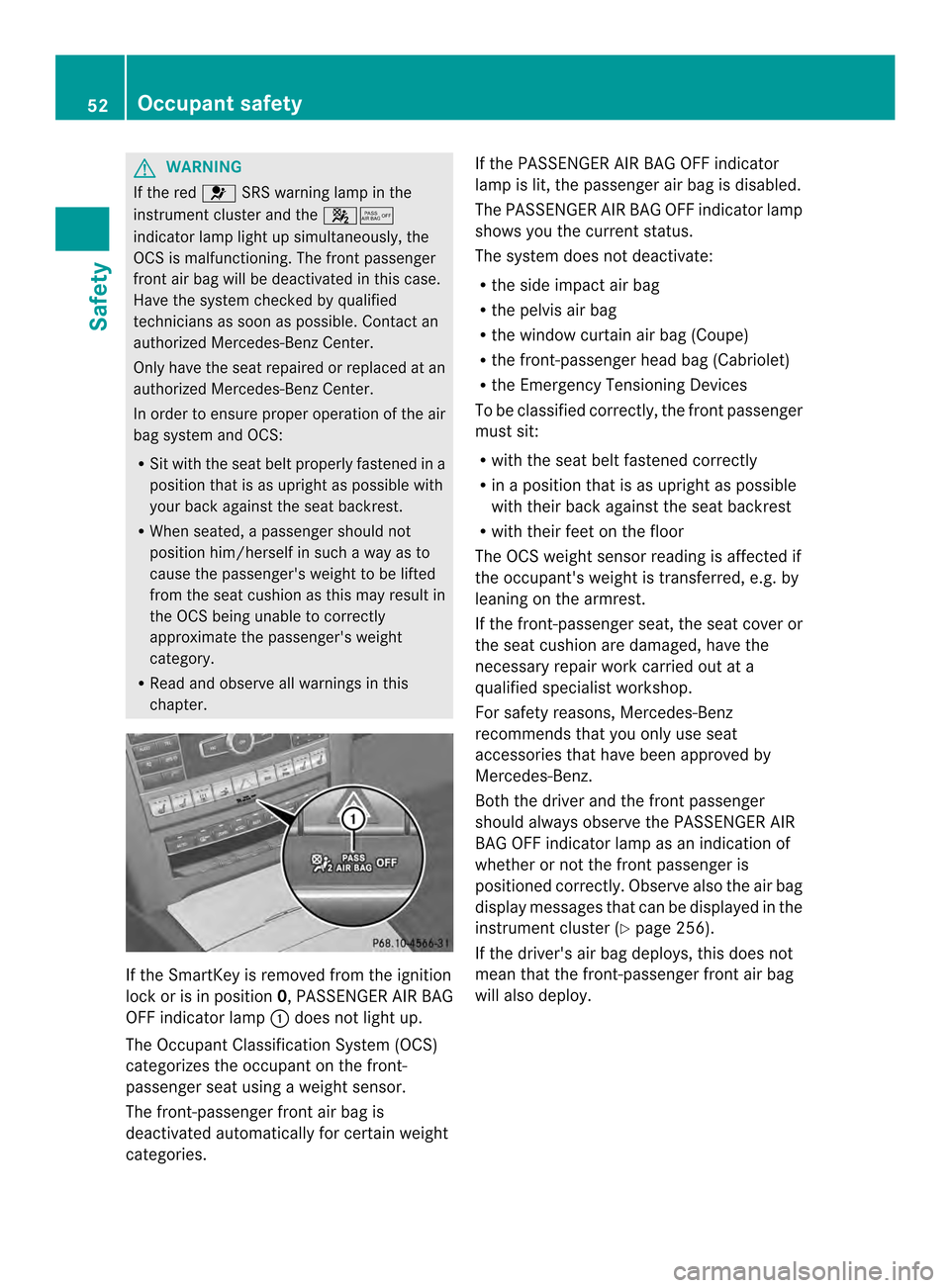
chapter. If the SmartKey is removed from the ignition
lock or is in position 0,PASSENGER AIR BAG
OFF indicator lamp 0002does not light up.
The Occupant Classification System (OCS)
categorizes the occupant on the front-
passenge rseat using a weight sensor.
The front-passenger fron tair bag is
deactivated automatically for certain weight
categories. If the PASSENGER AIR BAG OFF indicator
lamp is lit, the passenger air bag is disabled.
The PASSENGER AI
RBAG OFF indicator lamp
shows you the current status.
The system does not deactivate:
R the side impact ai rbag
R the pelvis air bag
R the window curtain air bag (Coupe)
R the front-passenger head bag (Cabriolet)
R the Emergency Tensioning Devices
To be classified correctly, the fron tpassenger
must sit:
R with the seat belt fastened correctly
R in a positio nthat is as upright as possible
with their back against the seat backrest
R with their feet on the floor
The OCS weight sensor reading is affected if
the occupant's weight is transferred, e.g. by
leaning on the armrest.
If the front-passenger seat, the seat cover or
the seat cushion are damaged, have the
necessary repair work carried out at a
qualified specialist workshop.
For safety reasons, Mercedes-Benz
recommends that you only use seat
accessories that have been approved by
Mercedes-Benz.
Both the driver and the front passenger
should always observe the PASSENGER AIR
BAG OFF indicator lamp as an indication of
whether or not the front passenger is
positioned correctly. Observe also the air bag
display messages that can be displayed in the
instrument cluster (Y page 256).
If the driver's air bag deploys, this does not
mean that the front-passenger front air bag
will also deploy. 52
Occupant safetySafety
Page 57 of 394
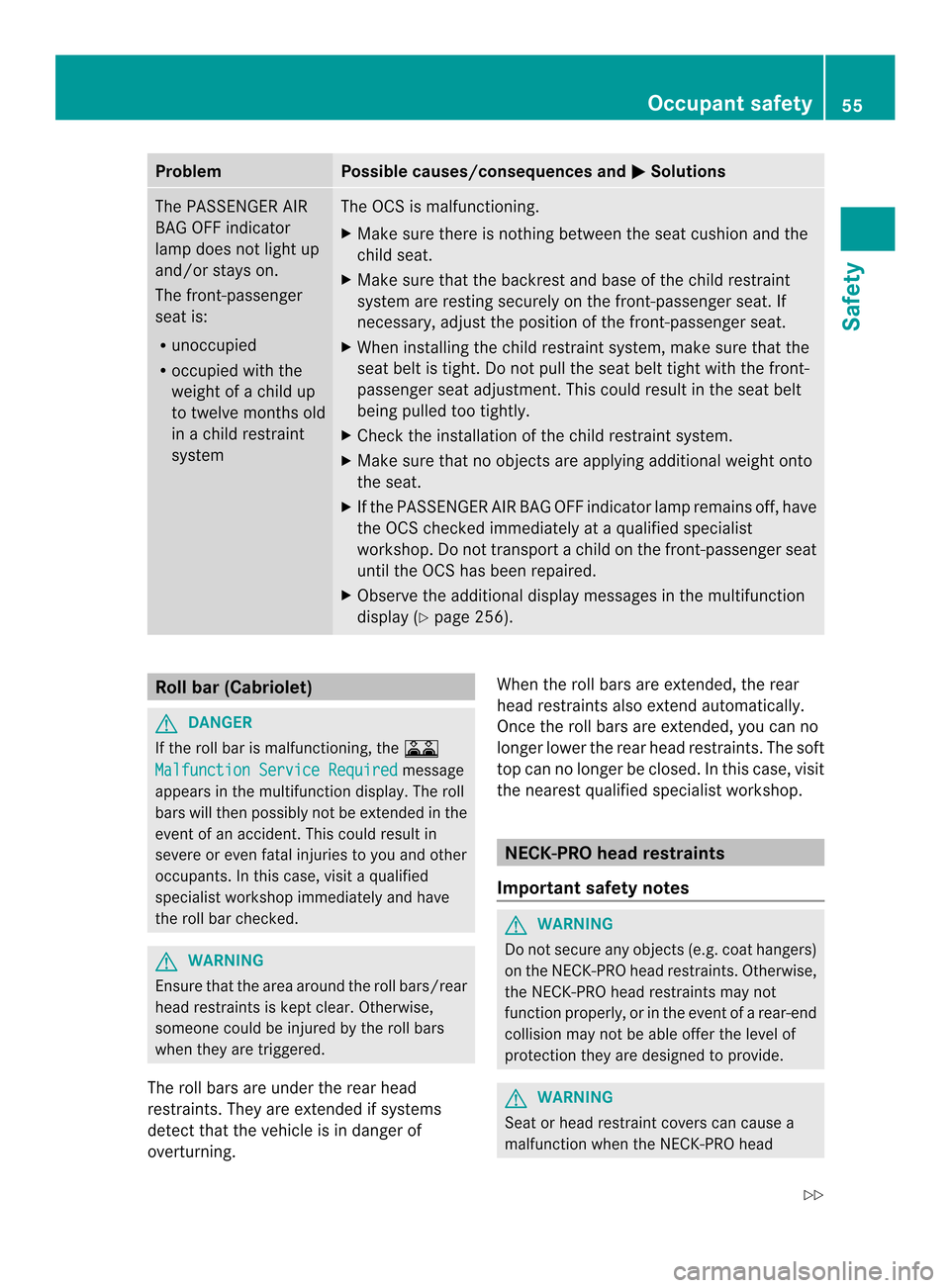
Problem Possible causes/consequences and
0001 Solutions
The PASSENGER AIR
BAG OFF indicator
lamp does not light up
and/or stays on.
The front-passenger
seat is:
R
unoccupied
R occupied with the
weight of a child up
to twelve months old
in a child restraint
system The OCS is malfunctioning.
X
Make sure there is nothing between the seat cushion and the
child seat.
X Make sure that the backrest and base of the child restraint
system are resting securely on the front-passenger seat. If
necessary, adjust the position of the front-passenger seat.
X When installing the child restraint system, make sure that the
seat belt is tight. Do not pull the seat belt tight with the front-
passenger seat adjustment .This could result in the seat belt
being pulled too tightly.
X Check the installation of the child restraint system.
X Make sure that no objectsa re applying additional weight onto
the seat.
X If the PASSENGER AIR BAG OFF indicator lamp remains off, have
the OCS checked immediatel yataqualified specialist
workshop. Do not transport a child on the front-passenger seat
until the OCS has been repaired.
X Observe the additional display messages in the multifunction
display ( Ypage 256). Roll bar (Cabriolet)
G
DANGER
If the roll bar is malfunctioning, the 0013
Malfunction Service Required message
appears in the multifunction display. The roll
bars will then possibly not be extended in the
event of an accident. This could result in
severe or even fatal injuries to you and other
occupants. In this case, visit a qualified
specialist workshop immediately and have
the roll bar checked. G
WARNING
Ensure that the area around the roll bars/rear
head restraints is kept clear. Otherwise,
someone could be injured by the roll bars
when they are triggered.
The roll bars are under the rear head
restraints. They are extended if systems
detec tthat the vehicle is in danger of
overturning. When the roll bars are extended, the rear
head restraints also extend automatically.
Once the roll bars are extended, you can no
longer lower the rear head restraints. The soft
top can no longer be closed. In this case, visit
the nearest qualified specialist workshop. NECK-PRO head restraints
Important safety notes G
WARNING
Do not secure any objects (e.g. coat hangers)
on the NECK-PRO head restraints. Otherwise,
the NECK-PRO head restraints may not
function properly, or in the event of a rear-end
collision may not be able offer the level of
protection they are designed to provide. G
WARNING
Seat or head restraint covers can cause a
malfunction when the NECK-PRO head Occupant safety
55Safety
Z
Page 64 of 394
Tensioning Device could be triggered in the
event of an accident.
i Vehicles with PRE-SAFE ®
: Emergency
Tensioning Devices that are triggered by an
electric motor can be deployed as often as
desired and do not need to be replaced.
The fronts eat belts and the outer seat belts
in the rear are equipped with Emergency
Tensioning Devices and seat belt force
limiters.
The ETDs tighten the seat belts in an accident,
pulling them close against the body.
The ETDs do not correct incorrect seat
positions or incorrectly fastened seat belts.
The ETDs do not pull vehicle occupants back
towards the backrest.
The ETDs can only be activated when:
R the ignition is switched on
R the restraint systems are operational; see
"SRS warning lamp 001D" (Ypage 43)
R the belt tongue is engaged in the buckle on
each of the front seat belts
The ETDs on the outside seats in the rear
compartment are triggered independently of
the lock status of the seat belts.
The ETDs are triggered depending on the type
and severity of an accident:
R in the event of a head-on or rear-end
collision if the vehicle decelerates or
accelerates rapidly in a longitudinal
direction during the initial stages of the
impact.
R in the event of a side impact if the vehicle
decelerates or accelerates rapidly in a
lateral direction on the side opposite to the
impact.
R Cabriolet: in certain situations if the vehicle
rolls over and the system determines that
it can provide additional protection
If the ETDs are deployed, you will hear a bang,
and a small amount of powder may also be
released. Only in rare cases will the bang
affect your hearing. The powder that is
released generally does not constitute a health hazard and does not indicate that there
is a fire in the vehicle. The dust might cause
some temporary breathing difficulty for
people with asthma or other breathing
trouble. To avoid this, you may wish to get out
of the vehicle as soon as it is safe to do so.
You can also open the window to allow fresh
air to enter the vehicle interior. The
001DSRS
warning lamp lights up.
If the seat belt is also equipped with a seat
belt force limiter and this is triggered, the
force exerted by the seat belt on the vehicle
occupan tis reduced.
The seat belt force limiters for the front seats
are synchronized with the front air bags,
which absorb part of the deceleration force.
This results in the force exerted on the
occupant being distributed over a greater
area.
Automatic comfort-fit feature The front seat belts have an automatic
comfort-fit feature. The automatic comfort-fit
feature reduces the retraction force of the
seat belts. This results in increased seat belt
comfort. Children in the vehicle
Child restraint systems
Important safety notes G
WARNING
According to accident statistics, children are
safer when properly restrained in the rear
seating positions than in the front seating
position. Thus, we strongly recommend that
children be placed in the rear seats whenever
possible.R egardless of seating position,
children 12 years old and under must be
seated and properly secured in an appropriate
infant restraint, toddler restraint, or booster
seat recommended for the size and weight of
the child. 62
Children in the vehicleSafety
Page 69 of 394

Always lock rea
rseat backrests after
installing a Top Tether belt. Observe the lock
verification indicator. Adjust the rear seat
backrests so that they are positioned
vertically.
Top Tether provides an additional connection
between the LATCH-type (ISOFIX) child
restraint system secured with LATCH-type
(ISOFIX) and the rear seat. This helps reduce
the risk of injury even further. If the child
restraint system is equipped with Top Tether,
this should always be used.
The Top Tether anchorage points are installed
in the rear compartment behind the head
restraints.
If the rear seat backrest is not engaged and
locked, this will be shown in the multifunction
display in the instrument cluster. A warning
tone also sounds. The Coupe has Top Tether anchorages. X
Press down the rear of cover 0003in the
direction of the arrow.
Cover 0003is raised slightly at the front.
X Fold up cover 0003of Top Tether anchorage
0023.
X Depending on the model and version, and
according to the manufacturer's
installation instructions, route Top Tether
belt 0020on the left and right past head
restraint 0002.
or
X Route Top Tether belt 0020over the center of
the head restraint.
X Hook Top Tether hook 0022into Top Tether
anchorage 0023.
X Make sure that Top Tether belt 0020is not
twisted.
X Install the LATCH-type (ISOFIX) child
restraint system with Top Tether .Always
comply with the child restraint system
manufacturer's installation instructions
when doing so. Make sure that Top Tether
belt 0020is tight. Child-proof locks
Important safety notes G
WARNING
If children are left unsupervised in the vehicle,
they could:
R open the doors, thus endangering other
people or road users.
R get out and disrupt traffic.
R operate the vehicle's equipment.
Additionally, children could set the vehicle in
motion if, for example, they:
R release the parking brake.
R shifting the automatic transmission out of
park position P
R Start the engine.
There is a risk of an accident and injury. Children in the vehicle
67Safety
Z
Page 74 of 394
G
WARNING
The distance warning function does not react:
R to people or animals
R to oncoming vehicles
R to crossing traffic
R when cornering
Thus, the distance warning function cannot
provide a warning in all critical situations.
There is a risk of an accident.
Always pay careful attention to the traffic
situation and be ready to brake. G
WARNING
The distance warning function cannot always
clearly identify objects and comple xtraffic
situations.
In such cases, the distance warning function
may:
R give an unnecessary warning
R not give a warning
There is a risk of an accident.
Always pay careful attention to the traffic
situation and do not rely solely on the distance
warning function.
Function
X To activate/deactivate: activate or
deactivate the distance warning function in
the on-board computer (Y page 241).
If the distance warning function is not
activated, the 0001symbol appears in the
assistance graphics display.
The distance warning function can help you
to minimize the risk of a front-end collision
with a vehicle ahead or reduce the effects of
such a collision. If the distance warning
function detects that there is a risk of a
collision, you will be warned visually and
acoustically.T he distance warning function
cannot prevent a collision without your
intervention.
Starting at a speed of around 4 mph
(7 km/h), the distance warning function
warns you if you rapidly approach a vehicle in front. An intermittent warning tone will then
sound, and the
000Adistance warning lamp
will light up in the instrumentc luster.
X Brake immediately in order to increase the
distance from the vehicle in front.
or
X Take evasive action, provided it is safe to
do so.
Due to the nature of the system, particularly
complicated but non-critical driving
conditions may also cause the system to
display a warning.
With the help of the radar sensor system, the
distance warning function can detect
obstacles that are in the path of your vehicle
for an extended period of time.
From a speed of aroun d40 mph (70 km/h),
the distance warning function can also react
to stationary obstacles, such as stopped or
parked vehicles.
If you approach an obstacle and the distance
warning function detects a risk of a collision,
the system will initially alert you both visually
and acoustically.
In particular, the detectio nofobstacles can
be impaired if:
R dirt on the sensors or anything else
covering the sensors
R snow or heavy rain
R interference by other radar sources
R there are strong radar reflections, for
example in parking garages
R a narrow vehicle traveling in front, e.g. a
motorbike
R a vehicle traveling in fron tonadifferent line
relative to the center of your vehicle
Following damage to the fron tend of the
vehicle, have the configuratio nand operation
of the rada rsensor checked at a qualified
specialist workshop. This also applies to
collisions at low speeds where there is no
visible damage to the fron tofthe vehicle. 72
Driving safety systemsSafety
Page 109 of 394
AIRCAP
Important safety notes G
WARNING
When retracting the AIRCAP, persons could
become caught in the moving mechanism.
There is a ris kofinjury.
Ensure tha tpersons do not hold onto the
upper frame of the windshield and do not
touch the AIRCAP wind deflector. G
WARNING
When retracting the AIRCAP, persons could
become caught in the moving mechanism.
There is a risk of injury.
Ensure that persons do not hold onto the
upper frame of the windshield and do not
touch the AIRCAP wind deflector.
With AIRCAP, four people can travel
comfortably with the soft top open. AIRCAP
reduces the draft for the driver and
passengers in both the fron tand the rear
compartment in a vehicle with the soft top
down.
AIRCAP has the following components:
R a speed-dependent wind deflector above
the windshield
R an AIRCAP wind screen between the two
head restraints on the rea rbench seat
When AIRCAP has been activated, the
AIRCAP wind screen between the two rear
seat head restraints extends upwards. At a
speed of approximately 25 mph (40k m/h) or
higher, the wind deflector on the windshield
also extends. If you drive at speeds below
approximately 9mph (15 km/h), the wind
deflector retracts automatically.
AIRCAP can be activated or deactivated up to
speeds of approximately 100 mph
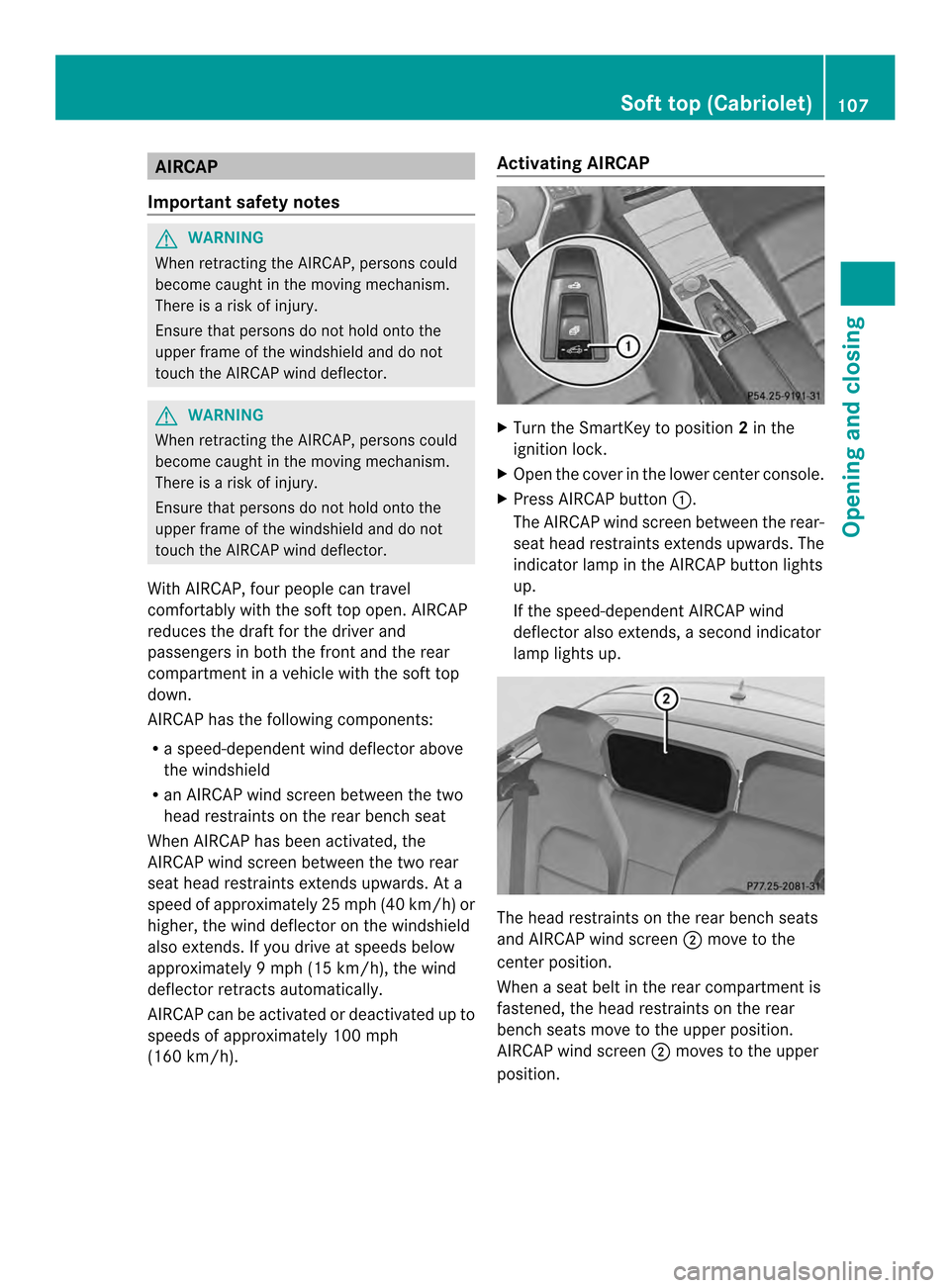
(160 km/h). Activating AIRCAP
X
Turn the SmartKey to position 2in the
ignition lock.
X Open the cover in the lower center console.
X Press AIRCAP button 0002.
The AIRCAP wind screen between the rear-
seat head restraints extends upwards. The
indicator lamp in the AIRCAP button lights
up.
If the speed-dependent AIRCAP wind
deflector also extends, a second indicator
lamp lights up. The head restraints on the rear bench seats
and AIRCAP wind screen
0003move to the
center position.
When a seat belt in the rear compartment is
fastened, the head restraints on the rear
bench seats move to the upper position.
AIRCAP wind screen 0003moves to the upper
position. Soft top (Cabriolet)
107Opening and closing Z
Page 111 of 394

X
Pull the AIRCAP wind screen out of the
guide rails in the direction of the arrow.
Make sure that you pull the AIRCAP wind
screen forwards slightly when doing so.
Installing X
Keeping the AIRCAP wind screen
horizontal, guide it into the slot between
the head restraints in the direction of the
arrow with both racks straight down.
X Push the AIRCAP wind screen down until
the bolts are at the same height as the
brackets on the head restraints.
X Insert the bolts into the brackets on both
sides.
X Tighten the bolts with the 4mmAllen key
until they engage.
The markings on the bolts are vertical. Soft top (Cabriolet)
109Opening and closing Z
Page 113 of 394

G
WARNING
If children operate the sliding sunroof they
could become trapped, particularly if they are
left unsupervised. There is a risk of injury.
When leaving the vehicle, always take the
SmartKey with you and lock the vehicle. Never
leave children unsupervised in the vehicle.
! Only open the sliding sunroof if it is free
of snow and ice. Otherwise, malfunctions
may occur.
Do not allow anything to protrude from the
sliding sunroof. Otherwise, the seals could
be damaged.
! The weather can change abruptly .Itcould
start to rain or snow. Make sure that the
sliding sunroof is closed when you leave the
vehicle. The vehicle electronics can be
damaged if water enters the vehicle
interior.
i Resonance noises can occur in addition
to the usual airflow noises when the sliding
sunroof is open. They are caused by minor
pressure fluctuations in the vehicle interior.
Change the position of the sliding sunroof
or open a side window slightly to reduce or
eliminate these noises. Reversing feature for the panorama
roof with power tilt/sliding panel
In the following section, the term "sliding
sunroof" refers to the panorama roof with
power tilt/sliding panel.
The sliding sunroof is equipped with an
automatic reversing feature. If a solid object
blocks or restricts the sliding sunroof during
the closing process, the sliding sunroof opens
again automatically. However, the automatic
reversing feature is only an aid and does not
relieve you of the responsibility of paying
attention when closing the sliding sunroof. G
WARNING
The reversing feature does not react:
R to soft, light and thin objects, e.g. small
fingers
R over the last 1/6 in(4 mm) of the closing
movement
R during resetting
R when closing the sliding sunroof again
manually immediately after automatic
reversing
This means that the reversing feature cannot
prevent someone being trapped in these
situations. There is a risk of injury.
Make sure that no body parts are in close
proximity during the closing procedure.
If somebody becomes trapped:
R release the switch immediately, or
R during automatic operation, push the
switch briefly in any direction
The closing process is stopped. Operating the panorama roof with
power tilt/sliding panel
Overhead control panel
0002
To raise
0003 To open
0023 To close/lower
The panorama roof with power tilt/sliding
panel can only be operated when the roller
sunblind is open. Sliding sunroof (Coupe)
111Opening and closing Z
Page 114 of 394

X
To open and close: turn the SmartKey to
position 1or 2in the ignition lock.
X Press or pull the 0002switch in the
corresponding direction.
i If you press the 0002switch beyond the
point of resistance, an automatic opening/
closing process is started in the
corresponding direction. Yo ucan stop
automatic operatio nby operating the
switch again. Operating the roller sunblind for the
panoram
aroof with power tilt/sliding
panel
Important safety notes G
WARNING
When opening or closing th eroller sunblind,
parts of the body could be trapped between
the roller sunblind and the frame or sliding
sunroof. There is a risk of injury.
When opening or closing make sure that no
parts of the body are in the sweep of the roller
sunblind.
If somebody becomes trapped:
R release the switch immediately, or
R during automatic operation, push the
switch briefly in any direction
The opening or closing procedure will be
stopped.
The roller sunblind shields the vehicle interior
from sunlight. The roller sunblind can only be
opened and closed when the panorama roof
with power tilt/sliding panel is closed.
Roller sunblind reversing feature The roller sunblind is equipped with an
automatic reversing feature. If a solid object
blocks or restricts the roller sunblind during
the closing process, the roller sunblind opens
again automatically. The automatic reversing
feature is only an aid and is not a substitute for your attentiveness to the roller sunblind
while it is closing. G
WARNING
The reversing feature especially does not
react to soft, light and thin objects such as
small fingers. This means that the reversing
feature cannot prevent someone being
trapped in these situations. There is a risk of
injury.
When closing make sure that no parts of the
body are in the sweep of the roller sunblind.
If somebody becomes trapped:
R release the switch immediately, or
R during automatic operation, push the
switch briefly in any direction
The closing process is stopped.
Opening and closing Overhead control panel
0002
Opening
0003 Opening
0023 Closing
X Turn the SmartKey to position 1or 2in the
ignition lock.
X Press or pull the 0002switch in the
corresponding direction.
i If you press or pull the 0002switch
beyond the point of resistance, an
automatic opening/closing process is
started in the corresponding direction .You
can stop automatic operation by pressing
or pulling again. 112
Sliding sunroof (Coupe)Opening and closing
Page 116 of 394
Problems with the sliding sunroof
In the following section, the term "sliding sunroof" refers to the panorama roof with power
tilt/sliding panel. G
WARNING
If you close the sliding sunroof again immediately after it has been blocked or reset, the sliding
sunroof closes with increased or maximum force. The reversing feature is then not active. Parts
of the body could be trapped in the closing area in the process. This poses an increased risk of
injury or even fatal injury.
Make sure that no parts of the body are in the closing area.
If somebody becomes trapped:
R release the switch immediately, or
R during automatic operation, push the switch briefly in any direction
The closing process is stopped.
! If the sliding sunroof still cannot be opened or closed as a result of a malfunction, contact
a qualified specialist workshop. Problem Possible causes/consequences and
0001 Solutions
The sliding sunroof
cannot be closed and
you cannot see the
cause. If the sliding sunroof is obstructed during closing and reopens
again slightly:
X
Immediately after the sliding sunroof blocks, pull the 0002
switch in the overhead control panel down to the point of
resistance and hold it until the sliding sunroof is closed.
The sliding sunroof is closed with increased force.
If the sliding sunroof is obstructed again during closing and then
reopens slightly:
X Immediately after the sliding sunroof blocks, pull the 0002
switch in the overhead control panel down to the point of
resistance and hold it until the sliding sunroof is closed.
The sliding sunroof is closed without the anti-entrapment
feature. 114
Sliding sunroof (Coupe)Opening and closing