lock MERCEDES-BENZ E-Class COUPE 2014 C207 User Guide
[x] Cancel search | Manufacturer: MERCEDES-BENZ, Model Year: 2014, Model line: E-Class COUPE, Model: MERCEDES-BENZ E-Class COUPE 2014 C207Pages: 394, PDF Size: 5.28 MB
Page 32 of 394
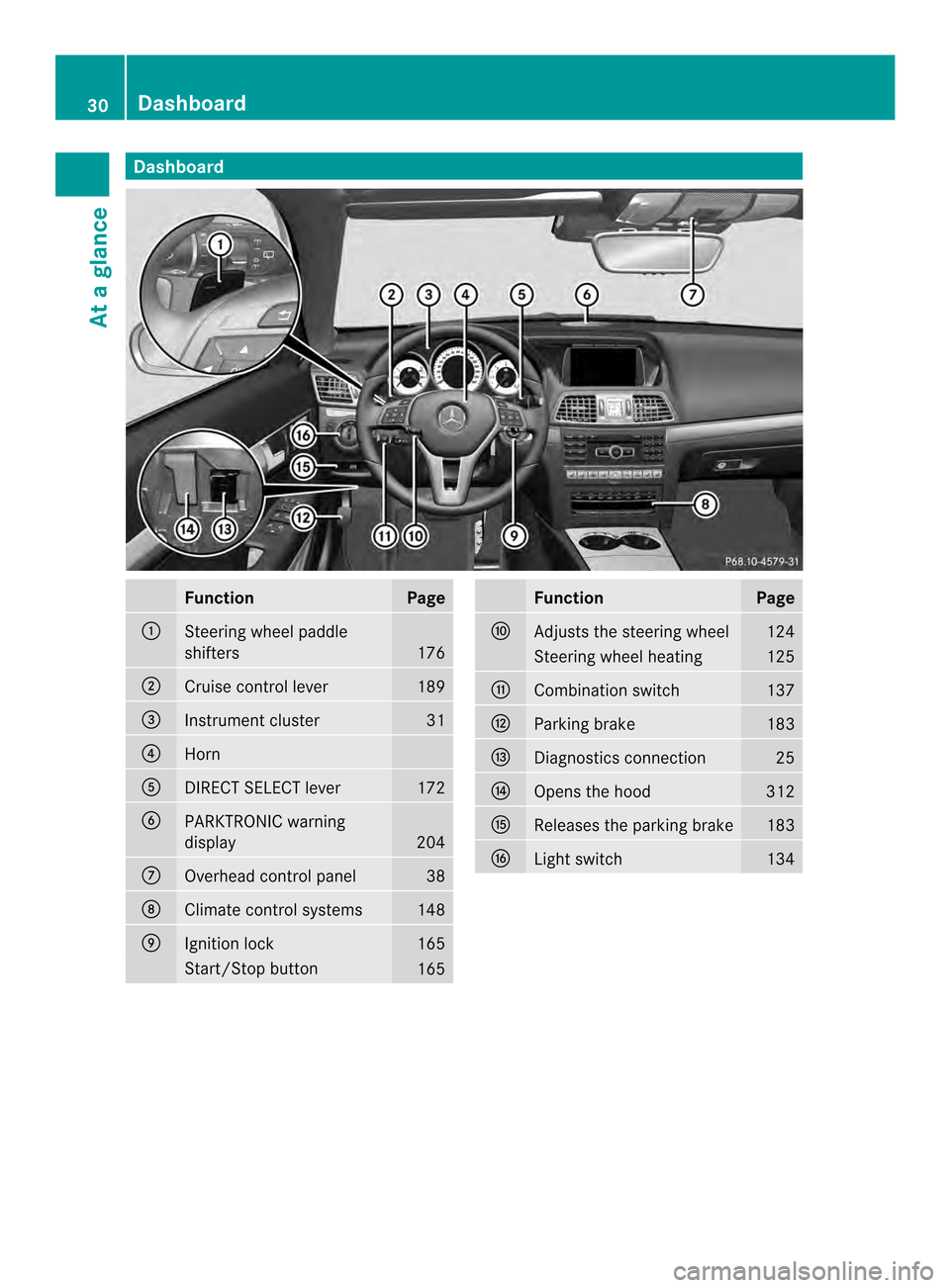
Dashboard
Function Page
0002
Steering wheel paddle
shifters
176
0003
Cruise control lever 189
0023
Instrument cluster 31
0022
Horn
0020
DIRECT SELECT lever 172
0021
PARKTRONIC warning
display
204
0014
Overhead control panel 38
0015
Climate control systems 148
0016
Ignition lock 165
Start/Stop button
165 Function Page
0017
Adjusts the steering wheel 124
Steering wheel heating 125
0018
Combination switch 137
001A
Parking brake 183
001B
Diagnostics connection 25
001C
Opens the hood 312
001D
Releases the parking brake 183
001E
Light switch 13430
Dashboa
rdAt a glance
Page 41 of 394
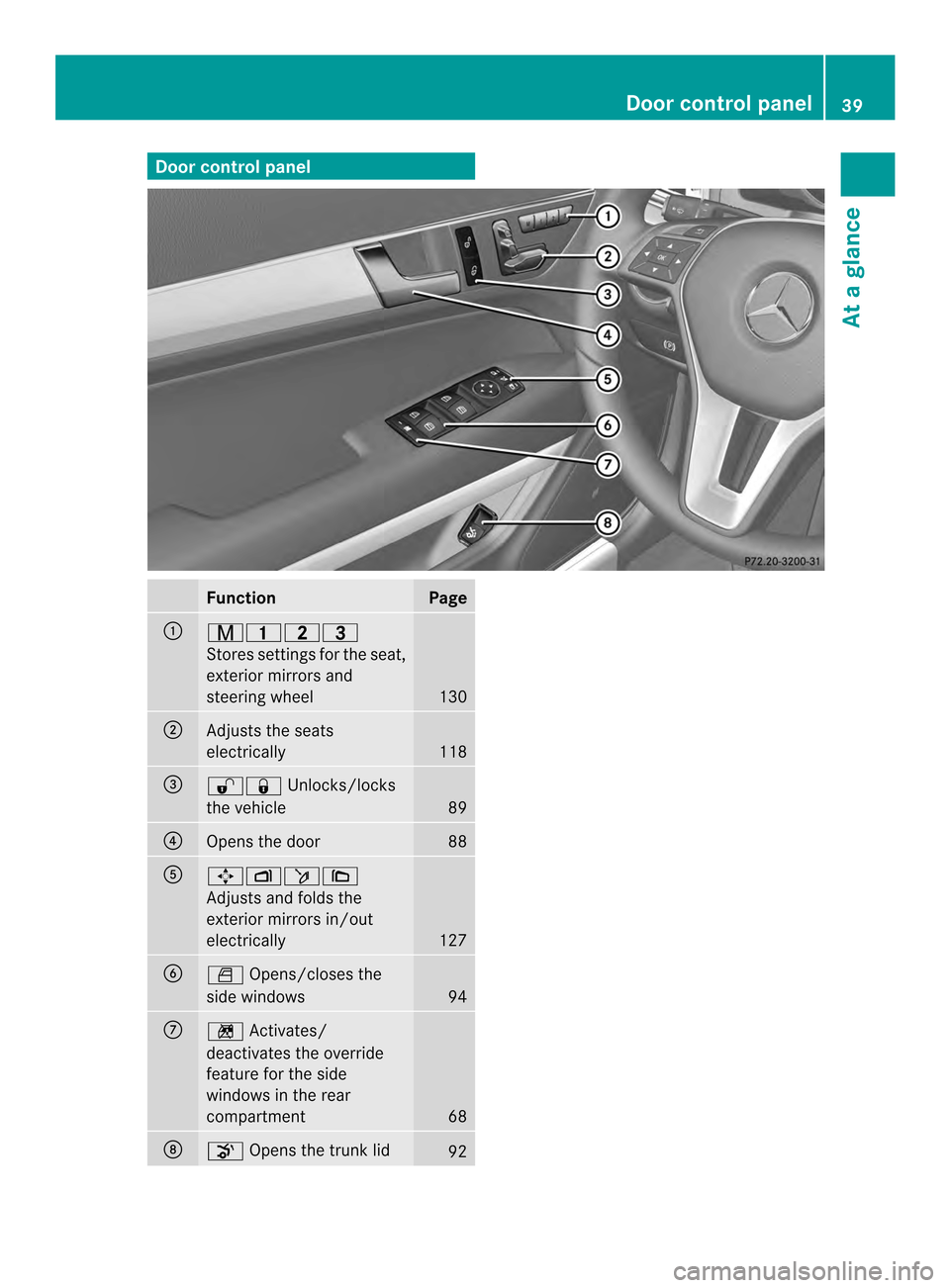
Door control panel
Function Page
0002
0014000D0009
Stores settings fo
rthe seat,
exterior mirrors and
steering wheel 130
0003
Adjusts the seats
electrically
118
0023
000E000D
Unlocks/locks
the vehicle 89
0022
Opens the door 88
0020
0005000A0011000B
Adjusts and folds the
exterior mirrors in/out
electrically
127
0021
0008
Opens/closes the
side windows 94
0014
0012
Activates/
deactivates the override
feature for the side
windows in the rear
compartment 68
0015
0013
Opens the trunk lid 92 Doorc
ontrol panel
39At a glance
Page 43 of 394
Useful information
..............................42
Panic alarm .......................................... 42
Occupant safety .................................. 42
Children in the vehicle ........................62
Driving safet ysystems ....................... 68
Theft deterrent locking system .........78 41Safety
Page 44 of 394
Useful information
i This Operator's Manual describes all
models and all standard and optional
equipment of your vehicle available at the
time of publication of the Operator's
Manual. Country-specific differences are
possible. Please note that your vehicle may
not be equipped with all features
described. This also applies to safety-
related systems and functions.
i Read the information on qualified
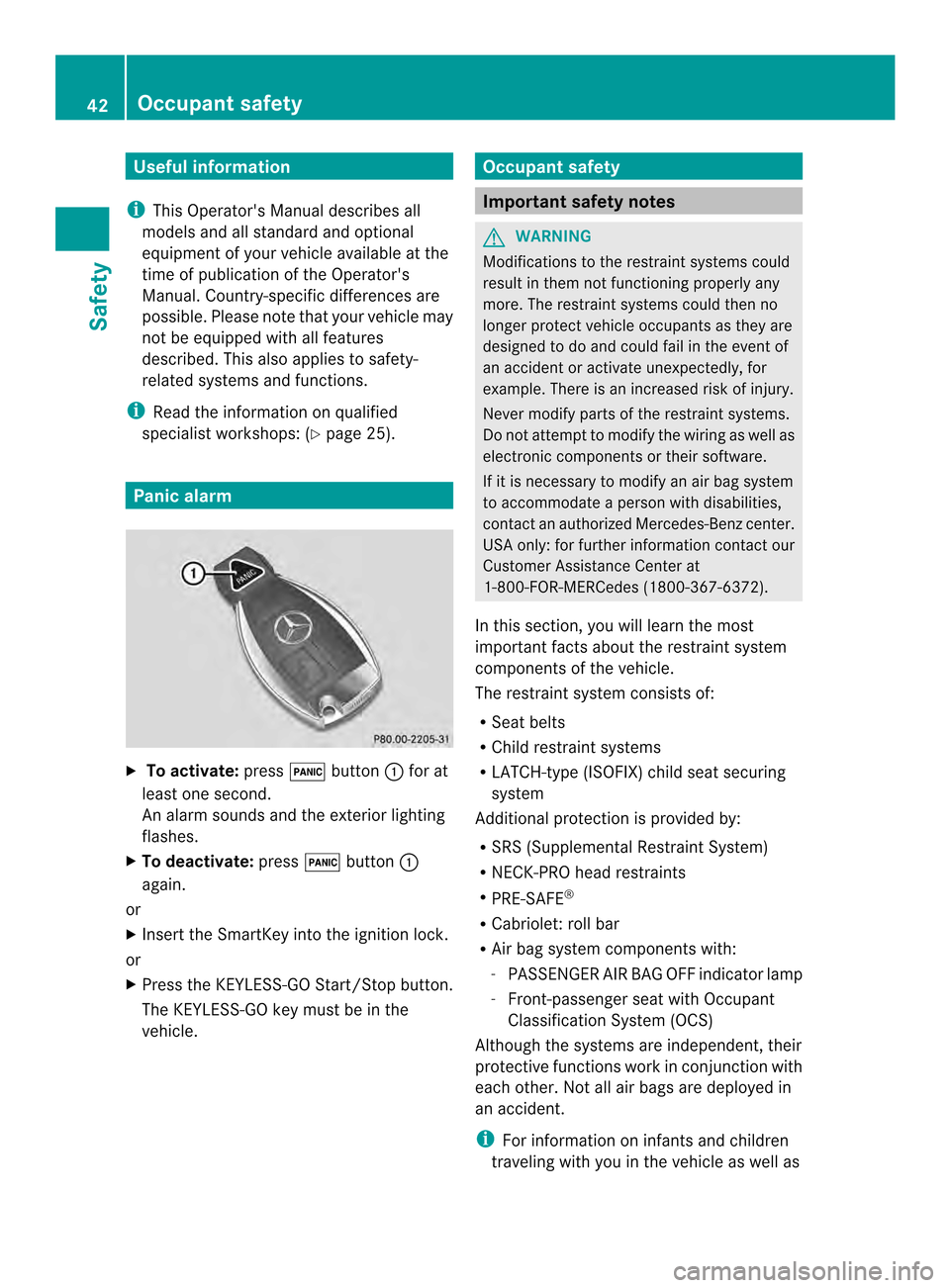
specialist workshops: (Y page 25).Panic alarm
X
To activate: press000Fbutton 0002for at
least one second.
An alarm sounds and the exterior lighting
flashes.
X To deactivate: press000Fbutton 0002
again.
or
X Insert the SmartKey into the ignition lock.
or
X Press the KEYLESS-GO Start/Stop button.
The KEYLESS-GO key must be in the
vehicle. Occupant safety
Important safety notes
G
WARNING
Modifications to the restraint systems could
result in them not functioning properly any
more. The restraint systems could then no
longer protect vehicle occupants as they are
designed to do and could fail in the even tof
an accident or activate unexpectedly, for
example. There is an increased risk of injury.
Never modify parts of the restraint systems.
Do no tattemp tto modify the wiring as well as
electronic components or their software.
If it is necessary to modify an air bag system
to accommodate a person with disabilities,
contact an authorized Mercedes-Benz center.
USA only: for further information contact our
Customer Assistance Center at
1-800-FOR-MERCedes (1800-367-6372).
In this section, you will learn the most
important facts about the restraint system
components of the vehicle.
The restraint system consists of:
R Seat belts
R Child restraint systems
R LATCH-type (ISOFIX) child seat securing
system
Additional protection is provided by:
R SRS (Supplemental Restraint System)
R NECK-PRO head restraints
R PRE-SAFE ®
R Cabriolet: roll bar
R Air bag system components with:
-PASSENGER AIR BAG OFF indicator lamp
- Front-passenger seat with Occupant
Classification System (OCS)
Although the systems are independent, their
protective functions work in conjunction with
each other. Not all air bags are deployed in
an accident.
i For information on infants and children
traveling with you in the vehicle as well as 42
Occupant safetySafety
Page 54 of 394
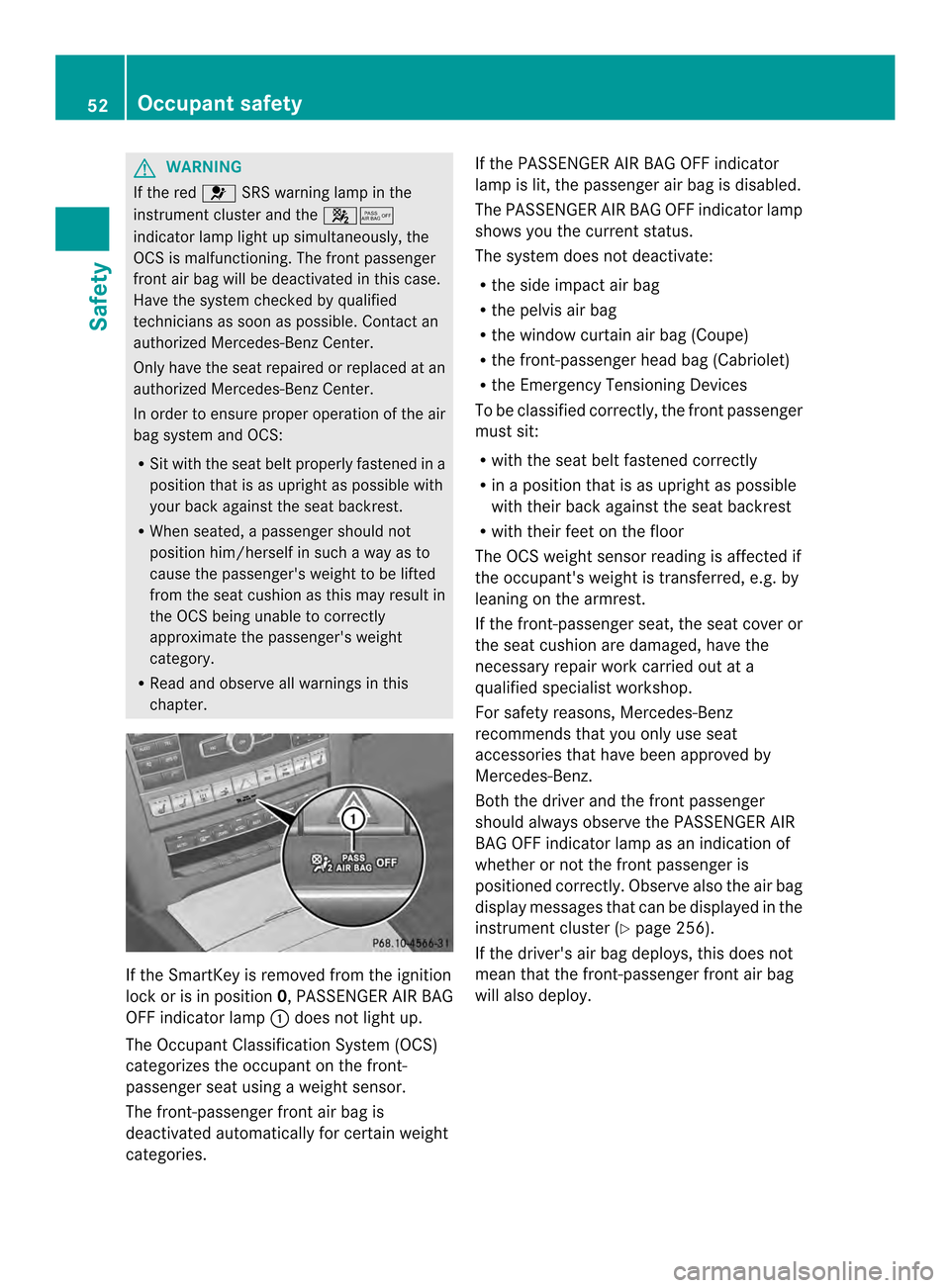
G
WARNING
If the red 001DSRS warning lamp in the
instrument cluster and the 0018001A
indicator lamp light up simultaneously, the
OCS is malfunctioning. The front passenger
front air bag will be deactivated in this case.
Have the system checked by qualified
technicians as soon as possible.C ontactan
authorized Mercedes-Ben zCenter.
Only have the seat repaired or replaced at an
authorized Mercedes-Benz Center.
In order to ensure proper operation of the air
bag system and OCS:
R Sit with the seat belt properly fastened in a
position that is as upright as possible with
your back against the seat backrest.
R When seated, a passenger should not
position him/herself in such a way as to
cause the passenger's weight to be lifted
from the seat cushion as this may result in
the OCS being unable to correctly
approximate the passenger's weight
category.
R Read and observe all warnings in this
chapter. If the SmartKey is removed from the ignition
lock or is in position 0,PASSENGER AIR BAG
OFF indicator lamp 0002does not light up.
The Occupant Classification System (OCS)
categorizes the occupant on the front-
passenge rseat using a weight sensor.
The front-passenger fron tair bag is
deactivated automatically for certain weight
categories. If the PASSENGER AIR BAG OFF indicator
lamp is lit, the passenger air bag is disabled.
The PASSENGER AI
RBAG OFF indicator lamp
shows you the current status.
The system does not deactivate:
R the side impact ai rbag
R the pelvis air bag
R the window curtain air bag (Coupe)
R the front-passenger head bag (Cabriolet)
R the Emergency Tensioning Devices
To be classified correctly, the fron tpassenger
must sit:
R with the seat belt fastened correctly
R in a positio nthat is as upright as possible
with their back against the seat backrest
R with their feet on the floor
The OCS weight sensor reading is affected if
the occupant's weight is transferred, e.g. by
leaning on the armrest.
If the front-passenger seat, the seat cover or
the seat cushion are damaged, have the
necessary repair work carried out at a
qualified specialist workshop.
For safety reasons, Mercedes-Benz
recommends that you only use seat
accessories that have been approved by
Mercedes-Benz.
Both the driver and the front passenger
should always observe the PASSENGER AIR
BAG OFF indicator lamp as an indication of
whether or not the front passenger is
positioned correctly. Observe also the air bag
display messages that can be displayed in the
instrument cluster (Y page 256).
If the driver's air bag deploys, this does not
mean that the front-passenger front air bag
will also deploy. 52
Occupant safetySafety
Page 55 of 394
The OCS may have detected that the seat:
R is empty or occupied by the weight of a
typical child up to twelve months old,
seated in a child restraint system.
R is occupied by a small individual, such as a
young teenager or a small adult.
R is occupied by a child in a child restraint
system whose weight is greater than that
of a typical twelve month old child.
These are examples of when the OCS
deactivates the front-passenger fronta ir bag.
Deactivation takes place although the
collision fulfills the criteria for deploying the
driver's air bag.
For further information, see "Air bag display
messages" (Y page 256).
System self-test G
WARNING
If the 0018001Aindicator lamp does not
illuminate, the system is not functioning. You
must contact an authorized Mercedes-Benz
Center before seating any child on the front
passenger seat. G
WARNING
Objects betwee nthe seat surface and the
child restraint system could affect the
function of the OCS. This could result in the
front-passenger front air bag not functioning
as intended during an accident. This poses an
increased risk of injury or even fatal injury.
Do not place any objectsb etween the seat
surface and the child restraint system. Make
sure that the bottom and back of the child
restraint system make full contact with the
front-passenger seat cushion and backrest.
Always comply with the child restraint system
manufacturer's installation instructions. The PASSENGER AIR BAG OFF indicator lamp
lights up:
R
if you turn the SmartKey in the ignition lock
to position 1or 2
R if you press the KEYLESS-GO Start/Stop
button once or twice on vehicles with
KEYLESS-GO
R if an adult is seated properly on the front-
passenger seat and the OCS classifies the
occupant as an adult
The PASSENGER AIR BAG OFF indicator
lamp goes out again after approximately six
seconds.
If the seat is not occupied and the OCS
detects that the front-passenger seat is
empty, the PASSENGER AIR BAG OFF
indicator lamp will continue to light up. The
PASSENGER AIR BAG OFF indicator lamp
will not go out.
For more information about the OCS, see
"Problems with the Occupant Classification
System" (Y page 54). Occupant safety
53Safety Z
Page 59 of 394
possibility of personal injuries occurring as a
result of an acciden tcannot be eliminated.
Always adapt your driving style to suit the
prevailing road and weather conditions and
maintain a safe distance from the vehicle in
front. Drive carefully.
PRE-SAFE ®
intervenes:
R if BAS intervenes, e.g. in emergency
braking situations.
R if BAS PLUS intervenes powerfully — on
vehicles with DISTRONIC PLUS.
R if, on vehicles with DISTRONIC PLUS, the
radar sensor system detect sanimminent
dange rofcollision in certain situations.
R in critical driving situations, e.g. when
physical limits are exceeded and the
vehicle understeers or oversteers severely.
PRE-SAFE ®
takes the following measures
depending on the hazardous situation
detected:
R the front seat belts are pre-tensioned.
R the front-passenger seat is adjusted if it is
in an unfavorable position.
R the air pressure in the side bolsters of the
seat cushion and seat backrest of the front
multicontour seats is increased.
R Coupe: if the vehicle skids, the panorama
roof with power tilt/sliding panel and the
front side windows are closed so that only
a small gap remains.
R Cabriolet: if the vehicle skids, the front side
windows are closed so that only a small gap
remains.
If the hazardous situation passes without
resulting in an accident, PRE-SAFE ®
slackens
the belt pre-tensioning. The air pressure in
the side bolsters on the multicontour seat is
reduced again. All settings made by PRE-
SAFE ®
can then be reversed.
If the seat belts are not released:
X When the vehicle is stationary, move the
backrest or seat back slightly.
The seat belt pre-tensioning is reduced and
the locking mechanism is released. Information about seat belt adjustment, a
convenience function integrated into PRE-
SAFE
®
, can be found in the "Seat belt
adjustment" section (Y page 60). Seat belts
Important safety notes G
WARNING
The seat belt does not offer the intended level
of protection if the backrest is not in the
upright position. When braking or in the event
of an accident, you could slide underneath the
seat belt and sustain abdomen or neck
injuries, for example. This poses an increased
risk of injury or even fatal injury.
Adjust the seat properly before beginning
your journey. Always make sure that the seat
is in the upright position. G
WARNING
Seat belts cannot protect as intended, if:
R they are damaged, extremely dirty,
bleached or dyed
R the seat belt buckle is damaged or
extremely dirty
R the Emergency Tensioning Devices or the
belt anchorage has been modified.
Damage caused to seat belts in an accident
may not be visible, e.g. by splinters of glass.
Modified or damaged seat belts can tear or
fail, for example in the event of an accident.
Modified Emergency Tensioning Devices may
be deployed unintentionally or fail to be
deployed when required. There is an
increased risk of injury, possibly even fatal.
Never modify seat belts, Emergency
Tensioning Devices, seat belt anchorages and
inertia reels. Ensure that seat belts are not
damaged or worn and are clean.
Only use seat belts that have been approved
for your vehicle by Mercedes-Benz. Occupant safety
57Safety Z
Page 61 of 394

R
Never place your feet on the instrument
panel, dashboard, or on the seat. Always
keep both feet on the floor in front of the
seat.
R When using a seat belt to secure infant
restraints, toddler restraints, or children in
booster seats, always follow the child seat
manufacturer's instructions.
Fastening seat belts G
WARNING
According to accident statistics, children are
safer when properly restrained on the rear
seats than on the front-passenger seat. Thus,
we strongly recommend that children be
placed in the rear seat whenever possible.
Regardless of seating position, children 12
years old and under must be seated and
properly secured in an appropriately sized
child restraint system or booster seat
recommended for the size and weight of the
child. For additional information, see the
"Childrenint he vehicle" section.
Ac hild's risk of serious or fatal injuries is
significantly increased if the child restraints
are not properly secured in the vehicle and/
or the child is not properly secured in the child
restraint. G
WARNING
Seat belt presenter 0002must be retracted
while the vehicle is in motion. Only when seat
belt presenter 0002is retracted can the seat
belt be properly positioned on the body and
protect the occupant as intended. Seat-belt extender (example: Coupe)
The seat-belt extender for the driver and front
passenger helps you fasten your seat belt.
Seat-belt extender
0002is extended when the
respective door is closed and the SmartKey
is turned to position 1or 2in the ignition lock. You can also extend seat-belt extender
0002by
using seat-belt extender button 0020in the
center console.
X Press seat-belt extender button 0020.
Seat-belt extender 0002extends.
Seat-belt extender 0002is retracted again if:
R the belt tongue is engaged in the seat belt
buckle.
R the belt tongue is not engaged in the seat
belt buckle within 60 seconds.
R the respective door is opened.
R the SmartKey is turned to position 0in the
ignition lock.
R you release the seat backrest and fold it
forwards.
R the front-passenger seat is unoccupied
after, approximately five seconds. Occupant safety
59Safety Z
Page 62 of 394
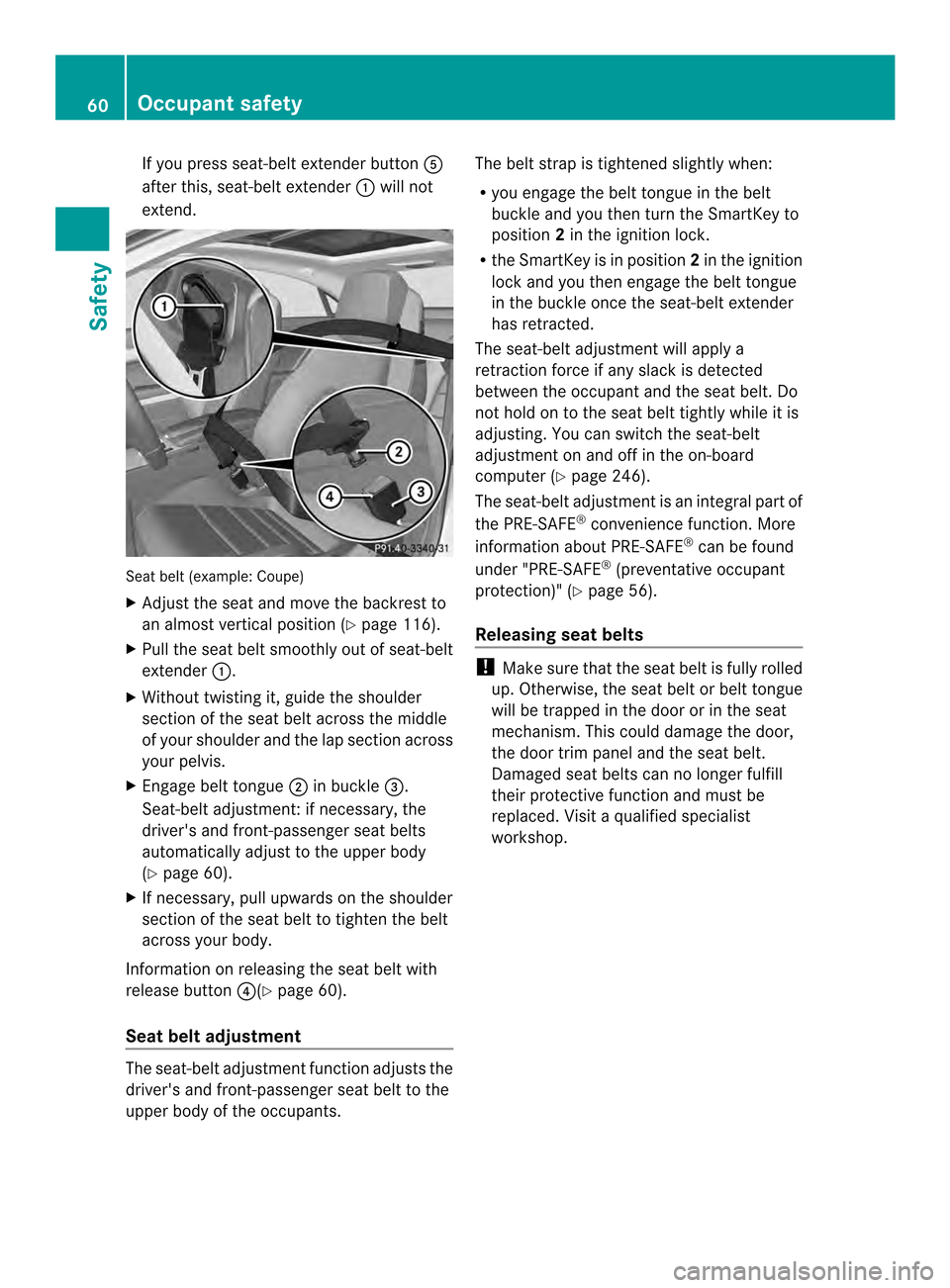
If you press seat-bel
textender button 0020
afte rthis, seat-belt extender 0002will not
extend. Seat belt (example: Coupe)
X
Adjust the seat and move the backrest to
an almost vertical position (Y page 116).
X Pull the seat belt smoothly out of seat-belt
extender 0002.
X Without twisting it, guide the shoulder
section of the seat belt across the middle
of your shoulder and the lap section across
your pelvis.
X Engage belt tongue 0003in buckle 0023.
Seat-belt adjustment:ifn ecessary, the
driver's and front-passenger seat belts
automatically adjust to the upper body
(Y page 60).
X If necessary, pull upwards on the shoulder
section of the seat belt to tighten the belt
across your body.
Information on releasing the seat belt with
release button 0022(Ypage 60).
Seat belt adjustment The seat-belt adjustment function adjusts the
driver's and front-passenger seat belt to the
upper body of the occupants. The belt strap is tightened slightly when:
R
you engage the belt tongue in the belt
buckle and you then turn the SmartKey to
position 2in the ignition lock.
R the SmartKey is in position 2in the ignition
lock and you then engage the belt tongue
in the buckle once the seat-belt extender
has retracted.
The seat-belt adjustment will apply a
retraction force if any slack is detected
between the occupant and the seat belt. Do
not hold on to the seat belt tightly while it is
adjusting. You can switch the seat-belt
adjustment on and off in the on-board
computer (Y page 246).
The seat-belt adjustment is an integral part of
the PRE-SAFE ®
convenience function. More
information about PRE-SAFE ®
can be found
under "PRE-SAFE ®
(preventative occupant
protection)" (Y page 56).
Releasing seat belts !
Make sure that the seat belt is fully rolled
up. Otherwise, the seat belt or belt tongue
will be trapped in the door or in the seat
mechanism. This could damage the door,
the door trim panel and the seat belt.
Damaged seat belts can no longer fulfill
their protective function and must be
replaced. Visit a qualified specialist
workshop. 60
Occupant safetySafety
Page 64 of 394
Tensioning Device could be triggered in the
event of an accident.
i Vehicles with PRE-SAFE ®
: Emergency
Tensioning Devices that are triggered by an
electric motor can be deployed as often as
desired and do not need to be replaced.
The fronts eat belts and the outer seat belts
in the rear are equipped with Emergency
Tensioning Devices and seat belt force
limiters.
The ETDs tighten the seat belts in an accident,
pulling them close against the body.
The ETDs do not correct incorrect seat
positions or incorrectly fastened seat belts.
The ETDs do not pull vehicle occupants back
towards the backrest.
The ETDs can only be activated when:
R the ignition is switched on
R the restraint systems are operational; see
"SRS warning lamp 001D" (Ypage 43)
R the belt tongue is engaged in the buckle on
each of the front seat belts
The ETDs on the outside seats in the rear
compartment are triggered independently of
the lock status of the seat belts.
The ETDs are triggered depending on the type
and severity of an accident:
R in the event of a head-on or rear-end
collision if the vehicle decelerates or
accelerates rapidly in a longitudinal
direction during the initial stages of the
impact.
R in the event of a side impact if the vehicle
decelerates or accelerates rapidly in a
lateral direction on the side opposite to the
impact.
R Cabriolet: in certain situations if the vehicle
rolls over and the system determines that
it can provide additional protection
If the ETDs are deployed, you will hear a bang,
and a small amount of powder may also be
released. Only in rare cases will the bang
affect your hearing. The powder that is
released generally does not constitute a health hazard and does not indicate that there
is a fire in the vehicle. The dust might cause
some temporary breathing difficulty for
people with asthma or other breathing
trouble. To avoid this, you may wish to get out
of the vehicle as soon as it is safe to do so.
You can also open the window to allow fresh
air to enter the vehicle interior. The
001DSRS
warning lamp lights up.
If the seat belt is also equipped with a seat
belt force limiter and this is triggered, the
force exerted by the seat belt on the vehicle
occupan tis reduced.
The seat belt force limiters for the front seats
are synchronized with the front air bags,
which absorb part of the deceleration force.
This results in the force exerted on the
occupant being distributed over a greater
area.
Automatic comfort-fit feature The front seat belts have an automatic
comfort-fit feature. The automatic comfort-fit
feature reduces the retraction force of the
seat belts. This results in increased seat belt
comfort. Children in the vehicle
Child restraint systems
Important safety notes G
WARNING
According to accident statistics, children are
safer when properly restrained in the rear
seating positions than in the front seating
position. Thus, we strongly recommend that
children be placed in the rear seats whenever
possible.R egardless of seating position,
children 12 years old and under must be
seated and properly secured in an appropriate
infant restraint, toddler restraint, or booster
seat recommended for the size and weight of
the child. 62
Children in the vehicleSafety