seats MERCEDES-BENZ E-Class COUPE 2014 C207 User Guide
[x] Cancel search | Manufacturer: MERCEDES-BENZ, Model Year: 2014, Model line: E-Class COUPE, Model: MERCEDES-BENZ E-Class COUPE 2014 C207Pages: 394, PDF Size: 5.28 MB
Page 64 of 394
Tensioning Device could be triggered in the
event of an accident.
i Vehicles with PRE-SAFE ®
: Emergency
Tensioning Devices that are triggered by an
electric motor can be deployed as often as
desired and do not need to be replaced.
The fronts eat belts and the outer seat belts
in the rear are equipped with Emergency
Tensioning Devices and seat belt force
limiters.
The ETDs tighten the seat belts in an accident,
pulling them close against the body.
The ETDs do not correct incorrect seat
positions or incorrectly fastened seat belts.
The ETDs do not pull vehicle occupants back
towards the backrest.
The ETDs can only be activated when:
R the ignition is switched on
R the restraint systems are operational; see
"SRS warning lamp 001D" (Ypage 43)
R the belt tongue is engaged in the buckle on
each of the front seat belts
The ETDs on the outside seats in the rear
compartment are triggered independently of
the lock status of the seat belts.
The ETDs are triggered depending on the type
and severity of an accident:
R in the event of a head-on or rear-end
collision if the vehicle decelerates or
accelerates rapidly in a longitudinal
direction during the initial stages of the
impact.
R in the event of a side impact if the vehicle
decelerates or accelerates rapidly in a
lateral direction on the side opposite to the
impact.
R Cabriolet: in certain situations if the vehicle
rolls over and the system determines that
it can provide additional protection
If the ETDs are deployed, you will hear a bang,
and a small amount of powder may also be
released. Only in rare cases will the bang
affect your hearing. The powder that is
released generally does not constitute a health hazard and does not indicate that there
is a fire in the vehicle. The dust might cause
some temporary breathing difficulty for
people with asthma or other breathing
trouble. To avoid this, you may wish to get out
of the vehicle as soon as it is safe to do so.
You can also open the window to allow fresh
air to enter the vehicle interior. The
001DSRS
warning lamp lights up.
If the seat belt is also equipped with a seat
belt force limiter and this is triggered, the
force exerted by the seat belt on the vehicle
occupan tis reduced.
The seat belt force limiters for the front seats
are synchronized with the front air bags,
which absorb part of the deceleration force.
This results in the force exerted on the
occupant being distributed over a greater
area.
Automatic comfort-fit feature The front seat belts have an automatic
comfort-fit feature. The automatic comfort-fit
feature reduces the retraction force of the
seat belts. This results in increased seat belt
comfort. Children in the vehicle
Child restraint systems
Important safety notes G
WARNING
According to accident statistics, children are
safer when properly restrained in the rear
seating positions than in the front seating
position. Thus, we strongly recommend that
children be placed in the rear seats whenever
possible.R egardless of seating position,
children 12 years old and under must be
seated and properly secured in an appropriate
infant restraint, toddler restraint, or booster
seat recommended for the size and weight of
the child. 62
Children in the vehicleSafety
Page 66 of 394
loose in the even
tofanaccident, heavy
braking or a sudde nchange in direction. The
child restraint system could be thrown about,
striking vehicle occupants. There is an
increased risk of injury, possibly even fatal.
Always install child restraint systems
properly, even if they are not being used.
Make sure that you observe the child restraint
system manufacturer's installation
instructions. G
WARNING
Child restraint systems or their securing
systems which have been damaged or
subjected to a load in an accident can no
longer protect as intended. The child cannot
then be restrained in the event of an accident,
heavy braking or sudden changes of direction.
There is an increased risk of injury, possibly
even fatal.
Replace child restraint systems which have
been damaged or subjected to a load in an
accident as soon as possible. Have the
securing systems on the child restraint
system checked at a qualified specialist
workshop, before you install a child restraint
system again. G
WARNING
Infants and small children should never share
a seat belt with another occupant. In the event
of an accident, they could be crushed
between the occupant and seat belt.
Ac hild's risk of serious or fatal injuries is
significantly increased if the child restraints
are not properly secured in the vehicle and/
or the child is not properly secured in the child
restraint.
Children that are too large for a child restraint
must travel in seats using normal seat belts.
Position the shoulder belt across the chest
and shoulder, not the face or neck.Ab ooster
seat may be necessary to achieve proper seat
belt positioning for children over 41 lbs
(18 kg) until they reach a height where alap/ shoulder belt fits properly without a booster
seat.
When the child restraint is no
tinuse, remove
it from the vehicle or secure it with the seat
belt to prevent the child restraint from
becoming a projectile in the event of an
accident. G
WARNING
If children are left unsupervised in the vehicle,
they could:
R open the doors, thus endangering other
people or road users.
R get out and disrupt traffic.
R operate the vehicle's equipment.
Additionally, children could set the vehicle in
motion if, for example, they:
R release the parking brake.
R shifting the automatic transmission out of
park position P
R Start the engine.
There is a risk of an accident and injury.
When leaving the vehicle, always take the
SmartKey with you and lock the vehicle. Never
leave children or animals unattended in the
vehicle. Always keep the SmartKey out of
reach of children. G
WARNING
If persons, particularly children are subjected
to prolonged exposure to extreme heat or
cold, there is a risk of injury, possibly even
fatal. Never leave children unattended in the
vehicle. G
WARNING
If the child restraint system is subjected to
direct sunlight, parts may get very hot.
Children may burn themselves on these parts,
particularly on the metal parts of the child
restraint system. There is a risk of injury.
If you leave the vehicle, taking the child with
you, always ensure that the child restraint
system is not exposed to direct sunlight. 64
Children in the vehicleSafety
Page 68 of 394
LATCH-type (ISOFIX) child seat anchors
in the rear
G
WARNING
LATCH-type (ISOFIX) child restraint systems
do not offer sufficient protective effect for
children whose weight is greater than 48 lbs
(22 kg) who are secured using the safety belt
integrated in the child restraint system. In the
event of an accident, a child might not be
restrained correctly. This poses an increased
risk of injury or even fatal injury.
If the child weighs more than 48 lbs (22 kg),
only use LATCH-type (ISOFIX) child restraint
systems with which the child is also secured
with the vehicle seat belt .Also secure the
child restraint system with the Top Tether
belt, if available.
When installing a child restraint system, be
sure to observe the manufacturer's
installation instructions and the instructions
for correct use of the child restraint system. Coupe
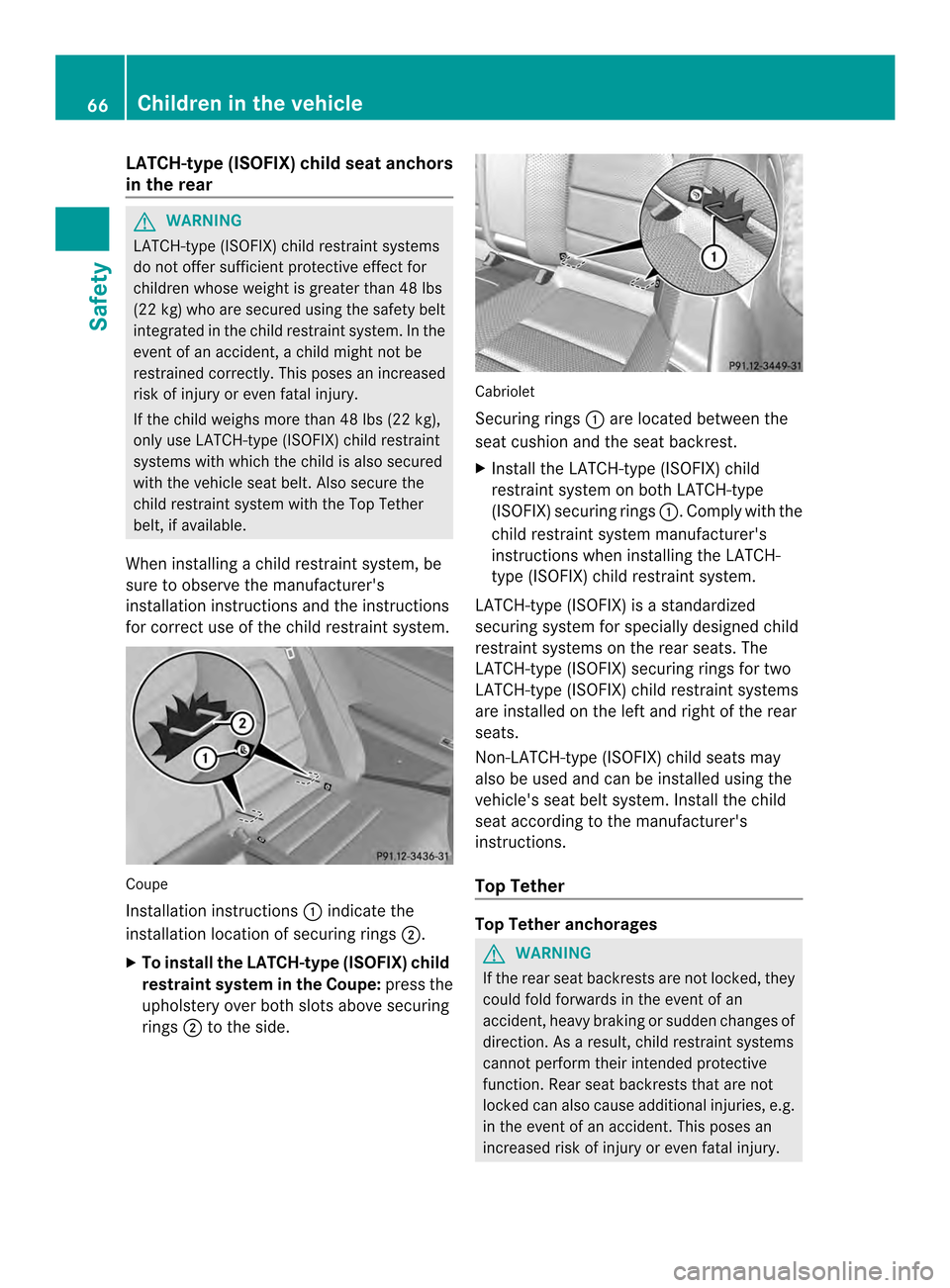
Installation instructions
0002indicate the
installation location of securing rings 0003.
X To install the LATCH-type (ISOFIX) child
restraint system in the Coupe: press the
upholstery over both slots above securing
rings 0003to the side. Cabriolet
Securing rings
0002are located betwee nthe
seat cushion and the seat backrest.
X Install the LATCH-type (ISOFIX) child
restraint system on both LATCH-type
(ISOFIX) securing rings 0002.Comply with the
child restraint system manufacturer's
instructions when installing the LATCH-
type (ISOFIX) child restraint system.
LATCH-type (ISOFIX) is a standardized
securing system for specially designed child
restraint systems on the rear seats. The
LATCH-type (ISOFIX) securing rings for two
LATCH-type (ISOFIX) child restraint systems
are installed on the left and right of the rear
seats.
Non-LATCH-type (ISOFIX) child seats may
also be used and can be installed using the
vehicle's seat belt system. Install the child
seat according to the manufacturer's
instructions.
Top Tether Top Tether anchorages
G
WARNING
If the rear seat backrests are not locked, they
could fold forwards in the event of an
accident, heavy braking or sudden changes of
direction .As a result, child restraint systems
cannot perform their intended protective
function. Rear seat backrests that are not
locked can also cause additional injuries, e.g.
in the event of an accident. This poses an
increased risk of injury or even fatal injury. 66
Children in the vehicleSafety
Page 70 of 394
When leaving the vehicle, always take the
SmartKey with you and lock the vehicle. Never
leave children or animals unattended in the
vehicle. Always keep the SmartKey out of
reach of children.
G
WARNING
If persons, particularly children are subjected
to prolonged exposure to extreme heat or
cold, there is a risk of injury, possibly even
fatal. Never leave children unattended in the
vehicle. G
WARNING
If children are travelin ginthe vehicle, they
could:
R open doors, thus endangering other people
or road users
R exit the vehicle and be caught by oncoming
traffic
R operate vehicle equipment and become
trapped
There is a risk of an accident and injury.
Always activate the child-proof locks and
override feature if children are traveling in the
vehicle. When leaving the vehicle, always take
the key with you and lock the vehicle. Never
leave children unattended in the vehicle.
You can activate the child-proof lock for the
rear side windows (Y page 68).
Override feature for the rear side
windows G
WARNING
When children ride on the vehicle's rear seats,
activate the override switch. Otherwise the
children could be injured, e.g. by trapping
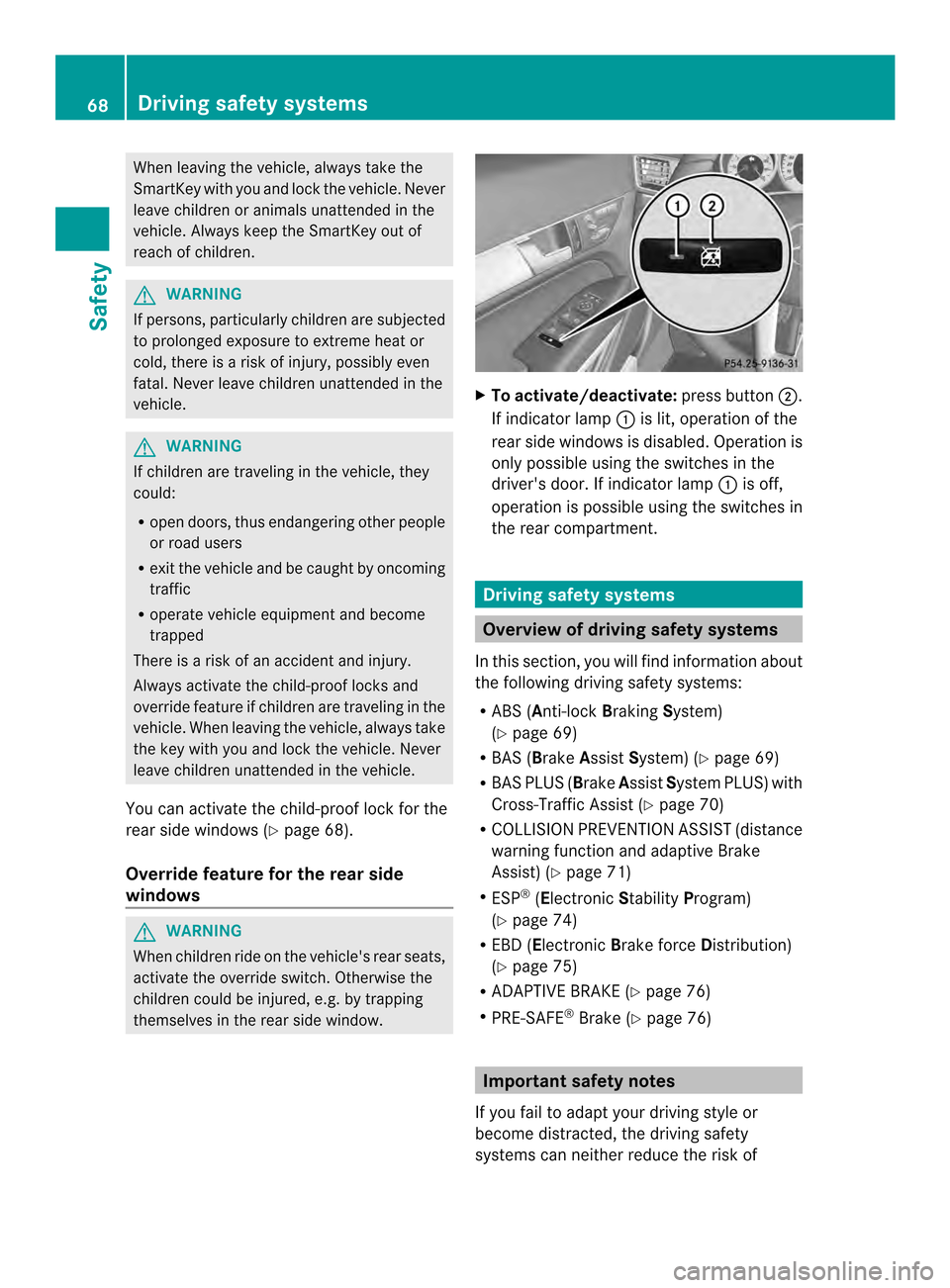
themselves in the rear side window. X
To activate/deactivate: press button0003.
If indicator lamp 0002is lit, operation of the
rear side windows is disabled. Operation is
only possible using the switches in the
driver's door. If indicator lamp 0002is off,
operation is possible using the switches in
the rear compartment. Driving safety systems
Overview of driving safety systems
In this section, you will find information about
the following driving safety systems:
R ABS ( Anti-lock BrakingSystem)
(Y page 69)
R BAS ( Brake Assist System) (Y page 69)
R BAS PLUS (Brake AssistSystem PLUS) with
Cross-Traffic Assist (Y page 70)
R COLLISION PREVENTION ASSIST (distance
warning function and adaptive Brake
Assist) (Y page 71)
R ESP ®
(Electronic StabilityProgram)
(Y page 74)
R EBD ( Electronic Brake force Distribution)
(Y page 75)
R ADAPTIVE BRAKE (Y page 76)
R PRE-SAFE ®
Brake (Y page 76) Important safety notes
If you fail to adapt your driving style or
become distracted, the driving safety
systems can neither reduce the risk of 68
Driving safety systemsSafety
Page 103 of 394
If, when closing, you drive at speeds above
25 mph (40 km/h), the opening procedure
is stopped. The Open/Close Convertible Top Completely message
appears in the multifunctio ndisplay. In
order to close the soft top fully, reduce your
speed again to below 25 mph (40 km/h)
and press the soft-top switch again. Opening and closing using the
SmartKey
Important safety notes G
WARNING
When opening or closing the soft top, there is
a risk that parts of the body could become
trapped by moving parts such as the roof
mechanism, the trunk lid, or the side
windows .There is a risk of injury.
When opening or closing the roof, make sure
that no parts of the body are in the vicinity of
moving parts. Release the switch if somebody
becomes trapped.
Opening and closing The SmartKey must be near the door handle.
X To open: press and hold the 000Ebutton
on the SmartKey until the soft top is fully
opened.
The Convertible Top in Operation message appears in the multifunction
display. The seat ventilation is switched on.
The rear side windows open.
X To close: press and hold the 000Dbutton
on the SmartKey until the soft top is fully
closed.
The Convertible Top in Operation message appears in the multifunction
display. The soft top and the side windows
close. Closing the soft top manually
Important safety notes G
WARNING
Closing the soft top manually is a complex,
technically challenging procedure which can
also be physically demanding. You or others
can become trapped. There is a risk of injury.
Where possible, have the soft top closed
manually at a qualified specialist workshop.
If the soft top cannot be closed automatically,
check the following points:
R is the trunk partition engaged
(Y page 106)?
R are the head restraints on the rear bench
seats extended?
R is the trunk lid closed?
R is the on-board voltage sufficient?
Start the engine if necessary.
If automatic operation still does not work, the
soft top can be closed manually.
To carry out this work, you will need the
assistance of another person.
Closing the soft top X
Apply the parking brake.
X Open the side windows.
X Lower the head restraints automatically
(Y page 119) or manually (Y page 119).
X Remove the SmartKey from the ignition
lock.
X Open the trunk.
X Take the two straps out of the vehicle tool
kit (Y page 328).
X Take the hex-socket wrench out of the
Operator's Manual wallet and keep it with
you. Soft top (Cabriolet)
101Opening and closing Z
Page 108 of 394

Trunk partition
General notes !
To avoid damaging the sof ttop or load
when folding back the soft top, observe the
following:
R when the trunk partition is open, do not
place any objects in or behind the net on
the side that are so long they could
obstruct the trunk partition or damage
the opened soft top.
R make sure that the cargo does not push
the trunk partition upwards.
The soft top can only be opened when the
trunk partition is closed.
The trunk partition can be used to cover
luggage and loads in the trunk.
Opening and closing X
To close: pull trunk partition 0002by the
handle in the direction of the arrow until it
rests on the sides of the trunk.
Trunk partition 0002finishes closing
automatically.
X To open: push trunk partition 0002against
the direction of the arrow by the handle.
The trunk partition finishes opening
automatically. Brackets for the wind screen
G
WARNING
If you use the wind screen in darkness or in
other conditions offering poor visibility, your
view to the rear is further impaired. There is a
risk of an accident.
Only use the wind screen when visibility
conditions are good.
! Mercedes-Benz recommends that you
only use wind screens which have been
tested and approved for Mercedes-Benz
vehicles. This helps to prevent damage to
the vehicle.
! Observe the backrest position of the front
seats if the wind screen is installed, since
the backrest could collide with the wind
screen here. The wind screen protects against wind when
driving with the soft top open. It is secured
above the rear bench seats. For this reason,
only the driver and the front passenger can
travel in the vehicle when the wind screen is
installed.
X
When installing the wind screen, use lateral
brackets 0002.
Observe the manufacturer's installation
instructions. 106
Soft top (Cabriolet)Opening and closing
Page 109 of 394
AIRCAP
Important safety notes G
WARNING
When retracting the AIRCAP, persons could
become caught in the moving mechanism.
There is a ris kofinjury.
Ensure tha tpersons do not hold onto the
upper frame of the windshield and do not
touch the AIRCAP wind deflector. G
WARNING
When retracting the AIRCAP, persons could
become caught in the moving mechanism.
There is a risk of injury.
Ensure that persons do not hold onto the
upper frame of the windshield and do not
touch the AIRCAP wind deflector.
With AIRCAP, four people can travel
comfortably with the soft top open. AIRCAP
reduces the draft for the driver and
passengers in both the fron tand the rear
compartment in a vehicle with the soft top
down.
AIRCAP has the following components:
R a speed-dependent wind deflector above
the windshield
R an AIRCAP wind screen between the two
head restraints on the rea rbench seat
When AIRCAP has been activated, the
AIRCAP wind screen between the two rear
seat head restraints extends upwards. At a
speed of approximately 25 mph (40k m/h) or
higher, the wind deflector on the windshield
also extends. If you drive at speeds below
approximately 9mph (15 km/h), the wind
deflector retracts automatically.
AIRCAP can be activated or deactivated up to
speeds of approximately 100 mph
(160 km/h). Activating AIRCAP
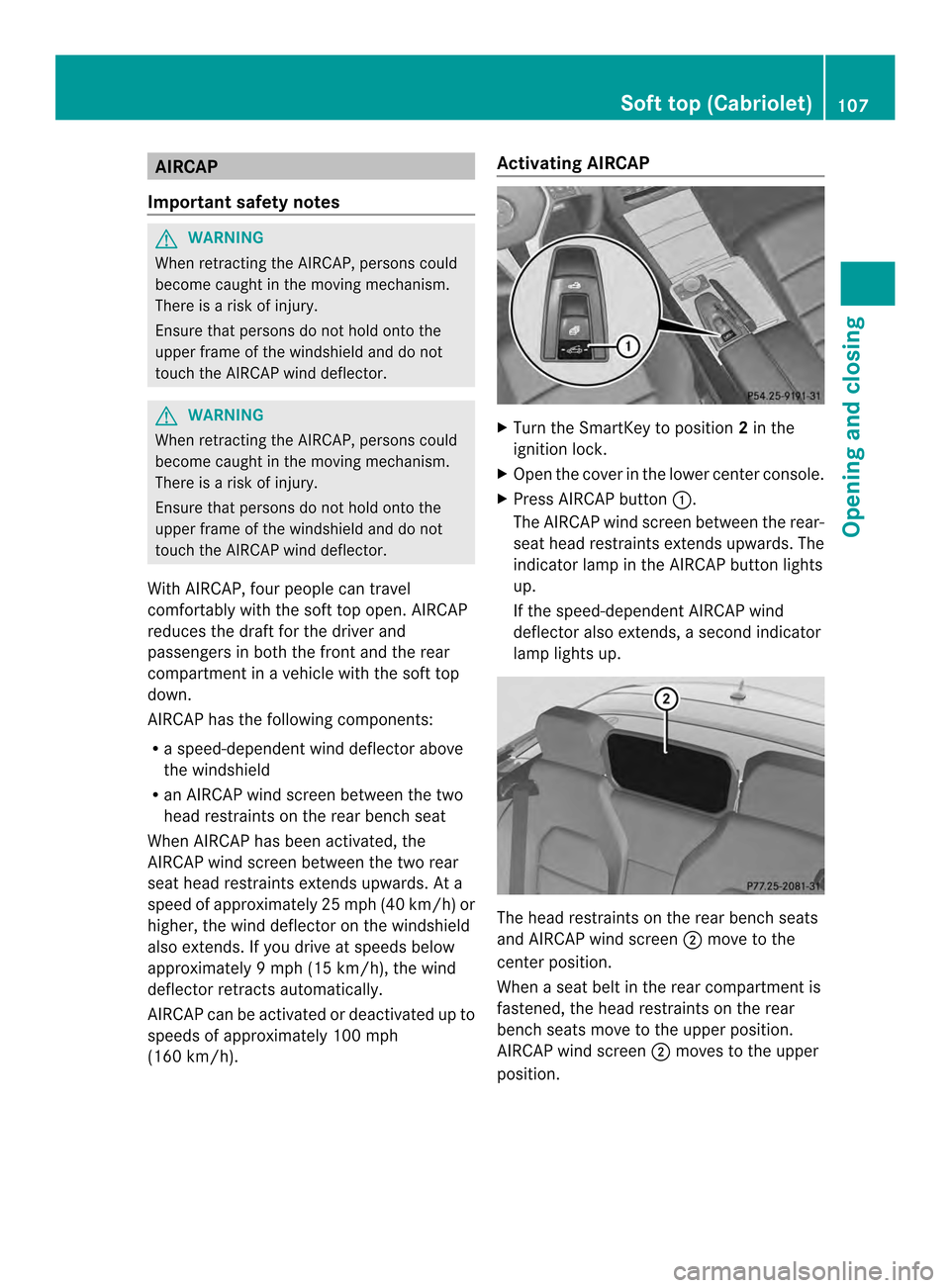
X
Turn the SmartKey to position 2in the
ignition lock.
X Open the cover in the lower center console.
X Press AIRCAP button 0002.
The AIRCAP wind screen between the rear-
seat head restraints extends upwards. The
indicator lamp in the AIRCAP button lights
up.
If the speed-dependent AIRCAP wind
deflector also extends, a second indicator
lamp lights up. The head restraints on the rear bench seats
and AIRCAP wind screen
0003move to the
center position.
When a seat belt in the rear compartment is
fastened, the head restraints on the rear
bench seats move to the upper position.
AIRCAP wind screen 0003moves to the upper
position. Soft top (Cabriolet)
107Opening and closing Z
Page 110 of 394

Wind deflector
0023extends depending on
vehicle speed.
i If you park your vehicle with the roof open
and remove the SmartKey, the AIRCAP
wind screen retracts automatically. If, after
parking the vehicle, the engine is restarted,
the AIRCAP system is activated
automatically.
i AIRCAP cannot be extended or retracted
if the vehicle speed exceeds approximately
100 mph (160 km/h).
Deactivating AIRCAP X
Turn the SmartKey to position 2in the
ignition lock.
X Open the cover in the lower center console.
X Press AIRCAP button 0002.
The two indicato rlamps on the AIRCAP
butto ngo out. The wind deflector 0023retracts.
The head restraints on the rear seats and
AIRCAP wind screen 0003move to the lowest
position simultaneously.
i If there are passengers wearing seat belts
in the rear compartment, the head
restraints on the rear bench seats and the
AIRCAP wind screen remain in the upper
position.
Retracting the head restraints on the
rear bench seats from the driver's seat To improve the rear view, you can retrac
tthe
head restraints on the rear bench seats individually (Y
page 119). The wind deflector
remains in its current position. Installing and removing the AIRCAP
wind screen
Preparation You will need a
4mmAllen key to install/
remove the AIRCAP wind screen.
Before installing or removing the AIRCAP
wind screen:
X Turn the SmartKey to position 2in the
ignition lock.
X Open the folding roof fully (Y page 100).
X Extend the head restraints in the rear
compartment fully (Y page 119).
Removing Bolts on the AIRCAP wind screen between the head
restraints in the rear compartment
X
Use the 4 mm hex-socket wrench to turn
the bolts on both sides counter-clockwise
by about 90° and loosen them.
X Pull the bolts out of the brackets on the
head restraints. 108
Soft top (Cabriolet)Opening and closing
Page 117 of 394
Useful information
............................116
Correct driver's seat position ..........116
Seats .................................................. 117
Steering wheel .................................. 124
Mirrors ............................................... 127
Memory function .............................. 130 115Seats, steering wheel and mirrors
Page 118 of 394
Useful information
i This Operator's Manual describes all
models and all standard and optional
equipment of your vehicle available at the
time of publication of the Operator's
Manual. Country-specific differences are
possible. Please note that your vehicle may
not be equipped with all features
described. This also applies to safety-
related systems and functions.
i Read the information on qualified
specialist workshops: (Y page 25).Correct driver's seat position
G
WARNING
You could lose control of your vehicle if you
do the following while driving:
R adjust the driver's seat, head restraint,
steering wheel or mirrors
R faste nthe seat belt
There is a risk of an accident.
Adjust the driver's seat, head restraint,
steering wheel and mirror and fasten your
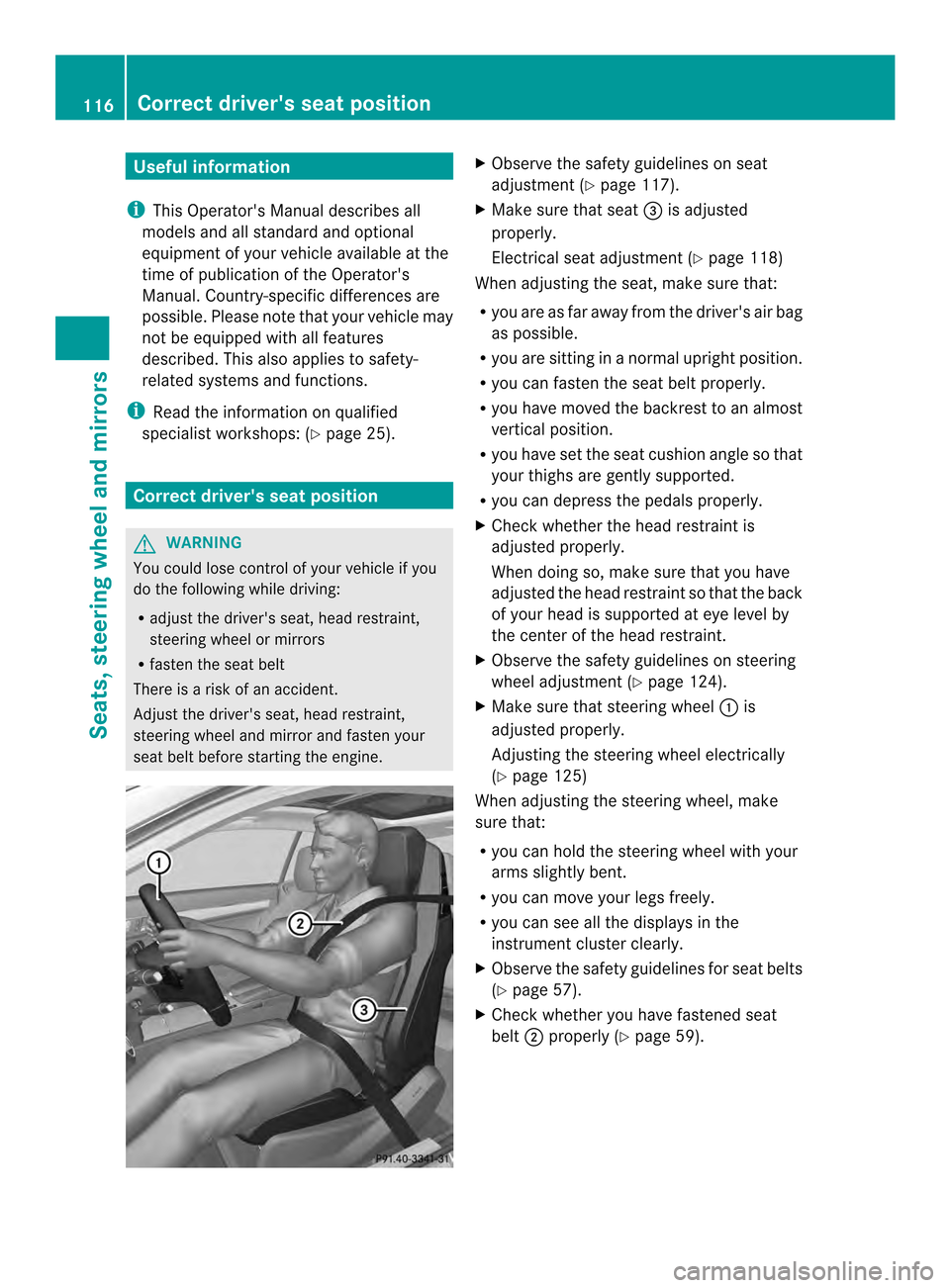
seat belt before starting the engine. X
Observe the safety guidelines on seat
adjustment (Y page 117).
X Make sure that seat 0023is adjusted
properly.
Electrical seat adjustment (Y page 118)
When adjusting the seat, make sure that:
R you are as far away from the driver's air bag
as possible.
R you are sitting in a normal upright position.
R you can fasten the seat belt properly.
R you have moved the backrest to an almost
vertical position.
R you have set the seat cushion angle so that
your thighs are gently supported.
R you can depress the pedals properly.
X Check whether the head restraint is
adjusted properly.
When doing so, make sure that you have
adjusted the head restraint so that the back
of your head is supported at eye level by
the center of the head restraint.
X Observe the safety guidelines on steering
wheel adjustment (Y page 124).
X Make sure that steering wheel 0002is
adjusted properly.
Adjusting the steering wheel electrically
(Y page 125)
When adjusting the steering wheel, make
sure that:
R you can hold the steering wheel with your
arms slightly bent.
R you can move your legs freely.
R you can see all the displays in the
instrumentc luster clearly.
X Observe the safety guidelines for seat belts
(Y page 57).
X Check whether you have fastened seat
belt 0003properly (Y page 59).116
Correct driver's seat positionSeats, steering wheel and mirrors