belt MERCEDES-BENZ E-Class COUPE 2014 C207 Owner's Guide
[x] Cancel search | Manufacturer: MERCEDES-BENZ, Model Year: 2014, Model line: E-Class COUPE, Model: MERCEDES-BENZ E-Class COUPE 2014 C207Pages: 394, PDF Size: 5.28 MB
Page 109 of 394
AIRCAP
Important safety notes G
WARNING
When retracting the AIRCAP, persons could
become caught in the moving mechanism.
There is a ris kofinjury.
Ensure tha tpersons do not hold onto the
upper frame of the windshield and do not
touch the AIRCAP wind deflector. G
WARNING
When retracting the AIRCAP, persons could
become caught in the moving mechanism.
There is a risk of injury.
Ensure that persons do not hold onto the
upper frame of the windshield and do not
touch the AIRCAP wind deflector.
With AIRCAP, four people can travel
comfortably with the soft top open. AIRCAP
reduces the draft for the driver and
passengers in both the fron tand the rear
compartment in a vehicle with the soft top
down.
AIRCAP has the following components:
R a speed-dependent wind deflector above
the windshield
R an AIRCAP wind screen between the two
head restraints on the rea rbench seat
When AIRCAP has been activated, the
AIRCAP wind screen between the two rear
seat head restraints extends upwards. At a
speed of approximately 25 mph (40k m/h) or
higher, the wind deflector on the windshield
also extends. If you drive at speeds below
approximately 9mph (15 km/h), the wind
deflector retracts automatically.
AIRCAP can be activated or deactivated up to
speeds of approximately 100 mph
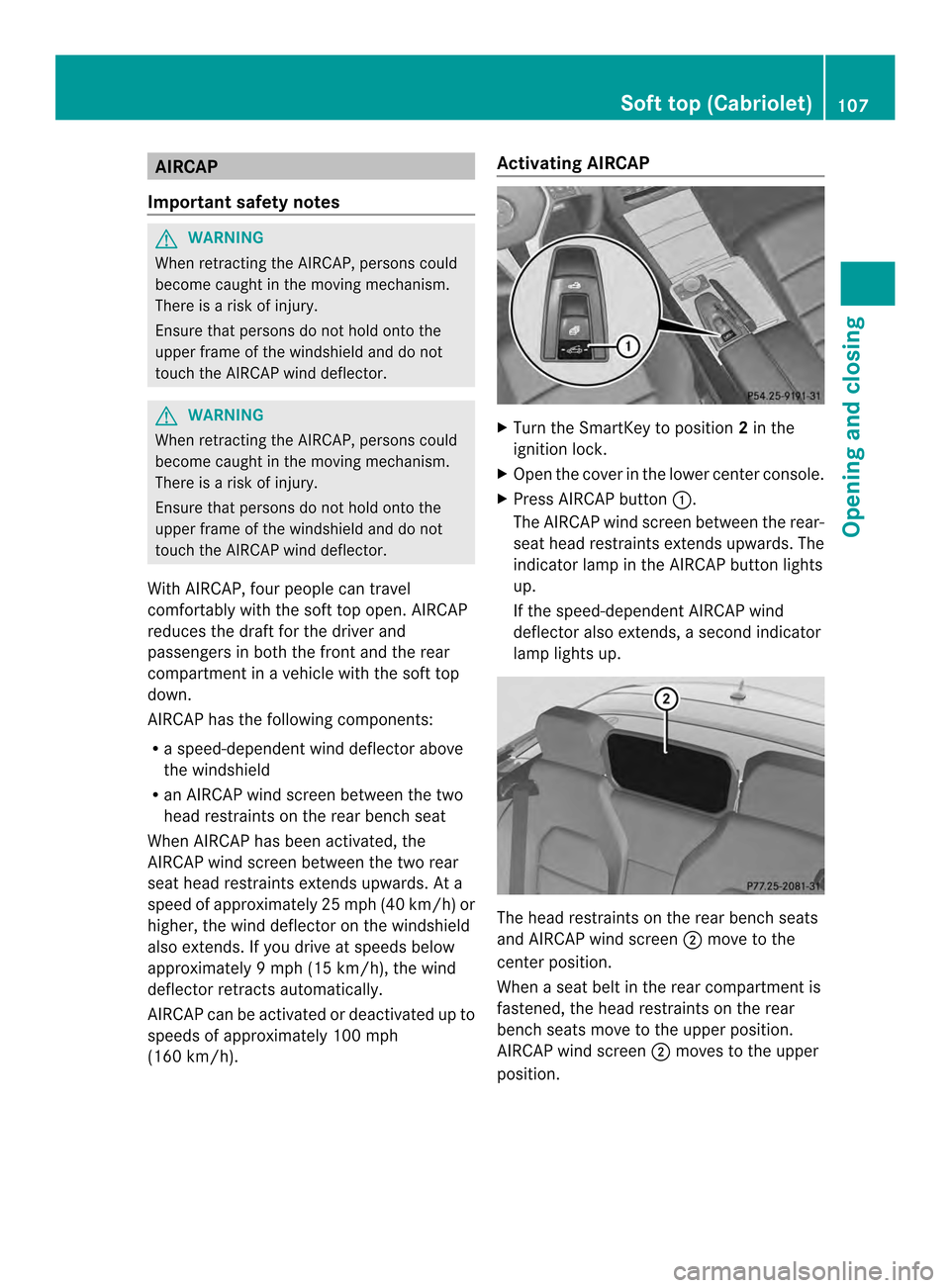
(160 km/h). Activating AIRCAP
X
Turn the SmartKey to position 2in the
ignition lock.
X Open the cover in the lower center console.
X Press AIRCAP button 0002.
The AIRCAP wind screen between the rear-
seat head restraints extends upwards. The
indicator lamp in the AIRCAP button lights
up.
If the speed-dependent AIRCAP wind
deflector also extends, a second indicator
lamp lights up. The head restraints on the rear bench seats
and AIRCAP wind screen
0003move to the
center position.
When a seat belt in the rear compartment is
fastened, the head restraints on the rear
bench seats move to the upper position.
AIRCAP wind screen 0003moves to the upper
position. Soft top (Cabriolet)
107Opening and closing Z
Page 110 of 394

Wind deflector
0023extends depending on
vehicle speed.
i If you park your vehicle with the roof open
and remove the SmartKey, the AIRCAP
wind screen retracts automatically. If, after
parking the vehicle, the engine is restarted,
the AIRCAP system is activated
automatically.
i AIRCAP cannot be extended or retracted
if the vehicle speed exceeds approximately
100 mph (160 km/h).
Deactivating AIRCAP X
Turn the SmartKey to position 2in the
ignition lock.
X Open the cover in the lower center console.
X Press AIRCAP button 0002.
The two indicato rlamps on the AIRCAP
butto ngo out. The wind deflector 0023retracts.
The head restraints on the rear seats and
AIRCAP wind screen 0003move to the lowest
position simultaneously.
i If there are passengers wearing seat belts
in the rear compartment, the head
restraints on the rear bench seats and the
AIRCAP wind screen remain in the upper
position.
Retracting the head restraints on the
rear bench seats from the driver's seat To improve the rear view, you can retrac
tthe
head restraints on the rear bench seats individually (Y
page 119). The wind deflector
remains in its current position. Installing and removing the AIRCAP
wind screen
Preparation You will need a
4mmAllen key to install/
remove the AIRCAP wind screen.
Before installing or removing the AIRCAP
wind screen:
X Turn the SmartKey to position 2in the
ignition lock.
X Open the folding roof fully (Y page 100).
X Extend the head restraints in the rear
compartment fully (Y page 119).
Removing Bolts on the AIRCAP wind screen between the head
restraints in the rear compartment
X
Use the 4 mm hex-socket wrench to turn
the bolts on both sides counter-clockwise
by about 90° and loosen them.
X Pull the bolts out of the brackets on the
head restraints. 108
Soft top (Cabriolet)Opening and closing
Page 118 of 394
Useful information
i This Operator's Manual describes all
models and all standard and optional
equipment of your vehicle available at the
time of publication of the Operator's
Manual. Country-specific differences are
possible. Please note that your vehicle may
not be equipped with all features
described. This also applies to safety-
related systems and functions.
i Read the information on qualified
specialist workshops: (Y page 25).Correct driver's seat position
G
WARNING
You could lose control of your vehicle if you
do the following while driving:
R adjust the driver's seat, head restraint,
steering wheel or mirrors
R faste nthe seat belt
There is a risk of an accident.
Adjust the driver's seat, head restraint,
steering wheel and mirror and fasten your
seat belt before starting the engine. X
Observe the safety guidelines on seat
adjustment (Y page 117).
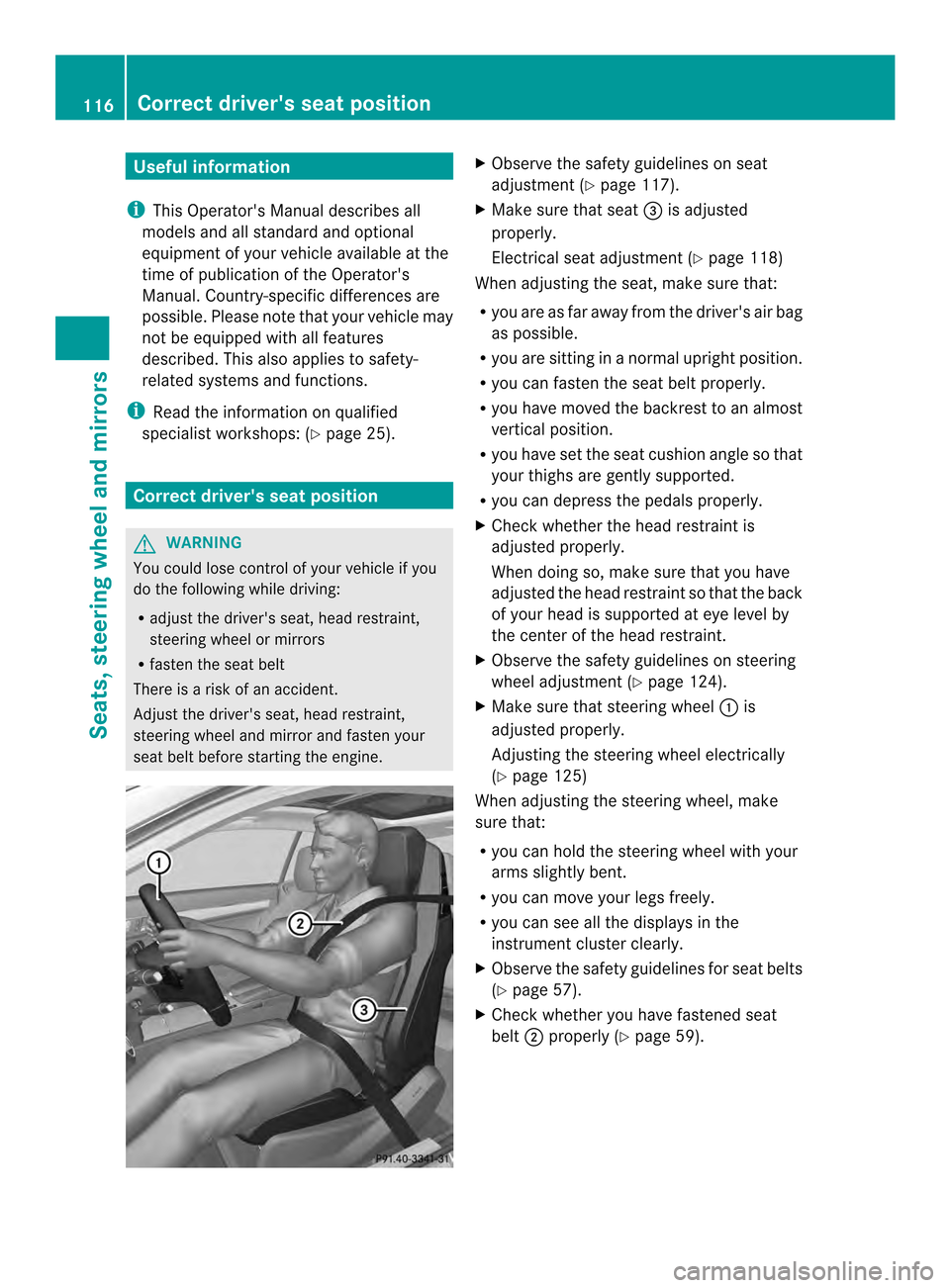
X Make sure that seat 0023is adjusted
properly.
Electrical seat adjustment (Y page 118)
When adjusting the seat, make sure that:
R you are as far away from the driver's air bag
as possible.
R you are sitting in a normal upright position.
R you can fasten the seat belt properly.
R you have moved the backrest to an almost
vertical position.
R you have set the seat cushion angle so that
your thighs are gently supported.
R you can depress the pedals properly.
X Check whether the head restraint is
adjusted properly.
When doing so, make sure that you have
adjusted the head restraint so that the back
of your head is supported at eye level by
the center of the head restraint.
X Observe the safety guidelines on steering
wheel adjustment (Y page 124).
X Make sure that steering wheel 0002is
adjusted properly.
Adjusting the steering wheel electrically
(Y page 125)
When adjusting the steering wheel, make
sure that:
R you can hold the steering wheel with your
arms slightly bent.
R you can move your legs freely.
R you can see all the displays in the
instrumentc luster clearly.
X Observe the safety guidelines for seat belts
(Y page 57).
X Check whether you have fastened seat
belt 0003properly (Y page 59).116
Correct driver's seat positionSeats, steering wheel and mirrors
Page 119 of 394
The seat belt should:
R
fit snugly across your body
R be routed across the middle of your
shoulder
R be routed in your pelvic area across the hip
joints
X Before starting off, adjust the rear-view
mirror and the exterior mirrors in such a
way that you have a good view of road and
traffic conditions (Y page 127).
X Vehicles with a memory function: save
the seat, steering wheel and exterior mirror
settings with the memory function
(Y page 130). Seats
Important safety notes
G
WARNING
Children could become trapped if they adjust
the seats, particularly when unattended.
There is a risk of injury.
When leaving the vehicle, always take the
SmartKey with you and lock the vehicle. Never
leave children unsupervised in the vehicle. G
WARNING
You could lose control of your vehicle if you
do the following while driving:
R adjust the driver's seat, head restraint,
steering wheel or mirrors
R fasten the seat belt
There is a risk of an accident.
Adjust the driver's seat, head restraint,
steering wheel and mirror and fasten your
seat belt before starting the engine. G
WARNING
If you adjust the seat height carelessly, you or
other vehicle occupants could be trapped and
thereby injured. Children in particular could
accidentally press the electrical seat adjustmen
tbuttons and become trapped.
There is a ris kofinjury.
While moving the seats, make sure tha tyour
hands or other body parts do not get under
the lever assembly of the seat adjustment
system. G
WARNING
When you adjust a seat, you or other vehicle
occupants could become trapped, e.g. on the
seat guide rail. There is arisk of injury.
Make sure when adjusting aseat that no one
has any body parts in the sweep of the seat. G
WARNING
If head restraints are not installed and
adjusted correctly, they cannot provide
protection as intended. There is an increased
risk of injury in the head and neck area, e.g.
in the event of an accident or when braking.
Always drive with the head restraints
installed. Before driving off, make sure for
every vehicle occupant that the center of the
head restraint supports the back of the head
at about eye level. G
WARNING
The seat belt does not offer the intended level
of protection if you have not moved the
backrest to an almost vertical position .When
braking or in the event of an accident, you
could slide underneath the seat belt and
sustain abdomen or neck injuries, for
example. This poses an increased risk of
injury or even fatal injury.
Adjust the seat properly before beginning
your journey. Always ensure that the backrest
is in an almost vertical position and that the
shoulder section of your seat belt is routed
across the center of your shoulder. Seats
117Seats, steering wheel and mirrors Z
Page 120 of 394

!
To avoid damage to the seats and the seat
heating, observe the following information:
R keep liquids from spilling on the seats. If
liquid is spilled on the seats, dry them as
soon as possible.
R if the seat covers are damp or wet, do not
switch on the seat heating. The seat
heating should also not be used to dry
the seats.
R clean the seat covers as recommended;
see "Interior care".
R do not transport heavy loads on the
seats. Do not place sharp objects on the
seat cushions, e.g. knives, nails or tools.
The seats should only be occupied by
passengers, if possible.
R when the seat heating is in operation, do
not cover the seats with insulating
materials, e.g. blankets, coats, bags,
seat covers, child seats or booster seats.
! Make sure that there are no objects in the
footwell or behind the seats when resetting
the seats. There is a risk that the seats
and/or the objects could be damaged.
i The head restraints in the front seats are
installed with the NECK-PRO system
(Y page 55). For this reason, it is not
possible to remove the head restraints
from the front seats.
For more information, contact a qualified
specialist workshop. Adjusting the seats
0002
Head restraint height
0003 Seat cushion angle
0023 Seat height
0022 Seat fore-and-aft adjustment
0020 Backrest angle
i If PRE-SAFE ®
is triggered, the front-
passenger seat will be moved to a better
position if it was previouslyinan
unfavorable position.
i You can store the seat settings using the
memory function (Y page 130).
i Vehicles with the through-loading
feature: if you fold down a rear seat
backrest, the respective front seat is
moved forwards slightly if necessary. This
prevents the seats from colliding. Adjusting the head restraints
Important safety notes G
WARNING
You could lose control of your vehicle if you
do the following while driving:
R adjust the driver's seat ,head restraint,
steering wheel or mirrors
R fasten the seat belt
There is a risk of an accident.
Adjust the driver's seat, head restraint,
steering wheel and mirror and fasten your
seat belt before starting the engine. 118
SeatsSeats, steering wheel and mirrors
Page 121 of 394

G
WARNING
If head restraints are not installed and
adjusted correctly, they cannot provide
protection as intended. There is an increased
risk of injury in the head and neck area, e.g.
in the event of an accident or when braking.
Always drive with the head restraints
installed. Before driving off, make sure for
every vehicle occupant that the center of the
head restraint supports the back of the head
at about eye level.
General notes Observe the important safety notes regarding
the seats (Y page 117).
Do not rotate the head restraints of the front
and rear seats. Otherwise, you cannot adjust
the height and angle of the head restraints to
the correct position.
Adjusting the height of the head
restraints electrically X
To adjust the head restraint height: slide
switch for head restraint adjustment 0002up
or down in the direction of the arrow. Rear seat head restraints Lowering and extending the rear seat
head restraints from the front (Cabriolet)
X
Turn the SmartKey to position 2in the
ignitio nlock (Y page 165).
X To lower: press button 0002.
The head restraints move to the lowest
position.
If AIRCAP is activated, the right-hand
indicator lamp on the AIRCAP button goes
out.
X To extend: press button 0002again.
The head restraints only move into the
central position if AIRCAP is activated and
no rear seat belt has been fastened.
If AIRCAP is activated, the right-hand
indicator lamp on the AIRCAP button
comes on.
i Please see further information on AIRCAP
(Y page 107). Lowering the head restraints in the
rear compartment manually
(Cabriolet)
If the head restraints in the rear compartment
are in the upper position, the soft top cannot
be closed fully. Seats
119Seats, steering wheel and mirrors Z
Page 122 of 394

Lower the head restraints in the rear
compartment manually if:
R
the head restraint electronics are
malfunctioning.
R the opening or closing procedure of the soft
top is interrupted, leaving the soft top
compartment cover open. Cover
0003can only be released if:
R the soft top is interrupted during the
opening or closing procedure.
R the soft top compartment cover is left
open.
X Push the mechanical key into two
openings 0002betwee nthe head restraints
until cover 0003releases.
X Take off cover 0003. X
Lowering the head restraints: turn
thumbwheel 0002in the direction of the front
seats. Folding the front seat backrests
forward/back
Important safety notes G
WARNING
If the backrest is not engaged, it could fold
forwards during a braking maneuver or in the
event of an accident, for example. The seat
backrest will then push the vehicle occupant
against the seat belt. The seat belt can no
longer offer the intended level of protection
and could even cause injuries. There is an
increased risk of injury.
Before each journey, make sure that the
backrest engages fully as described. G
WARNING
You could lose control of your vehicle if you
do the following while driving:
R adjust the driver's seat, steering wheel or
mirrors
R fasten the seat belt
There is a risk of an accident.
Adjust the driver's seat, steering wheel or
mirrors and fasten your seat belt before
starting the engine. G
WARNING
When you adjust a seat, you or other vehicle
occupants could become trapped, e.g. on the
seat guide rail. There is arisk of injury.
Make sure when adjusting aseat that no one
has any body parts in the sweep of the seat. 120
SeatsSeats, steering wheel and mirrors
Page 126 of 394
Problems with the seat ventilation
Problem Possible causes/consequences and
0001 Solutions
The seat ventilation has
switched off
prematurely or cannot
be switched on. The on-board voltage is too low because too many electrical
consumers are switched on.
X
Switch off electrical consumers that you do not need, such as
the rear window defroster or interior lighting.
Once the battery is sufficiently charged, the seat ventilation will
switch back on automatically. AIRSCARF (Cabriolet)
G
WARNING
When AIRSCARF is switched on, very hot air
can flow from the vents in the head restraints.
This could result in burns in the immediate
vicinity of the air vents. There is a risk of injury.
Reduce the heater output before it becomes
too hot. Driver's and front-passenger seat
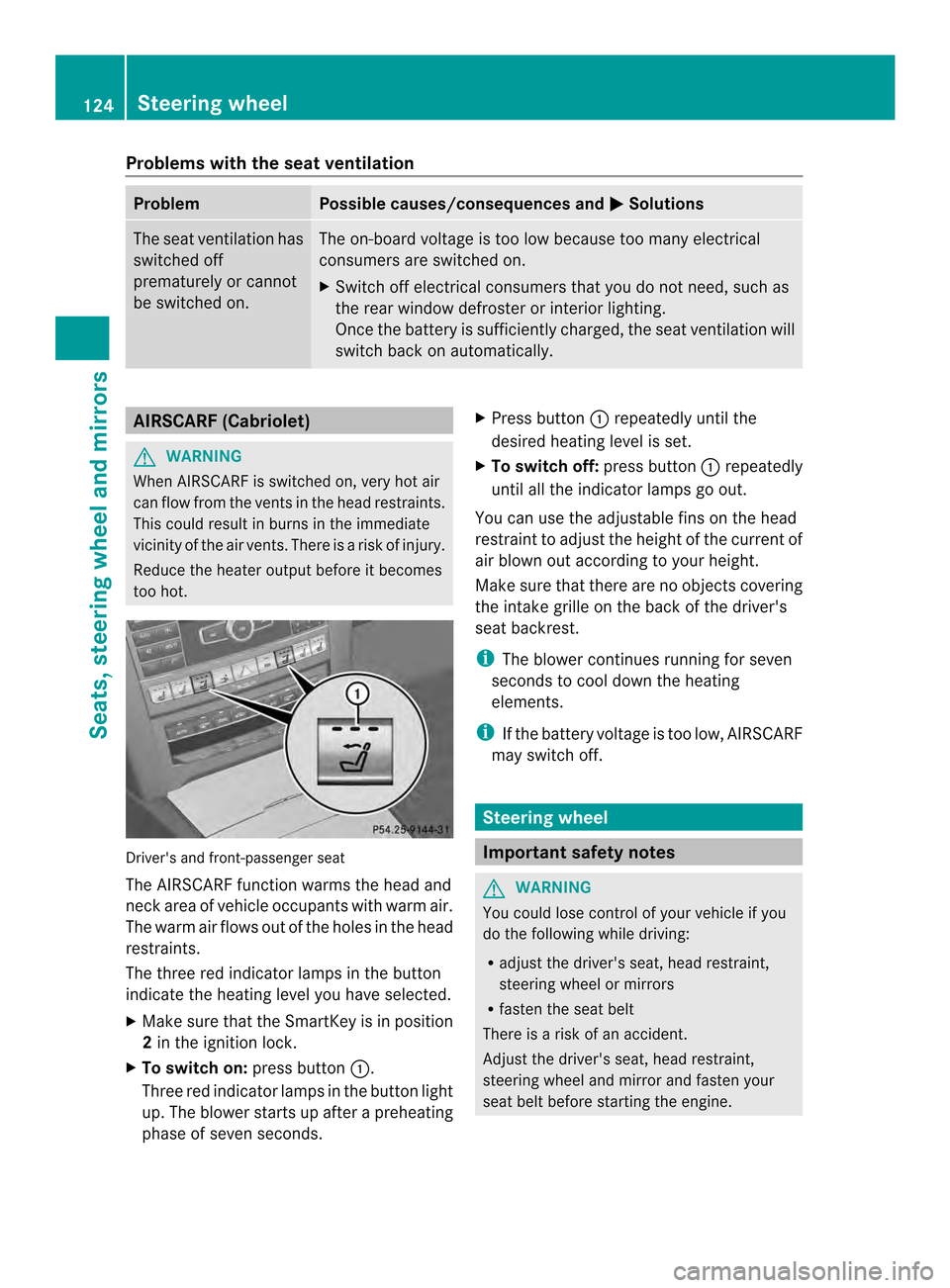
The AIRSCARF function warms the head and
neck area of vehicle occupants with warm air.
The warm air flows out of the holes in the head
restraints.
The three red indicator lamps in the button
indicate the heating level you have selected.
X
Make sure that the SmartKey is in position
2in the ignition lock.
X To switch on: press button0002.
Three red indicator lamps in the button light
up. The blower starts up after a preheating
phase of seven seconds. X
Press button 0002repeatedly until the
desired heating level is set.
X To switch off: press button0002repeatedly
until all the indicator lamps go out.
You can use the adjustable fins on the head
restraint to adjust the height of the current of
air blown out according to your height.
Make sure that there are no objects covering
the intake grille on the back of the driver's
seat backrest.
i The blower continues running for seven
seconds to cool down the heating
elements.
i If the battery voltage is too low, AIRSCARF
may switch off. Steering wheel
Important safety notes
G
WARNING
You could lose control of your vehicle if you
do the following while driving:
R adjust the driver's seat, head restraint,
steering wheel or mirrors
R fasten the seat belt
There is a risk of an accident.
Adjust the driver's seat, head restraint,
steering wheel and mirror and fasten your
seat belt before starting the engine. 124
Steering wheelSeats, steering wheel and mirrors
Page 129 of 394

Position of the steering wheel for
driving The steering wheel is moved to the last
selected position when:
R the driver's door is closed
R with KEYLESS-GO: you press the Start/
Stop button once on vehicles with
KEYLESS-GO
or
R with the SmartKey: you insert the
SmartKey into the ignition lock.
When you close the driver's door with the
ignition switched on, the steering wheel is
also automatically moved to the previously
set position.
The last position of the steering wheel is
stored when you switch off the ignition or
when you store the settingw ith the memory
function (Y page 130).
Crash-responsive EASY-EXIT feature If the crash-responsive EASY-EXIT feature is
triggered in an accident, the steering column
will move upwards when the driver's door is
opened. This occurs irrespective of the
position of the SmartKey in the ignition lock.
This makes it easier to exit the vehicle and
rescue the occupants.
The crash-responsive EASY-EXIT feature is
only operational if the EASY-EXIT/ENTRY
feature is activated in the on-board computer.
(Y page 246) Mirrors
Rear-view mirror
X
Anti-glare mode: flick anti-glare lever 0002
forwards or back. Exterior mirrors
Adjusting the exterior mirrors G
WARNING
You could lose control of your vehicle if you
do the following while driving:
R adjust the driver's seat ,head restraint,
steering wheel or mirrors
R fasten the seat belt
There is a risk of an accident.
Adjust the driver's seat, head restraint,
steering wheel and mirror and fasten your
seat belt before starting the engine. G
WARNING
The exterior mirror on the front-passenger
side reduces the size of the image. Visible
objects are actually closer than they appear.
This means that you could misjudge the
distance from road users traveling behind,
e.g. when changing lane. There is a risk of an
accident.
For this reason, always make sure of the
actual distance from the road users traveling
behind by glancing over your shoulder. Mirrors
127Seats, steering wheel and mirrors Z
Page 171 of 394
Automatic engine switch-off
General notes
The ECO start/stop function is operational
and the 000Csymbol is displayed in green in
the multifunction display, if:
R the indicator lamp in th eECO butto nis lit
green.
R the outside temperature is within the
comfort range.
R the engine is at normal operating
temperature.
R the set temperature for the vehicle interior
has been reached.
R the battery is sufficiently charged.
R the system detects that the windshield is
not fogged up when the air-conditioning
system is switched on.
R the hood is closed.
R the driver's door is closed and the driver's
seat belt is fastened.
If conditions for automatic engine switch-off
have not been fulfilled, the 000Csymbol will
be shown in yellow.
i All of the vehicle's systems remain active
when the engine has been stopped
automatically.
i The engine can be switched off
automatically a maximum of four times
(first stop and three subsequent stops) in
succession. The 000Csymbol is shown in
yellow in the multifunction display after the
engine has been started automatically for
the fourth time. The automatic engine
switch-off is available once againw hen the
000C symbol is shown in green in the
multifunction display.
Vehicles with automatic transmission
If the vehicle is braked to a standstill in Dor
N, the ECO start/stop function switches off
the engine automatically.
i The HOLD function can be activated if the
engine has been switched off automatically. It is then not necessary to
continue applying the brakes during the
automatic stop phase. When you depress
the accelerator pedal, the engine starts
automatically and the braking effect of the
HOLD function is deactivated.
Automatic engine start General notes
The engine starts automatically if:
R
you switch off the ECO start/stop function
by pressing the ECO button.
R you engage reverse gear R.
R the vehicle starts to roll.
R the brake system requires this.
R the temperature in the vehicle interior
deviates from the set range.
R the system detects moisture on the
windshield when the air-conditioning
system is switched on.
R the condition of charge of the battery is too
low.
R the driver's seat belt is removed or the
driver's door is opened.
Vehicles with automatic transmission
The engine is started automatically if you:
R release the brake pedal when HOLD is not
activated and the transmission is in
position Dor N.
R depress the accelerator pedal.
R move the transmission out of position P.
i Shifting the transmission to position P
does not start the engine.
i If you shift the transmission from Rto D,
the ECO start/stop function is available
again once the 000Csymbol reappears in
green in the multifunction display. Driving
169Driving and parking Z