ignition MERCEDES-BENZ E-CLASS COUPE 2015 Owners Manual
[x] Cancel search | Manufacturer: MERCEDES-BENZ, Model Year: 2015, Model line: E-CLASS COUPE, Model: MERCEDES-BENZ E-CLASS COUPE 2015Pages: 345, PDF Size: 11.42 MB
Page 14 of 345
Tank content/reserve fuel .............3
30
Fuel filler flap
Opening ......................................... 148
Fuel filter (white display message) .. 233
Fuel level
Calling up the range (on-board
computer) ...................................... 209
Gauge .............................................. 30
Fuel reserve
see Fuel
Fuel tank
Capacity ........................................ 330
Problem (malfunction) ................... 150
Fuse allocation chart (vehicle tool
kit) ...................................................... 297
Fuses
Allocation chart ............................ .311
Before changing ............................ .311
Dashboard fuse box ....................... 311
Fuse box in the boot ..................... .312
Fuse box in the engine compart-
ment .............................................. 311
Important safety notes .................. 310 G
Garage door opener Clearing the memory ..................... 278
Frequencies ................................... 279
General notes ................................ 276
Important safety notes .................. 277
Opening/closing the garage door .. 278
Problems when programming ....... .278
Programming (button in the rear-
view mirror) ................................... 277
Synchronising the rolling code ....... 278
Genuine Mercedes-Benz parts ........... 23
Glove compartment .......................... 266
Google™ Local Search
See also Digital Owner's Manual ... 256 H
Hazard warning lamps ......................108
Head restraints
Adjusting ......................................... 95
Adjusting (electrically) ..................... 96
Adjusting (manually) ........................ 95 see NECK-PRO head restraints
Headbag
Display message ............................ 229
Headlamp flasher .............................. 108
Headlamps
Misting up ...................................... 110
see Automatic headlamp mode
Heating
see Climate control
High-pressure cleaners .................... 291
Hill start assist .................................. 135
HOLD function
Activating ....................................... 171
Deactivating ................................... 171
Display message ............................ 234
Function/notes ............................ .170
Home address
See also Digital Owner's Manual ... 256
Horn ...................................................... 28 I
Ignition lock see Key positions
Immobiliser .......................................... 71
Indicator and warning lamp
Restraint system ............................ 251
Indicator and warning lamps
COLLISION PREVENTION ASSIST
PLUS .............................................. 254
Coolant .......................................... 252
Engine diagnostics ......................... 252
Indicator lamps
Display message ............................ 229
see Warning and indicator lamps
Indicators
see Turn signals
Insect protection on the radiator .... 285
Instrument cluster
Overview .......................................... 30
Settings ......................................... 216
Warning and indicator lamps ........... 30
Instrument cluster lighting .............. 216
Intelligent Light System
Activating/deactivating ................. 217
Display message ............................ 229
Overview ........................................ 108 Index
11
Page 15 of 345
Setting the dipped-beam head-
lamps for driving on the right/left .. 217
Interior lighting
Automatic control system .............. 110
Delayed switch-off (on-board
computer) ...................................... 218
Overview ........................................ 110
Reading lamp ................................. 110
Setting brightness for display/
switches (on-board computer) ....... 216
Interior motion sensor
Deactivating ..................................... 73
Function ........................................... 72
Priming ............................................ 73
Switching off .................................... 73
iPod ®
See also Digital Owner's Manua l... 256
ISOFIX child seat securing system .... 49J
Jack Storage location ............................ 297
Using ............................................. 322
Jump starting (engine) ...................... 305K
Key Changing the battery ....................... 77
Checking the battery ....................... 77
Convenience opening feature .......... 86
Display message ............................ 245
Door central locking/unlocking ....... 74
Emergency key element ................... 76
Important safety notes .................... 74
Loss ................................................. 79
Modifying the programming ............. 76
Overview .......................................... 74
Positions (ignition lock) ................. 132
Problem (malfunction) ..................... 79
Starting the engine ........................ 134
Key positions
Key ................................................ 132
KEYLESS GO .................................. 132
KEYLESS-GO
Convenience closing ........................ 86
Deactivation ..................................... 75 Display message ............................ 245
Locking ............................................ 75
Removing the Start/Stop button ... 133
Start/Stop button .......................... 132
Starting the engine ........................ 134
Unlocking ......................................... 75
Kickdown
Driving tips .................................... 143
Manual drive progra m.................... 146
Kneebag ............................................... 42 L
Lamps see Warning and indicator lamps
Lane Keeping Assist
Activating/deactivating ................. 215
Display message ............................ 235
Function/information .................... 195
Lane package ..................................... 193
Lashing eyelets ................................. 269
Licence plate lamp (display mes-
sage) ................................................... 229
Light sensor (display message) ....... 230
Lighting
see Lights
Lights
Activating/deactivating the Intel-
ligent Light System ........................ 217
Activating/deactivating the inte-
rior lighting delayed switch-off ....... 218
Active light function ....................... 109
Adaptive Highbeam Assist PLUS .... 109
Automatic headlamp mode ............ 106
Cornering light function ................. 109
Dipped-beam headlamp s............... 107
Driving abroad ............................... 106
Foglamps (extended range) ........... 109
Hazard warning lamps ................... 108
Headlamp flashe r........................... 108
Light switch ................................... 106
Main-beam headlamp s................... 108
Motorway mode ............................. 109
Parking lamps ................................ 107
Rear foglamp ................................. 107
Setting brightness for display/
switches (on-board computer) ....... 216
Side lamps ..................................... 107 12
Index
Page 31 of 345
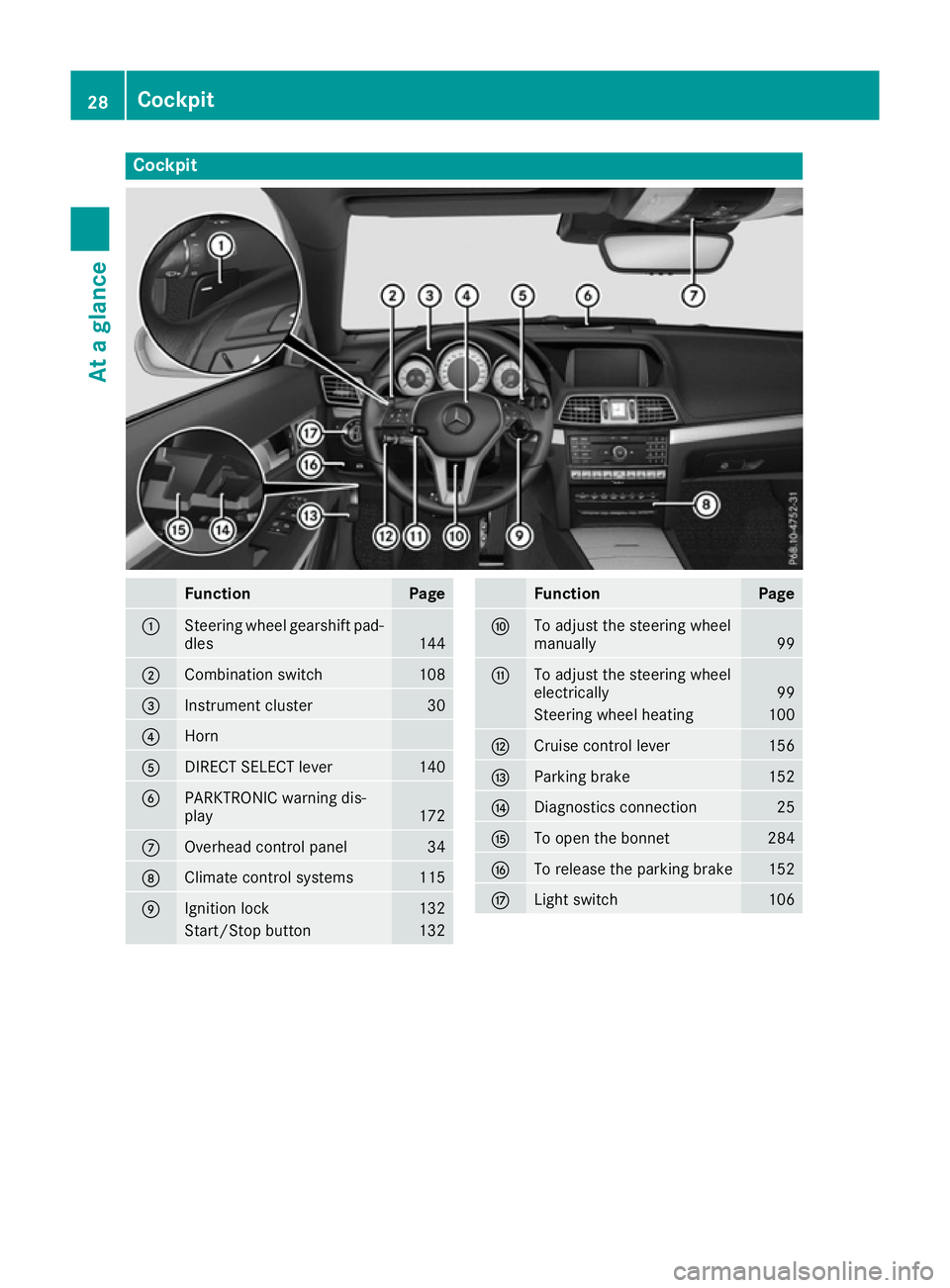
Cockpit
Function Page
:
Steering wheel gearshift pad-
dles 144
;
Combination switch 108
=
Instrument cluster 30
?
Horn
A
DIRECT SELECT lever 140
B
PARKTRONIC warning dis-
play
172
C
Overhead control panel 34
D
Climate control systems 115
E
Ignition lock 132
Start/Stop button 132 Function Page
F
To adjust the steering wheel
manually
99
G
To adjust the steering wheel
electrically
99
Steering wheel heating 100
H
Cruise control lever 156
I
Parking brake 152
J
Diagnostics connection 25
K
To open the bonnet 284
L
To release the parking brake 152
M
Light switch 10628
CockpitAt a glance
Page 32 of 345
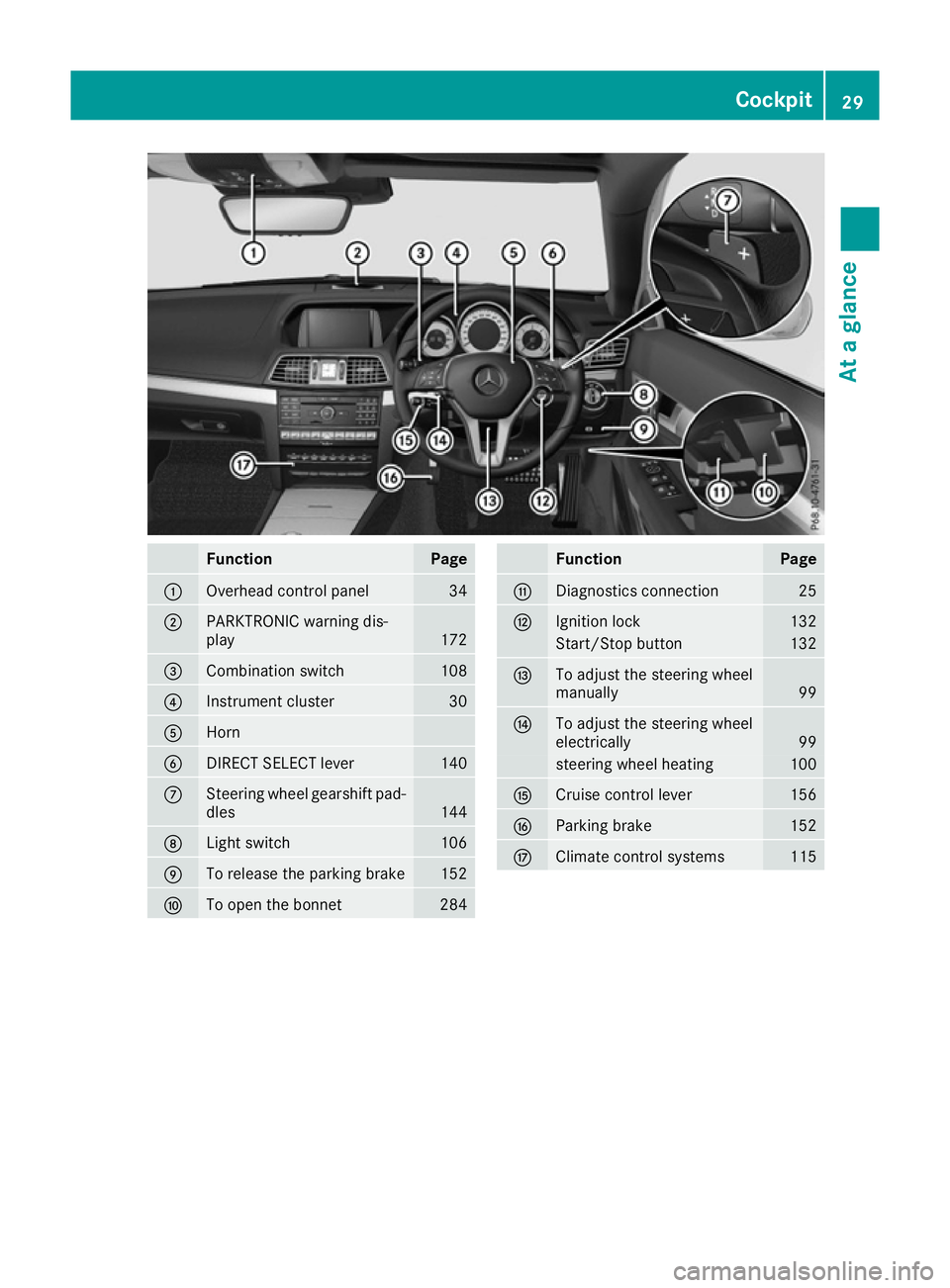
Function Page
:
Overhead control panel 34
;
PARKTRONIC warning dis-
play
172
=
Combination switch 108
?
Instrument cluster 30
A
Horn
B
DIRECT SELECT lever 140
C
Steering wheel gearshift pad-
dles 144
D
Light switch 106
E
To release the parking brake 152
F
To open the bonnet 284 Function Page
G
Diagnostics connection 25
H
Ignition lock 132
Start/Stop button 132
I
To adjust the steering wheel
manually
99
J
To adjust the steering wheel
electrically
99
steering wheel heating 100
K
Cruise control lever 156
L
Parking brake 152
M
Climate control systems 115Cockpit
29At a glance
Page 39 of 345
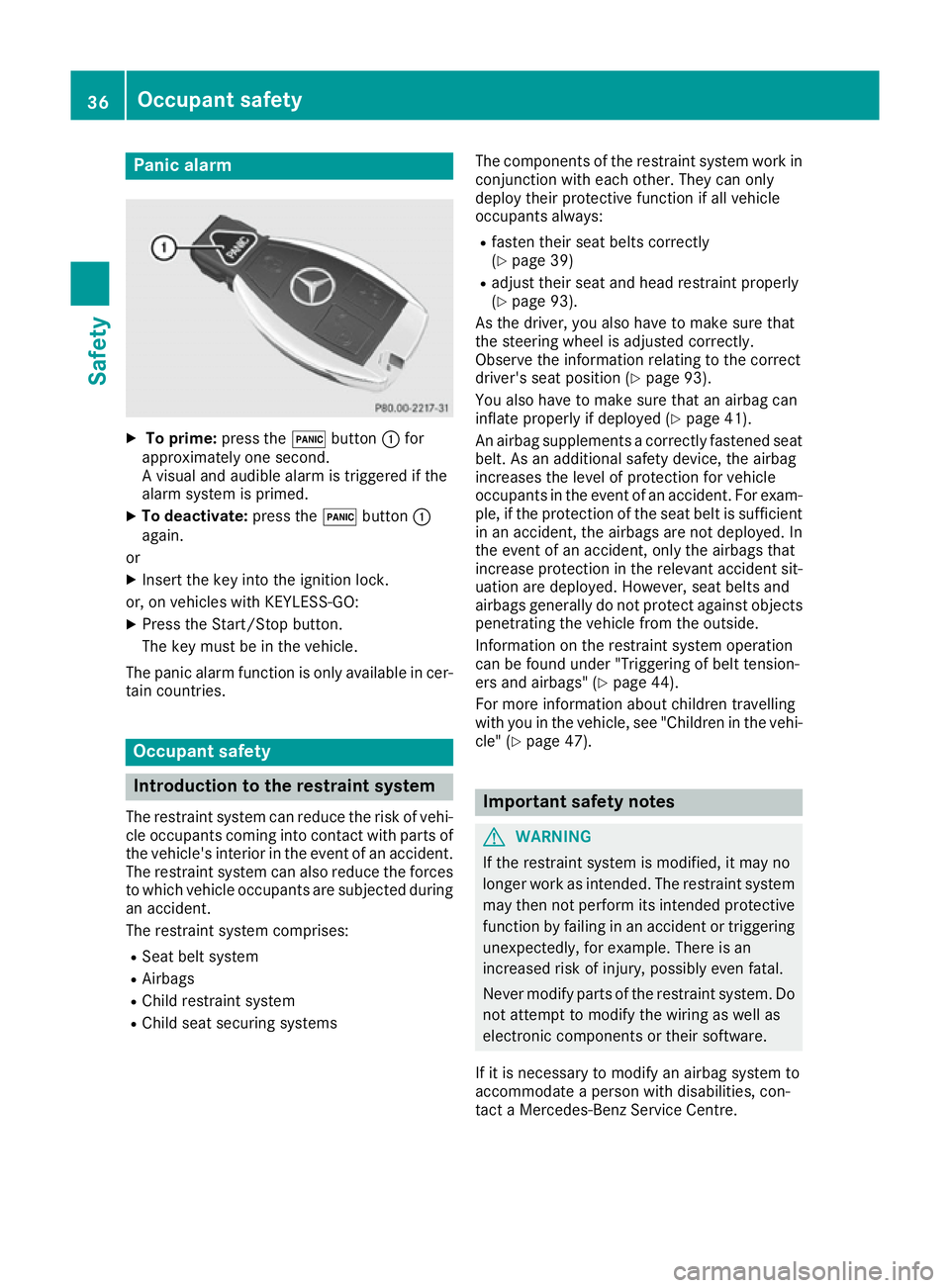
Panic alarm
X
To prime: press the!button :for
approximately one second.
A visual and audible alarm is triggered if the
alarm system is primed.
X To deactivate: press the!button :
again.
or
X Insert the key into the ignition lock.
or, on vehicles with KEYLESS‑GO: X Press the Start/Stop button.
The key must be in the vehicle.
The panic alarm function is only available in cer- tain countries. Occupant safety
Introduction to the restraint system
The restraint system can reduce the risk of vehi- cle occupants coming into contact with parts of
the vehicle's interior in the event of an accident.
The restraint system can also reduce the forces to which vehicle occupants are subjected during
an accident.
The restraint system comprises:
R Seat belt system
R Airbags
R Child restraint system
R Child seat securing systems The components of the restraint system work in
conjunction with each other. They can only
deploy their protective function if all vehicle
occupants always:
R fasten their seat belts correctly
(Y page 39)
R adjust their seat and head restraint properly
(Y page 93).
As the driver, you also have to make sure that
the steering wheel is adjusted correctly.
Observe the information relating to the correct
driver's seat position (Y page 93).
You also have to make sure that an airbag can
inflate properly if deployed (Y page 41).
An airbag supplements a correctly fastened seat belt. As an additional safety device, the airbag
increases the level of protection for vehicle
occupants in the event of an accident. For exam-
ple, if the protection of the seat belt is sufficient in an accident, the airbags are not deployed. In
the event of an accident, only the airbags that
increase protection in the relevant accident sit- uation are deployed. However, seat belts and
airbags generally do not protect against objects penetrating the vehicle from the outside.
Information on the restraint system operation
can be found under "Triggering of belt tension-
ers and airbags" (Y page 44).
For more information about children travelling
with you in the vehicle, see "Children in the vehi-
cle" (Y page 47). Important safety notes
G
WARNING
If the restraint system is modified, it may no
longer work as intended. The restraint system
may then not perform its intended protective function by failing in an accident or triggering
unexpectedly, for example. There is an
increased risk of injury, possibly even fatal.
Never modify parts of the restraint system. Do not attempt to modify the wiring as well as
electronic components or their software.
If it is necessary to modify an airbag system to
accommodate a person with disabilities, con-
tact a Mercedes-Benz Service Centre. 36
Occupant safetySafety
Page 40 of 345
Restraint system warning lamp
The functions of the restraint system are
checked after the ignition is switched on and at
regular intervals while the engine is running.
Therefore, malfunctions can be detected in
good time.
The 6 restraint system warning lamp in the
instrument cluster lights up when the ignition is switched on. It goes out no later than a few sec-
onds after the vehicle is started. The compo-
nents of the restraint system are in operational
readiness.
A malfunction has occurred if the 6restraint
system warning lamp:
R does not light up after the ignition is switched
on
R does not go out after a few seconds with the
engine running
R lights up again while the engine is running G
WARNING
If the restraint system is malfunctioning,
restraint system components may be trig-
gered unintentionally or might not be trig-
gered at all in the event of an accident with a high rate of vehicle deceleration. This can
effect belt tensioners or airbags, for example. There is an increased risk of serious or even
fatal injuries.
Have the restraint system checked and
repaired immediately at a qualified specialist
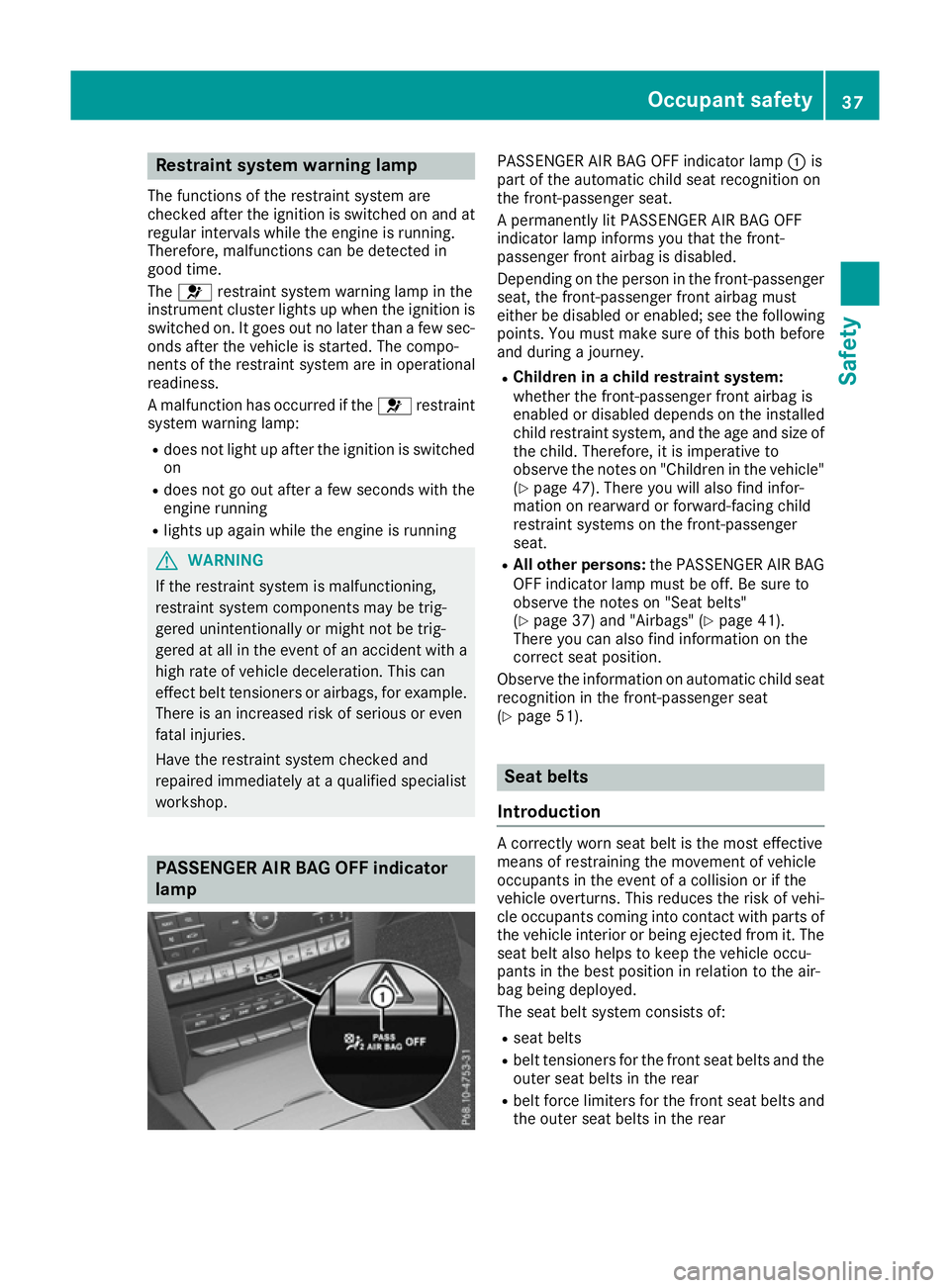
workshop. PASSENGER AIR BAG OFF indicator
lamp PASSENGER AIR BAG OFF indicator lamp
:is
part of the automatic child seat recognition on
the front-passenger seat.
A permanently lit PASSENGER AIR BAG OFF
indicator lamp informs you that the front-
passenger front airbag is disabled.
Depending on the person in the front-passenger seat, the front-passenger front airbag must
either be disabled or enabled; see the following
points. You must make sure of this both before
and during a journey.
R Children in a child restraint system:
whether the front-passenger front airbag is
enabled or disabled depends on the installed
child restraint system, and the age and size of the child. Therefore, it is imperative to
observe the notes on "Children in the vehicle"
(Y page 47). There you will also find infor-
mation on rearward or forward-facing child
restraint systems on the front-passenger
seat.
R All other persons: the PASSENGER AIR BAG
OFF indicator lamp must be off. Be sure to
observe the notes on "Seat belts"
(Y page 37) and "Airbags" (Y page 41).
There you can also find information on the
correct seat position.
Observe the information on automatic child seat recognition in the front-passenger seat
(Y page 51). Seat belts
Introduction A correctly worn seat belt is the most effective
means of restraining the movement of vehicle
occupants in the event of a collision or if the
vehicle overturns. This reduces the risk of vehi- cle occupants coming into contact with parts of
the vehicle interior or being ejected from it. The
seat belt also helps to keep the vehicle occu-
pants in the best position in relation to the air-
bag being deployed.
The seat belt system consists of:
R seat belts
R belt tensioners for the front seat belts and the
outer seat belts in the rear
R belt force limiters for the front seat belts and
the outer seat belts in the rear Occupant safety
37Safety Z
Page 43 of 345
tive door is closed and the key is turned to posi-
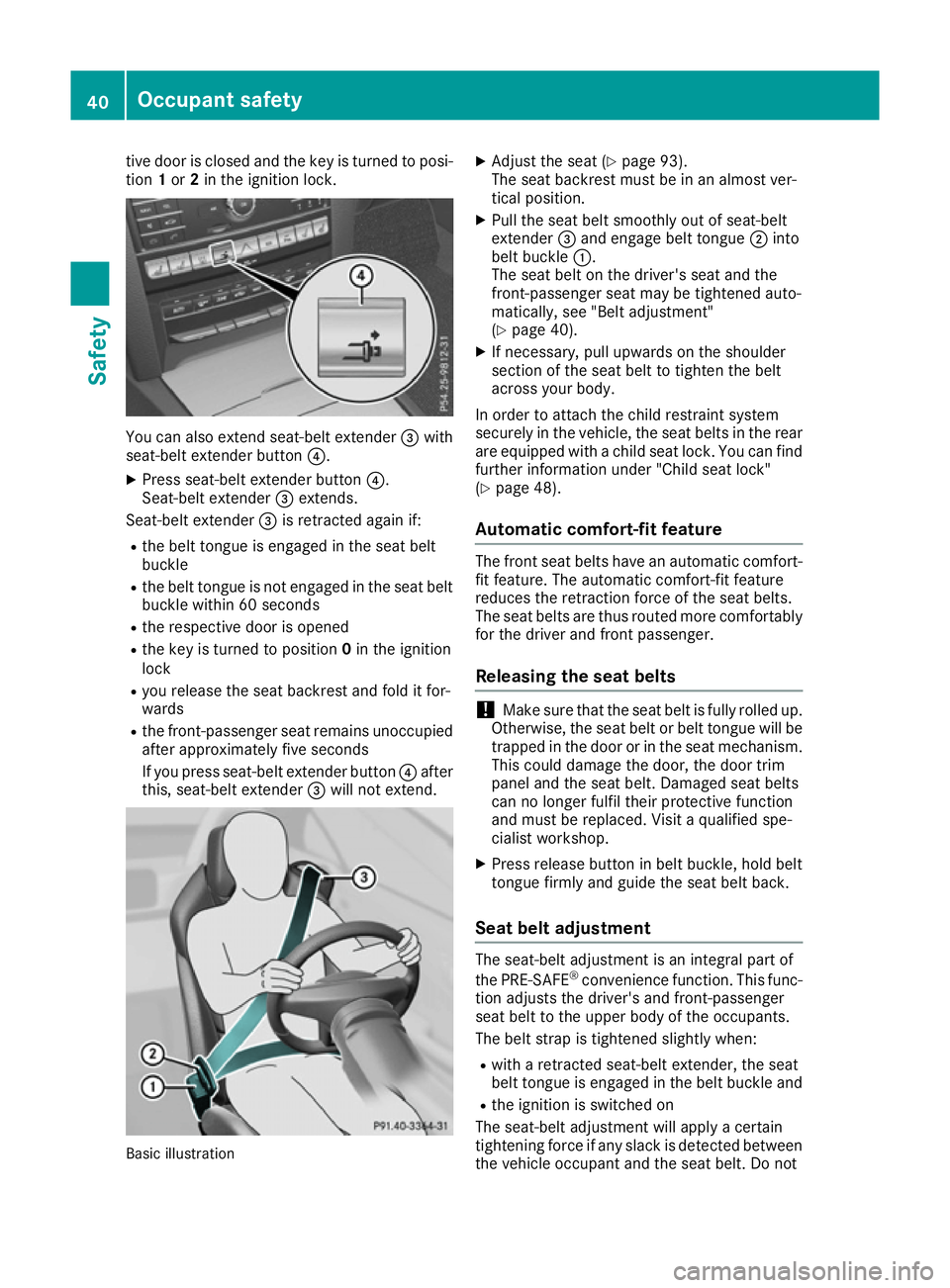
tion 1or 2in the ignition lock. You can also extend seat-belt extender
=with
seat-belt extender button ?.
X Press seat-belt extender button ?.
Seat-belt extender =extends.
Seat-belt extender =is retracted again if:
R the belt tongue is engaged in the seat belt
buckle
R the belt tongue is not engaged in the seat belt
buckle within 60 seconds
R the respective door is opened
R the key is turned to position 0in the ignition
lock
R you release the seat backrest and fold it for-
wards
R the front-passenger seat remains unoccupied
after approximately five seconds
If you press seat-belt extender button ?after
this, seat-belt extender =will not extend. Basic illustration X
Adjust the seat (Y page 93).
The seat backrest must be in an almost ver-
tical position.
X Pull the seat belt smoothly out of seat-belt
extender =and engage belt tongue ;into
belt buckle :.
The seat belt on the driver's seat and the
front-passenger seat may be tightened auto-
matically, see "Belt adjustment"
(Y page 40).
X If necessary, pull upwards on the shoulder
section of the seat belt to tighten the belt
across your body.
In order to attach the child restraint system
securely in the vehicle, the seat belts in the rear
are equipped with a child seat lock. You can find
further information under "Child seat lock"
(Y page 48).
Automatic comfort-fit feature The front seat belts have an automatic comfort-
fit feature. The automatic comfort-fit feature
reduces the retraction force of the seat belts.
The seat belts are thus routed more comfortably for the driver and front passenger.
Releasing the seat belts !
Make sure that the seat belt is fully rolled up.
Otherwise, the seat belt or belt tongue will be
trapped in the door or in the seat mechanism.
This could damage the door, the door trim
panel and the seat belt. Damaged seat belts
can no longer fulfil their protective function
and must be replaced. Visit a qualified spe-
cialist workshop.
X Press release button in belt buckle, hold belt
tongue firmly and guide the seat belt back.
Seat belt adjustment The seat-belt adjustment is an integral part of
the PRE-SAFE
®
convenience function. This func-
tion adjusts the driver's and front-passenger
seat belt to the upper body of the occupants.
The belt strap is tightened slightly when:
R with a retracted seat-belt extender, the seat
belt tongue is engaged in the belt buckle and
R the ignition is switched on
The seat-belt adjustment will apply a certain
tightening force if any slack is detected between
the vehicle occupant and the seat belt. Do not 40
Occupant safetySafety
Page 47 of 345
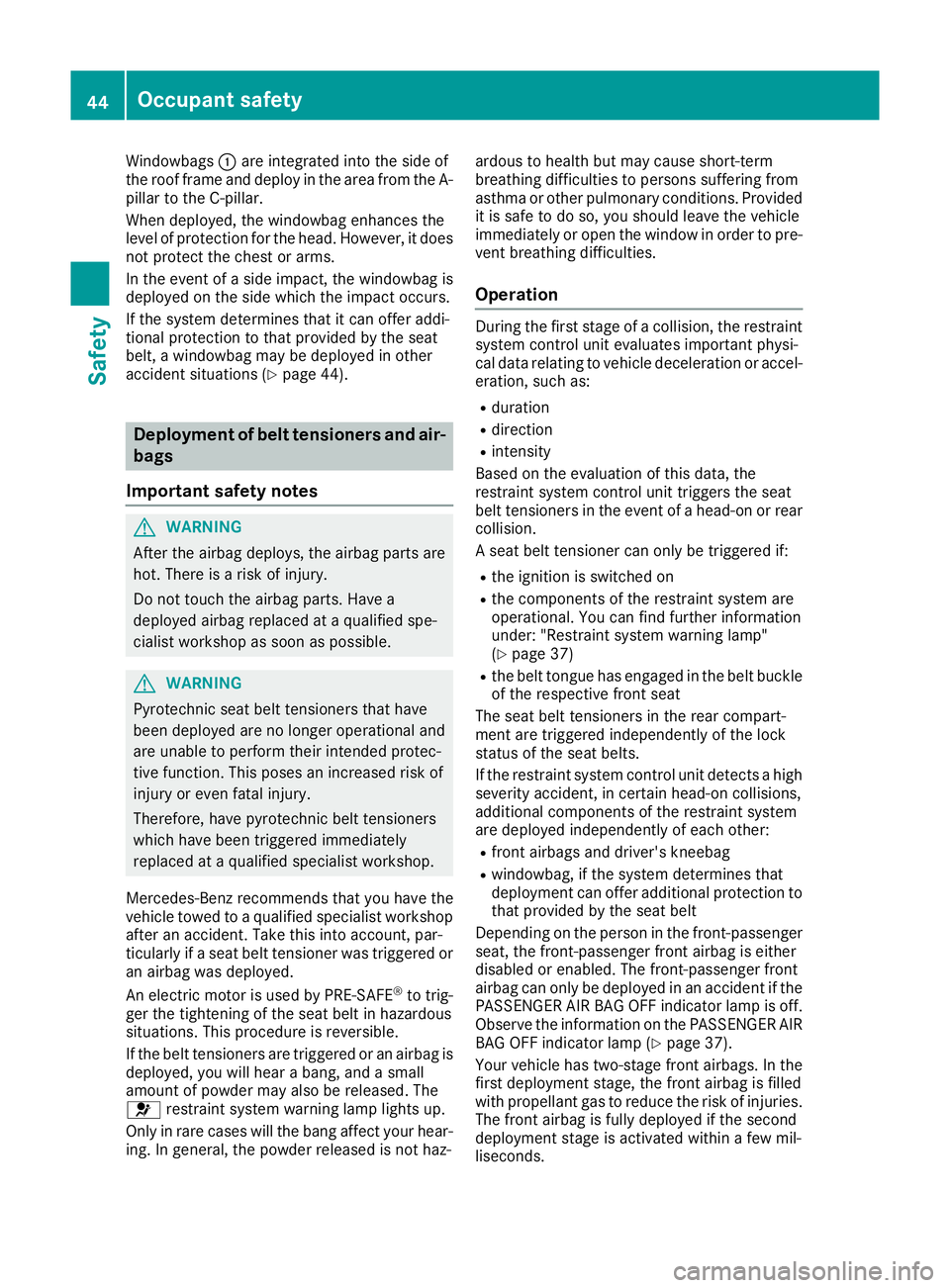
Windowbags
:are integrated into the side of
the roof frame and deploy in the area from the A-
pillar to the C-pillar.
When deployed, the windowbag enhances the
level of protection for the head. However, it does
not protect the chest or arms.
In the event of a side impact, the windowbag is
deployed on the side which the impact occurs.
If the system determines that it can offer addi-
tional protection to that provided by the seat
belt, a windowbag may be deployed in other
accident situations (Y page 44).Deployment of belt tensioners and air-
bags
Important safety notes G
WARNING
After the airbag deploys, the airbag parts are
hot. There is a risk of injury.
Do not touch the airbag parts. Have a
deployed airbag replaced at a qualified spe-
cialist workshop as soon as possible. G
WARNING
Pyrotechnic seat belt tensioners that have
been deployed are no longer operational and
are unable to perform their intended protec-
tive function. This poses an increased risk of
injury or even fatal injury.
Therefore, have pyrotechnic belt tensioners
which have been triggered immediately
replaced at a qualified specialist workshop.
Mercedes-Benz recommends that you have the
vehicle towed to a qualified specialist workshop
after an accident. Take this into account, par-
ticularly if a seat belt tensioner was triggered or
an airbag was deployed.
An electric motor is used by PRE-SAFE ®
to trig-
ger the tightening of the seat belt in hazardous
situations. This procedure is reversible.
If the belt tensioners are triggered or an airbag is deployed, you will hear a bang, and a small
amount of powder may also be released. The
6 restraint system warning lamp lights up.
Only in rare cases will the bang affect your hear-
ing. In general, the powder released is not haz- ardous to health but may cause short-term
breathing difficulties to persons suffering from
asthma or other pulmonary conditions. Provided
it is safe to do so, you should leave the vehicle
immediately or open the window in order to pre- vent breathing difficulties.
Operation During the first stage of a collision, the restraint
system control unit evaluates important physi-
cal data relating to vehicle deceleration or accel-
eration, such as:
R duration
R direction
R intensity
Based on the evaluation of this data, the
restraint system control unit triggers the seat
belt tensioners in the event of a head-on or rear
collision.
A seat belt tensioner can only be triggered if:
R the ignition is switched on
R the components of the restraint system are
operational. You can find further information
under: "Restraint system warning lamp"
(Y page 37)
R the belt tongue has engaged in the belt buckle
of the respective front seat
The seat belt tensioners in the rear compart-
ment are triggered independently of the lock
status of the seat belts.
If the restraint system control unit detects a high severity accident, in certain head-on collisions,
additional components of the restraint system
are deployed independently of each other:
R front airbags and driver's kneebag
R windowbag, if the system determines that
deployment can offer additional protection to
that provided by the seat belt
Depending on the person in the front-passenger seat, the front-passenger front airbag is either
disabled or enabled. The front-passenger front
airbag can only be deployed in an accident if the PASSENGER AIR BAG OFF indicator lamp is off.
Observe the information on the PASSENGER AIR
BAG OFF indicator lamp (Y page 37).
Your vehicle has two-stage front airbags. In the
first deployment stage, the front airbag is filled
with propellant gas to reduce the risk of injuries.
The front airbag is fully deployed if the second
deployment stage is activated within a few mil-
liseconds. 44
Occupant safetySafety
Page 55 of 345
wards from the retracted seat-belt extender.
If necessary, adjust the front-passenger seat
accordingly. Always observe the information
about suitable positioning of the child
restraint system in this Owner's Manual as
well as the child restraint system manufac-
turer's installation instructions.
i Ensure that your vehicle is equipped with
automatic child seat recognition for the front-
passenger seat (Y page 52). If this is not the
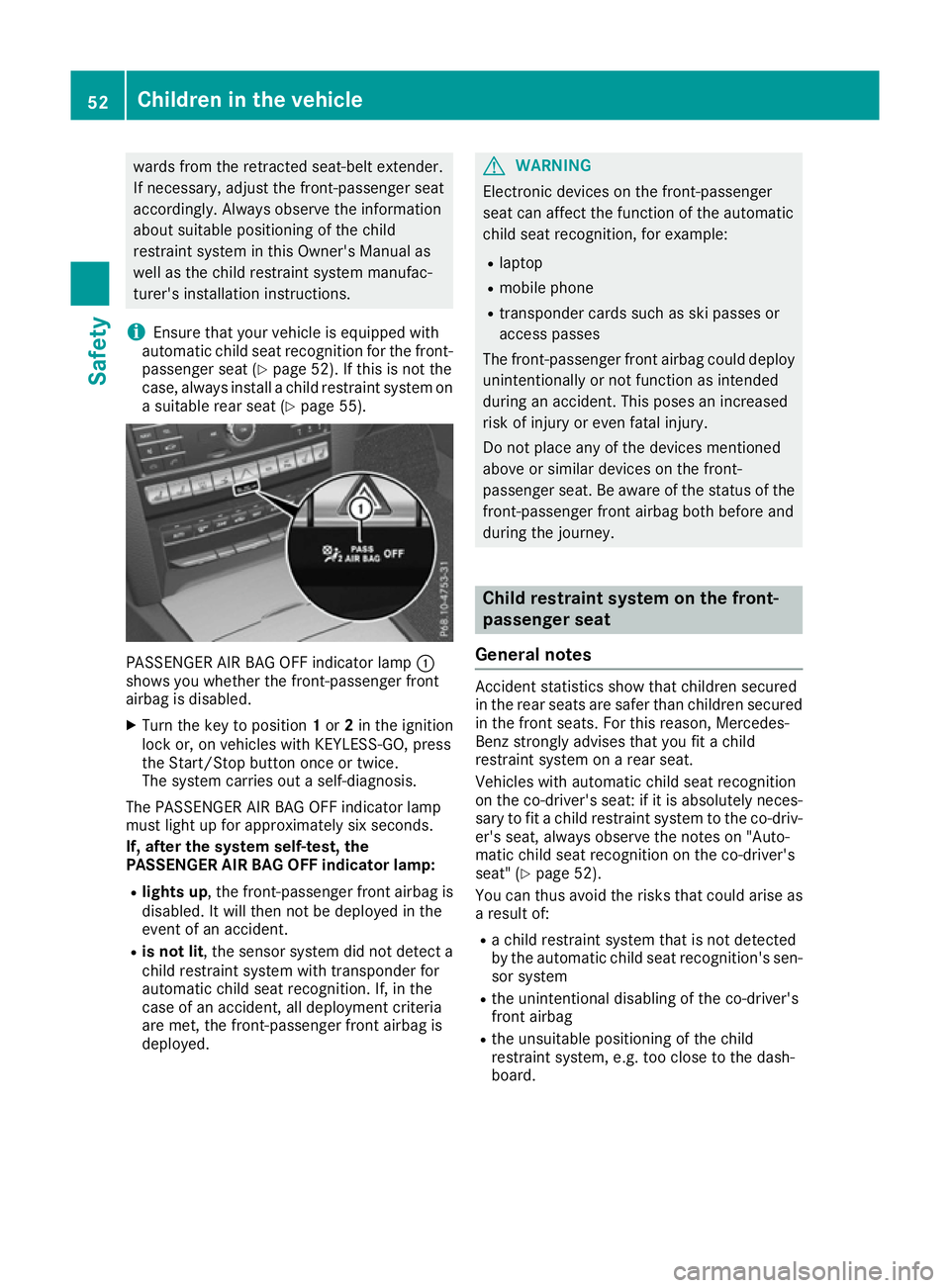
case, always install a child restraint system on a suitable rear seat (Y page 55).PASSENGER AIR BAG OFF indicator lamp
:
shows you whether the front-passenger front
airbag is disabled.
X Turn the key to position 1or 2in the ignition
lock or, on vehicles with KEYLESS-GO, press
the Start/Stop button once or twice.
The system carries out a self-diagnosis.
The PASSENGER AIR BAG OFF indicator lamp
must light up for approximately six seconds.
If, after the system self-test, the
PASSENGER AIR BAG OFF indicator lamp:
R lights up , the front-passenger front airbag is
disabled. It will then not be deployed in the
event of an accident.
R is not lit , the sensor system did not detect a
child restraint system with transponder for
automatic child seat recognition. If, in the
case of an accident, all deployment criteria
are met, the front-passenger front airbag is
deployed. G
WARNING
Electronic devices on the front-passenger
seat can affect the function of the automatic
child seat recognition, for example:
R laptop
R mobile phone
R transponder cards such as ski passes or
access passes
The front-passenger front airbag could deploy unintentionally or not function as intended
during an accident. This poses an increased
risk of injury or even fatal injury.
Do not place any of the devices mentioned
above or similar devices on the front-
passenger seat. Be aware of the status of the front-passenger front airbag both before and
during the journey. Child restraint system on the front-
passenger seat
General notes Accident statistics show that children secured
in the rear seats are safer than children secured
in the front seats. For this reason, Mercedes-
Benz strongly advises that you fit a child
restraint system on a rear seat.
Vehicles with automatic child seat recognition
on the co-driver's seat: if it is absolutely neces-
sary to fit a child restraint system to the co-driv- er's seat, always observe the notes on "Auto-
matic child seat recognition on the co-driver's
seat" (Y page 52).
You can thus avoid the risks that could arise as
a result of:
R a child restraint system that is not detected
by the automatic child seat recognition's sen-
sor system
R the unintentional disabling of the co-driver's
front airbag
R the unsuitable positioning of the child
restraint system, e.g. too close to the dash-
board. 52
Children in the vehicleSafety
Page 56 of 345
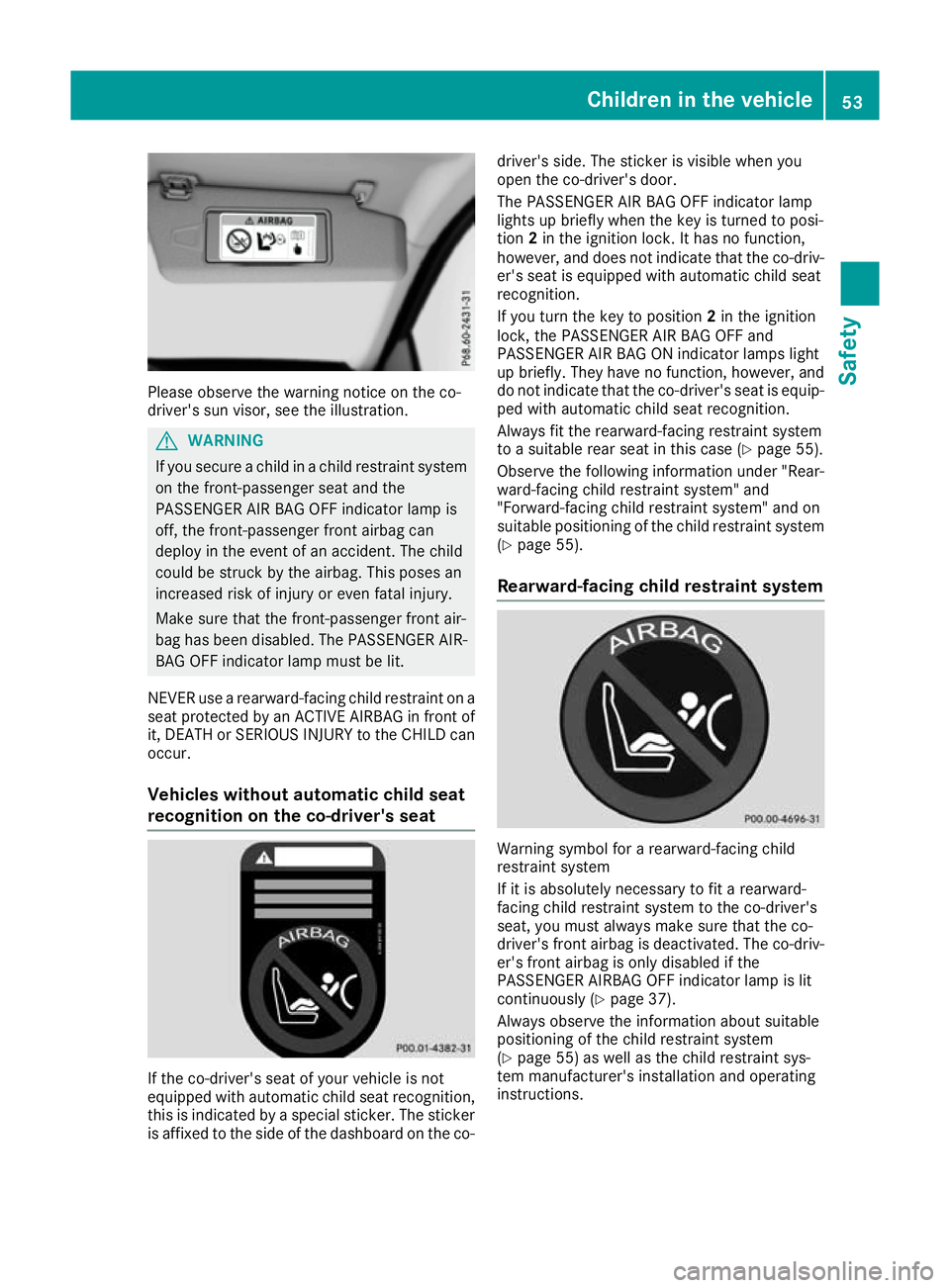
Please observe the warning notice on the co-
driver's sun visor, see the illustration. G
WARNING
If you secure a child in a child restraint system on the front-passenger seat and the
PASSENGER AIR BAG OFF indicator lamp is
off, the front-passenger front airbag can
deploy in the event of an accident. The child
could be struck by the airbag. This poses an
increased risk of injury or even fatal injury.
Make sure that the front-passenger front air-
bag has been disabled. The PASSENGER AIR- BAG OFF indicator lamp must be lit.
NEVER use a rearward-facing child restraint on a seat protected by an ACTIVE AIRBAG in front of
it, DEATH or SERIOUS INJURY to the CHILD can
occur.
Vehicles without automatic child seat
recognition on the co-driver's seat If the co-driver's seat of your vehicle is not
equipped with automatic child seat recognition,
this is indicated by a special sticker. The sticker is affixed to the side of the dashboard on the co- driver's side. The sticker is visible when you
open the co-driver's door.
The PASSENGER AIR BAG OFF indicator lamp
lights up briefly when the key is turned to posi-
tion
2in the ignition lock. It has no function,
however, and does not indicate that the co-driv-
er's seat is equipped with automatic child seat
recognition.
If you turn the key to position 2in the ignition
lock, the PASSENGER AIR BAG OFF and
PASSENGER AIR BAG ON indicator lamps light
up briefly. They have no function, however, and do not indicate that the co-driver's seat is equip- ped with automatic child seat recognition.
Always fit the rearward-facing restraint system
to a suitable rear seat in this case (Y page 55).
Observe the following information under "Rear-
ward-facing child restraint system" and
"Forward-facing child restraint system" and on
suitable positioning of the child restraint system (Y page 55).
Rearward-facing child restraint system Warning symbol for a rearward-facing child
restraint system
If it is absolutely necessary to fit a rearward-
facing child restraint system to the co-driver's
seat, you must always make sure that the co-
driver's front airbag is deactivated. The co-driv-
er's front airbag is only disabled if the
PASSENGER AIRBAG OFF indicator lamp is lit
continuously (Y page 37).
Always observe the information about suitable
positioning of the child restraint system
(Y page 55) as well as the child restraint sys-
tem manufacturer's installation and operating
instructions. Children in the vehicle
53Safety Z