warning lights MERCEDES-BENZ E-CLASS COUPE 2017 Owners Manual
[x] Cancel search | Manufacturer: MERCEDES-BENZ, Model Year: 2017, Model line: E-CLASS COUPE, Model: MERCEDES-BENZ E-CLASS COUPE 2017Pages: 541, PDF Size: 10.71 MB
Page 12 of 541
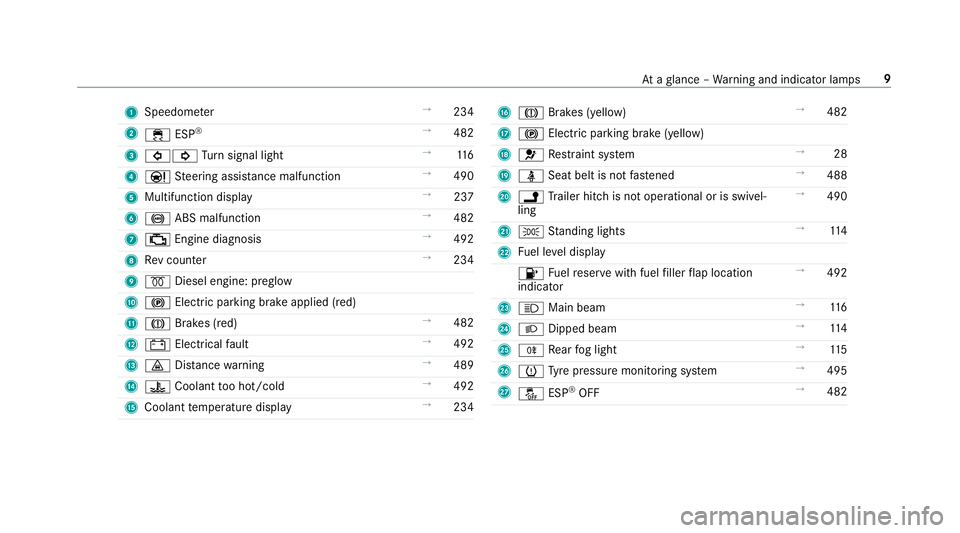
1
Speedom eter →
234
2 ÷ ESP®
→
482
3 #! Turn signal light →
11 6
4 Ð Steering assis tance malfunction →
490
5 Multifunction displ ay →
237
6 ! ABS malfunction →
482
7 ; Engine diagnosis →
492
8 Rev counter →
234
9 % Diesel engine: preglow
A ! Electric parking brake applied (red)
B J Brakes (red) →
482
C # Electrical fault →
492
D · Distance warning →
489
E ? Coolant too hot/cold →
492
F Coolant temp erature display →
234 G
J Brakes (yellow) →
482
H ! Electric pa rking brake (yellow)
I 6 Restra int sy stem →
28
J ü Seat belt is not fastened →
488
K j Trailer hit chis not operational or is swivel‐
ling →
490
L T Standing lights →
11 4
M Fuel le vel display
8 Fuelreser vewith fuel filler flap location
indicator →
492
N K Main beam →
11 6
O L Dipped beam →
11 4
P R Rear fog light →
11 5
Q h Tyre pressure monitoring sy stem →
495
R å ESP®
OFF →
482 At
aglance – Warning and indicator lamps 9
Page 14 of 541
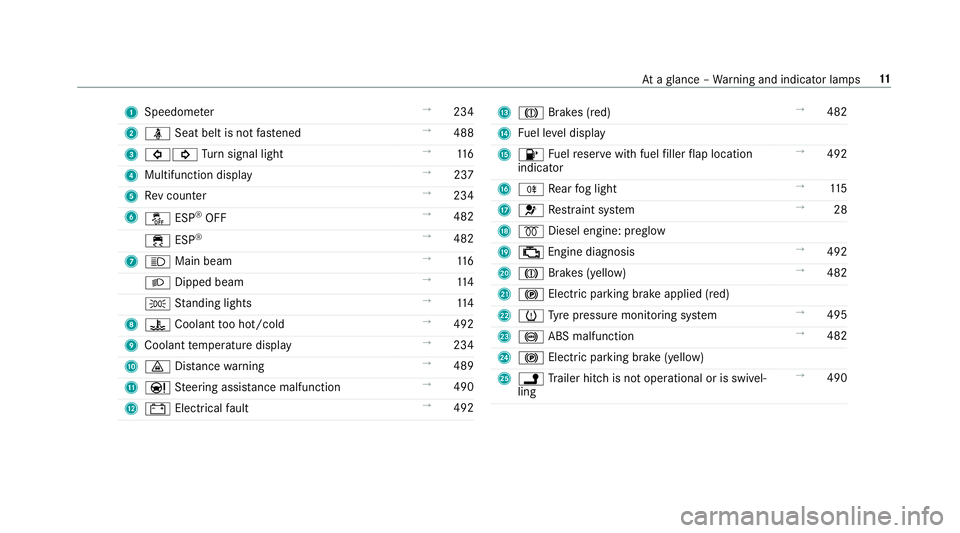
1
Speedom eter →
234
2 ü Seat belt is not fastened →
488
3 #! Turn signal light →
11 6
4 Multifunction display →
237
5 Rev counter →
234
6 å ESP®
OFF →
482
÷ ESP®
→
482
7 K Main beam →
11 6
L Dipped beam →
11 4
T Standing lights →
11 4
8 ? Coolant too hot/cold →
492
9 Coolant temp erature display →
234
A · Distance warning →
489
B Ð Steering assis tance malfunction →
490
C # Electrical fault →
492 D
J Brakes (red) →
482
E Fuel le vel display
F 8 Fuelreser vewith fuel filler flap location
indicator →
492
G R Rear fog light →
11 5
H 6 Restra int sy stem →
28
I % Diesel engine: preglow
J ; Engine diagnosis →
492
K J Brakes (yellow) →
482
L ! Electric pa rking brake applied (red)
M h Tyre pressure monitoring sy stem →
495
N ! ABS malfunction →
482
O ! Electric pa rking brake (yellow)
P j Trailer hit chis not operational or is swivel‐
ling →
490 At
aglance – Warning and indicator lamps 11
Page 20 of 541
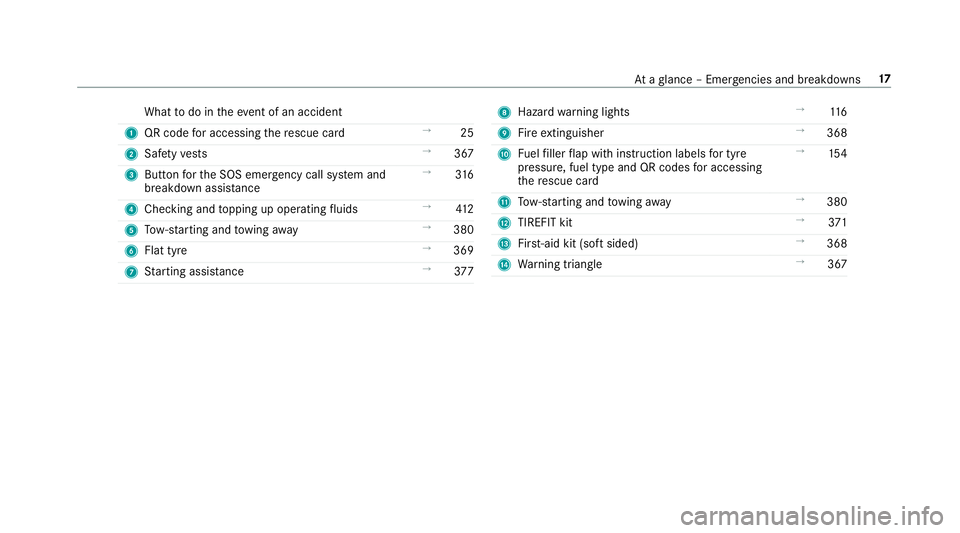
What
todo in theeve nt of an accident
1 QR code for accessing there scue card →
25
2 Safetyve sts →
367
3 Button forth e SOS emer gency call sy stem and
breakdown assis tance →
316
4 Checking and topping up operating fluids →
412
5 Tow- starting and towing away →
380
6 Flat tyre →
369
7 Starting assis tance →
377 8
Haza rdwa rning lights →
11 6
9 Fire extinguisher →
368
A Fuelfiller flap with instruction labels for tyre
pressu re, fuel type and QR codes for accessing
th ere scue card →
154
B Tow- starting and towing away →
380
C TIREFIT kit →
371
D First-aid kit (so ftsided) →
368
E Warning triangle →
367 At
aglance – Emer gencies and breakdowns 17
Page 31 of 541
Re
stra int sy stem functionality When
the ignition is switched on, a sy stem self-
te st is per form ed, during which the6
re stra int sy stem warning lamp lights up. It goes
out no later than a few seconds af terth eve hicle
is star ted. The components of there stra int sys‐
te m are then functional. Re
stra int sy stem malfunction R
The 6 restra int sy stem warning lamp
does not light up when the ignition is
switched on.
R The 6 restra int sy stem warning lamp
lights up continuously or repeatedly during a
journe y. &
WARNING Risk of inju ryor fata l injury
due toa malfunction in there stra int sys‐
tem
If th ere stra int sy stem is malfunctioning,
re stra int sy stem components may be trig‐
ge red unintentionally or might not be trig‐
ge red at all in theev ent of an accident. This may af
fect the seat belt tensioner or airbag,
fo rex ample. #
Have there stra int sy stem checked and
re paired immediately at a qualified spe‐
cialist workshop. Fu
nction of there stra int sy stem in an acci‐
dent How
there stra int sy stem works is de term ined by
th e se verity of the impact de tected and the type
of accident anticipated:
R Frontal impact
R Rear impact
R Side impact
R Rollover
The activation thre sholds forth e components of
th ere stra int sy stem are de term ined based on
th eev aluation of the sensor values measured at
va rious points in theve hicle. This process is pre-
em ptive in nature. The triggering/deployment of
th e components of there stra int sy stem should ta
ke place in good time at thest art of the colli‐
sion.
Fa ctors whi chcan only be seen and measu red
af te r a collision has occur red cann otplay a deci‐
sive role in airbag deployment, nor do they pro‐
vide an indication of airbag deployment.
The vehicle may be deformed significantly with‐
out an airbag being deplo yed. This is the case if
only parts which are relatively easily deformed
are af fected and thera te ofvehicle deceleration
is not high. Con versely, an airbag may be
deplo yedev en though theve hicle suf fers only
minor deformation. If very rigid vehicle parts
such as longitudinal members are hit, forex am‐
ple, theve hicle deceleration may be high enough
fo rth is to happen. 28
Occupant saf ety
Page 42 of 541

The
status of the front passenger airbag is then
displa yed:
R PASSENGER AIR BAG ON lights up for
60 seconds, subsequently bo thindicator
lamps are off (PASSENGER AIR BAG ON and
OFF): the front passenger airbag is able to
deploy in theeve nt of an accident.
R PASSENGER AIR BAG OFF lights up continu‐
ously: the front passenger airbag is disabled.
It will then not be deplo yed in theev ent of an
accident.
If th ePA SSENGER AIR BAG ON indicator lamp is
off, on lythePA SSENGER AIR BAG OFF indicator
lamp sho wsthest atus of the front passenger
airbag. The PASSENGER AIR BAG OFF indicator
lamp may be lit continuously or be off.
If th ePA SSENGER AIR BAG OFF indicator lamp
and the6 restra int sy stem warning lamp
light up simultaneousl y,the front passenger seat
may not be used. Also in this case, do not ins tall
a ch ild restra int sy stem on the front passenger
seat. Ha vethe automatic front passenger airbag
shutoff checked and repaired immediately at a
qu alified specialist workshop. St
atus display
If th e front passenger seat is occupied, ensure,
bo th before and during the journe y,that thest a‐
tus of the front passenger airbag is cor rect for
th e pr evailing situation.
Af ter in stalling a rear wa rd-facing child
re stra int sy stem on the front passenger
seat: PASSENGER AIR BAG OFF must be lit con‐
tinuousl y. &
WARNING Risk of inju ryor death caused
by using a rear wa rd-facing child restra int
sy stem when the front passenger airbag
is enabled
If yo u secure a child in a rear wa rd-facing
ch ild restra int sy stem on the front passenger
seat and thePA SSENGER AIR BAG OFF indi‐
cator lamp is off, the front passenger airbag
can deploy in theeve nt of an accident.
The child could be stru ck bythe airbag.
Alw ays make sure that the front passenger
airbag is disabled. The PASSENGER AIR BAG
OFF indicator lamp must be lit. When ins
talling a child restra int sy stem on the
front passenger seat, obse rveth eve hicle-spe‐
cific information .
Depending on thech ild restra int sy stem and the
st ature of thech ild, thePA SSENGER AIR BAG
OFF indicator lamp may be off. In this case, do
not ins tallth ere ar wa rd-facing child restra int
sy stem on the front passenger seat.
Ins tead, ins tallth ere ar wa rd-facing child
re stra int sy stem on a suitable rear seat.
Af ter in stalling a forw ard-facing child
re stra int sy stem on the front passenger
seat: depending on thech ild restra int sy stem
and thest ature of thech ild, PASSENGER AIR
BA G OFF may be lit continuously or be off.
Alw ays obser vethefo llowing information. Occupant saf
ety39
Page 43 of 541
&
WARNING Risk of inju ryor death due to
incor rect positioning of thefo rw ard-
fa cing child restra int sy stem
If yo u secure a child in a forw ard-facing child
re stra int sy stem on the front passenger seat
and you position the front passenger seat too
close tothe cockpit, in theeve nt of an acci‐
dent, thech ild could:
R Come into con tact wi th theve hicle inte‐
ri or if thePA SSENGER AIR BAG OFF indi‐
cator lamp is lit, forex ample.
R Bestru ck bythe airbag if thePA SSENGER
AIR BAG OFF indicator lamp is off. #
Alw ays mo vethe front passenger seat
as far back as possible and fully retract
th e seat cushion length adjustment.
Alw ays make sure that the shoulder belt
st ra p is cor rectly routed from the seat
belt outlet on theve hicle tothe shoul‐
der belt guide on thech ild restra int sys‐
te m. The shoulder belt stra p must be
ro uted forw ards and down wards from
th e seat belt outlet. If necessar y,adjust th
e seat belt outlet and the front
passenger seat accordingly. #
Alw ays obser vethech ild restra int sys‐
te m manufacturer's ins tallation instruc‐
tions. When ins
talling a child restra int sy stem on the
front passenger seat, obse rveth eve hicle-spe‐
cific information .
If a person is sitting in the front passenger
seat: PASSENGER AIR BAG OFF may be lit con‐
tinuously or be off, depending on the person's
st ature. Alw ays obser vethefo llowing informa‐
tion.
If th e front passenger seat is occupied by:
R An adult or a pe rson with a build cor respond‐
ing tothat of an adult, thePA SSENGER AIR
BA G OFF indicator lamp must be off. This
indicates that the front passenger airbag is
enabled.
If th ePA SSENGER AIR BAG OFF indicator
lamp is lit continuousl y,an adult or person
with a build cor responding tothat of an adult should not use
the front passenger seat.
Ins tead, they should use a rear seat.
R A person with a smaller build (e.g. a teenager
or small adult), thePA SSENGER AIR BAG OFF
indicator lamp either lights up and remains lit
depending on there sult of the classification
or, alternativel y,goes out.
- PASSENGER AIRB AGOFF is off: mo vethe
front passenger seat as far back as possi‐
ble or a person with a smaller build
should use a rear seat.
- Ifth ePA SSENGER AIRB AGOFF indicator
lamp is lit continuously: a person with a
smaller build should not use the front
passenger seat. &
WARNING Risk of inju ryor death when
th ePA SSENGER AIR BAG OFF indicator
lamp is lit
If th ePA SSENGER AIR BAG OFF indicator
lamp remains lit af terth e sy stem self-test,
th e front passenger airbag is disabled. It will
not be deplo yed in theeve nt of an accident.
In this case, the front passenger airbag can‐ 40
Occupant saf ety
Page 45 of 541
Information on PRE-SAFE
®
PLUS (anticipa‐
to ry occupant pr otection plus) PRE-
SAFE®
PLUS can de tect cer tain impacts,
particular lyan imminent rear impact, and take
pre-em ptive measures toprotect theve hicle
occupants. These measures cannot necessarily
pr eve nt an imminent impact.
PRE-SAFE ®
PLUS can implement thefo llowing
measures independently of each other:
R Tightening the seat belts on the driver's seat
and front passenger seat.
R Activating there ar hazard warning lights at a
higher flashing frequenc y.
R Increasing brake pressure when theve hicle
is stationar y.This brake application is cancel‐
led automatically when theve hicle pulls
aw ay.
If an accident did not occur, the pre-em ptive
measures that we retake n are reve rsed.
PRE-SAFE ®
PLUS sy stem limitations
R No me asures are implemented:
- Ifth eve hicle is reve rsing. or
- When theve hicle is towing a trailer and
th ere is a risk of a rear impact.
R The brakes are not applied:
- Whilst driving.
or
- When entering or exiting a parking space
using Parking Pilot. Children in
theve hicle Note
s onthe safe transportation of children &
WARNING Risk of accident and inju ry
due tochildren left unat tended in the
ve hicle
If yo u lea vechildren unat tended in theve hi‐
cle, they may be able toset theve hicle in
motion, forex ample by:
R Releasing the parking brake. R
Shifting the automatic transmission out
of park position jor shifting the manual
transmission into neutral.
R Starting the engine.
In addition, they may operate vehicle equip‐
ment. #
Never lea vechildren and animals unat‐
te nded in theve hicle. #
When leaving theve hicle, alw aysta ke
th eke y with you and lock theve hicle.
This also applies tomobile phones if the
"Digital Car Key in the smartphone"
function is activated via the Mercedes
connect me web app. &
WARNING This poses an increased risk
of death due toheat strokeorexposure
to cold in theve hicle
If persons – particularly children – experi‐
ence prolonged exposure toextremely high
or low temp eratures, this poses a risk of
injury or evenfa ta l injur y. 42
Occupant saf ety
Page 92 of 541

#
Toselect the front passenger seat: press
button 1.
When the indicator lamp lights up, the front
passenger seat is selected. #
Adjust the front passenger seat using the
buttons in the door control panel on the driv‐
er's side. Ad
justing the 4-w aylumbar support 1
Toraise
2 Tosof ten
3 Tolower
4 Toharden #
Using buttons 1to4 , adjust the conto ur
of the backrest individually tosuit your bac k. Head
restra ints Ad
justing the head restra ints on the front
seats &
WARNING Risk of inju rythro ugh adjust‐
ing vehicle settings while theve hicle is in
motion
Yo u could lose cont rol of theve hicle in the
fo llowing situations:
R ifyo u adjust the driver's seat, the head
re stra ints, thesteering wheel or the mir‐
ro r while theve hicle is in motion
R ifyo ufast enyour seat belt while theve hi‐
cle is in motion #
Before starting the engine: adjust the
driver's seat, the head restra ints, the
st eering wheel or the mir ror and fasten
yo ur seat belt. Seats and
stowing 89
Page 114 of 541

#
Insert the plug of the device into 230 V
soc ket1.
When the on-board electrical sy stem voltage
is suf ficient, indicator la mp2lights up. Wire
lesscharging of the mobile phone and
connection with theex terior aerial Note
s on wireless charging of the mobile
phone &
WARNING Risk of inju ryfrom incor rectly
stowe d objects
If objects in the passenger compartment are
stowe d incor rectl y,they can slide or be
th ro wn around and hit vehicle occupants. In
addition, cup holders, open stowage spaces
and mobile phone brac kets cann otalw ays
re tain all objects they contain.
The reis a risk of injur y,particularly in the
ev ent of sudden braking or a sudden change
in direction. #
Alw aysstow objects so that they can‐
not be throw n around in su chsitua‐
tions. #
Alw ays make sure that objects do not
pr otru de from stowage spaces, luggage
nets or stowage nets. #
Close the loc kable stow age spaces
before starting a journe y. #
Alw aysstow and secure heavy, hard,
poin ted, sharp-edged, fragile or bulky
objects in the boot. Obser
vethe no tes on loading theve hicle. &
WARNING Risk offire from placing
objects in the mobile phone stowage
compartment
If yo u place objects in the mobile phone
stow age compartment, they may heat up
exc essively and even catch fire. #
Do not place additional objects, espe‐
cially those mode of me tal, in the
mobile phone stowage compartment. *
NO
TEDama getoobjects caused by
placing them in the mobile phone stow‐
age compartment If
yo u place objects in the mobile phone
stow age compartment, these may be dam‐
aged byelectromagnetic fields. #
Do not place credit cards, storage
media or other objects sensitive to
electromagnetic fields in the mobile
phone stowage compartment. *
NO
TEDama getothe mobile phone
stow age compartment caused byliquids If liquids enter
the mobile phone stowage
compartment, the compartment may be
damaged. #
Ensure that no liquids enter the mobile
phone stowage compartment. R
Depending on theve hicle equipment, the
mobile phone is connected totheve hicle's
ex terior aerial via thech arging module. Seats and
stowing 111
Page 118 of 541

#
4 Ã Automatic driving lights (prefer red
light switch position) #
5 L Dipped beam/main beam #
6 R Switches there ar fog light on or off
When dipped beam is activated, the indicator
lamp forth est anding lights is deactivated and
re placed bythe dipped beam indicator lamp.
Alw ays park your vehicle safely and in a well-lit
area, in accordance with there leva nt le galst ipu‐
lations.
* NO
TEBattery discharging byoperating
th est anding lights Operating
thest anding lights over a period of
hours puts a stra in on the batter y. #
Where possible, switch on the
ri ght X or left Wparking light. In
the case of se vere battery discharging, the
st anding lights or parking lights are automati‐
cally swit ched off tofacilitate a futu reengine
st art. The
exterior lighting (e xcept standing and park‐
ing lights) swit ches off automatically when the
driver's door is opened.
Au tomatic driving lights
The standing lights, dipped beam and daytime
ru nning lights are switched on au tomatical ly
depending on the ignition status, whe ther the
engine is running and on the light conditions. &
WARNING Risk of accident when the
dipped beam is switched off in poor visi‐
bility
When the light switch is set toà ,the
dipped beam may not be switched on auto‐
matically if there is fog, snow or other causes
of poor visibility such as spr ay. #
In such cases, turn the light switch to
L . The automatic driving lights are only an aid.
Yo u
are responsible forve hicle lighting. Ac
tivating/deactivating the rear fog light
Re quirement:
R The light switch is in theL orà posi‐
tion. #
Press the R button.
Please obser vethe count ry-specific la wsonthe
use of rear fog lamps. Light and sight
11 5