ESP MERCEDES-BENZ E-CLASS COUPE 2018 Manual PDF
[x] Cancel search | Manufacturer: MERCEDES-BENZ, Model Year: 2018, Model line: E-CLASS COUPE, Model: MERCEDES-BENZ E-CLASS COUPE 2018Pages: 486, PDF Size: 6.31 MB
Page 315 of 486
#Make surethat no engine oil is spilled
next tothefiller opening.
#Allow the engine tocool off and thor‐
oughly clean the engine oil from compo‐
nent parts before starting theve hicle.
* NO
TEEngine damage causedbyan
incor rect oil filter, incor rect oil or addi‐
tives
#Do not use engine oils or oil filters
which do not cor respond tothe specifi‐
cations explicitly prescribed forth e
service inter vals.
#Do not alter the engine oil or oil filter in
order toachie velonger change inter vals
th an prescri bed.
#Do not use additives.
#Follow the instructions in the service
inter val display rega rding the oil
ch ange.
* NO
TEDama gecaused bytopping up too
much engine oil
Ad ding too much engine oil can cause dam‐
age tothe engine or the catalytic con verter.
#Ha ve excess engine oil remo ved at a
qu alified specialist workshop.
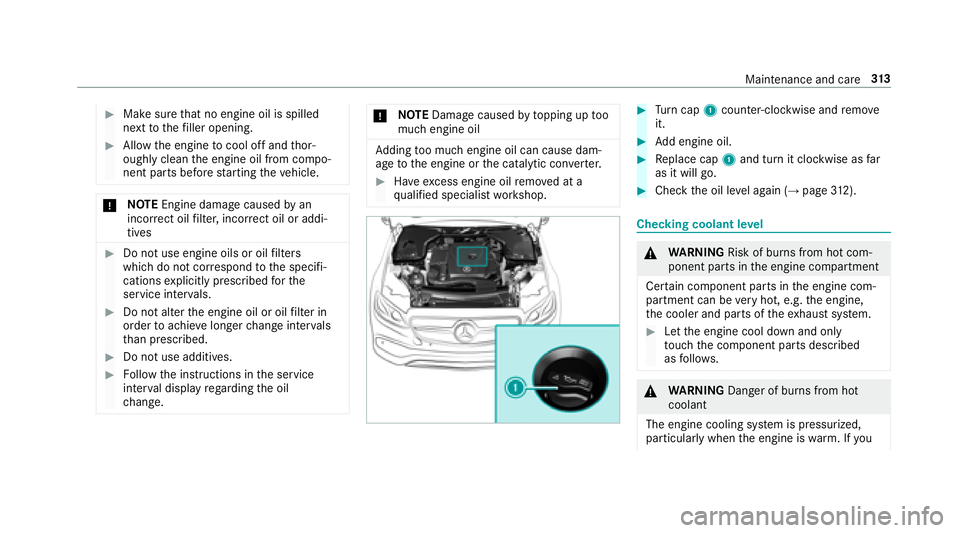
#Tu rn cap 1counter-clockwise and remo ve
it.
#Ad d engine oil.
#Replace cap 1and turn it clockwise as far
as it will go.
#Check the oil le vel again (→page 312).
Che cking coolant le vel
&
WARNING Risk of burn s from hot com‐
ponent parts in the engine compartment
Cer tain component parts in the engine com‐
partment can be very hot, e.g. the engine,
th e cooler and parts of theex haust sy stem.
#Let the engine cool down and only
to uch the component parts described
as follo ws .
&
WARNING Danger of burn s from hot
coolant
The engine cooling sy stem is pressurized,
particularly when the engine is warm. If you
Maintenance and care 31
3
Page 325 of 486
#Observethe information and warning
no tes on MOExtended tires (run-flat
tires).
In theeve nt of a flat tire, thefo llowing options
are available depending on your vehicle's equip‐
ment:
RVe hicles with MOExtended tires: it is pos‐
sible tocontinue the journey for a short
period of time. Make sure you observ eth e
no tes on MOExtended tires (run-flat tires)
(
→page 323).
RVe hicles with a TIREFIT kit: you can repair
th e tire so that it is possible tocontinue the
journ eyfor a short period of time. Todo this,
use the TIREFIT kit (
→page 324).
RVe hicles with a Mercedes-Benz emer‐
ge ncy call sy stem: intheev ent of a break‐
down, consult the Mercedes-Benz emer gency
call sy stem Cus tomer Assis tance Center.
RChange the wheel (→page 366).
MOExtended tires (tires with run-flat proper‐
ties)
& WARNING Risk of accident when driving
in li mp-home mode
When driving in emergency mode the han‐
dling characteristics are impaired, e.g. when
cornering, when accelerating stronglyand
when braking.
#Do not exceed the specified maximum
speed.
#Av oid any abrupt steering and driving
maneuvers as well as driving over
obs tacles (curbs, pot holes, off-road).
This applies, in part icular,toa loaded
ve hicle.
#Stop driving in the emer gency mode if
yo u notice:
Rbanging noise
Rvehicle vibration
Rsmoke which smells like rubber
Rcontinuous ESP®inter vention
Rcrac ksin tire side walls
#After driving in emergency mode ha ve
th erims checkedby aqu alified special‐
ist workshop with rega rd totheir fur ther
use.
#The defective tire must be replaced in
eve rycase.
With MOExtended tires (run-flat tires), you can
continue todrive your vehicle even if there is a
tot al loss of pressure in one or more tires. How‐
eve r,th e tire af fected must not show any clearly
visible damage.
Yo u can recognize MOExtended tires bythe
MOExtended marking which appears onthe side
wa ll of the tire.
Ve hicles with tire pressure monitoring sys‐
te m: MOExtended tires may only be used in con‐
junction wi than activated tire pressure monitor‐
ing sy stem.
If a pressure loss warning message appears in
th e multifunction display:
RCheck the tire for dama ge.
Breakdown assis tance 323
Page 330 of 486
#Correct the tire pressure if it is still at least
13 0 kPa (1.3 bar/19 psi). See theTire and
Loading Info rmation placard on the driver's
side B‑pillar or the tire pressure table in the
fuel filler flap forva lues.
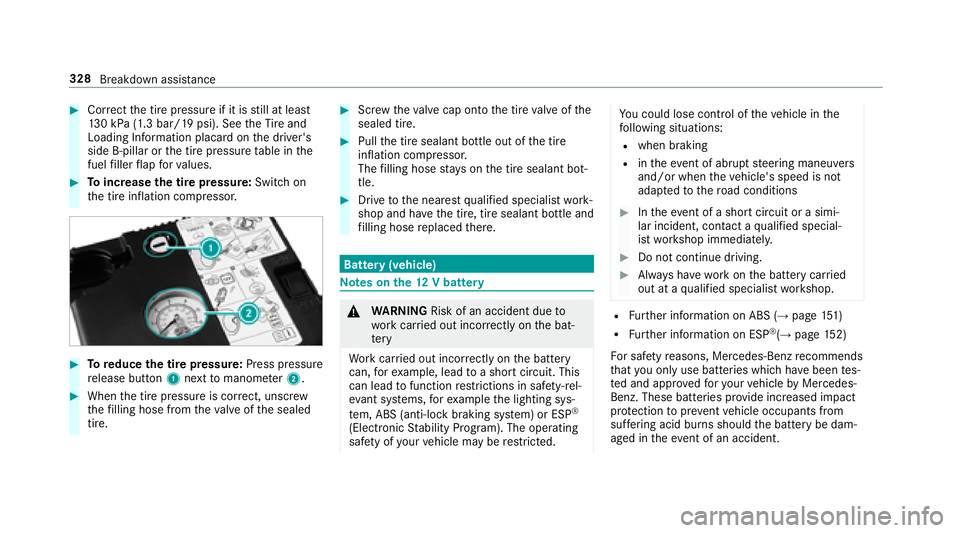
#To increase the tire pressure: Switchon
th e tire inflation compressor.
#To reduce the tire pressure: Press pressure
re lease button 1next tomanome ter2.
#When the tire pressure is cor rect, unscr ew
th efilling hose from theva lve of the sealed
tire.
#Scr ew theva lve cap onto the tire valve of the
sealed tire.
#Pull the tire sealant bottle out of the tire
inflation compressor.
The filling hose stay s on the tire sealant bot‐
tle.
#Drive tothe nearest qualified specialist work‐
shop and ha vethe tire, tire sealant bottle and
fi lling hose replaced there.
Bat tery (vehicle)
Note s onthe12 V battery
&
WARNING Risk of an accident due to
wo rkcar ried out incor rectly on the bat‐
te ry
Wo rkcar ried out incor rectly on the battery
can, forex ample, lead toa short circuit. This
can lead tofunction restrictions in saf ety-re l‐
eva nt sy stems, forex ample the lighting sys‐
te m, ABS (anti-lock braking system) or ESP
®
(Elect ronic Stability Prog ram). The operating
saf etyof your vehicle may be restricted.
Yo u could lose cont rol of theve hicle in the
fo llowing situations:
Rwhen braking
Rin theeve nt of ab rupt steering maneuvers
and/or when theve hicle's speed is not
adap tedto thero ad conditions
#In theeve nt of a short circuit or a simi‐
lar incident, contact a qualified special‐
ist workshop immediately.
#Do not continue driving.
#Alw ays ha vewo rkon the battery car ried
out at a qualified specialist workshop.
RFu rther information on ABS (→page 151)
RFu rther information on ESP®(→page 152)
Fo r saf etyre asons, Mercedes-Benz recommends
th at you only use batte ries which ha vebeen tes‐
te d and appr oved foryo ur vehicle byMercedes-
Benz. These batteries pr ovide inc reased impact
pr otection toprev ent vehicle occupants from
suf fering acid bu rns should the battery be dam‐
aged in theev ent of an accident.
328
Breakdown assis tance
Page 331 of 486
Allvehicles except vehicles with a lithium-
ion battery
& WARNING Risk ofexplosion due toelec‐
tros tatic charge
Electros taticch arge can cause spark s which
may ignite the highly flammable gas mixture
in the batter y.
#Todischar geany electros tatic charge
th at may ha vebuilt up, touch the me tal
ve hicle body before handling the bat‐
te ry.
The highly flammable gas mixture is created
while the battery is charging and during starting
assis tance.
&
WARNING Danger of chemical burns
from the battery acid
Battery acid is caustic.
#Av oid contact with the skin, eyes or
clo thing.
#Do not lean overth e batter y.
#Do not inhale battery gases.
#Ke ep children away from the batter y.
#Immediate lyrinse battery acid off thor‐
oughly with plenty of clean water and
seek medical attention immediately.
All vehicles
+ENVIRONMENTAL NOTEEnvironmental
damage causedbyimproper disposal of
batteries
Bat teries conta in pollutants. It is
illegal todispose of them with the household
ru bbish.
#
Dispose of batteries in an
environmen tally responsible manner.
Ta ke dischar ged batteries toaqu alified
specialist workshop or toa collection
point for used batteries.
If yo u ha vetoconnect the12 volt batter y,con‐
ta ct a qualified specialist workshop.
Comply with saf etyno tes and take protective
measures when handling batteries.
Risk of explosion
Fire, open flames and smoking are
prohibite d when handling the batter y.
Av oid creating spar ks.
Electrolyte or battery acid is cor ro‐
sive. Avoid contact with the skin, eyes
or clo thing. Wear suitable pr otective
clo thing, in particular glove s, an
apron and a face mas k.Immediate ly
ri nse electrolyte or acid splashes off
with clean water.Consult a docto r if
necessar y.
Breakdown assis tance 329
Page 344 of 486
Noise or unusual handling characteristics
While driving, pay attention tovibrations, noises
and unusual handling characteristics, e.g. pulling
to one side. This may indicate that the wheels or
tires are damaged. If you suspect that a tire is
defective, reduce your speed immediatel y.Stop
th eve hicle as soon as possible tocheck the
wheels and tires for dama ge. Hidden tire dam‐
age could also be causing the unusual handling
ch aracteristics. If youfind no signs of damage,
ha ve the tires and wheels checked at a qualified
specialist workshop.
Re gular checking of wheels and tires
&
WARNING Risk of accident from dam‐
aged tires
Dama ged tires can cause tire pressure loss.
As a result, you could lose cont rol of your
ve hicle.
#Check the tires regularly for signs of
dama geand replace any damaged tires
immediatel y.
&
WARNING Risk of aquaplaning due to
insuf ficient tire tread
Insuff icient tire tread will result in reduced
tire grip. The tire tread is no longer able to
dissipate water.
This means that in heavy rain or slush the
ri sk of hydroplaning is increased, in particu‐
lar if vehicle speed is not adap tedto suit the
conditions.
If th e tire pressure is too high or too lo w,
tires may exhibit dif fere nt le vels of wear at
dif fere nt locations on the tire conta ct sur‐
fa ce.
#Thus, you should regularly check the
tread de pth and the condition of the tire
conta ct surf ace across the entire width
of all tires.
Minimum tread dep thfor:
RSummer tires: âin (3 mm)
RM+S tires: ãin (4 mm)
#For saf etyre asons, replace the tires
before the legally prescribed limit for
th e minimum tread dep thisreached.
Car ryout thefo llowing checks on all wheels reg‐
ularly, at least once a month or as requ ired, e.g.
prior toa long journey or driving off- road:
RCheck the tire pressure (→page 343).
RVisual check of wheels and tires for dama ge.
RCheck theva lve caps.
The valves must be pr otected against mois‐
ture and dirt bytheva lve caps appr oved
especially foryo ur vehicle byMercedes-Benz.
RVisual check of the tread dep thand the tire
conta ct surf ace across the entire width.
The minimum tread dep thfor summer tires is
â in (3 mm) and for winter tires ãin
(4 mm).
34 2
Wheels and tires
Page 345 of 486
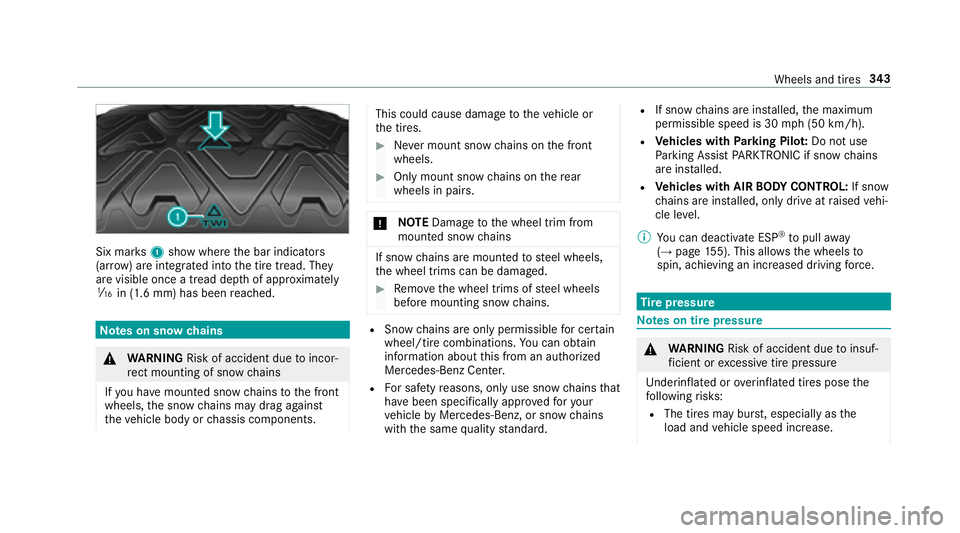
Six marks1 show where the bar indicators
(ar row ) are integrated into the tire tread. They
are visible once a tread dep thof appr oximately
á in (1.6 mm) has been reached.
Note s on snow chains
&
WARNING Risk of accident due toincor‐
re ct mounting of snow chains
If yo u ha vemounted snow chains tothe front
wheels, the snow chains may drag against
th eve hicle body or chassis components.
This could cause damage totheve hicle or
th e tires.
#Ne ver mount snow chains on the front
wheels.
#Only mount snow chains on there ar
wheels in pairs.
* NO
TEDama getothe wheel trim from
mounted snow chains
If snow ch ains are mounte dto steel wheels,
th e wheel trims can be damaged.
#Re mo vethe wheel trims of steel wheels
before mounting snow chains.
RSn ow chains are only pe rmissible for cer tain
wheel/tire combinations. You can obtain
information about this from an authorized
Mercedes-Benz Center.
RFo r saf etyre asons, only use snow ch ainsthat
ha ve been specifically appr oved foryo ur
ve hicle byMercedes-Benz, or snow chains
with the same quality standard.
RIf snow ch ains are ins talled, the maximum
permissible speed is 30 mph (50 km/h).
RVehicles with Parking Pilo t:Do no t use
Pa rking Assist PARKTRONI Cif sn ow ch ains
are ins talled.
RVe hicles with AIR BODY CONT ROL:If snow
ch ains are ins talled, only drive at raised vehi‐
cle le vel.
% You can deactivate ESP
®to pull away
(→page 155). This allo wsthe wheels to
spin, achieving an increased driving forc e.
Tire pressure
Note s on tire pressure
&
WARNING Risk of accident due toinsuf‐
fi cient or excessive tire pressure
Underinfla ted or overinfla ted tires pose the
fo llowing risks:
RThe tires may bur st, especially as the
load and vehicle speed increase.
Wheels and tires 34
3
Page 349 of 486
Further related subjects:
RNo tes on tire pressure (→page 343)
RTire pressure table (→page 345)
RTire and Loading Info rmation placard
(→page 349)
Ti re pressure moni toring sy stem
Fu nction of the tire pressure moni toring sys‐
te m
&
DANG ER Risk of accident due toincor‐
re ct tire pressure
Every tire, including the spare (if pr ovided),
should be checked when cold at least once a
month and inflated tothe pressure recom‐
mended bytheve hicle manufacturer (see
Ti re and Loading Info rmation placard on the
B-pillar on the driver ’sside or the tire pres‐
sure label on the inside of the fuel filler flap
of your vehicle). If your vehicle has tires of a
dif fere nt size than the size indicated on the
Ti re and Loading Info rmation placard or the
tire pressure table, you need todeterm ine
th e proper tire pressure forth ose tires.
As an added saf etyfe ature, your vehicle has
been equipped with a tire pressure monitor‐
ing sy stem (TPMS) that illuminates a low tire
pressure indicator lamp when one or more of
yo ur tires are signif icantly underinflated.
Ac cording ly, if the low tire pressure indicator
lamp lights up, you should stop and check
yo ur tires as soon as possible, and inflate
th em tothe proper pressure. Driving on a
significantly underinflated tire causes the tire
to ove rheat and can lead totire failure.
Un derinflation also increases fuel consump‐
tion and reduces tire tread life, and may
af fect theve hicle's handling and braking abil‐
ity. Please no tethat the TPMS is not a substi‐
tute for proper tire maintenance, and it is the
driver's responsibility tomaintain cor rect tire
pressure, even if underinflation has not
re ached the le velto trig ger illumination of
th e TPMS low tire pressure indicator lamp.
Yo ur vehicle has also been equipped with a
TPMS malfunction indicator toindicate whenthe sy stem is not operating proper ly. The
TPMS malfunction indica tor is combined with
th e low tire pressure indicator lamp. When
th e sy stem de tects a malfunction, the indica‐
to r lamp will flash for app roxima tely a minute
and then remain continuously illumina ted.
This sequence will continue upon subsequent
ve hicle start-ups as long as the malfunction
ex ists.
When the malfunction indicator is illumina‐
te d, the sy stem may not be able todetect or
signal low tire pressure as intended. TPMS
malfunctions may occur for a variet yof rea‐
sons, including the ins tallation of incompati‐
ble replacement or alternate tires or wheels
on theve hicle that pr eventthe TPMS from
functioning properly.
Alw aysch eck the TPMS malfunction warning
lamp af terre placing one or more tires or
wheels on your vehicle toensure that the
re placement or alternate tires and wheels
allow the TPMS tocontinue tofunction prop‐
erly.
Wheels and tires 34
7
Page 350 of 486
The system checks the tire pressure and the tire
te mp erature of the tires mounted on theve hicle
by means of a tire pressure sensor.
New tire pressure sensors, e.g. in winter tires,
are automatically taught-in thefirs t time they are
driven.
The tire pressure appears in the multifunction
display (
→page 208).
If th ere is a subs tantial pressure loss or if the
tire temp erature is excessive, a warning is given:
RVia display messages (→page 414).
RViath eh warning lamp in the instrument
clus ter (→page 446).
It is the driver's responsibility toset the tire
pressure tothere commended cold tire pressure
suitable forth e operating situation. Set the tire
pressure for cold tires using a tire pressure
ga uge. Notethat the cor rect tire pressure forth e
cur rent operating situation must firs t be taught-
in to the tire pressure monitoring sy stem.
In most cases, the tire pressure monitoring sys‐
te m will auto matically update the new refere nce
va lues af teryo u ha vechanged the tire pressure. Yo
u can, ho wever,also update there fere nce val‐
ues byrestarting the tire pressure monitoring
sy stem manually (
→page 349).
Sy stem limitations
The tire pressure monitoring sy stem does not
issue a warning:
RIfth e tire pressure is set incor rectly.
RIfth ere is a sudden pressure loss caused, for
ex ample byafo re ign object penetrating the
tire.
RIf th ere is a malfunction caused byano ther
ra dio signal source.
Make sure toobser vethefo llowing fur ther rela‐
te d subjec t:
RNotes on tire pressure (→page 343)
Checking the tire pressure with the tire pres‐
sure moni toring sy stem
Requ irement:
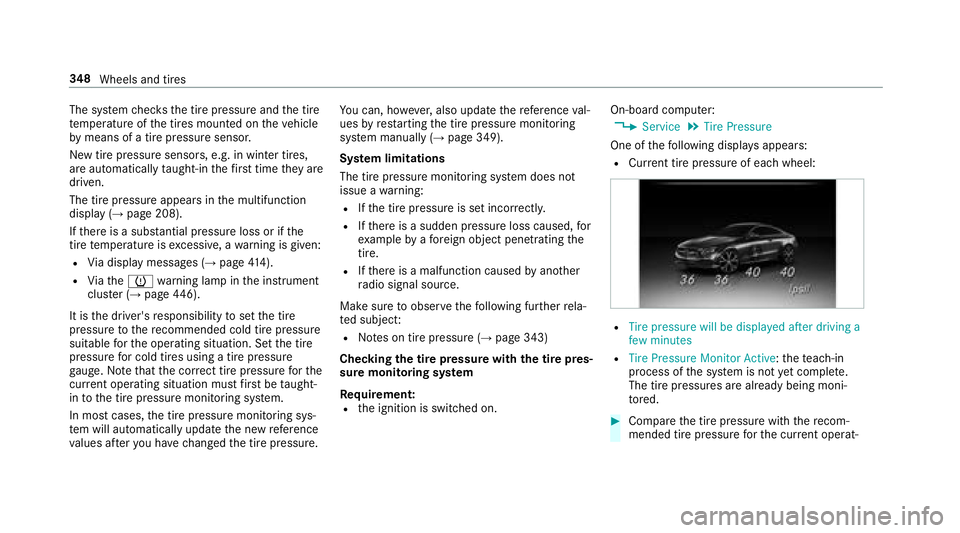
Rthe ignition is switched on. On-board computer:
,6HUYLFH.7LUH 3UHVVXUH
One of thefo llowing displa ysappears:
RCur rent tire pressure of ea chwheel:
R7LUH SUHVVXUH ZLOO EH GLVSOD\HG DIWHU GULYLQJ D
IHZ PLQXWHV
R7LUH 3UHVVXUH 0RQLWRU $FWLYH: thete ach-in
process of the sy stem is not yet comple te.
The tire pressures are already being moni‐
to re d.
#Compare the tire pressure with there com‐
mended tire pressure forth e cur rent operat‐
34 8
Wheels and tires
Page 357 of 486
and one-half times aswell on the go vernment
te st track as a tire graded 100.
The relative per form ance of tires depends upon
th e actual conditions of their use, ho wever,and
may depart significantly from the norm due to
va riations in driving habits, service practices and
dif fere nces in road characteristics and climate
conditions.
Tr action grade
&
DANG ER Risk of accident due toinade‐
qu ate traction
The traction grade assigned tothis tire is
based on stra ight-ahead braking traction
te sts, and does not include either accelera‐
tion, cornering, hydroplaning or peak traction
ch aracteristics.
#Alw ays adapt your drivin gst yle and
drive at a speed tosuit the pr evailing
traf fic and weather conditions.
* NO
TEDama getothe driv etra in from
wheelspin
#Av oid wheelspin.
The traction grades – from highest tolowest –
are AA, A,B and C. Those grades represent the
tire's ability tostop on wet pa vement as meas‐
ured under controlled conditions on specified
go vernment test sur faces made of asphalt and
concr ete.
Te mp erature grade
&
WARNING Risk of accident from tire
ove rheating and tire failure
The temp erature grade forth is tire is es tab‐
lished for a tire that is proper ly inflated and
not overloaded. Excessive speed, underinfla‐
tion, or excessive loading, either separately
or in combination, can cause excessive heat
build-up and possible tire failure.
#Obser vethere commended tire pres‐
sure s and regularly check the tire pres‐
sure of all tires including the spare
wheel.
#Ad just the tire pressure as necessar y.
Thetemp erature grades are A (the highest), B
and C. They represent the tire's resis tance tothe
ge neration of heat and its ability todissipate
heat when tested under controlled conditions on
a specified indoor laboratory test wheel. Sus‐
ta ined high temp eratures can cause the material
of the tire todegenerate and reduce tire life, and
exc essive temp erature can lead tosudden tire
fa ilure. Grade C cor responds toa le vel of per‐
fo rm ance which all passenger car tires must
meet under therequ irements of the US Depart‐
ment of Transpor tation.
DO T,Tire Identification Number (TIN)
US tire regulations stipulate that eve rytire man‐
ufactu rer or retreader must imprint a TIN in or
on the side wall of each tire produced.
Wheels and tires 355
Page 362 of 486
Uniform Tire Quality Grading Standards: a
uniform standard tograde thequ ality of tires
with rega rd totread quality, tire traction and
te mp erature characteristics. The quality grading
assessment is made bythe manufacturer follow‐
ing specifications from theU. S. go vernment. The
qu ality grade of a tire is imprinted on the side
wa ll of the tire.
Re commended tire pressure :th ere commen‐
ded tire pressure is the tire pressure specified
fo rth e tires mounted totheve hicle at thefa c‐
to ry.
The tire and information table conta insthere c‐
ommended tire pressure for cold tires, the maxi‐
mum permissible load and the maximum permis‐
sible vehicle speed.
The tire pressure table conta insthere commen‐
ded tire pressure for cold tires under various
operating conditions, i.e. loading and/or speed
of theve hicle.
Increased vehicle weight due tooptional
equipment: the combined weight of all standard
and optional equipment available forth eve hicle, re
ga rdless of whe ther it is actually ins talled on
th eve hicle or not.
Rim: the part of the wheel on which the tire is
mounted.
GA WR (Gross Axle Weight Rating): the GAWR
is the maximum gross axle load. The actual load
on an axle must ne verexc eed the gross axle
we ight rating. The gross axl e
we ight rati
ng can
be found on theve hicle identification plate on
th e B‑pillar on the driver's side.
Speed rating: the speed rating is pa rtof the tire
identification. It specifies the speed range for
which a tire is appr oved.
GV W (Gross Vehicle Weight): the gross vehicle
we ight comprises thewe ight of theve hicle
including fuel, tools, the spare wheel, accesso‐
ri es ins talled, occupants, luggage and the trailer
dr aw bar nose weight, if applicable. The gross
ve hicle weight must not exceed the gross vehicle
we ight rating GVWR as specified on theve hicle
identification plate on the B‑pillar on the driver's
side.
GV WR (Gross Vehicle Weight Rating): the
GV WR is the maximum permitted gross weight of
the fully laden vehicle (weight of theve hicle
including all accessories, occupants, fuel, lug‐
ga ge and the trailer dr awbar nose weight if appli‐
cable). The gross vehicle weight rating is speci‐
fi ed on theve hicle identification plate on the
B‑pillar on the driver's side.
Maximum weight of the laden vehicle: the
maximum weight is the sum of the unladen
we ight of theve hicle, thewe ight of the accesso‐
ri es, the maximum load and thewe ight of
optional equipment ins talled at thefa ctor y.
Kilopascal (kPa): metricunit for tire pressure .
6.9 kPa cor responds to1 psi. Ano ther unit for
tire pressure is bar.100 kilop ascal (kPa
) equals
1 bar.
Load index: in additiontothe load-bearing
index, the load index may also be imprinted on
th e side wall of the tire. This specifies the load-
bearing capacity of the tire more precisel y.
Curb weight: thewe ight of a vehicle with stand‐
ard equipment including the maximum capacity
of fuel, oil and coolant. It also includes the air
conditioning sy stem and optional equipment if
360
Wheels and tires