child lock MERCEDES-BENZ E-CLASS COUPE 2018 Owner's Manual
[x] Cancel search | Manufacturer: MERCEDES-BENZ, Model Year: 2018, Model line: E-CLASS COUPE, Model: MERCEDES-BENZ E-CLASS COUPE 2018Pages: 486, PDF Size: 6.31 MB
Page 17 of 486
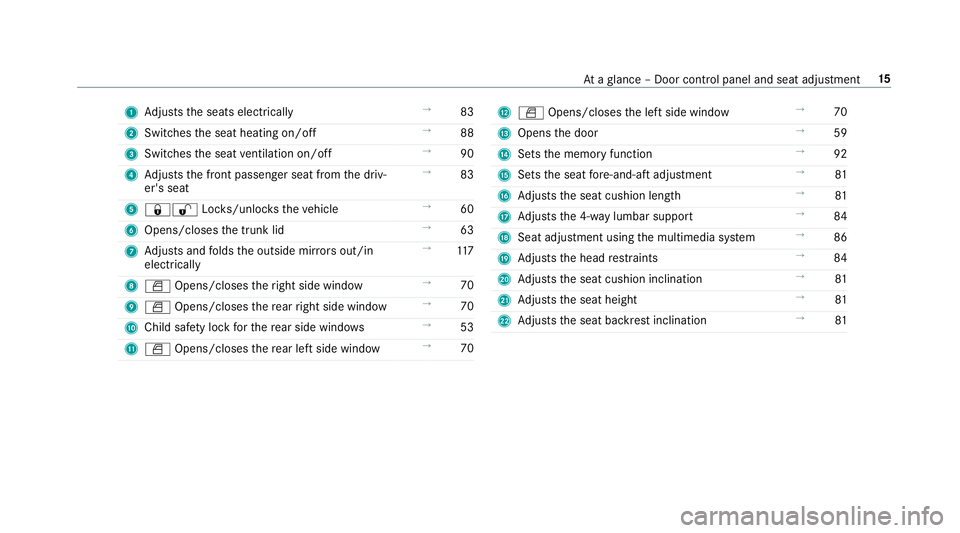
1Adjusts the seats electrically →
83
2 Switches the seat heating on/off →
88
3 Switches the seat ventilation on/off →
90
4 Adjusts the front passenger seat from the driv‐
er's seat →
83
5 &% Locks/unloc kstheve hicle →
60
6 Opens/closes the trunk lid →
63
7 Adjusts and folds the outside mir rors out/in
electrically →
117
8 W Opens/closes theright side window →
70
9 W Opens/closes there ar right side window →
70
A Child saf etyloc kfo rth ere ar side wind ows →
53
B W Opens/closes there ar left side wind ow→
70CW Opens/closes the left side window →
70
D Opens the door →
59
E Sets the memory function →
92
F Sets the seat fore -and-aft adjustment →
81
G Adjusts the seat cushion length →
81
H Adjusts the 4-w aylumbar support →
84
I Seat adjustment using the multimedia sy stem →
86
J Adjusts the head restra ints →
84
K Adjusts the seat cushion inclination →
81
L Adjusts the seat height →
81
M Adjusts the seat backrest inclination →
81
Ataglance – Door control panel and seat adjustment 15
Page 46 of 486
cannot perform its intended pr otective func‐
tion, e.g. when a person is seated in the front
passenger seat.
That person could, forex ample, come into
con tact wi th theve hicle interior, especially if
th e person is sitting too close tothe cockpit.
If th e front passenger seat is occupied,
alw ays ensure that:
RThe classification of the person in the
front passenger seat is cor rect and the
front passenger air bag is enabled or
deactivated in accordance with the per‐
son in the front passenger seat.
RThe person is seated proper lywith a cor‐
re ctly fastened seat belt.
RThe front passenger seat has been mo ved
as far back as possible.
Fu rther related subjects:RChild restra int sy stem on the front passenger
seat (→page 52).
PRE-SAFE®sy stem
Information on PRE- SAFE®(anticipa tory
occupant pr otection)
PRE- SAFE®is able todetect cer tain critical driv‐
ing situations and implement pre-em ptive meas‐
ures toprotect theve hicle occupants.
PRE-SAFE
®can implement thefo llowing meas‐
ures independently of each other:
RTightening the seat belts on the driver's seat
and front passenger seat.
RClosing the side windo ws.
RVehicles with sliding sunroof: Closingthe
sliding sunroof.
RVe hicles with memory function: Adjusting
th e front passenger seat toa more favo rable
seat position.
RVe hicles with multicontour seat: Increas‐
ing the air pressure in the seat side bols ters
of the seat backrest.
RPRE-SAFE®Sound: pr ovided that the multi‐
media sy stem is switched on, generates a brief noise signal
tostimulate the innate pro‐
te ctive mechanism of a person's heari ng.
* NO
TEDama gecaused byobjects in the
fo ot we ll or behind the seat
The automatic adjustment of the seat posi‐
tion may result in damage tothe seat and/or
th e object.
#St ow objects in a suitable place.
Reversing PRE- SAFE®measures
If an accident did not occur, the pre-em ptive
measures that we retaken ar ere ve rsed. You
will need toper form certain settings your‐
self.
#If th e seat belt pre-tensioning is not reduced,
mo vethe seat backrest back slightl y.
The locking mechanism releases.
44
Occupant saf ety
Page 47 of 486
Information on PRE-SAFE®PLUS (anticipa‐
to ry occupant pr otection plus)
PRE- SAFE®PLUS can de tect cer tain impacts,
particular lyan imminent rear impact, and take
pre-em ptive measures toprotect theve hicle
occupants. These measures cannot necessarily
pr eve nt an imminent impact.
PRE-SAFE
®PLUS can implement thefo llowing
measures independently of each other:
RTightening the seat belts on the driver's seat
and front passenger seat.
RInc reasing brake pressure when theve hicle
is stationar y.This brake application is can‐
celed automatically when theve hicle pulls
aw ay.
If an accident did not occur, the pre-em ptive
measures that we retake n are reve rsed.
PRE-SAFE
®PLUS sy stem limitationsRNo me asures are implemented:
-Ifth eve hicle is backing up.
RThe brakes are not applied:
-Whilst driving. or
-When entering or
exiting a parking space
using Parking Pilot.
Children in theve hicle
Note s onthe safe transportation of children
&
WARNING Risk of accident and injury
due tochildren left unatte nded inthe
ve hicle
If yo u lea vechildren unaccompanied in the
ve hicle, they may be able toset theve hicle in
motion, forex ample by:
RRe leasing the parking brake.
RShifting the transmission out of park
position j.
RStarting the engine.
In addition, they may operate vehicle equip‐
ment.
#Ne ver lea vechildren and animals unat‐
te nded in theve hicle.
#When leaving theve hicle, alw aysta ke
th e SmartK eywith you and lock the
ve hicle.
&
WARNING Risk offata l injury due to
ex posure toextreme heat or cold in the
ve hicle
If people – particularly children – are
ex posed toextreme heat or cold over an
ex tended pe riod of time, there is a risk of
injury or evenfa ta l injur y.
#Never lea veanyone – pa rticularly chil‐
dren – unatte nded intheve hicle.
&
WARNING Risk of burn s whenthech ild
seat is exposed todirect sunlight
If th ech ild restra int sy stem is exposed to
direct sunlight or heat, parts could heat up.
Children could suf fer burns from these parts,
particularly on me tallic parts of thech ild
re stra int sy stem.
Occupant saf ety 45
Page 53 of 486
Rear seat backrests that are not loc ked can
also cause additional injuries, e.g. in the
ev ent of an accident.
#Alw ays lock rear seat backrests af ter
ins talling TopTe ther belts.
#Obser vethe lock verification indicator.
If th e seat backrest is not engaged and loc ked,
th is will be shown in the multifunction display in
th e instrument clus ter.
The risk of injury can be reduced byTopTe ther
as TopTe ther pr ovides an additional connection
between thech ild restra int sy stem secured with
LA TC H-type (ISOFIX) and theve hicle.
The child restra int sy stem must be equipped
with a TopTe ther belt.
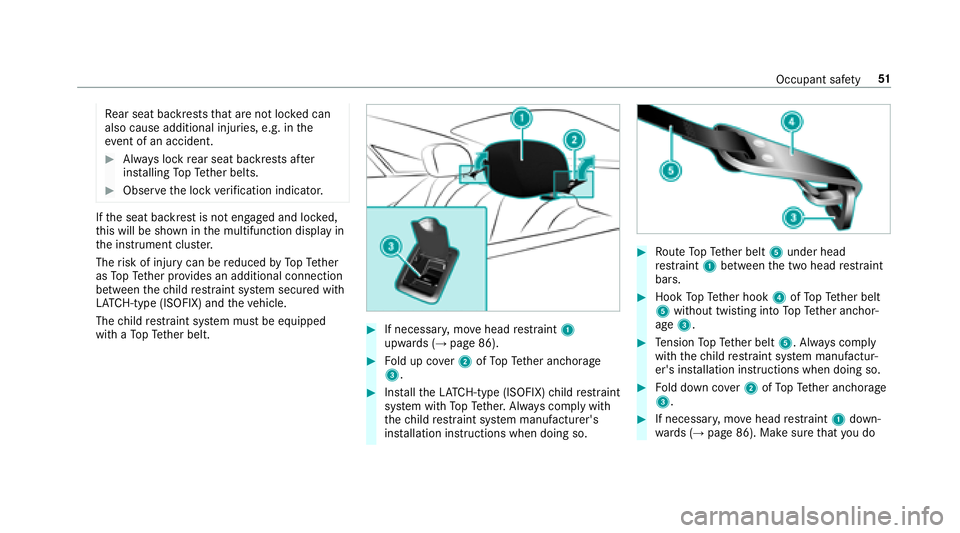
#If necessar y,mo vehead restra int 1
upwards (→page 86).
#Fo ld up co ver2 ofTopTe ther anchorage
3.
#Ins tallth eLA TC H-type (ISOFIX) child restra int
sy stem with TopTe ther. Alw ays comply with
th ech ild restra int sy stem manufacturer's
ins tallation instructions when doing so.
#Ro ute TopTe ther belt 5under head
re stra int 1 between the two head restra int
bars.
#Hook TopTe ther hook 4ofTopTe ther belt
5 without twisting into TopTe ther anchor‐
age 3.
#Tension TopTe ther belt 5. Alw ays comply
with thech ild restra int sy stem manufactur‐
er's ins tallation instructions when doing so.
#Fo ld down co ver2 ofTopTe ther anchorage
3.
#If necessar y,mo vehead restra int 1 down‐
wa rds (→page 86). Make sure that you do
Occupant saf ety 51
Page 55 of 486
Child safety loc ks
Activating/deactivating the child saf ety lock
fo r the rear side windo ws
&
WARNING Risk of accident and injury
due tochildren left unatte nded inthe
ve hicle
If yo u lea vechildren unaccompanied in the
ve hicle, they may be able toset theve hicle in
motion, forex ample by:
RRe leasing the parking brake.
RShifting the transmission out of park
position j.
RStarting the engine.
In addition, they may operate vehicle equip‐
ment.
#Ne ver lea vechildren and animals unat‐
te nded in theve hicle.
#When leaving theve hicle, alw aysta ke
th e SmartK eywith you and lock the
ve hicle.
&
WARNING Risk offata l injury due to
ex posure toextreme heat or cold in the
ve hicle
If people – particularly children – are
ex posed toextreme heat or cold over an
ex tended pe riod of time, there is a risk of
injury or evenfa ta l injur y.
#Never lea veanyone – pa rticularly chil‐
dren – unatte nded intheve hicle.
&
WARNING Thereis arisk of accident
and injury if you lea vechildren unatte n‐
ded in theve hicle
If ch ildren are tra veling in theve hicle, they
could:
ROpen doo rs,th ereby endangering other
persons or road users.
RGet out of theve hicle and be hit by
oncoming traf fic.
ROpe rate ve hicle equipment and become
trapped, forex ample.
#Alw ays activate thech ild saf etyloc ks
av ailable if children are tra veling in the
ve hicle.
#Ne ver lea vechildren unatte nded inthe
ve hicle.
#When leaving theve hicle, alw aysta ke
th e SmartK eywith you and lock the
ve hicle.
Child saf etyloc ksare available forth e side win‐
do ws inthere ar.
Occupant saf ety 53
Page 57 of 486
SmartKey
Overview of SmartK eyfunctions
&
WARNING ‑ Danger of accident or injury
if ch ildren are left unatte nded intheve hi‐
cle
If ch ildren are left unatte nded intheve hicle,
th ey could:
Ropen doo rs,th ereby endangering other
persons or road users.
Rge t out of theve hicle and be hit by
oncoming traf fic.
Rope rate ve hicle equipment.
Moreo ver,ch ildren could also set theve hicle
in motion by,fo rex ample:
Rreleasing the parking brake.
Rshifting the automatic transmission out of
park position P jor shifting manual
transmission into idle position.
Rst arting the engine.
#Ne ver lea vechildren and animals unat‐
te nded in theve hicle.
#When leaving theve hicle, alw aysta ke
th eke ywit hyo u and lock theve hicle.
#Ke ep theve hicle keyout of there ach of
ch ildren.
* NO
TEDama getotheke ycaused by
magnetic fields
#Ke ep theke yaw ay from strong mag‐
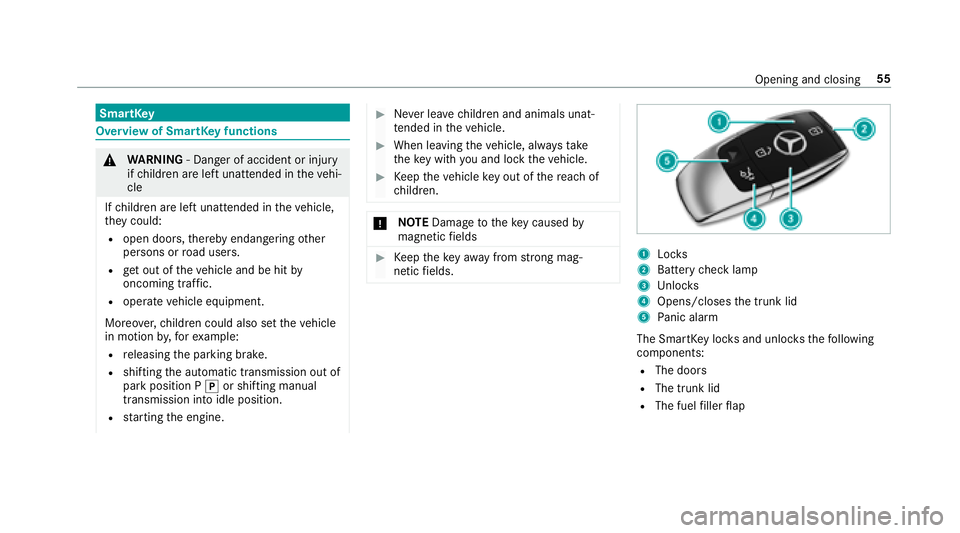
netic fields.1Loc ks
2Battery check lamp
3Unloc ks
4Opens/closes the trunk lid
5Pa nic alarm
The Smart Keyloc ksand unlo cksth efo llowing
components:
RThe doors
RThe trunk lid
RThe fuel filler flap
Opening and closing 55
Page 72 of 486
Side windows
Opening/closing the side windo ws
&
WARNING Risk of entrapment when
opening a side window
When opening a side windo w,parts of the
body could be dr awn in or become trapped
between the side window and window frame.
#When opening, make sure that nobody
is touching the side windo w.
#If someone is trapped, release the but‐
to n immedia tely or pull it in order to
close the side window again.
&
WARNING Risk of becoming trapped
when closing a side window
When closing a side windo w,body parts
could be trapped in the closing area in the
process.
#When closing, make sure that no body
parts are in the closing area.
#If someone is trapped, release the but‐
to n immedia tely or pres sth e button in
order toreopen the side windo w.
&
WARNING Risk of becoming trapped
when children opera tethe side windo ws
Childr en could become trapped if they oper‐
ate the side windo ws, particularly when unat‐
te nded.
#Ac tivate thech ild saf etyloc kfo rth e
re ar side wind ows.
#When leaving theve hicle, alw aysta ke
th e SmartK eywith you and lock the
ve hicle.
#Ne ver lea vechildren unatte nded inthe
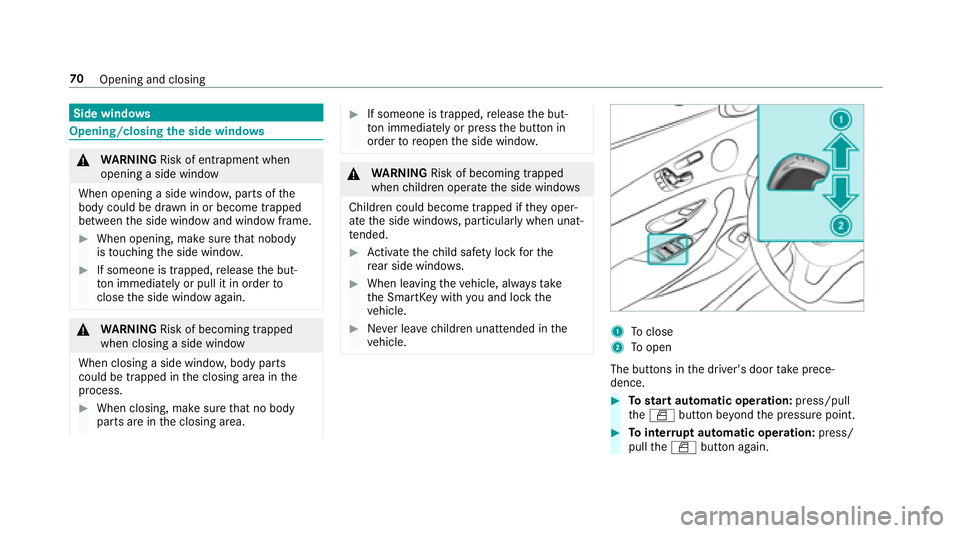
ve hicle.1To close
2Toopen
The buttons in the driver's door take prece‐
dence.
#To start automatic operation: press/pull
th eW button be yond the pressure point.
#To inter rupt automatic operation: press/
pull theW button again.
70
Opening and closing
Page 75 of 486
ProblemPossible causes/consequences and MSolutions
If a side window is obstructed during closing and reopens again slightly:
#Immediately af terth e window is obstructed, pull the cor responding button again until the side window
has closed, and hold the button for an additional second.
The side window is closed with increased forc e.
If a side window is obstructed again during closing and reopens again slightly:
#Re peat the pr evious step.
The side window is closed without the automatic reve rsing function.
Sliding sunroof
Opening/closing the sliding sunroof
%
The term "slidin g sunro of" also refers to the
panoramic sliding sunroof.
& WARNING Risk of becoming trapped
while opening and closing the sliding
sunroof
During opening and closing, parts of the
body could getcaught in the sweep of the
sliding sunroof.
#When opening or closing, make sure
th at no body parts are in the sweep.
#Re lease the button immediately if
somebody becomes trapped.
or
#Press the button in any direction during
th e automatic opening/closing process.
The opening/closing process is stop‐
ped.
& WARNING Risk of becoming trapped if
th e sliding sunroof is operated bychil‐
dren
Children operating the sliding sunroof could
get caught in the moving parts, particularly if
unattended.
#Ne ver lea vechildren unatte nded inthe
ve hicle.
#When leaving theve hicle, alw aysta ke
th eke ywit hyo u and lock theve hicle.
Opening and closing 73
Page 83 of 486
Seats
Adjusting the front seat mechanically and
electrically
& WARNING Risk of becoming trapped if
th e seats are adjus tedby children
Children could become trapped if they adjust
th e seats, particularly when unattended.
#When leaving theve hicle, alw aysta ke
th e SmartK eywith you and lock the
ve hicle.
#Ne ver lea vechildren unatte nded inthe
ve hicle.
The seats can be adjus ted when the ignition is
switched off.
& WARNING Risk of becoming trapped
when adjusting the seats
When you adjust a seat, you or other vehicle
occupants could become trapped, e.g. on the
seat guide rail.
#Make sure when adjusting a seat that
no one has any body parts in the sweep
of the seat.
Obser vethe saf etyno tes on "Airbags" and "Chil‐
dren in theve hicle".
&
WARNING Risk of accident due tothe
driver's seat not being engaged
If th e driver's seat is not engaged, it could
mo veunexpectedly while theve hicle is in
motion.
This could cause youto lose control of the
ve hicle.
#Alw ays make sure that the driver's seat
is engaged before starting theve hicle.
&
WARNING Risk of becoming trapped if
th e seat height is adjus ted carelessly
If yo u adjust the seat height carelessly, you
or other vehicle occupants could be trapped
and thereby injured.
Children in particular could accidenta lly
press the electrical seat adjustment buttons
and become trapped.
#While moving the seats, make sure that
hands or other body parts do not get
under the le ver assembly of the seat
adjustment sy stem.
&
WARNING Risk of injury duetohead
re stra ints which are not ins talled or are
adjus ted incor rectly
If head restra ints are not ins talled or are
adjus ted incor rectly, the head restra ints can‐
not pr ovide pr otection as intended.
There is an increased risk of injury in the
head and neck area, e.g. in theeve nt of an
accident or when braking.
#Alw ays drive with the head restra ints
ins talled.
#Before driving off, make sure forev ery
ve hicle occupant that the center of the
head restra int supports the back of the
head at about eye le vel.
Seats and stowing 81
Page 92 of 486
Switchingthe seat ventilation on/off
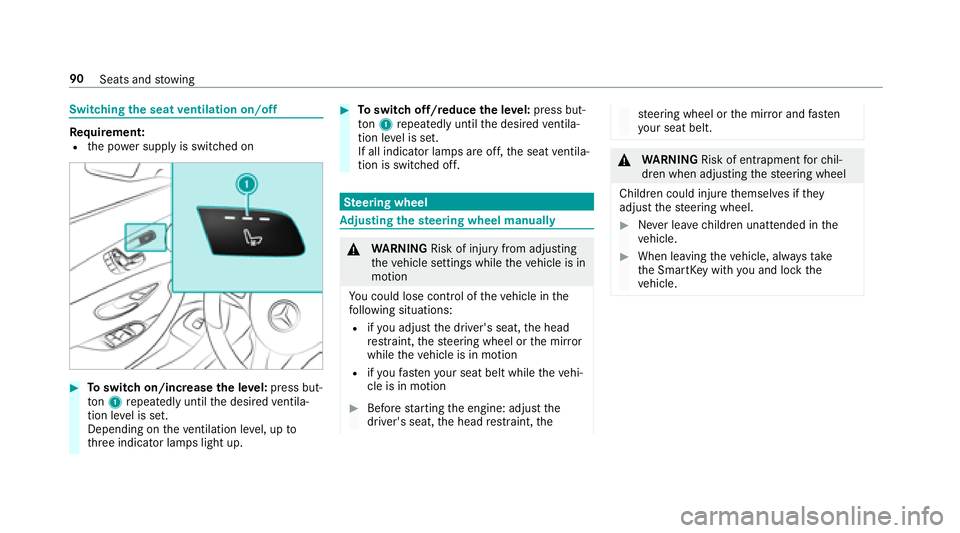
Re quirement:Rthe po wer supp lyis switched on
#To switch on/increase the le vel:press but‐
to n1 repeatedly until the desired ventila‐
tion le vel is set.
Depending on theve ntilation le vel, up to
th re e indicator lamps light up.
#To switch off/reduce the le vel:press but‐
to n1 repeatedly until the desired ventila‐
tion le vel is set.
If all indicator lamps are off, the seat ventila‐
tion is switched off.
Ste ering wheel
Adjusting the steering wheel manually
&
WARNING Risk of injury from adjusting
th eve hicle settings while theve hicle is in
motion
Yo u could lose cont rol of theve hicle in the
fo llowing situations:
Rifyo u adjust the driver's seat, the head
re stra int, thesteering wheel or the mir ror
while theve hicle is in motion
Rifyo ufa sten your seat belt while theve hi‐
cle is in motion
#Before starting the engine: adjust the
driver's seat, the head restra int, the
steering wheel or the mir ror and fasten
yo ur seat belt.
&
WARNING Risk of entrapment forch il‐
dren when adjusting thesteering wheel
Children could injure themselves if they
adjust thesteering wheel.
#Ne ver lea vechildren unatte nded inthe
ve hicle.
#When leaving theve hicle, alw aysta ke
th e SmartK eywith you and lock the
ve hicle.
90
Seats and stowing