wheel MERCEDES-BENZ E-CLASS ESTATE 2009 User Guide
[x] Cancel search | Manufacturer: MERCEDES-BENZ, Model Year: 2009, Model line: E-CLASS ESTATE, Model: MERCEDES-BENZ E-CLASS ESTATE 2009Pages: 373, PDF Size: 12.37 MB
Page 27 of 373
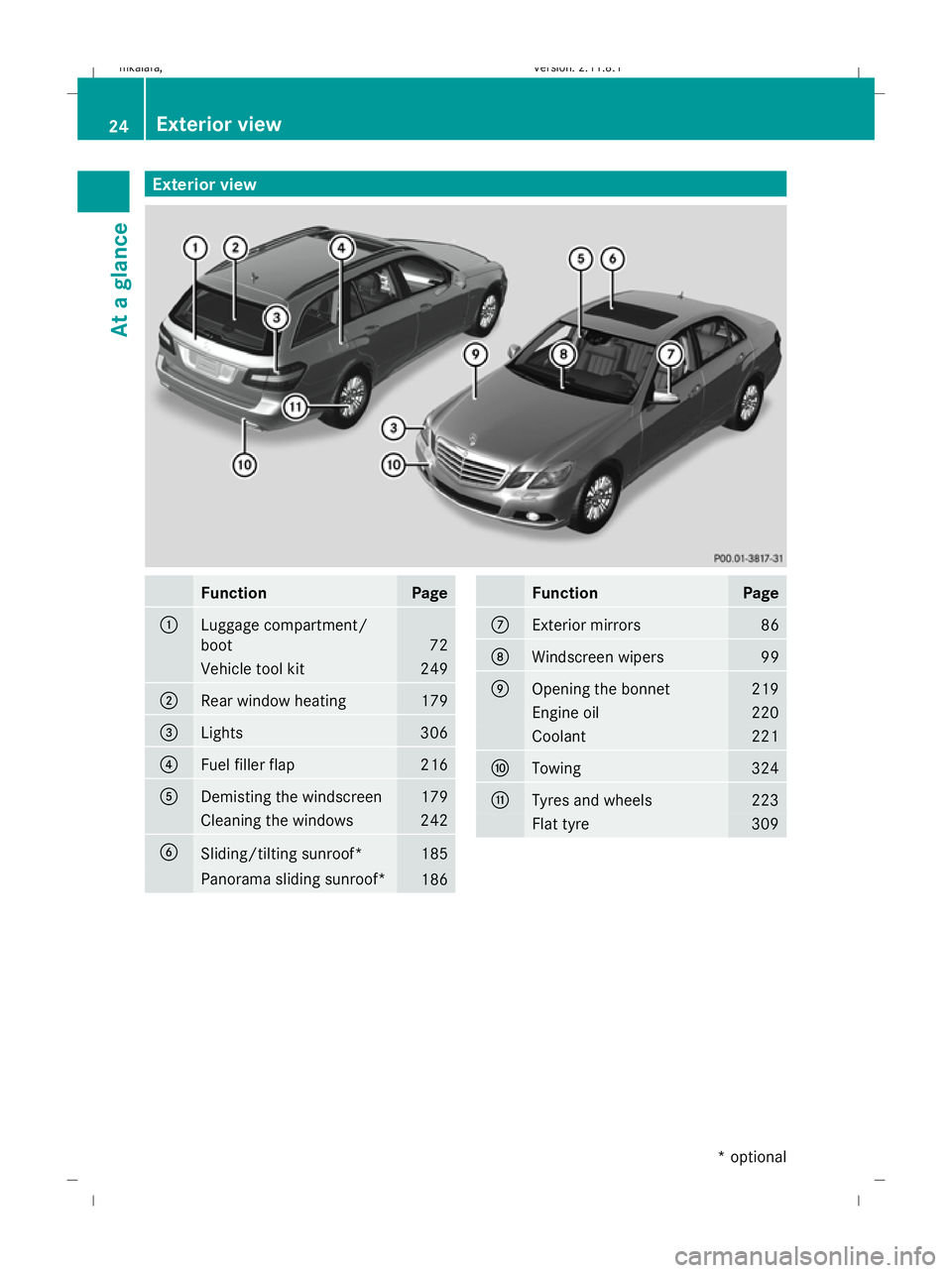
Exterior view
Function Page
:
Luggage compartment/
boot
72
Vehicle tool kit 249
;
Rear window heating 179
=
Lights 306
?
Fuel filler flap 216
A
Demisting the windscreen 179
Cleaning the windows 242
B
Sliding/tilting sunroof* 185
Panorama sliding sunroof*
186 Function Page
C
Exterior mirrors 86
D
Windscreen wipers 99
E
Opening the bonnet 219
Engine oil 220
Coolant 221
F
Towing 324
G
Tyres and wheels 223
Flat tyre 30924
Exterior viewAt a glance
* optional
212_AKB; 2; 4, en-GB
mkalafa,
Version: 2.11.8.1 2009-05-05T14:17:16+02:00 - Seite 24
Dateiname: 6515346702_buchblock.pdf; erzeugt am 07. May 2009 14:15:29; WK
Page 28 of 373
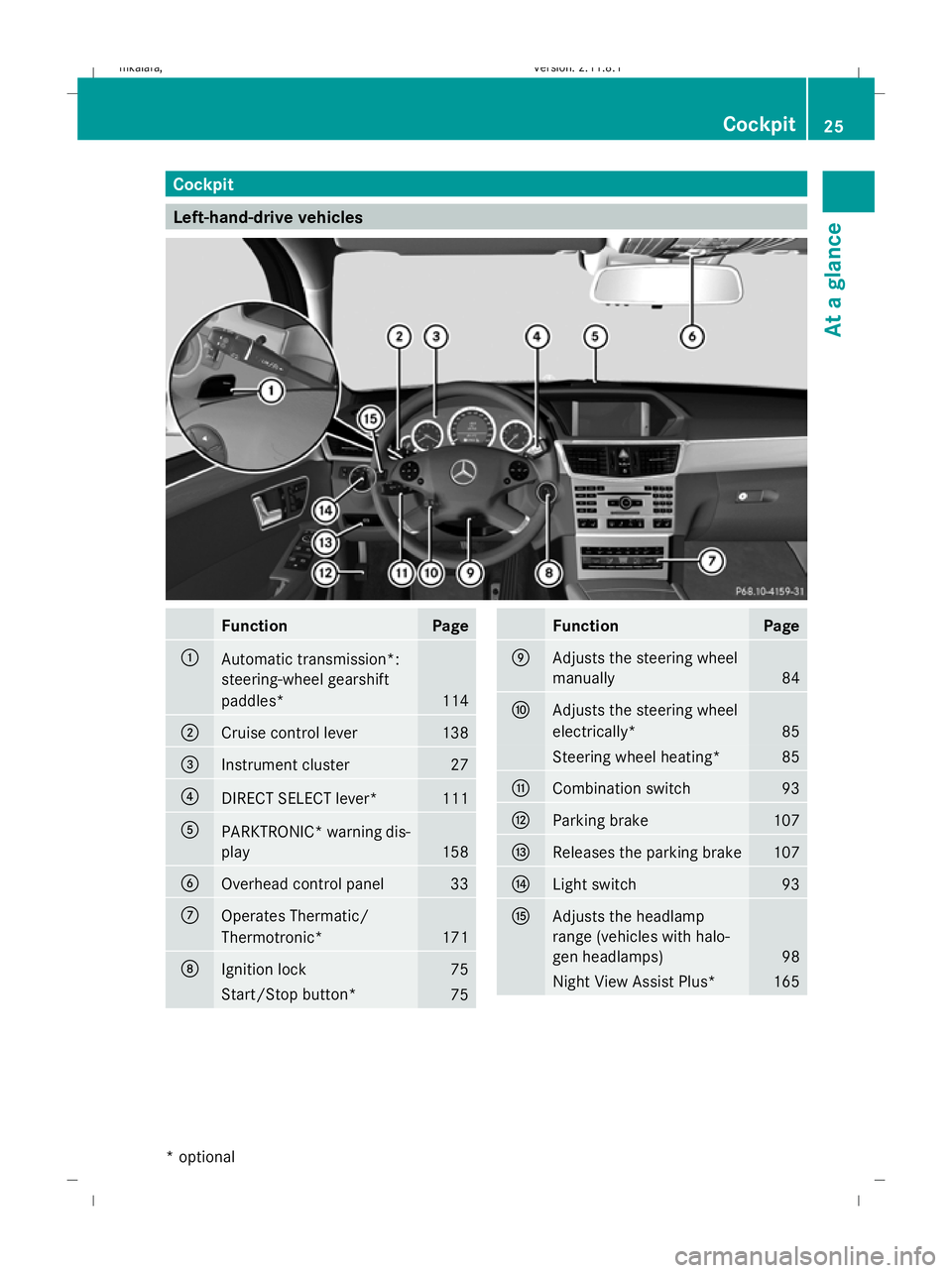
Cockpit
Left-hand-drive vehicles
Function Page
:
Automatic transmission*:
steering-wheel gearshift
paddles*
114
;
Cruise control lever 138
=
Instrument cluster 27
?
DIRECT SELECT lever* 111
A
PARKTRONIC* warning dis-
play
158
B
Overhead control panel 33
C
Operates Thermatic/
Thermotronic*
171
D
Ignition lock 75
Start/Stop button*
75 Function Page
E
Adjusts the steering wheel
manually
84
F
Adjusts the steering wheel
electrically*
85
Steering wheel heating* 85
G
Combination switch 93
H
Parking brake 107
I
Releases the parking brake 107
J
Light switch 93
K
Adjusts the headlamp
range (vehicles with halo-
gen headlamps)
98
Night View Assist Plus* 165Cockpit
25At a glance
* optional
212_AKB; 2; 4, en-GB
mkalafa
,V ersion: 2.11.8.1
2009-05-05T14:17:16+02:00 - Seite 25
Dateiname: 6515346702_buchblock.pdf; erzeugt am 07. May 2009 14:15:29; WK
Page 29 of 373
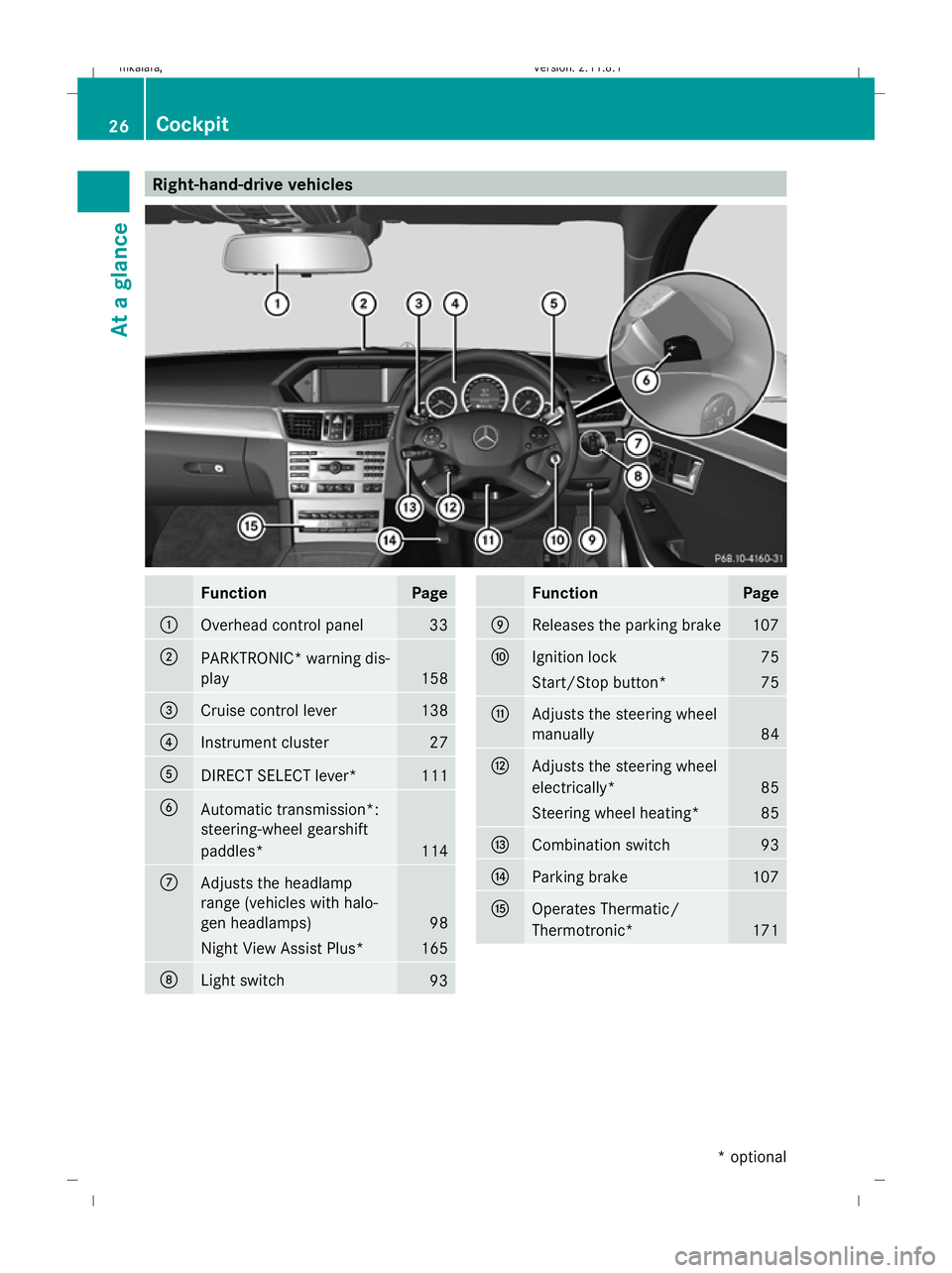
Right-hand-drive vehicles
Function Page
:
Overhead control panel 33
;
PARKTRONIC
*warning dis-
play 158
=
Cruise control lever 138
?
Instrument cluster 27
A
DIRECT SELECT lever* 111
B
Automatic transmission*:
steering-wheel gearshift
paddles*
114
C
Adjusts the headlamp
range (vehicles with halo-
gen headlamps)
98
Night View Assist Plus* 165
D
Light switch
93 Function Page
E
Releases the parking brake 107
F
Ignition lock 75
Start/Stop button* 75
G
Adjusts the steering wheel
manually
84
H
Adjusts the steering wheel
electrically*
85
Steering wheel heating* 85
I
Combination switch 93
J
Parking brake 107
K
Operates Thermatic/
Thermotronic*
17126
CockpitAt a glance
* optional
212_AKB; 2; 4, en-GB
mkalafa
,V ersion: 2.11.8.1
2009-05-05T14:17:16+02:00 - Seite 26
Dateiname: 6515346702_buchblock.pdf; erzeugt am 07. May 2009 14:15:30; WK
Page 33 of 373
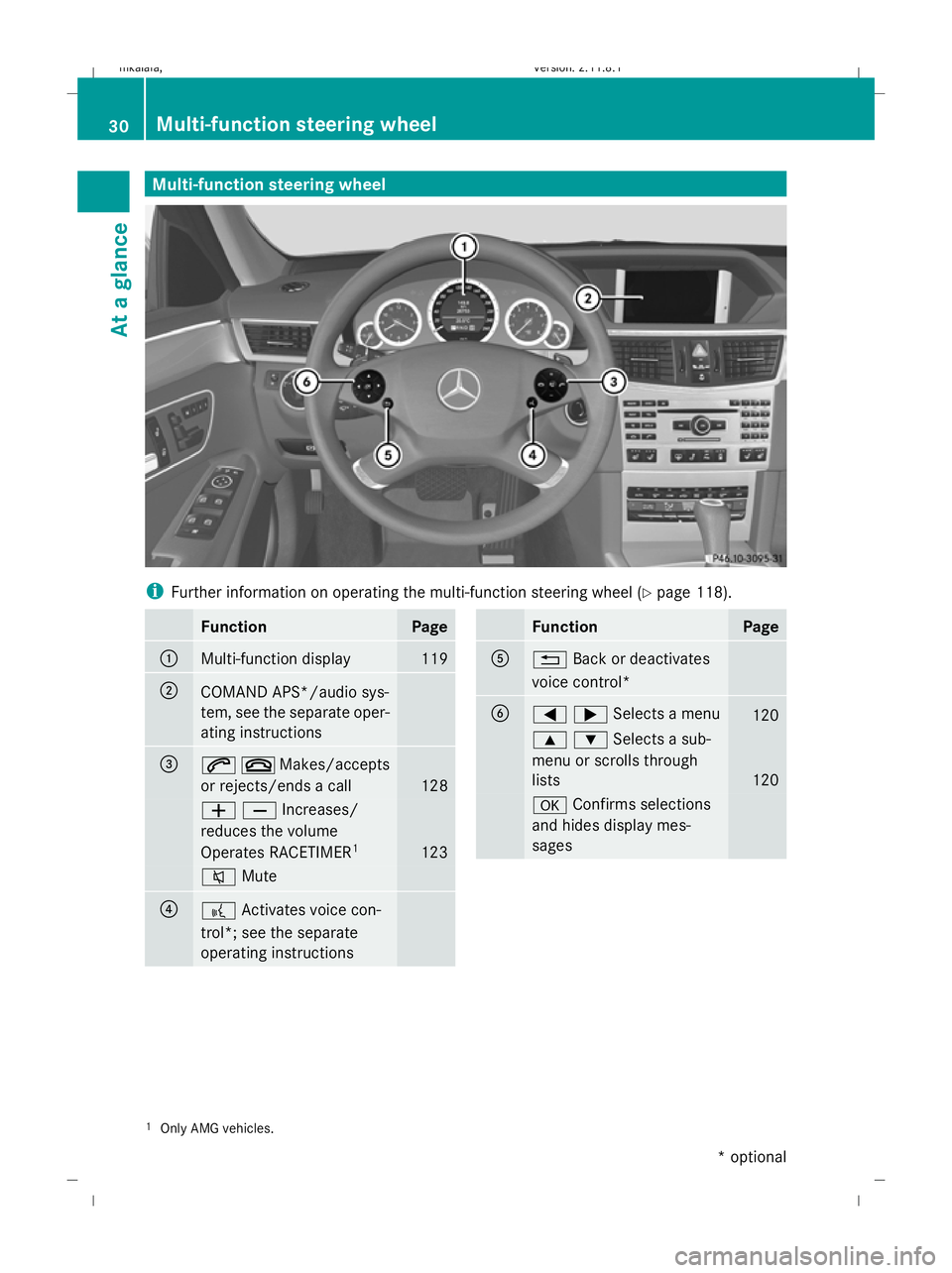
Multi-function steering wheel
i
Further information on operating the multi-function steering wheel (Y page 118).Function Page
:
Multi-function display 119
;
COMAND APS*/audio sys-
tem, see the separate oper-
ating instructions
=
6~Makes/accepts
or rejects/ends a call
128
WXIncreases/
reduces the volume
Operates RACETIMER
1 123
8
Mute ?
?
Activates voice con-
trol*; see the separate
operating instructions Function Page
A
%
Back or deactivates
voice control* B
=;Selects a menu
120
9:Selects a sub-
menu or scrolls through
lists
120
a
Confirms selections
and hides display mes-
sages 1
Only AMG vehicles. 30
Multi-function steering wheelAt a glance
* optional
212_AKB; 2; 4, en-GB
mkalafa
,V ersion: 2.11.8.1
2009-05-05T14:17:16+02:00 - Seite 30
Dateiname: 6515346702_buchblock.pdf; erzeugt am 07. May 2009 14:15:32; WK
Page 37 of 373
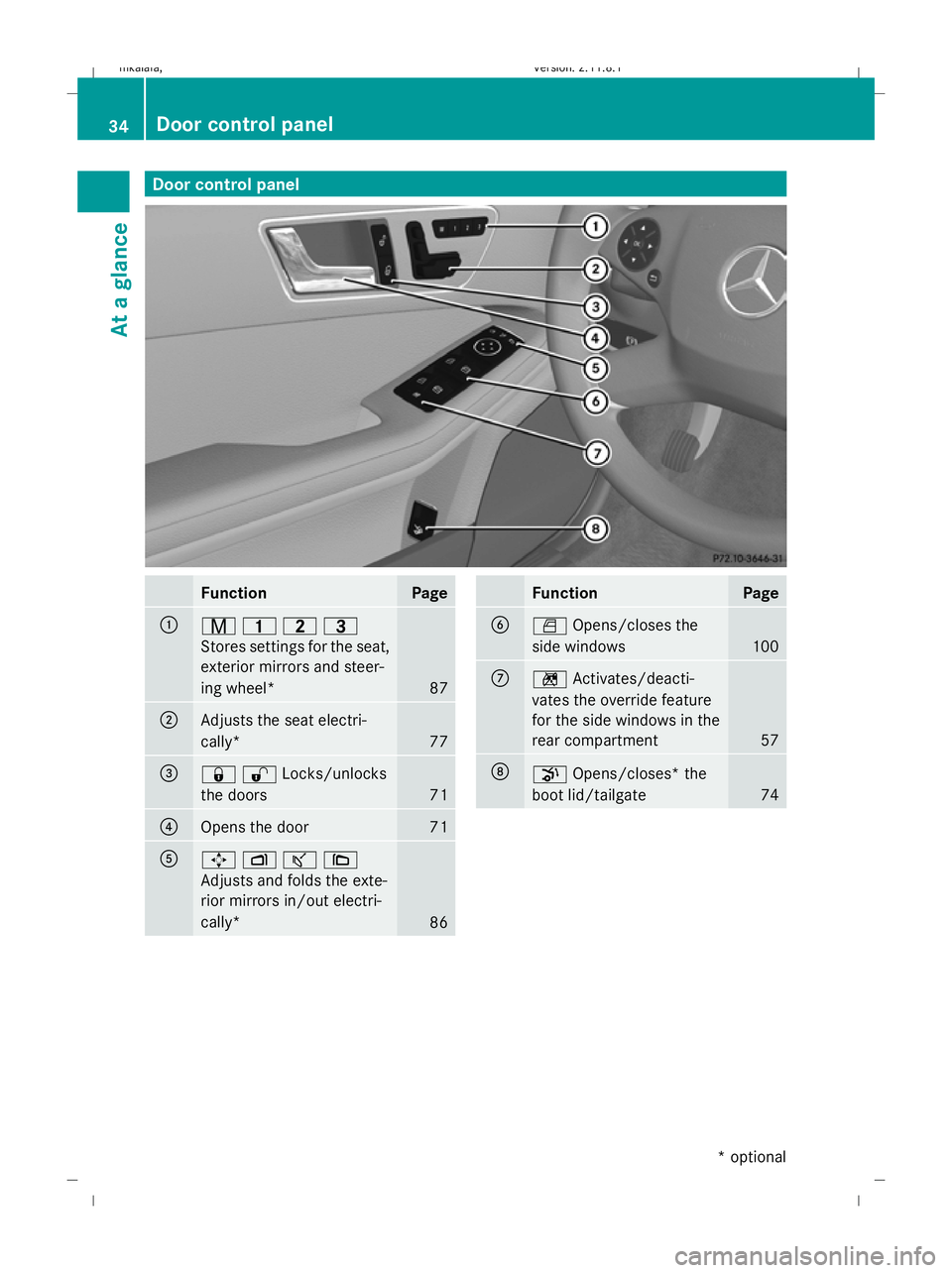
Door control panel
Function Page
:
r
45=
Stores settings for the seat,
exterior mirrors and steer-
ing wheel* 87
;
Adjusts the seat electri-
cally*
77
=
&%Locks/unlocks
the doors
71
?
Opens the door 71
A
7
Zª\
Adjusts and folds the exte-
rior mirrors in/out electri-
cally* 86 Function Page
B
W
Opens/closes the
side windows 100
C
n
Activates/deacti-
vates the override feature
for the side windows in the
rear compartment 57
D
p
Opens/closes* the
boot lid/tailgate 7434
Door control panelAt a glance
* optional
212_AKB; 2; 4, en-GB
mkalafa,
Version: 2.11.8.1 2009-05-05T14:17:16+02:00 - Seite 34
Dateiname: 6515346702_buchblock.pdf; erzeugt am 07. May 2009 14:15:35; WK
Page 39 of 373
Occupant safety
Notes on occupant safety
Seat belts, together with belt tensioners, belt
force limiters and airbags, are complemen-
tary, coordinated restraint systems. They
reduce the risk of injury in specific, pre-
defined types of accident situations and
thereby increase occupant safety. However,
seat belts and airbags generally do not pro-
tect against objects penetrating the vehicle
from the outside.
To ensure that the restraint systems can
deliver their full potential protection, make
sure that:
R the seat and head restraint are adjusted
properly (Y page 76).
R the seat belt has been fastened properly
(Y page 89).
R the airbags can inflate properly if they are
deployed (Y page 39).
R the steering wheel is adjusted properly
(Y page 84).
R the restraint systems have not been modi-
fied.
i An airbag increases the protection of
vehicle occupants wearing a seat belt.
However, airbags are only an additional
restraint system which complements, but
does not replace, the seat belt. All vehicle
occupants must wear their seat belt cor-
rectly at all times, even if the vehicle is
equipped with airbags. This is because – on
the one hand – airbags are not deployed in
all types of accident, as in some situations
airbag deployment would not increase the
protection afforded to vehicle occupants,
provided they are wearing their seat belt
correctly. On the other hand, airbag deploy-
ment only provides increased protection if
the seat belt is worn correctly because: R
the seat belt helps to keep the vehicle
occupant in the best position in relation
to the airbag.
R for example, in a head-on collision, the
seat belt can more adequately prevent
the occupant from being propelled
towards the point of the impact, and is
thus better suited to prevent injury.
Therefore, in accident situations where an
airbag is deployed, it only provides protec-
tion in addition to the seat belt if the seat
belt is being worn correctly. G
Risk of accident and injury
Always have maintenance work carried out at
a qualified specialist workshop which has the
necessary specialist knowledge and tools to
carry out the work required.
Mercedes-Benz recommends that you use a
Mercedes-Benz Service Centre for this pur-
pose.
In particular, work relevant to safety or on
safety-related systems must be carried out at
a qualified specialist workshop. If this work is
not carried out correctly, the operating safety
of your vehicle may be affected. There is a risk
of an accident and injury. G
Risk of injury
The restraint system may not work as inten-
ded if the following components have been
modified or work on these components has
not been performed correctly:
R restraint system, consisting of the seat
belts and anchorages, belt tensioners, belt
force limiters, airbags
R wiring
R networked electronic systems
Airbags or belt tensioners could then fail, e.g.
in the event of an accident in which the decel-
eration force would normally be high enough
to trigger the systems, or they could be trig-
gered unintentionally. Never carry out any
modifications on the restraint systems. 36
Occupant safetySafety
212_AKB; 2; 4, en-GB
mkalafa,
Version: 2.11.8.1 2009-05-05T14:17:16+02:00 - Seite 36
Dateiname: 6515346702_buchblock.pdf; erzeugt am 07. May 2009 14:15:36; WK
Page 42 of 373
G
Risk of injury
If the seat belt tensioners have been trig-
gered, they provide no additional protection
in the event of another accident. Therefore,
have belt tensioners which have been trig-
gered replaced at a qualified specialist work-
shop.
Comply with safety regulations when dispos-
ing of belt tensioners. Any Mercedes-Benz
Service Centre can provide details of these
regulations.
Airbags Airbag deployment slows down and restricts
the movement of the vehicle occupant.
If the airbags are deployed, you will hear a
bang and a small amount of powder may also
be released. Only in rare cases will the bang
affect your hearing. The powder that escapes
does not generally constitute a health hazard.
The SRS warning lamp 6lights up.
The AIRBAG identification indicates the loca-
tion of the airbags. G
Risk of injury
Airbags provide additional protection; they
are not, however, a substitute for seat belts.
Observe the following notes to reduce the risk
of serious or even fatal injury if an airbag is
deployed:
R all vehicle occupants ― in particular, preg-
nant women ― must wear their seat belt
correctly at all times and lean back against
the backrest, which should be positioned
as close to the vertical as possible. The
head restraint must support the back of the
head at about eye level.
R always secure children less than 1.50 m tall
or under 12 years of age in suitable child
restraint systems.
R all vehicle occupants must select a seat
position that is as far away from the airbag
as possible. The driver's seat position must
allow the vehicle to be driven safely. The driver's chest should be as far away from
the middle of the driver's front airbag cover
as possible.
R move the front-passenger seat as far back
as possible, especially if a child is secured
in a child restraint system on the seat.
R vehicle occupants – in particular, children
– must not lean their head into the area of
the window in which the sidebag/head air-
bag is deployed.
R rearward-facing child restraint systems
must not be fitted to the front-passenger
seat unless the front-passenger front air-
bag has been disabled. The front-passenger
front airbag of a vehicle fitted with auto-
matic child seat recognition* is only disa-
bled when a child restraint system with
automatic child seat recognition is fitted to
the front-passenger seat. The 4
PASSENGER AIRBAG OFF warning lamp
must be continuously lit.
If the front-passenger seat of your vehicle
does not have automatic child seat recog-
nition*, or your rearward-facing child
restraint system does not have automatic
child seat recognition, children must be
secured in a child restraint system on a
suitable seat in the rear. If you secure a
forward-facing child restraint system to the
front-passenger seat, you must move the
front-passenger seat as far back as possi-
ble.
R make sure there are no heavy or sharp-
edged objects in pockets of clothing.
R do not lean forwards, e.g. over the cover of
the driver's/front-passenger front airbag,
particularly when the vehicle is in motion.
R do not put your feet on the dashboard.
R only hold the steering wheel by the rim. This
allows the airbag to deploy fully. You could
be injured if the airbag is deployed and you
are holding the inside of the steering wheel. Occupant safety
39Safety
* optional
212_AKB; 2; 4, en-GB
mkalafa
,V ersion: 2.11.8.1
2009-05-05T14:17:16+02:00 - Seite 39 Z
Dateiname: 6515346702_buchblock.pdf; erzeugt am 07. May 2009 14:15:36; WK
Page 43 of 373
R
do not lean on the doors from inside the
vehicle.
R make sure that there are no people, ani-
mals or objects between the vehicle occu-
pants and the area of deployment of the
airbag.
R do not place any objects between the seat
backrest and the door.
R do not hang any hard objects, for example,
coat hangers, on the grab handles or coat
hooks.
R do not attach accessories, e.g. cup holders,
to the doors.
It is not possible to rule out a risk of injuries
caused by an airbag due to the high speed at
which the airbag is required to deploy. G
Risk of injury
The airbag's functionality can only be guaran-
teed if the following parts are not covered and
no badges or stickers are attached to them:
R padded steering wheel boss
R knee airbag cover below the steering col-
umn
R front-passenger front airbag cover
R outer side of front seats
R side panel next to the rear seat backrest G
Risk of injury
When an airbag deploys, a small amount of
powder is released. The powder may cause
short-term breathing difficulties to persons
suffering from asthma or other pulmonary
conditions.
In order to prevent potential breathing diffi-
culties, you should leave the vehicle as soon
as it is safe to do so. You can also open the
window to allow fresh air to enter the interior.
The powder generally does not constitute a
health hazard and does not indicate that there
is a fire in the vehicle. G
Risk of injury
The airbag parts are hot after the airbag has
been deployed. Do not touch them; other-
wise, you may burn yourself.
Have the airbags checked at a qualified spe-
cialist workshop. Otherwise, occupants are
not protected by the airbags in the event of
another accident.
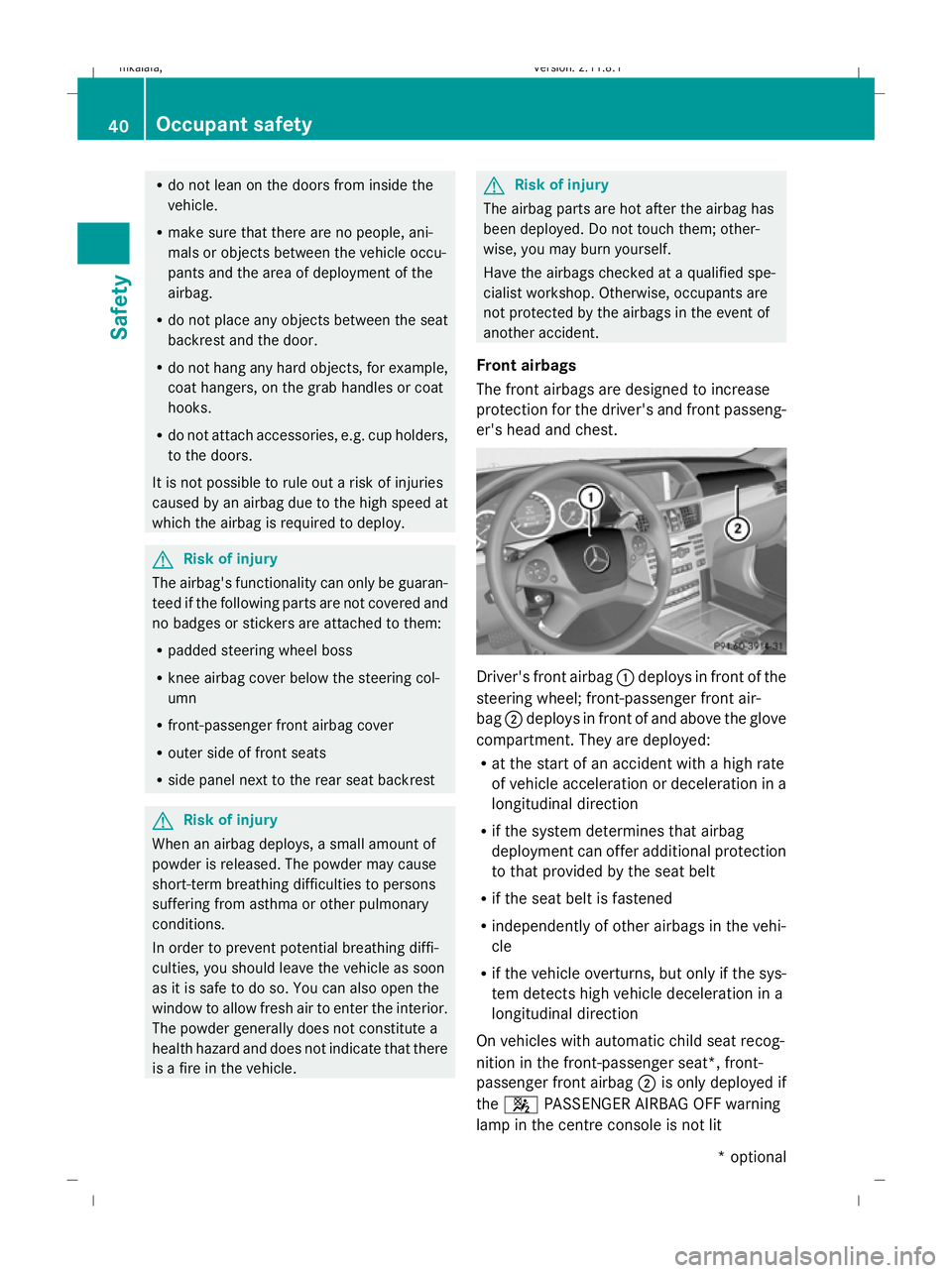
Front airbags
The front airbags are designed to increase
protection for the driver's and front passeng-
er's head and chest. Driver's front airbag
:deploys in front of the
steering wheel; front-passenger front air-
bag ;deploys in front of and above the glove
compartment. They are deployed:
R at the start of an accident with a high rate
of vehicle acceleration or deceleration in a
longitudinal direction
R if the system determines that airbag
deployment can offer additional protection
to that provided by the seat belt
R if the seat belt is fastened
R independently of other airbags in the vehi-
cle
R if the vehicle overturns, but only if the sys-
tem detects high vehicle deceleration in a
longitudinal direction
On vehicles with automatic child seat recog-
nition in the front-passenger seat*, front-
passenger front airbag ;is only deployed if
the 4 PASSENGER AIRBAG OFF warning
lamp in the centre console is not lit 40
Occupant safetySafety
* optional
212_AKB; 2; 4, en-GB
mkalafa,
Version: 2.11.8.1 2009-05-05T14:17:16+02:00 - Seite 40
Dateiname: 6515346702_buchblock.pdf; erzeugt am 07. May 2009 14:15:36; WK
Page 61 of 373
X
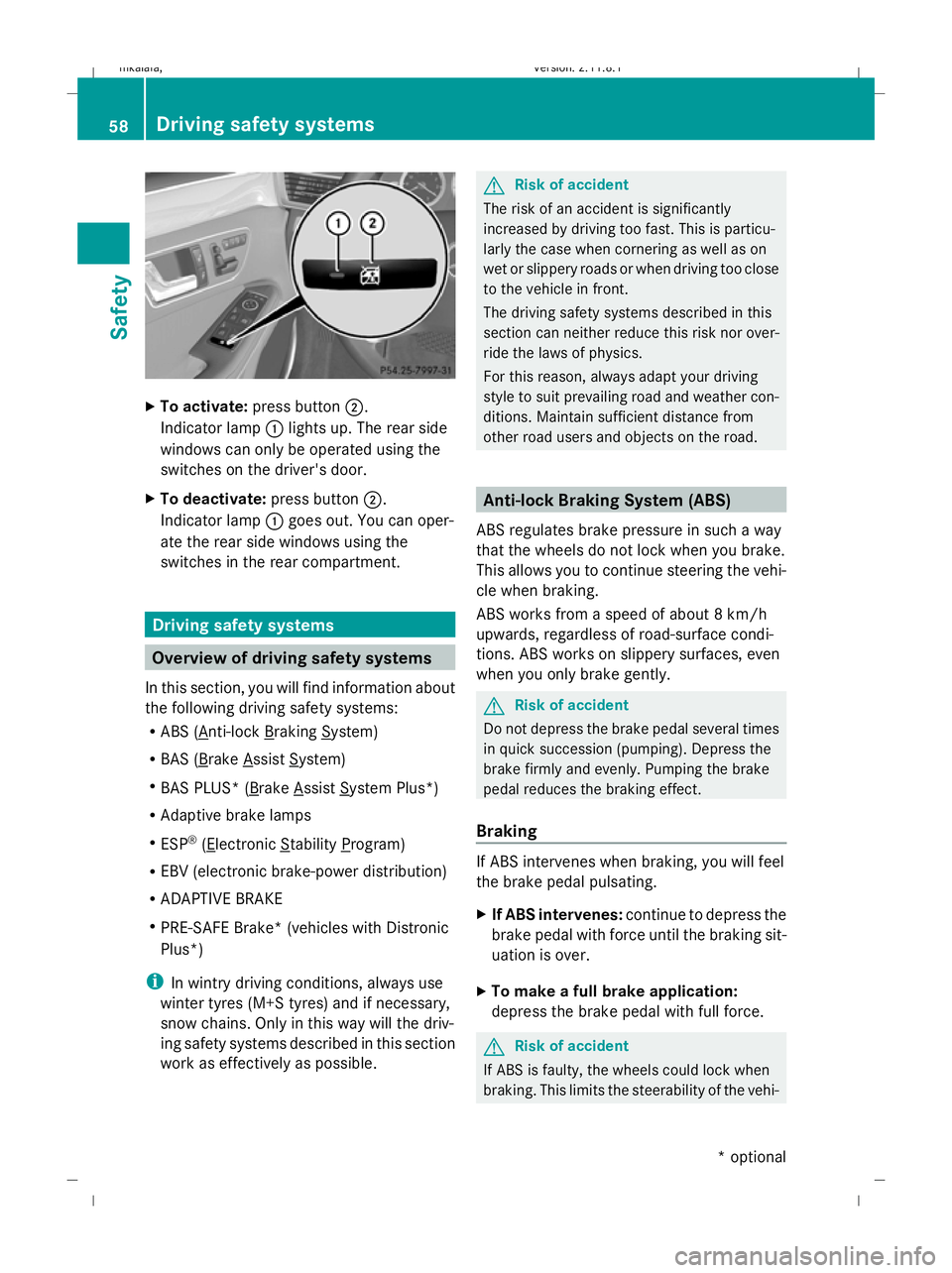
To activate: press button ;.
Indicator lamp :lights up. The rear side
windows can only be operated using the
switches on the driver's door.
X To deactivate: press button;.
Indicator lamp :goes out. You can oper-
ate the rear side windows using the
switches in the rear compartment. Driving safety systems
Overview of driving safety systems
In this section, you will find information about
the following driving safety systems:
R ABS ( Anti-lock Braking System)
R BAS ( Brake Assist System)
R BAS PLUS* ( Brake Assist System Plus*)
R Adaptive brake lamps
R ESP ®
( Electronic Stability Program)
R EBV (electronic brake-power distribution)
R ADAPTIVE BRAKE
R PRE-SAFE Brake* (vehicles with Distronic
Plus*)
i In wintry driving conditions, always use
winter tyres (M+S tyres) and if necessary,
snow chains. Only in this way will the driv-
ing safety systems described in this section
work as effectively as possible. G
Risk of accident
The risk of an accident is significantly
increased by driving too fast. This is particu-
larly the case when cornering as well as on
wet or slippery roads or when driving too close
to the vehicle in front.
The driving safety systems described in this
section can neither reduce this risk nor over-
ride the laws of physics.
For this reason, always adapt your driving
style to suit prevailing road and weather con-
ditions. Maintain sufficient distance from
other road users and objects on the road. Anti-lock Braking System (ABS)
ABS regulates brake pressure in such a way
that the wheels do not lock when you brake.
This allows you to continue steering the vehi-
cle when braking.
ABS works from a speed of about 8 km/h
upwards, regardless of road-surface condi-
tions. ABS works on slippery surfaces, even
when you only brake gently. G
Risk of accident
Do not depress the brake pedal several times
in quick succession (pumping). Depress the
brake firmly and evenly. Pumping the brake
pedal reduces the braking effect.
Braking If ABS intervenes when braking, you will feel
the brake pedal pulsating.
X
If ABS intervenes: continue to depress the
brake pedal with force until the braking sit-
uation is over.
X To make a full brake application:
depress the brake pedal with full force. G
Risk of accident
If ABS is faulty, the wheels could lock when
braking. This limits the steerability of the vehi- 58
Driving safety systemsSafety
* optional
212_AKB; 2; 4, en-GB
mkalafa,
Version: 2.11.8.1 2009-05-05T14:17:16+02:00 - Seite 58
Dateiname: 6515346702_buchblock.pdf; erzeugt am 07. May 2009 14:15:42; WK
Page 62 of 373
cle when braking and the braking distance
may increase.
If ABS is deactivated due to a malfunction,
then BAS, BAS PLUS* and ESP ®
are also
deactivated. There is an increased risk of your
vehicle skidding in certain situations.
You should always adapt your driving style to
suit prevailing road and weather conditions. BAS (Brake Assist)
BAS operates in emergency braking situa-
tions. If you depress the brake pedal quickly,
BAS automatically boosts the braking force,
thus shortening the stopping distance.
X Keep the brake pedal firmly depressed until
the emergency braking situation is over.
ABS prevents the wheels from locking.
The brakes will function as usual once you
release the brake pedal. BAS is deactivated. G
Risk of accident
If BAS has malfunctioned, the braking system
remains available with full brake boosting
effect. However, braking force is not auto-
matically increased in emergency braking sit-
uations and the stopping distance may
increase. BAS PLUS* (Brake Assist)
BAS PLUS provides braking assistance in haz-
ardous situations and uses radar sensor tech-
nology to assess the traffic situation. G
Risk of accident
BAS PLUS is only an aid to assist you when
driving. You are responsible for maintaining a
safe distance from other vehicles, for the vehi-
cle's speed and for braking in good time.
Always pay attention to the traffic conditions.
You may otherwise recognise dangers too
late, cause an accident and injure yourself
and others. BAS PLUS can detect obstacles that are in the
path of your vehicle for an extended period of
time. Should you approach a detected obsta-
cle quickly, BAS PLUS calculates the braking
force necessary to avoid a rear-end collision.
Should you additionally apply the brakes, BAS
PLUS will automatically increase the braking
force to a level suitable for the traffic condi-
tions.
If BAS PLUS demands particularly high brak-
ing force, PRE-SAFE
®
is activated simultane-
ously.
X Keep the brake pedal depressed until the
emergency braking situation is over.
ABS prevents the wheels from locking.
The brakes will work normally again when:
R you release the brake pedal
R no obstacle is detected in front of your
vehicle
R there is no longer any danger of a rear-end
collision
BAS PLUS is then deactivated.
At speeds up to approximately 70 km/h, BAS
PLUS can also detect stationary obstacles,
for example, stopped or parked vehicles.
The radar sensors are automatically deacti-
vated in the vicinity of radio telescope facili-
ties (Y page 362).
For BAS PLUS to assist you when driving, the
radar sensor system must be switched on and
operational. You can check this by activating
Distronic Plus* (Y page 140) or via the
"Radar sensor" function in the on-board com-
puter (Y page 134). G
Risk of accident
Only clearly identified obstacles will initiate
braking assistance by BAS PLUS. In particular,
the detection of obstacles can be restricted if
there is:
R dirt on the sensors or the sensors are cov-
ered
R snow or heavy rain Driving safety systems
59Safety
* optional
212_AKB; 2; 4, en-GB
mkalafa
,V ersion: 2.11.8.1
2009-05-05T14:17:16+02:00 - Seite 59 Z
Dateiname: 6515346702_buchblock.pdf; erzeugt am 07. May 2009 14:15:42; WK