brake light MERCEDES-BENZ E-CLASS SALOON 2008 Manual PDF
[x] Cancel search | Manufacturer: MERCEDES-BENZ, Model Year: 2008, Model line: E-CLASS SALOON, Model: MERCEDES-BENZ E-CLASS SALOON 2008Pages: 401, PDF Size: 6.89 MB
Page 334 of 401
Battery
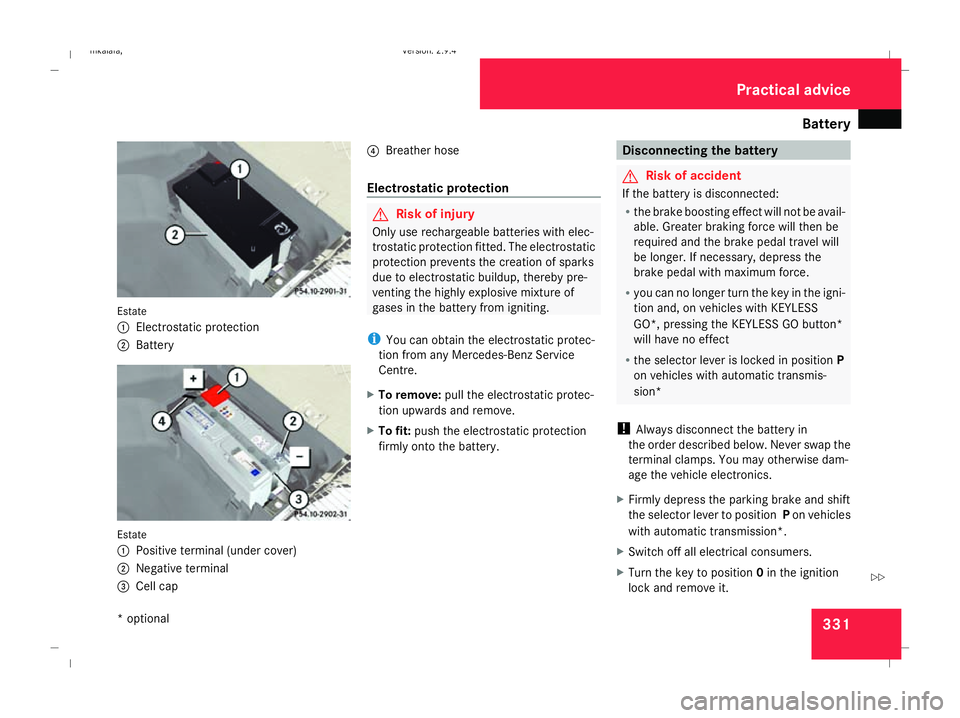
331Estate
1 Electrostatic protection
2 Battery Estate
1 Positive terminal (under cover)
2 Negative terminal
3 Cell cap 4
Breather hose
Electrostatic protection G
Risk of injury
Only use rechargeable batteries with elec-
trostatic protection fitted. The electrostatic
protection prevents the creation of sparks
due to electrostatic buildup, thereby pre-
venting the highly explosive mixture of
gases in the battery from igniting.
i You can obtain the electrostatic protec-
tion from any Mercedes-Benz Service
Centre.
X To remove: pull the electrostatic protec-
tion upwards and remove.
X To fit: push the electrostatic protection
firmly onto the battery. Disconnecting the battery
G
Risk of accident
If the battery is disconnected:
R the brake boosting effect will not be avail-
able. Greater braking force will then be
required and the brake pedal travel will
be longer. If necessary, depress the
brake pedal with maximum force.
R you can no longer turn the key in the igni-
tion and, on vehicles with KEYLESS
GO*, pressing the KEYLESS GO button*
will have no effect
R the selector lever is locked in position P
on vehicles with automatic transmis-
sion*
! Always disconnect the battery in
the order described below. Never swap the
terminal clamps. You may otherwise dam-
age the vehicle electronics.
X Firmly depress the parking brake and shift
the selector lever to position Pon vehicles
with automatic transmission*.
X Switch off all electrical consumers.
X Turn the key to position 0in the ignition
lock and remove it. Practical advice
* optional
211_AKB; 2; 5, en-GB
mkalafa
, Version: 2.9.4 2008-02-29T16:57:07+01:00 - Seite 331 ZDateiname: 6515_3416_02_buchblock.pdf; preflight
Page 337 of 401
Jump-starting
334 G
Risk of injury
There is a risk of acid burns when jump-
starting a vehicle due to the gases which
escape from the battery. Do not lean over
the battery while the engine is being jump-
started. G
Risk of explosion
Gases escaping from the battery during
jump-starting may cause minor explosions.
Avoid creating sparks. Keep naked flames
away from the battery, and do not smoke.
Comply with safety precautions and take
protective measures when handling batter-
ies. You will find these under “Battery” in
the index.
X Make sure that the two vehicles do not
touch.
X Depress the parking brake.
X Manual transmission: engage neutral.
X Automatic transmission*: move the
selector lever to P.
X All vehicles: switch off all electrical con-
sumers. Saloon
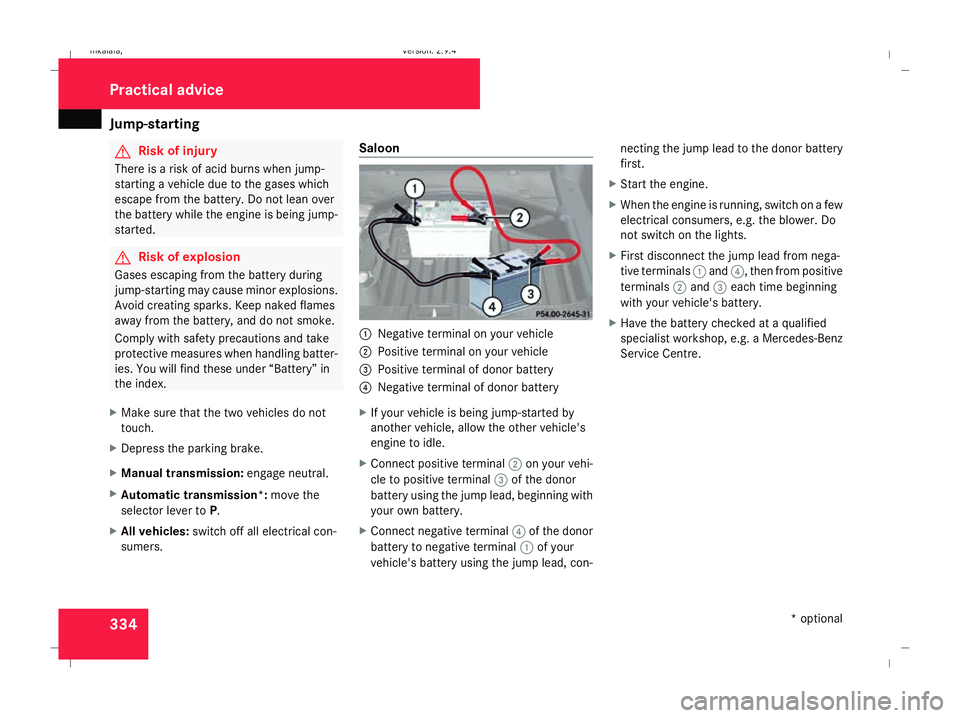
1
Negative terminal on your vehicle
2 Positive terminal on your vehicle
3 Positive terminal of donor battery
4 Negative terminal of donor battery
X If your vehicle is being jump-started by
another vehicle, allow the other vehicle's
engine to idle.
X Connect positive terminal 2on your vehi-
cle to positive terminal 3of the donor
battery using the jump lead, beginning with
your own battery.
X Connect negative terminal 4of the donor
battery to negative terminal 1of your
vehicle's battery using the jump lead, con- necting the jump lead to the donor battery
first.
X Start the engine.
X When the engine is running, switch on a few
electrical consumers, e.g. the blower. Do
not switch on the lights.
X First disconnect the jump lead from nega-
tive terminals 1and 4, then from positive
terminals 2and 3each time beginning
with your vehicle's battery.
X Have the battery checked at a qualified
specialist workshop, e.g. a Mercedes-Benz
Service Centre. Practical advice
* optional
211_AKB; 2; 5, en-GB
mkalafa,
Version: 2.9.4
2008-02-29T16:57:07+01:00 - Seite 334 Dateiname: 6515_3416_02_buchblock.pdf; preflight
Page 339 of 401
Jump-starting
336 the battery while the engine is being jump-
started. G
Risk of explosion
Gases escaping from the battery during
jump-starting may cause minor explosions.
Avoid creating sparks. Keep naked flames
away from the battery, and do not smoke.
Comply with safety precautions and take
protective measures when handling batter-
ies. You will find these under “Battery” in
the index.
! You must not use the jump-start connec-
tors in the engine compartment to jump-
start another vehicle. The jump-start con-
nectors are not suitable for jump-starting
another vehicle. The vehicle could be dam-
aged by this.
X Make sure that the two vehicles do not
touch.
X Depress the parking brake.
X Vehicles with manual transmission: engage
neutral.
X Vehicles with automatic transmission*:
move the selector lever to P.X
Switch off all electrical consumers.
X Start the engine and allow it to idle. Saloon
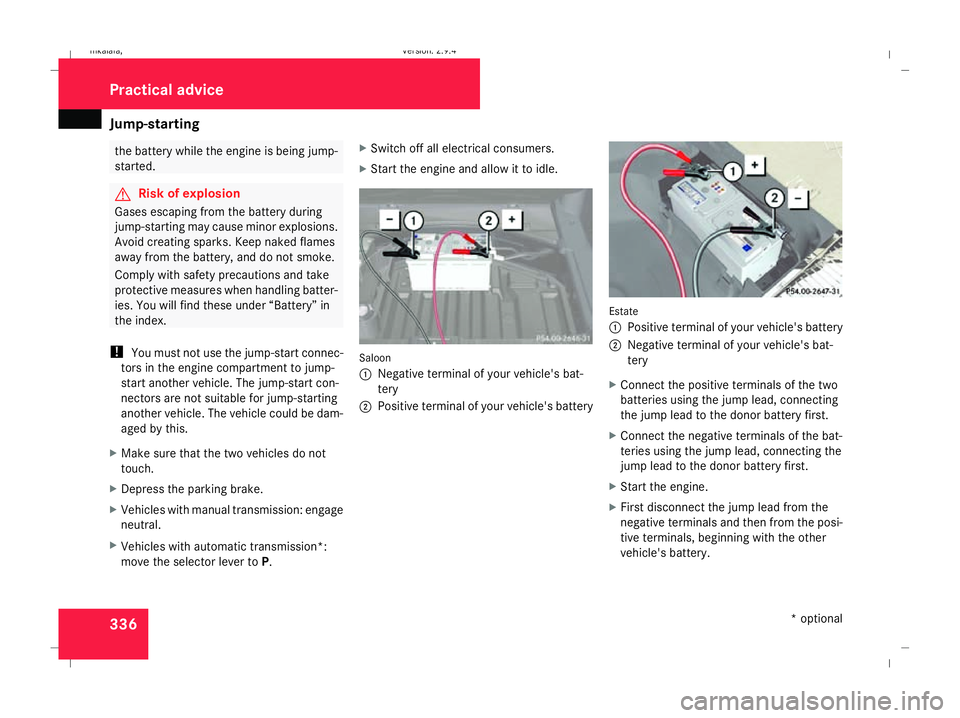
1
Negative terminal of your vehicle's bat-
tery
2 Positive terminal of your vehicle's battery Estate
1
Positive terminal of your vehicle's battery
2 Negative terminal of your vehicle's bat-
tery
X Connect the positive terminals of the two
batteries using the jump lead, connecting
the jump lead to the donor battery first.
X Connect the negative terminals of the bat-
teries using the jump lead, connecting the
jump lead to the donor battery first.
X Start the engine.
X First disconnect the jump lead from the
negative terminals and then from the posi-
tive terminals, beginning with the other
vehicle's battery. Practical advice
* optional
211_AKB; 2; 5, en-GB
mkalafa,
Version: 2.9.4 2008-02-29T16:57:07+01:00 - Seite 336Dateiname: 6515_3416_02_buchblock.pdf; preflight
Page 340 of 401
Towing and tow-starting
337Towing and tow-starting
Points to remember
G
Risk of accident
If you tow the vehicle, you must use a rigid
towing bar if:
R the engine is not running
R there is a brake system malfunction
R the voltage supply or the vehicle's elec-
trical system is damaged
The electric power steering and the brake
force boosting effect do not work when the
engine is not running. Greater braking force
will then be required and the brake pedal
travel will be longer. If necessary, depress
the brake pedal with maximum force.
Do not tow the vehicle if the key cannot be
turned in the ignition lock. If this is the case,
the steering is locked and the vehicle can-
not be steered.
If you tow or tow-start another vehicle, its
weight must not exceed the maximum per-
missible gross vehicle weight of your vehi-
cle. G
Risk of accident
The vehicle is braked when HOLD is activa-
ted. Therefore, deactivate HOLD if the vehi-
cle is to be towed.
If you tow or tow-start another vehicle, its
weight must not exceed the maximum per-
missible gross vehicle weight of your vehi-
cle.
It is better to have the vehicle transported
than to have it towed.
When towing, observe the legal requirements
in all countries concerned.
! When towing, pull away slowly and with-
out jerking. If the tractive power is too high,
the vehicles could be damaged. Do not use
the towing eye for recovery.
! You may tow the vehicle for a maximum
of 50 km. A towing speed of 50 km/h must
not be exceeded.
With towing distances over 50 km, the
entire vehicle needs to be lifted up and
transported.
! Only secure the tow cable or towing bar
to the towing eyes. You may otherwise
damage the vehicle. R
Vehicles with an automatic transmission*
must not be tow-started.
R If the engine does not start, try jump start-
ing (Y page 333).
R If it is not possible to jump-start the vehicle,
have it towed to the nearest qualified spe-
cialist workshop, e.g. a Mercedes-Benz
Service Centre.
R If the vehicle has suffered transmission
damage, only tow it with the propeller shaft
disconnected.
R The automatic transmission* selector lever
must be in the Nposition when towing the
vehicle away.
R If you are towing the vehicle over a consid-
erable distance, this must only be done
with the rear axle raised.
R The ignition must be switched off if you are
towing the vehicle with the front/rear axle
raised. Intervention by ESP ®
could other-
wise damage the brake system.
R Vehicles with 4MATIC* may not be towed
with the front or rear axle raised.
R Before towing the vehicle, make sure that
the battery is connected and charged. Oth-
erwise: Practical advice
* optional
211_AKB; 2; 5, en-GB
mkalafa
,V ersion: 2.9.4
2008-02-29T16:57:07+01:00 - Seite 337 ZDateiname: 6515_3416_02_buchblock.pdf; preflight
Page 342 of 401
Towing and tow-starting
339Towing the vehicle
! You may tow the vehicle for a maximum
of 50 km. A towing speed of 50 km/h must
not be exceeded.
With towing distances over 50 km, the
entire vehicle needs to be lifted up and
transported.
! Vehicles with 4MATIC* may not be towed
with the front or rear axle raised.
! The engine must be switched off (key in
ignition lock in position 0or position 1) if
the vehicle is being towed with the rear axle
raised or if the parking brake is being tested
on a dynamometer. Intervention by ESP ®
could otherwise damage the brake system.
Vehicles with manual transmission X
Turn the key to position 2in the ignition
lock.
X Shift to neutral. Vehicles with automatic transmission* X
Turn the key to position 2in the ignition
lock.
X Move the selector lever to N. Tow-starting (emergency engine
starting)
Please note:
R Vehicles with an automatic transmission*
must not be tow-started.
R The battery must be connected.
R The engine and catalytic converter must be
cold.
R Avoid repeated and lengthy starting
attempts.
Vehicles with manual transmission X
Turn the key to position 2in the ignition
lock.
X Fully depress the clutch pedal.
X Shift to neutral. X
Tow the vehicle or let it roll.
X Shift to a suitable gear and bring the clutch
pedal up slowly. Do not depress the accel-
erator pedal.
The engine is started. Removing the towing eye
X Take the wheel wrench from the vehicle
tool kit ( Ypage 254).
X Insert the wheel wrench handle into the
towing eye and turn it anti-clockwise.
X Unscrew the towing eye.
X Replace the cover and press it until it
engages.
X Return the towing eye and the wheel
wrench to the vehicle tool kit. Practical advice
* optional
211_AKB; 2; 5, en-GB
mkalafa
,V ersion: 2.9.4
2008-02-29T16:57:07+01:00 - Seite 339 ZDateiname: 6515_3416_02_buchblock.pdf; preflight
Page 379 of 401

Trailer coupling*
376 Trailer loads
All models except
E 200/E 230 62 E 200
E 230
Permissible trailer load, braked
63 Saloon 1,900 kg
1,700 kg
64 Estate
Vehicles with manual transmission
Vehicles with automatic transmission* 1,900 kg
2,100 kg
1,700 kg
64
2,100 kg Permissible trailer load, unbraked Saloon 750 kg 750 kg
Estate 750 kg 750 kg
Maximum drawbar noseweight
65 Saloon 76 kg 76 kg
Estate 84 kg 84 kg
62
The E 63 AMG model cannot be used to tow a trailer.
63 At a minimum gradient-climbing capability of 12% from a standstill
64 At a minimum gradient-climbing capability of 8 %: 1,900 kg
65 The drawbar noseweight is not included in the trailer load. Technical data
* optional
211_AKB; 2; 5, en-GB
mkalafa
,V ersion: 2.9.4
2008-02-29T16:57:07+01:00 - Seite 376 Dateiname: 6515_3416_02_buchblock.pdf; preflight
Page 380 of 401

Service products and capacities
377Service products and capacities
Notes on service products and capaci-
ties
Service products are:
R fuels (e.g. petrol, diesel)
R lubricants (e.g. engine oil, transmission oil)
R coolant
R brake fluid
R windscreen washer fluid
Mercedes-Benz recommends that you only
use those products which have been tested
and specially approved by Mercedes-Benz for
your vehicle and are listed in the Mercedes-
Benz Owner's Manual in the relevant chapter
since:
R parts and service products are matched
R damage caused by the use of non-approved
service products is not covered by the war-
ranty You can recognise service products approved
by Mercedes-Benz by the following inscrip-
tion on the containers:
R
MB-Freigabe (e.g. MB-Freigabe 229.51)
R MB Approval (e.g. MB Approval 229.51)
Other designations or recommendations that
relate to a level of quality or a specification in
accordance with an MB Approval have not
necessarily been approved by Mercedes-
Benz.
You can obtain further information from any
Mercedes-Benz Service Centre. G
Risk of injury
When handling, storing and disposing of
any service products, please observe the
relevant regulations, as you could other-
wise endanger yourself and others.
Keep service products away from children.
To protect your health, do not allow service
products to come into contact with your eyes or open wounds. See a doctor imme-
diately if any service product is swallowed.
H
Environmental note
Dispose of service products in an environ-
mentally-responsible manner. Fuels
G
Risk of explosion
Fuel is highly flammable. Fire, naked flames
and smoking are therefore prohibited when
handling fuels.
Switch off the engine and the auxiliary heat-
ing* before refuelling. G
Risk of injury
Do not allow fuel to come into contact with
skin or clothing.
Allowing fuels to come into direct contact
with your skin or inhaling fuel vapours is
damaging to your health.
Tank capacity Technical data
* optional
211_AKB; 2; 5, en-GB
mkalafa,
Version: 2.9.4
2008-02-29T16:57:07+01:00 - Seite 377 ZDateiname: 6515_3416_02_buchblock.pdf; preflight
Page 393 of 401

Service products and capacities
390 E 200 CDI E 220 CDI E 280 CDI
E 280 CDI
4MATIC
E 300 Bluetec E 320 CDI
E 320 CDI
4MATIC E 420 CDI
Coolant 10.2 l 10.2 l 13.0 l 13.0 l 15.3 l
Amount of antifreeze/corrosion inhibitor required for antifreeze protection
Down to –37 °C
(approx. 50%) 5.1 l 5.1 l 6.5 l 6.5 l 7.7 l
Down to –45 °C
(approx. 55%) 5.6 l 5.6 l 7.2 l 7.2 l 8.4 l
Brake fluid
Over a period of time, the brake fluid absorbs
moisture from the air; this lowers its boiling
point. G
Risk of accident
If the boiling point of the brake fluid is too
low, vapour pockets may form in the brake
system when the brakes are applied hard
(e.g. when driving downhill). This would
impair braking efficiency. Have the brake fluid renewed every two
years with a brake fluid that has been
approved by Mercedes-Benz and have this
confirmed in the Service Booklet.
i There is usually a notice in the engine
compartment to remind you when the next
brake fluid change is due. Windscreen washer system
The washer fluid reservoir holds approxi-
mately 4.5 litres; on vehicles with the head-
lamp cleaning system* it holds 7 litres.
The headlamp cleaning system* and the
windscreen washer system are both supplied
from the washer fluid reservoir.
X At temperatures above freezing point:
Top up the washer fluid reservoir with a
mixture of water and windscreen washer
concentrate (Y page 226).
X At temperatures below freezing point: Technical data
* optional
211_AKB; 2; 5, en-GB
mkalafa,
Version: 2.9.4 2008-02-29T16:57:07+01:00 - Seite 390Dateiname: 6515_3416_02_buchblock.pdf; preflight