jump start MERCEDES-BENZ E-CLASS SALOON 2008 Owners Manual
[x] Cancel search | Manufacturer: MERCEDES-BENZ, Model Year: 2008, Model line: E-CLASS SALOON, Model: MERCEDES-BENZ E-CLASS SALOON 2008Pages: 401, PDF Size: 6.89 MB
Page 11 of 401
8 G
Garage door Opening/closing (with the remote
control) . . . . . . . . . . . . . . . . . . . . .215
Garage door opener . . . . . . . . . . . . ..214
Clearing the memory . . . . . . . . . . .216
Frequencies . . . . . . . . . . . . . . . . . .391
Programming the remote control . .214
Gear indicator (on-board computer) 126
Gearshift program Manual . . . . . . . . . . . . . . . . . . . . . .118
Genuine Mercedes-Benz parts . . . ..344
Glove compartment . . . . . . . . . . . . ..205
Gross vehicle weight, maximum
permissible . . ..369, 371, 372, 373, 374 H
Headlamp Misting up . . . . . . . . . . . . . . . . . . .299
Headlamps
Cleaning . . . . . . . . . . . . . . . . . . . . .246
Cleaning system . . . . . . . . . . . . . . .103
Headlamps delayed switch-off
see Exterior lighting delayed switch-off
Head restraint
Adjusting (front) . . . . . . . . . . . . .79, 80
Adjusting (rear) . . . . . . . . . . . . . . . .81
Luxury . . . . . . . . . . . . . . . . . . . .79, 81 NECK-PR
O.. . . . . . . . . . . . . . . . . . .47
Removing (rear) . . . . . . . . . . . . . . . .83
Head restraints
Resetting triggered NECK-PRO
head restraints . . . . . . . . . . . . . . . .309
Heating
see Air conditioning
High-pressure cleaners . . . . . . . . . ..245
HOLD . . . . . . . . . . . . . . . . . . . . . . . . . .155
Display message . . . . . . . . . . . . . .264
HomeLink ®
see Garage door opener I
Immobiliser . . . . . . . . . . . . . . . . . . . . .62
Indicator and warning lamp Brakes (red ).. . . . . . . . . . . . . . . . .286
Coolant . . . . . . . . . . . . . . . . . . . . .287
Distronic (red ).. . . . . . . . . . .149, 286
Engine diagnostic . . . . . . . . . . . . . .288
ESP ®
. . . . . . . . . . . . . . . . . . . .60, 285
PASSENGER AIRBAG OFF . . . .49, 283
Reserve fuel . . . . . . . . . . . . . . . . . .291
Seat belt . . . . . . . . . . . . . . . . . . . . .290
SRS . . . . . . . . . . . . . . . . . . . . .41, 289
Tyre pressure monitor . . . . . . . . . .289
Indicator and warning lamps . . . . ..285
Indicator lamp see Indicator and warning lamp Instrument cluster
. . . . . . . . . . . . ..120
Overview . . . . . . . . . . . . . . . . . .26, 28
Selecting the language (on-board
computer) . . . . . . . . . . . . . . . . . . .133
Instrument lighting . . . . . . . . . . . . ..120
Integrated child seat . . . . . . . . . . . . ..55
Intelligent Light System . . . . . . . . ..103
Display message . . . . . . . . . . . . . .274
Menu (on-board computer) . . . . . .137
Interior lighting . . . . . . . . . . . . . . . . .104
Ambient (on-board computer) . . . .136
Automatic control . . . . . . . . . . . . .105
Delayed switch-off (on-board
computer) . . . . . . . . . . . . . . . . . . .136
Manual control . . . . . . . . . . . . . . . .105
Reading lamp . . . . . . . . . . . . . . . . .105
Interior motion sensor . . . . . . . . . . ..63
ISOFIX child seat securing system ..54 J
Jack Operation . . . . . . . . . . . . . . . . . . . .324
Storage location . . . . . . . . . . . . . . .254
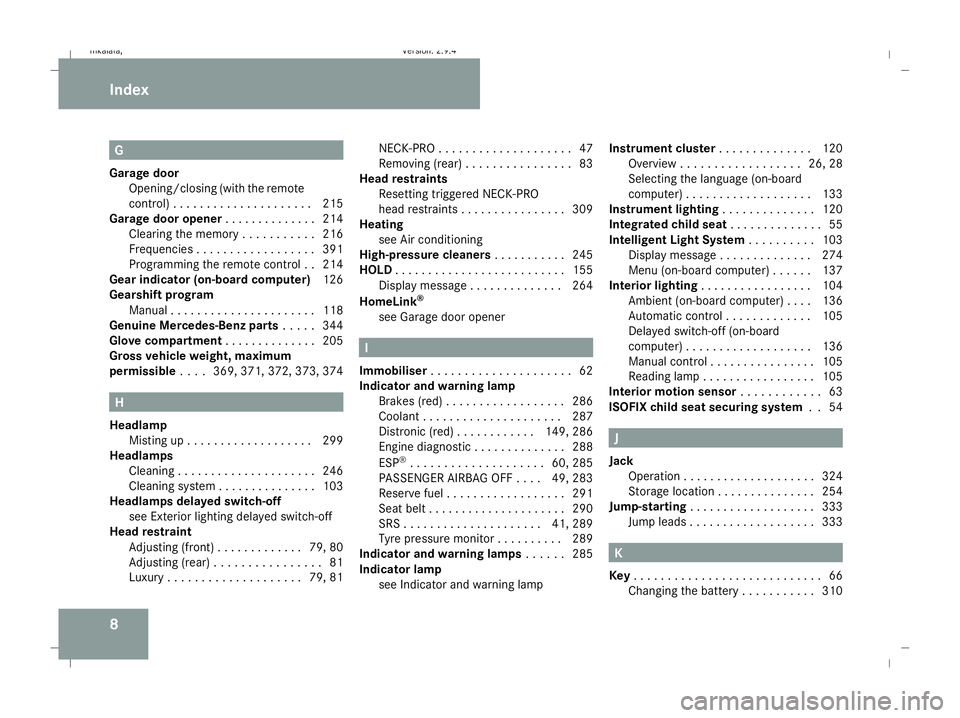
Jump-starting . . . . . . . . . . . . . . . . . . .333
Jump leads . . . . . . . . . . . . . . . . . . .333 K
Key . . . . . . . . . . . . . . . . . . . . . . . . . . . .66
Changing the battery . . . . . . . . . . .310 Index
211_AKB; 2; 5, en-GB
mkalafa,
Version: 2.9.4 2008-02-29T16:57:07+01:00 - Seite 8Dateiname: 6515_3416_02_buchblock.pdf; preflight
Page 254 of 401
251
Where will I find...?
...........................252
Display messages ............................. 257
Troubleshooting ................................ 282
Locking/unlocking in an emer-
gency ................................................. 306
Resetting triggered NECK-PRO
head restraints .................................. 309
Changing the batteries .....................310
Changing the bulbs ...........................311
Replacing the wiper blades ..............315
Flat tyre ............................................. 317
Battery ............................................... 329
Jump-starting .................................... 333
Towing and tow-starting ..................337
Fuses .................................................. 340 Practical advice
211_AKB; 2; 5, en-GB
mkalafa,
Version: 2.9.4 2008-02-29T16:57:07+01:00 - Seite 251Dateiname: 6515_3416_02_buchblock.pdf; preflight
Page 298 of 401
Troubleshooting
295Engine
Problem Possible cause/consequence Suggested solutions
The engine will not start. HOLD is activated. X
Deactivating HOLD (Y page 155).
X Start the engine again. The engine will not start. You can
hear the starter motor operating. R
There is a malfunction in the
engine electronics.
R There is a malfunction in the
fuel supply. X
Turn the key back to position 0in the ignition lock before the next
starting attempt.
X Try to start the engine again (Y page 110). Avoid excessively long
and frequent attempts to start the engine, as this will drain the
battery.
If the engine does not start after several attempts:
X Consult a qualified specialist workshop. Vehicles with a diesel engine:
The engine will not start. You can
hear the starter motor operating.
The reserve fuel warning lamp is
on and the fuel gauge shows
0. The fuel tank has been run dry. X
Refuel the vehicle.
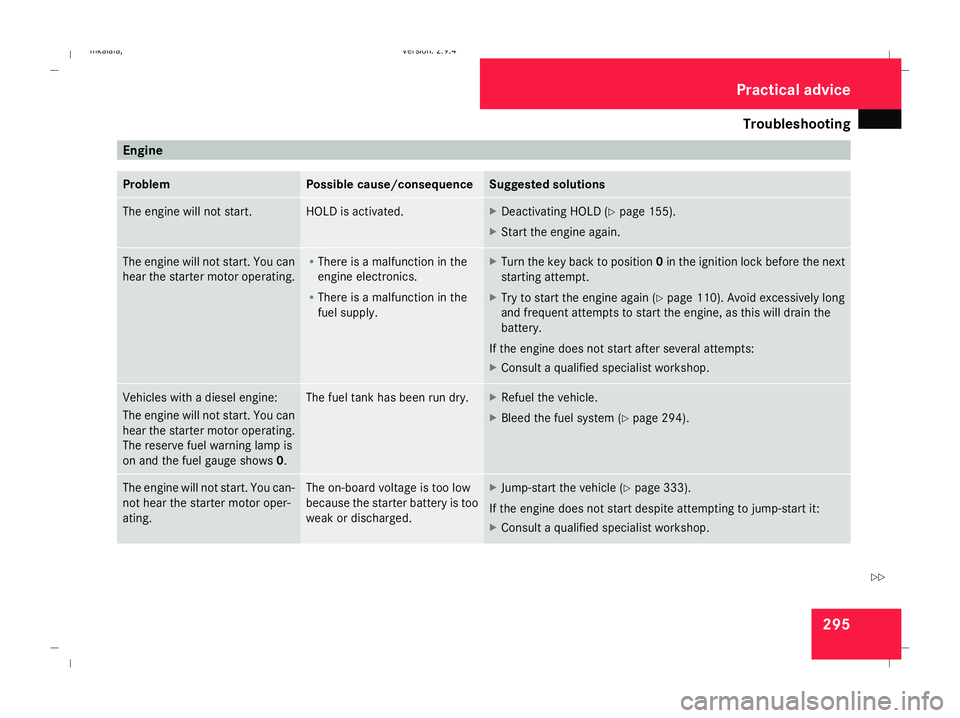
X Bleed the fuel system (Y page 294).The engine will not start. You can-
not hear the starter motor oper-
ating. The on-board voltage is too low
because the starter battery is too
weak or discharged. X
Jump-start the vehicle (Y page 333).
If the engine does not start despite attempting to jump-start it:
X Consult a qualified specialist workshop. Practical advice
211_AKB; 2; 5, en-GB
mkalafa
,V ersion: 2.9.4
2008-02-29T16:57:07+01:00 - Seite 295 ZDateiname: 6515_3416_02_buchblock.pdf; preflight
Page 305 of 401
Troubleshooting
302 Problem Possible cause/consequence Suggested solutions
The key cannot be turned in the
ignition lock. The key has been in position
0for
a considerable time. X
Remove the key and reinsert it into the ignition lock.
X Check the starter battery and recharge it if necessary
(Y page 329).
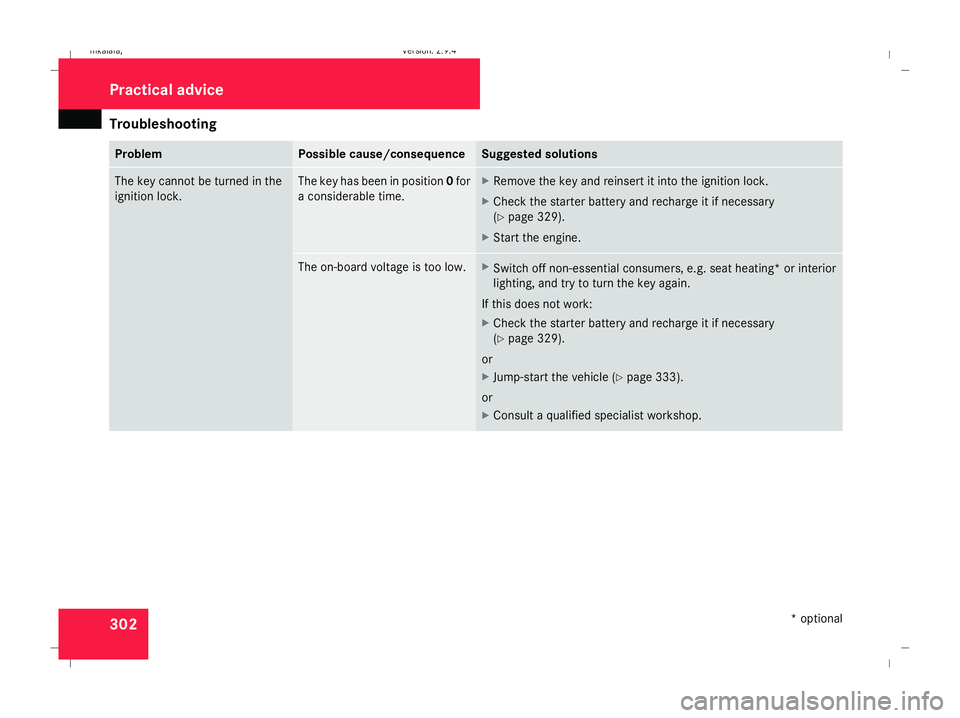
X Start the engine. The on-board voltage is too low. X
Switch off non-essential consumers, e.g. seat heating* or interior
lighting, and try to turn the key again.
If this does not work:
X Check the starter battery and recharge it if necessary
(Y page 329).
or
X Jump-start the vehicle (Y page 333).
or
X Consult a qualified specialist workshop. Practical advice
* optional
211_AKB; 2; 5, en-GB
mkalafa
,V ersion: 2.9.4
2008-02-29T16:57:07+01:00 - Seite 302 Dateiname: 6515_3416_02_buchblock.pdf; preflight
Page 336 of 401
Jump-starting
333
X
Charge the battery. Observe the notes in
the operating instructions for your battery
charger.
X Refit the charged battery.
To do this, follow the steps described in
"Removing the battery" (Y page 332) in
reverse order.
! Do not fit refillable batteries without elec-
trostatic protection. The electrostatic dis-
charge could otherwise cause the battery
to explode. The battery acid released could
cause damage to your vehicle.
Further information on electrostatic protec-
tion (Y page 331). G
Risk of injury
Battery acid is caustic. Avoid contact with
the skin, eyes or clothing. Reconnecting the battery
! Always reconnect the battery in the
sequence described below. Never swap the
terminal clamps. You may otherwise dam-
age the vehicle electronics.
X Switch off all electrical consumers.
X Connect the positive terminal clamp and
secure the cover.
X Connect the negative terminal clamp.
X Connect the breather hose. Make sure that
a cell cap is fitted between the battery and
the breather hose.
X Refit the electrostatic protection if neces-
sary (Y page 331).
i If the battery power supply has been inter-
rupted (e.g. if it has been reconnected), you
must carry out the following tasks:
R Set the time (Y page 135).
R Reset the sliding/tilting sunroof*
(Y page 182).
R Reset the function for folding the exterior
mirrors in/out automatically* by folding
the mirrors out once (Y page 91). Jump-starting
Jump-starting your vehicle
If your vehicle's battery is discharged, the
engine can be jump-started from another
vehicle or from an external battery using jump
leads.
Observe the following points:
R Jump-starting may only be performed when
the engine and catalytic converter are cold.
R Do not start the engine if the battery is fro-
zen. Let the battery thaw first.
R Jump-starting may only be performed from
batteries with a nominal voltage of 12 V.
R Only use jump leads which are protected
against polarity reversal and which have a
sufficient cross-section and insulated ter-
minal clamps.
i Jump leads which are protected against
polarity reversal and further information
about jump-starting can be obtained from
any Mercedes-Benz Service Centre.
! Avoid repeated and lengthy starting
attempts.
Never start the vehicle using a rapid battery
charger. Practical advice
* optional
211_AKB; 2; 5, en-GB
mkalafa,
Version: 2.9.4
2008-02-29T16:57:07+01:00 - Seite 333 ZDateiname: 6515_3416_02_buchblock.pdf; preflight
Page 337 of 401
Jump-starting
334 G
Risk of injury
There is a risk of acid burns when jump-
starting a vehicle due to the gases which
escape from the battery. Do not lean over
the battery while the engine is being jump-
started. G
Risk of explosion
Gases escaping from the battery during
jump-starting may cause minor explosions.
Avoid creating sparks. Keep naked flames
away from the battery, and do not smoke.
Comply with safety precautions and take
protective measures when handling batter-
ies. You will find these under “Battery” in
the index.
X Make sure that the two vehicles do not
touch.
X Depress the parking brake.
X Manual transmission: engage neutral.
X Automatic transmission*: move the
selector lever to P.
X All vehicles: switch off all electrical con-
sumers. Saloon
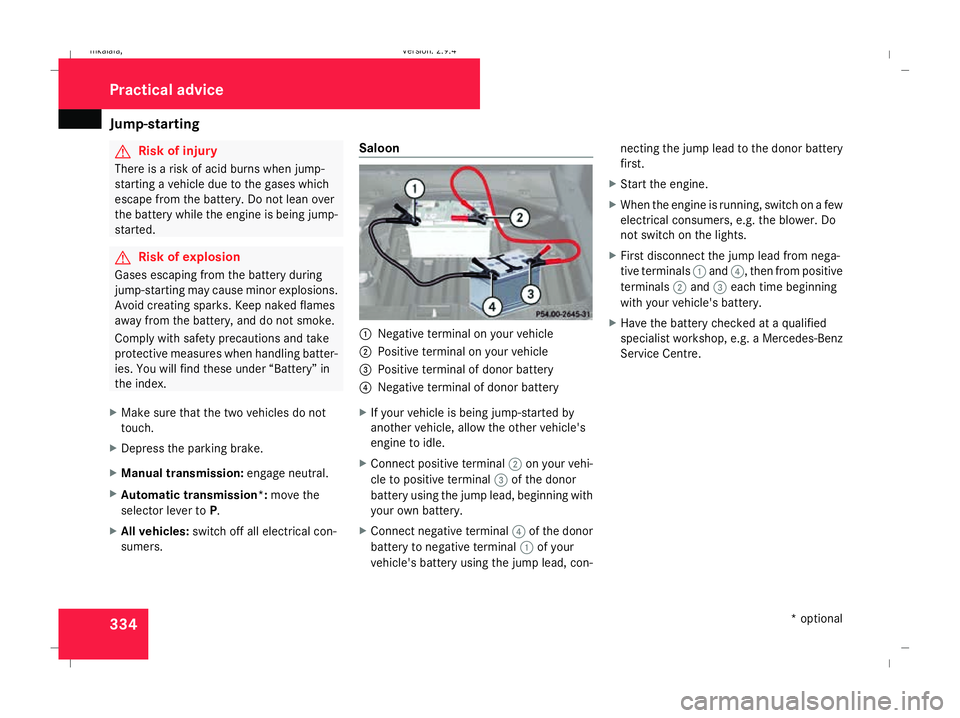
1
Negative terminal on your vehicle
2 Positive terminal on your vehicle
3 Positive terminal of donor battery
4 Negative terminal of donor battery
X If your vehicle is being jump-started by
another vehicle, allow the other vehicle's
engine to idle.
X Connect positive terminal 2on your vehi-
cle to positive terminal 3of the donor
battery using the jump lead, beginning with
your own battery.
X Connect negative terminal 4of the donor
battery to negative terminal 1of your
vehicle's battery using the jump lead, con- necting the jump lead to the donor battery
first.
X Start the engine.
X When the engine is running, switch on a few
electrical consumers, e.g. the blower. Do
not switch on the lights.
X First disconnect the jump lead from nega-
tive terminals 1and 4, then from positive
terminals 2and 3each time beginning
with your vehicle's battery.
X Have the battery checked at a qualified
specialist workshop, e.g. a Mercedes-Benz
Service Centre. Practical advice
* optional
211_AKB; 2; 5, en-GB
mkalafa,
Version: 2.9.4
2008-02-29T16:57:07+01:00 - Seite 334 Dateiname: 6515_3416_02_buchblock.pdf; preflight
Page 338 of 401
Jump-starting
335
Estate
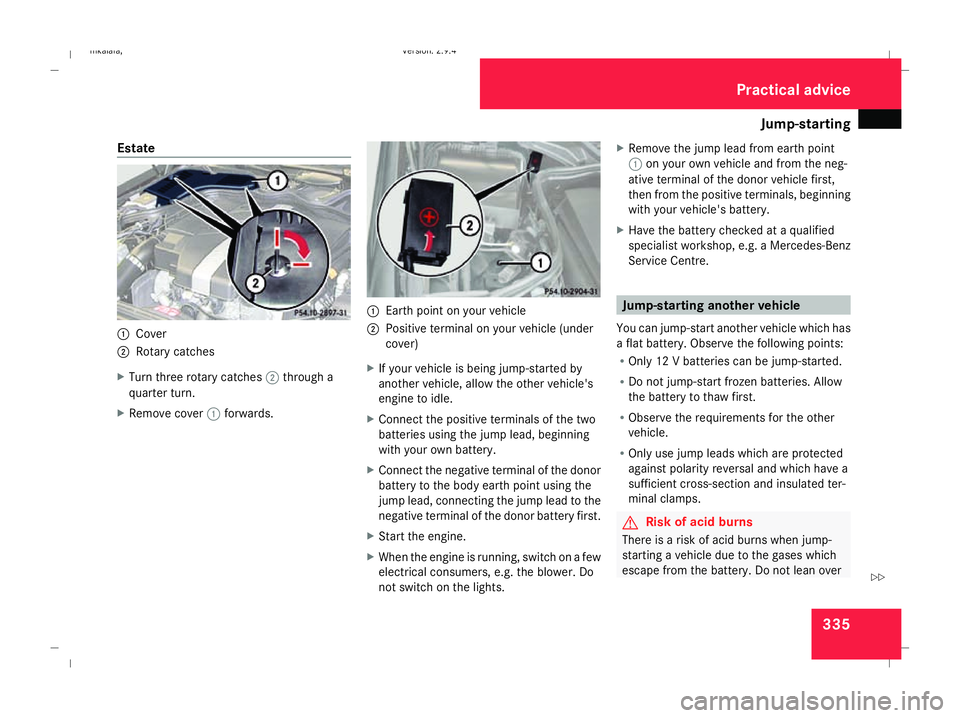
1
Cover
2 Rotary catches
X Turn three rotary catches 2through a
quarter turn.
X Remove cover 1forwards. 1
Earth point on your vehicle
2 Positive terminal on your vehicle (under
cover)
X If your vehicle is being jump-started by
another vehicle, allow the other vehicle's
engine to idle.
X Connect the positive terminals of the two
batteries using the jump lead, beginning
with your own battery.
X Connect the negative terminal of the donor
battery to the body earth point using the
jump lead, connecting the jump lead to the
negative terminal of the donor battery first.
X Start the engine.
X When the engine is running, switch on a few
electrical consumers, e.g. the blower. Do
not switch on the lights. X
Remove the jump lead from earth point
1 on your own vehicle and from the neg-
ative terminal of the donor vehicle first,
then from the positive terminals, beginning
with your vehicle's battery.
X Have the battery checked at a qualified
specialist workshop, e.g. a Mercedes-Benz
Service Centre. Jump-starting another vehicle
You can jump-start another vehicle which has
a flat battery. Observe the following points:
R Only 12 V batteries can be jump-started.
R Do not jump-start frozen batteries. Allow
the battery to thaw first.
R Observe the requirements for the other
vehicle.
R Only use jump leads which are protected
against polarity reversal and which have a
sufficient cross-section and insulated ter-
minal clamps. G
Risk of acid burns
There is a risk of acid burns when jump-
starting a vehicle due to the gases which
escape from the battery. Do not lean over Practical advice
211_AKB; 2; 5, en-GB
mkalafa,
Version: 2.9.4
2008-02-29T16:57:07+01:00 - Seite 335 ZDateiname: 6515_3416_02_buchblock.pdf; preflight
Page 339 of 401
Jump-starting
336 the battery while the engine is being jump-
started. G
Risk of explosion
Gases escaping from the battery during
jump-starting may cause minor explosions.
Avoid creating sparks. Keep naked flames
away from the battery, and do not smoke.
Comply with safety precautions and take
protective measures when handling batter-
ies. You will find these under “Battery” in
the index.
! You must not use the jump-start connec-
tors in the engine compartment to jump-
start another vehicle. The jump-start con-
nectors are not suitable for jump-starting
another vehicle. The vehicle could be dam-
aged by this.
X Make sure that the two vehicles do not
touch.
X Depress the parking brake.
X Vehicles with manual transmission: engage
neutral.
X Vehicles with automatic transmission*:
move the selector lever to P.X
Switch off all electrical consumers.
X Start the engine and allow it to idle. Saloon
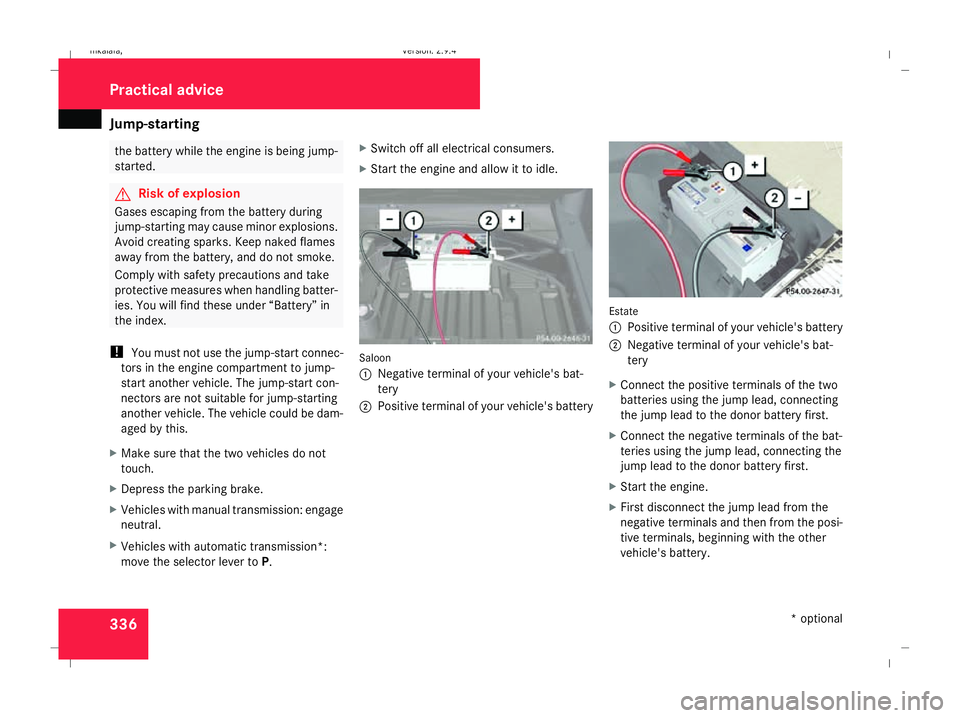
1
Negative terminal of your vehicle's bat-
tery
2 Positive terminal of your vehicle's battery Estate
1
Positive terminal of your vehicle's battery
2 Negative terminal of your vehicle's bat-
tery
X Connect the positive terminals of the two
batteries using the jump lead, connecting
the jump lead to the donor battery first.
X Connect the negative terminals of the bat-
teries using the jump lead, connecting the
jump lead to the donor battery first.
X Start the engine.
X First disconnect the jump lead from the
negative terminals and then from the posi-
tive terminals, beginning with the other
vehicle's battery. Practical advice
* optional
211_AKB; 2; 5, en-GB
mkalafa,
Version: 2.9.4 2008-02-29T16:57:07+01:00 - Seite 336Dateiname: 6515_3416_02_buchblock.pdf; preflight
Page 340 of 401
Towing and tow-starting
337Towing and tow-starting
Points to remember
G
Risk of accident
If you tow the vehicle, you must use a rigid
towing bar if:
R the engine is not running
R there is a brake system malfunction
R the voltage supply or the vehicle's elec-
trical system is damaged
The electric power steering and the brake
force boosting effect do not work when the
engine is not running. Greater braking force
will then be required and the brake pedal
travel will be longer. If necessary, depress
the brake pedal with maximum force.
Do not tow the vehicle if the key cannot be
turned in the ignition lock. If this is the case,
the steering is locked and the vehicle can-
not be steered.
If you tow or tow-start another vehicle, its
weight must not exceed the maximum per-
missible gross vehicle weight of your vehi-
cle. G
Risk of accident
The vehicle is braked when HOLD is activa-
ted. Therefore, deactivate HOLD if the vehi-
cle is to be towed.
If you tow or tow-start another vehicle, its
weight must not exceed the maximum per-
missible gross vehicle weight of your vehi-
cle.
It is better to have the vehicle transported
than to have it towed.
When towing, observe the legal requirements
in all countries concerned.
! When towing, pull away slowly and with-
out jerking. If the tractive power is too high,
the vehicles could be damaged. Do not use
the towing eye for recovery.
! You may tow the vehicle for a maximum
of 50 km. A towing speed of 50 km/h must
not be exceeded.
With towing distances over 50 km, the
entire vehicle needs to be lifted up and
transported.
! Only secure the tow cable or towing bar
to the towing eyes. You may otherwise
damage the vehicle. R
Vehicles with an automatic transmission*
must not be tow-started.
R If the engine does not start, try jump start-
ing (Y page 333).
R If it is not possible to jump-start the vehicle,
have it towed to the nearest qualified spe-
cialist workshop, e.g. a Mercedes-Benz
Service Centre.
R If the vehicle has suffered transmission
damage, only tow it with the propeller shaft
disconnected.
R The automatic transmission* selector lever
must be in the Nposition when towing the
vehicle away.
R If you are towing the vehicle over a consid-
erable distance, this must only be done
with the rear axle raised.
R The ignition must be switched off if you are
towing the vehicle with the front/rear axle
raised. Intervention by ESP ®
could other-
wise damage the brake system.
R Vehicles with 4MATIC* may not be towed
with the front or rear axle raised.
R Before towing the vehicle, make sure that
the battery is connected and charged. Oth-
erwise: Practical advice
* optional
211_AKB; 2; 5, en-GB
mkalafa
,V ersion: 2.9.4
2008-02-29T16:57:07+01:00 - Seite 337 ZDateiname: 6515_3416_02_buchblock.pdf; preflight