towing MERCEDES-BENZ E-CLASS SALOON 2015 Manual PDF
[x] Cancel search | Manufacturer: MERCEDES-BENZ, Model Year: 2015, Model line: E-CLASS SALOON, Model: MERCEDES-BENZ E-CLASS SALOON 2015Pages: 497, PDF Size: 16.23 MB
Page 411 of 497
!
Only secure the tow cable or tow bar to
the towing eyes or, if available,tot he trailer
tow hitch. You could otherwise damage the
vehicle.
! Observe the following points when towing
with atow rope:
R Secure the tow rope on the same side on
both vehicles.
R Make sure that the tow rope is not longer
than legally permitted. Mark the tow rope
in the middle, e.g. with awhite cloth
(30 x30c m).This will make other road
users aware that avehicle is being
towed.
R Only secure the tow cable to the towing
eyes or, if available,tot he trailer tow
hitch.
R Observe the brake lamps of the towing
vehicle while driving. Alwaysm aintain a
distance adistance so that the tow rope
does not sag.
R Do not use steel cables or chains to tow
your vehicle. You could otherwise dam-
age the vehicle.
! Do not use the towing eye for recovery,
this could damage the vehicle. If in doubt,
recover the vehicle with acrane.
! Pull aways
moothly when towing awayor
tow-starting avehicle. If the tractive power
is too high, the vehicles could be damaged.
! To tow vehicles with KEYLESS-GO, use
the key instead of the Start/Stop button.
The automatic transmission may otherwise switch to position Pwhen you open the
driver's or front-passenger door which
could damage the transmission.
! You may tow the vehicle for
amaximum of
50km. Atowing speed of 50 km/h must not
be exceeded.
For towing distances over 50 km, the entire
vehicle must be lifted up and transported.
! If you tow or tow-start another vehicle, its
weight must not exceed the maximum per- missible gross vehicle weight of your vehi-
cle.
HYBRID vehicles :make sure that you read
the "HYBRID" Supplement included in the
vehicle literature. You could otherwise fail to
recognise dangers, e.g. due to high voltage.
Observe the legal requirements for the rele-
vant countries when towing and tow-starting.
It is better to have the vehicle transported
than to have it towed.
If the vehicle has suffered transmission dam- age, have it transported on atransporter or
trailer.
When towing awayav ehicle with an auto-
matic transmission, the transmission must be
in position N.
The battery must be connected and charged.
Otherwise, you:
R cannot turn the key to position 2in the
ignition lock
R cannot shift the transmission to position N
on vehicles with automatic transmission
In the event of damage to the electrical
system
If the battery is defective, the automatic
transmission will be locked in position P.To
shift the automatic transmission to position
N,y ou must provide power to the vehicle's
electrical system in the same way as when
jump-starting (Y page 405).
Have the vehicle transported on atransporter
or trailer.
i Deactivate the automatic locking feature
before the vehicle is towed away
(Y page 102). You could otherwise be
locked out when pushing or towing the
vehicle.
i Deactivate tow-away protection before
the vehicle is towed away( Ypage 90).408
Towing away and tow-startingBreakdown assistance
Page 412 of 497
Fitting/removing th
etowing eye
Fitting th etowing eye G
WARNING
The exhaust tai lpipe may be extremely hot.
Ther eisar iskofb urning when removing the
rear cover.
Do no ttou ch th eexhaust tai lpipe. Use
extreme caution when removing th erear
cover. Towin
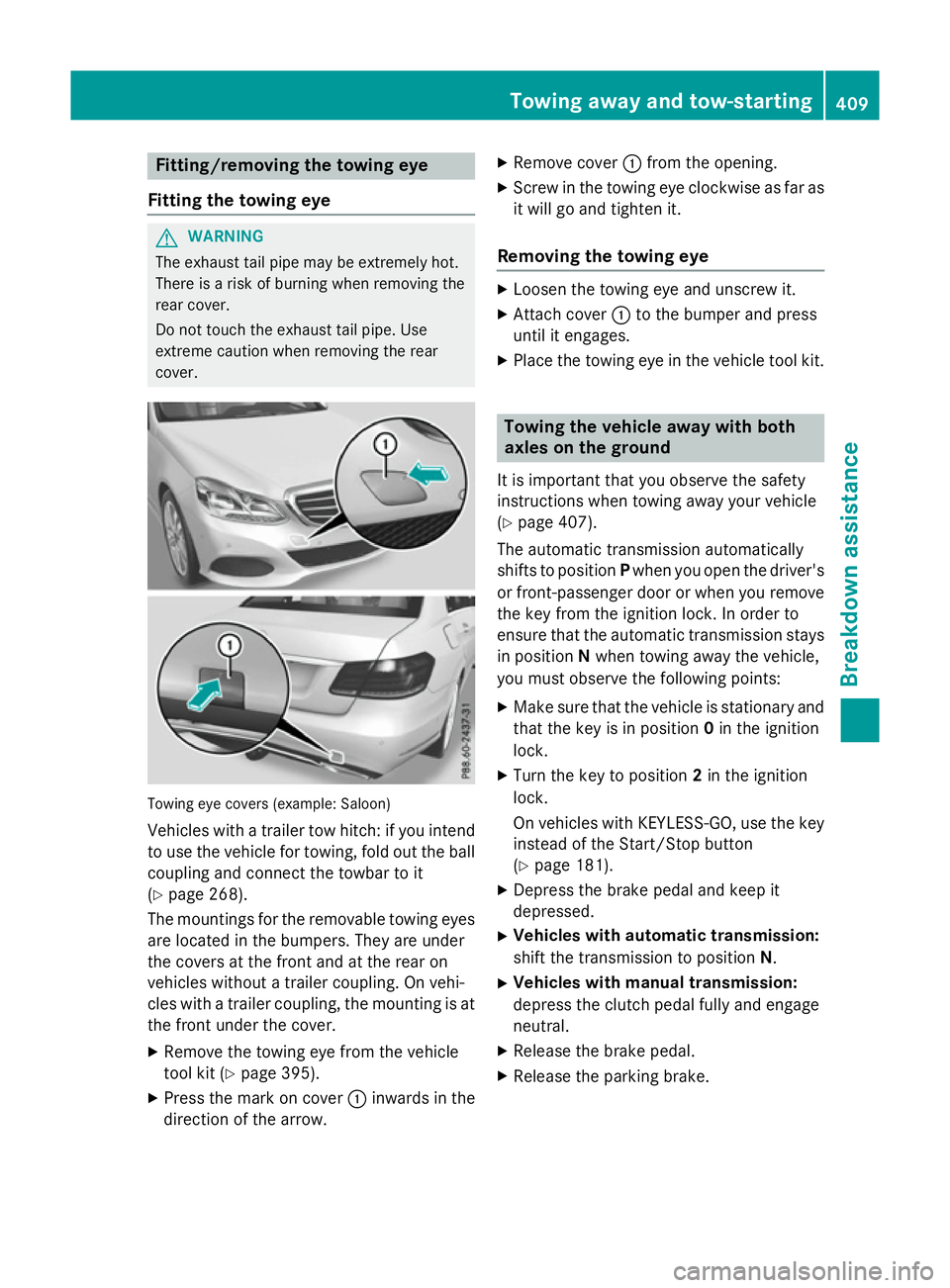
geye cover s(example: Saloon)
Vehicles wit hatrailer to whitch :ify ou intend
to use th evehicl efor towing, fol dout th eball
couplin gand connec tthe towbar to it
(Y page 268).
The mounting sfor th eremovable towin geyes
are locate dinthebumpers .They are under
th ec oversatt hefron tand at th erear on
vehicles without atrailer coupling. On vehi-
cle sw ithat railer coupling, th emounting is at
th ef ront under th ecover.
X Remove th etow inge ye from th evehicle
tool kit (Y page 395).
X Press th emarkonc over : inwards in the
direction of th earrow. X
Remove cover :from th eopening.
X Screw in th etow inge ye clockwise as far as
it will go and tighten it.
Removing th etowing eye X
Loosen th etow inge ye and unscrew it.
X Attac hcover : to th ebumper and press
until it engages.
X Plac ethe towin geye in th evehicl etoolkit. Towing th
evehicle awa ywith both
axles on th eground
It is important that you observ ethe safety
instruction swhen towin gaway your vehicle
(Y page 407).
The automatic transmission automatically
shifts to position Pwhen you open th edriver's
or front-passenger door or when you remove th ek eyfrom th eignition lock. In order to
ensure that th eautomatic transmission stays
in position Nwhen towin gaway th evehicle,
you must observ ethe followin gpoints:
X Mak esure that th evehicl eiss tationary and
that th ekeyis in position 0in th eignition
lock.
X Turn th ekeyto position 2in th eignition
lock.
On vehicles wit hKEYLESS-GO ,use th ekey
instead of th eStart/Sto pbutton
(Y page 181).
X Depress th ebrak epedal and keep it
depressed.
X Vehicles with automatic transmission:
shif tthe transmission to position N.
X Vehicles with manua ltra nsmission:
depress th eclutch pedal fully and engage
neutral.
X Releas ethe brak epedal.
X Releas ethe parking brake. Towin
gawaya nd tow-starting
409Breakdown assistance Z
Page 413 of 497
X
Switch on the hazard warning lamps
(Y page 145).
X Leave the key in position 2in the ignition
lock.
i Whe
ntowing with the hazard warning
lamps switche don, us ethe combination
switch as usua ltosignal achange of direc-
tion. In this case, onl ythe turn signal sfor
the desired direction flash. Whe nyou reset
the combination switch, the hazard warn-
ing lamps star tflashing again. Towin
gthe vehicle awa ywitht he rear
axl eraised
! Vehicles with 4MATI
Cmustn ot be towed
with the front or rea raxler aised ;otherwise,
the transmissio nmay be damaged.
! Vehicles with automatic transmission
mus tnot be towed with the rea raxler aised.
The car/traile rcombination may otherwise
swerve or eve noverturn.
! The ignition mus
tbes witche doff if you
are towing the vehicl ewitht he rea raxle
raised .Intervention by ESP ®
could other-
wise damag ethe brake system.
Onl yvehicle swithout 4MATIC can be
towed awa ywitht he rear axl eraised.
X Switch on the hazard warning lamps
(Y page 145).
X Mov ethe front wheel stothe straight-
ahea dposition.
X Turn the key in the ignition lock to position
0 and remove the key from the ignition
lock.
X Whe nleaving the vehicle, take the key or
the KEYLESS-GO key with you.
Whe ntowing your vehicl eawayw itht he rear
axl eraised ,itisi mportant tha tyou observe
the safety instructions (Y page 407). Transporting the vehicle
! Yo
um ay onl ysecure the vehicl ebythe
wheels, not by parts of the vehicl esuchas
axl eors teering components .Otherwise,
the vehicl ecould be damaged.
The towing eyes or traile rtow hitch can be
used to pull the vehicl eonto atraile rort rans-
porter if yo uwishtot ranspor tit.
X Vehicles with manual transmission:
depress the clutch peda lfully and shift to
neutral.
X Vehicles with automatic transmission:
turn the key to position 2in the ignition
lock.
X Shift the automatic transmissio ntoposi-
tion N.
As soon as the vehicle is loaded: X Prevent the vehicl efrom rolling away by
applying the parking brake.
X Vehicles with manual transmission:
depress the clutch peda lfully and engage
first or reverse gear.
X Vehicles with automatic transmission:
shift the automatic transmissio ntoposi-
tion P.
X Turn the key in the ignition lock to position
0 and remove the key from the ignition
lock.
X Secure the vehicle. Note
sfor 4MATIC vehicles
! Vehicles with 4MATI
Cmustn ot be towed
with the front or rea raxler aised ;otherwise,
the transmissio nmay be damaged.
If the vehicl ehastransmissio ndamageor
damag etothe front or rea raxle, have it trans-
ported on atransporter or trailer.
In the even tofdamage to the electrical
system
If the battery is defective, the automatic
transmissio nwillbel ocked in position P.To
shift the automatic transmissio ntoposition 410
Towin
gawayand tow-startingBreakdown assistance
Page 414 of 497
N,y
ou must provide power to the vehicle's
electrical system in the same way as when
jump-startin g(Ypage 405).
Have the vehicle transported on atransporter
or trailer. Tow-starting (emergency engine
starting)
! Vehicles with automatic transmission
must not be tow-started. The transmission
may otherwise be damaged.
i You can find information on "Jump-start-
ing" under (Y page 405).
Before tow-starting, the following conditions
must be fulfilled:
R the battery is connected
R the engin ehas cooled down
R the exhaust system has cooled down
When tow-starting, it is important that you
observ ethe safet ynotes (Y page 407) and the
legal requirementsine ach respective coun-
try.
X Switch on the hazard warnin glamps
(Y page 145).
X Fit the towin geye (Y page 409).
X Secure the rigid towin gbar or the towing
rope.
X Depress the brake pedal and keep it
depressed.
X Turn the key to position 2in the ignition
lock.
X Depress the clutc hpedal fully, engage sec-
ond gear and continue to keep the clutch
pedal fully depressed.
X Release the brake pedal.
X Tow-start the vehicle.
X Release the clutc hpedal slowly, do not
depress the accelerator pedal while doing
so.
X When the engin ehas been started, imme-
diately depress the clutc hpedal fully and
shift to neutral. X
Pull over at asuitable place and sto pthe
vehicle safely, paying attention to road and
traffic conditions.
X Depress the parkin gbrake.
X Remove the rigid towin gbar or towin grope.
X Remove the towin geye (Y page 409).
X Switch off the hazard warnin glamps. Electrical fuses
Important safet
ynotes G
WARNING
If you manipulate, bridge or replace afaulty
fuse with afuse of ahigher amperage, the
electric cables could be overloaded. This may result in afire. There is arisk of an accident
and injury.
Always replace faulty fuses with specified new fuses of the correct amperage.
! Only use fuses that have been approved
for Mercedes-Benz vehicles and which
have the correct fuse ratin gfor the system
concerned. Otherwise, components or sys-
tem scould be damaged.
The fuses in your vehicle serv etodisconnect
faulty circuits. If afuse blows, all the compo-
nents on the circuit and their function swill
fail.
Blown fuses must be replaced with fuses of
the same rating, which you can recognise by
the colour and fuse rating. The fuse ratings
are listed in the fuse allocation chart.
If the newly inserted fuse also blows, have the
cause traced and rectified at aqualified spe-
cialist workshop, e.g. aMercedes-Benz Ser-
vice Centre. Befor
ereplacing afuse
Pay attention to the important safet ynotes
(Y page 411). Electrical fuses
411Breakdown assistance Z
Page 424 of 497
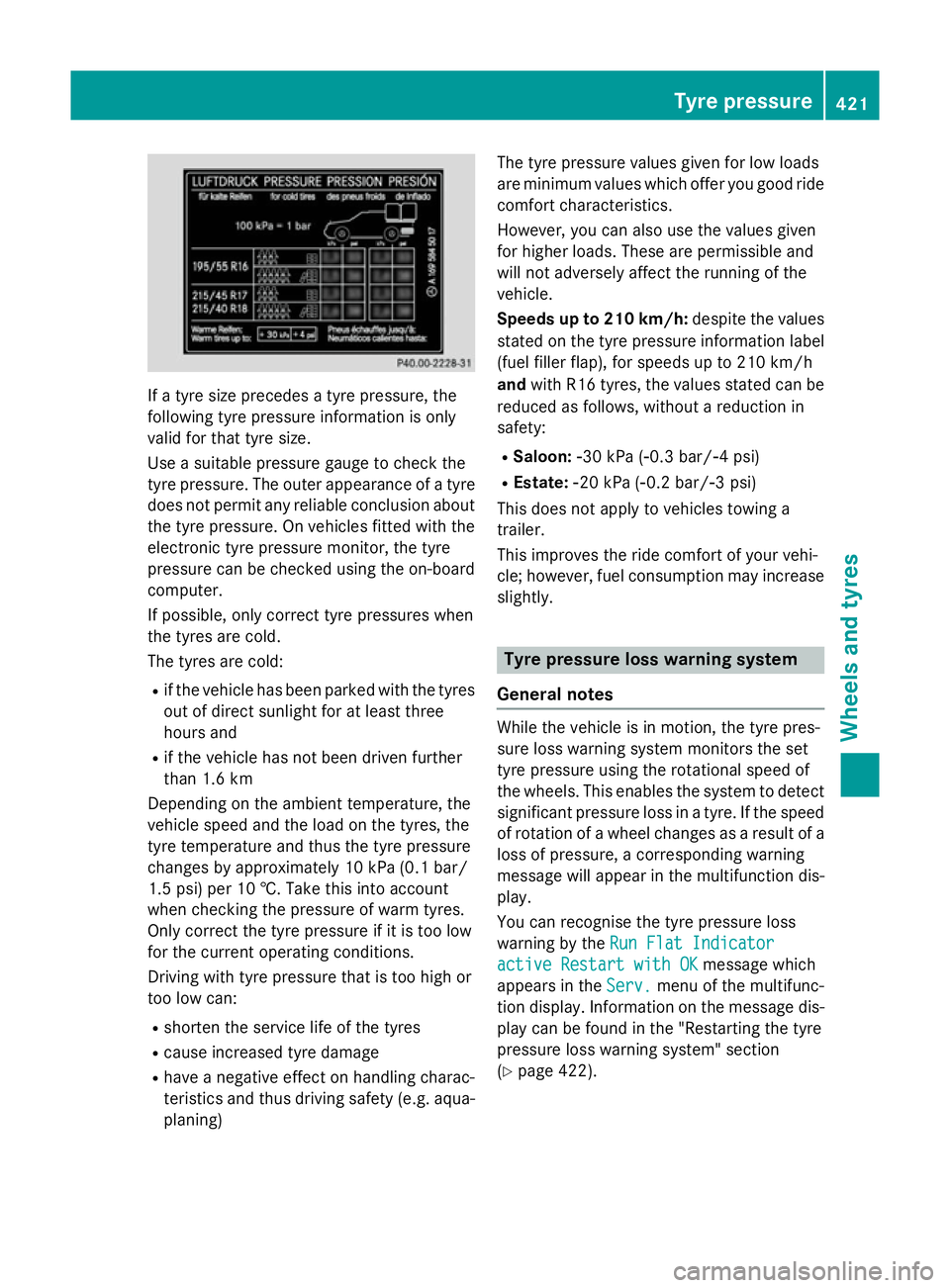
If
at yre size precedes atyre pressure, the
following tyre pressure information is only
validf or that tyre size.
Use asuitable pressure gauge to check the
tyre pressure. The outer appearance of atyre
does not permit any reliable conclusion about the tyre pressure. On vehicle sfitted with the
electronic tyre pressure monitor, the tyre
pressure can be checked using the on-board
computer.
If possible, only correct tyre pressures when
the tyres are cold.
The tyres are cold:
R if the vehicle has been parked with the tyres
out of direct sunlight for at least three
hours and
R if the vehicle has not been driven further
than 1.6 km
Depending on the ambient temperature ,the
vehicle speed and the loadont he tyres, the
tyre temperature and thus the tyre pressure
changes by approximately 10 kPa (0. 1bar/
1.5 psi )per 10 †. Take this into account
when checking the pressure of warm tyres.
Only correct the tyre pressure if it is too low
for the current operating conditions.
Driving with tyre pressure that is too high or
too low can:
R shorten the service life of the tyres
R cause increased tyre damage
R have anegative effect on handling charac-
teristics and thus driving safety (e.g. aqua-
planing) The tyre pressure values given for low loads
are minimum values which offer you good ride
comfort characteristics.
However, you can also use the values given
for higherl oads. These are permissible and
willn ot adversely affect the running of the
vehicle.
Speeds up to 210 km/h: despite the values
stated on the tyre pressure information label (fuel filler flap), for speedsupt o210 km/h
and with R16 tyres, the values stated can be
reduced as follows, withou tareduction in
safety:
R Saloon: Ò30 kPa (Ò0.3 bar/Ò4p si)
R Estate: Ò20 kPa (Ò0.2 bar/Ò3p si)
This does not apply to vehicle stowing a
trailer.
This improves the ride comfort of yourv ehi-
cle; however, fuel consumption may increase slightly. Tyre pressure lossw
arning system
General notes Whilet
he vehicle is in motion, the tyre pres-
sure loss warning system monitors the set
tyre pressure using the rotational speed of
the wheels. This enables the system to detect significant pressure loss in atyre. If the speed
of rotation of awhee lchanges as aresultofa
loss of pressure, acorresponding warning
messag ewilla ppear in the multifunction dis-
play.
You can recognise the tyre pressure loss
warning by the Run Flat Indicator Run Flat Indicator
active Restart with OK
active Restart with OK messagewhich
appears in the Serv.
Serv.menu of the multifunc-
tion display.I nformation on the messag edis-
playc an be found in the "Restarting the tyre
pressure loss warning system" section
(Y page 422). Tyre pressure
421Wheelsand tyres Z
Page 469 of 497
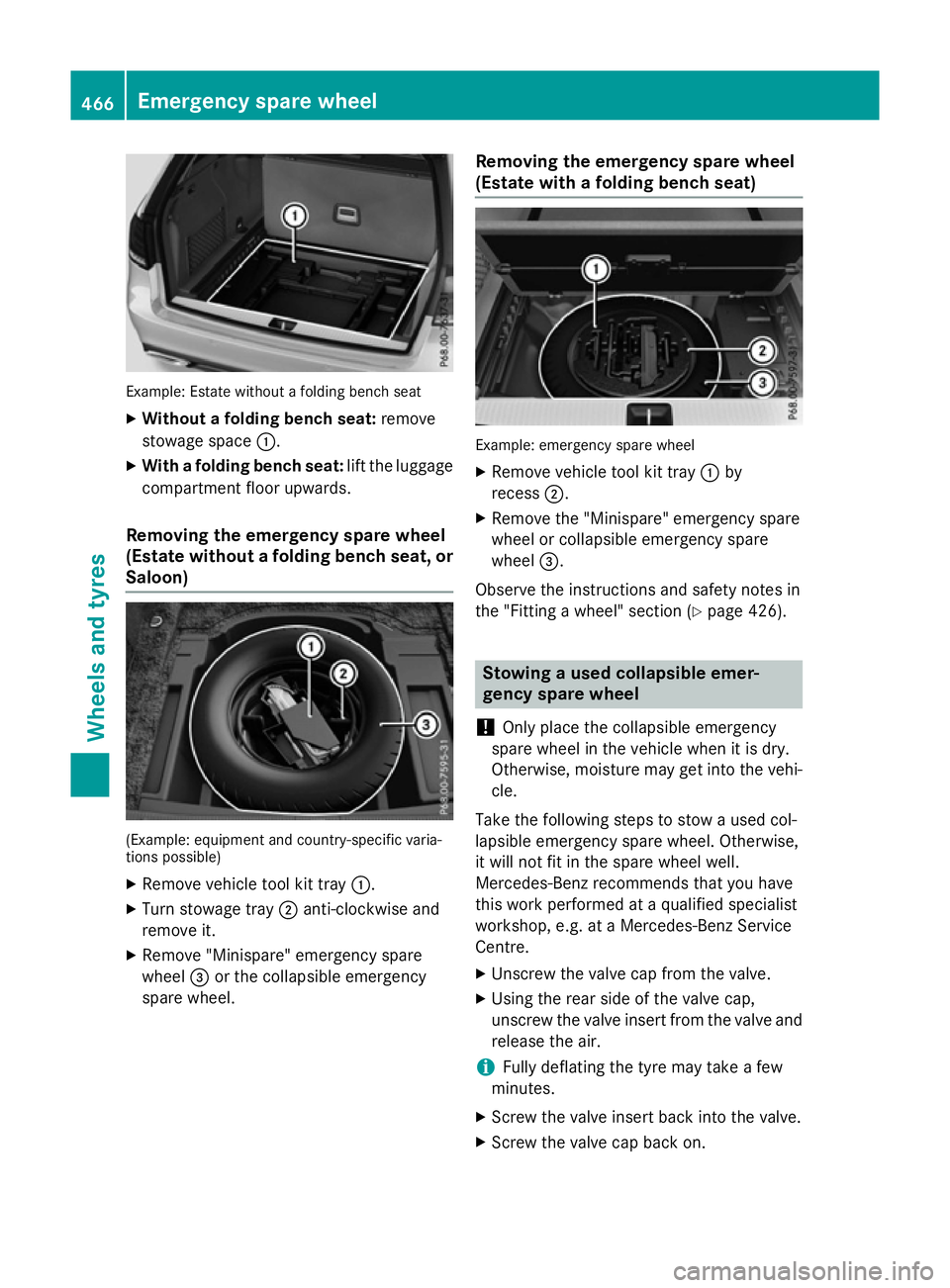
Example: Estate withou
tafolding bench seat
X Without afolding benc hseat:remove
stowag espace :.
X With afolding benc hseat:lift the luggage
compartment floor upwards.
Removing the emergenc yspare wheel
(Estate withou tafolding benc hseat, or
Saloon) (Example: equipment and country-specific varia-
tions possible)
X Remov evehicl etool kit tray :.
X Turn stowag etray ;anti-clockwise and
remove it.
X Remov e"Minispare" emergency spare
wheel =or the collapsibl eemergency
spare wheel. Removing the emergenc
yspare wheel
(Estate with afolding benc hseat) Example: emergency spare wheel
X Remove vehicl etool kit tray :by
recess ;.
X Remove the "Minispare" emergency spare
whee lorcollapsibl eemergency spare
wheel =.
Observ ethe instructions and safety notes in
the "Fitting awheel "sectio n(Ypage 426). Stowing
ausedc olla psibl eemer-
genc yspare wheel
! Onl
yplace the collapsibl eemergency
spare whee linthe vehicl ewhenitisd ry.
Otherwise, moisture ma ygetinto the vehi-
cle.
Take the following step stostowausedc ol-
lapsibl eemergency spare wheel. Otherwise,
it will not fit in the spare whee lwell.
Mercedes-Benz recommends tha tyou have
thi sw orkp erformed at aquali fied specialist
workshop ,e.g.ata Mercedes-Benz Service
Centre.
X Unscrew the valve cap from the valve.
X Using the rea rsideoft he valve cap,
unscrew the valve insert from the valve and release the air.
i Fully deflating the tyr
emaytake afew
minutes.
X Screw the valve insert back into the valve.
X Screw the valve cap back on. 466
Emergenc
yspare wheelWheel sand tyres
Page 480 of 497
R
efficien tuse of the fuel by the engine
R driving style
R other non-technical factors, such as envi-
ronmental influences, road conditions or
traffic flow
You can minimise your vehicle's CO 2emis-
sions by driving carefully and having it serv-
iced regularly.
The vehicle will use more fuel than usual in the following situations:
R at very low outside temperatures
R in urban traffic
R on short journeys
R in mountainous terrain
R when towing atrailer
i Only for certain countries: you can find
the curren tconsumption and emission val-
ues of your vehicle in the COC documents
(EU CERTIFICATE OF CONFORMITY). These documents are delivered with your vehicle.
The consumption figures were, in each
case, based on the currently applicable ver- sion:
R for vehicles that comply with standards
up to and including the EURO 4standard,
in accordance with EU Directive
80/1268/EEC
R for vehicles that comply with or exceed
the EURO 5standard, in accordance with
Regulation (EC) No. 715/2007
Deviations from these values may occur
under normal operatin gconditions. AdBlue
®
Important safety notes Comply with the important safety notes for
servic
eproduct swhen handling AdBlue ®
(Y page 473). AdBlue
®
is aw ater-soluble fluid for the
exhaust gas aftertreatmen tofdiesel engines.
It is:
R non-toxic
R colourless and odourless
R non-flammable
If you open the AdBlue ®
tank ,small amounts
of ammonia vapour may be released.
Ammonia vapours have apungent odour and
are particularly irritating to the skin ,to
mucous membranes and to the eyes. You may experience aburning sensation in your eyes,
nose and throat. You may also experience
coughing and watery eyes.
Do not inhale any ammonia vapours that may
be released. Only fill the AdBlue ®
tank in well-
ventilated areas.
Low outsid etemperatures AdBlue
®
freezes at atemperature of approx-
imately -11 †. The vehicle is delivered from
the factory equipped with an AdBlue ®
pre-
heating system. Winter operation can thus be guaranteed even at temperatures below
-11 †.
Additives !
Only use AdBlue ®
in accordance with ISO
22241. Do not use additives with AdBlue ®
and do not dilute AdBlue ®
with water. This
may destro ythe BlueTEC exhaust gas after-
treatment system.
Purity !
Impurities in AdBlue ®
(e.g. due to other
servic eproducts, cleanin gagents or dust)
lead to:
R increased emission values
R damage to the catalytic converter
R engine damage
R malfunctions in the BlueTEC ®
exhaust
gas aftertreatmen tsystem Service products and capacities
477Technical data Z
Page 486 of 497
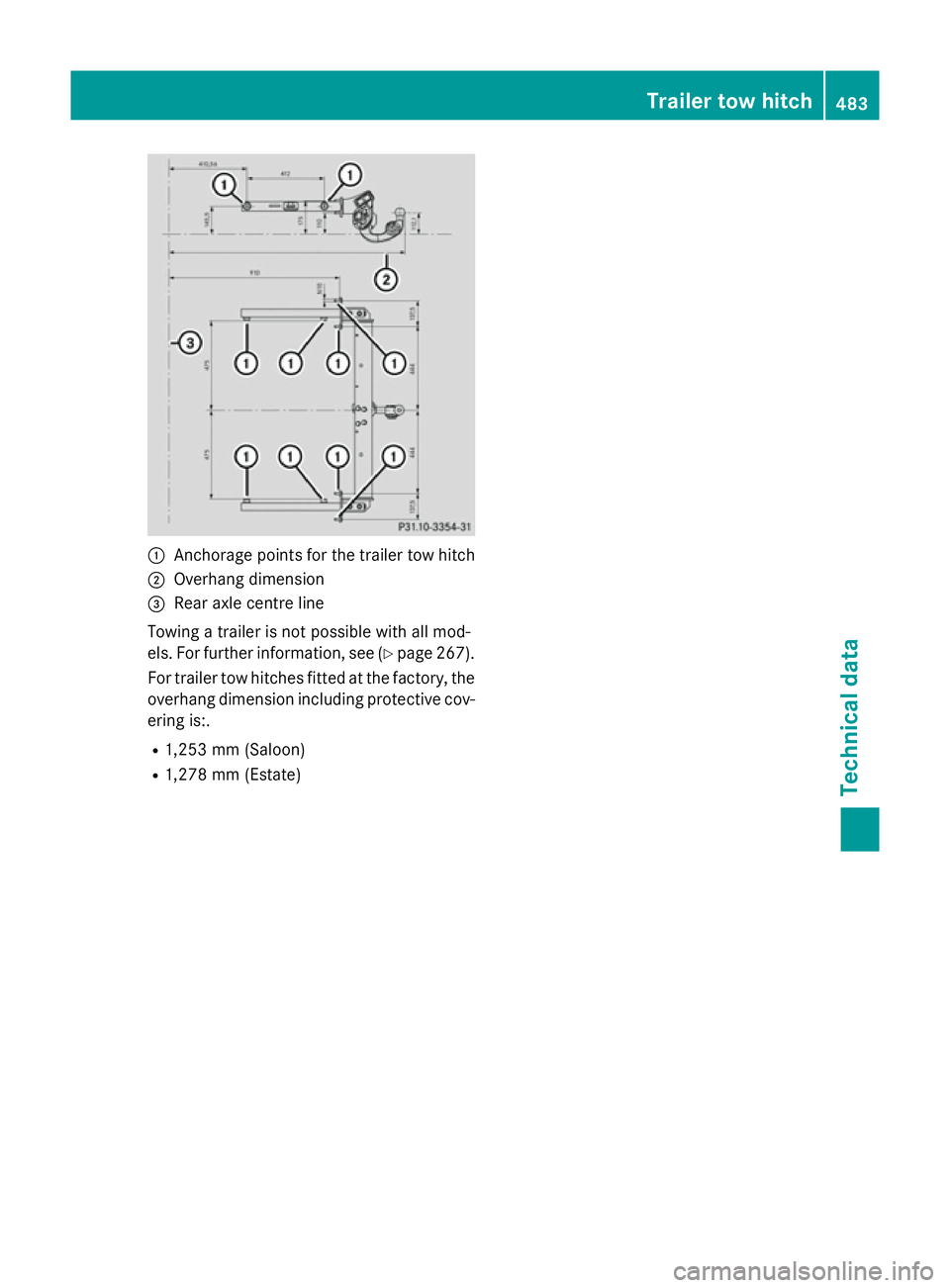
:
Anchorage points for the trailer tow hitch
; Overhang dimension
= Rear axl ecentre line
Towing atrailer is not possibl ewitha llmod-
els. For furthe rinformation, see (Y page 267).
For trailer tow hitche sfitte datt he factory ,the
overhang dimensio nincluding protective cov-
ering is:.
R 1,253 mm (Saloon)
R 1,278 mm (Estate) Trailer tow hitch
483Technicaldata Z
Page 487 of 497
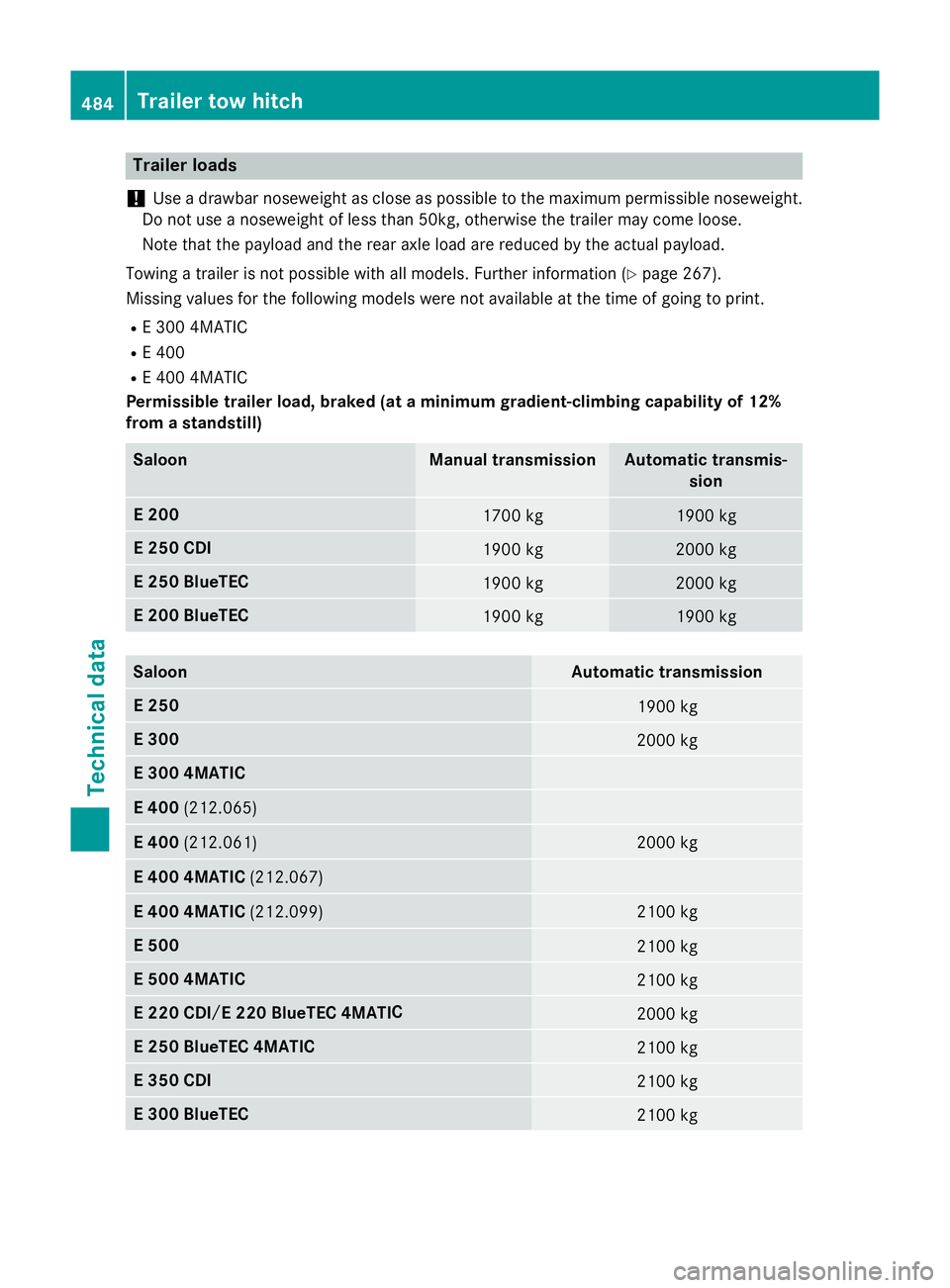
Trailer loads
! Use
adrawbar noseweight as close as possibl etothe maximum permissibl enoseweight.
Do not us eanoseweight of less tha n50kg, otherwis ethe trailer ma ycome loose.
Note tha tthe payloa dand the rea raxlel oa da rereduce dbythe actual payload.
Towing atrailer is not possibl ewitha llmodels. Further informatio n(Ypage 267).
Missing values for the following model sweren ot availabl eatthe time of going to print.
R E3 00 4MATIC
R E4 00
R E4 00 4MATIC
Permissibl etrailer load, braked (at aminimum gradient-climbing capability of 12%
fro mas tandstill) Saloon Manual transmission Automati
ctransmis-
sion E2
00 1700 kg 1900 kg
E2
50 CDI 1900 kg 2000 kg
E2
50 BlueTEC 1900 kg 2000 kg
E2
00 BlueTEC 1900 kg 1900 kg
Saloon Automati
ctransmission E2
50 1900 kg
E3
00 2000 kg
E3
00 4MATIC E4
00 (212.065) E4
00 (212.061) 2000 kg
E4
00 4MATIC (212.067) E4
00 4MATIC (212.099) 2100 kg
E5
00 2100 kg
E5
00 4MATIC 2100 kg
E2
20 CDI 2000 kg
E2
50 BlueTEC 4MATIC 2100 kg
E3
50 CDI 2100 kg
E3
00 BlueTEC 2100 kg484
Trailer tow hitchTechnica
ldata E2
20 BlueTEC 4MATI C
/
Page 492 of 497
The actual noseweight may not,h
owever, be higher than the value which is given:
R on the type plate of the trailer tow hitch and
R on the type plate of the trailer
The lowest weight applies.
You can attach carrier systems, e.g. bicycle racks or load-bearing implements, to the ball
coupling. The maximum noseweight of 75 kg applies when using carrier systems on the ball
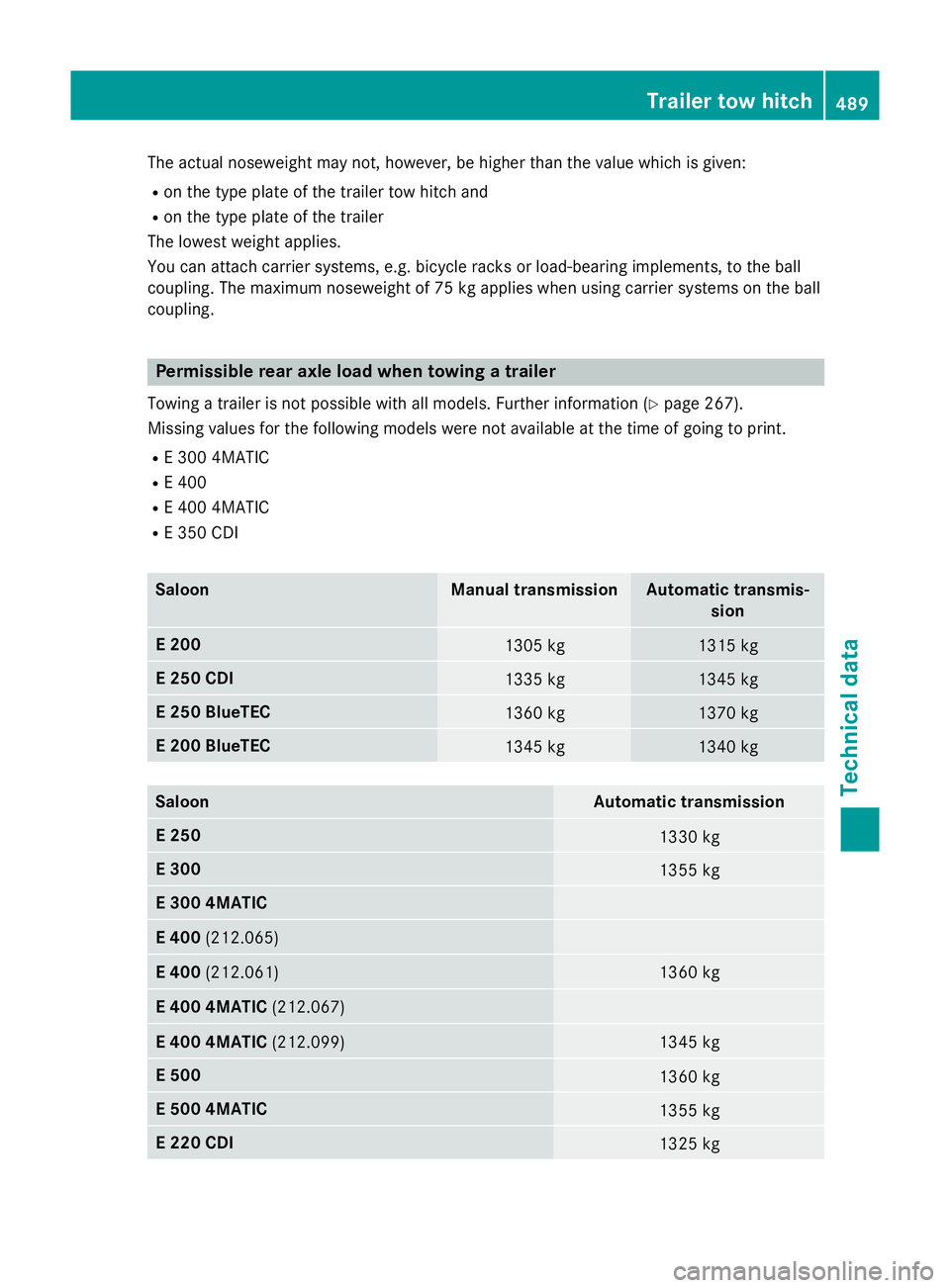
coupling. Permissible rear axle load when towing
atrailer
Towing atrailer is not possible with all models. Further information (Y page 267).
Missing values for the following models were not available at the time of going to print.
R E3 00 4MATIC
R E4 00
R E4 00 4MATIC
R E3 50 CDI Saloon Manua
ltra nsmission Automatic transmis-
sion E2
00 1305 kg 1315 kg
E2
50 CDI 1335 kg 1345 kg
E2
50 BlueTEC 1360 kg 1370 kg
E2
00 BlueTEC 1345 kg 1340 kg
Saloon Automatic transmission
E2
50 1330 kg
E3
00 1355 kg
E3
00 4MATIC E4
00 (212.065) E4
00 (212.061) 1360 kg
E4
00 4MATIC (212.067) E4
00 4MATIC (212.099) 1345 kg
E5
00 1360 kg
E5
00 4MATIC 1355 kg
E2
20 CDI 1325 kgTrailer tow hitch
489Technical data Z