transmission MERCEDES-BENZ E-CLASS SALOON 2017 Workshop Manual
[x] Cancel search | Manufacturer: MERCEDES-BENZ, Model Year: 2017, Model line: E-CLASS SALOON, Model: MERCEDES-BENZ E-CLASS SALOON 2017Pages: 497, PDF Size: 10.38 MB
Page 360 of 497
5
Folding chock
6 Ratchet for jack
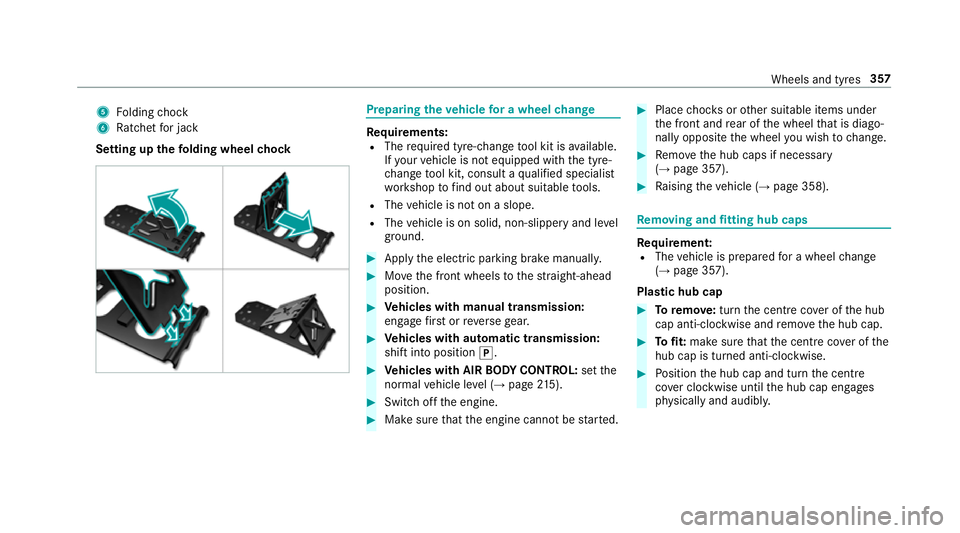
Setting up thefo lding wheel chock Prepa
ring theve hicle for a wheel change Re
quirements:
R The requ ired tyre-change tool kit is available.
If yo ur vehicle is not equipped with the tyre-
ch ange tool kit, consult a qualified specialist
wo rkshop tofind out about suitable tools.
R The vehicle is not on a slope.
R The vehicle is on solid, non-slippery and le vel
ground. #
Apply the electric parking brake manually. #
Movethe front wheels tothest ra ight-ahead
position. #
Vehicles with manual transmission:
engage firs t or reve rsege ar. #
Vehicles with automatic transmission:
shift into position j. #
Vehicles with AIR BODY CONT ROL:set the
normal vehicle le vel (→ page 215). #
Switch off the engine. #
Make sure that the engine cann otbe star ted. #
Place choc ks orother suitable items under
th e front and rear of the wheel that is diago‐
nally opposite the wheel you wish tochange. #
Remo vethe hub caps if necessary
(→ page 357). #
Raising theve hicle (→ page 358). Re
moving and fitting hub caps Re
quirement:
R The vehicle is prepared for a wheel change
(→ page 357).
Pla stic hub cap #
Toremo ve:turn the cent recover of the hub
cap anti-clockwise and remo vethe hub cap. #
Tofit: make sure that the cent recover of the
hub cap is turned anti-clockwise. #
Position the hub cap and turn the cent re
co ver clockwise until the hub cap engages
ph ysically and audibly. Wheels and tyres
357
Page 368 of 497
*
NO
TEInva lidation of the operating per‐
mit due tofailure tocomply wi th the
instructions for ins tallation and use The operating permit may be in
validated if
th e instructions for ins tallation and use of
two-w ayradios are not obser ved. #
Only use appr oved frequency bands. #
Obser vethe maximum permissible out‐
put po wer in these frequency bands. #
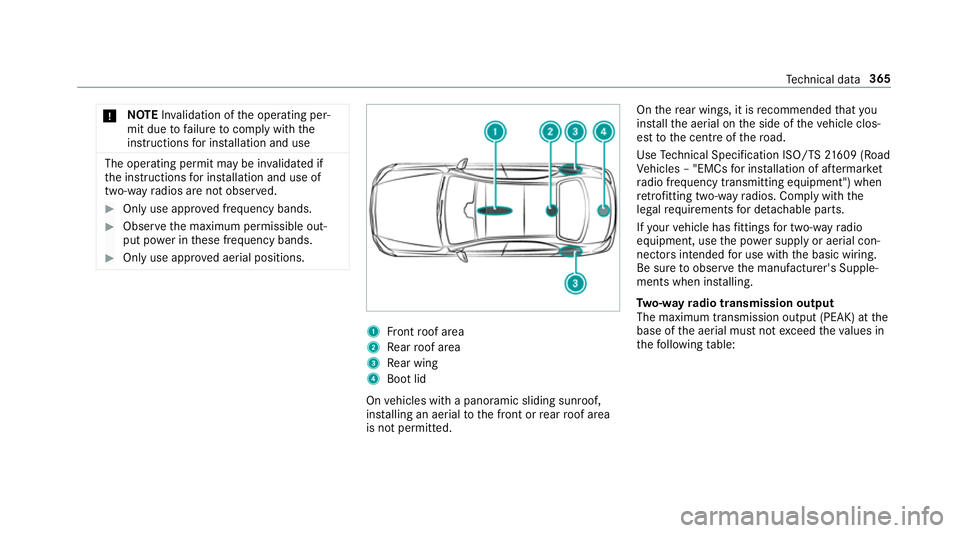
Only use appr oved aerial positions. 1
Front roof area
2 Rear roof area
3 Rear wing
4 Boot lid
On vehicles with a panoramic sliding sunroof,
ins talling an aerial tothe front or rear roof area
is not permitted. On
there ar wings, it is recommended that you
ins tallth e aerial on the side of theve hicle clos‐
est tothe cent reofthero ad.
Use Tech nical Specification ISO/TS 21609 (Road
Ve hicles – "EMCs for ins tallation of af term arket
ra dio frequency transmitting equipment") when
re trofitting two-w ayradios. Comply with the
legal requirements for de tach able parts.
If yo ur vehicle has fittings for two-w ayradio
equipment, use the po wer supp lyor aerial con‐
nectors intended for use with the basic wiring.
Be sure toobser vethe manufacturer's Supple‐
ments when ins talling.
Tw o-w ayradio transmission output
The maximum transmission output (PEAK) at the
base of the aerial must not exceed theva lues in
th efo llowing table: Te
ch nical da ta365
Page 369 of 497
frequency band and maximum transmission
output
Fr
equency band Maximum transmis‐
sion output
Sho rtwa ve
3 - 54 MHz 10
0 W
4 m frequency band
74 - 88 MHz 30 W
2 m frequency band
14 4 - 174 MHz 50 W
Tr unked radio sys‐
te m/T etra
380 - 460 MHz 10 W
70 cm frequency
band
420 - 450 MHz 35 W
Tw o-w ayradio
(2G/3G/4G) 10 W The
following can be used in theve hicle without
re strictions:
R two-w ayradios with a maximum transmission
output of up to100 mW
R two-w ayradios with transmit ter frequencies
in the 380 - 410 MHz frequency band and a
maximum transmission output of up to2 W
(trunked radio sy stem/T etra)
R mobile phones (2G/3G/4G)
There are no restrictions when positioning the
aerial on the outside of theve hicle forth efo llow‐
ing frequency bands:
R trunked radio sy stem/T etra
R 70 cm frequency band
R 2G/3G/4G Ve
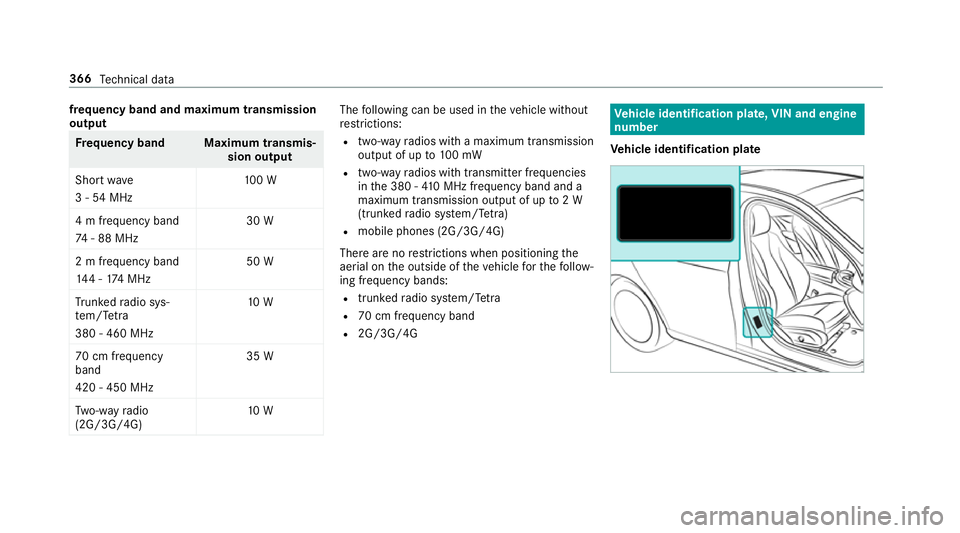
hicle identification plate, VIN and engine
number
Ve hicle identification plate 366
Tech nical da ta
Page 373 of 497
Fu
el Information on fuel
grades forve hicles with
a petrol engine
Obser vethe no tes on operating fluids
(→ page 368).
* NO
TEDama gecaused bythe wrong fuel Even small amounts of
the wrong fuel could
re sult in damage tothe fuel sy stem, the
engine and the emission control sy stem. #
Only refuel using premium-grade unlea‐
ded fuel that con form sto EN 228, or an
equi valent specification.
Fu el of this specification may con tain up to
10 %ethanol. Your vehicle is suitable for use
with E10 fuel.
Do not refuel using:
R Diesel
R E85, E100
R Petrol containing me thanol (M15, M30,
M85, M100) R
Petrol wi thadditives con taining me tal
If yo u accidentally refuel with the wrong fuel: #
Do not switch the ignition on. #
Consult a qualified specialist workshop. If
th eav ailable fuel is not suf ficiently low in sul‐
phu r,th is can produce unpleasant odours.
E 200 (automatic transmission), E 250,
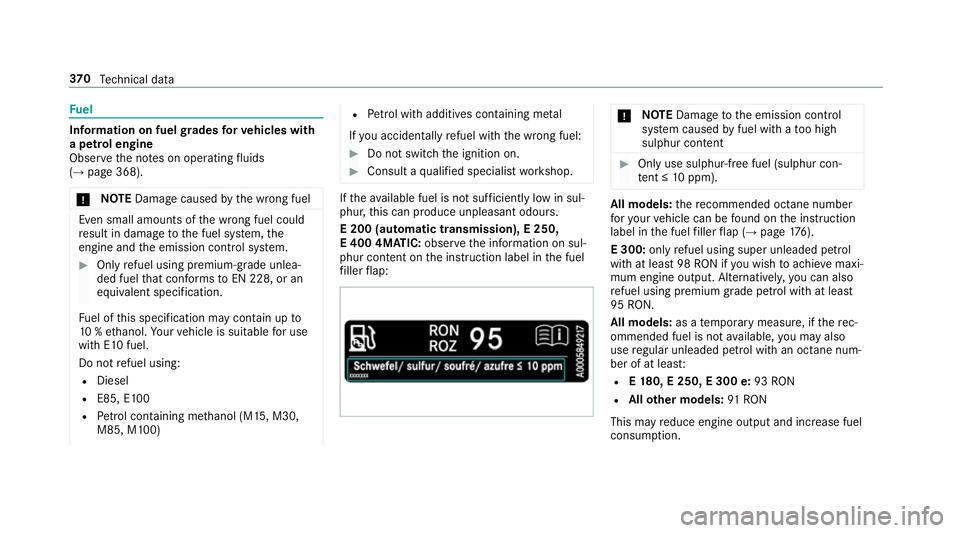
E 400 4MATIC: observethe information on sul‐
phur conte nt onthe instruction label in the fuel
fi ller flap: *
NO
TEDama getothe emission control
sy stem caused byfuel with a too high
sulphur content #
Only use sulphur-free fuel (sulphur con‐
tent ≤ 10ppm). All models:
there commended octane number
fo ryo ur vehicle can be found on the instruction
label in the fuel filler flap (→ page176).
E 300: onlyrefuel using super unleaded petrol
with at lea st98 RON if you wish toachie vemaxi‐
mum engine output. Alternatively, you can also
re fuel using premium grade petrol with at lea st
95 RON.
All models: as atemp orary measure, if there c‐
ommended fuel is not available, you may also
use regular unleaded petrol with an octane num‐
ber of at leas t:
R E18 0, E 250, E 300 e: 93RON
R Allother models: 91RON
This may reduce engine output and increase fuel
consum ption. 37 0
Tech nical da ta
Page 383 of 497
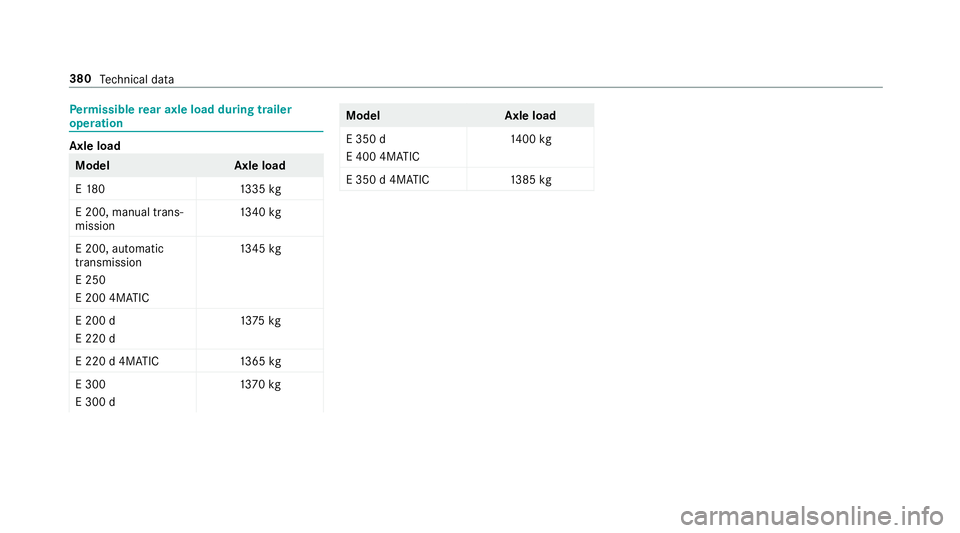
Pe
rm issible rear axle load during trailer
operation Axle load
Model
Axle load
E 18 01 335kg
E 200, manual trans‐
mission 13
40 kg
E 200, au tomatic
transmission
E 250
E 200 4MATIC 13
45 kg
E 200 d
E 220 d 13
75 kg
E 220 d 4MATIC 1365 kg
E 300
E 300 d 13
70 kg Model
Axle load
E 350 d
E 400 4MATIC 14
00 kg
E 350 d 4MATIC 1385 kg 380
Tech nical da ta
Page 394 of 497
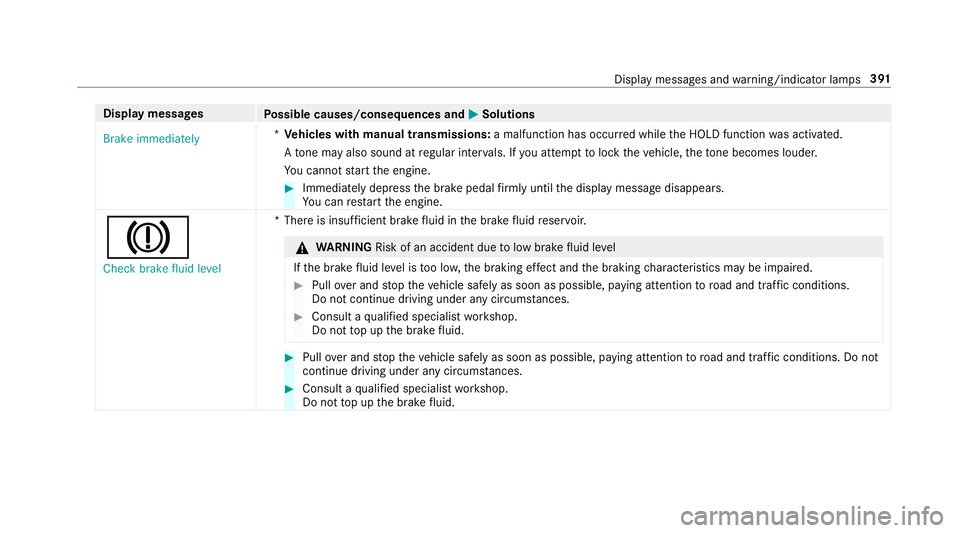
Display messages
Possible causes/consequences and M
MSolutions
Brake immediately *
Ve hicles with manual transmissions: a malfunction has occurred while the HOLD function was activated.
A tone may also sound at regular inter vals. If you attem pttolock theve hicle, theto ne becomes louder.
Yo u cannot start the engine. #
Immediately depress the brake pedal firm lyuntil the display message disappears.
Yo u can restart the engine.
J
Check brake fluid level *T
here is insuf ficient brake fluid in the brake fluid reser voir. &
WARNING Risk of an accident due tolow brake fluid le vel
If th e brake fluid le vel is too lo w,the braking ef fect and the braking characteristics may be impaired. #
Pull over and stop theve hicle safely as soon as possible, paying attention toroad and traf fic conditions.
Do not continue driving under any circums tances. #
Consult a qualified specialist workshop.
Do not top up the brake fluid. #
Pull over and stop theve hicle safely as soon as possible, paying attention toroad and traf fic conditions. Do not
continue driving under any circums tances. #
Consult a qualified specialist workshop.
Do not top up the brake fluid. Display messages and
warning/indicator lamps 391
Page 428 of 497
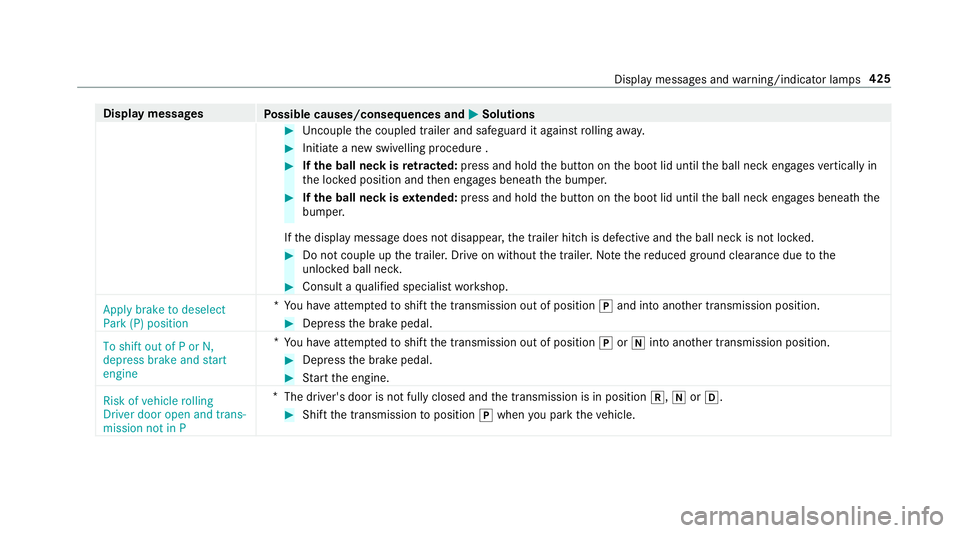
Display messages
Possible causes/consequences and M
MSolutions #
Uncouple the coupled trailer and safeguard it against rolling away. #
Initiate a new swivelling procedure . #
Ifth e ball neck is retracted: press and hold the button on the boot lid until the ball neck engages vertically in
th e loc ked position and then engages beneath the bumper. #
Ifth e ball neck is extended: press and hold the button on the boot lid until the ball neck engages beneath the
bumper.
If th e display message does not disappear, the trailer hitch is defective and the ball neck is not loc ked. #
Do not couple up the trailer. Drive on without the trailer. No tethere duced ground clearance due tothe
unlo cked ball nec k. #
Consult a qualified specialist workshop.
Apply brake to deselect
Park (P) position *
Yo u ha veattem ptedto shift the transmission out of position jand into ano ther transmission position. #
Depress the brake pedal.
To shift out of P or N,
depress brake and start
engine *
Yo u ha veattem ptedto shift the transmission out of position jori into ano ther transmission position. #
Depress the brake pedal. #
Start the engine.
Risk of vehicle rolling
Driver door open and trans-
mission not in P *
The driver's door is not fully closed and the transmission is in position k,iorh. #
Shift the transmission toposition jwhen you park theve hicle. Display messages and
warning/indicator lamps 425
Page 429 of 497
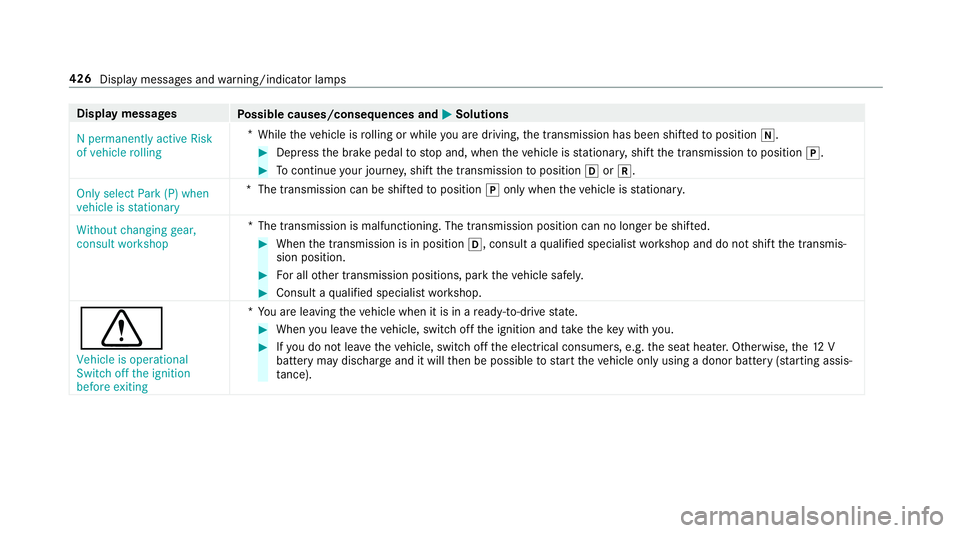
Display messages
Possible causes/consequences and M
MSolutions
N permanently active Risk
of vehicle rolling *
While theve hicle is rolling or while you are driving, the transmission has been shif tedto position i. #
Depress the brake pedal tostop and, when theve hicle is stationar y,shift the transmission toposition j. #
Tocontinue your journe y,shift the transmission toposition hork.
Only select Park (P) when
vehicle is stationary *
The transmission can be shif tedto position jonly when theve hicle is stationar y.
Without changing gear,
consult workshop *T
he transmission is malfunctioning. The transmission position can no longer be shif ted. #
When the transmission is in position h, consult aqualified specialist workshop and do not shift the transmis‐
sion position. #
For all other transmission positions, park theve hicle safely. #
Consult a qualified specialist workshop.
d Vehicle is operational
Switch off the ignition
before exiting *Y
ou are leaving theve hicle when it is in a ready-to-drive state. #
When you lea vetheve hicle, switch off the ignition and take theke y with you. #
Ifyo u do not lea vetheve hicle, switch off the electrical consumers, e.g. the seat heater. Otherwise, the12 V
battery may dischar geand it will then be possible tostart theve hicle only using a donor battery (s tarting assis‐
ta nce). 426
Display messa ges and warning/indicator lamps
Page 430 of 497
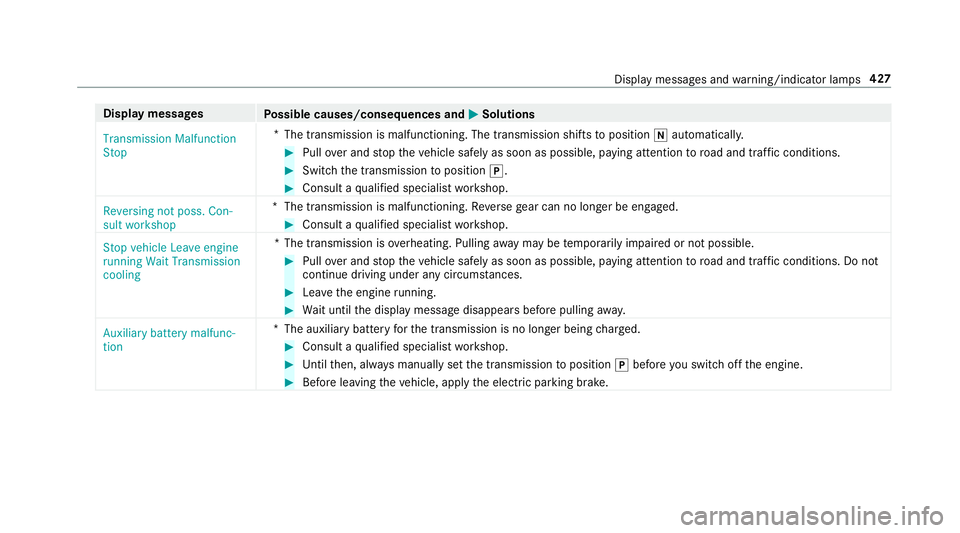
Display messages
Possible causes/consequences and M
MSolutions
Transmission Malfunction
Stop *
The transmission is malfunctioning. The transmission shifts toposition iautomaticall y. #
Pull over and stop theve hicle safely as soon as possible, paying attention toroad and traf fic conditions. #
Switch the transmission toposition j. #
Consult a qualified specialist workshop.
Reversing not poss. Con-
sult workshop *T
he transmission is malfunctioning. Reversege ar can no lon ger be engaged. #
Consult a qualified specialist workshop.
Stop vehicle Leave engine
running Wait Transmission
cooling *T
he transmission is overheating. Pulling away may be temp orarily impaired or not possible. #
Pull over and stop theve hicle safely as soon as possible, paying attention toroad and traf fic conditions. Do not
continue driving under any circums tances. #
Lea vethe engine running. #
Wait until the display message disappears before pulling away.
Auxiliary battery malfunc-
tion *T
he auxiliary batteryforth e transmission is no longer being charge d. #
Consult a qualified specialist workshop. #
Untilthen, alw ays manually set the transmission toposition jbefore you swit choff the engine. #
Before leaving theve hicle, apply the electric parking brake. Display messages and
warning/indicator lamps 427
Page 432 of 497
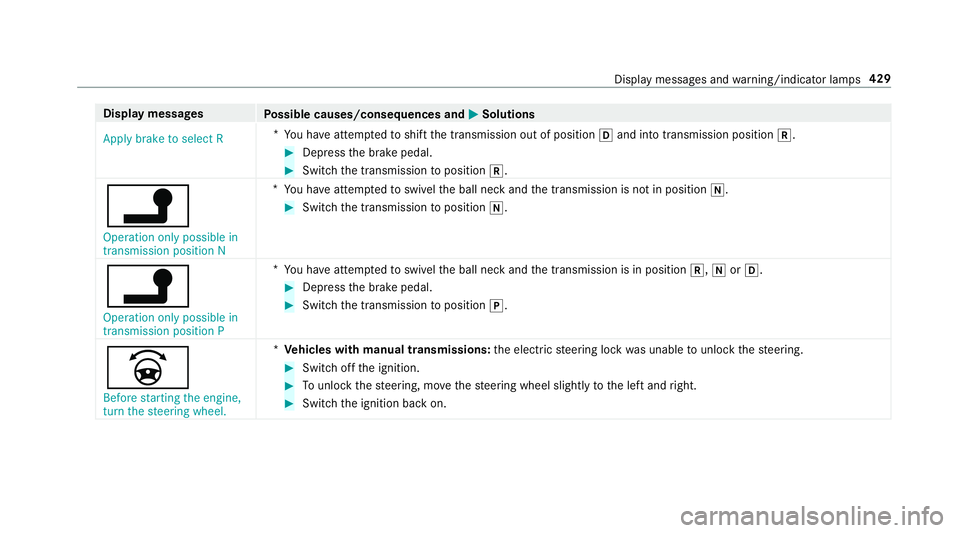
Display messages
Possible causes/consequences and M
MSolutions
Apply brake to select R *
Yo u ha veattem ptedto shift the transmission out of position hand into transmission position k. #
Depress the brake pedal. #
Switch the transmission toposition k.
j
Operation only possible in
transmission position N *
Yo u ha veattem ptedto swivel the ball neck and the transmission is not in position i. #
Switch the transmission toposition i.
j
Operation only possible in
transmission position P *
Yo u ha veattem ptedto swivel the ball neck and the transmission is in position k,iorh. #
Depress the brake pedal. #
Switch the transmission toposition j.
_
Before starting the engine,
turn the steering wheel. *
Ve hicles with manual transmissions: the electric steering lock was unable tounlo ck th esteering. #
Switch off the ignition. #
Tounlo ckthesteering, mo vethesteering wheel slightly tothe left and right. #
Switch the ignition back on. Display messages and
warning/indicator lamps 429