ABS MERCEDES-BENZ E-CLASS WAGON 2001 W210 User Guide
[x] Cancel search | Manufacturer: MERCEDES-BENZ, Model Year: 2001, Model line: E-Class WAGON, Model: MERCEDES-BENZ E-Class WAGON 2001 W210Pages: 345, PDF Size: 16.08 MB
Page 228 of 345
225 Driving systems
Te ch n ica l
data Instruments
and controlsOperationDrivingInstrument
cluster displayPractical hints Car care Index Antilock brake system (ABS)
Important!
The ABS improves steering control of the vehicle during
hard braking maneuvers.
The ABS prevents the wheels from locking up above a
vehicle speed of approximately 5 mph (8 km / h)
independent of road surface conditions.At the instant one of the wheels is about to lock up, a
slight pulsation can be felt in the brake pedal,
indicating that the ABS is in the regulating mode. Keep
firm and steady pressure on the brake pedal while
experiencing the pulsation.
Continuous steady brake pedal pressure results in
applying the advantages of the ABS, namely braking
power and ability to steer the vehicle.
In the case of an emergency brake maneuver keep
continuous full pressure on the brake pedal. In this
manner only can the ABS be most effective.
On slippery road surfaces, the ABS will respond even
with light brake pedal pressure because of the
increased likelihood of locking wheels. The pulsating
brake pedal can be an indication of hazardous road
conditions and functions as a reminder to take extra
care while driving.
Wa r n i n g !
Do not pump the brake pedal, rather use firm,
steady brake pedal pressure. Pumping the brake
pedal defeats the purpose for ABS and significantly
reduces braking effectiveness.
Page 229 of 345
226 Driving systems
Te ch n ica l
data Instruments
and controlsOperationDrivingInstrument
cluster displayPractical hints Car care Index
ABS control
The ABS malfunction indicator lamp- in the
instrument cluster comes on with the electronic key in
steering lock position 2 and should go out with the
engine running.
When the ABS malfunction indicator lamp in the
instrument cluster comes on while the engine is
running, it indicates that the ABS has detected a
malfunction and has switched off. In this case, the brake
system functions in the usual manner, but without
antilock assistance.
For ABS malfunction indicator lamp, see page 245.
With the ABS malfunctioning, the BAS and ESP are also
switched off. Both malfunction indicator lamps come on
with the engine running.
If the charging voltage falls below 10 volts, the
malfunction indicator lamp comes on and the ABS is
switched off. When the voltage is above this value again,
the malfunction indicator lamp should go out and the
ABS is operational.If the ABS malfunction indicator lamp stays illuminated,
have the system checked at your authorized
Mercedes-Benz Center as soon as possible.
Note:
To alert following vehicles to slippery road conditions
you discover, operate your hazard warning flashers as
appropriate.
Wa r n i n g !
ABS cannot prevent the natural laws of physics
from acting on the vehicle, nor can it increase
braking or steering efficiency beyond that afforded
by the condition of the vehicle brakes and tires or
the traction afforded. The ABS cannot prevent
accidents, including those resulting from excessive
speed in turns, following another vehicle too
closely, or aquaplaning. Only a safe, attentive, and
skillful driver can prevent accidents. The
capabilities of an ABS equipped vehicle must never
be exploited in a reckless or dangerous manner
which could jeopardize the user’s safety or the
safety of others.
Page 232 of 345
229 Driving systems
Te ch n ica l
data Instruments
and controlsOperationDrivingInstrument
cluster displayPractical hints Car care Index Notes:
The malfunction indicator lamp for the ESP is combined
with that of the BAS.
The yellow BAS / ESP malfunction indicator lamp in the
instrument cluster and the yellow ESP warning
lampv in the speedometer dial come on with the
electronic key in steering lock position 2. They should
go out with the engine running.
If the BAS / ESP malfunction indicator lamp comes on
continuously with the engine running, a malfunction
has been detected in either system. Only partial engine
output will be available.
If the BAS malfunctions, the brake system functions in
the usual manner, but without BAS.
If the ESP warning message is displayed, have the BAS
or ESP checked at your authorized Mercedes-Benz
Center as soon as possible.
With the ABS malfunctioning, the ESP is also switched
off.Driving the vehicle with varied size tires will cause the
wheels to rotate at different speeds, therefore the ESP
may activate (yellow ESP warning lamp in speedometer
dial comes on). For this reason, all wheels, including the
spare wheel, must have the same tire size.
When testing the parking brake on a brake test
dynamometer, the engine must be shut off. Otherwise,
the ESP will immediately be engaged and will apply the
rear wheel brakes.
In winter operation, the maximum effectiveness of the
ESP is only achieved with Mercedes-Benz recommended
M+S rated radial-ply tires and / or snow chains.
Synchronizing ESP
If the power supply was interrupted (battery
disconnected or empty), the BAS / ESP malfunction
indicator lamp may be illuminated with the engine
running.
Turn steering wheel completely to the left and then to
the right. The BAS / ESP malfunction indicator lamp
should go out.
Page 244 of 345
241 Contents - Instrument cluster display
Te ch n ica l
data Instruments
and controlsOperation DrivingInstrument
cluster displayPractical hints Car care Index
Instrument cluster displayMalfunction and indicator
lamps in the
instrument cluster .................... 242
On-board
diagnostic system .......................242
Check engine malfunction
indicator lamp .............................242
Brake warning lamp ..................243
Supplemental restraint
system (SRS)
indicator lamp .............................244
Fuel reserve and fuel cap
placement warning ....................244
Electronic stability program
(ESP) — warning lamp ...............245BAS / ESP malfunction
indicator lamp ............................ 245
ABS malfunction
indicator lamp ............................ 245
Seat belt warning lamp ............. 246
Malfunction and
indicator lamp in the
center console ........................... 246
AIRBAG OFF
indicator lamp ............................ 246
Malfunction and warning
messages in the
multifunction display .............. 247
DISPLAY DEFECTIVE ................ 248
BATTERY / ALTERNATOR ........ 249
ABS-SYSTEM .............................. 250
BRAKE ASSIST ........................... 250
BRAKE LINING WEAR .............. 251BRAKE FLUID ............................. 251
PARKING BRAKE .......................252
ENGINE FAN ...............................252
COOLANT
(coolant level) .............................253
COOLANT TEMP.
(coolant temperature) ................254
LIGHTING SYSTEM ....................255
LIGHT SENSOR ...........................256
REMOVE KEY .............................256
TELE AID .....................................257
STEERING GEAR OIL .................257
ENGINE OIL LEVEL ...................258
WASHER FLUID .........................259
ELEC. STABIL. PROG.
(Electronic stability
program) ......................................260
Page 248 of 345
245 Malfunction and indicator lamps
Te ch n ica l
data Instruments
and controlsOperation DrivingInstrument
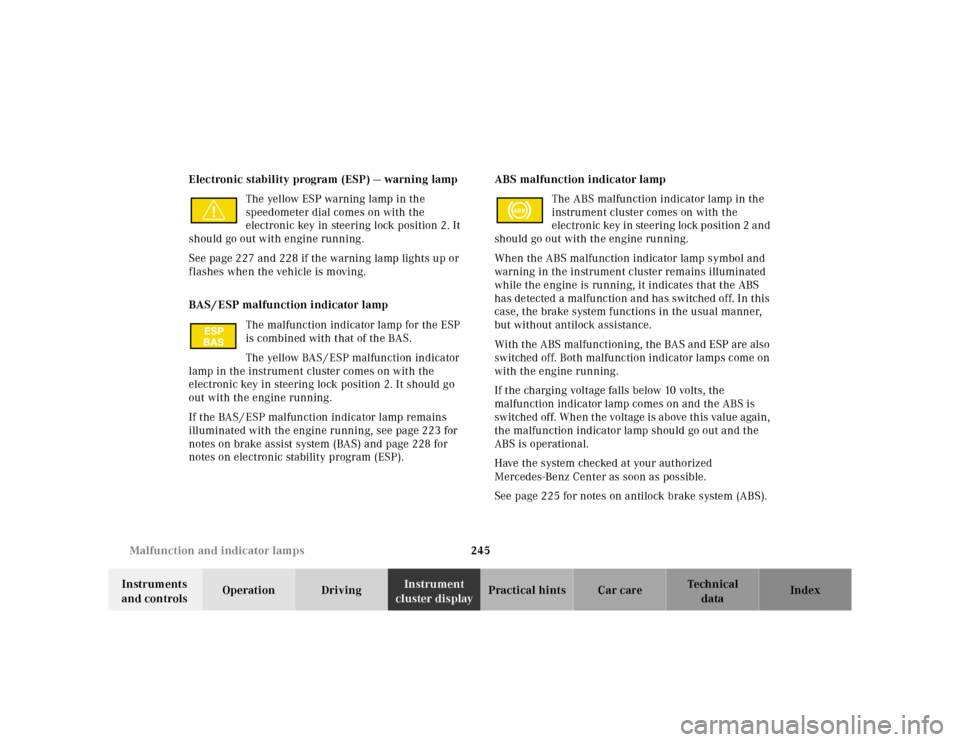
cluster displayPractical hints Car care Index Electronic stability program (ESP) — warning lamp
The yellow ESP warning lamp in the
speedometer dial comes on with the
electronic key in steering lock position 2. It
should go out with engine running.
See page 227 and 228 if the warning lamp lights up or
flashes when the vehicle is moving.
BAS / ESP malfunction indicator lamp
The malfunction indicator lamp for the ESP
is combined with that of the BAS.
The yellow BAS / ESP malfunction indicator
lamp in the instrument cluster comes on with the
electronic key in steering lock position 2. It should go
out with the engine running.
If the BAS / ESP malfunction indicator lamp remains
illuminated with the engine running, see page 223 for
notes on brake assist system (BAS) and page 228 for
notes on electronic stability program (ESP).ABS malfunction indicator lamp
The ABS malfunction indicator lamp in the
instrument cluster comes on with the
electronic key in steering lock position 2 and
should go out with the engine running.
When the ABS malfunction indicator lamp symbol and
warning in the instrument cluster remains illuminated
while the engine is running, it indicates that the ABS
has detected a malfunction and has switched off. In this
case, the brake system functions in the usual manner,
but without antilock assistance.
With the ABS malfunctioning, the BAS and ESP are also
switched off. Both malfunction indicator lamps come on
with the engine running.
If the charging voltage falls below 10 volts, the
malfunction indicator lamp comes on and the ABS is
switched off. When the voltage is above this value again,
the malfunction indicator lamp should go out and the
ABS is operational.
Have the system checked at your authorized
Mercedes-Benz Center as soon as possible.
See page 225 for notes on antilock brake system (ABS).
ABS
Page 253 of 345
250 Malfunction and warning messages
Te ch n ica l
data Instruments
and controlsOperation DrivingInstrument
cluster displayPractical hints Car care Index
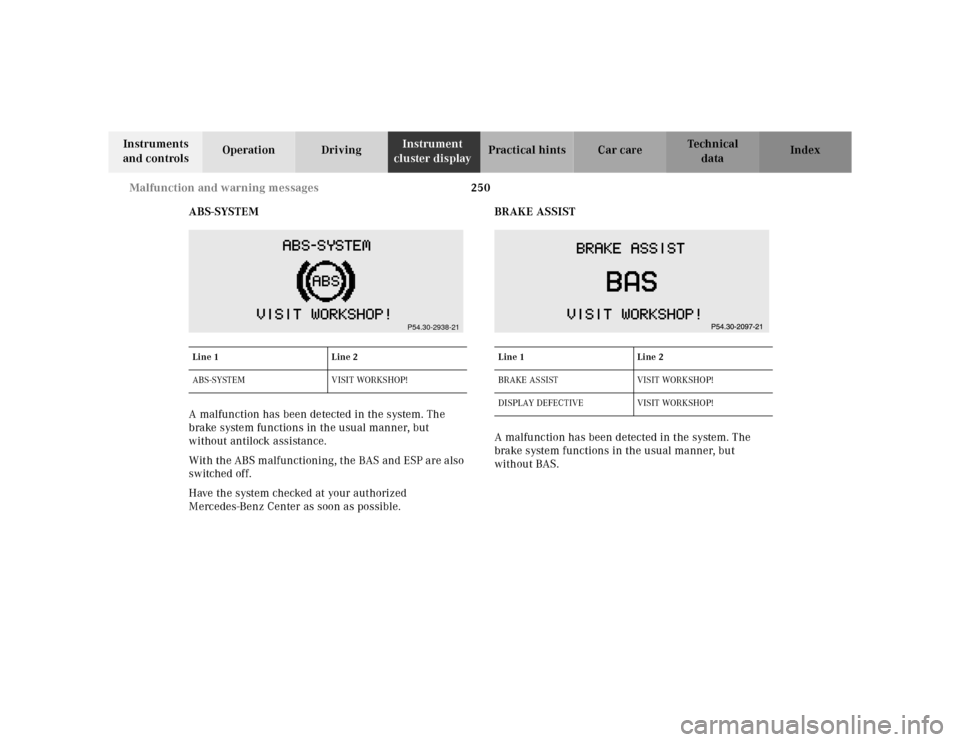
ABS-SYSTEM
A malfunction has been detected in the system. The
brake system functions in the usual manner, but
without antilock assistance.
With the ABS malfunctioning, the BAS and ESP are also
switched off.
Have the system checked at your authorized
Mercedes-Benz Center as soon as possible.BRAKE ASSIST
A malfunction has been detected in the system. The
brake system functions in the usual manner, but
without BAS.
Line 1 Line 2
ABS-SYSTEM VISIT WORKSHOP!
P54.30-2938-21
Line 1 Line 2
BRAKE ASSIST VISIT WORKSHOP!
DISPLAY DEFECTIVE VISIT WORKSHOP!
Page 267 of 345
264 Fuses
Te ch n ica l
data Instruments
and controlsOperation DrivingInstrument
cluster displayPractical hintsCar care Index
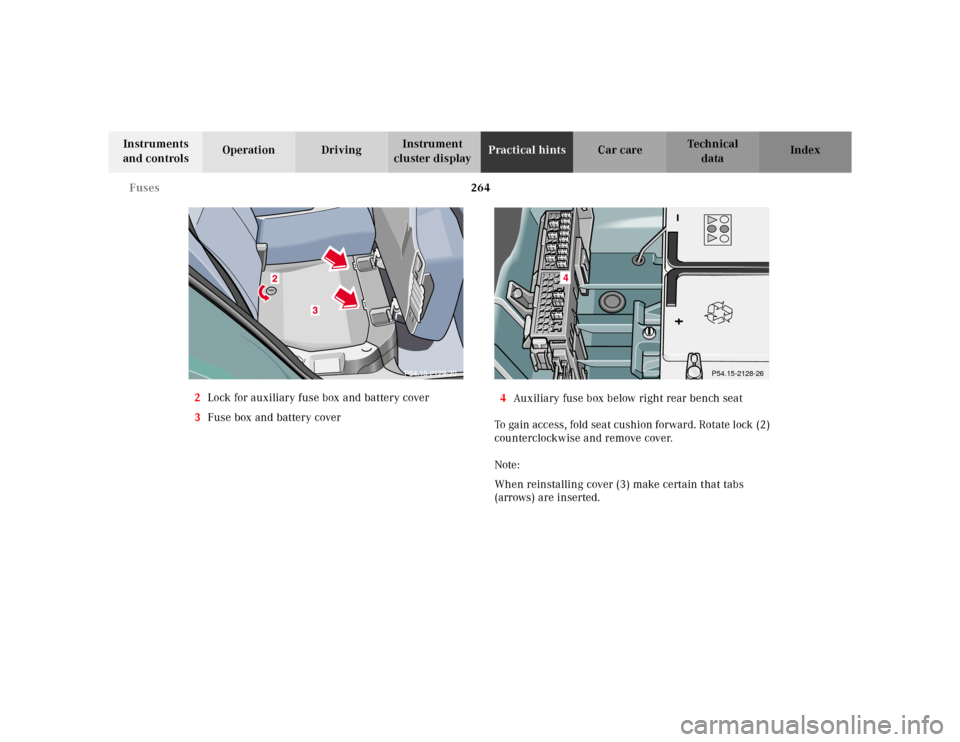
2Lock for auxiliary fuse box and battery cover
3Fuse box and battery cover4Auxiliary fuse box below right rear bench seat
To gain access, fold seat cushion forward. Rotate lock (2)
counterclockwise and remove cover.
Note:
When reinstalling cover (3) make certain that tabs
(arrows) are inserted.
4
P54.15-2128-26
Page 306 of 345
303 Replacing wiper blade insert
Te ch n ica l
data Instruments
and controlsOperation DrivingInstrument
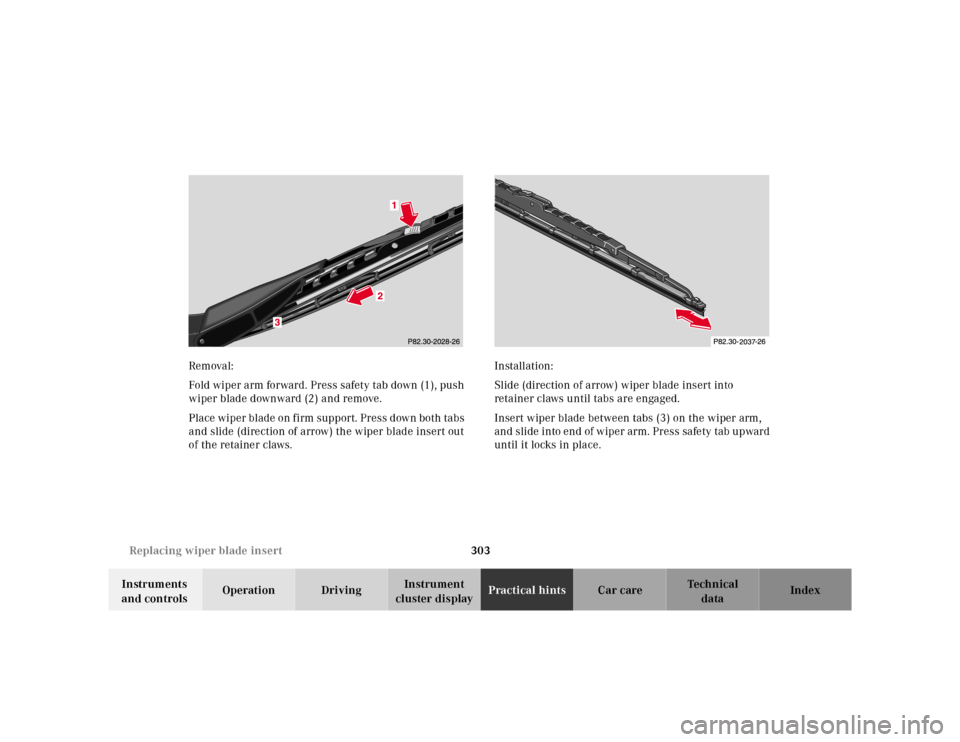
cluster displayPractical hintsCar care Index Removal:
Fold wiper arm forward. Press safety tab down (1), push
wiper blade downward (2) and remove.
Place wiper blade on firm support. Press down both tabs
and slide (direction of arrow) the wiper blade insert out
of the retainer claws.Installation:
Slide (direction of arrow) wiper blade insert into
retainer claws until tabs are engaged.
Insert wiper blade between tabs (3) on the wiper arm,
and slide into end of wiper arm. Press safety tab upward
until it locks in place.
Page 327 of 345
324 Fuels, coolants, lubricants etc. - capacities
Te ch n ica l
data Instruments
and controlsOperation DrivingInstrument
cluster displayPractical hints Car care Index
Engine oils
Engine oils are specifically tested for their suitability in
our engines. Therefore, use only engine oils
recommended by Mercedes-Benz. Information on
recommended brands is available at your authorized
Mercedes-Benz Center.
Please follow Service Booklet recommendations for
scheduled oil changes. Failure to do so could result in
engine damage not covered by the Mercedes-Benz
Limited Warranty.
Engine oil additives
Do not blend oil additives with engine oil. They may be
harmful to the engine operation.
Damage or malfunctions resulting from blending oil
additives are not covered by the Mercedes-Benz Limited
War ra nt y.Air conditioner refrigerant
R-134a (HFC) refrigerant and special PAG lubricating oil
is used in the air conditioner system.
Never use R-12 (CFC) or mineral-based lubricating oil,
otherwise damage to the system will occur.
Brake fluid
During vehicle operation, the boiling point of the brake
fluid is continuously reduced through the absorption of
moisture from the atmosphere. Under extremely hard
operating conditions, this moisture content can lead to
the formation of bubbles in the system thus reducing
the system’s efficiency.
The brake fluid must therefore be replaced every two
years, preferably in the spring.
It is recommended to use only brake fluid approved by
Mercedes-Benz. Your authorized Mercedes-Benz Center
will provide you with additional information.
Page 333 of 345
330
Te ch n ica l
data Instruments
and controlsOperation DrivingInstrument
cluster displayPractical hints Car careIndex
Index
AABS (Antilock brake system) .......................................225
Malfunction indicator lamp .....................................245
ABS-SYSTEM - malfunction and
warning messages ....................................................250
Adjusting steering wheel ................................................ 81
Air conditioner refrigerant ...........................................324
Air distribution .............................................................. 130
Air volume ...................................................................... 130
Airbag deactivation system ............................................ 67
AIRBAG OFF indicator lamp ........................................246
Airbags .............................................................................. 70
Alarm system .............................................................. 41, 43
Anticorrosion/antifreeze ....................218, 270, 322, 326
Antilock brake system (ABS) .......................................225
Malfunction indicator lamp .....................................245
Antitheft alarm system ................................................... 41
Aquaplaning ................................................................... 215
Armrest, rear bench ...................................................... 161
Ashtrays .......................................................................... 165
Center console, front ................................................ 165
Rear doors .................................................................. 166Audio system .................................................................. 135
Anti-theft system ....................................................... 137
Button and soft key operation ................................. 138
Cassette mode ............................................................143
CD changer .................................................................148
CD mode ..................................................................... 147
Operating and display elements ............................. 136
Operating safety ........................................................ 135
Operation – audio and telephone ........................... 135
Radio mode ................................................................ 141
Telephone operation ................................................. 151
Audio systems ...................................................................97
Cassette player ............................................................99
CD player ......................................................................98
Radio .............................................................................97
Automatic central locking ..............................................37
Automatic climate control ............................................126
Activated charcoal filter ........................................... 132
Air distribution .......................................................... 130
Air recirculation ........................................................ 131
Air volume .................................................................. 130
Basic setting ...............................................................129
Defogging windows ...................................................129
Defrosting ...................................................................129
Display and controls .................................................128
Dust filter ................................................................... 131