Battery MERCEDES-BENZ E-CLASS WAGON 2001 W210 Owner's Guide
[x] Cancel search | Manufacturer: MERCEDES-BENZ, Model Year: 2001, Model line: E-Class WAGON, Model: MERCEDES-BENZ E-Class WAGON 2001 W210Pages: 345, PDF Size: 16.08 MB
Page 244 of 345
241 Contents - Instrument cluster display
Te ch n ica l
data Instruments
and controlsOperation DrivingInstrument
cluster displayPractical hints Car care Index
Instrument cluster displayMalfunction and indicator
lamps in the
instrument cluster .................... 242
On-board
diagnostic system .......................242
Check engine malfunction
indicator lamp .............................242
Brake warning lamp ..................243
Supplemental restraint
system (SRS)
indicator lamp .............................244
Fuel reserve and fuel cap
placement warning ....................244
Electronic stability program
(ESP) — warning lamp ...............245BAS / ESP malfunction
indicator lamp ............................ 245
ABS malfunction
indicator lamp ............................ 245
Seat belt warning lamp ............. 246
Malfunction and
indicator lamp in the
center console ........................... 246
AIRBAG OFF
indicator lamp ............................ 246
Malfunction and warning
messages in the
multifunction display .............. 247
DISPLAY DEFECTIVE ................ 248
BATTERY / ALTERNATOR ........ 249
ABS-SYSTEM .............................. 250
BRAKE ASSIST ........................... 250
BRAKE LINING WEAR .............. 251BRAKE FLUID ............................. 251
PARKING BRAKE .......................252
ENGINE FAN ...............................252
COOLANT
(coolant level) .............................253
COOLANT TEMP.
(coolant temperature) ................254
LIGHTING SYSTEM ....................255
LIGHT SENSOR ...........................256
REMOVE KEY .............................256
TELE AID .....................................257
STEERING GEAR OIL .................257
ENGINE OIL LEVEL ...................258
WASHER FLUID .........................259
ELEC. STABIL. PROG.
(Electronic stability
program) ......................................260
Page 252 of 345
249 Malfunction and warning messages
Te ch n ica l
data Instruments
and controlsOperation DrivingInstrument
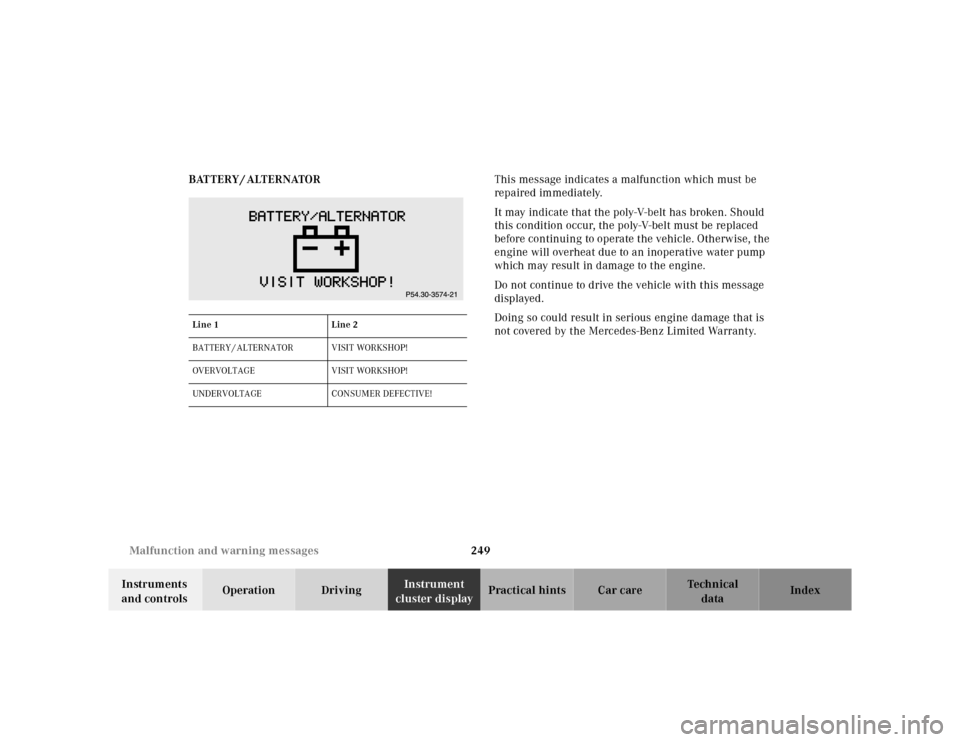
cluster displayPractical hints Car care Index BATTERY / ALTERNATORThis message indicates a malfunction which must be
repaired immediately.
It may indicate that the poly-V-belt has broken. Should
this condition occur, the poly-V-belt must be replaced
before continuing to operate the vehicle. Otherwise, the
engine will overheat due to an inoperative water pump
which may result in damage to the engine.
Do not continue to drive the vehicle with this message
displayed.
Doing so could result in serious engine damage that is
not covered by the Mercedes-Benz Limited Warranty.
Line 1 Line 2
BATTERY / ALTERNATOR VISIT WORKSHOP!
OVERVOLTAGE V ISIT WORKS HOP!
UNDERVOLTAGE CONSUMER DEFECTIVE!
Page 263 of 345
260 Malfunction and warning messages
Te ch n ica l
data Instruments
and controlsOperation DrivingInstrument
cluster displayPractical hints Car care Index
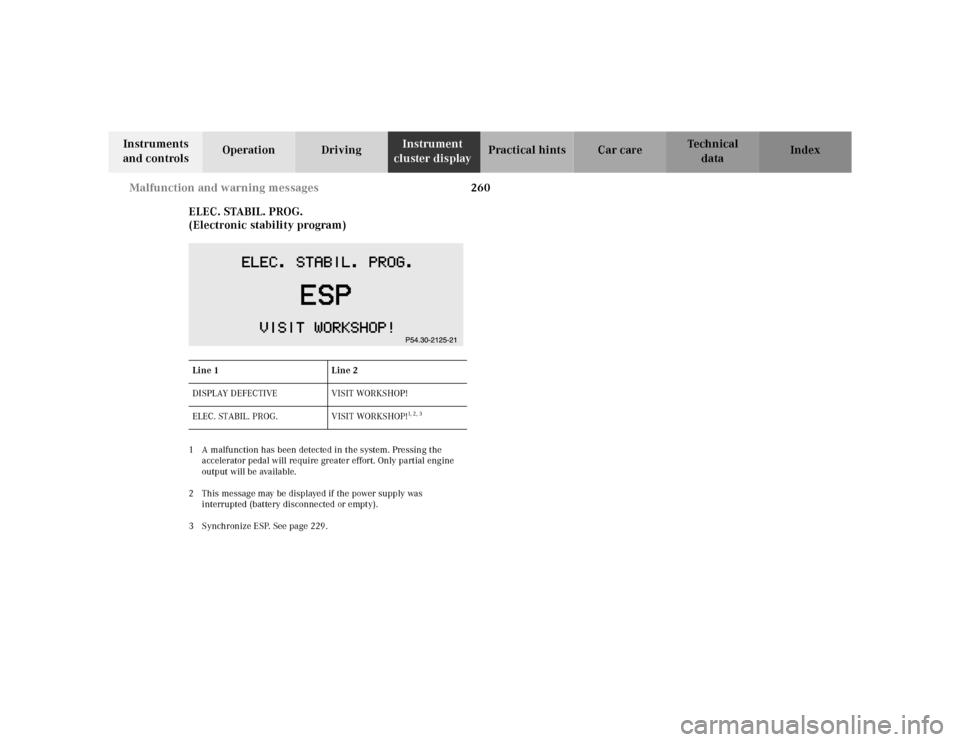
ELEC. STABIL. PROG.
(Electronic stability program)
1 A malfunction has been detected in the system. Pressing the
accelerator pedal will require greater effort. Only partial engine
output will be available.
2 This message may be displayed if the power supply was
interrupted (battery disconnected or empty).
3 Synchronize ESP. See page 229.Line 1 Line 2
DISPLAY DEFECTIVE VISIT WORKSHOP!
ELEC. STABIL. PROG. VISIT WORKSHOP!
1, 2 , 3
Page 264 of 345
261 Contents - Practical hints
Te ch n ica l
data Instruments
and controlsOperation DrivingInstrument
cluster displayPractical hintsCar care Index
Practical hintsFirst aid kit...................................... 262
Fuses ................................................ 263
Electrical outlet .............................. 265
Hood ................................................. 266
Checking engine oil level ............. 268
Automatic transmission
fluid level ................................... 269
Coolant level ................................... 269
Adding coolant ...........................270
Windshield and headlamp
washer system ........................... 271
Windshield and headlamp
washer fluid mixing ratio ......... 271Spare wheel, vehicle tools............ 272
Vehicle jack .................................... 273
Wheels ............................................ 274
Tire replacement ........................274
Rotating wheels ......................... 275
Spare wheel..................................... 276
Spare wheel bolts .......................276
Changing wheels........................... 277
Tire inflation pressure ................. 282
Battery............................................. 283
Jump starting.................................. 285
Towing the vehicle ........................ 288
Transmission selector lever,
manually unlocking ................. 290Exterior lamps ................................ 291
Headlamp assembly ...................292
Taillamp assemblies ..................295
Changing batteries in the
electronic main key .................. 298
Synchronizing
remote control ............................300
Emergency engine
shut-down................................... 300
Emergency operation of
sliding / pop-up roof ................. 301
Manual release for
fuel filler flap ............................. 302
Replacing wiper blade insert ....... 302
Roof rack ......................................... 305
Page 267 of 345
264 Fuses
Te ch n ica l
data Instruments
and controlsOperation DrivingInstrument
cluster displayPractical hintsCar care Index
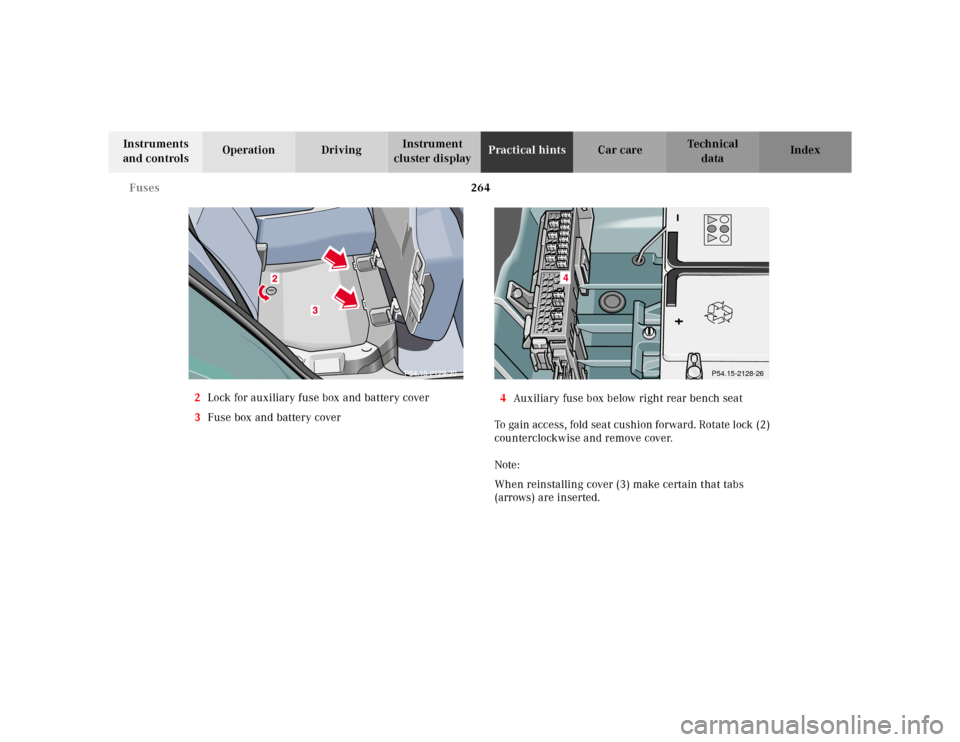
2Lock for auxiliary fuse box and battery cover
3Fuse box and battery cover4Auxiliary fuse box below right rear bench seat
To gain access, fold seat cushion forward. Rotate lock (2)
counterclockwise and remove cover.
Note:
When reinstalling cover (3) make certain that tabs
(arrows) are inserted.
4
P54.15-2128-26
Page 286 of 345
283 Battery
Te ch n ica l
data Instruments
and controlsOperation DrivingInstrument
cluster displayPractical hintsCar care Index If a tire constantly loses air, it should be inspected for
damage.
The spare tire should be checked periodically for
condition and inflation. Spare tire will age and become
worn over time even if never used, and thus should be
inspected and replaced when necessary.Battery
Important!
Battery replacement information:
The maintenance-free battery is located under the rear
seat cushion. To minimize the chance for acid leakage
which could cause severe burns during a crash or
rollover, a special acid leakage resistant battery was
factory installed. A replacement battery for the vehicle
Wa r n i n g !
Do not overinflate tires. Overinflating tires can
result in sudden deflation (blowout) because they
are more likely to become punctured or damaged
by road debris, potholes etc.. Follow recommended
inflation pressures.Do not overload the tires by exceeding the specified
vehicle capacity weight (as indicated by the label
on the driver’s door latch post). Overloading the
tires can overheat them, possibly causing a
blowout.
Wa r n i n g !
Failure to follow these instructions can result in
severe injury or death.Never lean over batteries while connecting, you
might get injured.Battery fluid contains sulfuric acid. Do not allow
this fluid to come in contact with eyes, skin or
clothing. In case it does, immediately flush affected
area with water and seek medical help if necessary.A battery will also produce hydrogen gas, which is
flammable and explosive. Keep flames or sparks
away from battery, avoid improper connection of
jumper cables, smoking etc..
Page 287 of 345
284 Battery
Te ch n ica l
data Instruments
and controlsOperation DrivingInstrument
cluster displayPractical hintsCar care Index
must not leak acid when upside down for at least
15 minutes. Your authorized Mercedes-Benz Center can
provide such a special battery.
The service life of the battery is dependent on its
condition of charge. The battery should always be kept
sufficiently charged, in order to last an optimum length
of time.
Therefore, we strongly recommend that you have the
battery charge checked frequently, and corrected if
necessary, especially if you use the vehicle less than
approximately 200 miles (300 km) per month,
mostly for short distance trips, or if it is not used for
long periods of time.
Only charge a battery with a battery charger after the
battery has been disconnected from the vehicle’s
electrical circuit.
Always disconnect the battery negative lead first and
connect last.
When removing and connecting the battery, always
make sure that all electrical consumers are off and the
electronic key is in steering lock position 0. The battery,
its filler caps, the vent tube and the opposite plug must
always be securely installed when the vehicle in operation. During removal and installation always
protect the disconnected battery positive (+) terminal
with the cover attached to the battery.
While the engine is running the battery terminal clamps
must not be loosened or detached, otherwise the
generator and other electronic components would be
damaged.
Note:
After reconnecting the battery also resynchronize the
front seat head restraints, the express feature of the
power windows, and the electronic stability program
(ESP), see page 46, 156 and 229.
Battery recycling
Batteries contain material that can harm the
environment with improper disposal.
Large 12 Volt storage batteries contain lead.
Recycling of batteries is the preferred method of
disposal.
Many states require sellers of batteries to accept old
batteries for recycling.
Page 288 of 345
285 Jump starting
Te ch n ica l
data Instruments
and controlsOperation DrivingInstrument
cluster displayPractical hintsCar care Index Jump startingImportant!
A discharged battery can freeze at approximately +14°F
(–10°C). In that case, it must be thawed out before
jumper cables are used. Attempting to jump start a
frozen battery can result in it exploding, causing
personal injury.
Jumper cable specifications:
•Minimum cable cross-section of 25 mm
2 or
approximately 2 AWG
•Maximum length of 11.5 ft. (3.5 m).
If the battery is discharged, the engine should be started
with jumper cables and the (12 V) battery of another
vehicle.
Only use 12 V battery to jump start your vehicle. Jump
starting with more powerful battery could damage the
vehicle’s electrical systems, which will not be covered
by the Mercedes-Benz Limited Warranty.
Jump start the car by using the battery terminals located
under hood.
Wa r n i n g !
Failure to follow these directions will cause
damage to the electronic components, and can lead
to a battery explosion and severe injury or death.Never lean over batteries while connecting or jump
starting, you might get injured.Battery fluid contains sulfuric acid. Do not allow
this fluid to come in contact with eyes, skin or
clothing. In case it does, immediately flush affected
area with water, and seek medical help if
necessary.A battery will also produce hydrogen gas, which is
flammable and very explosive. Keep flames or
sparks away from battery, avoid improper
connection of jumper cables, smoking etc..Read all instructions before proceeding.
Page 289 of 345
286 Jump starting
Te ch n ica l
data Instruments
and controlsOperation DrivingInstrument
cluster displayPractical hintsCar care Index
Proceed as follows:
1. Position the vehicle with the charged battery so that
the jumper cables will reach, but never let the
vehicles touch. Make sure the jumper cables do not
have loose or missing insulation.
2. On both vehicles:
•Turn off engine and all lights and accessories,
except hazard warning f lashers or work lights.
•Apply parking brake and shift selector lever to
position “P”.
Important!
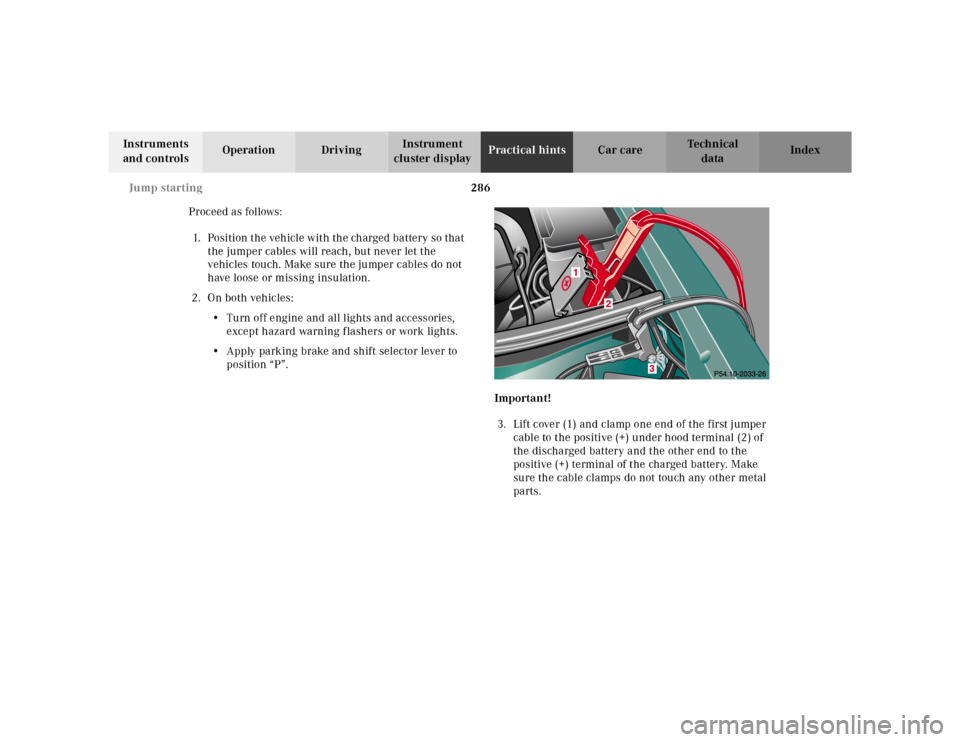
3. Lift cover (1) and clamp one end of the first jumper
cable to the positive (+) under hood terminal (2) of
the discharged battery and the other end to the
positive (+) terminal of the charged battery. Make
sure the cable clamps do not touch any other metal
parts.
Page 290 of 345
287 Jump starting
Te ch n ica l
data Instruments
and controlsOperation DrivingInstrument
cluster displayPractical hintsCar care Index 4. Clamp one end of the second jumper cable to the
grounded negative (–) terminal of the charged
battery and the final connection to the negative (–)
under hood terminal (3) of the disabled vehicle.
Important!
5. Start engine of the vehicle with the charged battery
and run at high idle. Make sure the cables are not
on or near pulleys, fans, or other parts that move
when the engine is started. Allow the discharged
battery to charge for a few minutes. Start engine of
the disabled vehicle in the usual manner.6. After the engine has started, remove jumper cables
by exactly reversing the above installation
sequence, starting with the last connection made
first. When removing each clamp, make sure that it
does not touch any other metal while the other end
is still attached.
Note:
If engine does not run after several unsuccessful
starting attempts, have it checked at the nearest
authorized Mercedes-Benz Center.
Excessive unburned fuel may damage the catalytic
converter.