light MERCEDES-BENZ E-Class WAGON 2012 W212 User Guide
[x] Cancel search | Manufacturer: MERCEDES-BENZ, Model Year: 2012, Model line: E-Class WAGON, Model: MERCEDES-BENZ E-Class WAGON 2012 W212Pages: 396, PDF Size: 17.07 MB
Page 19 of 396
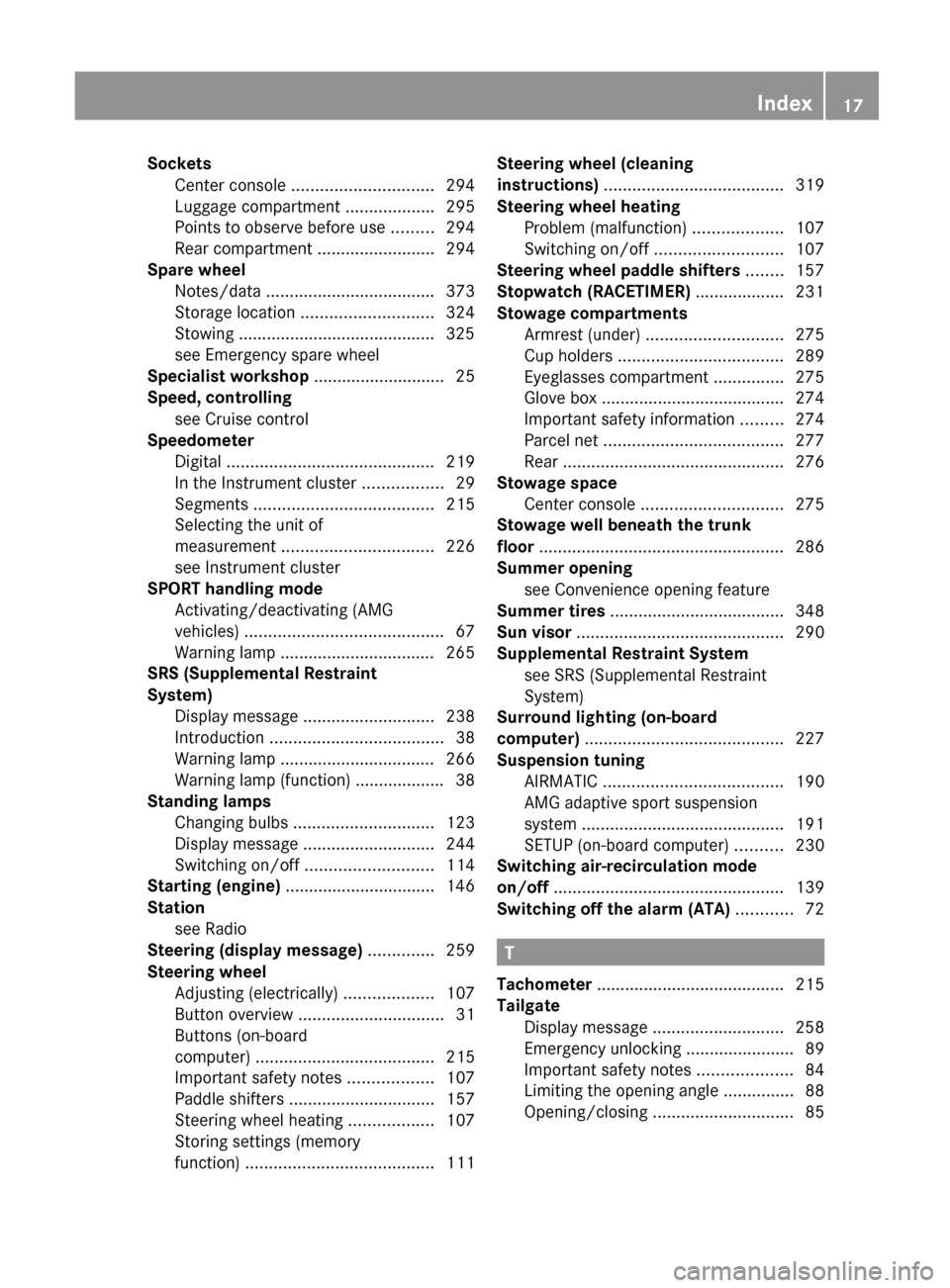
SocketsCenter console .............................. 294
Luggage compartment ...................295
Points to observe before use .........294
Rear compartment .........................294
Spare wheel
Notes/data .................................... 373
Storage location ............................ 324
Stowing .......................................... 325
see Emergency spare wheel
Specialist workshop ............................ 25
Speed, controlling see Cruise control
Speedometer
Digital ............................................ 219
In the Instrument cluster .................29
Segments ...................................... 215
Selecting the unit of
measurement ................................ 226
see Instrument cluster
SPORT handling mode
Activating/deactivating (AMG
vehicles) .......................................... 67
Warning lamp ................................. 265
SRS (Supplemental Restraint
System) Display message ............................ 238
Introduction ..................................... 38
Warning lamp ................................. 266
Warning lamp (function) ................... 38
Standing lamps
Changing bulbs .............................. 123
Display message ............................ 244
Switching on/off ........................... 114
Starting (engine) ................................ 146
Station see Radio
Steering (display message) .............. 259
Steering wheel Adjusting (electrically) ...................107
Button overview ............................... 31
Buttons (on-board
computer) ...................................... 215
Important safety notes ..................107
Paddle shifters ............................... 157
Steering wheel heating ..................107
Storing settings (memory
function) ........................................ 111Steering wheel (cleaning
instructions) ...................................... 319
Steering wheel heating Problem (malfunction) ...................107
Switching on/off ........................... 107
Steering wheel paddle shifters ........ 157
Stopwatch (RACETIMER) ................... 231
Stowage compartments Armrest (under) ............................. 275
Cup holders ................................... 289
Eyeglasses compartment ...............275
Glove box ....................................... 274
Important safety information .........274
Parcel net ...................................... 277
Rear ............................................... 276
Stowage space
Center console .............................. 275
Stowage well beneath the trunk
floor .................................................... 286
Summer opening see Convenience opening feature
Summer tires ..................................... 348
Sun visor ............................................ 290
Supplemental Restraint System see SRS (Supplemental Restraint
System)
Surround lighting (on-board
computer) .......................................... 227
Suspension tuning AIRMATIC ...................................... 190
AMG adaptive sport suspension
system ........................................... 191
SETUP (on-board computer) ..........230
Switching air-recirculation mode
on/off ................................................. 139
Switching off the alarm (ATA) ............ 72
T
Tachometer ........................................ 215
Tailgate Display message ............................ 258
Emergency unlocking .......................89
Important safety notes ....................84
Limiting the opening angle ...............88
Opening/closing .............................. 85
Index17
Page 30 of 396
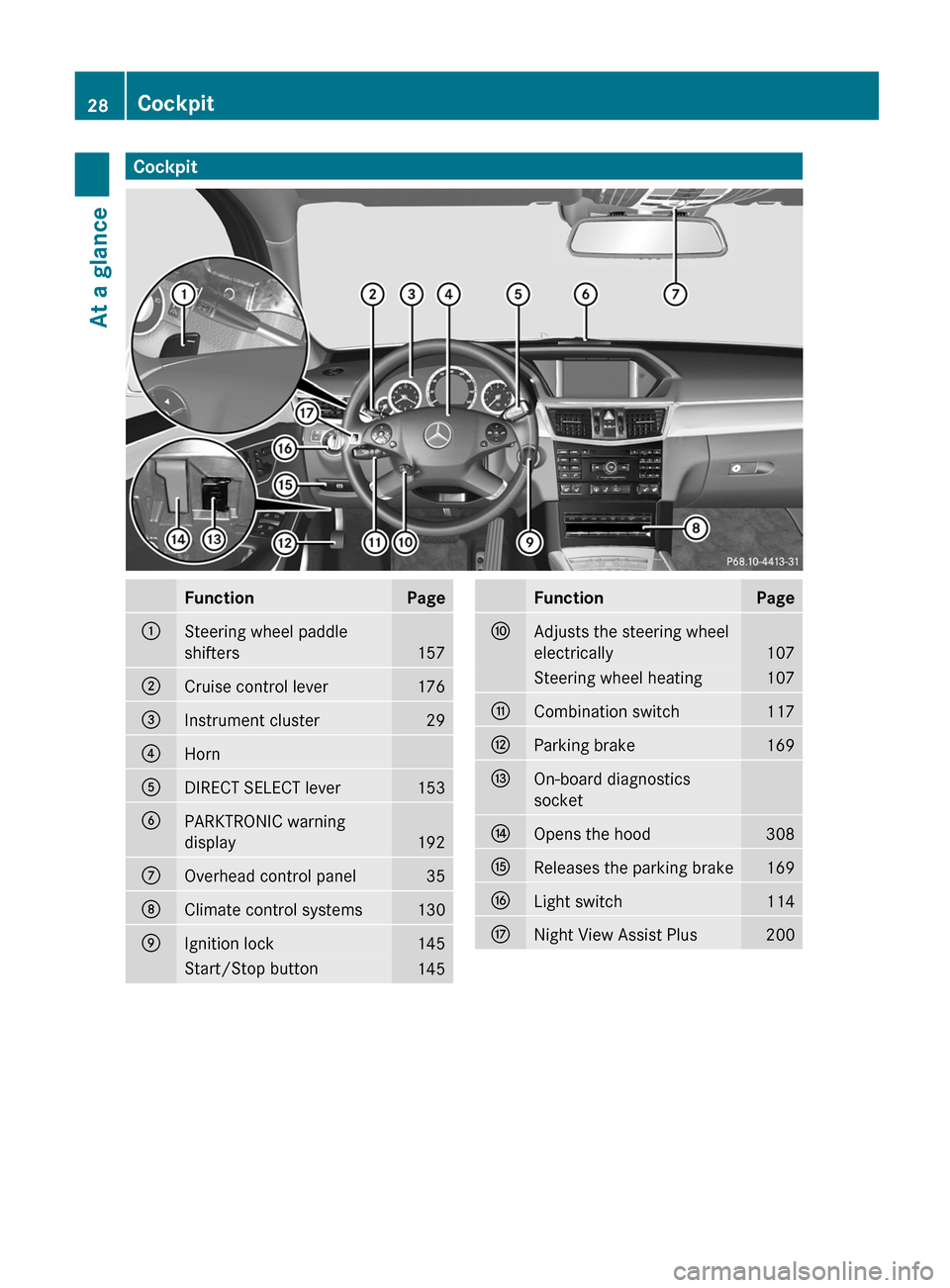
CockpitFunctionPage:Steering wheel paddle
shifters
157
;Cruise control lever176=Instrument cluster29?HornADIRECT SELECT lever153BPARKTRONIC warning
display
192
COverhead control panel35DClimate control systems130EIgnition lock145Start/Stop button145FunctionPageFAdjusts the steering wheel
electrically
107
Steering wheel heating107GCombination switch117HParking brake169IOn-board diagnostics
socketJOpens the hood308KReleases the parking brake169LLight switch114MNight View Assist Plus20028CockpitAt a glance
Page 31 of 396
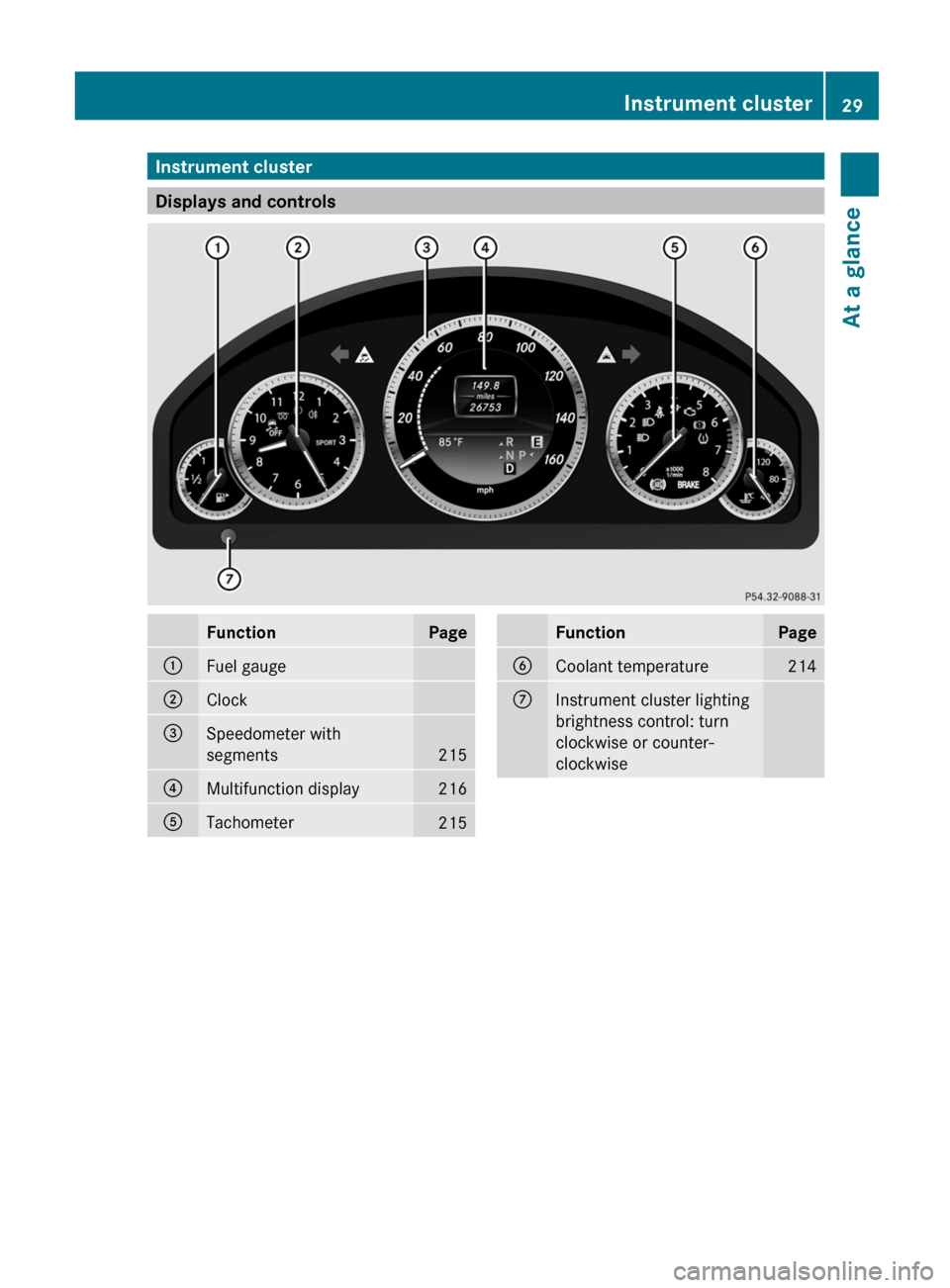
Instrument cluster
Displays and controls
FunctionPage:Fuel gauge;Clock=Speedometer with
segments
215
?Multifunction display216ATachometer215FunctionPageBCoolant temperature214CInstrument cluster lighting
brightness control: turn
clockwise or counter-
clockwiseInstrument cluster29At a glance
Page 35 of 396
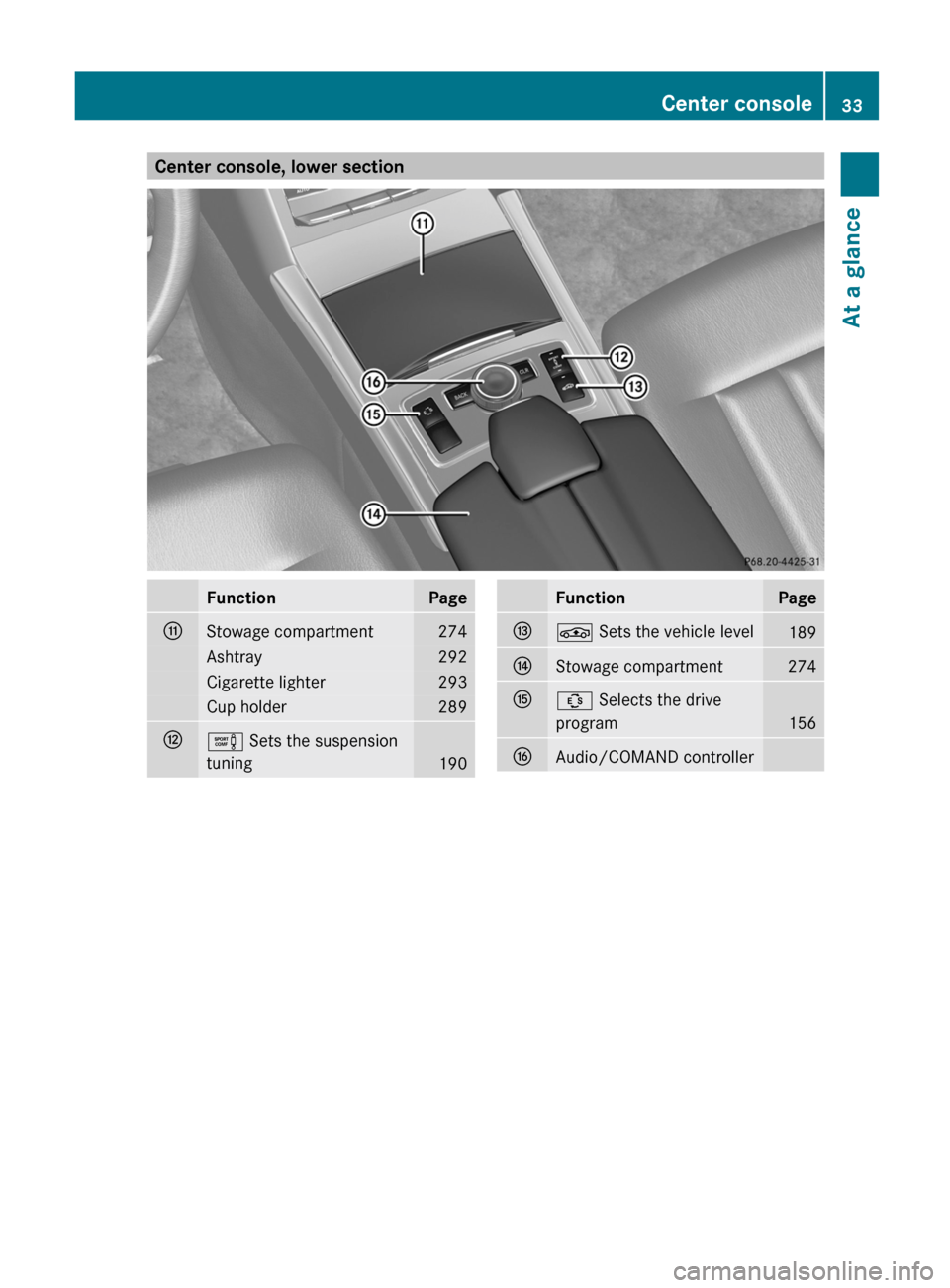
Center console, lower sectionFunctionPageGStowage compartment274Ashtray292Cigarette lighter293Cup holder289He Sets the suspension
tuning
190
FunctionPageIÉ Sets the vehicle level189JStowage compartment274KÛ Selects the drive
program
156
LAudio/COMAND controllerCenter console33At a glance
Page 36 of 396
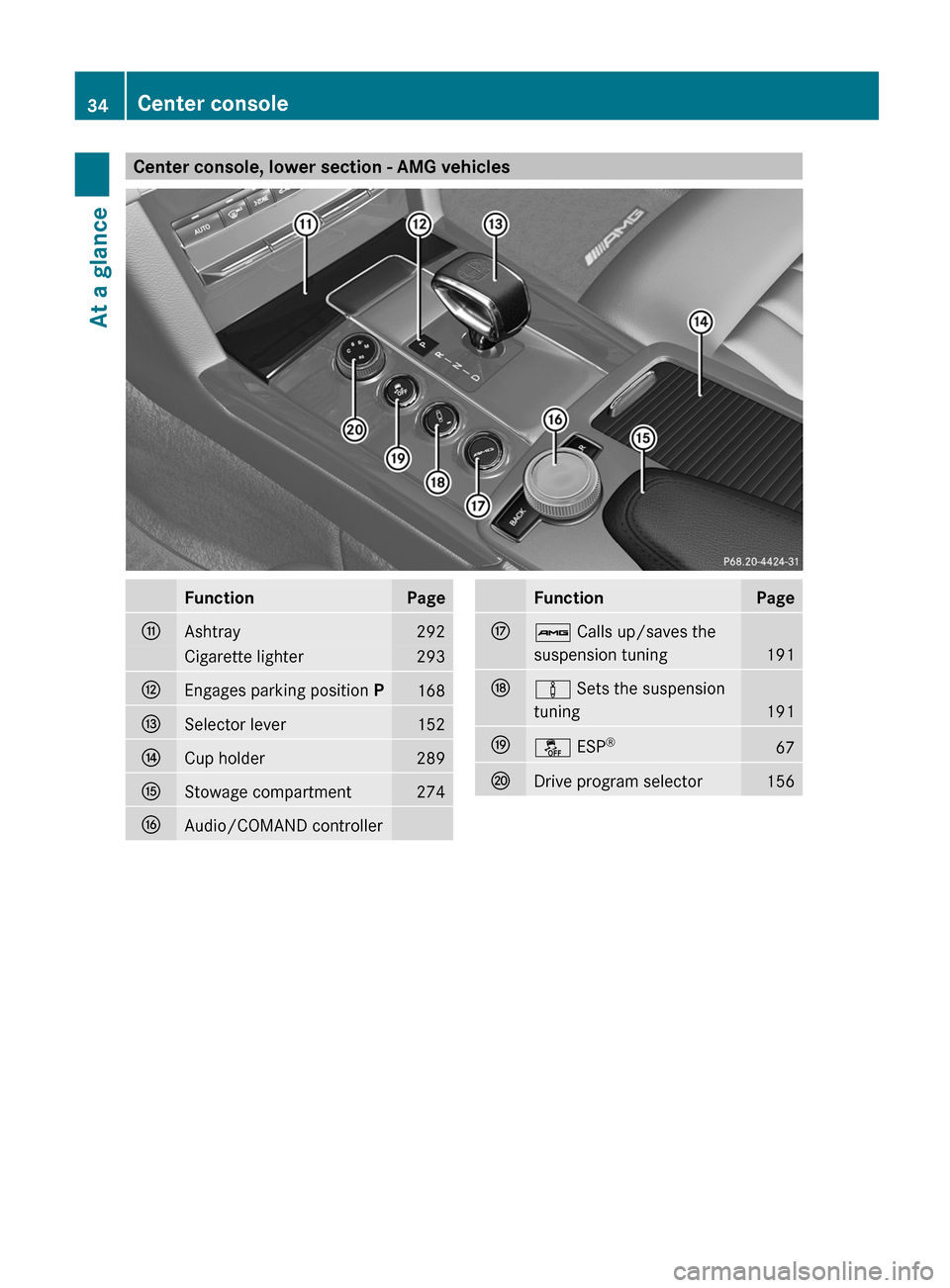
Center console, lower section - AMG vehiclesFunctionPageGAshtray292Cigarette lighter293HEngages parking position P168ISelector lever152JCup holder289KStowage compartment274LAudio/COMAND controllerFunctionPageMß Calls up/saves the
suspension tuning
191
Nà Sets the suspension
tuning
191
Oå ESP®67PDrive program selector15634Center consoleAt a glance
Page 37 of 396
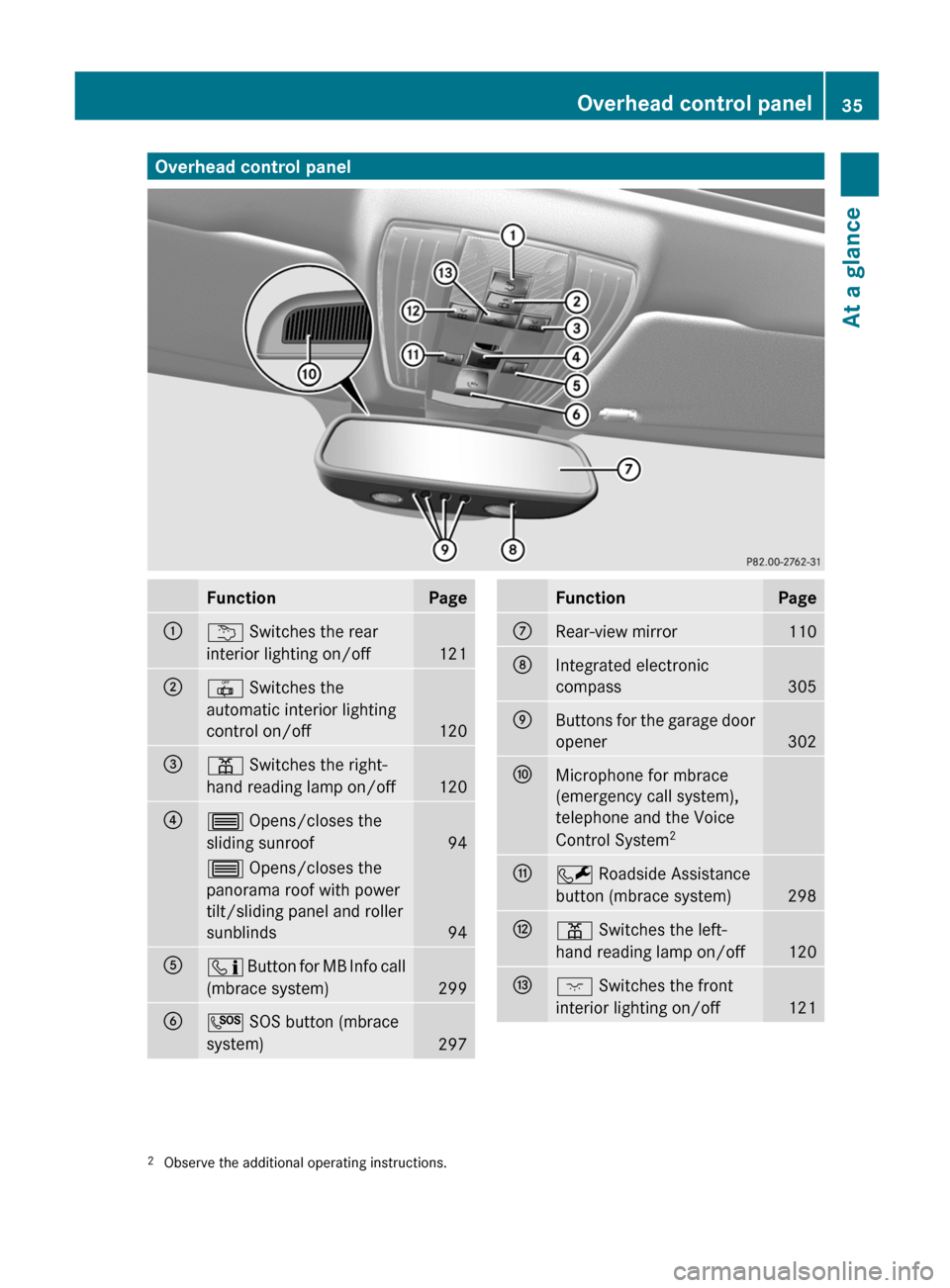
Overhead control panelFunctionPage:u Switches the rear
interior lighting on/off
121
;| Switches the
automatic interior lighting
control on/off
120
=p Switches the right-
hand reading lamp on/off
120
?3 Opens/closes the
sliding sunroof
94
3 Opens/closes the
panorama roof with power
tilt/sliding panel and roller
sunblinds
94
Aï Button for MB Info call
(mbrace system)
299
BG SOS button (mbrace
system)
297
FunctionPageCRear-view mirror110DIntegrated electronic
compass
305
EButtons for the garage door
opener
302
FMicrophone for mbrace
(emergency call system),
telephone and the Voice
Control System 2GF
Roadside Assistance
button (mbrace system)
298
Hp Switches the left-
hand reading lamp on/off
120
Ic Switches the front
interior lighting on/off
1212 Observe the additional operating instructions.Overhead control panel35At a glance
Page 40 of 396
Useful information
i This Operator's Manual describes all
models and all standard and optional
equipment of your vehicle available at the
time of publication of the Operator's
Manual. Country-specific differences are
possible. Please note that your vehicle may
not be equipped with all features
described. This also applies to safety-
related systems and functions.
i Please read the information on qualified
specialist workshops ( Y page 25).
Occupant safety
Overview of occupant safety
In this section, you will learn the most
important facts about the restraint system
components of the vehicle.
The restraint system consists of:
R seat belts
R child restraint systems
R LATCH-type (ISOFIX) child seat anchors
Additional protection is provided by:
R SRS (Supplemental Restraint System)
R NECK-PRO head restraints
R PRE-SAFE ®
R Air bag system components with:
- PASSENGER AIR BAG OFF indicator lamp
- front-passenger seat with Occupant
Classification System (OCS)
The different air bag systems work
independently of each other. The protective
functions of the system work in conjunction
with each other. Not all air bags are deployed
in an accident.
GWARNING
Modifications to or work improperly
conducted on restraint system components
or their wiring, as well as tampering with
interconnected electronic systems, can lead
to the restraint systems no longer functioning
as intended.
Air bags or Emergency Tensioning Devices
(ETDs), for example, could deploy
inadvertently or fail to deploy in accidents
although the deceleration threshold for air
bag deployment is exceeded. Therefore,
never modify the restraint systems. Do not
tamper with electronic components or their
software.
i See "Children in the vehicle"
( Y page 56) for more information on
infants and children traveling with you in
the vehicle and restraints for infants and
children.
SRS (Supplemental Restraint System)
Introduction
SRS consists of:
R the 6 SRS warning lamp
R air bags
R air bag control unit (with crash sensors)
R Emergency Tensioning Devices
R belt force limiters
SRS reduces the risk of occupants coming
into contact with the vehicle's interior in the
event of an accident. It can also reduce the
effect of the forces to which occupants are
subjected during an accident.
SRS warning lamp
SRS functions are checked regularly when
you switch on the ignition and when the
engine is running. Therefore, malfunctions
can be detected in good time.
The 6 SRS warning lamp in the instrument
cluster lights up when the ignition is switched
on. It goes out no later than a few seconds
after the engine is started.
The SRS components are in operational
readiness when the 6 SRS warning lamp
is not lit while the engine is running .
38Occupant safetySafety
Page 44 of 396
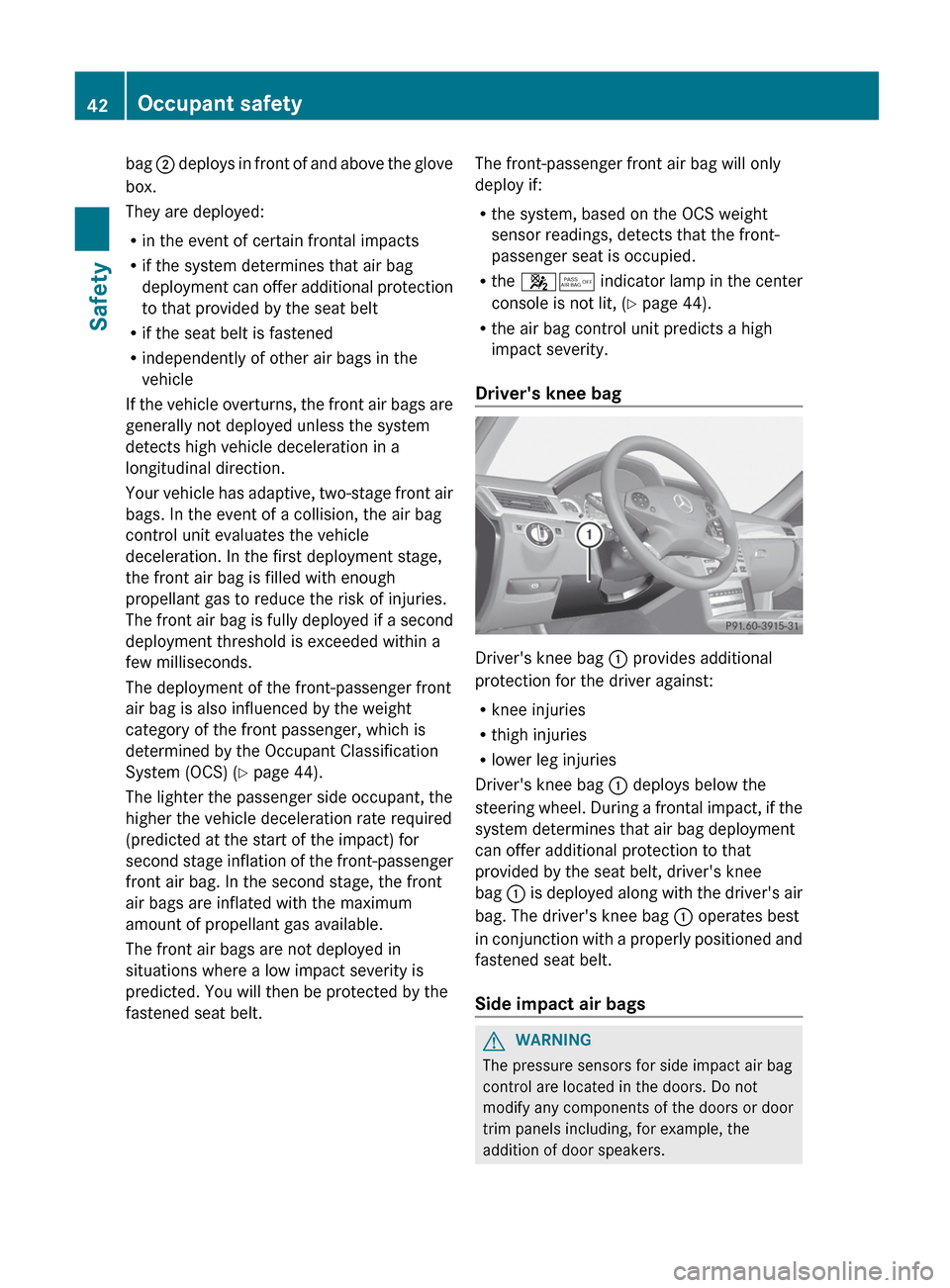
bag ; deploys in front of and above the glove
box.
They are deployed:
R in the event of certain frontal impacts
R if the system determines that air bag
deployment can offer additional protection
to that provided by the seat belt
R if the seat belt is fastened
R independently of other air bags in the
vehicle
If the vehicle overturns, the front air bags are
generally not deployed unless the system
detects high vehicle deceleration in a
longitudinal direction.
Your vehicle has adaptive, two-stage front air
bags. In the event of a collision, the air bag
control unit evaluates the vehicle
deceleration. In the first deployment stage,
the front air bag is filled with enough
propellant gas to reduce the risk of injuries.
The front air bag is fully deployed if a second
deployment threshold is exceeded within a
few milliseconds.
The deployment of the front-passenger front
air bag is also influenced by the weight
category of the front passenger, which is
determined by the Occupant Classification
System (OCS) ( Y page 44).
The lighter the passenger side occupant, the
higher the vehicle deceleration rate required
(predicted at the start of the impact) for
second stage inflation of the front-passenger
front air bag. In the second stage, the front
air bags are inflated with the maximum
amount of propellant gas available.
The front air bags are not deployed in
situations where a low impact severity is
predicted. You will then be protected by the
fastened seat belt.The front-passenger front air bag will only
deploy if:
R the system, based on the OCS weight
sensor readings, detects that the front-
passenger seat is occupied.
R the 45 indicator lamp in the center
console is not lit, ( Y page 44).
R the air bag control unit predicts a high
impact severity.
Driver's knee bag
Driver's knee bag : provides additional
protection for the driver against:
R knee injuries
R thigh injuries
R lower leg injuries
Driver's knee bag : deploys below the
steering wheel. During a frontal impact, if the
system determines that air bag deployment
can offer additional protection to that
provided by the seat belt, driver's knee
bag : is deployed along with the driver's air
bag. The driver's knee bag : operates best
in conjunction with a properly positioned and
fastened seat belt.
Side impact air bags
GWARNING
The pressure sensors for side impact air bag
control are located in the doors. Do not
modify any components of the doors or door
trim panels including, for example, the
addition of door speakers.
42Occupant safetySafety
Page 49 of 396
RIf you place a child in a forward-facing child
restraint on the front-passenger seat:
- move the seat as far back as possible
- use the proper child restraint
recommended for the age, size and
weight of the child
- secure child restraint with the vehicle's
seat belt according to the child seat
manufacturer's instructions
R For children larger than the typical 12-
month-old child, the front-passenger front
air bag may or may not be activated.
If the driver's air bag deploys, this does not
mean that the front-passenger front air bag
also has to deploy.
The OCS may have detected that the seat:
R was empty or occupied by a person with a
weight of up to or less than that of a typical
12-month-old child seated in a standard
child restraint
R was occupied by a small individual, such as
a young teenager or a small adult
R was occupied by a child in a child restraint
system, whose weight is greater than that
of a typical 12-month-old child.
These are examples of when the OCS
deactivates the front-passenger front air bag.
Deactivation takes place although the
collision fulfills the criteria for deploying the
driver's air bag.
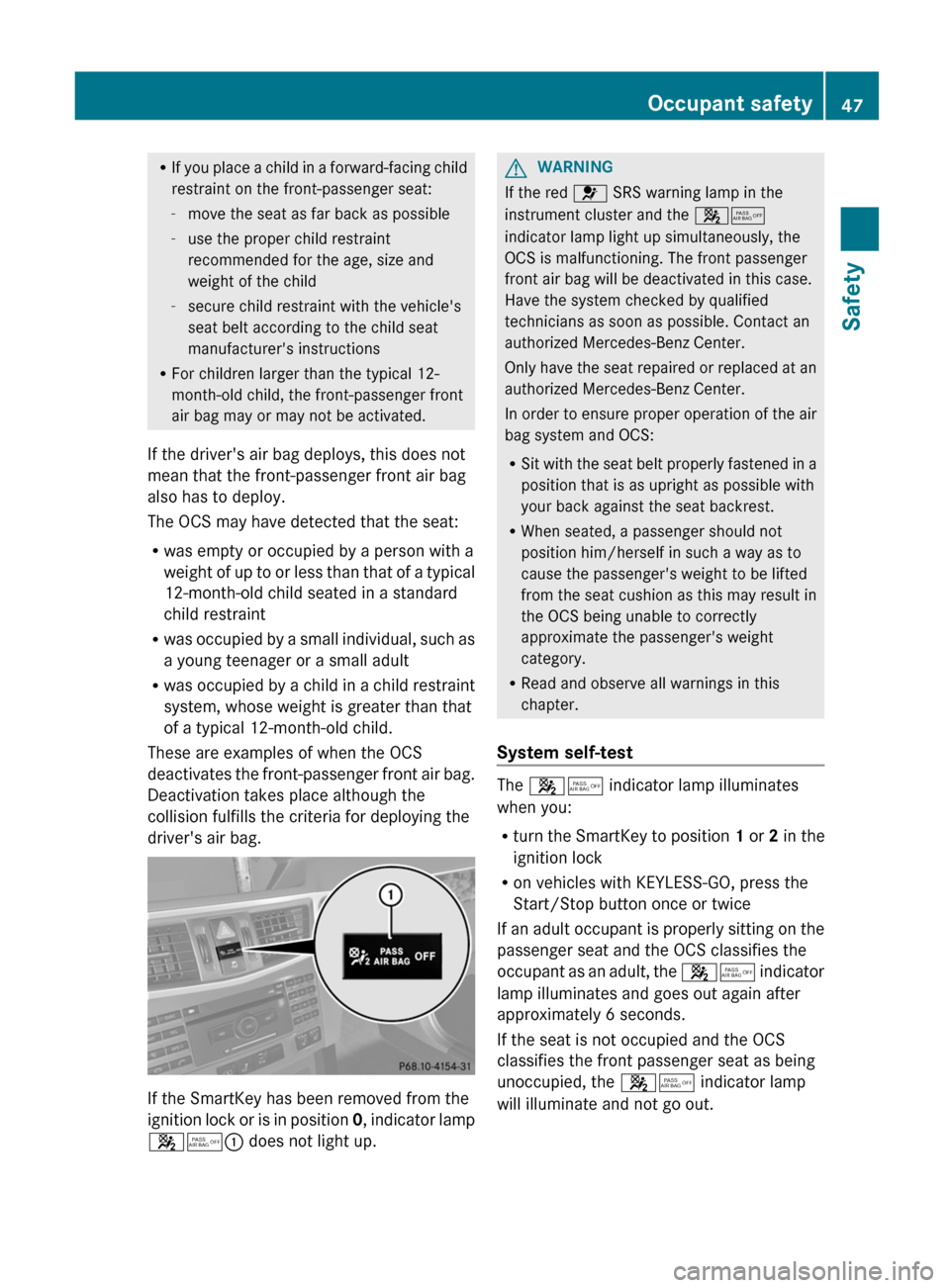
If the SmartKey has been removed from the
ignition lock or is in position 0, indicator lamp
45 : does not light up.
GWARNING
If the red 6 SRS warning lamp in the
instrument cluster and the 45
indicator lamp light up simultaneously, the
OCS is malfunctioning. The front passenger
front air bag will be deactivated in this case.
Have the system checked by qualified
technicians as soon as possible. Contact an
authorized Mercedes-Benz Center.
Only have the seat repaired or replaced at an
authorized Mercedes-Benz Center.
In order to ensure proper operation of the air
bag system and OCS:
R Sit with the seat belt properly fastened in a
position that is as upright as possible with
your back against the seat backrest.
R When seated, a passenger should not
position him/herself in such a way as to
cause the passenger's weight to be lifted
from the seat cushion as this may result in
the OCS being unable to correctly
approximate the passenger's weight
category.
R Read and observe all warnings in this
chapter.
System self-test
The 45 indicator lamp illuminates
when you:
R turn the SmartKey to position 1 or 2 in the
ignition lock
R on vehicles with KEYLESS-GO, press the
Start/Stop button once or twice
If an adult occupant is properly sitting on the
passenger seat and the OCS classifies the
occupant as an adult, the 45 indicator
lamp illuminates and goes out again after
approximately 6 seconds.
If the seat is not occupied and the OCS
classifies the front passenger seat as being
unoccupied, the 45 indicator lamp
will illuminate and not go out.
Occupant safety47SafetyZ
Page 52 of 396
PRE-SAFE®
(preventative occupant
protection)GWARNING
The PRE-SAFE ®
system reduces the impact of
an accident on vehicle occupants, as long as
their seat belts have been fastened correctly.
Although your vehicle is equipped with a PRE-
SAFE ®
system, the possibility of injury in the
event of an accident cannot be ruled out. You
should therefore always drive carefully and
adapt your driving style to the prevailing road,
weather and traffic conditions.
PRE-SAFE ®
takes preemptive measures to
protect occupants in certain hazardous
situations.
PRE-SAFE ®
intervenes:
R in emergency braking situations, e.g. if BAS
is activated or, in vehicles with DISTRONIC
PLUS, BAS PLUS intervenes powerfully
R if the radar sensor system detects an
imminent danger of collision in certain
situations (on vehicles with DISTRONIC
PLUS)
R in critical driving situations, e.g. when
physical limits are exceed and the vehicle
understeers or oversteers severely
PRE-SAFE ®
takes the following measures
depending on the hazardous situation
detected:
R the front seat belts are pre-tensioned.
R it adjusts the front-passenger seat if it is in
an unfavorable position.
R the air pressure in the side bolsters of the
seat cushion and seat backrest of the front
active multicontour seats is increased.
R if the vehicle skids, the sliding sunroof/
panorama roof with power tilt/sliding
panel and the side windows are closed so
that only a small gap remains.
If the hazardous situation passes without
resulting in an accident, PRE-SAFE ®
slackens
the belt pretensioning. The air pressure in the
side bolsters on the active multicontour seat
is reduced again. All settings made by PRE-
SAFE ®
can then be reversed.
If the seat belts are not released:XMove the backrest or seat back slightly, but
only when the vehicle is stationary.
The belt pretensioning is reduced and the
locking mechanism is released.GWARNING
Make sure that nobody can become trapped
as you adjust the seat.
! Make sure that there are no objects in the
footwell or behind the seats when resetting
the seats. There is a risk that the seats
and/or the objects could be damaged.
More information about seat-belt
adjustment, a convenience function
integrated into PRE-SAFE ®
, can be found in
the "Seat-belt adjustment" section
( Y page 54).
NECK-PRO head restraints
The NECK-PRO head restraints increase
protection to the driver's and front
passenger's head and neck. To this end, the
NECK-PRO head restraints on the driver's and
front-passenger seats are moved forwards
and upwards in the event of a rear-end
collision of a certain severity. This provides
better head support.
GWARNING
Do not secure any objects (e.g. coat hangers)
on the NECK-PRO head restraints. Otherwise,
the NECK-PRO head restraints may not
function properly, or in the event of a rear-end
collision may not be able offer the level of
protection they are designed to provide.
GWARNING
Seat or head restraint covers can cause a
malfunction when the NECK-PRO head
restraints are activated or when the side
impact air bags or pelvis air bags are
50Occupant safetySafety