lock MERCEDES-BENZ E-Class WAGON 2012 W212 User Guide
[x] Cancel search | Manufacturer: MERCEDES-BENZ, Model Year: 2012, Model line: E-Class WAGON, Model: MERCEDES-BENZ E-Class WAGON 2012 W212Pages: 396, PDF Size: 17.07 MB
Page 20 of 396
Opening/closing (automatically
from inside) ...................................... 87
Opening/closing (automatically
from outside) ................................... 86
Tail lamps
Display message ............................ 243
Tank
see Fuel tank
Tank content
Fuel gauge ....................................... 29
Technical data
Notes ............................................. 380
Tires/wheels ................................. 371
Vehicle data ................................... 390
TELEAID
Call priority .................................... 300
Display message ............................ 237
Downloading destinations
(COMAND) ..................................... 300
Emergency call .............................. 297
Important safety notes ..................296
Locating a stolen vehicle ...............301
MB info call button ........................299
Remote vehicle locking ..................301
Roadside Assistance button ..........298
Search & Send ............................... 300
Self-test ......................................... 296
System .......................................... 296
Vehicle remote unlocking ..............300
Telephone
Accepting a call ............................. 223
Display message ............................ 259
Menu (on-board computer) ............222
Number from the phone book ........ 223
Redialing ........................................ 223
Rejecting/ending a call .................223
Telescopic rod (EASY-PACK load-
securing kit) ....................................... 286
Temperature Coolant .......................................... 214
Coolant (on-board computer) ......... 230
Engine oil (on-board computer) ...... 230
Outside temperature ...................... 215
Setting (climate control) ................136
Theft deterrent locking system
Immobilizer ...................................... 71
Through-loading ................................ 278
Through-loading feature ................... 279Tilt/sliding sunroof
see Sliding sunroof
Timing (RACETIMER) ......................... 231
Tiredness assistant see ATTENTION ASSIST
TIREFIT kit .......................................... 326
Tire pressure Calling up (on-board computer) .....355
Checking manually ........................353
Display message ............................ 254
Maximum ....................................... 352
Notes ............................................. 351
Not reached (TIREFIT) ....................327
Pressure loss warning ....................353
Reached (TIREFIT) ..........................328
Recommended ............................... 349
Tire pressure monitoring system
Function/notes ............................. 355
Restarting ...................................... 357
Warning lamp ................................. 271
Tires
Aspect ratio (definition) .................369
Average weight of the vehicle
occupants (definition) ....................368
Bar (definition) ............................... 367
Characteristics .............................. 367
Checking ........................................ 347
Definition of terms .........................367
Direction of rotation ......................371
Display message ............................ 254
Distribution of the vehicle
occupants (definition) ....................370
DOT, Tire Identification Number
(TIN) ............................................... 366
DOT (Department of
Transportation) (definition) ............367
GAWR (Gross Axle Weight Rating)
(definition) ..................................... 368
GVW (Gross Vehicle Weight)
(definition) ..................................... 368
GVWR (Gross Vehicle Weight
Rating) (definition) .........................368
Important safety notes ..................346
Increased vehicle weight due to
optional equipment (definition) ......368
Kilopascal (kPa) (definition) ...........369
Labeling (overview) ........................363
Load bearing index (definition) ......37018Index
Page 21 of 396
Load index ..................................... 366
Load index (definition) ...................369
Maximum loaded vehicle weight
(definition) ..................................... 368
Maximum load on a tire
(definition) ..................................... 369
Maximum permissible tire
pressure (definition) ....................... 369
Maximum tire load .........................361
Maximum tire load (definition) .......369
Optional equipment weight
(definition) ..................................... 369
PSI (pounds per square inch)
(definition) ..................................... 369
Replacing ....................................... 370
Service life ..................................... 347
Sidewall (definition) .......................369
Speed rating (definition) ................368
Storing ........................................... 371
Structure and characteristics
(definition) ..................................... 367
Temperature .................................. 363
TIN (Tire Identification Number)
(definition) ..................................... 370
Tire bead (definition) ......................369
Tire pressure (definition) ................369
Tire pressures (recommended) ......368
Tire size (data) ............................... 371
Tire size designation, load-bearing
capacity, speed rating .................... 364
Tire tread ....................................... 347
Tire tread (definition) .....................369
Total load limit (definition) .............370
Traction ......................................... 362
Traction (definition) .......................370
Tread wear ..................................... 362
Uniform Tire Quality Grading
Standards ...................................... 362
Uniform Tire Quality Grading
Standards (definition) ....................368
Unladen weight (definition) ............369
Wear indicator (definition) .............370
Wheel rim (definition) ....................368
see Flat tire
Top Tether ............................................ 60
Towing Important safety guidelines ...........340
Installing the towing eye ................340Removing the towing eye ...............341
With the rear axle raised ................341
Towing away
With both axles on the ground .......341
Tow-starting
Emergency engine starting ............342
Important safety notes ..................340
Transmission
see Automatic transmission
Transporting the vehicle .................. 342
Trim pieces (cleaning instructions) . 319
Trip computer (on-board
computer) .......................................... 219
Trip meter see Trip odometer
Trip odometer
Calling up ....................................... 219
Resetting (on-board computer) ......220
Trunk
Emergency release ..........................89
Important safety guidelines .............84
Locking separately ...........................88
Opening/closing (automatically
from inside) ...................................... 87
Opening/closing (automatically
from outside) ................................... 86
Trunk lid
Display message ............................ 258
Opening/closing .............................. 84
Turn signals
Changing bulbs (front) ...................124
Display message ............................ 242
Switching on/off ........................... 117
Type identification plate
see Vehicle identification plate
U
Unlocking Emergency unlocking .......................83
From inside the vehicle (central
unlocking button) ............................. 82
Index19
Page 22 of 396
V
Vanity mirror (in sun visor) .............. 291
Vehicle Correct use ...................................... 25
Data acquisition ............................... 26
Display message ............................ 257
Equipment ....................................... 22
Individual settings ..........................226
Limited Warranty ............................. 26
Loading .......................................... 358
Locking (in an emergency) ...............84
Locking (SmartKey) .......................... 75
Lowering ........................................ 333
Maintenance .................................... 23
Parking for a long period ................ 169
Pulling away ................................... 147
Raising ........................................... 330
Reporting problems .........................25
Towing away .................................. 340
Transporting .................................. 342
Unlocking (in an emergency) ...........83
Unlocking (SmartKey) ......................75
Vehicle data ................................... 390
Vehicle battery
see Battery (vehicle)
Vehicle data ....................................... 390
see Technical data
Vehicle dimensions ........................... 390
Vehicle emergency locking ................ 84
Vehicle identification number see VIN
Vehicle identification plate .............. 381
Vehicle level AIRMATIC ...................................... 189
Vehicle level (display message) ....... 249
Vehicle tool kit .................................. 322
Video (DVD) ........................................ 222
VIN ...................................................... 381
W
Warning and indicator lamps ABS ................................................ 264
Brakes ........................................... 263
Check Engine ................................. 267
Coolant .......................................... 268
Cruise control ................................ 176
Distance warning ........................... 270
DISTRONIC PLUS ........................... 270
ESP ®
.............................................. 264
ESP ®
OFF ....................................... 265
Fuel tank ........................................ 267
LIM (DISTRONIC PLUS) ..................180
Overview .......................................... 30
PASSENGER AIRBAG OFF
indicator lamp .................................. 44
Reserve fuel ................................... 267
Seat belt ........................................ 261
SPORT handling mode ...................265
SRS ................................................ 266
Tire pressure monitor ....................271
Warranty ............................................ 381
Washer fluid Display message ............................ 259
see Windshield washer system
Wheel bolt tightening torque ........... 333
Wheel chock ...................................... 329
Wheels Changing a wheel .......................... 329
Checking ........................................ 347
Cleaning ......................................... 315
Important safety notes ..................346
Interchanging/changing ................370
Mounting a wheel .......................... 332
Removing a wheel ..........................331
Storing ........................................... 371
Tightening torque ........................... 333
Wheel size/tire size .......................371
Window curtain air bag
Display message ............................ 239
Operation ......................................... 44
Windows
Cleaning ......................................... 317
see Side windows
Windshield
Defrosting ...................................... 138
Windshield washer system .............. 311
Notes ............................................. 389
Windshield wipers
Problem (malfunction) ...................126
Rear window wiper ........................125
Replacing the wiper blades ............125
Switching on/off ........................... 12420Index
Page 30 of 396
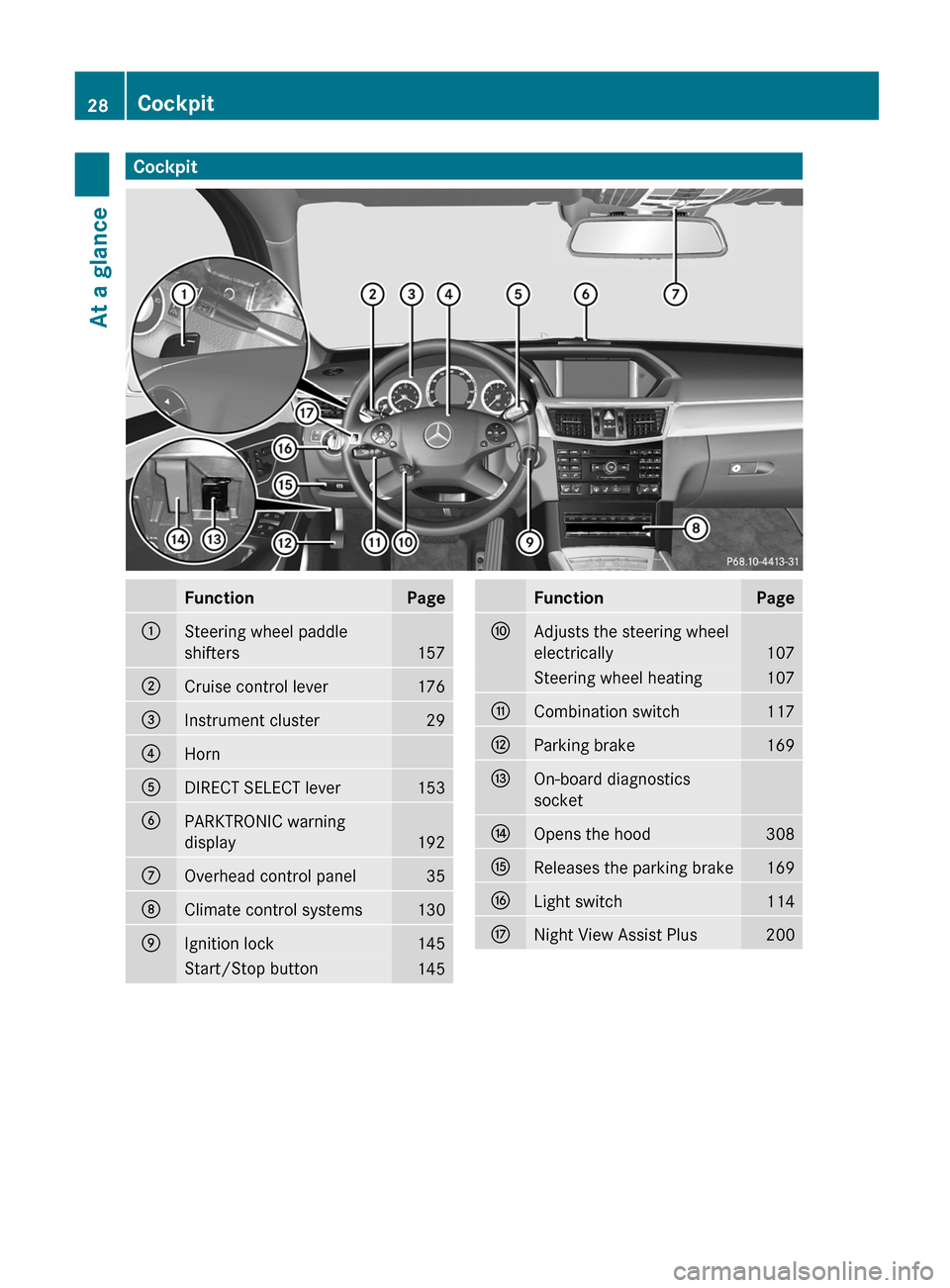
CockpitFunctionPage:Steering wheel paddle
shifters
157
;Cruise control lever176=Instrument cluster29?HornADIRECT SELECT lever153BPARKTRONIC warning
display
192
COverhead control panel35DClimate control systems130EIgnition lock145Start/Stop button145FunctionPageFAdjusts the steering wheel
electrically
107
Steering wheel heating107GCombination switch117HParking brake169IOn-board diagnostics
socketJOpens the hood308KReleases the parking brake169LLight switch114MNight View Assist Plus20028CockpitAt a glance
Page 31 of 396
Instrument cluster
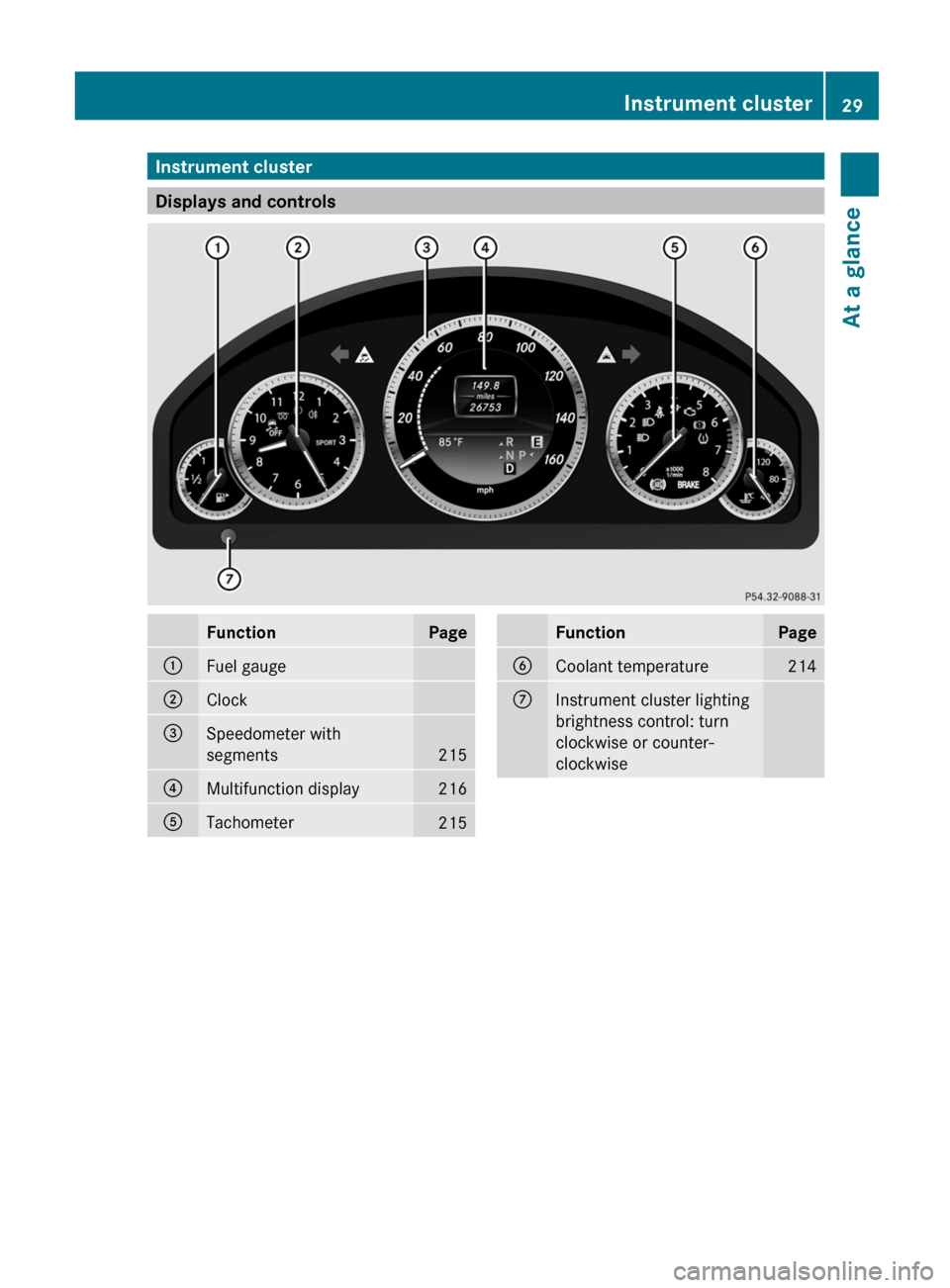
Displays and controls
FunctionPage:Fuel gauge;Clock=Speedometer with
segments
215
?Multifunction display216ATachometer215FunctionPageBCoolant temperature214CInstrument cluster lighting
brightness control: turn
clockwise or counter-
clockwiseInstrument cluster29At a glance
Page 38 of 396

Door control panelFunctionPage:r45=
Stores settings for the seat,
exterior mirrors and
steering wheel
111
;Adjusts the seat electrically100=%& Unlocks/locks
the vehicle
82
?Opens the door82A7 Zö\
Adjusts and folds the
exterior mirrors in/out
electrically
109
BW Opens/closes the
side windows
90
Cn Activates/
deactivates the override
feature for the side
windows in the rear
compartment
62
Dp Opens/closes the
trunk lid/tailgate
87
36Door control panelAt a glance
Page 39 of 396
Useful information ..............................38
Occupant safety .................................. 38
Children in the vehicle ........................56
Panic alarm .......................................... 62
Driving safety systems .......................63
Theft deterrent locking systems .......7137Safety
Page 49 of 396
RIf you place a child in a forward-facing child
restraint on the front-passenger seat:
- move the seat as far back as possible
- use the proper child restraint
recommended for the age, size and
weight of the child
- secure child restraint with the vehicle's
seat belt according to the child seat
manufacturer's instructions
R For children larger than the typical 12-
month-old child, the front-passenger front
air bag may or may not be activated.
If the driver's air bag deploys, this does not
mean that the front-passenger front air bag
also has to deploy.
The OCS may have detected that the seat:
R was empty or occupied by a person with a
weight of up to or less than that of a typical
12-month-old child seated in a standard
child restraint
R was occupied by a small individual, such as
a young teenager or a small adult
R was occupied by a child in a child restraint
system, whose weight is greater than that
of a typical 12-month-old child.
These are examples of when the OCS
deactivates the front-passenger front air bag.
Deactivation takes place although the
collision fulfills the criteria for deploying the
driver's air bag.
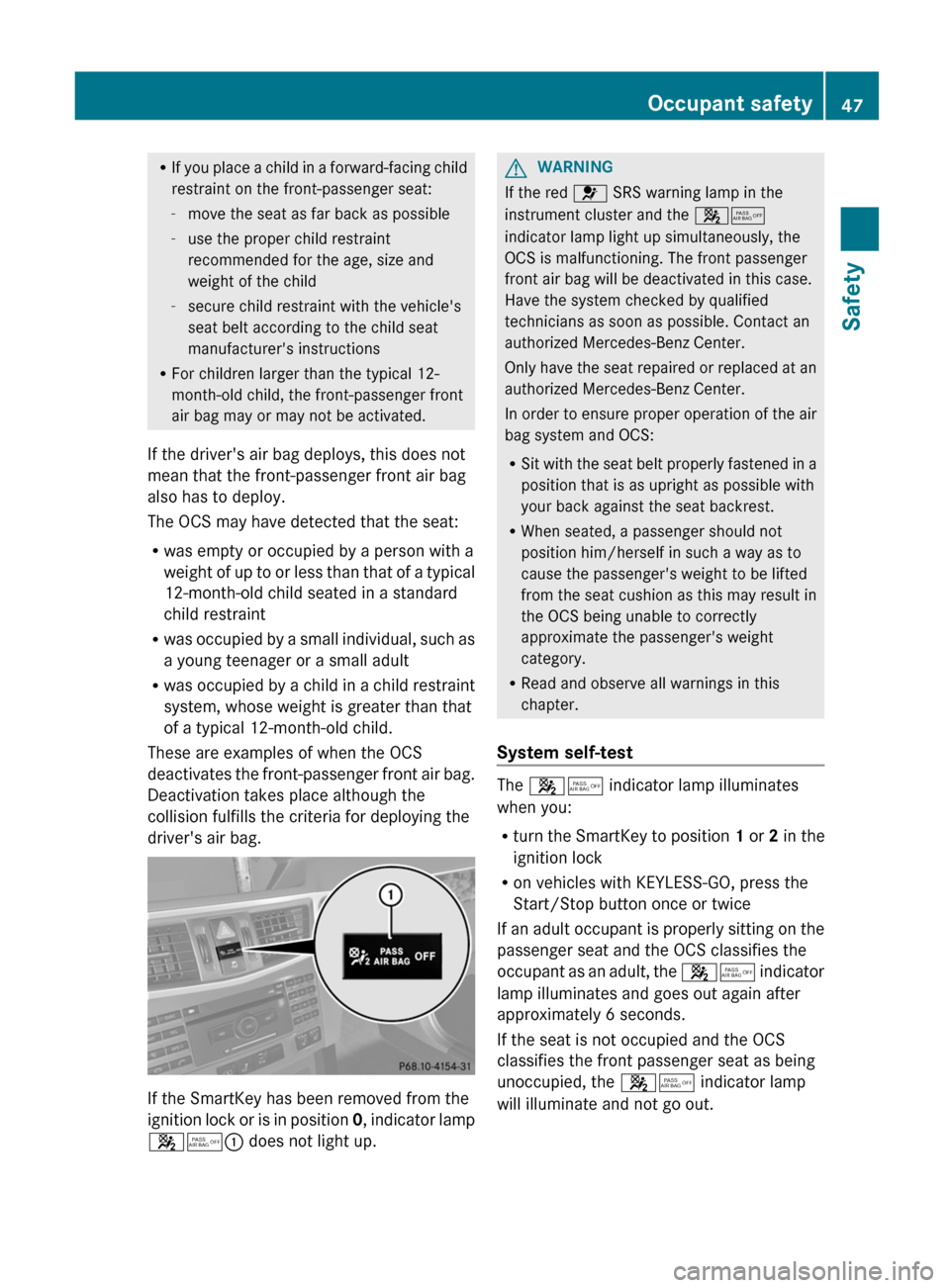
If the SmartKey has been removed from the
ignition lock or is in position 0, indicator lamp
45 : does not light up.
GWARNING
If the red 6 SRS warning lamp in the
instrument cluster and the 45
indicator lamp light up simultaneously, the
OCS is malfunctioning. The front passenger
front air bag will be deactivated in this case.
Have the system checked by qualified
technicians as soon as possible. Contact an
authorized Mercedes-Benz Center.
Only have the seat repaired or replaced at an
authorized Mercedes-Benz Center.
In order to ensure proper operation of the air
bag system and OCS:
R Sit with the seat belt properly fastened in a
position that is as upright as possible with
your back against the seat backrest.
R When seated, a passenger should not
position him/herself in such a way as to
cause the passenger's weight to be lifted
from the seat cushion as this may result in
the OCS being unable to correctly
approximate the passenger's weight
category.
R Read and observe all warnings in this
chapter.
System self-test
The 45 indicator lamp illuminates
when you:
R turn the SmartKey to position 1 or 2 in the
ignition lock
R on vehicles with KEYLESS-GO, press the
Start/Stop button once or twice
If an adult occupant is properly sitting on the
passenger seat and the OCS classifies the
occupant as an adult, the 45 indicator
lamp illuminates and goes out again after
approximately 6 seconds.
If the seat is not occupied and the OCS
classifies the front passenger seat as being
unoccupied, the 45 indicator lamp
will illuminate and not go out.
Occupant safety47SafetyZ
Page 52 of 396
PRE-SAFE®
(preventative occupant
protection)GWARNING
The PRE-SAFE ®
system reduces the impact of
an accident on vehicle occupants, as long as
their seat belts have been fastened correctly.
Although your vehicle is equipped with a PRE-
SAFE ®
system, the possibility of injury in the
event of an accident cannot be ruled out. You
should therefore always drive carefully and
adapt your driving style to the prevailing road,
weather and traffic conditions.
PRE-SAFE ®
takes preemptive measures to
protect occupants in certain hazardous
situations.
PRE-SAFE ®
intervenes:
R in emergency braking situations, e.g. if BAS
is activated or, in vehicles with DISTRONIC
PLUS, BAS PLUS intervenes powerfully
R if the radar sensor system detects an
imminent danger of collision in certain
situations (on vehicles with DISTRONIC
PLUS)
R in critical driving situations, e.g. when
physical limits are exceed and the vehicle
understeers or oversteers severely
PRE-SAFE ®
takes the following measures
depending on the hazardous situation
detected:
R the front seat belts are pre-tensioned.
R it adjusts the front-passenger seat if it is in
an unfavorable position.
R the air pressure in the side bolsters of the
seat cushion and seat backrest of the front
active multicontour seats is increased.
R if the vehicle skids, the sliding sunroof/
panorama roof with power tilt/sliding
panel and the side windows are closed so
that only a small gap remains.
If the hazardous situation passes without
resulting in an accident, PRE-SAFE ®
slackens
the belt pretensioning. The air pressure in the
side bolsters on the active multicontour seat
is reduced again. All settings made by PRE-
SAFE ®
can then be reversed.
If the seat belts are not released:XMove the backrest or seat back slightly, but
only when the vehicle is stationary.
The belt pretensioning is reduced and the
locking mechanism is released.GWARNING
Make sure that nobody can become trapped
as you adjust the seat.
! Make sure that there are no objects in the
footwell or behind the seats when resetting
the seats. There is a risk that the seats
and/or the objects could be damaged.
More information about seat-belt
adjustment, a convenience function
integrated into PRE-SAFE ®
, can be found in
the "Seat-belt adjustment" section
( Y page 54).
NECK-PRO head restraints
The NECK-PRO head restraints increase
protection to the driver's and front
passenger's head and neck. To this end, the
NECK-PRO head restraints on the driver's and
front-passenger seats are moved forwards
and upwards in the event of a rear-end
collision of a certain severity. This provides
better head support.
GWARNING
Do not secure any objects (e.g. coat hangers)
on the NECK-PRO head restraints. Otherwise,
the NECK-PRO head restraints may not
function properly, or in the event of a rear-end
collision may not be able offer the level of
protection they are designed to provide.
GWARNING
Seat or head restraint covers can cause a
malfunction when the NECK-PRO head
restraints are activated or when the side
impact air bags or pelvis air bags are
50Occupant safetySafety
Page 56 of 396
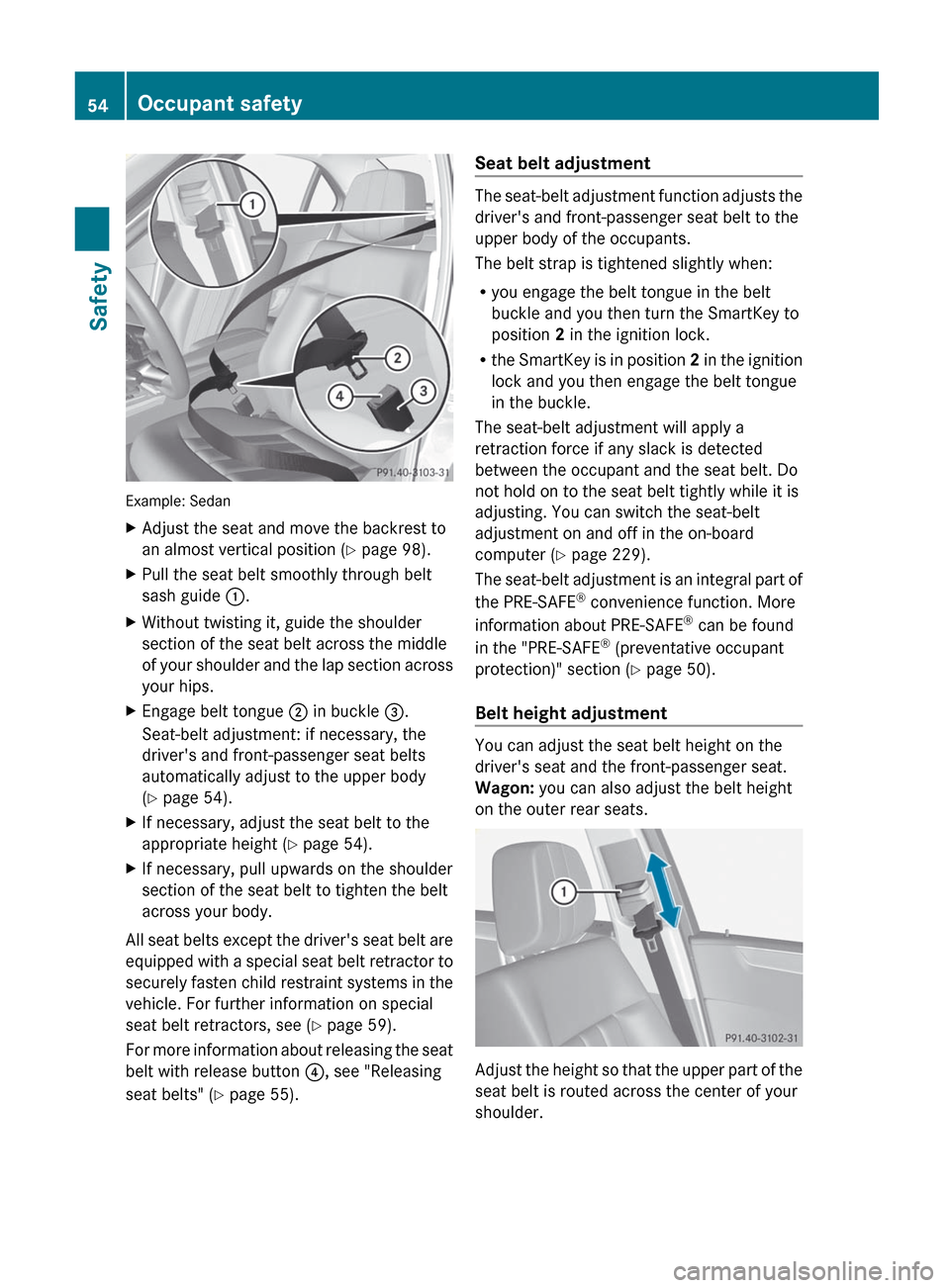
Example: Sedan
XAdjust the seat and move the backrest to
an almost vertical position ( Y page 98).XPull the seat belt smoothly through belt
sash guide :.XWithout twisting it, guide the shoulder
section of the seat belt across the middle
of your shoulder and the lap section across
your hips.XEngage belt tongue ; in buckle =.
Seat-belt adjustment: if necessary, the
driver's and front-passenger seat belts
automatically adjust to the upper body
( Y page 54).XIf necessary, adjust the seat belt to the
appropriate height ( Y page 54).XIf necessary, pull upwards on the shoulder
section of the seat belt to tighten the belt
across your body.
All seat belts except the driver's seat belt are
equipped with a special seat belt retractor to
securely fasten child restraint systems in the
vehicle. For further information on special
seat belt retractors, see ( Y page 59).
For more information about releasing the seat
belt with release button ?, see "Releasing
seat belts" ( Y page 55).
Seat belt adjustment
The seat-belt adjustment function adjusts the
driver's and front-passenger seat belt to the
upper body of the occupants.
The belt strap is tightened slightly when:
R you engage the belt tongue in the belt
buckle and you then turn the SmartKey to
position 2 in the ignition lock.
R the SmartKey is in position 2 in the ignition
lock and you then engage the belt tongue
in the buckle.
The seat-belt adjustment will apply a
retraction force if any slack is detected
between the occupant and the seat belt. Do
not hold on to the seat belt tightly while it is
adjusting. You can switch the seat-belt
adjustment on and off in the on-board
computer ( Y page 229).
The seat-belt adjustment is an integral part of
the PRE-SAFE ®
convenience function. More
information about PRE-SAFE ®
can be found
in the "PRE-SAFE ®
(preventative occupant
protection)" section ( Y page 50).
Belt height adjustment
You can adjust the seat belt height on the
driver's seat and the front-passenger seat.
Wagon: you can also adjust the belt height
on the outer rear seats.
Adjust the height so that the upper part of the
seat belt is routed across the center of your
shoulder.
54Occupant safetySafety