heating MERCEDES-BENZ E-Class WAGON 2012 W212 Owner's Guide
[x] Cancel search | Manufacturer: MERCEDES-BENZ, Model Year: 2012, Model line: E-Class WAGON, Model: MERCEDES-BENZ E-Class WAGON 2012 W212Pages: 396, PDF Size: 17.07 MB
Page 296 of 396
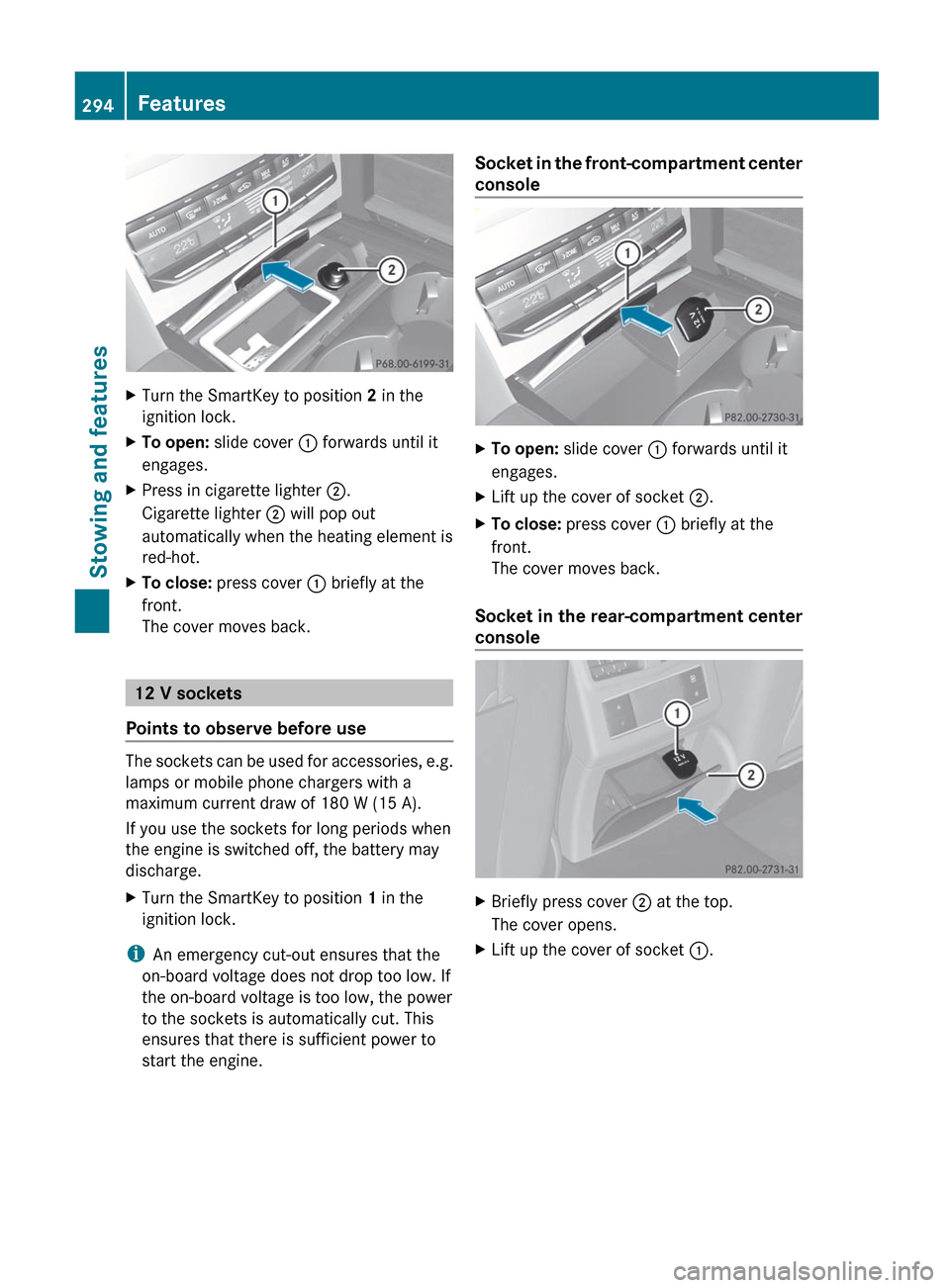
XTurn the SmartKey to position 2 in the
ignition lock.XTo open: slide cover : forwards until it
engages.XPress in cigarette lighter ;.
Cigarette lighter ; will pop out
automatically when the heating element is
red-hot.XTo close: press cover : briefly at the
front.
The cover moves back.
12 V sockets
Points to observe before use
The sockets can be used for accessories, e.g.
lamps or mobile phone chargers with a
maximum current draw of 180 W (15 A).
If you use the sockets for long periods when
the engine is switched off, the battery may
discharge.
XTurn the SmartKey to position 1 in the
ignition lock.
i An emergency cut-out ensures that the
on-board voltage does not drop too low. If
the on-board voltage is too low, the power
to the sockets is automatically cut. This
ensures that there is sufficient power to
start the engine.
Socket in the front-compartment center
consoleXTo open: slide cover : forwards until it
engages.XLift up the cover of socket ;.XTo close: press cover : briefly at the
front.
The cover moves back.
Socket in the rear-compartment center
console
XBriefly press cover ; at the top.
The cover opens.XLift up the cover of socket :.294FeaturesStowing and features
Page 317 of 396
Observe the following to make sure that the
automatic transmission stays in position N:XMake sure the vehicle is stationary and the
ignition is switched off.XTurn the SmartKey to position
2 (Y page 145) in the ignition lock.
Use the SmartKey instead of the Start/
Stop button on vehicles with KEYLESS-GO.XDepress and hold the brake pedal.XShift the automatic transmission to
position N.XRelease the brake pedal.XRelease the parking brake.XSwitch off the ignition and leave the
SmartKey in the ignition lock.
! Make sure that:
R the side windows and the sliding sunroof
are fully closed.
R the ventilation/heating is switched off
(the OFF button has been pressed).
R the windshield wiper switch is in position
0 .
Otherwise, the vehicle might be damaged.
After using an automatic car wash, wipe off
wax from the windshield and the wiper
blades. This will prevent smears and reduce
wiping noises caused by residue on the
windshield.
Washing by hand
Carefully remove all deposits of road salt as
soon as possible when driving in winter.
Also, clean the insides of the wheels when
washing the underbody of the vehicle.
XDo not use hot water and do not wash the
vehicle in direct sunlight.XUse a soft car sponge for cleaning.XUse a gentle cleaning agent, e.g. a
Mercedes-Benz approved car shampoo.XWash down the vehicle with a gentle water
jet.XDo not point the water jet directly at the air
inlets.XUse plenty of water and rinse the sponge
frequently.XRinse the vehicle with clean water and dry
it thoroughly with a chamois.XDo not allow the cleaning agent to dry on
the paintwork.
Power washers
GWARNING
Do not use power washers with circular-jet
nozzles (dirt grinders) to clean your vehicle, in
particular the tires. You could otherwise
damage the tires and cause an accident.
! Always maintain a distance of at least
11.8 in (30 cm) between the vehicle and the
power washer nozzle. Information about
the correct distance is available from the
equipment manufacturer.
Move the power washer nozzle around
when cleaning your vehicle.
Do not aim directly at any of the following:
R tires
R door gaps, roof gaps, joints etc.
R electrical components
R battery
R connectors
R lights
R seals
R trim elements
R ventilation slots
Damaged seals or electrical components
can lead to leaks or failures.
Cleaning the wheels
! Do not use acidic wheel cleaning products
to remove brake dust. This could damage
wheel bolts and brake components.
! Do not park the vehicle for an extended
period straight after cleaning it, particularly
after having cleaned the wheels with wheel
cleaner. Wheel cleaners could cause
increased corrosion of the brake discs and
Care315Maintenance and careZ
Page 389 of 396
! Do not refuel with low-grade fuel and do
not use fuel additives that are not tested
and approved for Mercedes-Benz vehicles.
Damage to or malfunctions of the fuel
system may otherwise occur.
DEF
Important safety notes
i For BlueTEC vehicles only.
DEF is a non-flammable, non-toxic, colorless,
odorless and water-soluble fluid.
! Rinse surfaces that have come into
contact with DEF immediately with water or
remove DEF using a damp cloth and cold
water. If the DEF has already crystallized,
use a sponge and cold water to clean it. DEF
residues crystallize after time and
contaminate the affected surfaces.
High outside temperatures
If DEF heats up to over 122 ‡ (50 †) for
extended periods, e.g. as a result of direct
sunlight on the DEF reservoir, DEF can
decompose. Ammonia vapors develop as a
result.
GWARNING
When opening the filler cap of the DEF tank
ammonia gas vapors may escape. Refill DEF
in a well ventilated area only. Ammonia gas
vapors have a pungent odor and are
particularly irritating for your skin, mucous
membranes, and eyes. Inhaling ammonia gas
vapors will cause burning eyes, nose, and
throat, as well as coughing and watering eyes.
Low outside temperatures
DEF freezes at a temperature of
approximately 12 ‡ (–11 †). The vehicle is
equipped with a DEF preheating system when
it leaves the factory. Winter operation is
therefore also guaranteed at temperatures
below 12 ‡ (–11 †).
Additives
! Only use DEF in accordance with ISO
22241. Do not use additives with DEF and
do not dilute DEF with water. This may
destroy the BlueTEC exhaust gas
aftertreatment system.
Purity
Assuring the purity of DEF is particularly
important with respect to avoiding
malfunctions in the exhaust gas
aftertreatment system.
If DEF is pumped out of the DEF tank, e.g.
during repair work, it must not be returned to
the tank. The purity of the fluid can no longer
be guaranteed.
! Impurities in DEF (e.g. due to other
service products, cleaning agents or dust)
lead to:
R increased emission values
R damage to the catalytic converter
R engine damage
R malfunctions in the BlueTEC exhaust gas
aftertreatment system
Engine oil
Please bear the following in mind
The engine oils are matched to the
performance of Mercedes-Benz engines and
service intervals. You should therefore only
use engine oils and oil filters that are
approved for vehicles with maintenance
systems.
For a list of approved engine oils and oil filters,
consult an authorized Mercedes-Benz Center
or go to the Internet site
http://www.mbusa.com (USA only).
! Never use engine oil or an oil filter of a
specification other than is necessary to
fulfill the prescribed service intervals. Do
not change the engine oil or oil filter in
order to achieve longer replacement
Service products and capacities387Technical dataZ
Page 391 of 396
fluids can be obtained from any authorized
Mercedes-Benz Center or on the Internet at
http://bevo.mercedes-benz.com.
Coolant
Important safety notes
The coolant is a mixture of water and
antifreeze/corrosion inhibitor. It performs
the following tasks:
R corrosion protection
R antifreeze protection
R raising the boiling point
The engine cooling system is filled at the
factory with coolant that contains an
antifreeze/corrosion inhibitor that ensures
protection down to approximately -35 ‡
(-37 †).
! Only add coolant that has been premixed
with the desired antifreeze protection.
Otherwise, the engine could be damaged.
Further information on coolants and on
filling can be found in the Mercedes-Benz
Specifications for Service Products, MB
Approval 310.1, e.g. on the Internet at
http://bevo.mercedes-benz.com . You can
also consult an authorized Mercedes-Benz
Center.
! Always use a suitable coolant mixture,
even in countries where high temperatures
prevail.
Otherwise, the engine cooling system is not
sufficiently protected from corrosion and
overheating.
If the coolant has antifreeze protection down
to -35 ‡ (-37 †), the boiling point of the
coolant under operating conditions is
approximately 266 ‡ (130 †).
Your vehicle has a range of aluminum
components. Aluminum components in the
engine make it necessary to use antifreeze/
corrosion inhibitor coolant that has been
specifically formulated to protect the
aluminum parts. Using other antifreeze/
corrosion inhibitors without these
characteristics affects the service life.
The coolant must be used throughout the year
in order to maintain the necessary corrosion
protection and to provide protection from
overheating. In the Service Booklet, you can
find information on the intervals for renewal.
The renewal interval is determined by the
coolant type and the engine cooling system
design. The renewal interval in the Service
Booklet is only valid if the coolant is renewed
or filled up with Mercedes-Benz approved
products. Therefore, only use MB 325.0 or
326.0 anticorrosion/antifreeze or another
Mercedes-Benz approved product of the
same specification.
Information on other products with the same
specifications that are approved by
Mercedes-Benz can be obtained at an
authorized Mercedes-Benz Center or on the
Internet at http://bevo.mercedes-benz.com.
The coolant is checked at every maintenance
interval at an authorized Mercedes-Benz
Center.
The antifreeze/corrosion inhibitor
concentration in the engine cooling system
should:
R be at least 50%. This will protect the engine
cooling system against freezing down to
approximately -35 ‡ (-37 † ).
R not exceed 55% (antifreeze protection to
-49 ‡ [-45 † ]); otherwise, heat will not
dissipate as effectively.
If the coolant level is too low, MB 325.0 or
326.0 anticorrosion/antifreeze should be
added. Have the engine cooling system
checked for possible leaks.
Windshield/headlamp cleaning
system
GWARNING
Washer solvent/antifreeze is highly
flammable. Do not spill washer solvent/
antifreeze on hot engine parts, because it may
Service products and capacities389Technical dataZ