trunk MERCEDES-BENZ E-Class WAGON 2012 W212 Service Manual
[x] Cancel search | Manufacturer: MERCEDES-BENZ, Model Year: 2012, Model line: E-Class WAGON, Model: MERCEDES-BENZ E-Class WAGON 2012 W212Pages: 396, PDF Size: 17.07 MB
Page 327 of 396
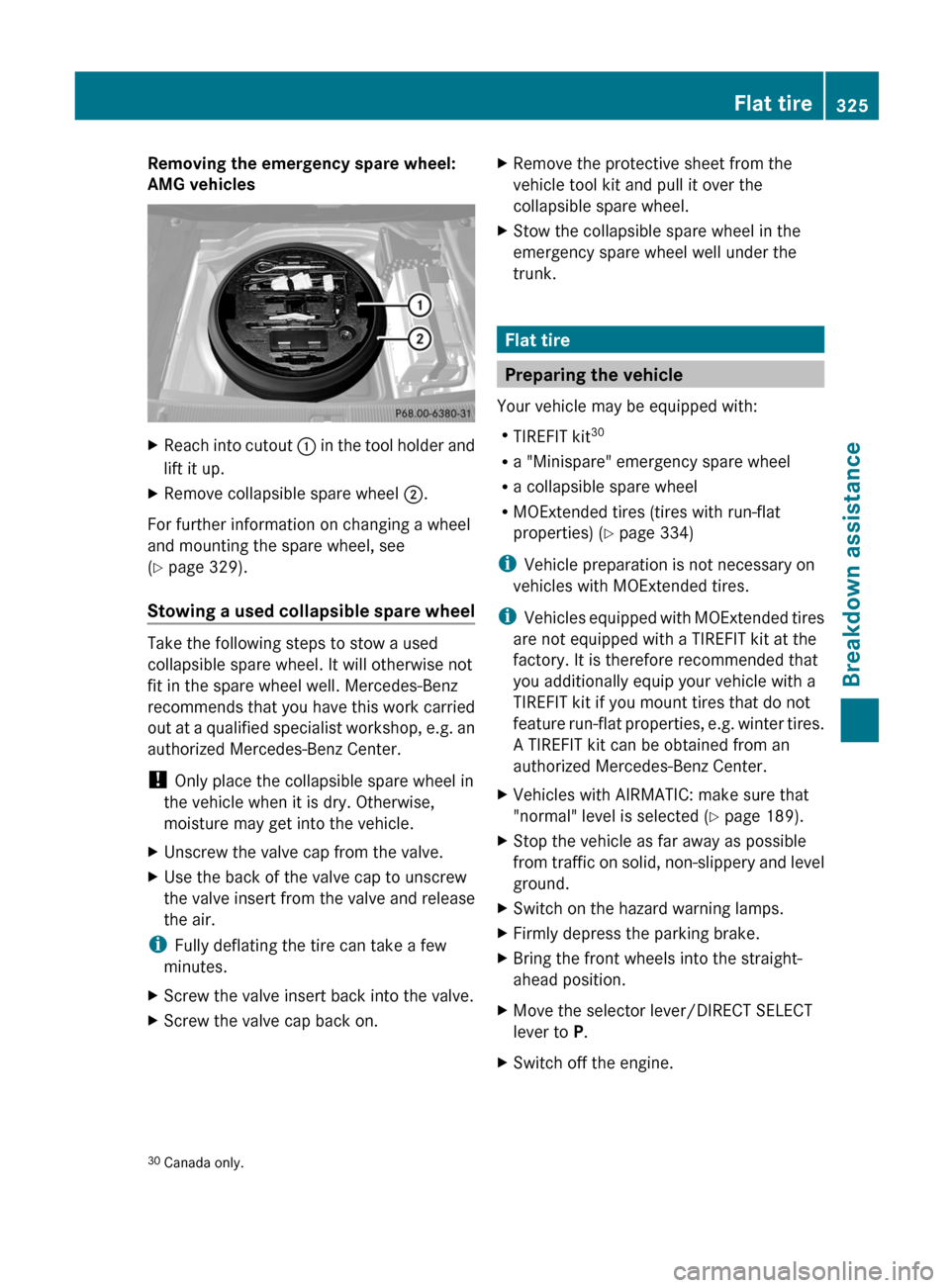
Removing the emergency spare wheel:
AMG vehiclesXReach into cutout : in the tool holder and
lift it up.XRemove collapsible spare wheel ;.
For further information on changing a wheel
and mounting the spare wheel, see
( Y page 329).
Stowing a used collapsible spare wheel
Take the following steps to stow a used
collapsible spare wheel. It will otherwise not
fit in the spare wheel well. Mercedes-Benz
recommends that you have this work carried
out at a qualified specialist workshop, e.g. an
authorized Mercedes-Benz Center.
! Only place the collapsible spare wheel in
the vehicle when it is dry. Otherwise,
moisture may get into the vehicle.
XUnscrew the valve cap from the valve.XUse the back of the valve cap to unscrew
the valve insert from the valve and release
the air.
i Fully deflating the tire can take a few
minutes.
XScrew the valve insert back into the valve.XScrew the valve cap back on.XRemove the protective sheet from the
vehicle tool kit and pull it over the
collapsible spare wheel.XStow the collapsible spare wheel in the
emergency spare wheel well under the
trunk.
Flat tire
Preparing the vehicle
Your vehicle may be equipped with:
R TIREFIT kit 30
R a "Minispare" emergency spare wheel
R a collapsible spare wheel
R MOExtended tires (tires with run-flat
properties) ( Y page 334)
i Vehicle preparation is not necessary on
vehicles with MOExtended tires.
i Vehicles equipped with MOExtended tires
are not equipped with a TIREFIT kit at the
factory. It is therefore recommended that
you additionally equip your vehicle with a
TIREFIT kit if you mount tires that do not
feature run-flat properties, e.g. winter tires.
A TIREFIT kit can be obtained from an
authorized Mercedes-Benz Center.
XVehicles with AIRMATIC: make sure that
"normal" level is selected ( Y page 189).XStop the vehicle as far away as possible
from traffic on solid, non-slippery and level
ground.XSwitch on the hazard warning lamps.XFirmly depress the parking brake.XBring the front wheels into the straight-
ahead position.XMove the selector lever/DIRECT SELECT
lever to P.XSwitch off the engine.30
Canada only.Flat tire325Breakdown assistance
Page 328 of 396
XVehicles without KEYLESS-GO: remove
the SmartKey from the ignition lock.XVehicles with KEYLESS-GO: open the
driver's door.
The on-board electronics have status 0,
which is the same as the SmartKey having
been removed.XVehicles with KEYLESS-GO: remove the
Start/Stop button from the ignition lock
( Y page 145).XAll occupants must get out of the vehicle.
Make sure that they are not endangered as
they do so.XMake sure that no one is near the danger
area while a wheel is being changed.
Anyone who is not directly assisting in the
wheel change should, for example, stand
behind the barrier.XGet out of the vehicle. Pay attention to
traffic conditions when doing so.XClose the driver's door.
TIREFIT kit
Using the TIREFIT kit
You can use the TIREFIT kit to seal small
punctures, particularly those in the tire tread.
You can use TIREFIT at outside temperatures
down to -4 ‡ (-20 †).
GWARNING
TIREFIT is a limited repair device. TIREFIT
cannot be used for cuts or punctures larger
than approximately 0.16 in (4 mm) and tire
damage caused by driving with extremely low
tire inflation pressure, or on a flat tire, or a
damaged wheel.
Do not drive the vehicle under such
circumstances.
Contact the nearest authorized Mercedes-
Benz Center for assistance or call Roadside
Assistance.
XDo not remove any foreign objects which
have penetrated the tire, e.g. screws or
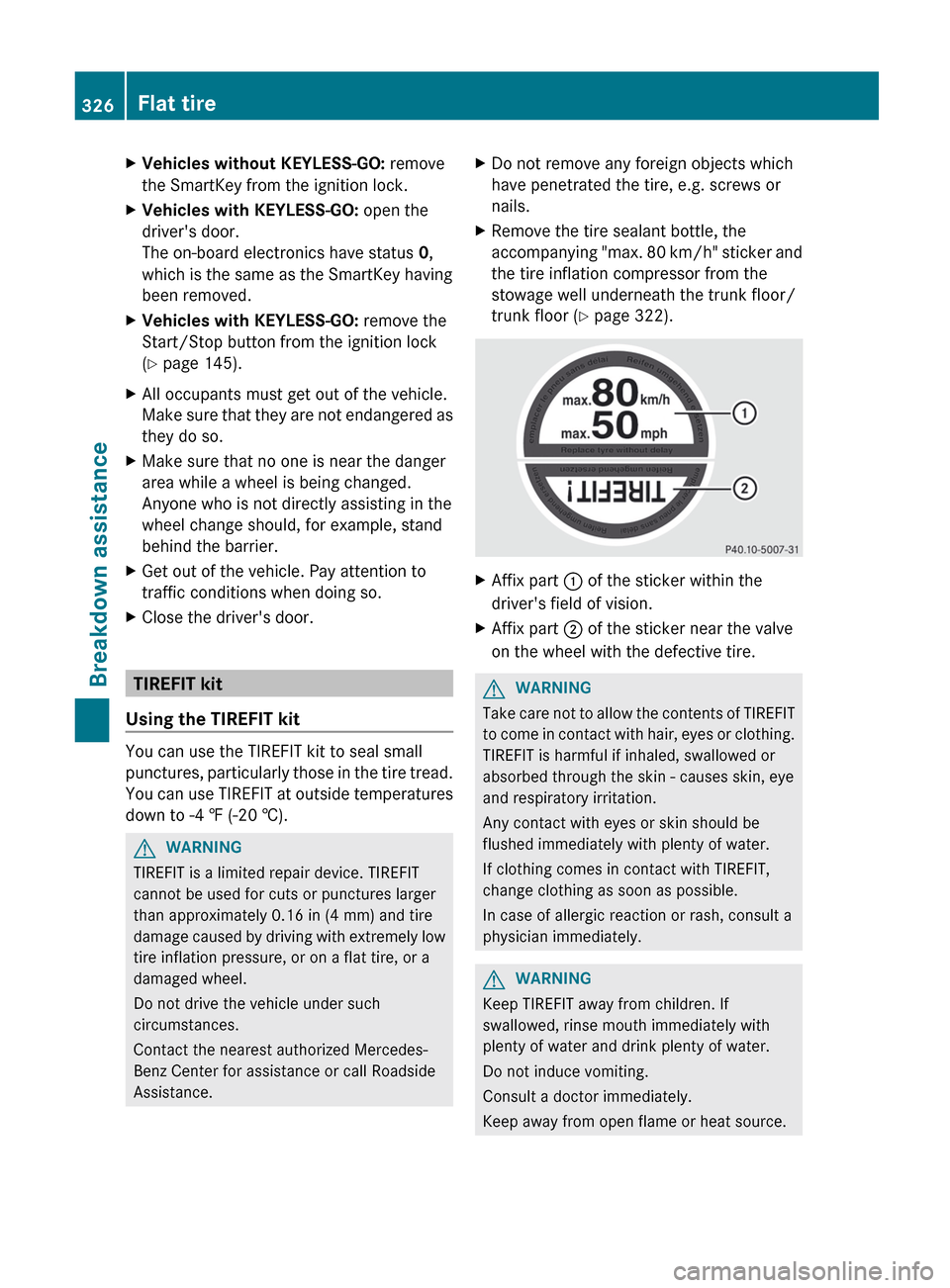
nails.XRemove the tire sealant bottle, the
accompanying "max. 80 km/h" sticker and
the tire inflation compressor from the
stowage well underneath the trunk floor/
trunk floor ( Y page 322).XAffix part : of the sticker within the
driver's field of vision.XAffix part ; of the sticker near the valve
on the wheel with the defective tire.GWARNING
Take care not to allow the contents of TIREFIT
to come in contact with hair, eyes or clothing.
TIREFIT is harmful if inhaled, swallowed or
absorbed through the skin - causes skin, eye
and respiratory irritation.
Any contact with eyes or skin should be
flushed immediately with plenty of water.
If clothing comes in contact with TIREFIT,
change clothing as soon as possible.
In case of allergic reaction or rash, consult a
physician immediately.
GWARNING
Keep TIREFIT away from children. If
swallowed, rinse mouth immediately with
plenty of water and drink plenty of water.
Do not induce vomiting.
Consult a doctor immediately.
Keep away from open flame or heat source.
326Flat tireBreakdown assistance
Page 331 of 396
XHave the tire sealant bottle replaced every
four years at a qualified specialist
workshop, e.g. an authorized Mercedes-
Benz Center.
Changing a wheel and mounting the
spare wheel
Preparing the vehicle
GWARNING
The wheel and tire size of the emergency
spare wheel/spare wheel may differ to that of
the damaged wheel. When using an
emergency spare wheel/spare wheel the
handling characteristics of the vehicle may
change.
Adapt your style of driving accordingly.
Never operate the vehicle with more than one
emergency spare wheel/spare wheel that
differs in size.
Only use an emergency spare wheel/spare
wheel of a differing size briefly and do not
switch off ESP ®
.
When using an emergency spare wheel, you
must not exceed the maximum speed of
50 mph (80 km/h).
GWARNING
Have the emergency spare wheel/spare
wheel replaced with a new wheel as soon as
possible at a qualified specialist workshop
which has the necessary specialist knowledge
and tools to carry out the work required.
Mercedes-Benz recommends that you use an
authorized Mercedes-Benz Center for this
purpose. In particular, work relevant to safety
or on safety-related systems must be carried
out at a qualified specialist workshop.
i Vehicles without a spare wheel/
emergency spare wheel are not equipped
with a tire-change tool kit at the factory. For
more information on which tools are
required to perform a wheel change on your
vehicle, e.g. wheel chock, lug wrench or
alignment bolt, consult an authorized
Mercedes-Benz Center.XPrepare the vehicle as described
( Y page 325).XRemove the following items (depending on
the vehicle's equipment) from the stowage
well under the trunk/trunk floor:
R the emergency spare wheel
R the lug wrench
R the folding wheel chock
R the jack
R the alignment bolt
R the tire inflation compressorXSecure the vehicle to prevent it from rolling
away.
Securing the vehicle to prevent it from
rolling away
GWARNING
Only jack up the vehicle on level ground or on
slight inclines/declines. The vehicle could
otherwise fall off the jack and injure you or
others.
If your vehicle is equipped with a wheel chock,
it can be found in the vehicle tool kit
( Y page 322).
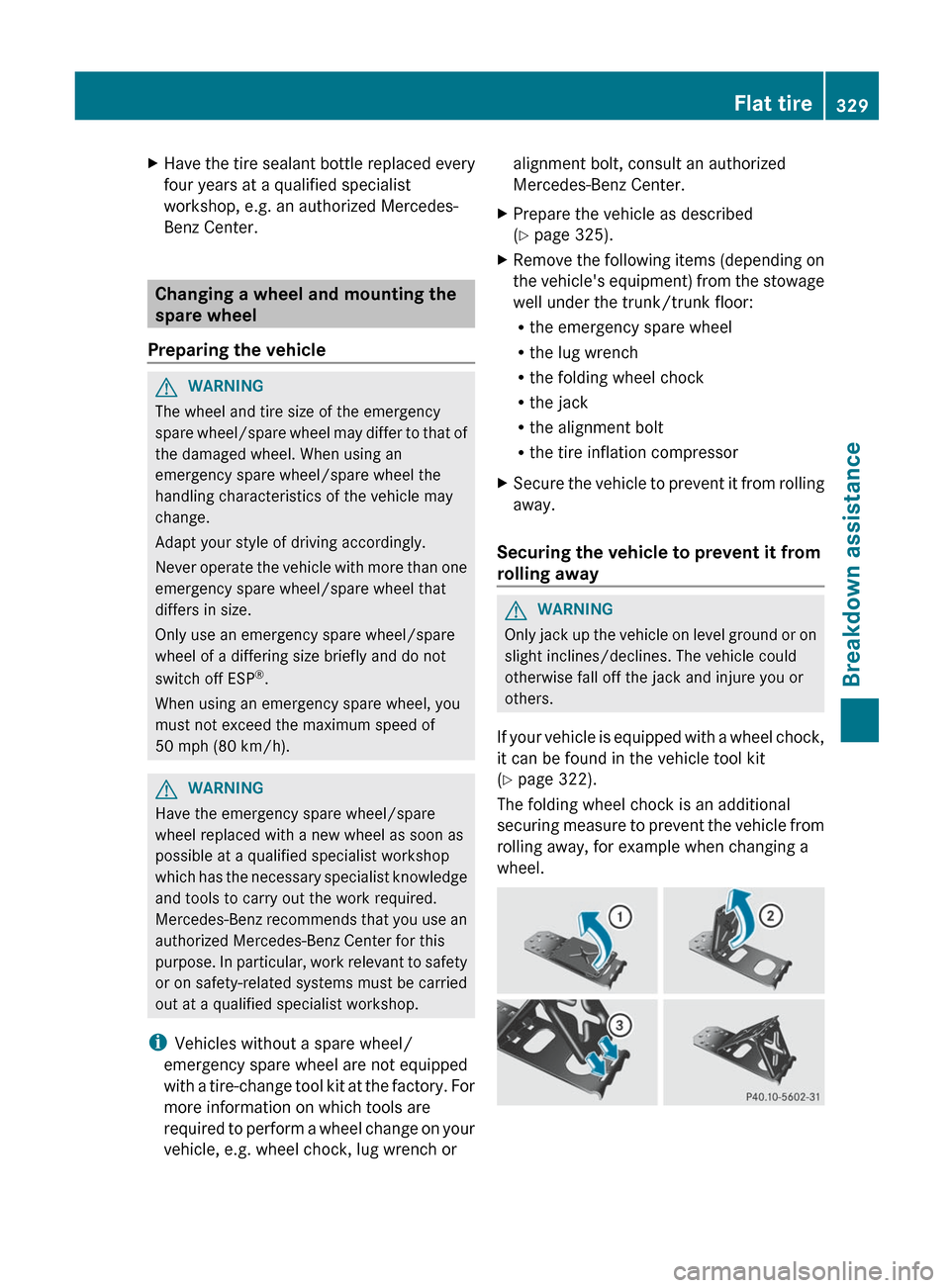
The folding wheel chock is an additional
securing measure to prevent the vehicle from
rolling away, for example when changing a
wheel.
Flat tire329Breakdown assistanceZ
Page 336 of 396
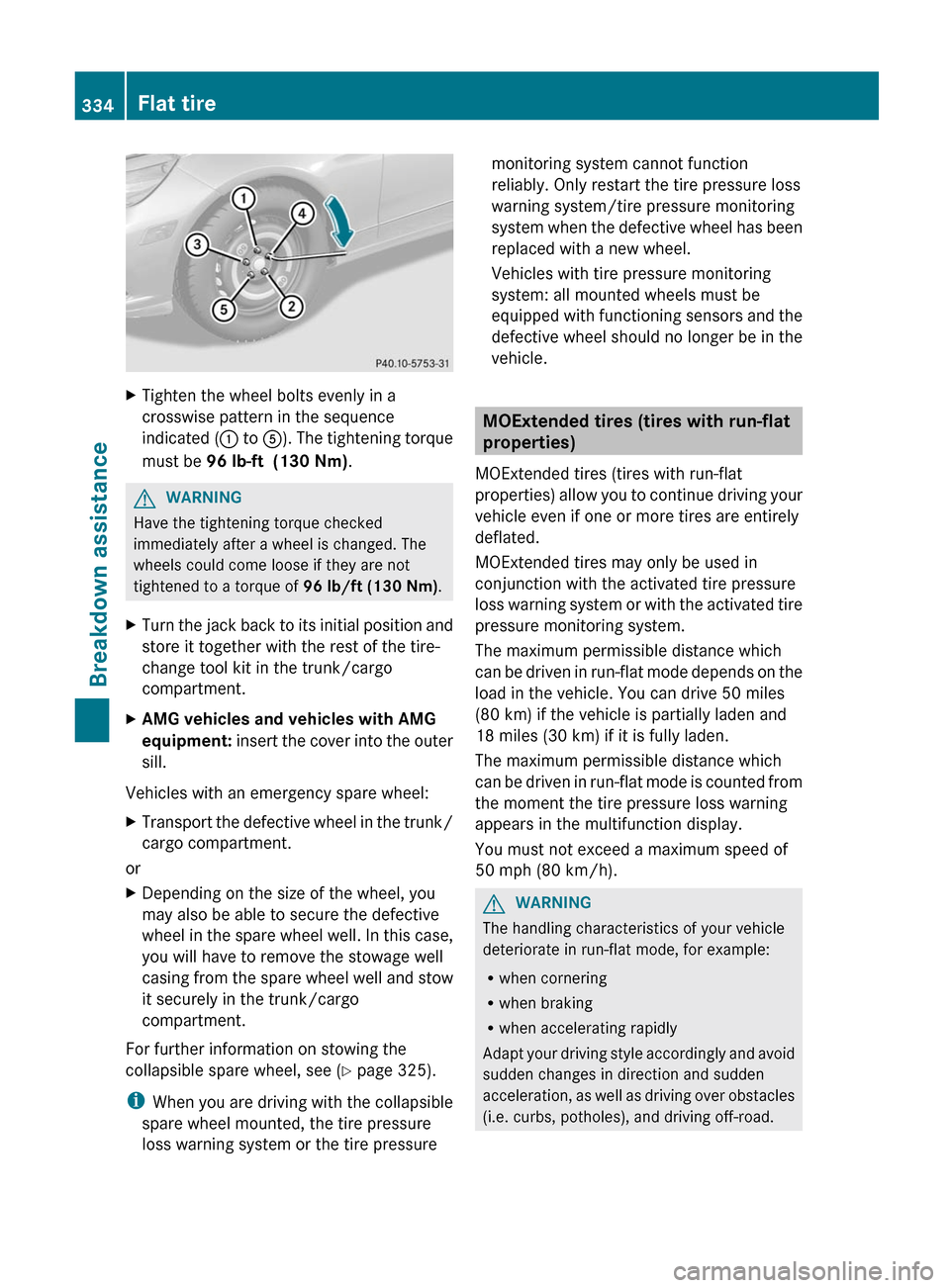
XTighten the wheel bolts evenly in a
crosswise pattern in the sequence
indicated ( : to A). The tightening torque
must be 96 lb-ft (130 Nm) .GWARNING
Have the tightening torque checked
immediately after a wheel is changed. The
wheels could come loose if they are not
tightened to a torque of 96 lb/ft (130 Nm).
XTurn the jack back to its initial position and
store it together with the rest of the tire-
change tool kit in the trunk/cargo
compartment.XAMG vehicles and vehicles with AMG
equipment: insert the cover into the outer
sill.
Vehicles with an emergency spare wheel:
XTransport the defective wheel in the trunk/
cargo compartment.
or
XDepending on the size of the wheel, you
may also be able to secure the defective
wheel in the spare wheel well. In this case,
you will have to remove the stowage well
casing from the spare wheel well and stow
it securely in the trunk/cargo
compartment.
For further information on stowing the
collapsible spare wheel, see ( Y page 325).
i When you are driving with the collapsible
spare wheel mounted, the tire pressure
loss warning system or the tire pressure
monitoring system cannot function
reliably. Only restart the tire pressure loss
warning system/tire pressure monitoring
system when the defective wheel has been
replaced with a new wheel.
Vehicles with tire pressure monitoring
system: all mounted wheels must be
equipped with functioning sensors and the
defective wheel should no longer be in the
vehicle.
MOExtended tires (tires with run-flat
properties)
MOExtended tires (tires with run-flat
properties) allow you to continue driving your
vehicle even if one or more tires are entirely
deflated.
MOExtended tires may only be used in
conjunction with the activated tire pressure
loss warning system or with the activated tire
pressure monitoring system.
The maximum permissible distance which
can be driven in run-flat mode depends on the
load in the vehicle. You can drive 50 miles
(80 km) if the vehicle is partially laden and
18 miles (30 km) if it is fully laden.
The maximum permissible distance which
can be driven in run-flat mode is counted from
the moment the tire pressure loss warning
appears in the multifunction display.
You must not exceed a maximum speed of
50 mph (80 km/h).
GWARNING
The handling characteristics of your vehicle
deteriorate in run-flat mode, for example:
R when cornering
R when braking
R when accelerating rapidly
Adapt your driving style accordingly and avoid
sudden changes in direction and sudden
acceleration, as well as driving over obstacles
(i.e. curbs, potholes), and driving off-road.
334Flat tireBreakdown assistance
Page 345 of 396
Before changing a fuseXPark the vehicle and apply the parking
brake.XSwitch off all electrical consumers.XRemove the SmartKey from the ignition
lock.
The fuses are located in various fuse boxes:
R fuse box in the engine compartment on the
left-hand side of the vehicle, when viewed
in the direction of travel
R fuse box in the trunk/cargo compartment
on the right-hand side of the vehicle, when
viewed in the direction of travel
The fuse allocation chart is located in the
vehicle tool kit ( Y page 322) in the stowage
compartment under the trunk/cargo
compartment floor.
Fuse box in the engine compartment
XMake sure that the windshield wipers are
turned off.GWARNING
Make sure that the windshield wipers are
switched off and that the SmartKey is
removed from the ignition lock before you
open the cover of the fuse box. Otherwise, the
windshield wipers and the wiper rods above
the cover could be set in motion. This could
lead to you or others being injured by the
wiper rods.
XOpen the hood ( Y page 308).XRemove any existing moisture from the
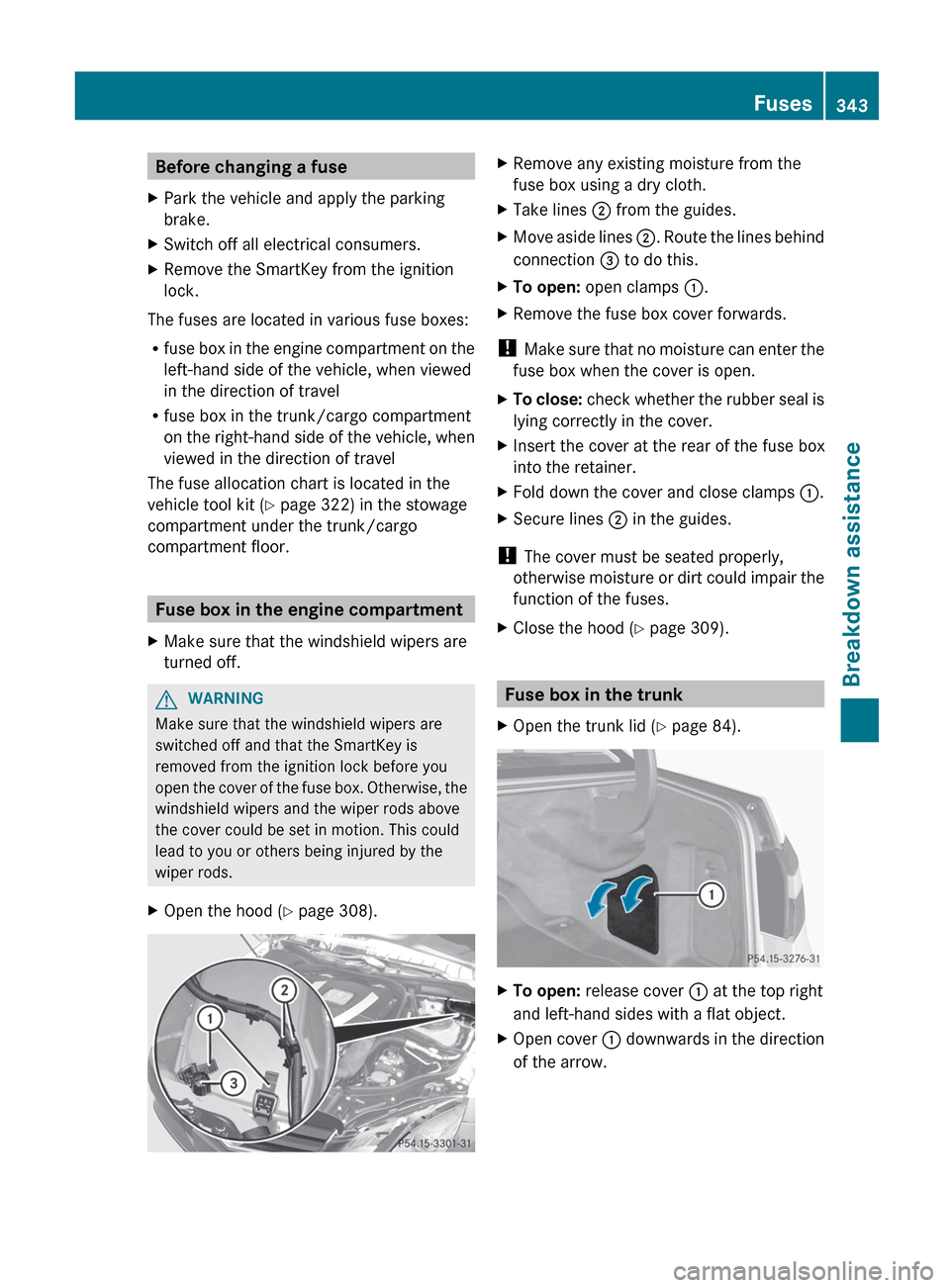
fuse box using a dry cloth.XTake lines ; from the guides.XMove aside lines ;. Route the lines behind
connection = to do this.XTo open: open clamps :.XRemove the fuse box cover forwards.
!
Make sure that no moisture can enter the
fuse box when the cover is open.
XTo close: check whether the rubber seal is
lying correctly in the cover.XInsert the cover at the rear of the fuse box
into the retainer.XFold down the cover and close clamps :.XSecure lines ; in the guides.
!
The cover must be seated properly,
otherwise moisture or dirt could impair the
function of the fuses.
XClose the hood ( Y page 309).
Fuse box in the trunk
XOpen the trunk lid ( Y page 84).XTo open: release cover : at the top right
and left-hand sides with a flat object.XOpen cover : downwards in the direction
of the arrow.Fuses343Breakdown assistanceZ
Page 392 of 396
ignite and burn. You could be seriously
burned.
Use MB SummerFit windshield washer
concentrate at temperatures above freezing:XMix 1 part MB SummerFit with 100 parts
water.
Use MB WinterFit windshield washer
concentrate at temperatures below freezing:
XAt temperatures down to 14 ‡(Ò 10 †): mix
1 part MB WinterFit with 2 parts water.XAt temperatures down to Ò 4 ‡( Ò 20 †): mix
1 part MB WinterFit with 1 part water.XAt temperatures down to
Ò 20.2 ‡(Ò 29 †): mix 2 parts MB WinterFit
with 1 part water.
! Only SummerFit and WinterFit can be
mixed. Otherwise, the jets could become
blocked.
Vehicle data
For the specified vehicle data, please note
that:
R The heights specified may vary due to:
- tires
- load
- condition of the suspension
- optional equipment
Missing values were not available at time of
going to print.
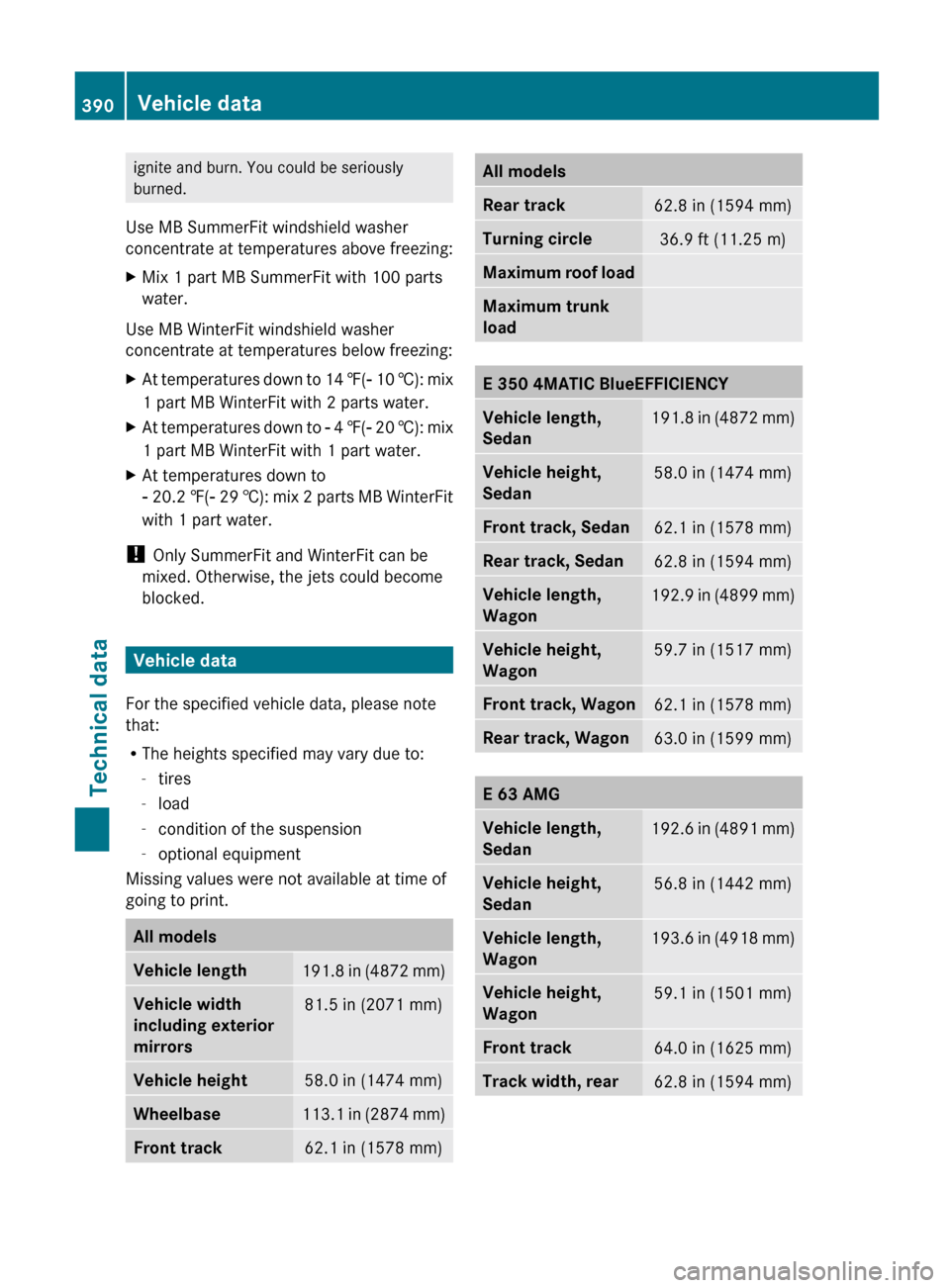
All modelsVehicle length191.8 in (4872 mm)Vehicle width
including exterior
mirrors81.5 in (2071 mm)Vehicle height58.0 in (1474 mm)Wheelbase113.1 in (2874 mm)Front track62.1 in (1578 mm)All modelsRear track62.8 in (1594 mm)Turning circle36.9 ft (11.25 m)Maximum roof loadMaximum trunk
loadE 350 4MATIC BlueEFFICIENCYVehicle length,
Sedan191.8 in (4872 mm)Vehicle height,
Sedan58.0 in (1474 mm)Front track, Sedan62.1 in (1578 mm)Rear track, Sedan62.8 in (1594 mm)Vehicle length,
Wagon192.9 in (4899 mm)Vehicle height,
Wagon59.7 in (1517 mm)Front track, Wagon62.1 in (1578 mm)Rear track, Wagon63.0 in (1599 mm)E 63 AMGVehicle length,
Sedan192.6 in (4891 mm)Vehicle height,
Sedan56.8 in (1442 mm)Vehicle length,
Wagon193.6 in (4918 mm)Vehicle height,
Wagon59.1 in (1501 mm)Front track64.0 in (1625 mm)Track width, rear62.8 in (1594 mm)390Vehicle dataTechnical data
Page 393 of 396

E 350 BlueTECVehicle height,
Sedan 4858.0 in (1474 mm)Maximum roof loadMaximum 220 lb
(100 kg)Maximum trunk
loadMaximum 220 lb (100 kg)48On vehicles with the AIRMATIC package, values vary depending on the level set for the vehicle suspension.Vehicle data391Technical dataZ