radiator MERCEDES-BENZ E-Class WAGON 2012 W212 Owner's Manual
[x] Cancel search | Manufacturer: MERCEDES-BENZ, Model Year: 2012, Model line: E-Class WAGON, Model: MERCEDES-BENZ E-Class WAGON 2012 W212Pages: 396, PDF Size: 17.07 MB
Page 13 of 396
Opening/closing the garage door ..304
Programming (button in the rear-
view mirror) ................................... 302
Gasoline ............................................. 161
Gear indicator (on-board
computer) .......................................... 230
Gear or selector lever (cleaning
guidelines) ......................................... 319
Genuine Mercedes-Benz parts ......... 380
Glove box ........................................... 274
H
Handbrake see Parking brake
Hazard warning lamps ...................... 118
Headlamp cleaning system Notes ............................................. 389
Headlamps
Adding fluid to cleaning system .....311
Cleaning system (function) ............117
Fogging up ..................................... 120
see Automatic headlamp mode
Head restraints
Adjusting ....................................... 100
Adjusting (angle) ............................ 100
Adjusting (electrically) ...................101
Adjusting (rear) .............................. 101
Installing/removing (rear) ..............102
Luxury ............................................ 101
see NECK-PRO head restraints
Heating
see Climate control
High-beam headlamps
Changing bulbs .............................. 123
Display message ............................ 243
Switching Adaptive Highbeam
Assist on/off ................................. 118
Switching on/off ........................... 117
Hill start assist .................................. 148
HOLD function Display message ............................ 250
Function/notes ............................. 187
Hood
Closing ........................................... 309
Display message ............................ 258
Opening ......................................... 308
Hydroplaning ..................................... 173
I
Ignition lock see Key positions
Immobilizer .......................................... 71
Indicator lamps see Warning and indicator lamps
Indicators
see Turn signals
Infrared lamps (changing bulbs) ...... 123
Insect protection on the radiator .... 309
Instrument cluster Overview .......................................... 29
Settings ......................................... 226
Warning and indicator lamps ...........30
Instrument cluster lighting ................ 29
Instrument lighting see Instrument cluster lighting
Interior lighting
Automatic control ..........................120
Delayed switch-off (on-board
computer) ...................................... 228
Emergency lighting ........................121
Manual control ............................... 121
Overview ........................................ 120
Reading lamp ................................. 120
Setting the brightness of the
ambient lighting (on-board
computer) ...................................... 227
see Interior lighting
J
Jack Storage location ............................ 322
Using ............................................. 330
Jump starting (engine) ...................... 338
K
Key see SmartKey
KEYLESS-GO
Convenience closing feature ............92
Display message ............................ 259
Locking ............................................ 75
Start/Stop button .......................... 145
Starting the engine ........................147
Unlocking ......................................... 75
Index11
Page 17 of 396
R
RACE START (AMG vehicles) ............. 188
RACETIMER (on-board computer) .... 231
Radar sensor system Activating/deactivating .................229
Display message ............................ 250
Radiator cover ................................... 309
Radio Selecting a station .........................221
see separate operating instructions
Reading lamp ..................................... 120
Rear axle level control (AMG
adaptive sport suspension
system) .............................................. 191
Rear compartment Setting the airflow .........................137
Setting the air vents ......................141
Setting the temperature ................136
Rear fog lamp
Display message ............................ 244
Switching on/off ........................... 116
Rear seat
Display message ............................ 258
Folding the backrest forwards/
back ............................................... 279
Rear sill protector ............................. 287
Rear view camera Cleaning instructions .....................318
Function/notes ............................. 198
Rear-view mirror
Anti-glare (manual) ........................109
Dipping (automatic) .......................110
Rear window blind ............................ 292
Rear window defroster Problem (malfunction) ...................139
Rear window heating
Switching on/off ........................... 139
Rear window wiper
Replacing the wiper blade .............. 126
Switching on/off ........................... 125
Refueling
Fuel gauge ....................................... 29
Important safety notes ..................160
Refueling process ..........................162
see Fuel
Remote control
Garage door opener .......................302Reporting
Malfunctions relevant to safety ........ 25
Reserve (fuel tank)
see Fuel
Reserve fuel
Display message ............................ 248
Warning lamp ................................. 267
see Fuel
Residual heat (climate control) ........ 140
Restraint system see SRS (Supplemental Restraint
System)
Retaining hook .................................. 282
Reverse gear Engaging (automatic
transmission) ................................. 152
Reversing lamps (display
message) ............................................ 244
Roadside Assistance (breakdown) .... 23
Roller blind see Roller sunblind
Roller sunblind
Panorama roof with power tilt/
sliding panel ..................................... 95
Rear side windows .........................291
Rear window .................................. 292
Roof carrier ........................................ 288
Roof lining and carpets (cleaning
guidelines) ......................................... 320
Roof load (maximum) ........................ 390
Route see Route guidance (navigation)
Route guidance (navigation) ............ 220
S
Safety Children in the vehicle .....................56
Child restraint systems ....................56
Occupant Classification System
(OCS) ............................................... 44
Overview of occupant safety
systems ........................................... 38
Safety systems
see Driving safety systems
Index15
Page 23 of 396
Winter drivingImportant safety notes ..................348
Slippery road surfaces ...................175
Snow chains .......................... 174, 349
Winter operation
Radiator cover ............................... 309
Winter tires
M+S tires ............................... 174, 348
Wiper blades
Cleaning ......................................... 317
Important safety notes ..................125
Replacing (rear window) ................126
Replacing (windshield) ...................125
Wooden trim (cleaning
instructions) ...................................... 319Index21
Page 176 of 396
workshop, e.g. at an authorized Mercedes-
Benz Center.
i Vehicles with a diesel engine: do not
cover the radiator, e.g. with a protective
cover. The measuring function of the
Onboard Diagnosis System may otherwise
provide inaccurate values. Some of these
values are required by law and must
therefore always be accurate.
Winter tires
At temperatures below 45 ‡(+7 †), use
winter tires or all-season tires. Both types of
tire are identified by the M+S marking.
Only winter tires bearing the i snowflake
symbol in addition to the M+S marking
provide the best possible grip in wintry road
conditions. Only these tires will allow driving
safety systems such as ABS and ESP ®
to
function optimally in winter, as these tires
have been designed specifically for driving on
snow.
Use M+S tires of the same make and tread on
all wheels to maintain safe handling
characteristics.
GWARNING
M+S tires with a tread depth of less than 1
/ 6
inch (4 mm) must be replaced immediately.
They are no longer suitable for use in winter.
Always observe the maximum permissible
speed specified for the M+S tires you have
mounted.
Once you have mounted the winter tires:
XCheck the tire pressures ( Y page 353).XRestart the tire pressure monitor
( Y page 355).GWARNING
If you use your spare wheel when M+S tires
are mounted on the other wheels, be aware
that the difference in tire characteristics
impairs cornering ability and reduces driving
stability. Adapt your driving style accordingly.
Have the spare wheel replaced by a normal
wheel with an M+S tire at the nearest
Mercedes-Benz Center.
Snow chains
For safety reasons, Mercedes-Benz
recommends that you only use snow chains
which have been specially approved for your
vehicle by Mercedes-Benz, or are of a
corresponding standard of quality.
! On vehicles with AIRMATIC, you must
drive at raised vehicle level if snow chains
have been mounted. The vehicle may
otherwise be damaged.
! There is not enough space for snow
chains on some wheel sizes. Observe the
information under "Tires and wheels" in the
"Technical Data" section to avoid damage
to the vehicle or the wheels.
R Only use snow chains when driving on
roads completely covered by snow. Do not
exceed the maximum permissible speed of
30 mph (50 km/h). Remove the snow
chains as soon as possible when you are no
longer driving on snow-covered roads.
R Local regulations may restrict the use of
snow chains. Applicable regulations must
be observed if you wish to mount snow
chains.
R Snow chains must not be mounted on
emergency spare wheels.
If you intend to mount snow chains, please
bear the following points in mind:
R you may not attach snow chains to all
wheel-tire combinations; see the
information under "Wheel and tire
combinations" in the "Wheels and tires"
section.
R mount snow chains only in pairs and only
to the rear wheels. Observe the
manufacturer's installation instructions.
! If snow chains are mounted on the front
wheels, the snow chains could grind
against the bodywork or components of the
174Driving tipsDriving and parking
Page 210 of 396
does not brake the vehicle to correct your
course.
If the lanes are very wide, it may not be
possible to monitor the complete width of the
neighboring lane. For this reason, vehicles in
the next lane may not be detected, especially
if they are driving in a staggered formation.
This may be the case if vehicles are driving at
that edge of their lane which is furthest away
from your vehicle.
Always pay attention to traffic conditions and
your surroundings. Otherwise, you may fail to
recognize dangers in time, cause an accident
and injure yourself and others.
If the lanes are narrow, vehicles driving in the
lane beyond the lane next to your vehicle may
be indicated, especially if the vehicles are not
driving in the middle of their lane. This may
be the case if there are vehicles driving at the
inner edge of their lanes.
Due to the nature of the system:
R warnings may be issued in error when
driving close to crash barriers or similar
solid lane borders.
R warnings may be interrupted when driving
alongside long vehicles, such as trucks, for
a prolonged time.
Two Active Blind Spot Assist radar sensors
are integrated into the front and rear bumpers
respectively. An additional radar sensor is
located behind the cover in the radiator grill.
Make sure that the sensor areas on the
bumpers and the sensor cover in the radiator
grill are free of dirt, ice and slush. The rear
sensors must not be covered, for example by
cycle racks or overhanging cargo. Following
a severe impact or in the event of damage to
the bumpers, have the function of the radar
sensors checked at a qualified specialist
workshop. Blind Spot Assist may otherwise
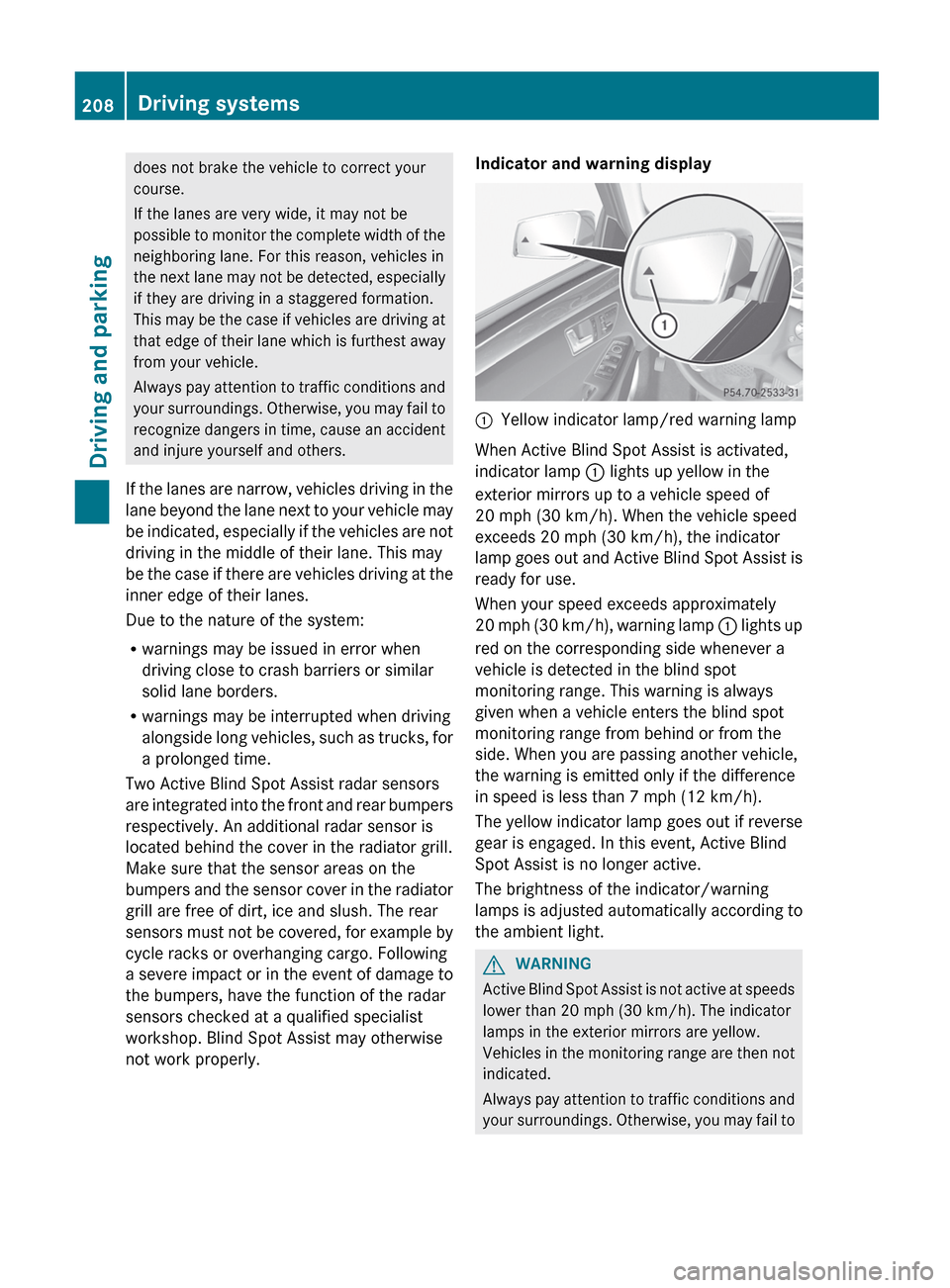
not work properly.Indicator and warning display:Yellow indicator lamp/red warning lamp
When Active Blind Spot Assist is activated,
indicator lamp : lights up yellow in the
exterior mirrors up to a vehicle speed of
20 mph (30 km/h). When the vehicle speed
exceeds 20 mph (30 km/h), the indicator
lamp goes out and Active Blind Spot Assist is
ready for use.
When your speed exceeds approximately
20 mph (30 km/h), warning lamp : lights up
red on the corresponding side whenever a
vehicle is detected in the blind spot
monitoring range. This warning is always
given when a vehicle enters the blind spot
monitoring range from behind or from the
side. When you are passing another vehicle,
the warning is emitted only if the difference
in speed is less than 7 mph (12 km/h).
The yellow indicator lamp goes out if reverse
gear is engaged. In this event, Active Blind
Spot Assist is no longer active.
The brightness of the indicator/warning
lamps is adjusted automatically according to
the ambient light.
GWARNING
Active Blind Spot Assist is not active at speeds
lower than 20 mph (30 km/h). The indicator
lamps in the exterior mirrors are yellow.
Vehicles in the monitoring range are then not
indicated.
Always pay attention to traffic conditions and
your surroundings. Otherwise, you may fail to
208Driving systemsDriving and parking
Page 240 of 396
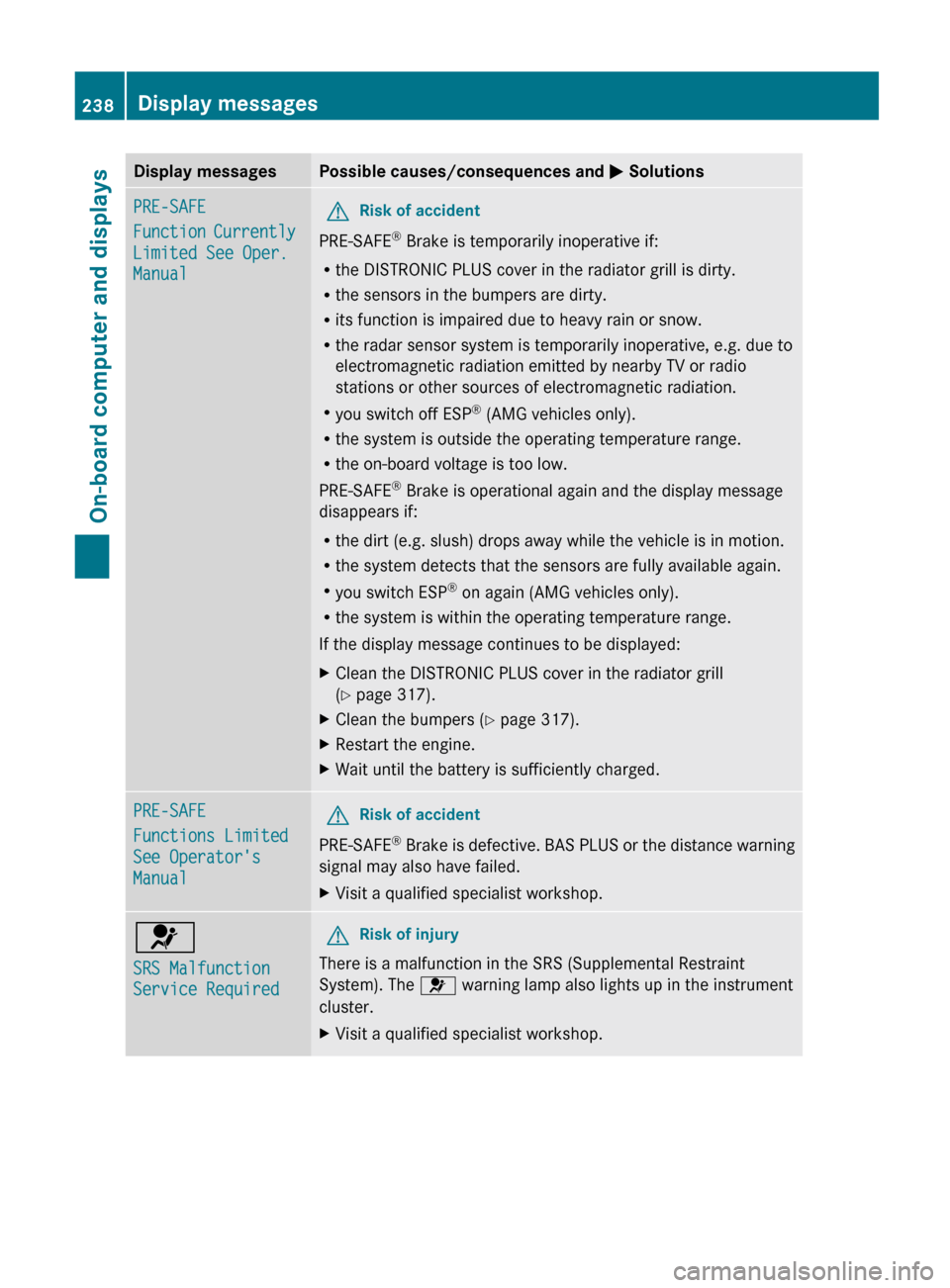
Display messagesPossible causes/consequences and M SolutionsPRE-SAFE
Function Currently
Limited See Oper.
ManualGRisk of accident
PRE-SAFE ®
Brake is temporarily inoperative if:
R the DISTRONIC PLUS cover in the radiator grill is dirty.
R the sensors in the bumpers are dirty.
R its function is impaired due to heavy rain or snow.
R the radar sensor system is temporarily inoperative, e.g. due to
electromagnetic radiation emitted by nearby TV or radio
stations or other sources of electromagnetic radiation.
R you switch off ESP ®
(AMG vehicles only).
R the system is outside the operating temperature range.
R the on-board voltage is too low.
PRE-SAFE ®
Brake is operational again and the display message
disappears if:
R the dirt (e.g. slush) drops away while the vehicle is in motion.
R the system detects that the sensors are fully available again.
R you switch ESP ®
on again (AMG vehicles only).
R the system is within the operating temperature range.
If the display message continues to be displayed:
XClean the DISTRONIC PLUS cover in the radiator grill
( Y page 317).XClean the bumpers ( Y page 317).XRestart the engine.XWait until the battery is sufficiently charged.PRE-SAFE
Functions Limited
See Operator's
ManualGRisk of accident
PRE-SAFE ®
Brake is defective. BAS PLUS or the distance warning
signal may also have failed.
XVisit a qualified specialist workshop.6
SRS Malfunction
Service RequiredGRisk of injury
There is a malfunction in the SRS (Supplemental Restraint
System). The 6 warning lamp also lights up in the instrument
cluster.
XVisit a qualified specialist workshop.238Display messagesOn-board computer and displays
Page 248 of 396
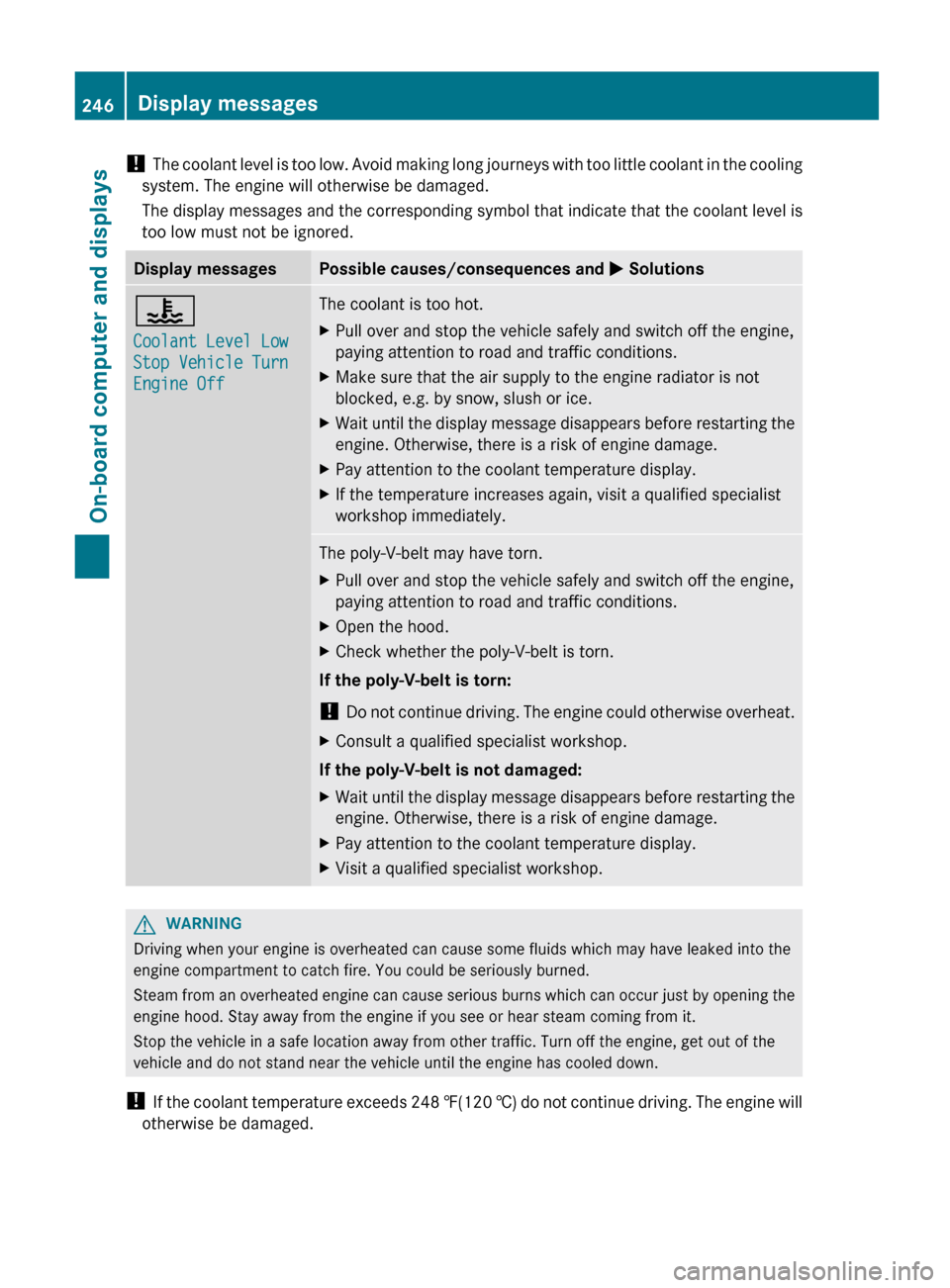
! The coolant level is too low. Avoid making long journeys with too little coolant in the cooling
system. The engine will otherwise be damaged.
The display messages and the corresponding symbol that indicate that the coolant level is
too low must not be ignored.Display messagesPossible causes/consequences and M Solutions?
Coolant Level Low
Stop Vehicle Turn
Engine OffThe coolant is too hot.XPull over and stop the vehicle safely and switch off the engine,
paying attention to road and traffic conditions.XMake sure that the air supply to the engine radiator is not
blocked, e.g. by snow, slush or ice.XWait until the display message disappears before restarting the
engine. Otherwise, there is a risk of engine damage.XPay attention to the coolant temperature display.XIf the temperature increases again, visit a qualified specialist
workshop immediately.The poly-V-belt may have torn.XPull over and stop the vehicle safely and switch off the engine,
paying attention to road and traffic conditions.XOpen the hood.XCheck whether the poly-V-belt is torn.
If the poly-V-belt is torn:
! Do not continue driving. The engine could otherwise overheat.
XConsult a qualified specialist workshop.
If the poly-V-belt is not damaged:
XWait until the display message disappears before restarting the
engine. Otherwise, there is a risk of engine damage.XPay attention to the coolant temperature display.XVisit a qualified specialist workshop.GWARNING
Driving when your engine is overheated can cause some fluids which may have leaked into the
engine compartment to catch fire. You could be seriously burned.
Steam from an overheated engine can cause serious burns which can occur just by opening the
engine hood. Stay away from the engine if you see or hear steam coming from it.
Stop the vehicle in a safe location away from other traffic. Turn off the engine, get out of the
vehicle and do not stand near the vehicle until the engine has cooled down.
! If the coolant temperature exceeds 248 ‡(120 †) do not continue driving. The engine will
otherwise be damaged.
246Display messagesOn-board computer and displays
Page 255 of 396
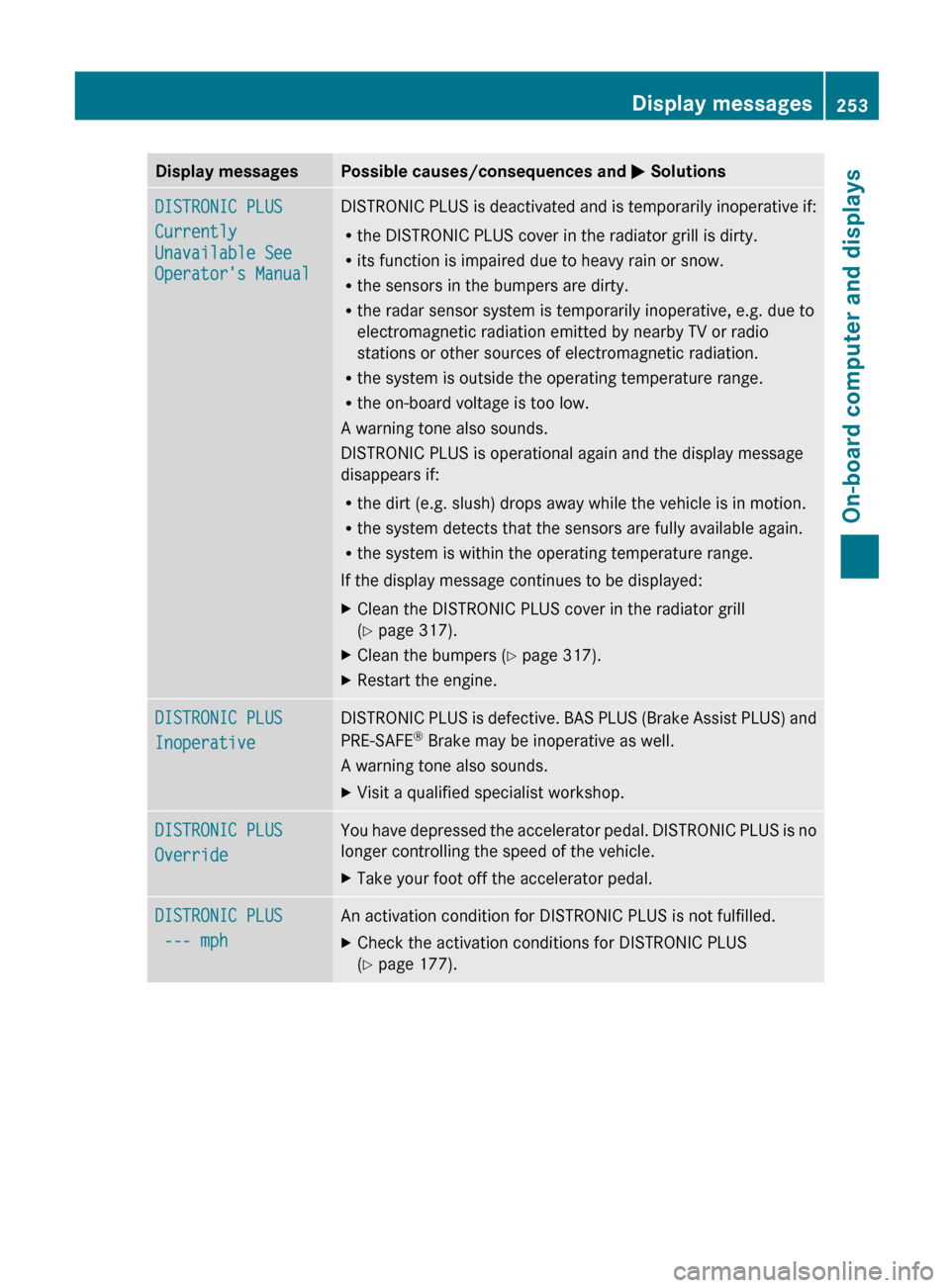
Display messagesPossible causes/consequences and M SolutionsDISTRONIC PLUS
Currently
Unavailable See
Operator's ManualDISTRONIC PLUS is deactivated and is temporarily inoperative if:
R the DISTRONIC PLUS cover in the radiator grill is dirty.
R its function is impaired due to heavy rain or snow.
R the sensors in the bumpers are dirty.
R the radar sensor system is temporarily inoperative, e.g. due to
electromagnetic radiation emitted by nearby TV or radio
stations or other sources of electromagnetic radiation.
R the system is outside the operating temperature range.
R the on-board voltage is too low.
A warning tone also sounds.
DISTRONIC PLUS is operational again and the display message
disappears if:
R the dirt (e.g. slush) drops away while the vehicle is in motion.
R the system detects that the sensors are fully available again.
R the system is within the operating temperature range.
If the display message continues to be displayed:XClean the DISTRONIC PLUS cover in the radiator grill
( Y page 317).XClean the bumpers ( Y page 317).XRestart the engine.DISTRONIC PLUS
InoperativeDISTRONIC PLUS is defective. BAS PLUS (Brake Assist PLUS) and
PRE-SAFE ®
Brake may be inoperative as well.
A warning tone also sounds.XVisit a qualified specialist workshop.DISTRONIC PLUS
OverrideYou have depressed the accelerator pedal. DISTRONIC PLUS is no
longer controlling the speed of the vehicle.XTake your foot off the accelerator pedal.DISTRONIC PLUS
--- mphAn activation condition for DISTRONIC PLUS is not fulfilled.XCheck the activation conditions for DISTRONIC PLUS
( Y page 177).Display messages253On-board computer and displaysZ
Page 271 of 396
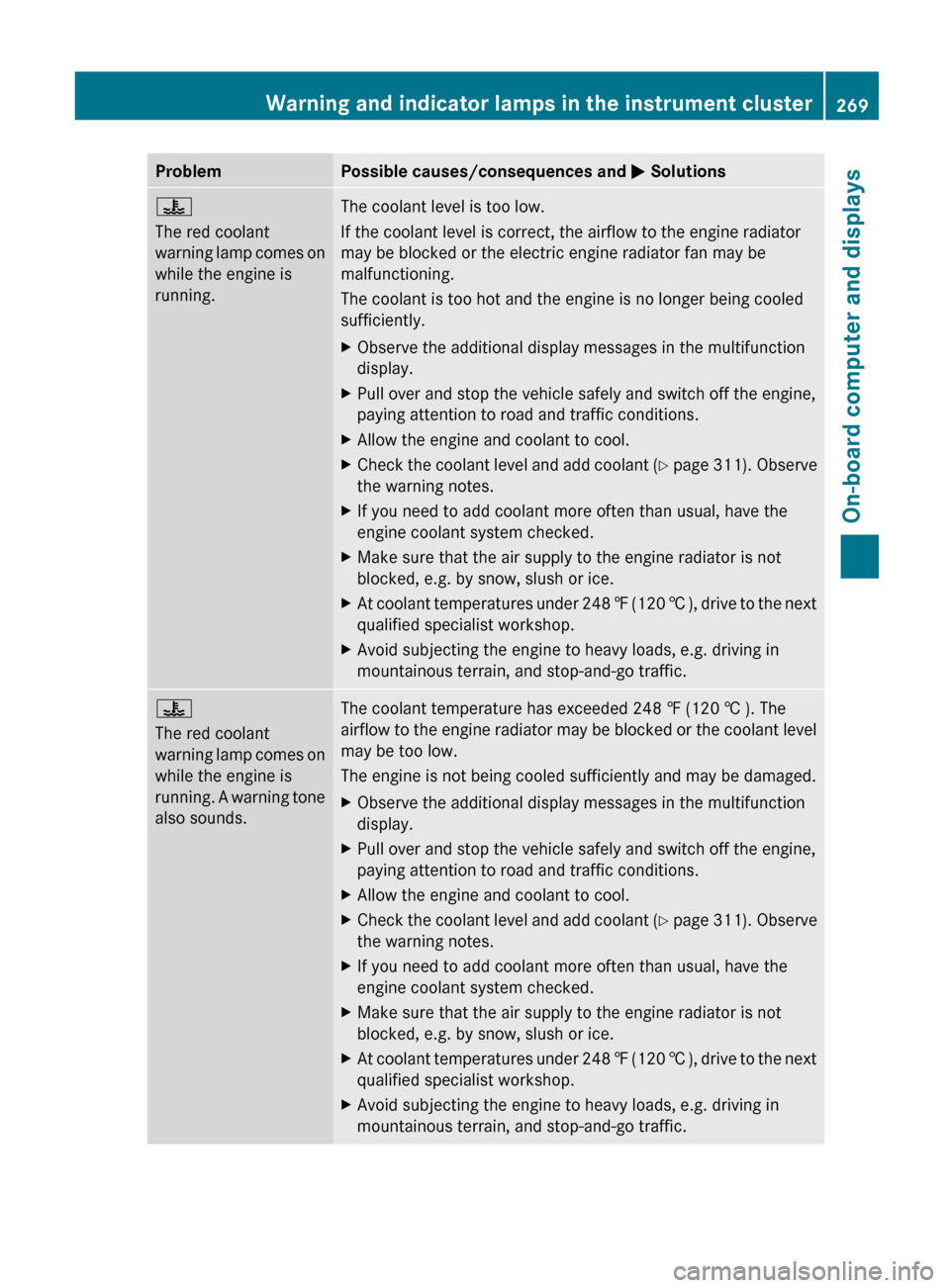
ProblemPossible causes/consequences and M Solutions?
The red coolant
warning lamp comes on
while the engine is
running.The coolant level is too low.
If the coolant level is correct, the airflow to the engine radiator
may be blocked or the electric engine radiator fan may be
malfunctioning.
The coolant is too hot and the engine is no longer being cooled
sufficiently.XObserve the additional display messages in the multifunction
display.XPull over and stop the vehicle safely and switch off the engine,
paying attention to road and traffic conditions.XAllow the engine and coolant to cool.XCheck the coolant level and add coolant (Y page 311). Observe
the warning notes.XIf you need to add coolant more often than usual, have the
engine coolant system checked.XMake sure that the air supply to the engine radiator is not
blocked, e.g. by snow, slush or ice.XAt coolant temperatures under 248 ‡ (120 † ), drive to the next
qualified specialist workshop.XAvoid subjecting the engine to heavy loads, e.g. driving in
mountainous terrain, and stop-and-go traffic.?
The red coolant
warning lamp comes on
while the engine is
running. A warning tone
also sounds.The coolant temperature has exceeded 248 ‡ (120 † ). The
airflow to the engine radiator may be blocked or the coolant level
may be too low.
The engine is not being cooled sufficiently and may be damaged.XObserve the additional display messages in the multifunction
display.XPull over and stop the vehicle safely and switch off the engine,
paying attention to road and traffic conditions.XAllow the engine and coolant to cool.XCheck the coolant level and add coolant (Y page 311). Observe
the warning notes.XIf you need to add coolant more often than usual, have the
engine coolant system checked.XMake sure that the air supply to the engine radiator is not
blocked, e.g. by snow, slush or ice.XAt coolant temperatures under 248 ‡ (120 † ), drive to the next
qualified specialist workshop.XAvoid subjecting the engine to heavy loads, e.g. driving in
mountainous terrain, and stop-and-go traffic.Warning and indicator lamps in the instrument cluster269On-board computer and displaysZ
Page 310 of 396

Useful information
i This Operator's Manual describes all
models and all standard and optional
equipment of your vehicle available at the
time of publication of the Operator's
Manual. Country-specific differences are
possible. Please note that your vehicle may
not be equipped with all features
described. This also applies to safety-
related systems and functions.
i Please read the information on qualified
specialist workshops ( Y page 25).
Engine compartment
Hood
Opening the hood
GWARNING
Do not pull the release lever while the vehicle
is in motion. Otherwise, the hood could be
forced open by passing air flow.
This could cause the hood to come loose and
injure you and/or others.
GWARNING
Do not open the hood when the engine is
overheated. You could be seriously injured.
Observe the coolant temperature gauge to
determine whether the engine may be
overheated. If you see flames or smoke
coming from the engine compartment, move
away from the vehicle. Wait until the engine
has cooled. If necessary, call the fire
department.
GWARNING
There is a risk of injury if the hood is open,
even if the engine is not running.
Some engine components can become very
hot.
To avoid the risk of burns, only touch those
components described in the Operator's
Manual and observe the relevant safety notes.
GWARNING
To help prevent personal injury, stay clear of
moving parts when the hood is open and the
engine is running.
The radiator fan may continue to run for
approximately 30 seconds or may even
restart after the engine has been turned off.
Stay clear of fan blades.
GWARNING
Vehicles with gasoline engine:
The engine is equipped with a transistorized
ignition system. Because of the high voltage
it is dangerous to touch any components
(ignition coils, spark plug sockets, diagnostic
socket) of the ignition system
R with the engine running
R while starting the engine
R when the ignition is switched on and the
engine is turned manually
GWARNING
Vehicles with diesel engine:
The engine is equipped with a high-voltage
electronic control unit for the injection
system. Because of the high voltage it is
dangerous to touch any components of the
injection system (injectors, electrical wires)
R with the engine running
R while starting the engine
R when the ignition is switched on
XMake sure that the windshield wipers are
switched off.GWARNING
The windshield wipers and wiper linkage
could be set in motion.
When the hood is open, you or others could
be injured by the wiper linkage.
Make sure that the windshield wipers are
switched off. Remove the SmartKey or make
sure that no ignition position has been
selected with KEYLESS-GO. All indicator
lamps must be off in the instrument cluster.
308Engine compartmentMaintenance and care