light MERCEDES-BENZ E-CLASS WAGON 2018 Owner's Manual
[x] Cancel search | Manufacturer: MERCEDES-BENZ, Model Year: 2018, Model line: E-CLASS WAGON, Model: MERCEDES-BENZ E-CLASS WAGON 2018Pages: 506, PDF Size: 6.73 MB
Page 352 of 506
RThe jumper cable/charging cable must not
come into contact with any parts which may
movewhen the engine is running.
RAlw ays make sure that nei ther you nor the
battery is elect rostatically charge d.
RKe ep away from fire and open flames.
RDo not lean overth e batter y.
RWhencharging: only use battery charge rs
te sted and appr oved byMercedes-Benz and
re ad the battery charge r's operating instruc‐
tions before charging the batter y.
Obser vethe additional following points during
st arting assis tance:
RSt arting assis tance may only be pr ovided
using batteries with a nominal voltage of
12 V.
RThe vehicles must not touch.
RGa soline engine: Onlyaccept starting assis‐
ta nce if the engine and exhaust sy stem are
cold.
#Secure theve hicle byapplying the electric
parking brake.
#Au tomatic transmission: Shiftthe trans‐
mission toposition j.
#Make sure that the ignition and all electrical
consumers are switched off.
#Open the hood.
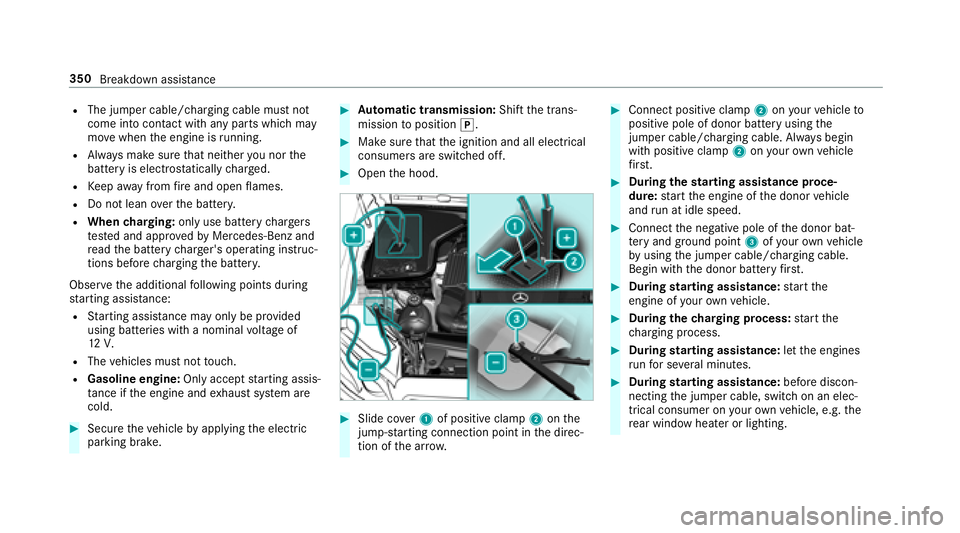
#Slide co ver1 of positive clamp 2onthe
jump-s tarting connection point in the direc‐
tion of the ar row.
#Connect positive clamp 2onyour vehicle to
positive pole of donor battery using the
jumper cable/charging cable. Alw ays begin
with positive clamp 2onyour ow nve hicle
fi rs t.
#Du ring thest arting assist ance proce‐
dure: start the engine of the donor vehicle
and run at idle speed.
#Connect the negative pole of the donor bat‐
te ry and ground po int3 ofyour ow nve hicle
by using the jumper cable/charging cable.
Begin with the donor battery firs t.
#Du ring starting assist ance:start the
engine of your ow nve hicle.
#During thech arging process: start the
ch arging process.
#During starting assist ance:letthe engines
ru nfo r se veral minutes.
#During starting assist ance:before discon‐
necting the jumper cable, switch on an elec‐
trical consumer on your ow nve hicle, e.g. the
re ar wind owheater or lighting.
350
Breakdown assis tance
Page 365 of 506
&WARNING Risk of accident caused by
re peated drop in tire pressure
If th e tire pressure drops repeatedl y,the
wheel, valve or tire may be damaged.
Insuf ficient tire pressure can cause the tires
to bur st.
#Inspect the tire for signs of fore ign
objects.
#Check whe ther the wheel or valve has a
leak.
#If yo u are unab leto rectify the damage,
conta ct aqualified specialist workshop.
Yo u can find information on tire pressure forth e
ve hicle's factor y-mounted tires on thefo llowing
labels:
RTi re and Loading Info rmation placard on the
B‑pillar of your vehicle (→page 367).
RTire pressure table on the inside of the fuel
fi ller flap (→page 363).
Observ eth e maximum tire pressure
(
→page 374). Use a sui
table pressure gauge tocheck the tire
pressure. The outer appearance of a tire does
not permit any reliable conclusion about the tire
pressure.
Ve hicles with a tire pressure monitoring sys‐
te m: You can also check the tire pressure using
th e on-board computer.
Only cor rect tire pressure when the tires are
cold. Conditions for cold tires:
RThe vehicle has been par ked with the tires
out of direct sunlight for at least th ree hours.
RThe vehicle has tr aveled less than 1 mile
(1.6 km).
A rise in the tire temp erature of 18°F (10 °C)
increases the tire pressure byappr ox.10 kPa
(0.1 bar/1.5 psi). Take this into account when
ch ecking the tire pressure of warm tires.
The tire pressure re commendedfor increased
load/speed in the tire pressure table can af fect
th eride comfort.
&
WARNING Risk of accident from unsuita‐
ble accessori es onthe tire valves
If yo u mount unsuitable accessories onto tire
va lves, the tire valves may be overloaded and
malfunction, which can cause tire pressure
loss. Tire pressure monitoring sy stems for
re trofitting will cause the tire valve toremain
open. This can also result in tire pressure
loss.
#Only scr ewstandard valve caps or valve
caps specifically appr ovedby
Mercedes-Benz foryo ur vehicle onto
th e tire valve.
Ti re pressure table
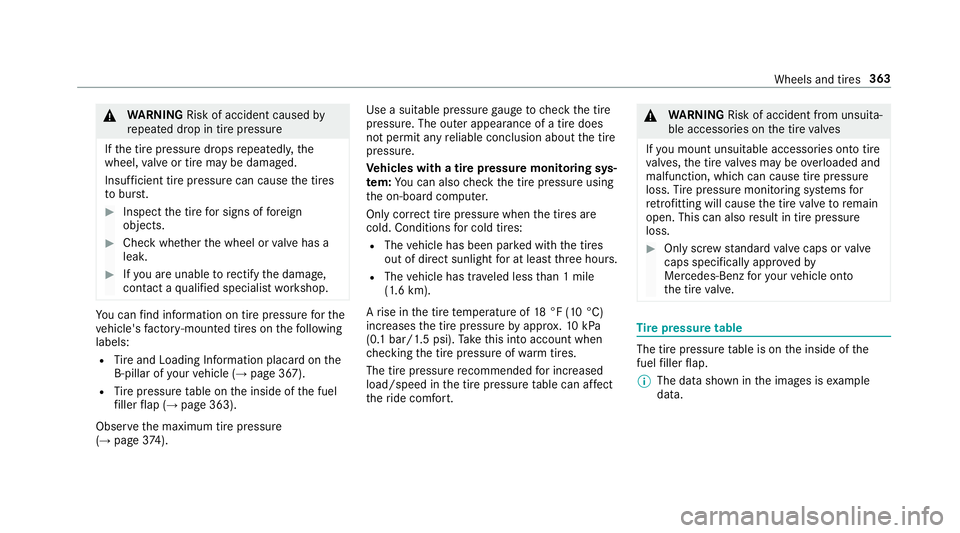
The tire pressure table is on the inside of the
fuel filler flap.
% The data shown in the images is example
data.
Wheels and tires 363
Page 367 of 506
Further related subjects:
RNo tes on tire pressure (→page 361)
RTire pressure table (→page 363)
RTire and Loading Info rmation placard
(→page 367)
Ti re pressure moni toring sy stem
Fu nction of the tire pressure moni toring sys‐
te m
&
DANG ER Risk of accident due toincor‐
re ct tire pressure
Every tire, including the spare (if pr ovided),
should be checked when cold at least once a
month and inflated tothe pressure recom‐
mended bytheve hicle manufacturer (see
Ti re and Loading Info rmation placard on the
B-pillar on the driver ’sside or the tire pres‐
sure label on the inside of the fuel filler flap
of your vehicle). If your vehicle has tires of a
dif fere nt size than the size indicated on the
Ti re and Loading Info rmation placard or the
tire pressure table, you need todeterm ine
th e proper tire pressure forth ose tires.
As an added saf etyfe ature, your vehicle has
been equipped with a tire pressure monitor‐
ing sy stem (TPMS) that illuminates a low tire
pressure indicator lamp when one or more of
yo ur tires are signif icantly underinflated.
Ac cording ly, if the low tire pressure indicator
lamp lights up, you should stop and check
yo ur tires as soon as possible, and inflate
th em tothe proper pressure. Driving on a
significantly underinflated tire causes the tire
to ove rheat and can lead totire failure.
Un derinflation also increases fuel consump‐
tion and reduces tire tread life, and may
af fect theve hicle's handling and braking abil‐
ity. Please no tethat the TPMS is not a substi‐
tute for proper tire maintenance, and it is the
driver's responsibility tomaintain cor rect tire
pressure, even if underinflation has not
re ached the le velto trig ger illumination of
th e TPMS low tire pressure indicator lamp.
Yo ur vehicle has also been equipped with a
TPMS malfunction indicator toindicate whenthe sy stem is not operating proper ly. The
TPMS malfunction indica tor is combined with
th e low tire pressure indicator lamp. When
th e sy stem de tects a malfunction, the indica‐
to r lamp will flash for app roxima tely a minute
and then remain continuously illumina ted.
This sequence will continue upon subsequent
ve hicle start-ups as long as the malfunction
ex ists.
When the malfunction indicator is illumina‐
te d, the sy stem may not be able todetect or
signal low tire pressure as intended. TPMS
malfunctions may occur for a variet yof rea‐
sons, including the ins tallation of incompati‐
ble replacement or alternate tires or wheels
on theve hicle that pr eventthe TPMS from
functioning properly.
Alw aysch eck the TPMS malfunction warning
lamp af terre placing one or more tires or
wheels on your vehicle toensure that the
re placement or alternate tires and wheels
allow the TPMS tocontinue tofunction prop‐
erly.
Wheels and tires 365
Page 378 of 506
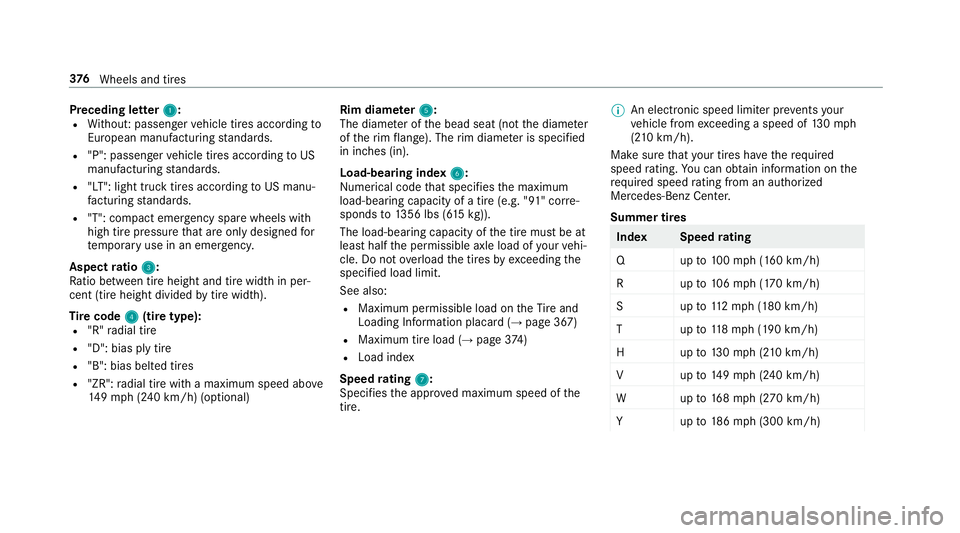
Preceding letter1:RWithout: passenger vehicle tires according to
European manufactu ring standards.
R"P": passenger vehicle tires according toUS
manufacturing standards.
R"LT": light truck tires according toUS manu‐
fa cturing standards.
R"T": compact emer gency spa rewheels with
high tire pressure that are only designe dfo r
te mp orary use in an emer gency.
Aspect ratio 3
:
Ra tio between tire height and tire width in per‐
cent (ti reheight divided bytire width).
Tire code 4
(tire type):R"R" radial tire
R"D": bias ply tire
R"B": bias belted tires
R"ZR": radial tire with a maximum speed abo ve
14 9mp h (240 km/h) (optional) Rim diame
ter5
:
The diam eter of the bead seat (not the diame ter
of therim flange). The rim diame ter is specified
in inches (in).
Load-bearing index 6
:
Numerical code that specifies the maximum
load-bearing capacity of a tire (e.g. "91" cor re‐
sponds to1356 lbs (6 15kg)).
The load-bearing capacity of the tire must be at
least half the permissible axle load of your vehi‐
cle. Do not overload the tires byexc eeding the
specified load limit.
See also:
RMaximum permissible load on theTire and
Loading Info rmation placard (→page 367)
RMaximum tire load (→page 374)
RLoad inde x
Speed rating 7
:
Specifies the appr oved maximum speed of the
tire. %
An electronic speed limite r prevents your
ve hicle from exceeding a speed of 130mp h
(2 10 km/h).
Make surethat your tires ha vetherequ ired
speed rating. You can obtain information on the
re qu ired speed rating from an au thorized
Mercedes-Benz Center.
Summer tires
Inde xS peedrating
Qu pto 100mp h (160 km/h)
Ru pto 106mp h (170 km/h)
Su pto 112mp h(1 80 km/h)
Tu pto 118mp h (190 km/h)
Hu pto 130mp h(210 km/h)
Vu pto 149mp h(2 40 km/h)
Wu pto 168mp h (270 km/h)
Yu pto 186mp h(3 00 km/h)
37 6
Wheels and tires
Page 379 of 506
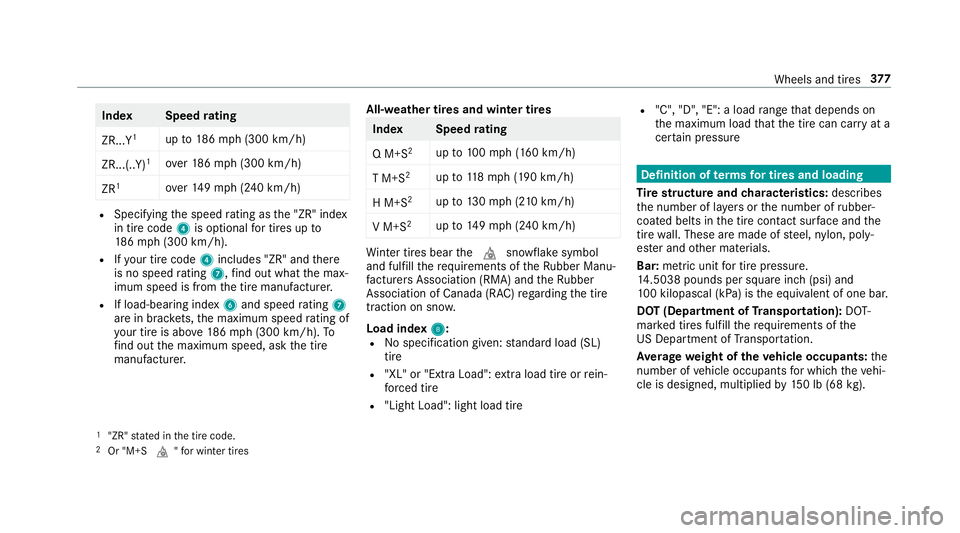
IndexS peedrating
ZR...Y
1up to186mp h(3 00 km/h)
ZR...(..Y)
1ove r18 6mp h(3 00 km/h)
ZR
1ove r14 9mp h (240 km/h)
RSpecifying the speed rating as the "ZR" index
in tire code 4is optional for tires up to
18 6mp h(3 00 km/h).
RIfyo ur tire co de4 includes "ZR"andthere
is no speed rating 7,find out what the max‐
imum speed is from the tire manufacturer.
RIf load-bearing index 6and speed rating 7
are in brac kets, the maximum speed rating of
yo ur tire isabo ve186mp h (300 km/h). To
fi nd out the maximum speed, ask the tire
manufacturer. All-weather tires and winter tires
Inde
xS peedrating
Q M+S
2up to100mp h (160 km/h)
T M+S
2up to118mp h(190 km/h)
H M+S
2up to130mp h (2 10km/h)
V M+S
2up to149mp h (240 km/h)
Winter tires bear thei snowflake symbol
and fulfill therequ irements of theRu bber Manu‐
fa cturers Association (RMA) and theRu bber
Association of Canada (RAC) rega rding the tire
traction on sno w.
Load index 8
:RNo specification given: standard load (SL)
tire
R"XL" or "Extra Load": extra load tire or rein‐
fo rc ed tire
R"Light Load": light load tire
R"C", "D", "E": a load range that depends on
th e maximum load that the tire can car ryat a
cer tain pressure
Definition of termsfo r tires and loading
Ti re stru ctureand characteristics: describes
th e number of la yers or the number of rubber-
coated belts in the tire conta ct surface and the
tire wall. These are made of steel, nylon, poly‐
es ter and other materials.
Bar: metric unit for tire pressure .
14 .5038 pounds per square inch (psi) and
10 0 kilopascal (kPa) is the equivalent of one bar.
DOT (Department of Transport ation):DOT-
mar ked tires fulfill therequ irements of the
US Department of Transpor tatio n.
Av erage weight of theve hicle occupants: the
number of vehicle occupants for which th eve hi‐
cle is designed, multiplied by150 lb (68 kg).
1"ZR" stated in the tire code.2Or "M+S i"for winter tires
Wheels and tires 37
7
Page 381 of 506
these are ins talled on theve hicle, but does not
include passengers or luggage.
Maximum tire load: the maximum tire load is
th e maximum permissible weight in kilog rams or
lbs for which a tire is appr oved.
Maximum permissible tire pressure: maxi‐
mum permissible tire pressure for one tire.
Maximum load on one tire: maximum load on
one tire. This is calculated bydividing the maxi‐
mum axle load of one axle bytwo.
PSI (pounds per square in ch):standard unit of
measurement for tire pressure .
Aspect ratio: ratio between tire height and tire
width in pe rcent.
Ti re pressure: pressure inside the tire applying
an outward forc eto eve rysquare inch of the tire.
The tire pressure is specified in pounds per
square inch (psi), in kilopascals (kPa) or in bar.
The tire pressure should only be cor rected when
th e tires are cold.
Cold tire pressure: the tires are cold when the
ve hicle has been par kedfo r at least 3 hours without direct sunlight on
the tires or theve hicle
has been driven for less than 1 mile (1.6 km).
Ti re contact sur face: the part of the tire that
comes into con tact wi th thero ad.
Ti re bead: the purpose of the tire bead is to
ensure that the tire sits securely on the wheel
ri m. There are se veral wire cores in the tire bead
to pr
eve ntthe t
ire fromchanging length on the
wheel rim.
Side wall:the part of the tire between the tread
and the tire bead.
We ight of optional equipment: the combined
we ight of the optional equipment weighing more
th an there placed standard parts and more than
5 lbs (2.3 kg).This optional equipment, such as
high-per form ance brakes, le vel control sy stem, a
ro of luggage rack or high-per form ance batte ries,
is not included in the curb weight and thewe ight
of the accessories.
TIN (Tire Identification Number): a unique
identification number which can be used bya
tire manufactu rerto identify tires, forex ample,
in a product recall, and thus identify the pur‐
ch asers. The TIN is made up of the manufactur‐ er's identity code, tire size, tire type code and
th
e manufacturing date.
Load-bearing index: the load-bearing index is a
code that con tains the maximum load-bearing
capacity of a tire.
Tr action: traction is the grip resulting from fric‐
tion between the tires and thero ad sur face.
We ar indicator: narrow bars (tread wear bars)
th at are distributed overth e tire conta ct surface.
If th e tire tread is le vel with the bars, thewe ar
limit of 1/ 16in (1.6 mm) has been reached.
Distribution of vehicle occupants: distribution
of vehicle occupants ov
er design
ated seat posi‐
tions in a vehicle.
Maximum permissible pa yload weight: nomi‐
nal load and luggage load plus 150 lb (68 kg)
multiplied bythe number of seats in theve hicle.
Wheels and tires 37
9
Page 401 of 506
*NO
TEDama getotheex terior lighting
due tounsuit able wind shieldwasher fluid
Uns uitable wind shieldwasher fluid may dam‐
age the plastic sur face of theex terior light‐
ing.
#Only use windshield washer fluid whic h
is also suitable for use on plast ic surfa‐
ces, e.g. MB SummerFit or MB Winter‐
Fit.
* NO
TEBlocked spr aynozzles caused by
mixing windshield washer fluids
#Do not mix MB SummerFit and MB Win‐
te rFit with other windshield washer flu‐
ids.
Do not use distilled or de-ionized water asthefill
le ve l sensor may be triggered er roneously.
Re commended windshield washer fluid:
RAbo vefreezing point: e.g. MB SummerFit
RBelow freezing point: e.g. MB WinterFit Fo
rth e cor rect mixing ratio referto the informa‐
tion on the antif reeze reser voir.
Ad d windshield washer fluid tothewa sher water
all year round.
Re frigerant
Note s onrefrigerants
Obser vethe no tes on operating fluids
(
→page 394).
* NO
TEDama gedue toincor rect refriger‐
ant
If a non-appr ovedre frigerant is used, the cli‐
mate control sy stem may be damaged.
#Only use there frigerant R‑134a
* NO
TEDama getothe climate control
sy stem due toincor rect refrigerant com‐
pressor oil
#Only use refrigerant compressor oil that
has been appr ovedby Mercedes-Benz.
#Do not mix the appr ovedre frigerant
compressor oil with a dif fere nt refriger‐
ant compressor oil.
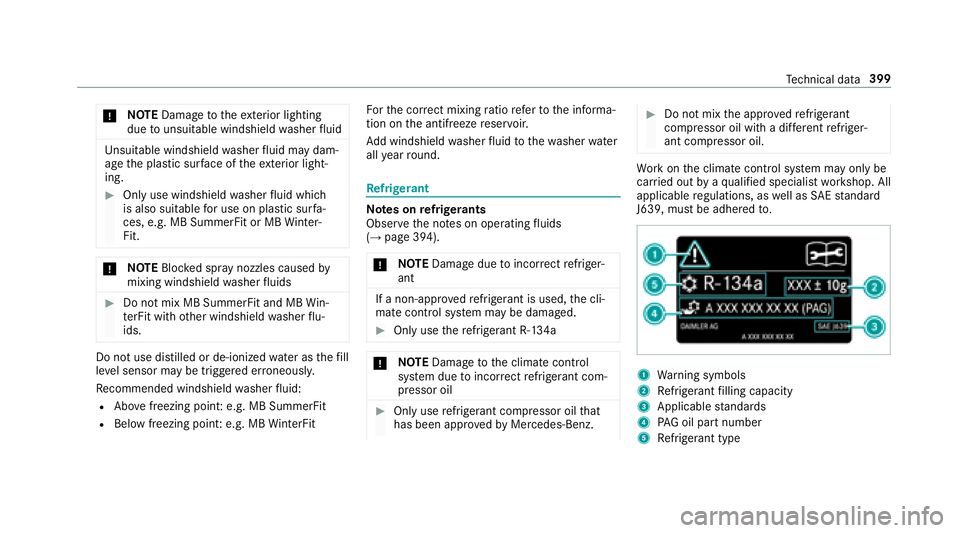
Wo rkon the climate control sy stem may only be
car ried out byaqu alified specialist workshop. All
applicable regulations, as well as SAEstandard
J639, must be adhered to.
1Wa rning symbols
2Re frigerant filling capacity
3Applicable standards
4PA G oil part number
5Re frigerant type
Tech nical da ta399
Page 406 of 506
Displaymessages
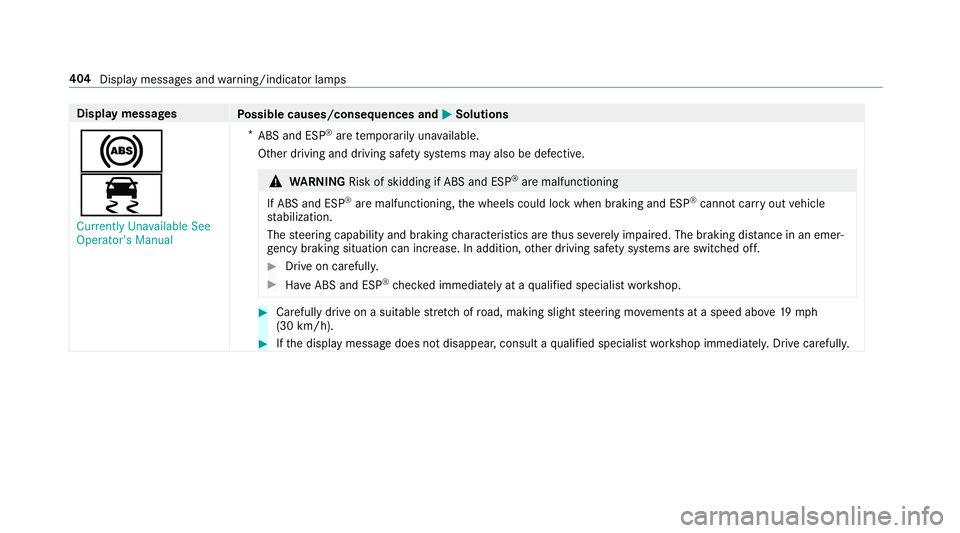
Possible causes/consequences and MSolutions
!
÷
&XUUHQWO\ 8QDYDLODEOH 6HH
2SHUDWRU
V 0DQXDO*
ABS and ESP
®are temp orarily una vailable.
Other driving and driving saf etysy stems may also be defective.
&
WARNING Risk of skidding if ABS and ESP®are malfunctioning
If ABS and ESP
®are malfunctioning, the wheels could lock when braking and ESP®cannot carryout vehicle
st abilization.
The steering capability and braking characteristics are thus se verely impaired .Th ebr aking dis tance in an emer‐
ge ncy braking situation can increase. In addition, other driving saf etysy stems are switched off.
#Drive on carefull y.
#Have ABS and ESP®checked immediately at a qualified specialist workshop.
#Carefully drive on a suitable stre tch of road, making slight steering mo vements at a speed abo ve19 mp h
(30 km/h).
#If th e display message does not disappear, consult a qualified specialist workshop immediately. Drive carefully.
404
Display messages and warning/indicator lamps
Page 407 of 506
Displaymessages
Possible causes/consequences and MSolutions
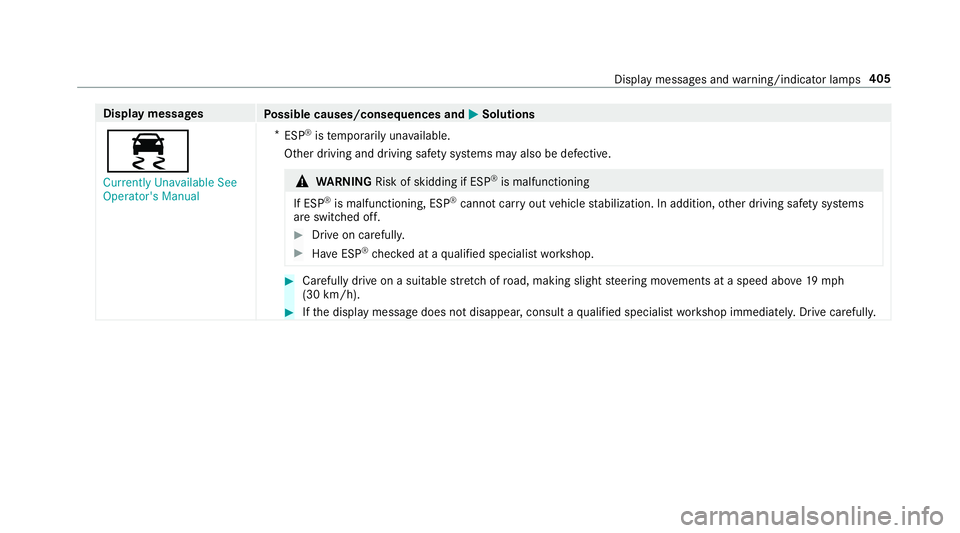
÷
&XUUHQWO\ 8QDYDLODEOH 6HH
2SHUDWRU
V 0DQXDO*
ESP
®is temp orarily una vailable.
Other driving and driving saf etysy stems may also be defective.
&
WARNING Risk of skidding if ESP®is malfunctioning
If ESP
®is malfunctioning, ESP®cannot car ryout vehicle stabilization. In addition, other driving saf etysy stems
are switched off.
#Drive on carefull y.
#Have ESP®checked at a qualified specialist workshop.
#Carefully drive on a suitable stre tch of road, making slight steering mo vements at a speed abo ve19 mp h
(30 km/h).
#If th e display message does not disappear, consult a qualified specialist workshop immediately. Drive carefully.
Display messages and warning/indicator lamps 405
Page 418 of 506
Displaymessages
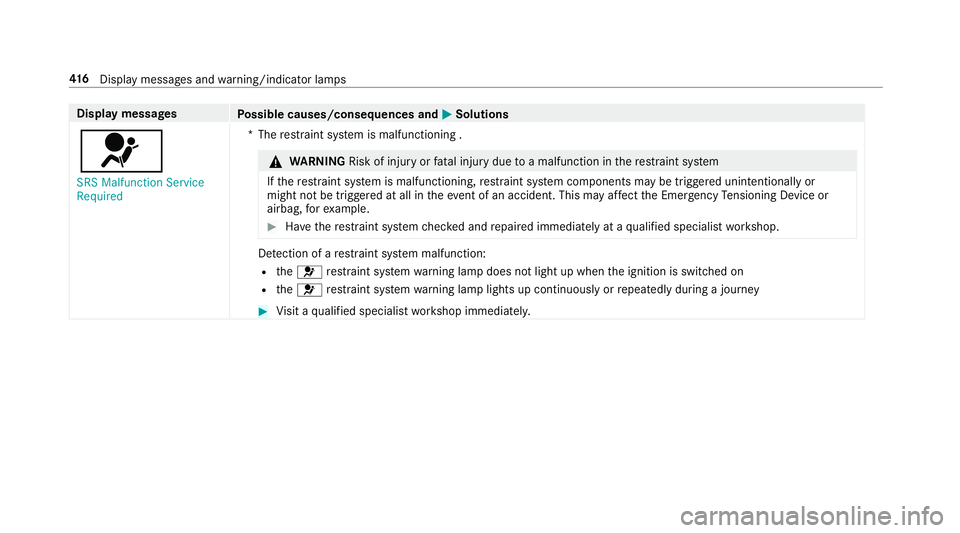
Possible causes/consequences and MSolutions
6
656 0DOIXQFWLRQ 6HUYLFH
5HTXLUHG*T
herestra int sy stem is malfunctioning .
&
WARNING Risk of injury orfata l injury due toa malfunction in there stra int sy stem
If th ere stra int sy stem is malfunctioning, restra int sy stem components may be triggered unintentionally or
might not be triggered at all in theeve nt of an accident. This may af fect the Emer gency Tensioning Device or
airbag, forex ample.
#Ha ve there stra int sy stem checked and repaired immediately at a qualified specialist workshop.
De tection of a restra int sy stem malfunction:
Rth e6 restra int sy stem warning lamp does not light up when the ignition is switched on
Rthe6 restra int sy stem warning lamp lights up continuously or repeatedly during a journey
#Visit a qualified specialist workshop immediatel y.
416
Displ aymessage s andwarning/indicator lamps