lock MERCEDES-BENZ E-CLASS WAGON 2018 Workshop Manual
[x] Cancel search | Manufacturer: MERCEDES-BENZ, Model Year: 2018, Model line: E-CLASS WAGON, Model: MERCEDES-BENZ E-CLASS WAGON 2018Pages: 506, PDF Size: 6.73 MB
Page 329 of 506
Battery disconnection periods
The ASSYST PLUS service inter val display
can only calculate the service due da tewhen
th e batte ryis connected.
#Notedown the service due date displa yed in
th e Instrument Display before disconnecting
th e battery (
→page 326).
Engine compartment
Ac tive hood (pedestrian pr otection)
Operation of the active hood (pedestrian pro‐
te ction)
In cer tain accident situations, therisk of injury
to pedestrians can be reduced bythe actuation
of the active hood. The rear area of the engine
hood is raised byappr oximately 85 mm.
Fo rth e drive tothewo rkshop, reset the trig‐
ge red active hood yourself. Ifth e active hood
has been triggered, pedestrian pr otection may
be limited.
A qu alified specialist workshop must re-ins tate
th e full functionality of the active hood. The active hood is not
available in all countries.
Re setting the active hood
&
WARNING Risk of burn s from hot com‐
ponent parts in the engine compartment
Cer tain component parts in the engine com‐
partment can be very hot, e.g. the engine,
th e cooler and parts of theex haust sy stem.
#Let the engine cool down and only
to uch the component parts described
as follo ws .
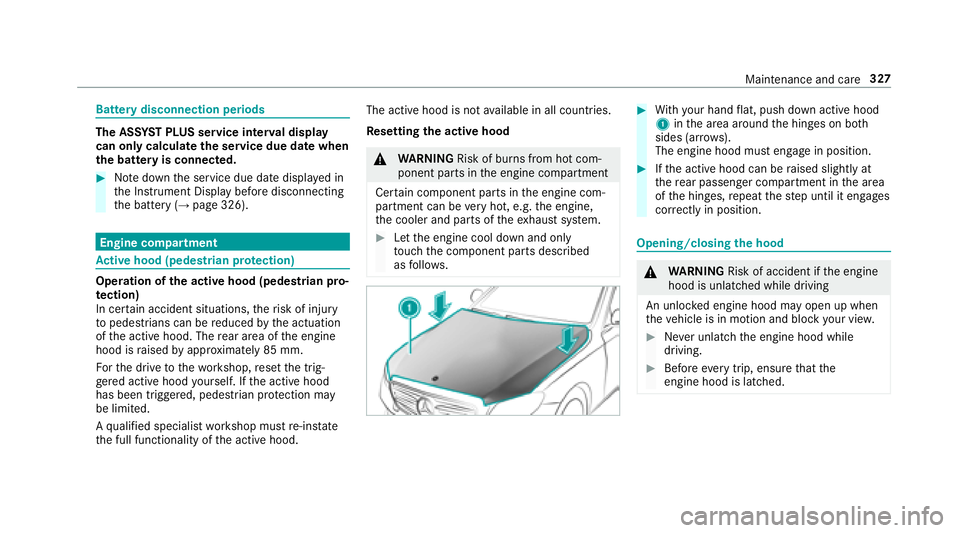
#With your hand flat, push down active hood
1 inthe area around the hinges on bo th
sides (ar rows).
The engine hood must engage in position.
#If th e active hood can be raised slightly at
th ere ar passenger compartment in the area
of the hinges, repeat thestep until it engages
cor rectly in position.
Opening/closing the hood
&
WARNING Risk of accident if the engine
hood is unlatched while driving
An unloc ked engine hood may open up when
th eve hicle is in motion and block your vie w.
#Never unlatch the engine hood while
driving.
#Before every trip, ensure that the
engine hood is latched.
Maintenance and care 327
Page 333 of 506
#Make surethat no engine oil is spilled
next tothefiller opening.
#Allow the engine tocool off and thor‐
oughly clean the engine oil from compo‐
nent parts before starting theve hicle.
* NO
TEEngine damage causedbyan
incor rect oil filter, incor rect oil or addi‐
tives
#Do not use engine oils or oil filters
which do not cor respond tothe specifi‐
cations explicitly prescribed forth e
service inter vals.
#Do not alter the engine oil or oil filter in
order toachie velonger change inter vals
th an prescri bed.
#Do not use additives.
#Follow the instructions in the service
inter val display rega rding the oil
ch ange.
* NO
TEDama gecaused bytopping up too
much engine oil
Ad ding too much engine oil can cause dam‐
age tothe engine or the catalytic con verter.
#Ha ve excess engine oil remo ved at a
qu alified specialist workshop.
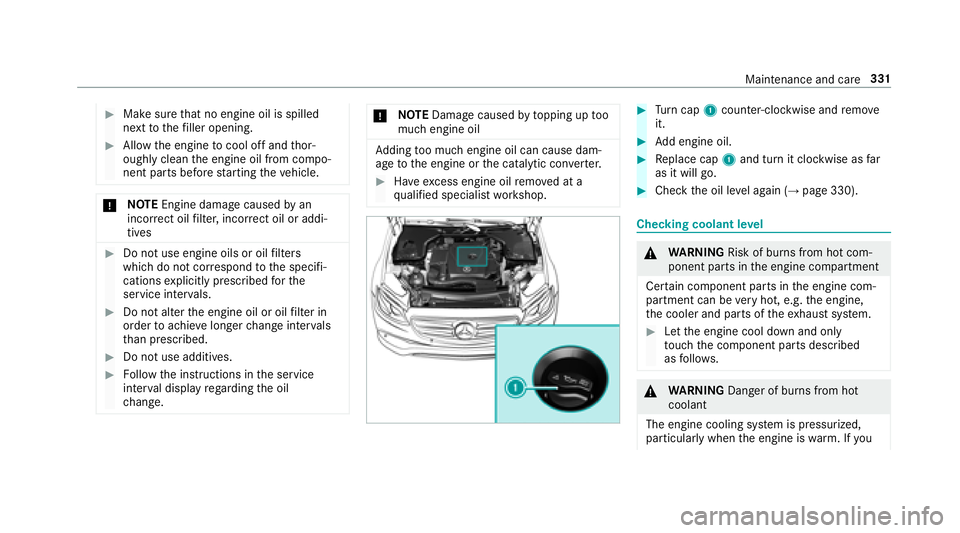
#Tu rn cap 1counter-clockwise and remo ve
it.
#Ad d engine oil.
#Replace cap 1and turn it clockwise as far
as it will go.
#Check the oil le vel again (→page 330).
Checking coolant le vel
&
WARNING Risk of burn s from hot com‐
ponent parts in the engine compartment
Cer tain component parts in the engine com‐
partment can be very hot, e.g. the engine,
th e cooler and parts of theex haust sy stem.
#Let the engine cool down and only
to uch the component parts described
as follo ws .
&
WARNING Danger of burn s from hot
coolant
The engine cooling sy stem is pressurized,
particularly when the engine is warm. If you
Maintenance and care 331
Page 334 of 506
openthe cap, you could bescalded byhot
coolant spr aying out.
#Let the mo tor cool down before opening
th e cap.
#When opening the cap, wearglove s and
pr otective eyew ear.
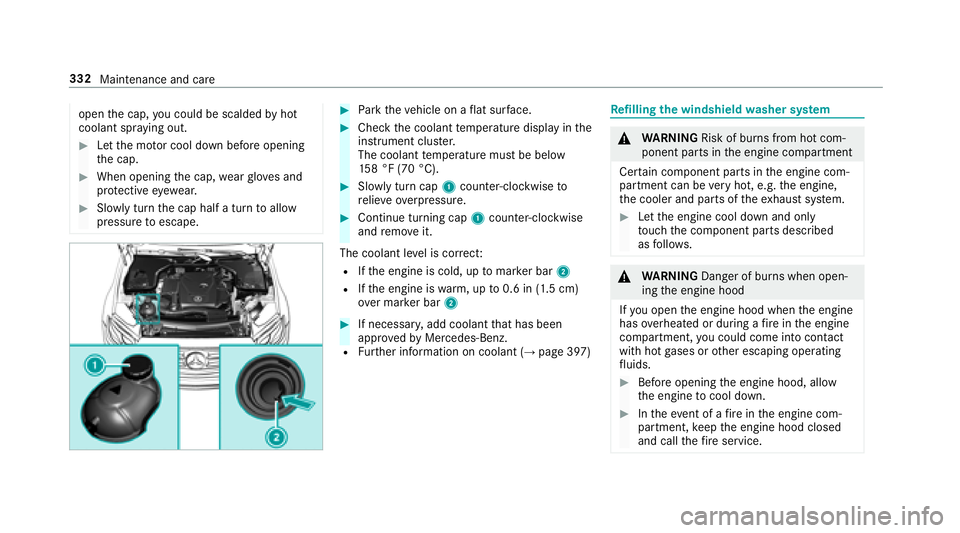
#Slowly turn the cap half a turn toallow
pressure toescape.
#Park theve hicle on a flat sur face.
#Check the coolant temp erature display in the
instrument clus ter.
The coolant temp erature must be below
15 8 °F (70 °C).
#Slowly turn cap 1counter-clockwise to
re lie ve ove rpressure.
#Continue turning cap 1counter-clockwise
and remo veit.
The coolant le vel is cor rect:
RIfth e engine is cold, up tomar ker bar 2
RIfth e engine is warm, up to0.6 in (1.5 cm)
ove r mar ker bar 2
#If necessar y,add coolant that has been
appr ovedby Mercedes-Benz.
RFurther information on coolant (→page 397)
Re filling the windshield washer sy stem
&
WARNING Risk of burn s from hot com‐
ponent parts in the engine compartment
Cer tain component parts in the engine com‐
partment can be very hot, e.g. the engine,
th e cooler and parts of theex haust sy stem.
#Let the engine cool down and only
to uch the component parts described
as follo ws .
&
WARNING Danger of burn s when open‐
ing the engine hood
If yo u open the engine hood when the engine
has overheated or during a fire inthe engine
compartment, you could come into contact
with hot gases or other escaping operating
fl uids.
#Before opening the engine hood, allow
th e engine tocool down.
#Intheeve nt of a fire inthe engine com‐
partment, keep the engine hood closed
and call thefire service.
332
Maintenance and care
Page 348 of 506
#Correct the tire pressure if it is still at least
13 0 kPa (1.3 bar/19 psi). See theTire and
Loading Info rmation placard B‑pillar on the
driver's side or the tire pressure table in the
fuel filler flap forva lues.
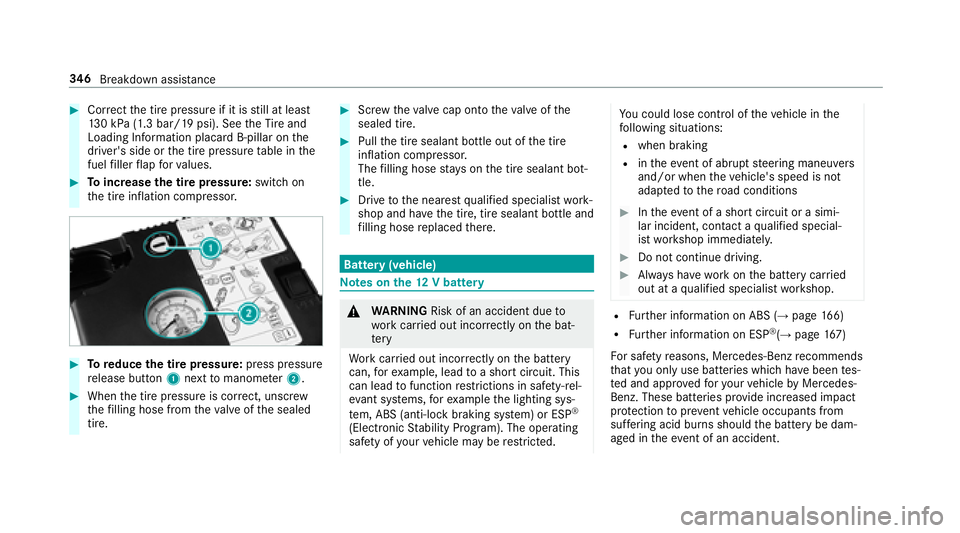
#To increase the tire pressure: switchon
th e tire inflation compressor.
#To reduce the tire pressure: press pressure
re lease button 1next tomanome ter2.
#When the tire pressure is cor rect, unscr ew
th efilling hose from theva lve of the sealed
tire.
#Scr ew theva lve cap onto theva lve of the
sealed tire.
#Pull the tire sealant bottle out of the tire
inflation compressor.
The filling hose stay s on the tire sealant bot‐
tle.
#Drive tothe nearest qualified specialist work‐
shop and ha vethe tire, tire sealant bottle and
fi lling hose replaced there.
Bat tery (vehicle)
Note s onthe12 V battery
&
WARNING Risk of an accident due to
wo rkcar ried out incor rectly on the bat‐
te ry
Wo rkcar ried out incor rectly on the battery
can, forex ample, lead toa short circuit. This
can lead tofunction restrictions in saf ety-re l‐
eva nt sy stems, forex ample the lighting sys‐
te m, ABS (anti-lock braking system) or ESP
®
(Elect ronic Stability Prog ram). The operating
saf etyof your vehicle may be restricted.
Yo u could lose cont rol of theve hicle in the
fo llowing situations:
Rwhen braking
Rin theeve nt of ab rupt steering maneuvers
and/or when theve hicle's speed is not
adap tedto thero ad conditions
#In theeve nt of a short circuit or a simi‐
lar incident, contact a qualified special‐
ist workshop immediately.
#Do not continue driving.
#Alw ays ha vewo rkon the battery car ried
out at a qualified specialist workshop.
RFu rther information on ABS (→page 166)
RFurther information on ESP®(→page 167)
Fo r saf etyre asons, Mercedes-Benz recommends
th at you only use batte ries which ha vebeen tes‐
te d and appr oved foryo ur vehicle byMercedes-
Benz. These batteries pr ovide inc reased impact
pr otection toprev ent vehicle occupants from
suf fering acid bu rns should the battery be dam‐
aged in theev ent of an accident.
34 6
Breakdown assis tance
Page 355 of 506
%Vehicles with automatic transmission: if
th e automatic transmission cannot be shif‐
te dto position i, havetheve hicle trans‐
por tedaw ay (
→page 354). A towing vehicle
with lifting equipment is requiredforve hicle
transpor tation.
* NO
TEDama gedue to to wing away at
exc essively high speeds or over long dis‐
ta nces
The driv etra in could be damaged when tow‐
ing at excessively high speeds or over long
dis tances.
#A towing speed of 30 mph (50 km/h)
must not be exceeded.
#Atowing dis tance of 30 miles (50 km)
must not be exceeded.
&
WARNING Risk of accident when towing
a ve hicle which is too heavy
If th eve hicle being tow- star ted or towe d
aw ay is heavier than the permissible gross
mass of your vehicle, thefo llowing situations
can occur:
RThe towing eye may become de tach ed.
RThe vehicle/trailer combination may
swer veoreve nov erturn.
#If ano ther vehicle is tow- star ted or
to we daw ay, its weight must not exceed
th e permissible gross mass of your ow n
ve hicle.
If a vehicle must be tow star ted or towe daw ay,
its weight must not exceed the permissible gross
mass of theto wing vehicle.
#Information on the permissible gross mass of
th eve hicle can be found on theve hicle iden‐
tification plate .
#Ve hicles with automatic transmission: do
not open the driver's door or front passenger
door, otherwise the automatic transmission
automatically shifts toposition j.
#Installth eto wing eye (→page 356).
#Attach theto w bar.
* NO
TEDama gedue toincor rect connec‐
tion
#Only connect theto w rope or tow bar to
th eto wing eyes.
#Deactivate the automatic locking mechanism
(→page 63).
#Do not activate the HOLD function.
#Deactivate Active Brake Assi st(→page 174).
#Ve hicles with automatic transmission:
shift the automatic transmission toposition
i.
#Re lease the electric parking brake.
Breakdown assis tance 353
Page 358 of 506
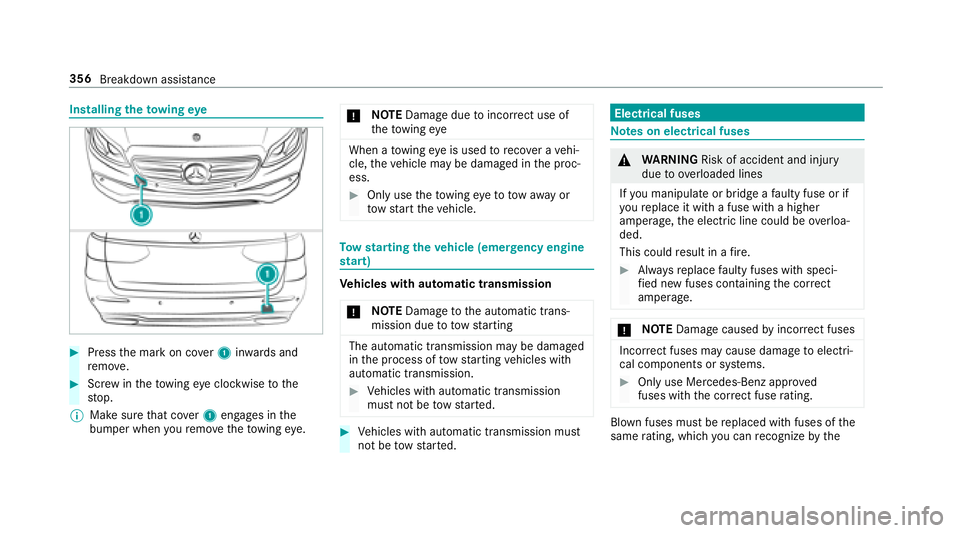
Installingtheto wing eye
#Press the mark on co ver1 inwa rds and
re mo ve.
#Scr ew intheto wing eyeclockwise tothe
st op.
% Make sure that co ver1 engages in the
bumper when youre mo vetheto wing eye. *
NO
TEDama gedue toincor rect use of
th eto wing eye
When a towing eye is used toreco ver a vehi‐
cle, theve hicle may be damaged in the proc‐
ess.
#Only use theto wing eyeto to waw ay or
to w start theve hicle.
To w starting theve hicle (eme rgency engine
st art)
Ve hicles with automatic transmission
* NO
TEDama getothe automatic trans‐
mission due to towstarting
The automatic transmission may be damaged
in the process of tow starting vehicles with
automatic transmission.
#Ve hicles with automatic transmission
must not be tow star ted.
#Ve hicles with automatic transmission must
not be tow star ted.
Electrical fuses
Note s on electrical fuses
&
WARNING Risk of accident and injury
due to ov erloaded lines
If yo u manipulate or bridge a faulty fuse or if
yo ure place it with a fuse with a higher
amperage, the electric line could be overloa‐
ded.
This could result in a fire .
#Alw aysre place faulty fuses with speci‐
fi ed new fuses conta iningthe cor rect
amperage.
* NO
TEDama gecaused byincor rect fuses
Incor rect fuses may cause damage toelectri‐
cal components or sy stems.
#Only use Mercedes-Benz appr oved
fuses with the cor rect fuse rating.
Blown fuses must bereplaced with fuses of the
same rating, which you can recognize bythe
356
Breakdown assis tance
Page 386 of 506
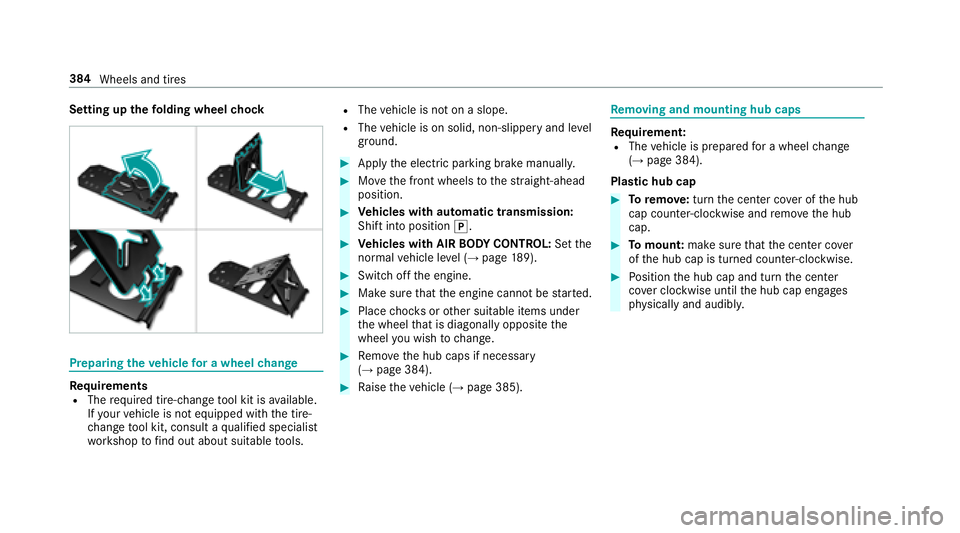
Setting upthefo lding wheel chock
Prepa ring theve hicle for a wheel change
Re quirementsRThe requ ired tire-change tool kit is available.
If yo ur vehicle is not equipped with the tire-
ch ange tool kit, consult a qualified specialist
wo rkshop tofind out about suitable tools.
RThe vehicle is not on a slope.
RThe vehicle is on solid, non-slippery and le vel
ground .
#Applythe electric parking brake manually.
#Mo vethe front wheels tothest ra ight-ahead
position.
#Ve hicles with automatic transmission:
Shift into position j.
#Vehicles with AIR BODY CONT ROL:Set the
normal vehicle le vel (→page 189).
#Switch off the engine.
#Make sure that the engine cannot bestar ted.
#Place choc ks orother suitable items under
th e wheel that is diagonally opposite the
wheel you wish tochange.
#Re mo vethe hub caps if necessary
(→page 384).
#Ra ise theve hicle (→page 385).
Re moving and mounting hub caps
Requirement:RThe vehicle is prepared for a wheel change
(→page 384).
Plast ic hub cap
#Toremo ve:turn the center co ver of the hub
cap counter-clockwise and remo vethe hub
cap.
#To mount: makesurethat the center co ver
of the hub cap is turned counter-clockwise.
#Po sition the hub cap and turn the center
co ver clockwise until the hub cap engages
ph ysically and audibly.
384
Wheels and tires
Page 387 of 506
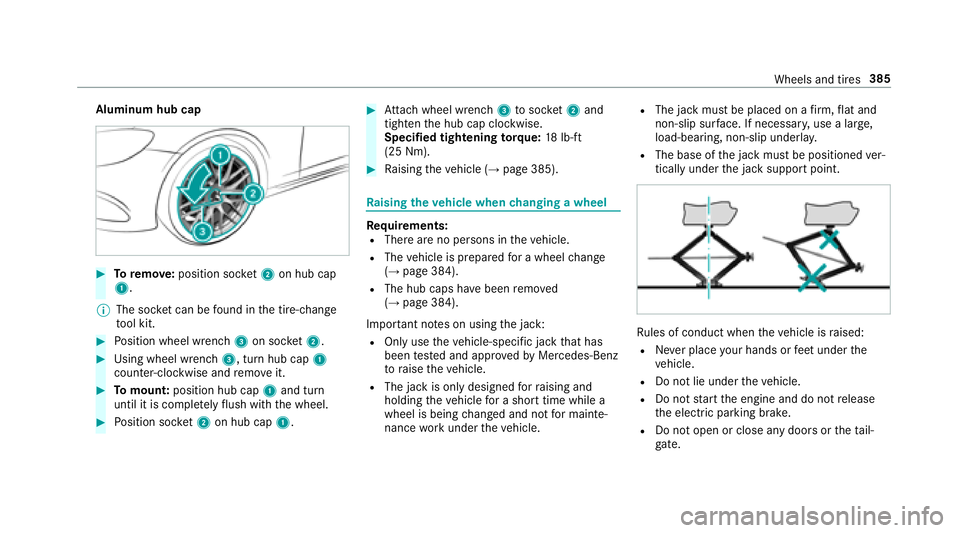
Aluminum hub cap
#Toremo ve:position soc ket2 on hub cap
1.
% The soc ket can be found inthe tire-change
to ol kit.
#Po sition wheel wrench 3on soc ket2.
#Using wheel wrench 3, turn hub cap1
counter-clo ckwise and remo veit.
#To mount: position hub cap 1and turn
until it is compl etely flush withth e wheel.
#Po sition soc ket2 on hub cap 1.
#Attach wheel wrench 3tosoc ket2 and
tighten the hub cap clockwise.
Specified tightening torq ue: 18lb-ft
(25 Nm).
#Ra ising theve hicle (→page 385).
Ra ising theve hicle when changing a wheel
Re quirements:RThere are no persons in theve hicle.
RThe vehicle is prepared for a wheel change
(→page 384).
RThe hub caps ha vebeen remo ved
(→page 384).
Impor tant no tes on using the jack:
ROnly use theve hicle-specific jack that has
been tested and appr ovedby Mercedes-Benz
to raise theve hicle.
RThe jack is only designed forra ising and
holding theve hicle for a short time while a
wheel is being changed and not for mainte‐
nance workunder theve hicle.
RThe jack must be placed on a firm ,fl at and
non-slip sur face. If necessar y,use a lar ge,
load-bearing, non-slip underla y.
RThe base ofthe jack must be positioned ver‐
tically under the jack support point.
Ru les of conduct when theve hicle is raised:
RNe ver place your hands or feet under the
ve hicle.
RDo not lie under theve hicle.
RDo not start the engine and do not release
th e electric parking brake.
RDo not open or close any doors or theta il‐
ga te.
Wheels and tires 385
Page 389 of 506
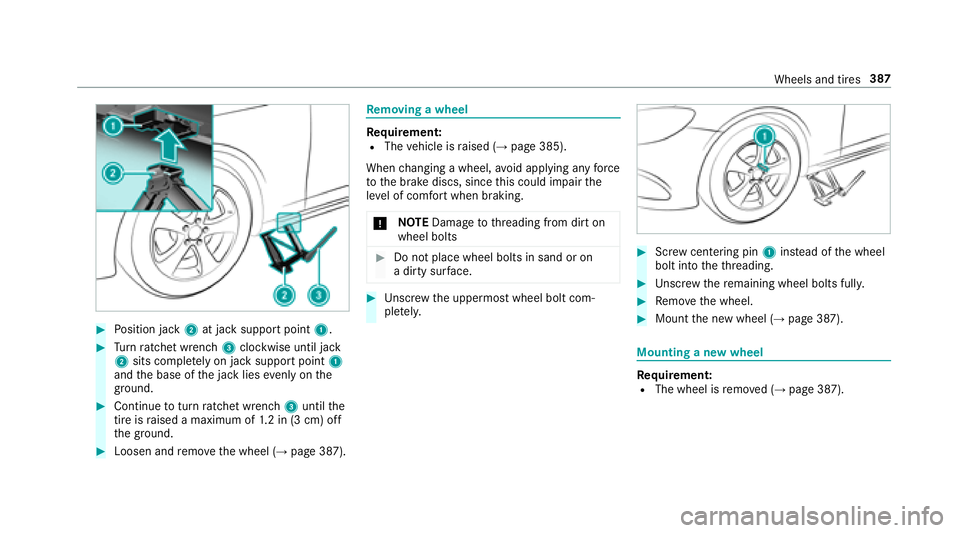
#Position jack 2at jack support point 1.
#Turn ratchet wrench 3clockwise until jack
2 sits comple tely on jack support point 1
and the base of the jack lies evenly on the
ground .
#Continue toturn ratchet wrench 3until the
tire is raised a maximum of 1.2 in (3 cm) off
th e ground.
#Loosen and remo vethe wheel (→page 387).
Re moving a wheel
Requirement:RThe vehicle is raised (→page 385).
When changing a wheel, avoid applying any forc e
to the brake discs, since this could impair the
le ve l of com fort when braking.
* NO
TEDama getothre ading from dirt on
wheel bolts
#Do not place wheel bolts in sand or on
a dirty sur face.
#Un scr ew the uppermost wheel bolt com‐
ple tely.
#Scr ew centering pin 1instead of the wheel
bolt into theth re ading.
#Un scr ew there maining wheel bolts fully.
#Re mo vethe wheel.
#Mount the new wheel (→page 387).
Mounting a new wheel
Re quirement:RThe wheel is remo ved (→page 387).
Wheels and tires 387
Page 390 of 506
&WARNING Risk of accident from losing a
wheel
Oiled, greased or damaged wheel bolt/wheel
nut thre ads or wheel hub/wheel mounting
bolt thre ads can cause the wheel bolts/
wheel nuts tocome loose.
As a result, you could lose a wheel while driv‐
ing.
#Ne ver oil or grease theth re ads.
#In theeve nt of damage totheth re ads,
con tact a qualified specialist workshop
immediatel y.
#Have the damaged wheel bolts or dam‐
aged hub thre ads replaced.
#Do not continue driving.
#Obser vethe information on thech oice of
tires (→page 380).
Fo r tires with a specified direction of rotation, an
ar row onthe side wall of the tire indicates the
cor rect dire ction of rotation. Observ eth e direc‐
tion of rotation when ins talling.
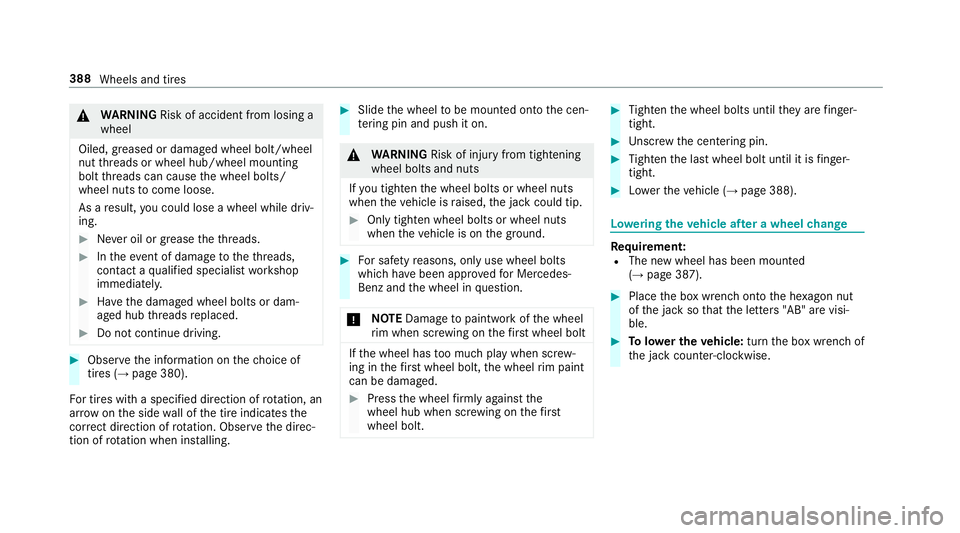
#Slide the wheel tobe mounted onto the cen‐
te ring pin and push it on.
&
WARNING Risk of injury from tightening
wheel bolts and nuts
If yo u tighten the wheel bolts or wheel nuts
when theve hicle is raised, the jack could tip.
#Only tighten wheel bolts or wheel nuts
when theve hicle is on the ground.
#Fo r saf etyre asons, only use wheel bolts
whic h havebeen appr ovedfo r Mercedes-
Benz and the wheel in question.
* NO
TEDama getopaintwork of the wheel
ri m when scr ewing on thefirs t wheel bolt
If th e wheel has too much play when scr ew‐
ing in thefirs t wheel bolt, the wheel rim paint
can be dama ged.
#Press the wheel firm lyagainst the
wheel hub when scr ewing on thefirs t
wheel bolt.
#Ti ghten the wheel bolts until they are finger-
tight.
#Un scr ew the centering pin.
#Tighten the last wheel bolt until it is finger-
tight.
#Lo we rth eve hicle (→page 388).
Lo weri ngtheve hicle af ter a wheel change
Re quirement:RThe new wheel has been mounted
(→page 387).
#Place the box wrench onto the he xagon nut
of the jack so that the letters "AB" are visi‐
ble.
#To lowe r the vehicle: turnthe box wrench of
th e jack counter-clockwise.
388
Wheels and tires