lock MERCEDES-BENZ E-SEDAN 2014 Owners Manual
[x] Cancel search | Manufacturer: MERCEDES-BENZ, Model Year: 2014, Model line: E-SEDAN, Model: MERCEDES-BENZ E-SEDAN 2014Pages: 430, PDF Size: 5.8 MB
Page 291 of 430
Problem Possible causes/consequences and
M
MSolutions !
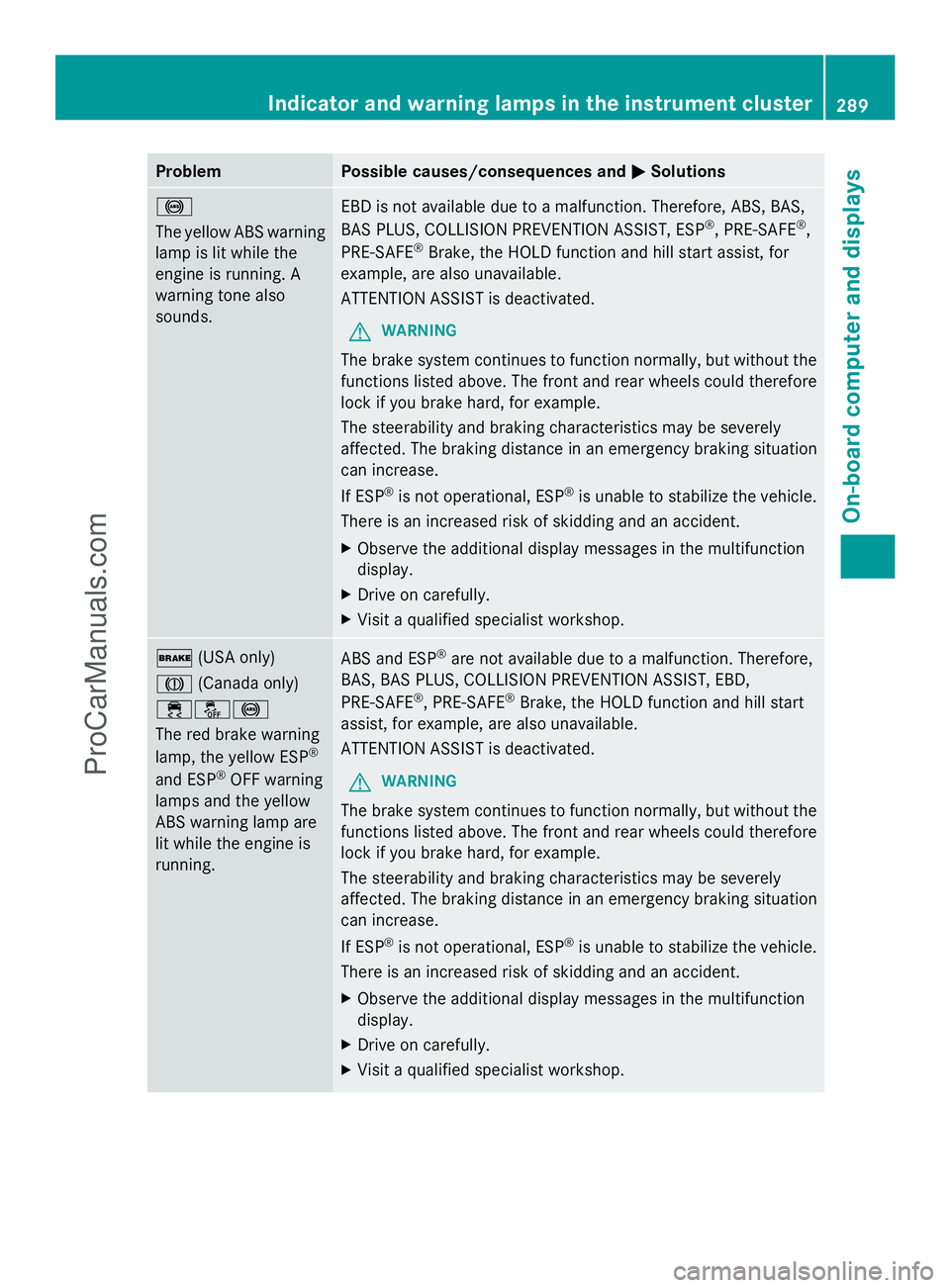
The yellow ABS warning
lamp is lit while the
engine is running. A
warning tone also
sounds.
EBD is not available due to a malfunction. Therefore, ABS, BAS,
BAS PLUS, COLLISION PREVENTION ASSIST, ESP
®
, PRE-SAFE ®
,
PRE-SAFE ®
Brake, the HOLD function and hill start assist, for
example, are also unavailable.
ATTENTION ASSIST is deactivated.
G WARNING
The brake system continues to function normally, but without the
functions listed above. The front and rear wheels could therefore
lock if you brake hard, for example.
The steerability and braking characteristics may be severely
affected. The braking distance in an emergency braking situation
can increase.
If ESP ®
is not operational, ESP ®
is unable to stabilize the vehicle.
There is an increased risk of skidding and an accident.
X Observe the additional display messages in the multifunction
display.
X Drive on carefully.
X Visit a qualified specialist workshop. $
(USA only)
J (Canada only)
֌!
The red brake warning
lamp, the yellow ESP ®
and ESP ®
OFF warning
lamps and the yellow
ABS warning lamp are
lit while the engine is
running. ABS and ESP
®
are not available due to a malfunction. Therefore,
BAS, BAS PLUS, COLLISION PREVENTION ASSIST, EBD,
PRE-SAFE ®
, PRE-SAFE ®
Brake, the HOLD function and hill start
assist, for example, are also unavailable.
ATTENTION ASSIST is deactivated.
G WARNING
The brake system continues to function normally, but without the
functions listed above. The front and rear wheels could therefore
lock if you brake hard, for example.
The steerability and braking characteristics may be severely
affected. The braking distance in an emergency braking situation
can increase.
If ESP ®
is not operational, ESP ®
is unable to stabilize the vehicle.
There is an increased risk of skidding and an accident.
X Observe the additional display messages in the multifunction
display.
X Drive on carefully.
X Visit a qualified specialist workshop. Indicator and warning lamps in the instrument cluster
289On-board computer and displays Z
ProCarManuals.com
Page 296 of 430
Problem Possible causes/consequences and
M
MSolutions ?
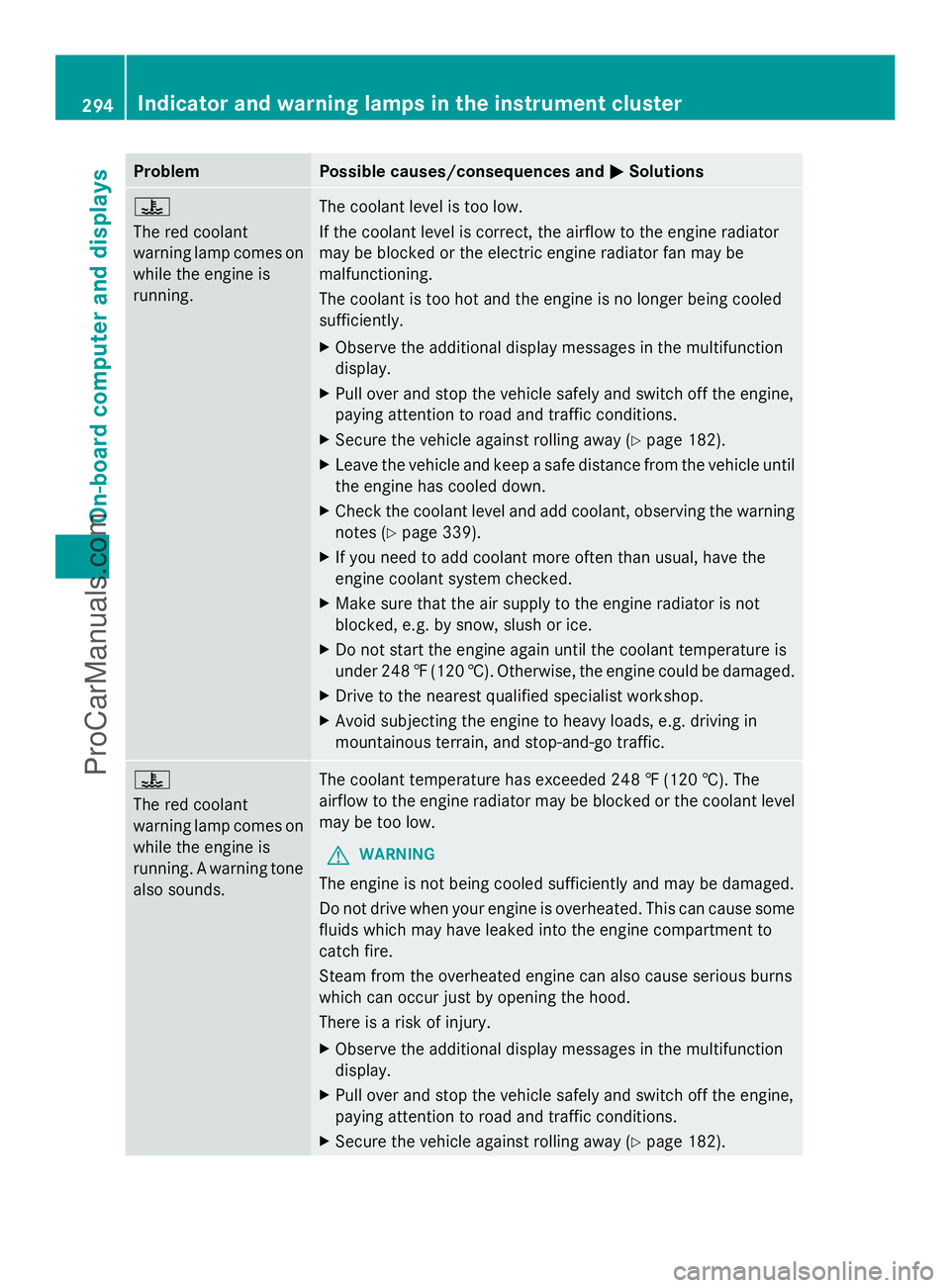
The red coolant
warning lamp comes on
while the engine is
running.
The coolant level is too low.
If the coolant level is correct, the airflow to the engine radiator
may be blocked or the electric engine radiator fan may be
malfunctioning.
The coolant is too hot and the engine is no longer being cooled
sufficiently.
X
Observe the additional display messages in the multifunction
display.
X Pull over and stop the vehicle safely and switch off the engine,
paying attention to road and traffic conditions.
X Secure the vehicle against rolling away (Y page 182).
X Leave the vehicle and keep a safe distance from the vehicle until
the engine has cooled down.
X Check the coolant level and add coolant, observing the warning
notes (Y page 339).
X If you need to add coolant more often than usual, have the
engine coolant system checked.
X Make sure that the air supply to the engine radiator is not
blocked, e.g. by snow, slush or ice.
X Do not start the engine again until the coolant temperature is
under 248 ‡(120 †). Otherwise, the engine could be damaged.
X Drive to the nearest qualified specialist workshop.
X Avoid subjecting the engine to heavy loads, e.g. driving in
mountainous terrain, and stop-and-go traffic. ?
The red coolant
warning lamp comes on
while the engine is
running. A warning tone
also sounds.
The coolant temperature has exceeded 248 ‡ (120 †). The
airflow to the engine radiator may be blocked or the coolant level
may be too low.
G WARNING
The engine is not being cooled sufficiently and may be damaged.
Do not drive when your engine is overheated. This can cause some
fluids which may have leaked into the engine compartment to
catch fire.
Steam from the overheated engine can also cause serious burns
which can occur just by opening the hood.
There is a risk of injury.
X Observe the additional display messages in the multifunction
display.
X Pull over and stop the vehicle safely and switch off the engine,
paying attention to road and traffic conditions.
X Secure the vehicle against rolling away (Y page 182).294
Indicator and warning lamps in the instrument clusterOn-board computer and displays
ProCarManuals.com
Page 297 of 430
Problem Possible causes/consequences and
M
MSolutions X
Leave the vehicle and keep a safe distance from the vehicle until
the engine has cooled down.
X Check the coolant level and add coolant, observing the warning
notes (Y page 339).
X If you need to add coolant more often than usual, have the
engine coolant system checked.
X Make sure that the air supply to the engine radiator is not
blocked, e.g. by snow, slush or ice.
X At coolant temperatures under 248 ‡(120 †), drive to the next
qualified specialist workshop.
X Avoid subjecting the engine to heavy loads, e.g. driving in
mountainous terrain, and stop-and-go traffic. Driving systems
Problem Possible causes/consequences and
M MSolutions ·
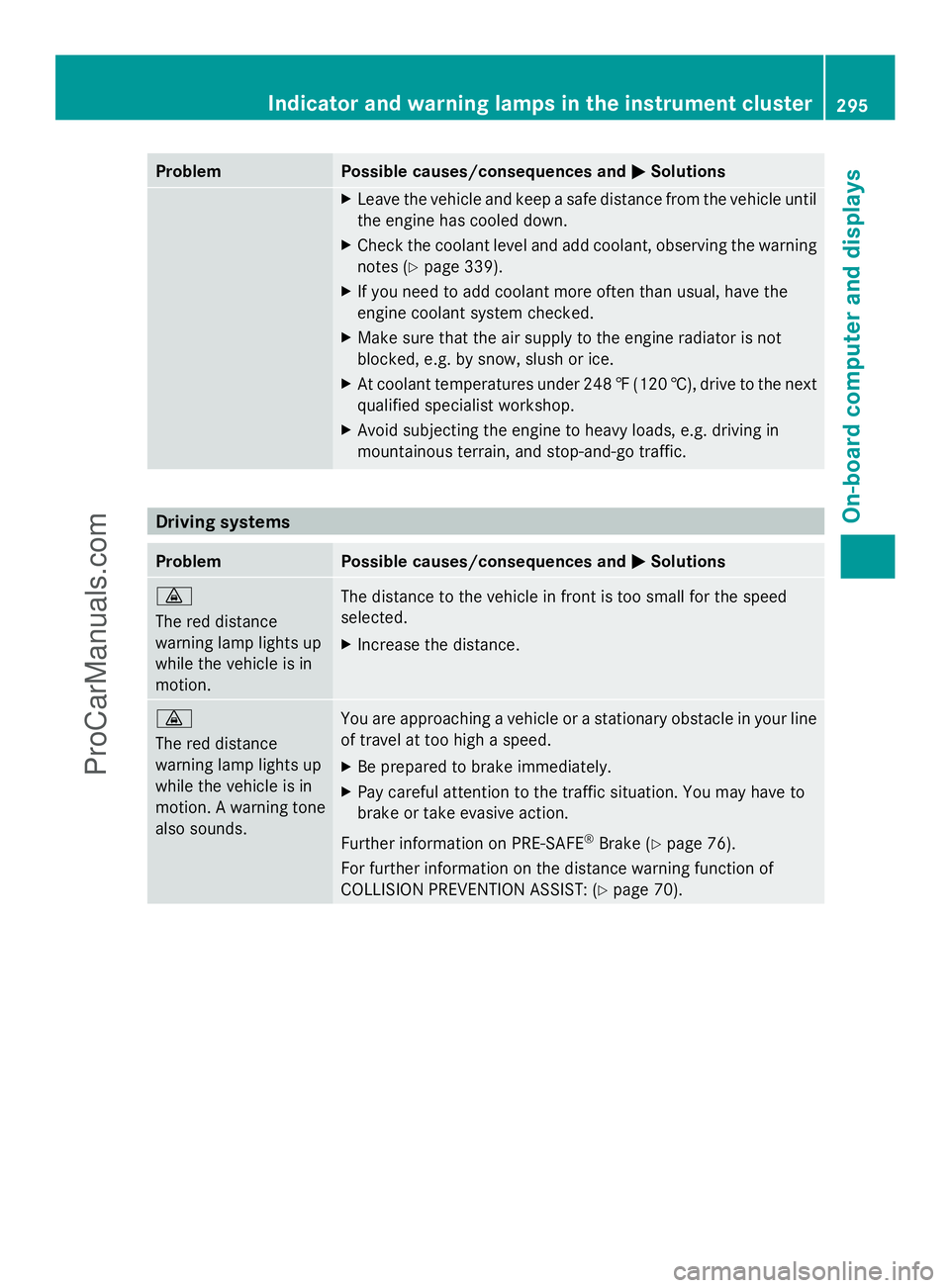
The red distance
warning lamp lights up
while the vehicle is in
motion.
The distance to the vehicle in front is too small for the speed
selected.
X
Increase the distance. ·
The red distance
warning lamp lights up
while the vehicle is in
motion. A warning tone
also sounds.
You are approaching a vehicle or a stationary obstacle in your line
of travel at too high a speed.
X
Be prepared to brake immediately.
X Pay careful attention to the traffic situation. You may have to
brake or take evasive action.
Further information on PRE-SAFE ®
Brake (Y page 76).
For further information on the distance warning function of
COLLISION PREVENTION ASSIST: (Y page 70).Indicator and warning lamps in the instrument cluster
295On-board computer and displays Z
ProCarManuals.com
Page 300 of 430
Useful information
i This Operator's Manual describes all
models and all standard and optional
equipment of your vehicle available at the
time of publication of the Operator's
Manual. Country-specific differences are
possible. Please note that your vehicle may
not be equipped with all features
described. This also applies to safety-
related systems and functions.
i Read the information on qualified
specialist workshops: (Y page 26).Stowage areas
Loading guidelines
G
WARNING
If objects, luggage or loads are not secured or
not secured sufficiently, they could slip, tip
over or be flung around and thereby hit vehicle
occupants. There is a risk of injury,
particularly in the event of sudden braking or
a sudden change in direction.
Always store objects so that they cannot be
flung around. Secure objects, luggage or
loads against slipping or tipping before the
journey. G
WARNING
Combustion engines emit poisonous exhaust
gases such as carbon monoxide. Exhaust
gases can enter the vehicle interior if the
trunk lid/tailgate is open when the engine is
running, especially if the vehicle is in motion.
There is a risk of poisoning.
Always switch off the engine before opening
the trunk lid/tailgate. Never drive with the
trunk lid/tailgate open. The handling characteristics of a laden
vehicle are dependent on the distribution of
the load within the vehicle. For this reason,
you should observe the following notes when
transporting a load:
R
Never exceed the maximum permissible
gross vehicle weight or the gross axle
weight rating of the vehicle (including
occupants). The values are specified on the
vehicle identification plate on the B-pillar of
the driver's door.
R The trunk/cargo compartment is the
preferred place to store objects.
R Position heavy loads as far forwards as
possible and as low down in the trunk/
cargo compartment as possible.
R The load must not protrude above the
upper edge of the seat backrests.
R Always place the load against the rear or
front seat backrests. Make sure that the
seat backrests are securely locked into
place.
R Always place the load behind unoccupied
seats if possible.
R Use the cargo tie down rings and the parcel
nets to transport loads and luggage.
R Use cargo tie-down rings and fastening
materials appropriate for the weight and
size of the load.
R When transporting objects in the cargo
compartment, the combined cargo cover
and net must always be installed (cargo
compartment cover and cargo net).
R Secure the load with sufficiently strong and
wear-resistant tie-downs. pad sharp edges
for protection. Stowage space
Important safety notes G
WARNING
If objects in the passenger compartment are
stowed incorrectly, they can slide or be
thrown around and hit vehicle occupants. 298
Stowage areasStowage and features
ProCarManuals.com
Page 301 of 430
There is a risk of injury, particularly in the
event of sudden braking or a sudden change
in direction.
R Always stow objects so that they cannot be
thrown around in such situations.
R Always make sure that objects do not
protrude from stowage spaces, parcel nets
or stowage nets.
R Close the lockable stowage spaces while
driving.
R Always stow and secure heavy, hard,
pointed, sharp-edged, fragile or bulky
objects in the trunk/cargo compartment.
Observe the loading guidelines (Y page 298).
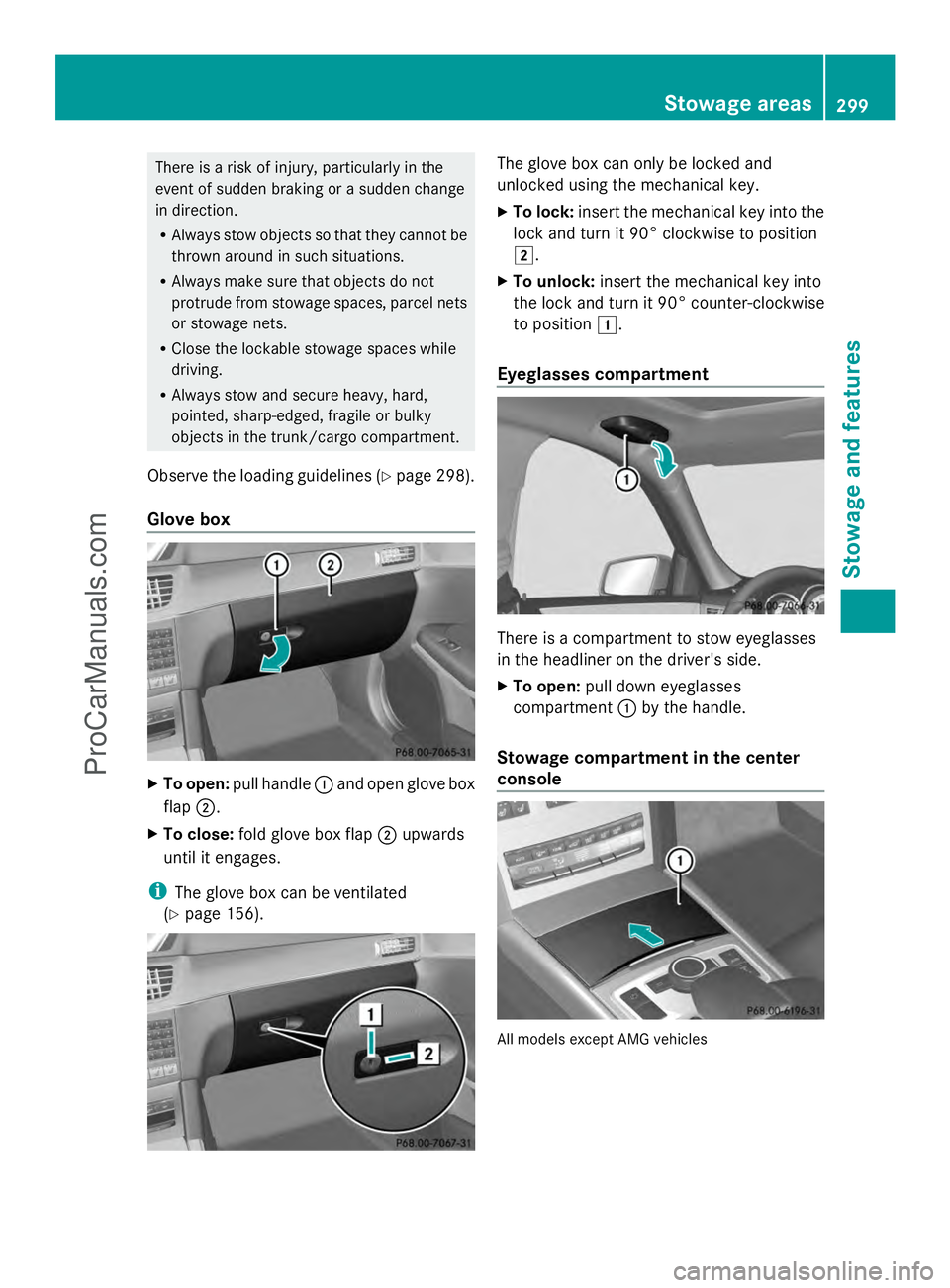
Glove box X
To open: pull handle :and open glove box
flap ;.
X To close: fold glove box flap ;upwards
until it engages.
i The glove box can be ventilated
(Y page 156). The glove box can only be locked and
unlocked using the mechanical key.
X
To lock: insert the mechanical key into the
lock and turn it 90° clockwise to position
2.
X To unlock: insert the mechanical key into
the lock and turn it 90° counter-clockwise
to position 1.
Eyeglasses compartment There is a compartment to stow eyeglasses
in the headliner on the driver's side.
X
To open: pull down eyeglasses
compartment :by the handle.
Stowage compartment in the center
console All models except AMG vehicles Stowage areas
299Stowage and features Z
ProCarManuals.com
Page 306 of 430
X
Vehicles without memory function: if
necessary, move the driver's or front-
passenger seat forwards.
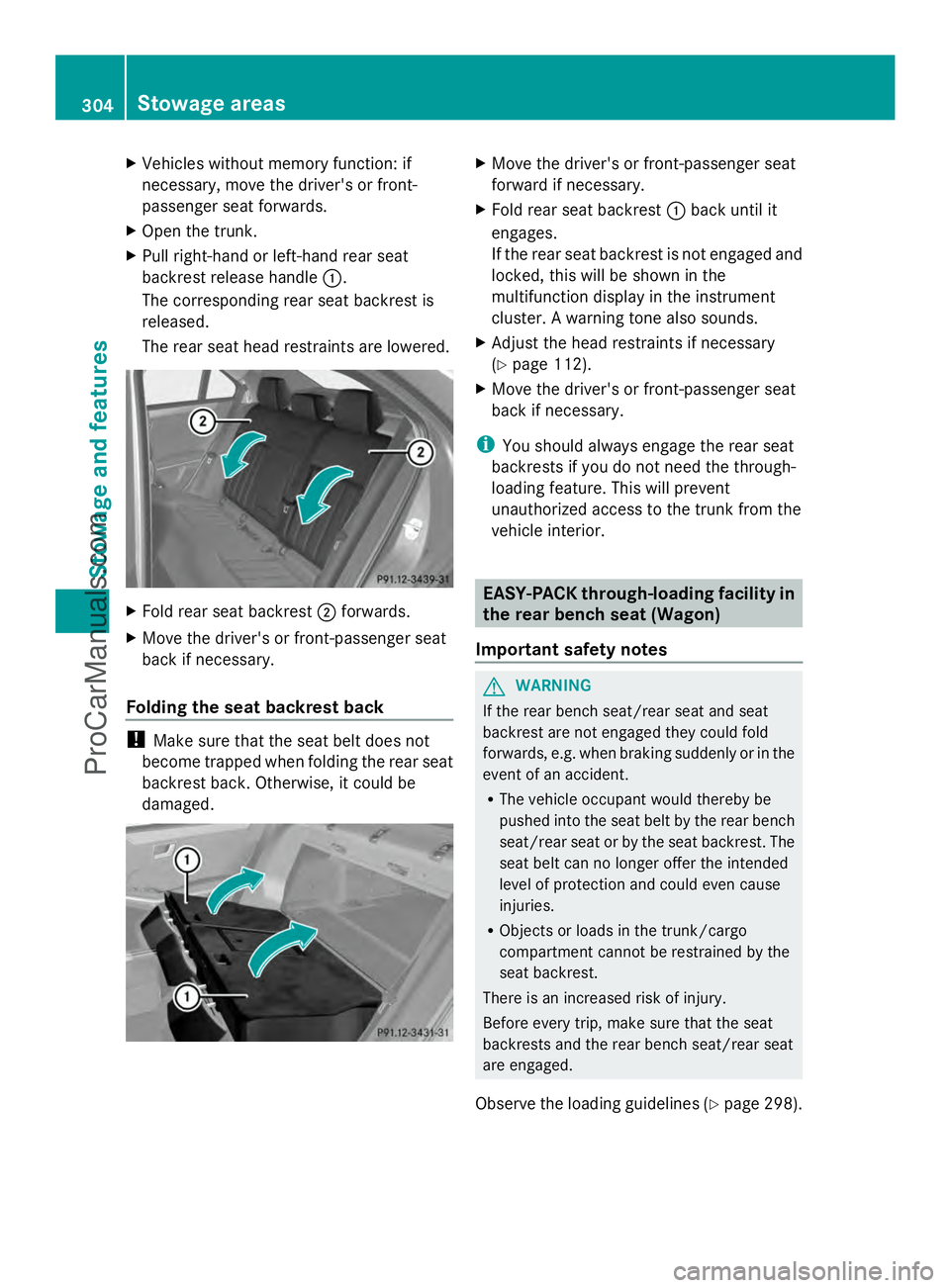
X Open the trunk.
X Pull right-hand or left-hand rear seat
backrest release handle :.
The corresponding rear seat backrest is
released.
The rear seat head restraints are lowered. X
Fold rear seat backrest ;forwards.
X Move the driver's or front-passenger seat
back if necessary.
Folding the seat backrest back !
Make sure that the seat belt does not
become trapped when folding the rear seat
backrest back. Otherwise, it could be
damaged. X
Move the driver's or front-passenger seat
forward if necessary.
X Fold rear seat backrest :back until it
engages.
If the rear seat backrest is not engaged and
locked, this will be shown in the
multifunction display in the instrument
cluster. A warning tone also sounds.
X Adjust the head restraints if necessary
(Y page 112).
X Move the driver's or front-passenger seat
back if necessary.
i You should always engage the rear seat
backrests if you do not need the through-
loading feature. This will prevent
unauthorized access to the trunk from the
vehicle interior. EASY-PACK through-loading facility in
the rear bench seat (Wagon)
Important safety notes G
WARNING
If the rear bench seat/rear seat and seat
backrest are not engaged they could fold
forwards, e.g. when braking suddenly or in the
event of an accident.
R The vehicle occupant would thereby be
pushed into the seat belt by the rear bench
seat/rear seat or by the seat backrest. The
seat belt can no longer offer the intended
level of protection and could even cause
injuries.
R Objects or loads in the trunk/cargo
compartment cannot be restrained by the
seat backrest.
There is an increased risk of injury.
Before every trip, make sure that the seat
backrests and the rear bench seat/rear seat
are engaged.
Observe the loading guidelines (Y page 298).304
Stowage areasStowage and features
ProCarManuals.com
Page 307 of 430
Folding the rear seat backrest forward
!
When folding the rear seat backrest
forwards, ensure that there are no items
lying on the seat cushions. These items
could otherwise be damaged or could
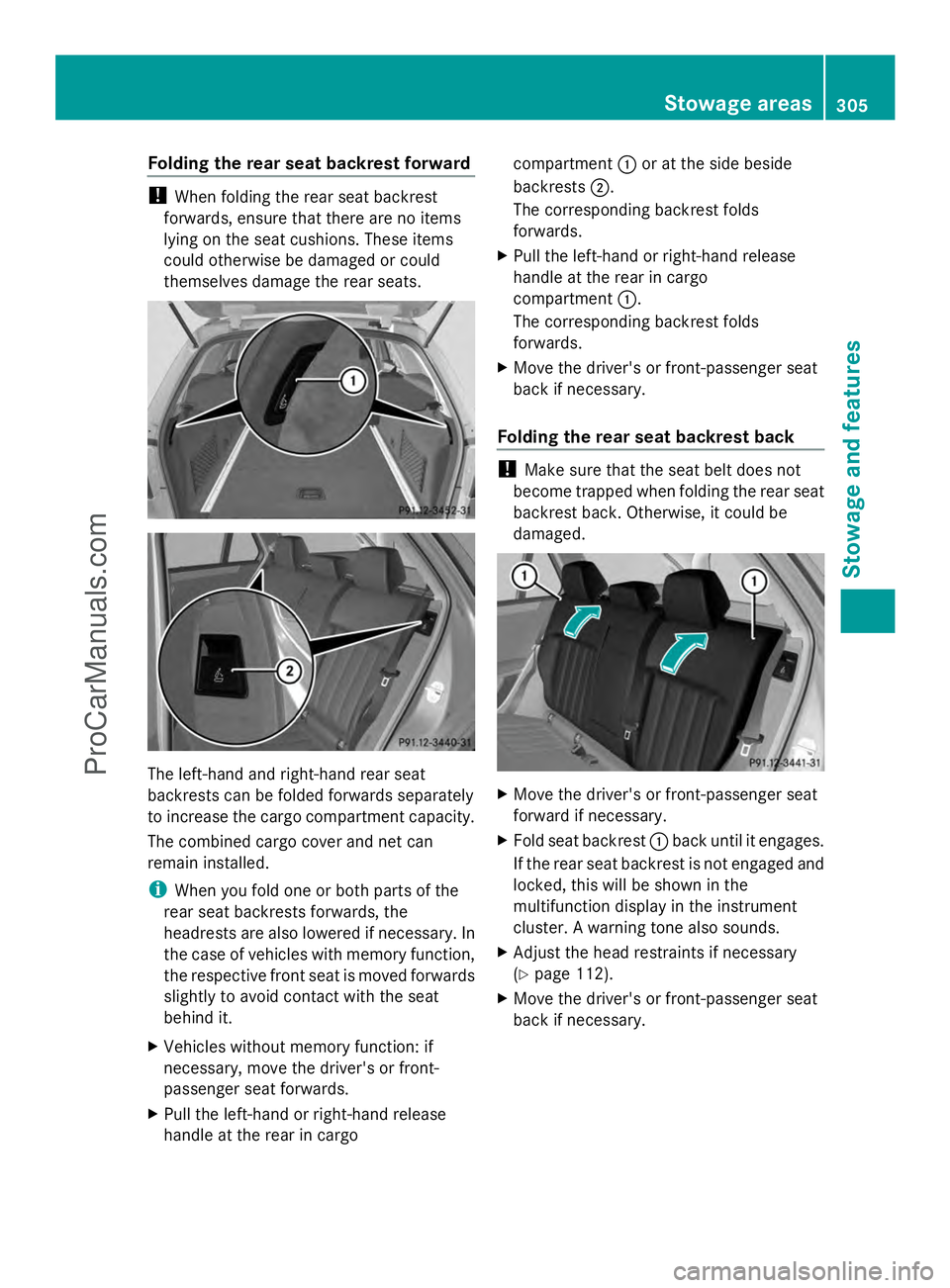
themselves damage the rear seats. The left-hand and right-hand rear seat
backrests can be folded forwards separately
to increase the cargo compartment capacity.
The combined cargo cover and net can
remain installed.
i When you fold one or both parts of the
rear seat backrests forwards, the
headrests are also lowered if necessary. In
the case of vehicles with memory function,
the respective front seat is moved forwards
slightly to avoid contact with the seat
behind it.
X Vehicles without memory function: if
necessary, move the driver's or front-
passenger seat forwards.
X Pull the left-hand or right-hand release
handle at the rear in cargo compartment
:or at the side beside
backrests ;.
The corresponding backrest folds
forwards.
X Pull the left-hand or right-hand release
handle at the rear in cargo
compartment :.
The corresponding backrest folds
forwards.
X Move the driver's or front-passenger seat
back if necessary.
Folding the rear seat backrest back !
Make sure that the seat belt does not
become trapped when folding the rear seat
backrest back. Otherwise, it could be
damaged. X
Move the driver's or front-passenger seat
forward if necessary.
X Fold seat backrest :back until it engages.
If the rear seat backrest is not engaged and
locked, this will be shown in the
multifunction display in the instrument
cluster. A warning tone also sounds.
X Adjust the head restraints if necessary
(Y page 112).
X Move the driver's or front-passenger seat
back if necessary. Stowage areas
305Stowage and featu res Z
ProCarManuals.com
Page 310 of 430
Installing/removing the combined
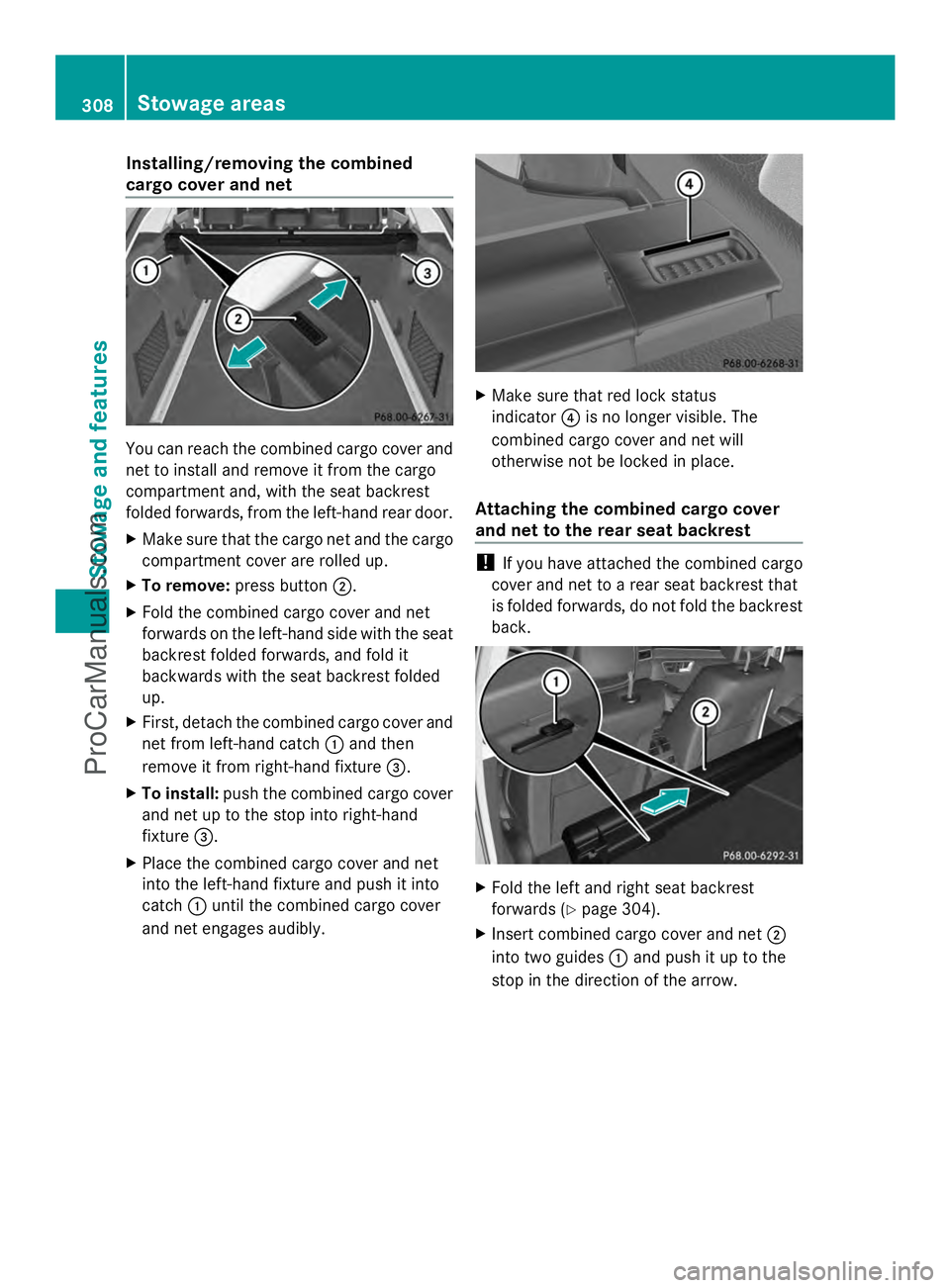
cargo cover and net You can reach the combined cargo cover and
net to install and remove it from the cargo
compartment and, with the seat backrest
folded forwards, from the left-hand rear door.
X Make sure that the cargo net and the cargo
compartment cover are rolled up.
X To remove: press button ;.
X Fold the combined cargo cover and net
forwards on the left-hand side with the seat
backrest folded forwards, and fold it
backwards with the seat backrest folded
up.
X First, detach the combined cargo cover and
net from left-hand catch :and then
remove it from right-hand fixture =.
X To install: push the combined cargo cover
and net up to the stop into right-hand
fixture =.
X Place the combined cargo cover and net
into the left-hand fixture and push it into
catch :until the combined cargo cover
and net engages audibly. X
Make sure that red lock status
indicator ?is no longer visible. The
combined cargo cover and net will
otherwise not be locked in place.
Attaching the combined cargo cover
and net to the rear seat backrest !
If you have attached the combined cargo
cover and net to a rear seat backrest that
is folded forwards, do not fold the backrest
back. X
Fold the left and right seat backrest
forwards (Y page 304).
X Insert combined cargo cover and net ;
into two guides :and push it up to the
stop in the direction of the arrow. 308
Stowage areasStowage and featu
res
ProCarManuals.com
Page 313 of 430
X
Raise box :and press hooks Ainto
anchorage ?as far as they will go.
X Turn left-hand rotating catch Bclockwise
and right-hand rotating catch Bcounter-
clockwise by 90°.
X To remove: turn left-hand rotating catch
B counter-clockwise and right-hand
rotating catch Bclockwise by 90°.
X Move box :downwards and pull it out
from anchorages ?.
i Store the EASY-PACK trunk box on a flat
surface after removal, e.g. on a suitable
shelf. EASY-PACK load-securing kit (Wagon)
Components and storage The EASY-PACK load-securing kit allows you
to use your cargo compartment for a variety
of purposes. The accessory parts are located
under the cargo compartment floor.
X Open the EASY-PACK folding luggage-
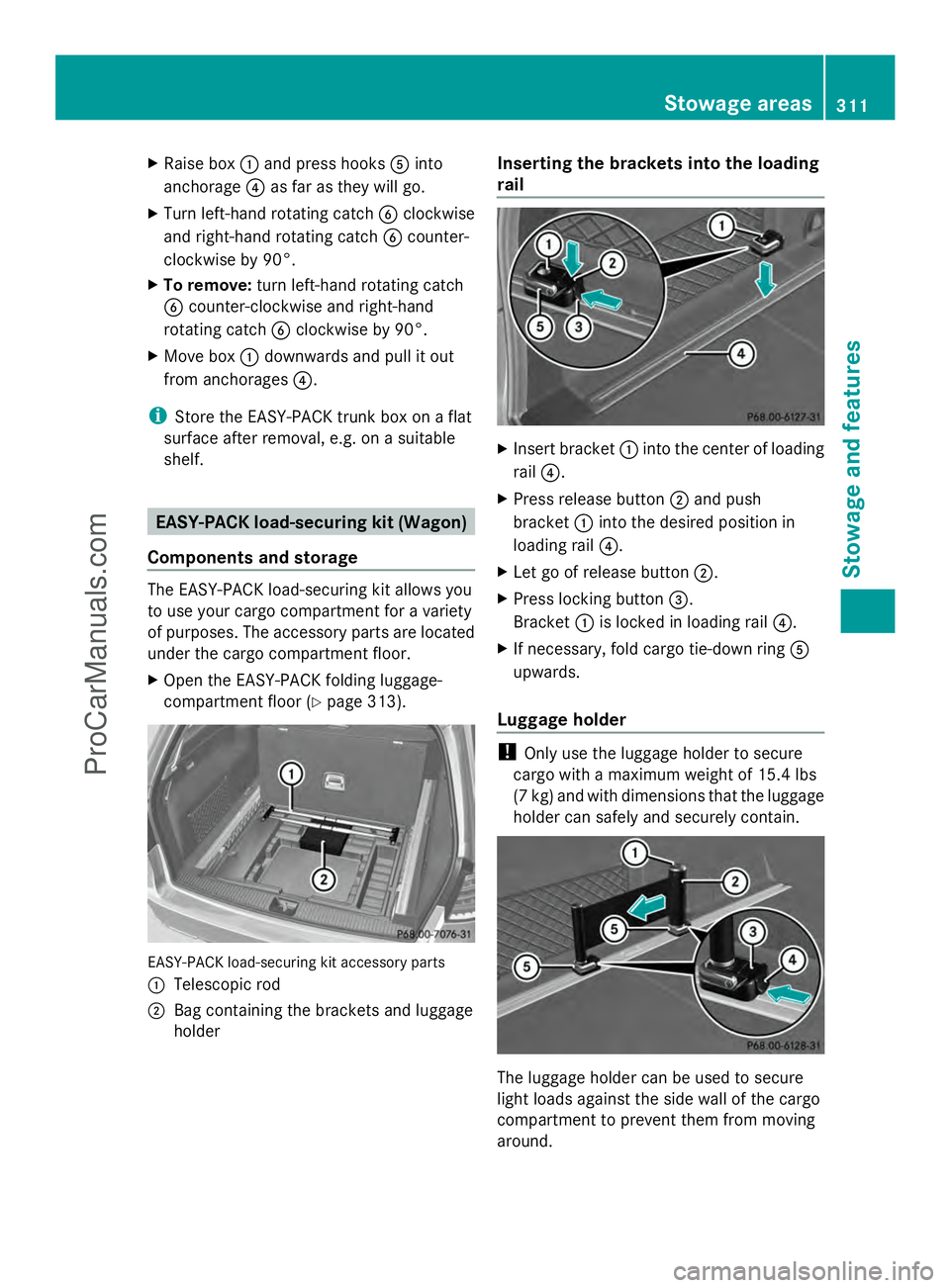
compartment floor (Y page 313).EASY-PACK load-securing kit accessory parts
: Telescopic rod
; Bag containing the brackets and luggage
holder Inserting the brackets into the loading
rail
X
Insert bracket :into the center of loading
rail ?.
X Press release button ;and push
bracket :into the desired position in
loading rail ?.
X Let go of release button ;.
X Press locking button =.
Bracket :is locked in loading rail ?.
X If necessary, fold cargo tie-down ring A
upwards.
Luggage holder !
Only use the luggage holder to secure
cargo with a maximum weight of 15.4 lbs
(7 kg) and with dimensions that the luggage
holder can safely and securely contain. The luggage holder can be used to secure
light loads against the side wall of the cargo
compartment to prevent them from moving
around. Stowage areas
311Stowage and fea tures Z
ProCarManuals.com
Page 314 of 430
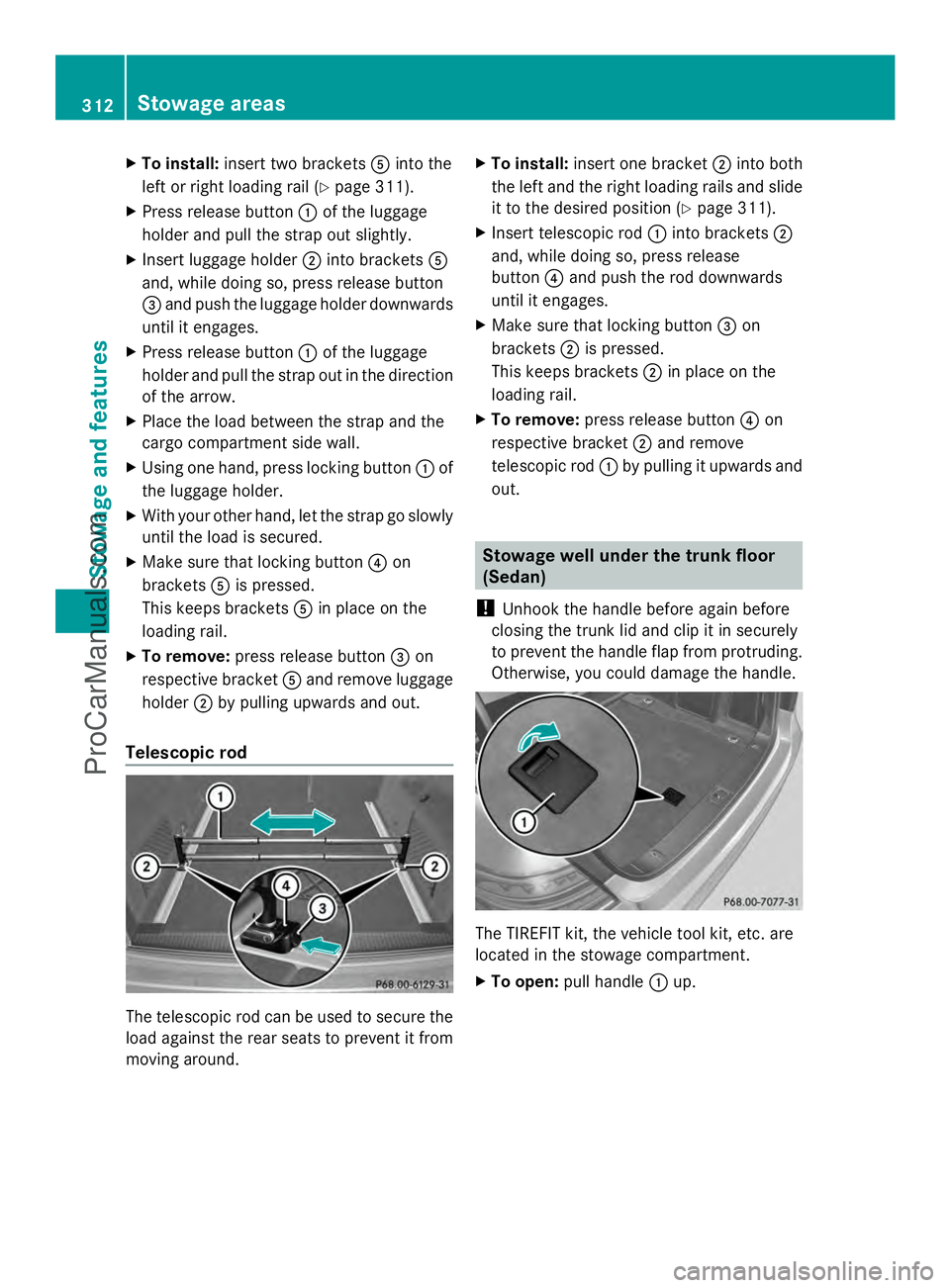
X
To install: insert two brackets Ainto the
left or right loading rail (Y page 311).
X Press release button :of the luggage
holder and pull the strap out slightly.
X Insert luggage holder ;into brackets A
and, while doing so, press release button
= and push the luggage holder downwards
until it engages.
X Press release button :of the luggage
holder and pull the strap out in the direction
of the arrow.
X Place the load between the strap and the
cargo compartment side wall.
X Using one hand, press locking button :of
the luggage holder.
X With your other hand, let the strap go slowly
until the load is secured.
X Make sure that locking button ?on
brackets Ais pressed.
This keeps brackets Ain place on the
loading rail.
X To remove: press release button =on
respective bracket Aand remove luggage
holder ;by pulling upwards and out.
Telescopic rod The telescopic rod can be used to secure the
load against the rear seats to prevent it from
moving around. X
To install: insert one bracket ;into both
the left and the right loading rails and slide
it to the desired position (Y page 311).
X Insert telescopic rod :into brackets ;
and, while doing so, press release
button ?and push the rod downwards
until it engages.
X Make sure that locking button =on
brackets ;is pressed.
This keeps brackets ;in place on the
loading rail.
X To remove: press release button ?on
respective bracket ;and remove
telescopic rod :by pulling it upwards and
out. Stowage well under the trunk floor
(Sedan)
! Unhook the handle before again before
closing the trunk lid and clip it in securely
to prevent the handle flap from protruding.
Otherwise, you could damage the handle. The TIREFIT kit, the vehicle tool kit, etc. are
located in the stowage compartment.
X
To open: pull handle :up. 312
Stowage areasSto
wage an d features
ProCarManuals.com