traction control MERCEDES-BENZ E320 2000 W210 User Guide
[x] Cancel search | Manufacturer: MERCEDES-BENZ, Model Year: 2000, Model line: E320, Model: MERCEDES-BENZ E320 2000 W210Pages: 341, PDF Size: 15.07 MB
Page 221 of 341
218 Driving systems
Te ch n ica l
data Instruments
and controlsOperationDrivingInstrument
cluster displayPractical hints Car care Index
ABS control
The ABS malfunction indicator lamp- in the
instrument cluster comes on with the electronic key in
steering lock position 2 and should go out with the
engine running.
When the ABS malfunction indicator lamp in the
instrument cluster comes on while the engine is
running, it indicates that the ABS has detected a
malfunction and has switched off. In this case, the brake
system functions in the usual manner, but without
antilock assistance.
For ABS malfunction indicator lamp, see page 237.
With the ABS malfunctioning, the BAS and ESP are also
switched off. Both malfunction indicator lamps come on
with the engine running.
If the charging voltage falls below 10 volts, the
malfunction indicator lamp comes on and the ABS is
switched off. When the voltage is above this value again,
the malfunction indicator lamp should go out and the
ABS is operational.If the ABS malfunction indicator lamp stays illuminated,
have the system checked at your authorized
Mercedes-Benz Center as soon as possible.
Note:
To alert following vehicles to slippery road conditions
you discover, operate your hazard warning flashers as
appropriate.
Wa r n i n g !
ABS cannot prevent the natural laws of physics
from acting on the vehicle, nor can it increase
braking or steering efficiency beyond that afforded
by the condition of the vehicle brakes and tires or
the traction afforded. The ABS cannot prevent
accidents, including those resulting from excessive
speed in turns, following another vehicle too
closely, or aquaplaning. Only a safe, attentive, and
skillful driver can prevent accidents. The
capabilities of an ABS equipped vehicle must never
be exploited in a reckless or dangerous manner
which could jeopardize the user’s safety or the
safety of others.
Page 222 of 341
219 Driving systems
Te ch n ica l
data Instruments
and controlsOperationDrivingInstrument
cluster displayPractical hints Car care Index Four Wheel Electronic Traction System (4MATIC)
with Electronic Stability Program (ESP)
(Model with All Wheel Drive [AWD])
The 4MATIC improves vehicle’s ability to use available
traction, e.g. during winter operation in mountains
under snowy conditions, by applying power to all four
wheels.
Important!
If the ESP warning lamp flashes:
•during take-off, apply as little throttle as possible,
•while driving, ease up on the accelerator.
Adapt your speed and driving to the prevailing road
conditions.Caution!
Operational tests with the engine running can only be
conducted on a 2-axle dynamometer.Otherwise the ESP
will immediately be engaged and will apply the brakes
to the spinning wheels.
If the vehicle is towed with one axle raised (see
page 282), or when testing the parking brake on a brake
test dynamometer, the engine must be shut off
(electronic key in steering lock position 0 or 1).
If one or more wheels tend to spin, ESP will apply the
brakes to them. The traction control for the front axle
wheels deactivate at approximately 50 mph (80 km / h),
and for the rear axle wheels at approximately 80 mph
(130 km / h).
The warning lamp in the speedometer blinks at any
speed as soon as one tire loses traction.
Note:
In winter operation, the maximum effectiveness of the
4MATIC is only achieved with Mercedes-Benz
recommended M+S rated radial-ply tires and / or snow
chains.
Page 223 of 341
220 Driving systems
Te ch n ica l
data Instruments
and controlsOperationDrivingInstrument
cluster displayPractical hints Car care Index
Electronic stability program (ESP)
The ESP enhances directional control and reduces
driving wheel spin of the vehicle under various driving
conditions.
Over / understeering of the vehicle is counteracted by
applying brakes to the appropriate wheel to create a
countervailing vehicle movement. Engine torque is also
limited. The ESP warning lamp, located in the
speedometer dial, starts to flash when ESP is in
operation.Important!
If the ESP warning lampv flashes:
•During take-off apply as little throttle as possible.
•While driving ease up on the accelerator.
•Adapt your speed and driving to the prevailing road
conditions.
•Do not switch off the ESP.
Caution!
If the vehicle is towed with the front axle raised (see
page 282), the engine must be shut off (electronic key in
steering lock position 0 or 1). Otherwise, the ESP will
immediately be engaged and will apply the rear wheel
brakes.
Wa r n i n g !
ESP cannot prevent the natural laws of physics
from acting on the vehicle, nor can it increase the
traction afforded. The ESP cannot prevent
accidents, including those resulting from excessive
speed in turns, or aquaplaning. Only a safe,
attentive, and skillful driver can prevent accidents.
The capabilities of an ESP equipped vehicle must
never be exploited in a reckless or dangerous
manner which could jeopardize the user’s safety or
the safety of others.
Page 225 of 341
222 Driving systems
Te ch n ica l
data Instruments
and controlsOperationDrivingInstrument
cluster displayPractical hints Car care Index
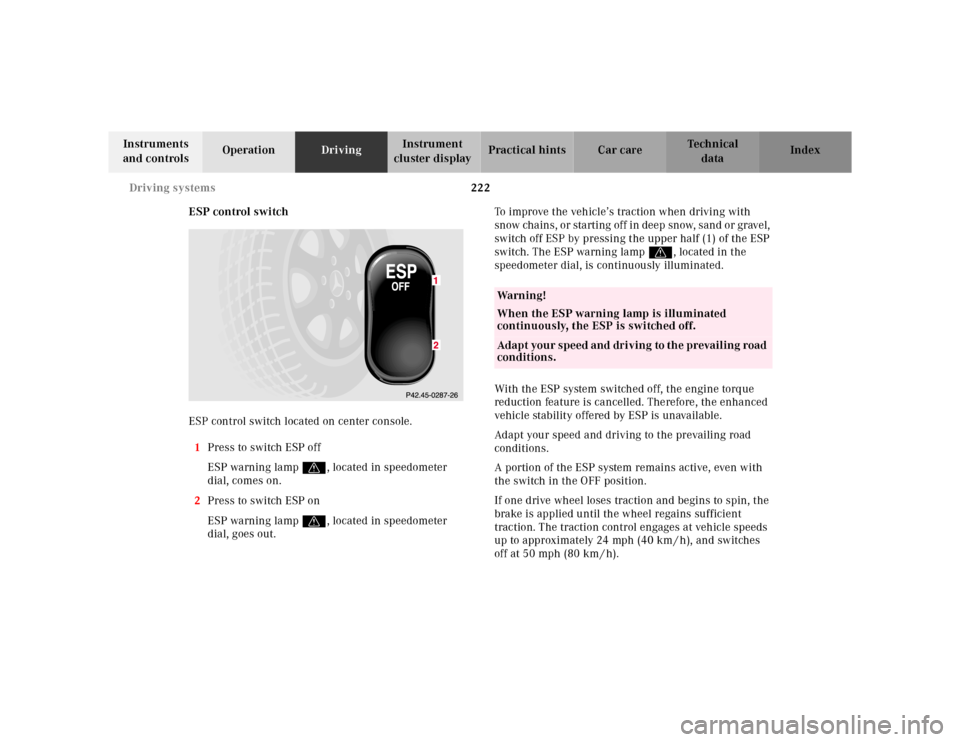
ESP control switch
ESP control switch located on center console.
1Press to switch ESP off
ESP warning lampv, located in speedometer
dial, comes on.
2Press to switch ESP on
ESP warning lampv, located in speedometer
dial, goes out.To improve the vehicle’s traction when driving with
snow chains, or starting off in deep snow, sand or gravel,
switch off ESP by pressing the upper half (1) of the ESP
switch. The ESP warning lampv, located in the
speedometer dial, is continuously illuminated.
With the ESP system switched off, the engine torque
reduction feature is cancelled. Therefore, the enhanced
vehicle stability offered by ESP is unavailable.
Adapt your speed and driving to the prevailing road
conditions.
A portion of the ESP system remains active, even with
the switch in the OFF position.
If one drive wheel loses traction and begins to spin, the
brake is applied until the wheel regains sufficient
traction. The traction control engages at vehicle speeds
up to approximately 24 mph (40 km / h), and switches
off at 50 mph (80 km / h).
Wa r n i n g !
When the ESP warning lamp is illuminated
continuously, the ESP is switched off. Adapt your speed and driving to the prevailing road
conditions.
Page 226 of 341
223 Driving systems
Te ch n ica l
data Instruments
and controlsOperationDrivingInstrument
cluster displayPractical hints Car care Index Note:
Avoid spinning of one drive wheel. This may cause
serious damage to the drive train which is not covered
by the Mercedes-Benz Limited Warranty.
The ESP warning lamp, located in the speedometer dial,
starts to f lash at any vehicle speed as soon as the tires
lose traction and the wheels begin to spin.
To return to the enhanced vehicle stability offered by
ESP: press lower half (2) of the switch (the ESP warning
lamp in the speedometer dial goes out).Important!
If the ESP warning lamp flashes:
•during take-off, apply as little throttle as possible,
•while driving, ease up on the accelerator.
Wa r n i n g !
ESP should not be switched off during normal
driving other than in circumstances described
above. Disabling of the system will reduce vehicle
stability in standard driving maneuvers.
Page 327 of 341
324 Consumer information
Te ch n ica l
data Instruments
and controlsOperation DrivingInstrument
cluster displayPractical hints Car care Index
Consumer information
This has been prepared as required of all manufactures
of passenger cars under Title 49, Code of U.S. Federal
Regulations, Part 575 pursuant to the “National Traffic
and Motor Vehicle Safety Act of 1966”.
Uniform tire quality grading
Quality grades can be found where applicable on the
tire sidewall between tread shoulder and maximum
section width. For example:
All passenger car tires must conform to federal safety
requirements in addition to these grades.Treadwear
The treadwear grade is a comparative rating based on
the wear rate of the tire when tested under controlled
conditions on a specified government test course. For
example, a tire graded 150 would wear one and one-half
(1
1/2) times as well on the government course as a tire
graded 100. The relative performance of tires depends
upon the actual conditions of their use, however, and
may depart significantly from the norm due to
variations in driving habits, service practices and
differences in road characteristics and climate.
Traction
The traction grades, from highest to lowest are “AA”,
“A”, “B”, and “C”. Those grades represent the tire’s
ability to stop on wet pavement as measured under
controlled conditions on specified government test
surfaces of asphalt and concrete. A tire marked “C” may
have poor traction performance. Tread wear 200 Traction AA Temperature A
Wa r n i n g !
The traction grade assigned to this tire is based on
straightahead braking traction tests, and does not
include acceleration, cornering, hydroplaning, or
peak traction characteristics.
Page 333 of 341
330 Index
Te ch n ica l
data Instruments
and controlsOperation DrivingInstrument
cluster displayPractical hints Car careIndex
Parking lamps ..................................................288, 289
Replacing bulbs .........................................................285
Side marker lamp, front ...........................................290
Standing lamps ................................................. 288, 289
Taillamp assemblies .................................................289
Turn signal lamps ............................................ 288, 289
FFirst aid kit .....................................................................254
Flexible service system (FSS) .......................................114
Four wheel electronic traction system
(4MATIC) with Electronic Stability
Program (ESP) ........................................................... 219
Fuel ..................................................................................229
Gasoline Additives ....................................................322
Premium unleaded gasoline ..................229, 319, 321
Fuel cap placement warning ........................................236
Fuel Requirements ........................................................ 321
Fuel reserve warning ....................................................236
Fuels, coolants, lubricants etc. - capacities ............... 318
Fuses, electrical .............................................................255
GGarage door opener ....................................................... 171
Gasoline
Additives .................................................................... 322
Fuel Requirements ...................................................321
Premium unleaded .................................................. 229
General notes on the
central locking system ............................................... 28
Glove box ......................................................................... 163HHazard warning flasher switch ................................... 125
Head restraints
Front seat .....................................................................52
Rear seat ....................................................................... 53
Synchronizing ............................................................. 48
Headlamp cleaning system ........................................... 121
Headlights ....................................................................... 122
Heated seats ......................................................................55
Hood ................................................................................ 257
Page 338 of 341
335 Index
Te ch n ica l
data Instruments
and controlsOperation DrivingInstrument
cluster displayPractical hints Car careIndex STEERING GEAR OIL - malfunction and warning
messages ....................................................................249
Steering lock ................................................................... 190
Steering wheel adjustment ............................................ 81
Storage compartments
Above ashtray in center console ............................ 164
Glove box .................................................................... 163
In center console ....................................................... 164
Stowing things in the vehicle ......................................254
Sun visors ....................................................................... 161
Supplemental restraint system (SRS) ........................... 68
Indicator lamp ...........................................................236
SRS malfunction ......................................................... 70
TTachometer ....................................................................... 91
Technical data ................................................................ 312
Electrical system ....................................................... 316
Main Dimensions ...................................................... 317
Rims and Tires .......................................................... 313
Weights ....................................................................... 316
Tele Aid ........................................................................... 178
Information ................................................................ 183
Initiating an emergency call manually ................. 181Roadside Assistance ................................................. 182
TELE AID - malfunction and
warning messages ................................................... 249
Telephone ........................................................................100
General notes ............................................................. 176
Incoming call ............................................................. 104
Redialing ....................................................................102
Telephone book ......................................................... 100
Telephones and two-way radios ................................... 176
The first 1 000 miles (1 500 km) ................................177
Tires ................................................................................ 206
Driving instructions ................................................ 206
Rims and tires ........................................................... 313
Rotating wheels ........................................................ 267
Tire inflation pressure ............................................. 276
Tire replacement ...................................................... 266
Tire speed rating ...................................................... 208
Tire traction .............................................................. 207
Winter driving instructions .................................... 209
Tow-away alarm ................................................................45
Towing the vehicle ........................................................ 282
Transmission selector lever,
manually unlokking ................................................ 284
Traveling abroad ............................................................ 211
Trip computer .................................................................106
Trip odometer ................................................................... 91