Motor MERCEDES-BENZ E320 2001 W210 User Guide
[x] Cancel search | Manufacturer: MERCEDES-BENZ, Model Year: 2001, Model line: E320, Model: MERCEDES-BENZ E320 2001 W210Pages: 341, PDF Size: 18.13 MB
Page 324 of 341

321 Fuels, coolants, lubricants etc. - capacities
Technical
data Instruments
and controlsOperation DrivingInstrument
cluster displayPractical hints Car care Index Premium unleaded gasoline
Caution!
To maintain the engine‘s durability and performance,
premium unleaded gasoline must be used. If premium
unleaded is not available and low octane fuel is used,
follow these precautions:
•have the fuel tank filled only partially with unleaded
regular and fill up with premium unleaded as soon
as possible,
•avoid full throttle driving and abrupt acceleration,
•do not exceed an engine speed of 3000 rpm, if the
vehicle is loaded with a light load such as two
persons and no luggage,
•do not exceed
2/3 of maximum accelerator pedal
position, if the vehicle is fully loaded or operating in
mountainous terrain.Fuel requirements
Use only Premium unleaded meeting ASTM
standa rd D 439:
The octane number (posted at the pump) must be
91 min. It is an average of both the Research (R) octane
number and the Motor (M) octane number: [(R+M) / 2].
This is also known as ANTI-KNOCK INDEX.
Unleaded gasoline containing oxygenates such as
Ethanol, IPA, IBA and TBA can be used provided the
ratio of any one of these oxygenates to gasoline does not
exceed 10%, MTBE not to exceed 15%.
The ratio of Methanol to gasoline must not exceed 3%
plus additional cosolvents.
Using mixtures of Ethanol and Methanol is not allowed.
Gasohol, which contains 10% Ethanol and 90% unleaded
gasoline, can be used.
These blends must also meet all other fuel requirements
such as resistance to spark knock, boiling range, vapor
pressure etc..
Page 326 of 341

323 Fuels, coolants, lubricants etc. - capacities
Technical
data Instruments
and controlsOperation DrivingInstrument
cluster displayPractical hints Car care Index the engine temperature will increase due to the lower
h eat transfer ca pa bil ity of th e sol ution. Therefore, d o not
use more than this amount of anticorrosion / antifreeze.
If the coolant level is low, water and MB anticorrosion /
antifreeze should be used to bring it up to the proper
level (have cooling system checked for signs of leakage).
The water in the cooling system must meet minimum
requirements, which are usually satisfied by normal
drinking water. If your are not sure about the water
quality, consult your authorized Mercedes-Benz Center.
Anticorrosion / antifreeze
Your vehicle contains a number of aluminum parts. The
use of aluminum components in motor vehicle engines
necessitates that anticorrosion / antifreeze coolant used
in such e ng ines b e specif ica lly formul ated to protec t th e
aluminum parts. (Failure to use such anticorrosion /
antifreeze coolant will result in a significantly
shortened service life.)
Therefore the following product is strongly
recommended for use in your vehicle: Mercedes-Benz
Anticorrosion / Antifreeze Agent.Before the start of the winter season (or once a year in
the hot southern regions), you should have the
anticorrosion / antifreeze concentration checked. The
coolant is also regularly checked each time you bring
your vehicle to your authorized Mercedes-Benz Center
for service.
Anticorrosion / antifreeze quantity
Model Approx. freeze protection
– 35°F
(– 37°C)– 49°F
(– 45°C)
E 320 5.3 US qt
(5.0 l)5.8 US qt
(5.5 l)
E 320 CDI, E 430,
E 55 AMG5.9 US qt
(5.6 l)6.5 US qt
(6.2 l)
Page 327 of 341
324 Consumer information
Technical
data Instruments
and controlsOperation DrivingInstrument
cluster displayPractical hints Car care Index
Consumer information
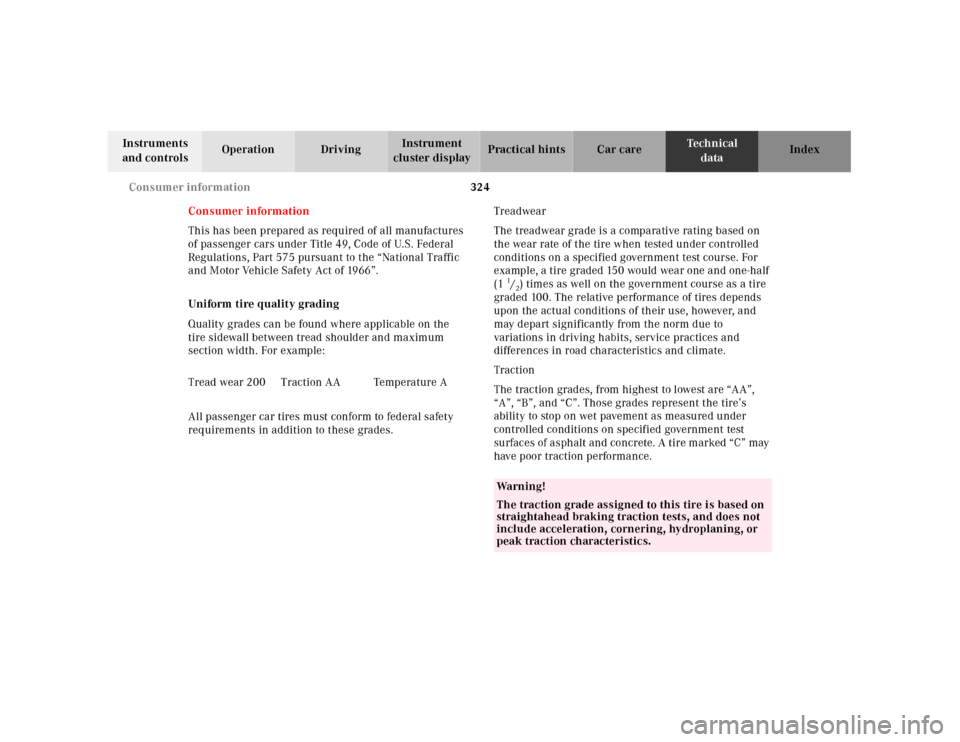
This has been prepared as required of all manufactures
of passenger cars under Title 49, Code of U.S. Federal
Regulations, Part 575 pursuant to the “National Traffic
and Motor Vehicle Safety Act of 1966”.
Uniform tire quality grading
Quality grades can be found where applicable on the
tire sidewall between tread shoulder and maximum
section width. For example:
All passenger car tires must conform to federal safety
requirements in addition to these grades.Treadwear
The treadwear grade is a comparative rating based on
the wear rate of the tire when tested under controlled
conditions on a specified government test course. For
example, a tire graded 150 would wear one and one-half
(1
1/2) times as well on the government course as a tire
graded 100. The relative performance of tires depends
upon the actual conditions of their use, however, and
may depart significantly from the norm due to
variations in driving habits, service practices and
differences in road characteristics and climate.
Traction
The traction grades, from highest to lowest are “AA”,
“A”, “B”, and “C”. Those grades represent the tire’s
ability to stop on wet pavement as measured under
controlled conditions on specified government test
surfaces of asphalt and concrete. A tire marked “C” may
have poor traction performance. Tread wear 200 Traction AA Temperature A
Wa r n i n g !
The traction grade assigned to this tire is based on
straightahead braking traction tests, and does not
include acceleration, cornering, hydroplaning, or
peak traction characteristics.
Page 328 of 341
325 Consumer information
Technical
data Instruments
and controlsOperation DrivingInstrument
cluster displayPractical hints Car care Index Temp era tur e
The temperature grades are “A” (the highest), “B”, and
“C”, representing the tire‘s resistance to the generation
of heat and its ability to dissipate heat when tested
under controlled conditions on a specified indoor
laboratory test wheel. Sustained high temperature can
cause the material of the tire to degenerate and reduce
tire life, and excessive temperature can lead to sudden
tire failure. The grade “C” corresponds to a level of
performance which all passenger car tires must meet
under the Federal Motor Vehicle Safety Standard
No. 109. Grades B and A represent higher levels of
performance on the laboratory test wheel than the
minimum required by law.
Wa r n i n g !
The temperature grade for this tire is established
for a tire that is properly inflated and not
overloaded. Excessive speed, underinflation, or
excessive loading, either separately or in
combination, can cause excessive heat build up
and possible tire failure.