Gas MERCEDES-BENZ E320 2002 W210 Owner's Manual
[x] Cancel search | Manufacturer: MERCEDES-BENZ, Model Year: 2002, Model line: E320, Model: MERCEDES-BENZ E320 2002 W210Pages: 350, PDF Size: 21.88 MB
Page 6 of 350

3 Contents
DrivingControl and operation
of radio transmitters ................ 176
The first 1 000 miles
(1 500 km) ................................. 177
Maintenance ................................... 177
Tele Aid ........................................... 178
Catalytic converter ........................ 188
Emission control ............................ 189
Steering lock ................................... 190
Starting and turning
off the engine ............................ 192
Automatic transmission ............... 193
Parking brake .................................202
Driving instructions ......................203
Drive sensibly - Save Fuel .........203
Drinking and driving .................203
Pedals ...........................................203
Power assistance ........................204
Brakes ..........................................204Driving off ................................... 205
Parking ........................................ 206
Tires ............................................. 206
Snow chains ............................... 209
Winter driving instructions ..... 209
Block heater ................................. 211
Deep water ................................... 211
Passenger compartment ............ 211
Traveling abroad ......................... 211
Cruise control .................................212
Brake assist system
(BAS) ...........................................215
Antilock brake system
(ABS) ...........................................217
Four Wheel Electronic Traction
System (4MATIC) ....................... 219
Electronic stability program
(ESP) ........................................... 220
Parking assist
(Parktronic) ............................... 224
What you should know
at the gas station ...................... 229
Check regularly and
before a long trip ...................... 231
Instrument cluster displayMalfunction and indicator lamps
in the instrument cluster .........234
On-board diagnostic system .....234
Check engine malfunction
indicator lamp .............................234
Brake warning lamp ..................235
Supplemental restraint system
(SRS) indicator lamp ..................236
Fuel reserve and fuel cap
placement warning ....................236
Electronic stability program
(ESP) — warning lamp ...............237
BAS / ESP malfunction
indicator lamp .............................237
ABS malfunction
indicator lamp .............................238
Seat belt warning lamp .............238
Malfunction and indicator lamp
in the center console ................239
W210.book Seite 3 Mittwoch, 30. Mai 2001 11:45 11
Page 8 of 350

5 Contents
Vehicle careCleaning and care
of the vehicle .............................304
Power washer ..............................305
Tar stains .....................................305
Paintwork, painted body
components .................................305
Engine cleaning ..........................306
Vehicle washing .........................306
Ornamental moldings ................306
Headlamps, taillamps,
turn signal lenses ......................306
Cleaning the parktronic
system sensors ...........................307
Window cleaning /
glass sunroof ...............................307
Wiper blades ...............................307
Light alloy wheels ......................308
Instrument cluster .....................308
Steering wheel and
gear selector lever ......................308
Cup holder ...................................308
Seat belts .....................................308Headliner and shelf
below rear window .................... 308
Upholstery .................................. 309
Hard plastic trim items ............. 309
Plastic and rubber parts ........... 309
Technical dataSpare parts service ........................312
Warranty coverage .........................312
Identification labels ....................... 313
Layout of poly-V-belt drive ............ 315
Technical data ................................. 316
Fuels, coolants, lubricants
etc. - capacities ......................... 322
Engine oils ...................................... 324
Engine oil additives ...................... 324
Air conditioner refrigerant .......... 324
Brake fluid ...................................... 324
Premium unleaded gasoline ........ 325
Fuel requirements ........................ 325
Gasoline additives ......................... 326
Coolants .......................................... 326
Consumer information ................. 328
IndexIndex ................................................330
W210.book Seite 5 Mittwoch, 30. Mai 2001 11:45 11
Page 14 of 350

11 IntroductionOperating your vehicle outside the USA or Canada
If you plan to operate your vehicle in foreign countries, please be aware that:
•Service facilities or replacement parts may not be readily available,
•unleaded gasoline for vehicles with catalytic converters may not be available; the use of leaded fuels will damage
the catalysts,
•gasoline may have a considerably lower octane rating, and improper fuel can cause engine damage.
Certain Mercedes-Benz models are available for delivery in Europe under our European Delivery Program. For details,
consult your authorized Mercedes-Benz Center or write to:
In the USA: In Canada:
Mercedes-Benz USA, LLC
European Delivery Department
One Mercedes Drive
Montvale, NJ 07645-0350Mercedes-Benz Canada, Inc.
European Delivery Department
849 Eglinton Avenue East
Toronto, Ontario M4G 2L5
W210.book Seite 11 Mittwoch, 30. Mai 2001 11:45 11
Page 178 of 350
175 Contents – Driving
Technical
data Instruments
and controlsOperationDrivingInstrument
cluster displayPractical hints Car care Index
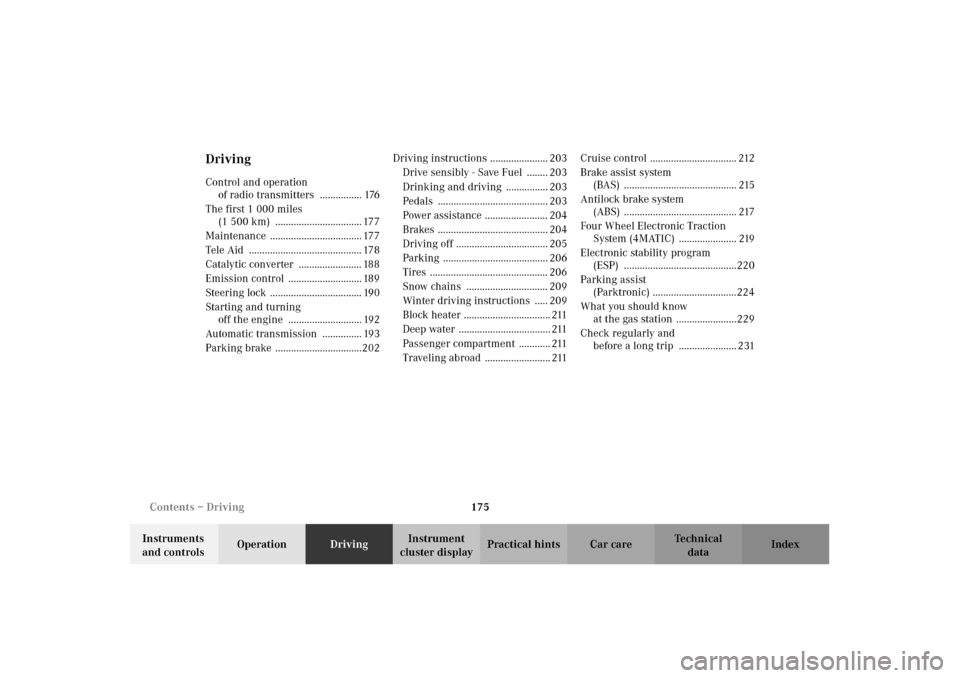
DrivingControl and operation
of radio transmitters ................ 176
The first 1 000 miles
(1 500 km) ................................. 177
Maintenance ................................... 177
Tele Aid ........................................... 178
Catalytic converter ........................ 188
Emission control ............................ 189
Steering lock ................................... 190
Starting and turning
off the engine ............................ 192
Automatic transmission ............... 193
Parking brake .................................202Driving instructions ...................... 203
Drive sensibly - Save Fuel ........ 203
Drinking and driving ................ 203
Pedals .......................................... 203
Power assistance ........................ 204
Brakes .......................................... 204
Driving off ................................... 205
Parking ........................................ 206
Tires ............................................. 206
Snow chains ............................... 209
Winter driving instructions ..... 209
Block heater ................................. 211
Deep water ................................... 211
Passenger compartment ............ 211
Traveling abroad ......................... 211Cruise control ................................. 212
Brake assist system
(BAS) ........................................... 215
Antilock brake system
(ABS) ........................................... 217
Four Wheel Electronic Traction
System (4MATIC) ...................... 219
Electronic stability program
(ESP) ...........................................220
Parking assist
(Parktronic) ................................224
What you should know
at the gas station .......................229
Check regularly and
before a long trip ...................... 231
W210.book Seite 175 Mittwoch, 30. Mai 2001 11:45 11
Page 191 of 350
188 Catalytic converter
Technical
data Instruments
and controlsOperationDrivingInstrument
cluster displayPractical hints Car care Index
Catalytic converter
Your Mercedes-Benz is equipped with monolithic type
catalytic converters, an important element in
conjunction with the oxygen sensors to achieve
substantial control of the pollutants in the exhaust
emissions. Keep your vehicle in proper operating
condition by following our recommended maintenance
instructions as outlined in your Service Booklet.
Caution!
To prevent damage to the catalytic converters, use only
premium unleaded gasoline in this vehicle.
Any noticeable irregularities in engine operation should
be repaired promptly. Otherwise, excessive unburned
fuel may reach the catalytic converter causing it to
overheat, which could start a fire.
Wa r n i n g !
As with any vehicle, do not idle, park or operate
this vehicle in areas where combustible materials
such as grass, hay or leaves can come into contact
with the hot exhaust system, as these materials
could be ignited and cause a vehicle fire.
W210.book Seite 188 Mittwoch, 30. Mai 2001 11:45 11
Page 192 of 350
189 Emission control
Technical
data Instruments
and controlsOperationDrivingInstrument
cluster displayPractical hints Car care Index Emission control
Certain systems of the engine serve to keep the toxic
components of the exhaust gases within permissible
limits required by law.
These systems, of course, will function properly only
when maintained strictly according to factory
specifications. Any adjustments on the engine should,
therefore, be carried out only by qualified
Mercedes-Benz authorized Center technicians. Engine
adjustments should not be altered in any way. Moreover,
the specified service jobs must be carried out regularly
according to Mercedes-Benz servicing requirements.
For details refer to the Service Booklet.
Wa r n i n g !
Inhalation of exhaust gas is hazardous to your
health. All exhaust gas contains carbon monoxide,
and inhaling it can cause unconsciousness and
lead to death.Do not run the engine in confined areas (such as a
garage) which are not properly ventilated. If you
think that exhaust gas fumes are entering the
vehicle while driving, have the cause determined
and corrected immediately. If you must drive under
these conditions, drive only with at least one
window fully open.
W210.book Seite 189 Mittwoch, 30. Mai 2001 11:45 11
Page 213 of 350
210 Driving instructions
Technical
data Instruments
and controlsOperationDrivingInstrument
cluster displayPractical hints Car care Index
Winter driving
Have your vehicle winterized at your authorized
Mercedes-Benz Center before the onset of winter.
•Change the engine oil if the engine contains an oil
which is not approved for winter operation. For
viscosity (SAE / CCMC class) and filling quantity,
see page 322.
•Check engine coolant anticorrosion / antifreeze
concentration.•Additive for the windshield washer and headlamp
cleaning system: Add MB Concentrate “S” to a
premixed windshield washer solvent / antifreeze
which is formulated for below freezing
temperatures, see page 265.
•Test battery: Battery capacity drops with decreasing
ambient temperature. A well charged battery helps
to ensure that the engine can be started, even at low
ambient temperatures.
•Tires: We recommend M+S rated radial-ply tires on
all four wheels for the winter season. Observe
permissible maximum speed for M+S rated
radial-ply tires and the legal speed limit.
Note:
In winter operation, the maximum effectiveness of the
antilock brake system (ABS) or electronic stability
program (ESP) can only be achieved with M+S rated
radial-ply tires and / or snow chains recommended by
Mercedes-Benz. Snow chains maximize performance.
Wa r n i n g !
If the vehicle becomes stuck in snow, make sure
that snow is kept clear of the exhaust pipe and
from around the vehicle with engine running.
Otherwise, deadly carbon monoxide (CO) gases may
enter vehicle interior resulting in unconsciousness
and death.To assure sufficient fresh air ventilation, open a
window slightly on the side of the vehicle not
facing the wind.
W210.book Seite 210 Mittwoch, 30. Mai 2001 11:45 11
Page 232 of 350
229 What you should know at the gas station
Technical
data Instruments
and controlsOperationDrivingInstrument
cluster displayPractical hints Car care Index What you should know at the gas station
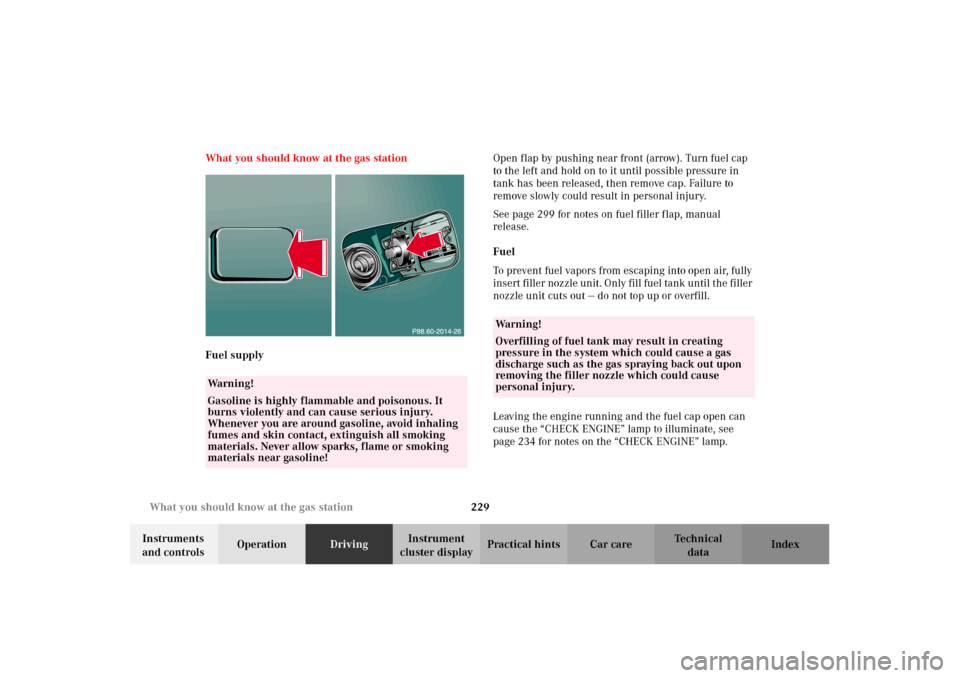
Fuel supplyOpen flap by pushing near front (arrow). Turn fuel cap
to the left and hold on to it until possible pressure in
tank has been released, then remove cap. Failure to
remove slowly could result in personal injury.
See page 299 for notes on fuel filler flap, manual
release.
Fuel
To prevent fuel vapors from escaping into open air, fully
insert filler nozzle unit. Only fill fuel tank until the filler
nozzle unit cuts out — do not top up or overfill.
Leaving the engine running and the fuel cap open can
cause the “CHECK ENGINE” lamp to illuminate, see
page 234 for notes on the “CHECK ENGINE” lamp.
Wa r n i n g !
Gasoline is highly flammable and poisonous. It
burns violently and can cause serious injury.
Whenever you are around gasoline, avoid inhaling
fumes and skin contact, extinguish all smoking
materials. Never allow sparks, flame or smoking
materials near gasoline!
Wa r n i n g !
Overfilling of fuel tank may result in creating
pressure in the system which could cause a gas
discharge such as the gas spraying back out upon
removing the filler nozzle which could cause
personal injury.
W210.book Seite 229 Mittwoch, 30. Mai 2001 11:45 11
Page 233 of 350
230 What you should know at the gas station
Technical
data Instruments
and controlsOperationDrivingInstrument
cluster displayPractical hints Car care Index
Fuel tank capacity approximately 21.1 US gal (80.0 l).
This includes approximately 2.6 US gal (10.0 l) reserve.
Use premium unleaded gasoline:
Posted Octane Index 91 (Average of 96 RON / 86 MON).
Engine oil
Engine oil level check, see page 262.
Fill quantity between upper and lower dipstick marking
level: 2.1 US qt (2.0 l).
Recommended engine oils, see Approved Service
Products sheet.
Coolant
For normal replenishing, use water (potable water
quality).
For further information (e.g. anticorrosion /antifreeze),
see page 326.
Spark plugs
Approved spark plugs, see page 320.Tire pressure
For tire pressure, refer to tire pressure label inside the
fuel filler flap.
Air conditioner
R-134a refrigerant and special PAG lubricant, see
page 322.
Bulbs
High and low beams: H7 (55 W),
low beam: Xenon (optional)
fog lamps: H1 (55 W),
turn signal lamps,
front 1156 NA (26.9 / 5 W / 32 / 4 cp),
parking and standing lamps, front: H 6W (6 W)
side marker lamps, front: 5 W / 4 cp,
turn signal lamps, rear: 21 W / 24 cp,
stop, tail and parking lamp: 21 W / 4 cp,
tail, parking and side marker lamp: 5 W / 4 cp,
rear fog lamp, driver´s side: 21 W / 32 cp,
backup lamps: 21 W / 32 cp,
license plate lamps: 5 W / 4 cp
W210.book Seite 230 Mittwoch, 30. Mai 2001 11:45 11
Page 283 of 350
280 Battery
Technical
data Instruments
and controlsOperation DrivingInstrument
cluster displayPractical hintsCar care Index
Battery
Important!
Battery replacement information:
The maintenance-free battery is located under the rear
seat cushion. To minimize the chance for acid leakage
which could cause severe burns during a crash or
rollover, a special acid leakage resistant battery was
factory installed. A replacement battery for the vehicle must not leak acid when upside down for at least 15
minutes. Your authorized Mercedes-Benz Center can
provide such a special battery.
The service life of the battery is dependent on its
condition of charge. The battery should always be kept
sufficiently charged, in order to last an optimum length
of time.
Therefore, we strongly recommend that you have the
battery charge checked frequently, and corrected if
necessary, especially if you use the vehicle less than
approximately 200 miles (300 km) per month,
mostly for short distance trips, or if it is not used for
long periods of time.
Only charge a battery with a battery charger after the
battery has been disconnected from the vehicle’s
electrical circuit.
Always disconnect the battery negative lead first and
connect last.
When removing and connecting the battery, always
make sure that all electrical consumers are off and the
electronic key is in steering lock position 0. The battery,
its filler caps, the vent tube and the opposite plug must
always be securely installed when the vehicle in
Wa r n i n g !
Failure to follow these instructions can result in
severe injury or death.Never lean over batteries while connecting, you
might get injured.Battery fluid contains sulfuric acid. Do not allow
this fluid to come in contact with eyes, skin or
clothing. In case it does, immediately flush affected
area with water and seek medical help if necessary.A battery will also produce hydrogen gas, which is
flammable and explosive. Keep flames or sparks
away from battery, avoid improper connection of
jumper cables, smoking etc..
W210.book Seite 280 Mittwoch, 30. Mai 2001 11:45 11